Yarrow Safety: Thujone, Asteraceae Allergy and Pregnancy
This is the page most articles about yarrow leave out, and it is the one with the most practical weight. Yarrow is widely described as "gentle," "safe," and "a mild traditional tea," and for a great many healthy adults drinking an occasional cup that description is fair. But yarrow carries five specific issues that are documented rather than speculative, and each of them identifies a group of people for whom yarrow carries a real risk: it contains thujone, the neuroactive constituent that puts wormwood and sage in a caution class of their own; it is an Asteraceae (Compositae) plant with well-characterized contact-allergy chemistry and broad cross-reactivity; it has reported photosensitivity; it is contraindicated in pregnancy; and it carries a theoretical bleeding-drug interaction plus a reason for caution in epilepsy.
There is also a sixth, entirely practical problem that undermines all of the above: you often cannot be sure what plant is in the packet. The garden ornamental Achillea cultivars are not the medicinal wild type, and "yarrow" on a label may be either. That section is at the end and is more important than it sounds.
Nothing here is a reason for a healthy non-pregnant adult without daisy-family allergy to be frightened of yarrow tea. It sets out which groups the concerns apply to.
Table of Contents
- Thujone: The Wormwood and Sage Caution Class
- What Thujone Means in Practice
- Asteraceae Allergy and Cross-Reactivity
- Documented Contact Dermatitis and Patch Testing
- Photosensitivity
- Pregnancy and Breastfeeding: A Contraindication
- The Anticoagulant and Antiplatelet Question
- Seizure Threshold and Epilepsy
- Other Drug Interactions
- The Essential Oil Is a Different Risk Category
- How to Tell Which Plant Is in the Packet
- Who the Research Raises Concerns For
- How Yarrow Is Used in the Low-Risk Zone
- Key Research Papers
- Connections
- Featured Videos
Thujone: The Wormwood and Sage Caution Class
Yarrow's essential oil contains thujone — a bicyclic monoterpene ketone that exists as α- and β-thujone. This is the same compound that made absinthe notorious, and it is the reason wormwood (Artemisia absinthium), sage (Salvia officinalis), tansy and thuja are all handled with restrictions that mild herbs are not. Yarrow belongs in that group. It is generally at the lower end of it — wormwood oil can be far richer in thujone — but the caution class is the same, and yarrow's thujone content is variable rather than negligible.
The pharmacology is understood, which is unusual for a herbal safety concern. Höld and colleagues, publishing in the Proceedings of the National Academy of Sciences (2000) in a paper on α-thujone as the active component of absinthe, showed that α-thujone is a modulator of the gamma-aminobutyric acid-A receptor — specifically a non-competitive blocker of the gamma-aminobutyric acid-gated chloride channel — and characterized its rapid metabolic detoxification. Gamma-aminobutyric acid (GABA) is the brain's principal inhibitory neurotransmitter. Blocking inhibition is, mechanistically, how convulsant drugs work: at sufficient dose thujone produces excitation and seizures in animals. The same paper's detoxification findings explain why moderate exposure is tolerated — thujone is metabolized quickly — which is exactly why dose and duration are the variables that matter. (Evidence tier: established pharmacology, animal and in-vitro.)
Two myths surround thujone, and they cut in both directions. Thujone did not cause the hallucinations attributed to absinthe in the nineteenth century; the reconstructed thujone content of historical absinthe was far too low, and modern analyses of surviving and reconstructed absinthe support the unglamorous conclusion that absinthe's harms were mostly those of a very strong alcoholic drink. Lachenmeier's work on wormwood as a plant with both neurotoxic and neuroprotective properties, in the Journal of Ethnopharmacology (2010), covers this ground. But the opposite myth — that thujone is therefore harmless and the concern was invented — is also wrong: thujone is a real gamma-aminobutyric acid-A antagonist with a real convulsant dose. Lachenmeier and Uebelacker (2010) note that the 2008 European Union regulation on flavourings deregulated the food use of thujone, while the European Medicines Agency introduced limits for it in herbal medicines in 2009; the regulation's annex still sets maximum thujone levels for alcoholic beverages and for non-alcoholic drinks made from Artemisia (wormwood) species.
What Thujone Means in Practice
Thujone is regulated. The 2008 European Union flavourings regulation (Regulation (EC) No 1334/2008) forbids adding isolated thujone to food and keeps maximum levels only for alcoholic beverages (10 mg/kg, or 35 mg/kg for those made from Artemisia species) and for non-alcoholic drinks made from Artemisia species (0.5 mg/kg); other food uses were deregulated. The European Medicines Agency's herbal committee has issued a public statement on herbal medicinal products containing thujone, setting out an exposure limit and a duration restriction for thujone-containing preparations. Lachenmeier and Uebelacker's risk assessment of thujone in foods and medicines containing sage and wormwood, in Regulatory Toxicology and Pharmacology (2010), re-examined those limits with dose-response modelling that included a long-term National Toxicology Program study in rats. They proposed an acceptable daily intake of 0.11 mg per kg of body weight per day, which they judged would not be reached even by consumers of high levels of thujone-containing foods (including absinthe); they estimated that 2 to 20 cups of wormwood or sage tea would be needed to reach it, regarded the short-term medicinal use of these herbs as safe, and concluded that the evidence does not point to any need for changes in regulations and that the current limits are sufficiently protective. Their assessment covers sage and wormwood, not yarrow specifically. Even so, a constituent with a regulatory exposure limit is unusual among herbal constituents.
For a reader, four points follow:
- Short courses, not continuous use. Occasional or short-term yarrow tea is a different exposure from a daily tincture taken for a year. Traditional practice happens to agree — bitters and fever teas were used in bouts, around meals or during illness — and regulatory duration limits on thujone-containing herbal products formalize the same idea.
- Modest amounts. A cup of tea from a teaspoon of dried herb delivers a small fraction of what a concentrated extract does. Escalating the dose because a small one "didn't do much" raises the thujone exposure.
- Water extracts are lower risk than alcohol extracts or oil. Thujone is a volatile, lipophilic terpene, so it partitions into essential oil and, less so, into alcohol tinctures; a covered infusion carries some but not all of it. The essential oil is the highest-exposure form by a wide margin and is not an internal product.
- Variability means you cannot calculate your exposure. Thujone content varies by chemotype, geography, harvest time and preparation. Nobody drinking yarrow tea knows their thujone dose. That uncertainty is why duration, amount and form are the variables that matter, rather than a reason for alarm.
Asteraceae Allergy and Cross-Reactivity
Yarrow is a member of the Asteraceae family, also called Compositae — the daisy family, one of the largest plant families on earth. This is not a botanical footnote; it is the most likely way yarrow will cause a problem for an ordinary person.
Asteraceae sensitivity is common, and it cross-reacts. Someone who reacts to one member of the family frequently reacts to others, because the responsible compounds are shared. People who react to any of the following are likely to react to yarrow as well:
- Ragweed (Ambrosia) — a major cause of seasonal allergic rhinitis;
- Mugwort (Artemisia vulgaris) — a dominant late-summer pollen allergen in Europe, and part of the well-described mugwort–celery–spice cross-reactivity pattern;
- Chamomile — both German and Roman;
- Feverfew, chrysanthemum, calendula (marigold), echinacea, dandelion, tansy, arnica, artichoke, lettuce and sunflower.
The chemistry behind the cross-reactivity is specific: sesquiterpene lactones. These are the same bitter compounds that give yarrow its digestive rationale and part of its anti-inflammatory activity. They are also potent contact sensitizers, and because the family shares them, sensitization to one plant transfers to others. This is why a "sesquiterpene lactone mix" and a Compositae mix are standard allergens in dermatological patch-test series — the problem is common enough to have earned a permanent place on the panel.
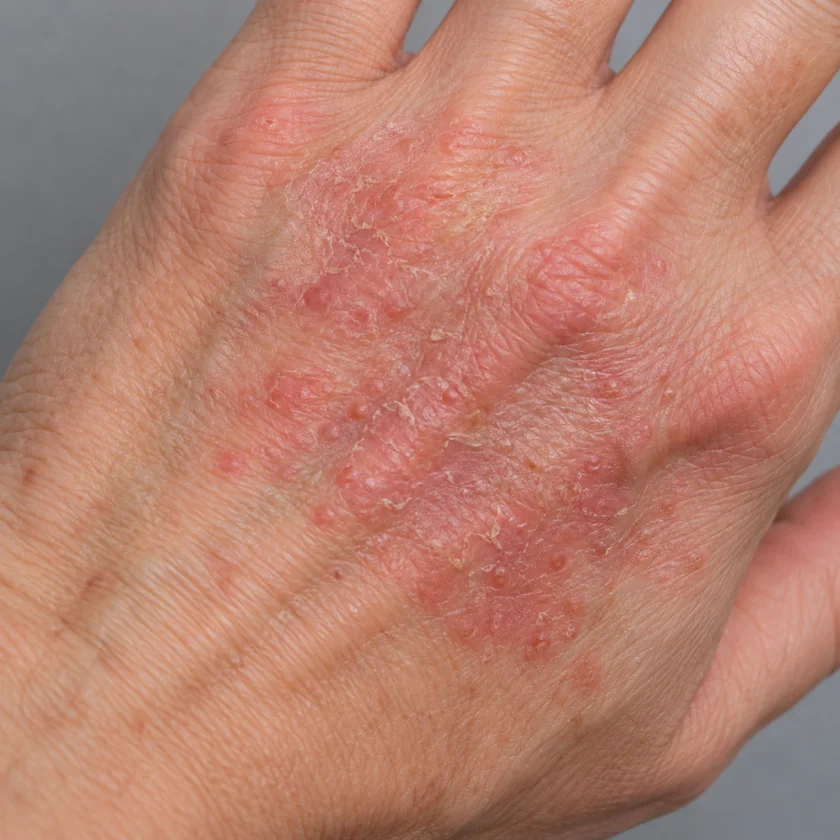
Reactions span the usual range. Contact dermatitis is the classic and best documented. Airborne contact dermatitis affects gardeners and florists handling large amounts of daisy-family plants. Oral or systemic reactions to ingested Asteraceae herbs are less common but described, and anaphylaxis to chamomile in ragweed-sensitive individuals is a documented, if rare, event — which is why "it's only a herbal tea" is not a safe assumption for someone with strong daisy-family allergy. (Evidence tier: established clinical allergology, case series and case reports.)
Documented Contact Dermatitis and Patch Testing
Yarrow specifically — not just "the daisy family" — has been chemically pinned down as a cause of allergic contact dermatitis. Hausen, Breuer, Weglewski and Rücker reported in Contact Dermatitis (1991) on "α-peroxyachifolid and other new sensitizing sesquiterpene lactones from yarrow (Achillea millefolium L., Compositae)," isolating the specific molecules responsible. That is an unusually well-characterized herbal adverse effect: the plant, the compound class and the individual sensitizers are all identified.
Paulsen's work on Compositae dermatitis, including a survey in Contact Dermatitis (1992) and later work on contact sensitization from Compositae-containing herbal remedies and cosmetics (2002), places yarrow in the broader clinical picture — a family that turns up repeatedly in dermatitis from herbal creams, ointments and "natural" cosmetics. Yarrow extract is a fairly common cosmetic ingredient, which means people are exposed to it without seeking it out.
Several points follow directly:
- Patch testing. The usual home patch test puts a small amount of the preparation on a coin-sized area of forearm skin, checked at 24 and 48 hours. Allergic contact dermatitis is delayed — a clean result after ten minutes means nothing.
- Broken skin. For people in a risk group, a sensitizer on a compromised barrier is the most likely way to become sensitized.
- Sensitization is usually permanent. Once a person reacts to sesquiterpene lactones, they are likely to react to the whole family thereafter, including plants they currently use happily. That is a real cost of a careless exposure.
- Yarrow in unexplained dermatitis. For people who use herbal skin products, yarrow is one possible cause, and the ingredient list is what identifies it — contact dermatitis from a "natural" cream is frequently missed because nobody thinks to ask.
Photosensitivity
Standard herbal safety references list photosensitivity among yarrow's adverse effects, and there are case reports of photodermatitis attributed to Achillea species — that is, skin reactions occurring where treated skin was exposed to sunlight. The literature here is small, the responsible constituents are not as cleanly identified as the contact-allergy sesquiterpene lactones, and it is not always easy to separate a photosensitive reaction from ordinary contact dermatitis on sun-exposed skin.
Given that, the sensible reading is: the signal is real enough to appear in reference works, thin enough that nobody can quantify the risk. The usual precaution described is cheap — keeping skin treated with yarrow out of strong sun for a day or so; a reaction that maps onto sun exposure points to this effect. (Evidence tier: case reports and reference-work listings; no systematic study.)
Pregnancy and Breastfeeding: A Contraindication
Herbal reference works, regulatory monographs and safety reviews consistently list internal use of yarrow in pregnancy as contraindicated. Two independent reasons support that position.
The emmenagogue tradition. Yarrow is classed throughout the historical literature as an emmenagogue — a plant believed to provoke menstrual flow — and such plants appear in the historical record of substances used to interrupt pregnancy. There is no reliable evidence that yarrow has any such effect at realistic doses, and there is equally no evidence that it is safe. The traditional signal is a reason for precaution, not proof of harm. This is discussed further on the menstrual and pelvic page.
Thujone. Thujone-containing herbs are listed as contraindicated in pregnancy as a class. The concern is a gamma-aminobutyric acid-A-active neuroactive terpene reaching a developing nervous system, at an unknown dose, with no safety data, from a herb whose benefits are traditional. The same reasoning keeps wormwood and sage-oil products off the list in pregnancy.
Breastfeeding has not been studied, so there is no safety data either way. Children are another gap: traditional-use herbal registrations for yarrow are typically restricted to adults, or to adults and adolescents, because there is no paediatric data — and thujone at an unknown dose in a small body is the concern.
If someone has drunk yarrow tea before realising they were pregnant, the evidence is reassuring rather than alarming: there is no evidence of harm from ordinary tea-level exposure, and the contraindication above is precautionary.
The Anticoagulant and Antiplatelet Question
Yarrow appears on standard lists of herbs with a theoretical interaction with anticoagulant and antiplatelet drugs — warfarin, direct oral anticoagulants, aspirin, clopidogrel and the rest. Two features make this worth taking seriously despite being theoretical.
First, the direction is genuinely unclear. Yarrow's folk reputation is styptic — stopping bleeding — and rests on a single old animal report on the alkaloid achilleine, described on the wound page. Simultaneously, its coumarin and flavonoid content is the basis for listing it as a possible antiplatelet or anticoagulant. Both claims are weak, they contradict each other, and no human study has resolved them. An unpredictable effect on coagulation in someone whose coagulation is being deliberately controlled by a drug is a worse situation than a known effect in either direction.
Second, the consequences of getting anticoagulation wrong are serious in both directions — bleeding on one side, clot or stroke on the other. Warfarin in particular has a narrow therapeutic window and a long list of documented herbal interactions; Ge, Zhang and Zuo's review of clinically evidenced herb–warfarin interactions in Evidence-Based Complementary and Alternative Medicine (2014) and Izzo and Ernst's updated systematic review of interactions between herbal medicines and prescribed drugs in Drugs (2009) are the standard entry points to that literature.
What this means: the interaction is theoretical and its direction unknown, and warfarin has a narrow therapeutic window, so for people on an anticoagulant or antiplatelet drug, or with a bleeding disorder, adding or stopping yarrow is an unmeasured change to coagulation; on warfarin, such a change shows up in the international normalized ratio (INR) blood test. It is also conventional for yarrow and similar herbs to be stopped a week or two before surgery or dental extraction, and disclosed to the anaesthetist. (Evidence tier: theoretical interaction; no human interaction studies specific to yarrow.)
Seizure Threshold and Epilepsy
This follows directly from the thujone pharmacology and is routinely omitted from herbal writing. Because α-thujone blocks the gamma-aminobutyric acid-A chloride channel — reducing inhibitory signalling — thujone-containing preparations are considered capable of lowering the seizure threshold, and high-dose exposure to thujone-rich essential oils is a recognised cause of convulsions. Clinical toxicology literature includes reports of seizures following ingestion of sage or wormwood essential oil, which is why those oils are classed as not for internal use.
Yarrow tea is not wormwood oil, and there is no body of case reports of yarrow tea causing seizures. But the direction of effect is not in doubt, and the points that follow are straightforward:
- For people with epilepsy or a history of seizures, concentrated yarrow preparations carry the clearest risk, and even the tea has no safety data. This includes people whose seizures are well controlled — control is what a lowered seizure threshold puts at risk.
- The same caution reasonably extends to anyone with a lowered seizure threshold for another reason: alcohol withdrawal, certain medications, a history of head injury or febrile seizures.
- Spinella's review of herbal medicines and epilepsy in Epilepsy & Behavior (2001) is a useful survey of which herbs carry this concern and why; thujone-containing plants are a recurring entry.
(Evidence tier: established mechanism plus case reports for concentrated thujone-rich oils; no yarrow-specific human data.)
Other Drug Interactions
Beyond the bleeding question, the interactions attributed to yarrow are pharmacologically plausible and clinically unstudied. They are listed here so they can be checked against an actual medication list:
- Sedatives and central nervous system depressants — benzodiazepines, sleep medication, alcohol. Yarrow's flavonoids include apigenin, which has central activity in laboratory models, and additive sedation is the standard caution.
- Antihypertensives — yarrow is described as mildly hypotensive, so additive blood-pressure lowering is possible; dizziness on standing is the usual sign.
- Acid-reducing drugs — proton-pump inhibitors and H2 blockers. A bitter intended to increase gastric secretion works against a drug intended to reduce it; more importantly, acid suppression is prescribed for a diagnosed reason, which the bitter works against.
- Lithium and other narrow-window drugs — herbs with any diuretic effect are conventionally flagged with lithium, because changes in fluid balance shift lithium levels.
- Anaesthesia and surgery — herbs like yarrow are conventionally stopped a week or two beforehand and disclosed.
- Iron absorption — yarrow is tannin-rich, and tannin-rich teas taken with meals reduce non-haem iron absorption. Relevant for anyone treating iron-deficiency anaemia: the effect applies when iron and yarrow tea are taken together.
Note the honest framing on all of these: they are extrapolations from constituent pharmacology, not measured interactions. That means they are neither dismissible nor established.
The Essential Oil Is a Different Risk Category
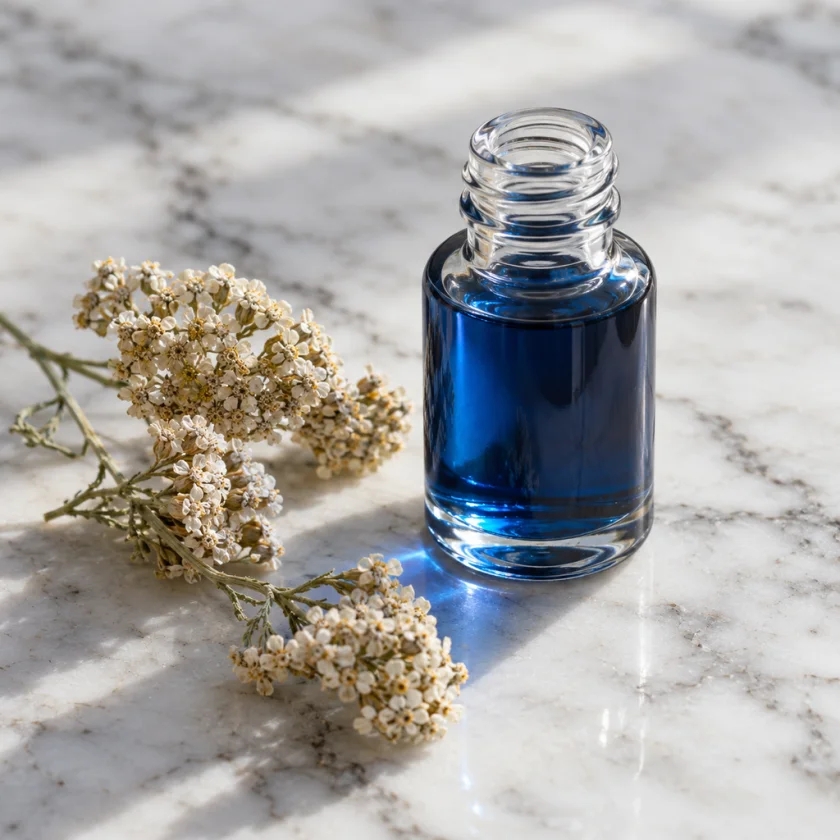
Everything above becomes several-fold more serious with the steam-distilled essential oil, sometimes sold as "blue yarrow" for its chamazulene content. An essential oil concentrates the volatile constituents — including thujone — by a very large factor relative to the herb. The points below are the actual safety margin:
- Swallowing it is the highest-risk route. Internal use of thujone-containing essential oils is where the seizure case reports come from.
- Undiluted oil on skin. Essential oils are normally diluted in a carrier oil, at a low dilution on facial or sensitive skin.
- Children. Paediatric essential-oil ingestion, often from an accessible bottle, is a recognised poisoning presentation.
- Pregnancy and epilepsy. Both are contraindications, for the thujone reasons above.
- Diffusers around infants, pets or people with asthma. Aromatic terpenes can trigger airway symptoms.
- Broken skin. The sensitizer issue combined with the concentration makes this the worst-case exposure.
Sources that describe taking yarrow essential oil internally are at odds with this safety literature.
How to Tell Which Plant Is in the Packet
This section is the practical one that almost nobody covers, and it quietly undermines every dose and safety statement above.
Achillea millefolium in the broad sense is not one plant. Written A. millefolium s.l., it is an aggregate of closely related populations differing in chromosome number and in chemistry. Whether a given plant produces the proazulene precursors that yield blue chamazulene on distillation tracks with its ploidy level, so two batches of "yarrow oil" can differ fundamentally — one deep blue and anti-inflammatory, one not. Essential-oil composition also shifts with geography, altitude, soil, harvest timing and drying, which is why antimicrobial studies from different countries report different potencies for the same nominal species. Thujone content varies along with everything else.
Garden ornamental Achillea is not the medicinal plant. The flat yellow, brick-red, coral and cream border perennials sold in garden centres — the named cultivars — are largely hybrids involving other Achillea species such as A. filipendulina. They are bred for flower colour and stem strength, not for the traditional constituent profile, and they are not interchangeable with wild A. millefolium. Harvesting the border for tea is not the traditional practice, whatever the plant label says.
Three consequences follow:
- Botanically identified material is the reliable kind — a supplier that names Achillea millefolium L., states the plant part (herb or flower), and ideally the origin. "Yarrow extract" with no botanical name tells you nothing.
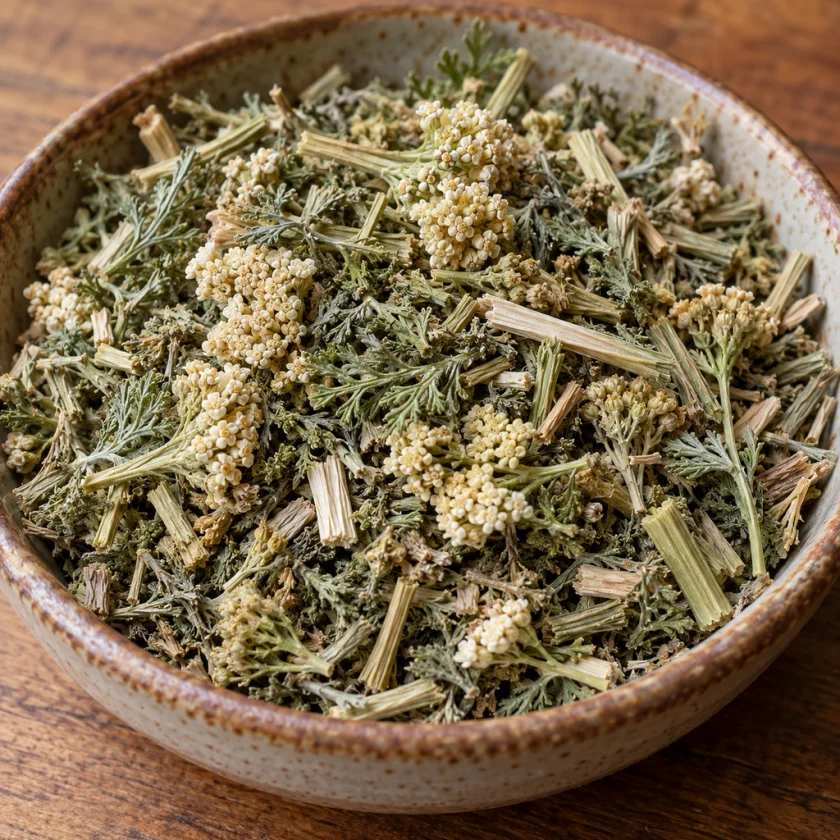
- The flower bed is not the herbal. Wild yarrow is identified by feathery many-times-divided leaves, flat-topped clusters of small mostly-white flower heads, and the characteristic aromatic smell when a leaf is crushed. Several toxic members of the carrot family also have finely cut leaves and flat flower clusters and have caused fatal misidentifications.
- Batch-to-batch variation occurs even from a good supplier, which is one more reason amount and duration matter.
Who the Research Raises Concerns For
Consolidated, so it can be read in one pass. The research and reference works raise concerns about yarrow for people who:
- are pregnant, trying to conceive, or breastfeeding;
- have epilepsy or any history of seizures, or take a medication that lowers seizure threshold;
- react to ragweed, mugwort, chamomile, feverfew, chrysanthemum, calendula, echinacea, arnica or tansy, or have known Compositae dermatitis;
- take an anticoagulant or antiplatelet drug, or have a bleeding disorder;
- have surgery or a dental extraction planned within the next two weeks;
- take sedatives, sleep medication, or blood-pressure medication;
- have an active peptic ulcer, erosive gastritis, reflux, or gallstones or bile-duct obstruction;
- have significant kidney or liver disease, where clearance of any unstudied plant constituent is unpredictable;
- are giving it to a young child — there is no paediatric safety data, and thujone is the concern;
- would be using it continuously for months rather than in short courses — long-term yarrow use is unstudied and thujone is the reason it cannot be assumed to be fine.
How Yarrow Is Used in the Low-Risk Zone
For a healthy non-pregnant adult with no daisy-family allergy, none of the above makes yarrow forbidding. These are the patterns of use that keep it in the low-risk zone where its traditional reputation belongs:
- Short courses. Days to a couple of weeks, around meals or during a cold, rather than daily and indefinitely.
- Modest amounts. Roughly a teaspoon of dried herb per cup, or the labelled drops of tincture. Escalating raises the thujone dose.
- Tea rather than oil. The water infusion, steeped with the cup covered, is the traditional form; the essential oil is not an internal product.
- Patch tests and cosmetic labels. A patch test shows a reaction to a topical preparation before wider use, and for people with daisy-family allergy the label matters because yarrow extract turns up in creams.
- One new thing at a time. When yarrow is the only new thing, a change can be traced to it.
- On the medication list. A herb missing from the medication list cannot be checked for interactions or flagged before surgery.
- Signs of a reaction — rash, itching, nausea, dizziness, headache, or a reaction on sun-exposed skin; resuming after a reaction repeats the exposure.
- Delayed diagnosis. This is the biggest risk on the page and it has nothing to do with chemistry: a herb used to manage a symptom that needs investigating causes harm through delay.
Key Research Papers
Papers with a PubMed record end with their PMID link; one paper not indexed in PubMed ends with its DOI, and the last three entries are PubMed topic searches.
- Höld KM, Sirisoma NS, Ikeda T, Narahashi T, Casida JE. "α-Thujone (the active component of absinthe): γ-aminobutyric acid type A receptor modulation and metabolic detoxification." Proceedings of the National Academy of Sciences, 2000;97(8):3826–31 — the GABA-A mechanism and rapid detoxification. PubMed PMID: 10725394
- Lachenmeier DW, Uebelacker M. "Risk assessment of thujone in foods and medicines containing sage and wormwood — evidence for a need of regulatory changes?" Regulatory Toxicology and Pharmacology, 2010;58(3):437–43 — how thujone exposure limits are derived; concludes the current limits are sufficiently protective. PubMed PMID: 20727933
- Lachenmeier DW. "Wormwood (Artemisia absinthium L.) — a curious plant with both neurotoxic and neuroprotective properties?" Journal of Ethnopharmacology, 2010;131(1):224–7 — dismantles the absinthe-hallucination myth without dismissing thujone. PubMed PMID: 20542104
- Hausen BM, Breuer J, Weglewski J, Rücker G. "α-Peroxyachifolid and other new sensitizing sesquiterpene lactones from yarrow (Achillea millefolium L., Compositae)." Contact Dermatitis, 1991;24(4):274–80 — identifies yarrow's specific contact sensitizers. PubMed PMID: 1868717
- Paulsen E. "Compositae dermatitis: a survey." Contact Dermatitis, 1992;26(2):76–86. PubMed PMID: 1633709; and "Contact sensitization from Compositae-containing herbal remedies and cosmetics." Contact Dermatitis, 2002;47(4):189–98 — the clinical picture of daisy-family dermatitis, including from herbal products. PubMed PMID: 12492516
- Spinella M. "Herbal medicines and epilepsy: the potential for benefit and adverse effects." Epilepsy & Behavior, 2001;2(6):524–532 — which herbs raise seizure concern, and why thujone plants recur. PubMed PMID: 12609386
- Izzo AA, Ernst E. "Interactions between herbal medicines and prescribed drugs: an updated systematic review." Drugs, 2009;69(13):1777–98 — the reference framework for herb–drug interaction claims. PubMed PMID: 19719333
- Ge B, Zhang Z, Zuo Z. "Updates on the clinical evidenced herb-warfarin interactions." Evidence-Based Complementary and Alternative Medicine, 2014;2014:957362 — the clinical evidence on herb–warfarin interactions. PubMed PMID: 24790635
- Cavalcanti AM, Baggio CH, Freitas CS, et al. "Safety and antiulcer efficacy studies of Achillea millefolium L. after chronic treatment in Wistar rats." Journal of Ethnopharmacology, 2006;107(2):277–84 — one of the few chronic-dosing animal safety assessments of yarrow. PubMed PMID: 16647233
- Ali SI, Gopalakrishnan B, Venkatesalu V. "Pharmacognosy, Phytochemistry and Pharmacological Properties of Achillea millefolium L.: A Review." Phytotherapy Research, 2017;31(8):1140–1161 — constituent profile, including the variable essential oil. PubMed PMID: 28618131
- Applequist WL, Moerman DE. "Yarrow (Achillea millefolium L.): A Neglected Panacea?" Economic Botany, 2011;65(2):209–225 — includes the taxonomic complexity of the A. millefolium aggregate. doi:10.1007/s12231-011-9154-3
- Literature on essential-oil ingestion and seizures, including clinical toxicology reports involving sage and wormwood oils — the reason thujone-containing oils are classed as not for internal use. PubMed: essential oil ingestion seizures toxicity
- Work on Asteraceae pollen cross-reactivity, including mugwort and ragweed sensitization patterns — the basis for the cross-reactivity warnings above. PubMed: mugwort ragweed cross-reactivity Asteraceae allergy
- Case reports and reference listings of photosensitivity attributed to Achillea — a thin but real literature. PubMed: Achillea photodermatitis photosensitivity
PubMed Topic Searches
- PubMed: Achillea millefolium adverse effects
- PubMed: Thujone toxicity seizure
- PubMed: Sesquiterpene lactone mix patch test
- PubMed: Herbal medicine pregnancy safety review
- PubMed: Achillea millefolium allergy anaphylaxis
- PubMed: Herbal supplement species authentication
External Resources
- NIH National Center for Complementary and Integrative Health — herb safety summaries written for the public.
- European Medicines Agency — publisher of the herbal monographs and of the public statement on thujone-containing herbal products.
- Poison Control (US) — what to do about an essential-oil ingestion, including by a child.
- NIH Office of Dietary Supplements — how supplements are regulated and why labels vary.
- Plants of the World Online (Kew) — sorting out the Achillea millefolium aggregate and the ornamental hybrids.
- PubMed — search the primary literature.
Connections
- All Herbs
- Yarrow — the main topic page
- Yarrow Benefits Hub — all four deep dives
- Yarrow for Wounds — where the contradictory bleeding claims come from
- Wormwood — the archetypal thujone herb
- Wormwood Benefits — same caution class, higher stakes
- Sage — the other common thujone-containing kitchen herb
- Sage Benefits — thujone limits in a culinary plant
- Mugwort — major Asteraceae pollen allergen that cross-reacts with yarrow
- Chamomile — daisy-family herb with documented allergy reports
- Chrysanthemum — classic Compositae contact allergen
- Feverfew — sesquiterpene lactones and the same sensitization risk
- Calendula — frequently in the same "natural" creams
- Echinacea — shares the daisy-family allergy caution
- Comfrey — another traditional herb whose real risk is internal use
- Contact Dermatitis — the reaction yarrow is documented to cause
- Dermatology — skin conditions overview
- Allergies — how cross-reactivity works
- Allergic Rhinitis — ragweed and mugwort sensitization
- Epilepsy — why seizure threshold matters here
- Iron-Deficiency Anemia — tannins, iron absorption and timing
Safety and disclaimer. This page is educational. Yarrow contains thujone and belongs to the same caution class as wormwood and sage: the low-risk pattern is modest amounts in short courses, and the essential oil is not an internal product. Reference works list internal yarrow as contraindicated in pregnancy, and breastfeeding has not been studied. The concerns are greatest for people with epilepsy or a seizure history, and for people who react to ragweed, mugwort, chamomile, feverfew, chrysanthemum, calendula or arnica — a patch test shows a reaction to a topical preparation before wider use. Yarrow has theoretical interactions with anticoagulant, antiplatelet, sedative and blood-pressure medication, and herbs like it are conventionally stopped a week or two before surgery. A symptom that is new, severe, worsening or unexplained needs a diagnosis, and a herb used in its place causes harm through delay.