Red Clover
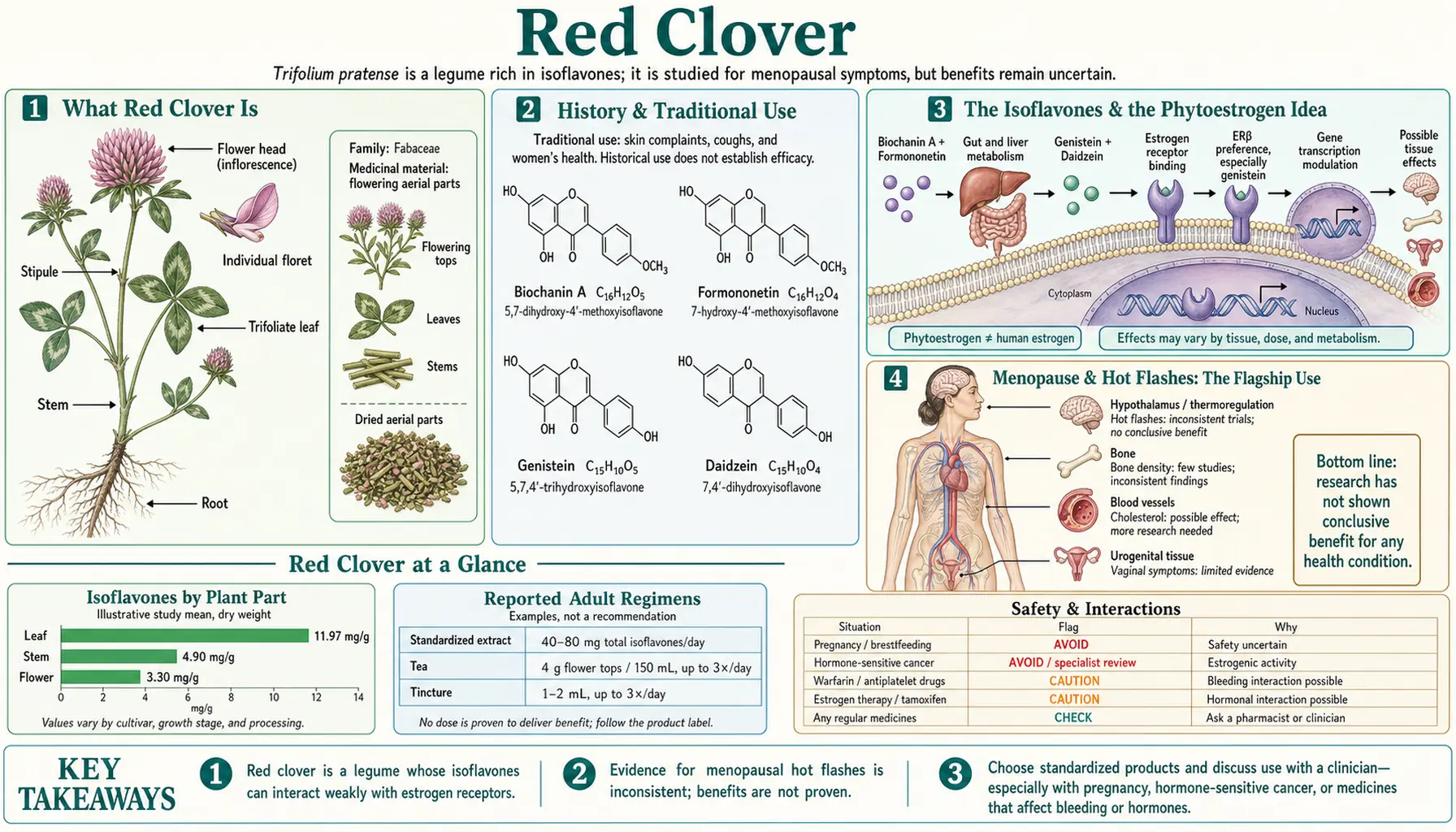
Red clover (Trifolium pratense) is the pink-purple wildflower you have almost certainly walked past in a summer meadow — a member of the pea and bean family (a legume) that farmers have long valued for feeding cattle and enriching soil. In the herbal world it has worn two very different hats over the centuries. Traditionally it was a gentle "blood purifier" and a cough and skin remedy. Today it is best known as a phytoestrogen herb for menopause, thanks to a group of plant compounds called isoflavones that faintly resemble the body's own estrogen. That modern reputation deserves an honest hearing, because the evidence is genuinely mixed: some trials found red clover eased hot flashes, others found nothing better than a placebo, and the most careful pooled reviews land somewhere in between — a modest effect at best. This page explains what red clover is, where its reputation came from, what isoflavones and "phytoestrogens" actually are, and what the research really shows for hot flashes, bones, and heart health — along with the safety cautions that matter most, especially for anyone with an estrogen-sensitive condition or on blood-thinning medication.
Table of Contents
- What Red Clover Is
- History & Traditional Use
- The Isoflavones & the Phytoestrogen Idea
- Menopause & Hot Flashes: The Flagship Use
- Bone-Density Research
- Heart & Cholesterol Research
- Estrogen-Sensitive Conditions, Blood Thinners & Interactions
- Forms, Standardized Extracts & Dosing
- Safety, Side Effects & Who Should Avoid It
- Research Papers
- Connections
- Featured Videos
What Red Clover Is
Red clover is a short-lived perennial in the legume family (Fabaceae, the pea and bean family), the same botanical group as peas, beans, lentils, and alfalfa. Its scientific name is Trifolium pratense — literally "three-leaf of the meadow," a nod to its classic trio of oval leaflets, each often marked with a pale crescent or "watermark." In summer it sends up rounded, pom-pom flower heads in shades of rose, pink, and magenta, packed with tiny individual blossoms that bumblebees love.
Although it is native to Europe, western Asia, and northwest Africa, red clover has been carried around the world as a farm crop and now grows wild across North America and beyond. For farmers it is a workhorse: as a legume it hosts nitrogen-fixing bacteria in its roots, so it enriches the soil, and it makes excellent hay and pasture for livestock. That agricultural role is more than a footnote — as you will see, the herb's estrogen-like chemistry was first noticed not in a clinic but in a sheep paddock.
The parts used medicinally are the flowering tops (the blossoms and the leaves just beneath them), harvested in full bloom and dried. These go into teas, tinctures, capsules, tablets, and standardized extracts. Do not confuse red clover with white clover (Trifolium repens), the smaller white-flowered lawn clover; red clover is the larger, pink-purple species used in herbal medicine.
History & Traditional Use
For most of its history, red clover was not a menopause herb at all — that is a modern chapter. In traditional Western herbalism, especially the 19th-century American Eclectic tradition, red clover was classed as an "alterative", an old term for a remedy thought to gradually restore healthy function and "purify the blood." It was brewed as a tea or taken as a syrup for coughs and bronchial complaints, including whooping cough, where its soothing, slightly expectorant quality was valued.
Its other major folk use was for the skin. Red clover was a classic remedy — taken internally as a tea and applied externally as a wash or ointment — for stubborn skin conditions such as eczema and psoriasis, often grouped with other "blood-cleansing" herbs. It was also used as a mild remedy for lymphatic swelling and general debility.
Honesty requires one difficult note about red clover's past. It became one of the herbs in the Hoxsey formula and similar early-20th-century tonics promoted as cancer cures. There is no reliable evidence that red clover treats or cures cancer, and this page does not endorse that use. Laboratory studies of individual clover isoflavones on cancer cells are interesting to scientists but do not translate into a proven human therapy, and — because of the estrogen-like activity discussed below — red clover actually warrants caution, not enthusiasm, in people with certain cancers.
The herb's shift from cough-and-skin remedy to menopause supplement is recent, dating largely to the 1990s, when standardized red clover isoflavone extracts were developed and marketed as a plant-based alternative to hormone therapy. That story turns entirely on the isoflavones.
The Isoflavones & the Phytoestrogen Idea
Everything distinctive about modern red clover comes down to a family of natural compounds called isoflavones. Red clover is one of the richest plant sources of them. Its four notable isoflavones are biochanin A, formononetin, genistein, and daidzein. Biochanin A and formononetin are the most abundant in the plant; genistein and daidzein are present in smaller amounts but are the more biologically active pair. Conveniently, the body does much of the conversion itself: biochanin A is demethylated into genistein, and formononetin into daidzein, during digestion. Soy contains genistein and daidzein too, which is why red clover and soy are often discussed together — but red clover's blend, with its heavy load of biochanin A and formononetin, is its own signature.
These isoflavones are phytoestrogens — "plant estrogens." The name captures the key fact: their molecular shape is similar enough to the body's own estrogen (estradiol) that they can slot into estrogen receptors and send a faint version of the estrogen signal. Two honest caveats matter here:
- They are weak. A phytoestrogen's effect at the receptor is a small fraction of real estrogen's — often hundreds to thousands of times weaker. Red clover is not hormone therapy in a capsule.
- They are selective and context-dependent. Isoflavones prefer one type of estrogen receptor (ER-beta) over the other (ER-alpha), which means they can behave a bit like a natural selective estrogen receptor modulator — mildly estrogen-like in some tissues and neutral or even mildly blocking in others, depending partly on how much of the body's own estrogen is around.
One more twist explains why red clover seems to work for some people and not others: equol. Gut bacteria in some individuals convert daidzein into equol, a more potent estrogen-like metabolite. Only a minority of people — perhaps a quarter to a third of Western adults — are "equol producers," and it is plausible that they respond differently to red clover than everyone else. Individual gut chemistry may be part of why the trials disagree.
The phytoestrogen concept did not come from a laboratory hunch — it came from sheep. In the 1940s in Western Australia, ewes grazing on clover-rich pasture developed a striking drop in fertility that came to be called "clover disease." Investigators traced it to isoflavones (formononetin among them) acting like estrogen in the animals' bodies. The clover most implicated was a close cousin, subterranean clover, but red clover carries the very same isoflavone chemistry. That episode was the first hard proof that plant compounds could exert real estrogenic effects — the foundation of the entire phytoestrogen field (Beck, Rohr & Jungbauer 2005).
Menopause & Hot Flashes: The Flagship Use
The reason most people reach for red clover today is to ease the symptoms of menopause — above all hot flashes (also called hot flushes) and night sweats, which are driven by the fall in the body's own estrogen. The logic is intuitive: if estrogen loss causes the flashes, perhaps a gentle plant estrogen can soften them. It is an appealing idea, and it is also where the evidence gets genuinely complicated. Red clover is one of the most-studied menopause herbs, and the studies do not agree.
The encouraging trials
Some randomized controlled trials found a real benefit. A frequently cited study of a standardized extract (marketed as Promensil) reported that 80 mg of red clover isoflavones a day significantly reduced hot-flush frequency compared with placebo (van de Weijer & Barentsen 2002). Results like this are why red clover extracts became popular in the first place, and why the herb cannot simply be dismissed.
The trials that found nothing
Other well-run trials found no advantage over placebo. The most important is the ICE Study (Isoflavone Clover Extract), a rigorous American randomized trial that tested two different red clover products against placebo and found that neither reduced hot flashes any better than the dummy pill (Tice 2003). Notably, the placebo groups in these menopause trials often improve a great deal on their own — the placebo response for hot flashes is famously large, sometimes 30–50% — which makes it genuinely hard for any remedy to prove it is doing something.
What the pooled reviews conclude
When researchers combine the trials, the picture is cautiously modest. Independent meta-analyses have reported at most a small reduction in hot flashes (Coon, Pittler & Ernst 2007), and a later pooled analysis restricted to the 80 mg standardized-extract trials found a modest but measurable drop in flush frequency (Myers & Vigar 2017). The most sober verdict comes from the Cochrane review of phytoestrogens for menopausal symptoms, the independent gold standard: after pooling the randomized evidence for red clover and other phytoestrogens, it concluded there was no conclusive proof that they relieve hot flashes better than placebo (Lethaby 2013). In plain terms: red clover might help some women a little, the strongest signal is for standardized 80 mg extracts, and the honest overall summary is "modest and unproven," not "clearly effective."
So what does that mean for a real person? Red clover is a reasonable, generally well-tolerated thing to try for mild-to-moderate hot flashes if you would like a plant-based option — but go in with realistic expectations, give it a fair trial of a couple of months, and do not be surprised if the benefit is small or hard to distinguish from time and the placebo effect. It is not a replacement for hormone therapy when symptoms are severe.
Bone-Density Research
Because estrogen helps protect bone, and bone loss accelerates after menopause, researchers have asked whether red clover's plant estrogens might slow that loss and guard against osteoporosis. The results, once again, are mixed and mostly modest.
One of the more rigorous tests was a one-year, double-blind, randomized trial of red clover isoflavones in postmenopausal women that measured bone mineral density directly. Overall it found no clear, convincing improvement in bone density from the isoflavones, tempering hopes for a strong bone-protective effect (Atkinson 2004). An earlier, smaller study of a red clover isoflavone extract (Rimostil) reported more favorable changes in some markers of bone and in cholesterol, but it was preliminary and short (Clifton-Bligh 2001). Later work has continued to produce mixed signals, with some newer supplements showing promise on bone-turnover markers but no consistent, established benefit on fracture risk.
The fair conclusion is that red clover is not an established treatment for osteoporosis. If protecting your bones is the goal, the well-proven foundations — adequate calcium and vitamin D, weight-bearing exercise, not smoking, and prescription bone medications when indicated — matter far more than a clover supplement. Red clover might, at most, be a minor supporting player.
Heart & Cholesterol Research
Estrogen also influences cholesterol and blood-vessel flexibility, so red clover's isoflavones have been studied for cardiovascular effects — particularly on the lipid profile (blood cholesterol and triglycerides). Here there are some faint but interesting signals.
A systematic review and meta-analysis pooling the trials of red clover isoflavones on the lipids of menopausal women found modest favorable changes in parts of the cholesterol profile — for example small improvements in certain fractions — though the effects were not large and were not consistent across every study (Kanadys 2020). Some individual trials also reported that red clover isoflavones improved the flexibility (compliance) of the large arteries, a measure of blood-vessel health, even when cholesterol itself changed little, and the older Rimostil study noted a favorable shift in HDL ("good") cholesterol (Clifton-Bligh 2001).
Taken together, this is an area of promising but preliminary research rather than a proven benefit. No one should take red clover as a heart-disease treatment or a substitute for managing blood pressure, cholesterol, and other cardiovascular risks in established ways. It is a plausible minor helper at most.
Estrogen-Sensitive Conditions, Blood Thinners & Interactions
The very quality that makes red clover interesting — its estrogen-like activity — is also the reason for its most important cautions. This section deserves careful reading before anyone starts the herb.
Estrogen-sensitive conditions
Some conditions are fueled or worsened by estrogen, and because red clover's isoflavones act (weakly) like estrogen, caution is warranted. These include breast, uterine (endometrial), and ovarian cancers, as well as endometriosis and uterine fibroids. The honest state of the evidence is mixed-but-mostly-reassuring in the short term: careful studies have found that red clover isoflavones did not increase mammographic breast density (a marker watched as a possible sign of breast stimulation) over the study period (Atkinson 2004, Breast Cancer Research), and short-term trials in women with a family history of breast cancer reported the isoflavones were safe and well tolerated (Powles 2008). Even so, the long-term effect of a daily plant estrogen on hormone-sensitive tissue is not fully known. Anyone with a history of, or active, estrogen-sensitive cancer — or these hormone-driven conditions — should talk to their oncologist or doctor before using red clover and generally err on the side of caution.
Blood thinners and bleeding risk
Red clover contains natural coumarin-type compounds, and it is theoretically possible for it to add to the effect of blood-thinning (anticoagulant and antiplatelet) medicines such as warfarin, aspirin, or clopidogrel, increasing the risk of bruising or bleeding. Solid human evidence for this interaction is limited, but the caution is standard and sensible. If you take a blood thinner, discuss red clover with your doctor first, and it is commonly advised to stop red clover about two weeks before any scheduled surgery.
Hormonal and other medications
Because it is estrogenic, red clover could in theory interact with hormone therapy, birth-control pills, and estrogen-blocking drugs such as tamoxifen. Whether it meaningfully helps or hinders these is unsettled, so the prudent course is to avoid combining red clover with hormone-modifying medication unless a clinician approves it. There is also a theoretical interaction with drugs processed by the liver's enzyme systems.
Forms, Standardized Extracts & Dosing
Red clover is sold in several forms, and — as with many isoflavone products — the concentration of active compounds varies from product to product, because clover's natural isoflavone content shifts with the plant's genetics, growing conditions, and even the season (Booth 2006). This is exactly why standardized extracts exist.
- Standardized isoflavone extracts — the form used in most of the menopause research (brand names such as Promensil and Rimostil). These are formulated to deliver a defined amount of isoflavones per dose, which is why trial doses are usually stated in milligrams of isoflavones, most commonly 40 to 80 mg per day. The clearest positive results were with the 80 mg dose.
- Dried flower tea — the traditional preparation: roughly one to two teaspoons of dried red clover blossoms steeped in a cup of hot water. Pleasant and gentle, but its isoflavone dose is uncontrolled and variable.
- Tinctures and liquid extracts — alcohol- or glycerin-based; potency depends on how they were made.
- Capsules of powdered flower — convenient, but unless standardized, the isoflavone content is uncertain.
Two practical expectations. First, red clover for menopause is a slow, background approach: give any product a fair trial of about eight to twelve weeks before deciding whether it helps. Second, because potency varies so much, a standardized extract that states its isoflavone content is the most reliable choice if you want to match what was studied — and following the specific product's label, ideally with a clinician's input, matters more here than with many other herbs.
Safety, Side Effects & Who Should Avoid It
For most healthy adults, red clover is generally well tolerated for short-term use, and in trials side effects were usually mild and no more common than with placebo. The most reported minor complaints are headache, nausea, and occasional rash; a few people notice breast tenderness or spotting, which would be worth mentioning to a doctor.
The more important safety story is about who should be cautious or avoid it altogether:
- Pregnancy and breastfeeding. Avoid red clover. Its estrogen-like activity, and its old reputation as a herb that affects the reproductive system, make it inappropriate during pregnancy, and there is not enough safety data for breastfeeding.
- Estrogen-sensitive conditions. As covered above, anyone with breast, uterine, or ovarian cancer (past or present), endometriosis, or uterine fibroids should use red clover only after discussing it with their doctor.
- People on blood thinners or facing surgery. Use caution with anticoagulant or antiplatelet drugs, and stop red clover roughly two weeks before scheduled surgery.
- People on hormone-modifying medication. Those taking hormone therapy, birth-control pills, or drugs like tamoxifen should check with a clinician first.
- Children. Red clover is not recommended for children, in whom it has not been studied.
As a general rule, if you take prescription medication or have a chronic health condition, it is wise to run red clover past a doctor or pharmacist before starting — both because of the blood-thinning caution and because a plant estrogen is not a trivial thing to add if your body's hormone balance matters to your health.
Research Papers
- Lethaby A, Marjoribanks J, Kronenberg F, Roberts H, Eden J, Brown J. Phytoestrogens for menopausal vasomotor symptoms. Cochrane Database of Systematic Reviews. 2013;(12):CD001395. doi:10.1002/14651858.CD001395.pub4 — The independent gold-standard review; pooling red clover and other phytoestrogen trials, it found no conclusive evidence they relieve hot flashes better than placebo.
- Tice JA, Ettinger B, Ensrud K, Wallace R, Blackwell T, Cummings SR. Phytoestrogen supplements for the treatment of hot flashes: the Isoflavone Clover Extract (ICE) Study — a randomized controlled trial. JAMA. 2003;290(2):207–214. doi:10.1001/jama.290.2.207 — A rigorous negative trial: two red clover extracts were no better than placebo at reducing hot flashes.
- van de Weijer PHM, Barentsen R. Isoflavones from red clover (Promensil) significantly reduce menopausal hot flush symptoms compared with placebo. Maturitas. 2002;42(3):187–193. doi:10.1016/S0378-5122(02)00080-4 — A key positive trial in which 80 mg/day of standardized red clover isoflavones reduced hot-flush frequency.
- Coon JT, Pittler MH, Ernst E. Trifolium pratense isoflavones in the treatment of menopausal hot flushes: a systematic review and meta-analysis. Phytomedicine. 2007;14(2–3):153–159. doi:10.1016/j.phymed.2006.12.009 — Pooled the trials and found at most a small reduction in hot flushes, underscoring how modest and inconsistent the effect is.
- Myers SP, Vigar V. Effects of a standardised extract of Trifolium pratense (Promensil) at a dosage of 80 mg in the treatment of menopausal hot flushes: a systematic review and meta-analysis. Phytomedicine. 2017;24:141–147. doi:10.1016/j.phymed.2016.12.003 — Restricting the analysis to the 80 mg extract found a modest but measurable drop in flush frequency, the strongest slice of the evidence.
- Beck V, Rohr U, Jungbauer A. Phytoestrogens derived from red clover: an alternative to estrogen replacement therapy? The Journal of Steroid Biochemistry and Molecular Biology. 2005;94(5):499–518. doi:10.1016/j.jsbmb.2004.12.038 — A detailed review of red clover's isoflavones (biochanin A, formononetin, genistein, daidzein) and how they interact with estrogen receptors.
- Booth NL, Overk CR, Yao P, et al. Seasonal variation of red clover (Trifolium pratense L., Fabaceae) isoflavones and estrogenic activity. Journal of Agricultural and Food Chemistry. 2006;54(4):1277–1282. doi:10.1021/jf052927u — Documents how much red clover's isoflavone content and estrogenic activity vary with season and plant material — the reason standardized extracts matter.
- Atkinson C, Compston JE, Day NE, Dowsett M, Bingham SA. The effects of phytoestrogen isoflavones on bone density in women: a double-blind, randomized, placebo-controlled trial. The American Journal of Clinical Nutrition. 2004;79(2):326–333. doi:10.1093/ajcn/79.2.326 — A one-year randomized trial of red clover isoflavones that found no clear overall improvement in bone density, tempering claims of strong bone protection.
- Clifton-Bligh PB, Baber RJ, Fulcher GR, Nery ML, Moreton T. The effect of isoflavones extracted from red clover (Rimostil) on lipid and bone metabolism. Menopause. 2001;8(4):259–265. doi:10.1097/00042192-200107000-00007 — An early, small study reporting favorable changes in HDL cholesterol and some bone markers with a red clover isoflavone extract.
- Kanadys W, Barańska A, Malm M, et al. Effects of red clover (Trifolium pratense) isoflavones on the lipid profile of menopausal women: a systematic review and meta-analysis. Journal of Clinical Medicine. 2020;9(6):1651. doi:10.1016/j.maturitas.2019.11.001 — Pooled lipid trials found modest, inconsistent improvements in parts of the cholesterol profile — promising but not decisive.
- Atkinson C, Warren RML, Sala E, et al. Red-clover-derived isoflavones and mammographic breast density: a double-blind, randomized, placebo-controlled trial. Breast Cancer Research. 2004;6(3):R170–R179. doi:10.1186/bcr773 — Reassuring safety data: red clover isoflavones did not increase mammographic breast density over the study period.
- Powles TJ, Howell A, Evans DGR, et al. Red clover isoflavones are safe and well tolerated in women with a family history of breast cancer. Menopause International. 2008;14(1):6–12. doi:10.1258/mi.2007.007033 — A short-term safety study in higher-risk women found red clover isoflavones were well tolerated, though long-term effects remain unknown.
Connections
- All Herbs
- Menopause
- Menopause & HRT
- Black Cohosh
- Chasteberry
- Sage
- Maca
- Licorice
- Osteoporosis
- Calcium
- Vitamin D3
- Cardiology
- Conditions on this site that reference this page: Cardiovascular Disease · Cholesterol Management · Coronary Artery Disease (CAD) · Breast Cancer · Endometriosis · Uterine Fibroids