⚠ Evidence warning: Clinical trials or other evidence do not support the claims that willow bark helps rheumatoid arthritis, ankylosing spondylitis, psoriatic arthritis, gout, tendinopathy, bursitis and fibromyalgia, and that the whole herb beats pure salicin in patients. This page keeps it as a report of what people, websites or other media say.
Willow Bark Anti-Inflammatory Action
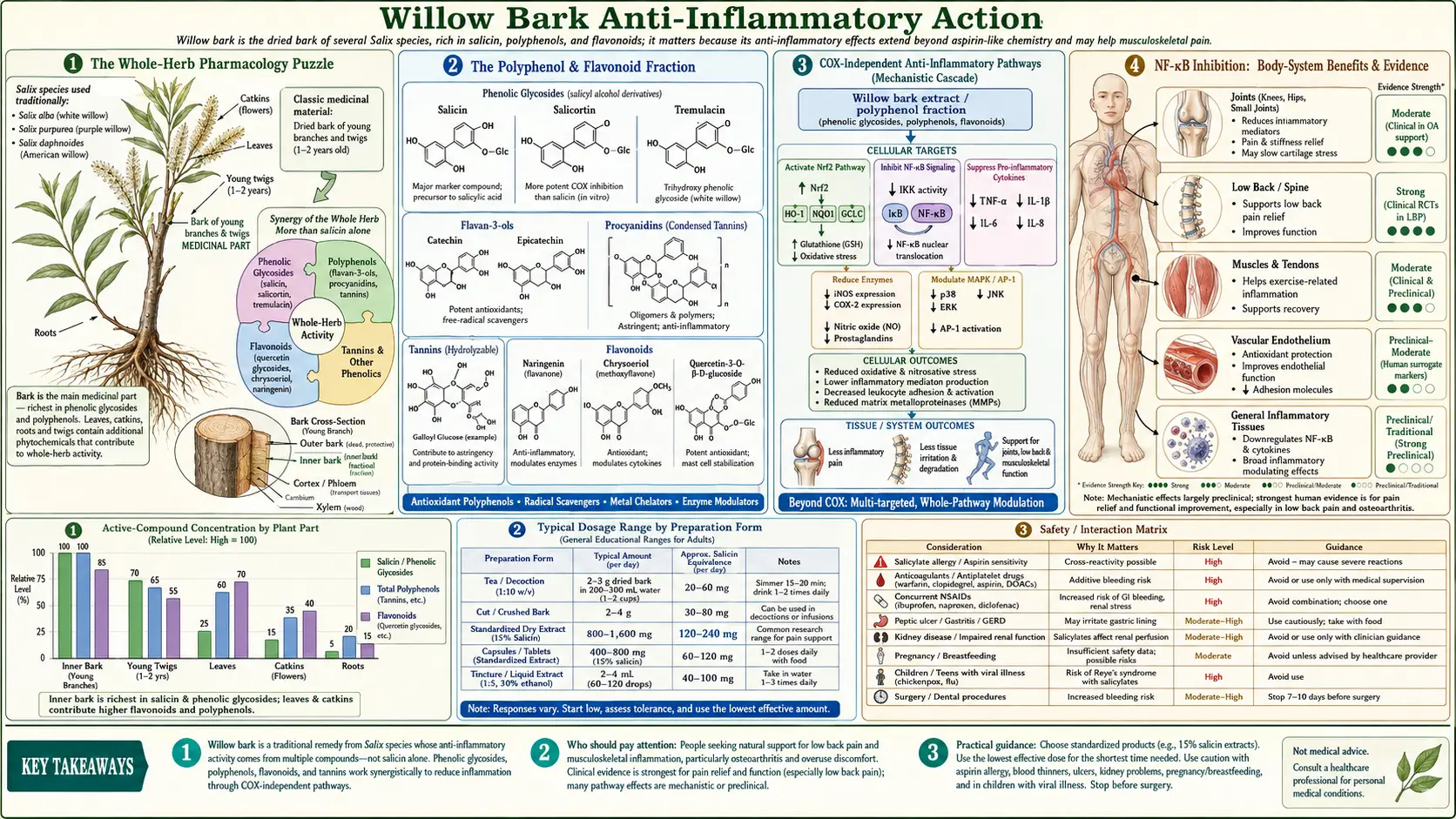
A persistent puzzle in willow bark pharmacology is that clinical effect outstrips what pure salicin pharmacokinetics would predict. A standard 240 mg daily salicin dose produces plasma salicylic acid concentrations of only 1-3 µg/mL — roughly an order of magnitude below the 20-50 µg/mL produced by therapeutic aspirin — yet low back pain trials report more effect than that predicts, including one open trial that found no significant difference from the nonsteroidal anti-inflammatory drug (NSAID) rofecoxib, while the blinded osteoarthritis and rheumatoid arthritis trials of Biegert 2004 did not show the extract beating placebo. A proposed resolution is the whole-herb advantage hypothesis: willow bark contains a substantial polyphenol and flavonoid fraction (catechins, proanthocyanidins, salicortin, tremulacin, isosalipurposide, picein) that produces COX-independent anti-inflammatory action through inhibition of NF-kappaB, tumor necrosis factor-alpha, and prostaglandin E2 synthesis. In laboratory work on human immune cells, a willow extract lowered inflammatory signals while pure salicin and salicylate had no effect (Fiebich and Chrubasik 2004); the claim that the whole extract is meaningfully more anti-inflammatory than its salicin content in patients stays a claim, because no clinical comparison of the two was found. This deep-dive maps the polyphenol fraction, the COX-independent mechanisms, and the clinical relevance for chronic inflammatory conditions.
Table of Contents
- The Whole-Herb Pharmacology Puzzle
- The Polyphenol & Flavonoid Fraction
- COX-Independent Anti-Inflammatory Pathways
- NF-kappaB Inhibition
- Tumor Necrosis Factor-alpha and Pro-Inflammatory Cytokine Suppression
- Prostaglandin E2 Synthesis Suppression
- The Biegert 2004 Rheumatoid Arthritis Trial and the Setty & Sigal 2005 Review
- The Whole-Herb Advantage Hypothesis
- Applications in Chronic Inflammatory Conditions
- Why Extract Standardization Matters
- Cautions
- Key Research Papers
- Connections
- Featured Videos
The Whole-Herb Pharmacology Puzzle
If willow bark's analgesic and anti-inflammatory action came only from its salicin content acting through salicylic acid's cyclooxygenase inhibition, the clinical effect should be modest. A 240 mg daily salicin dose, fully converted to salicylic acid, produces peak plasma concentrations of approximately 1-3 micrograms per milliliter. In a study of ten healthy volunteers, willow bark extract corresponding to 240 mg salicin gave peak serum salicylic acid levels averaging 1.2 mg/L (1.2 micrograms per milliliter), with total exposure equal to what 87 mg of aspirin would be expected to give; the authors concluded that salicylic acid alone is unlikely to explain any analgesic or anti-rheumatic effect. By contrast, therapeutic aspirin dosing (500-1000 mg) produces plasma salicylate concentrations of 20-50 µg/mL, and anti-inflammatory aspirin dosing in rheumatoid arthritis (historically used at 3-6 grams daily) targeted 150-300 µg/mL. On a salicylic acid basis alone, willow bark should produce only a fraction of the anti-inflammatory effect of even a single aspirin tablet.
Yet the low back pain trials report more than those numbers predict. In a blinded 2000 trial of 210 people with flare-ups of chronic low back pain, the share who were pain-free in the last week was 39% on 240 mg salicin/day, 21% on 120 mg/day and 6% on placebo. The Chrubasik 2001 trial, an open study with no placebo group and 114 people in each arm, found no significant difference between 240 mg salicin/day and rofecoxib 12.5 mg/day for low back pain. Other conditions give a different result. In the double-blind Biegert 2004 osteoarthritis trial (127 patients, 6 weeks), WOMAC pain scores fell by 8 mm (17%) on willow bark extract with 240 mg salicin/day, 23 mm (47%) on diclofenac 100 mg/day and 5 mm (10%) on placebo; the difference between willow bark and placebo was not statistically significant (p = 0.55), and the authors concluded the extract "showed no relevant efficacy" in osteoarthritis. Patients report subjective anti-inflammatory benefit that does not match the salicin-only pharmacokinetic prediction.
The proposed resolution to the puzzle, which rests on the low back pain results because the osteoarthritis and rheumatoid arthritis trials did not all find an effect, is that willow bark is not just a slow-release salicin delivery vehicle. The whole bark extract contains a substantial polyphenol and flavonoid fraction that produces independent anti-inflammatory action through cyclooxygenase-independent mechanisms. On this hypothesis, the total clinical effect is the sum of (1) salicin-derived salicylic acid producing modest COX inhibition plus (2) the polyphenol fraction producing additional NF-kappaB, tumor necrosis factor-alpha, and PGE2 suppression. This proposed multi-component effect is the "whole-herb advantage" — the reason given for the claim that willow extract outperforms equimolar pure salicin. The support comes from laboratory work: in human monocytes, an ethanolic extract lowered prostaglandin E2 and cytokine release while pure salicin and salicylate had no effect (Fiebich and Chrubasik 2004), and a 2007 review reports that animal and cell models pointed to the polyphenol and flavonoid fraction, with the single compounds responsible still to be identified (Nahrstedt 2007). No clinical comparison of willow extract with pure salicin was found.
The Polyphenol & Flavonoid Fraction
Standardized willow bark extracts contain at least four classes of secondary metabolites beyond salicin:
- Salicin-related glycosides — salicortin, tremulacin, picein, salireposide. These are structurally related to salicin and can themselves be hydrolyzed to release salicylic-acid-precursor moieties, contributing to the total salicylate pool.
- Catechins and proanthocyanidins — flavonoid polymers structurally similar to those in green tea, dark cocoa, and red wine. These contribute substantial antioxidant capacity and have well-documented anti-inflammatory action through NF-kappaB pathway inhibition.
- Flavonols and flavones — quercetin glycosides (isoquercitrin, rutin), kaempferol glycosides, and apigenin derivatives. Flavonols inhibit lipoxygenase, NF-kappaB, and several pro-inflammatory cytokines.
- Phenolic acids and tannins — gallic acid, ellagic acid, and condensed tannins. These contribute astringent properties (the characteristic mouthfeel of strong willow tea) and additional antioxidant capacity.
The polyphenol content of standardized willow extracts is substantial: total phenolic content typically 12-18% by mass, with total flavonoid content of 3-6%. By comparison, salicin content in the same standardized extracts is typically 15-25%. On a mass basis, polyphenols and flavonoids together are comparable to or larger than the salicin fraction — not a trace constituent, but a major component of the active extract.
The polyphenol fraction is also reasonably bioavailable. Catechins and flavonols are absorbed across the small intestine (partially as glycosides via SGLT1 and as aglycones after deconjugation), achieve plasma concentrations in the 0.1-1 µM range after dietary or extract dosing, and circulate as sulfate, glucuronide, and methylated conjugates that retain biological activity. The polyphenol fraction is not just a passive accompaniment to salicin — it reaches the systemic circulation and acts on the same molecular targets that drive chronic inflammation.
COX-Independent Anti-Inflammatory Pathways
The polyphenol fraction of willow bark produces anti-inflammatory action through mechanisms that do not involve the cyclooxygenase enzymes. The principal pathways are:
- NF-kappaB transcription factor inhibition. NF-kappaB is the master transcription factor regulating pro-inflammatory gene expression — it controls transcription of tumor necrosis factor-alpha, interleukin-1 (IL-1), interleukin-6 (IL-6), cyclooxygenase-2 (COX-2), iNOS, and dozens of other inflammatory mediators. Polyphenol inhibition of NF-kappaB activation produces broad reduction in inflammatory gene expression upstream of the prostaglandin pathway.
- Tumor necrosis factor-alpha synthesis suppression. Multiple studies of standardized willow extract show suppression of tumor necrosis factor-alpha production from lipopolysaccharide-stimulated macrophages and monocytes. Tumor necrosis factor-alpha is the central pro-inflammatory cytokine in rheumatoid arthritis, inflammatory bowel disease, psoriasis, and several other chronic inflammatory conditions.
- Lipoxygenase (LOX) inhibition. Flavonoids in willow extract inhibit 5-lipoxygenase, the enzyme that converts arachidonic acid to leukotrienes. Leukotrienes drive bronchoconstriction, vascular permeability, and neutrophil recruitment in asthma and chronic inflammation. This is a pathway aspirin does not address.
- Direct free radical scavenging. Polyphenols and tannins scavenge superoxide, hydroxyl radicals, and peroxyl radicals. This reduces oxidative damage to inflamed tissue and reduces the oxidant signaling that further amplifies NF-kappaB activation.
- Cell-adhesion molecule downregulation. Polyphenols reduce expression of ICAM-1, VCAM-1, and E-selectin on activated endothelium, reducing neutrophil and monocyte recruitment into inflamed tissue.
The combined effect of these pathways is broad anti-inflammatory action that suppresses inflammatory signaling at multiple steps — upstream of cyclooxygenase-2 induction (via NF-kappaB), in parallel to cyclooxygenase-2 (via 5-LOX), and downstream of mediator release (via cell-adhesion molecule blockade). Salicin-derived salicylic acid adds direct COX inhibition on top of this polyphenol-mediated framework.
NF-kappaB Inhibition
NF-kappaB (nuclear factor kappa-light-chain-enhancer of activated B cells) is the central transcription factor in pro-inflammatory gene expression. In the resting cell, NF-kappaB is sequestered in the cytoplasm bound to its inhibitor IkappaB. Inflammatory stimuli (tumor necrosis factor-alpha, interleukin-1 (IL-1), lipopolysaccharide (LPS), reactive oxygen species, T-cell receptor engagement) activate the IKK (IkappaB kinase) complex, which phosphorylates IkappaB and targets it for proteasomal degradation. Free NF-kappaB translocates to the nucleus and drives transcription of dozens of inflammatory genes.
Standardized willow bark extract inhibits NF-kappaB activation through multiple mechanisms documented in cell-culture studies:
- Suppression of IKK activity, reducing IkappaB phosphorylation
- Stabilization of IkappaB by interfering with its proteasomal degradation
- Direct interference with NF-kappaB DNA-binding activity in some studies
- Reduction in the expression of NF-kappaB target genes (cyclooxygenase-2, iNOS, tumor necrosis factor-alpha, interleukin-6) at the mRNA and protein level
This NF-kappaB suppression is a polyphenol effect — it is reproduced by isolated catechin, quercetin, and procyanidin fractions, and is not seen with pure salicin at comparable concentrations. The clinical translation is broad anti-inflammatory action upstream of any individual mediator, which explains why willow extract effects extend to conditions where pure aspirin would have limited utility (chronic autoimmune inflammation, gut inflammation, vascular inflammation).
Tumor Necrosis Factor-alpha and Pro-Inflammatory Cytokine Suppression
Tumor necrosis factor-alpha is the central pro-inflammatory cytokine in many chronic inflammatory diseases. The success of tumor necrosis factor-alpha-blocking biologics (infliximab, adalimumab, etanercept, certolizumab, golimumab) in rheumatoid arthritis, psoriasis, ankylosing spondylitis, and inflammatory bowel disease demonstrates how central tumor necrosis factor-alpha is to chronic inflammatory pathology. Anything that reduces tumor necrosis factor-alpha production produces broad anti-inflammatory benefit.
Standardized willow bark extract suppresses tumor necrosis factor-alpha production in lipopolysaccharide-stimulated monocyte and macrophage cell-culture models, though one human-monocyte study calls it weak: the concentration needed for half-maximal inhibition (IC50) was 180.0 µg/mL for tumor necrosis factor-alpha, 33.0 µg/mL for interleukin-1-beta and 86.0 µg/mL for interleukin-6, and the authors describe the extract as "a weak inhibitor of proinflammatory cytokines", with no effect on the activity of the cyclooxygenase-1 and cyclooxygenase-2 enzymes themselves (Fiebich and Chrubasik 2004). No study was found showing these concentrations are reached with oral dosing. The effect is dose-dependent and is partially attributable to NF-kappaB inhibition (since tumor necrosis factor-alpha is an NF-kappaB target gene) and partially to direct polyphenol effects on the tumor necrosis factor-alpha promoter.
The clinical relevance: patients with chronic conditions driven primarily by tumor necrosis factor-alpha-mediated inflammation (rheumatoid arthritis, psoriatic arthritis, ankylosing spondylitis, Crohn's disease) may benefit from willow bark as adjunctive therapy alongside standard care. The magnitude of effect from any natural anti-inflammatory is much smaller than from biological tumor necrosis factor-alpha blockade, but the additive benefit from a well-tolerated daily herbal anti-inflammatory can be meaningful for symptom control between flares. The one trial that tested willow bark in rheumatoid arthritis, Biegert 2004, did not indicate efficacy (see the rheumatoid arthritis section).
Similar mechanistic effects on interleukin-1-beta and interleukin-6 have been documented in some studies, with willow extract reducing inflammatory cytokine production across the broader pattern, not just tumor necrosis factor-alpha alone.
Prostaglandin E2 Synthesis Suppression
Prostaglandin E2 (PGE2) is the dominant pro-inflammatory prostaglandin in mammalian tissue. It drives the cardinal signs of acute inflammation (heat, redness, swelling, pain), is the principal fever-inducing prostaglandin at the hypothalamus, and contributes to chronic inflammatory pain through peripheral nociceptor sensitization. PGE2 synthesis depends on both cyclooxygenase-1 (COX-1) (constitutive) and cyclooxygenase-2 (inducible) activity acting on arachidonic acid substrate.
Standardized willow bark extract suppresses PGE2 synthesis through three mechanisms operating in parallel:
- Direct COX inhibition by salicin-derived salicylic acid — the classical mechanism, accounting for some fraction of the total PGE2 suppression.
- Reduced cyclooxygenase-2 induction via NF-kappaB inhibition — polyphenol-mediated NF-kappaB suppression reduces the inflammatory upregulation of cyclooxygenase-2 expression, which is normally the dominant source of PGE2 in inflamed tissue. Less cyclooxygenase-2 enzyme means less PGE2 even if individual cyclooxygenase-2 molecules are not directly inhibited.
- Phospholipase A2 suppression — some polyphenol constituents of willow extract reduce activity of cytosolic phospholipase A2, the enzyme that releases arachidonic acid from membrane phospholipids. Less arachidonic acid substrate means less downstream prostaglandin synthesis regardless of COX activity.
The three-mechanism PGE2 suppression is meaningfully broader than aspirin's pure COX inhibition. This is part of why willow extract's analgesic effect is clinically larger than the modest plasma salicylate concentrations would predict — the polyphenol fraction reduces PGE2 production at the substrate (arachidonic acid release) and enzyme expression (cyclooxygenase-2 induction) levels, not just at the catalytic activity level.
The Biegert 2004 Rheumatoid Arthritis Trial and the Setty & Sigal 2005 Review
Arathi R. Setty and Leonard H. Sigal published a comprehensive review in Seminars in Arthritis and Rheumatism in 2005 on herbal medications in rheumatology practice, with willow bark among the herbs covered. Its abstract lists willow bark extract as effective for osteoarthritis. It is a review, not a trial. The rheumatoid arthritis data on willow bark come from a separate paper, Biegert 2004.
That double-blind trial randomized 26 outpatients with active rheumatoid arthritis (RA) for six weeks, 13 to willow bark extract (240 mg salicin/day) and 13 to placebo. Pain on a 100 mm scale fell by 8 mm (15%) on willow bark and 2 mm (4%) on placebo. The difference was not statistically significant (estimated difference -0.8 mm, 95% confidence interval -20.9 to 19.3 mm, p = 0.93), and the authors wrote that the trial "did not indicate efficacy of this extract" in rheumatoid arthritis. A 2009 systematic review adds the caveat that the study was "grossly underpowered", meaning 26 people were too few to rule an effect in or out, and says further studies are needed to find out whether rheumatoid arthritis requires doses higher than 240 mg salicin per day. Accounts of willow bark in rheumatoid arthritis also describe a smaller effect than full-dose nonsteroidal anti-inflammatory drug addition and an excellent safety profile — no gastrointestinal (GI) events, no liver enzyme elevation, no renal function changes, no significant medication interactions — and interest in it as an adjunctive anti-inflammatory for people seeking to reduce or avoid daily nonsteroidal anti-inflammatory drug use; the trial abstract itself gives no such safety figures.
Subsequent larger trials of willow bark in rheumatoid arthritis have been limited, partly because the rheumatology field shifted heavily toward biologic disease-modifying antirheumatic drug (DMARD) therapy (tumor necrosis factor-alpha blockade, interleukin-6 blockade, JAK inhibitors) in the years after 2005, leaving less academic interest in herbal adjuncts. The clinical practice question, however, is real and recurring: many rheumatoid arthritis patients on biologic therapy still have residual inflammatory pain and stiffness between doses. Some people and practitioners describe a well-tolerated herbal anti-inflammatory like willow bark as filling that gap without the gastrointestinal and renal liabilities of chronic nonsteroidal anti-inflammatory drug use.
The Biegert trial is therefore best understood as a small negative trial, not as proof of concept: the claim that standardized willow bark produces measurable anti-inflammatory effect in patients already on standard care stays a claim. On long-term safety, the United States Pharmacopeia safety review reports no serious adverse effects in trials of 120-240 mg salicin daily for up to 8 weeks, all in adults, and the longest data are one 6-month observational study (see Applications below). Willow bark is described as far smaller in effect than disease-modifying antirheumatic drug or biologic therapy, no study found tested it as a replacement for them, and adjunctive use for residual symptoms is a reported practice rather than a tested one.
The Whole-Herb Advantage Hypothesis
The "whole-herb advantage" hypothesis proposes that standardized whole-plant extracts produce clinically larger effects than equimolar doses of their principal active constituent because of synergistic action of the co-constituents. The willow bark / salicin example is often offered as a demonstration of this hypothesis in herbal medicine, and it goes like this:
- Standardized willow extract delivering 240 mg/day salicin showed no significant difference from rofecoxib 12.5 mg/day in one open low back pain trial with no placebo group; in the blinded Biegert 2004 osteoarthritis trial, diclofenac 100 mg/day clearly outperformed it and it did not separate from placebo.
- Pure salicin alone at the same 240 mg/day dose is claimed to produce a much smaller analgesic effect; no clinical study making that comparison was found. In human monocytes in the laboratory, salicin and salicylate had no effect on the inflammatory signals measured (Fiebich and Chrubasik 2004).
- Pure salicylic acid at the calculated equivalent dose is described as producing a predictable but again smaller anti-inflammatory effect than willow extract.
On this hypothesis, the gap between (1) and (2)/(3) is the polyphenol contribution. The whole extract carries salicin plus catechins, proanthocyanidins, flavonols, and tannins; the polyphenol fraction adds NF-kappaB inhibition, tumor necrosis factor-alpha suppression, PGE2 substrate reduction, and direct antioxidant effects. The total clinical impact exceeds what salicin alone would predict because the inflammatory cascade has multiple intervention points and the extract addresses several simultaneously.
This is the central pharmacologic argument for using standardized willow bark extract rather than pure isolated salicin or pure salicylic acid (or aspirin) when the goal is chronic anti-inflammatory effect rather than acute analgesia. Aspirin is faster and produces more potent acute COX inhibition; standardized willow extract produces broader chronic anti-inflammatory effect with the multi-mechanism polyphenol contribution.
The whole-herb advantage also explains why crude willow bark tea, willow tincture, and standardized capsule formulations can all produce meaningful clinical effect — they all preserve the polyphenol fraction along with salicin. Purified salicin tablets, by contrast, have never been a successful pharmaceutical product, despite the obvious commercial logic of an isolated active ingredient. The same is true for many herbal medicines (turmeric/curcumin, milk thistle/silymarin, green tea/epigallocatechin gallate (EGCG)): the whole-plant or whole-extract preparations often outperform the isolated principal compound.
Applications in Chronic Inflammatory Conditions
Willow bark's multi-mechanism anti-inflammatory profile is the reason given for its described adjunctive use in several chronic inflammatory conditions:
- Osteoarthritis — often named as the next-best-studied use after low back pain, with conflicting trial results (a 2009 systematic review uses that word). In Schmid 2001 (78 patients, 2 weeks), WOMAC pain fell 14% on willow bark against a 2% rise on placebo (difference 6.5 mm, p = 0.047). In Biegert 2004 (127 patients, 6 weeks), the difference from placebo was not significant (p = 0.55). People and practitioners describe combining it with turmeric, ginger, and glucosamine sulfate. See Arthritis.
- Rheumatoid arthritis — described as adjunctive to standard disease-modifying antirheumatic drug or biologic therapy for residual inflammatory pain. The one trial, Biegert 2004 (26 patients), did not indicate efficacy and was underpowered. It is not described as a substitute for disease-modifying therapy.
- Ankylosing spondylitis — the inflammatory back pain typical of ankylosing spondylitis (AS) responds to willow extract similarly to chronic mechanical back pain. Adjunctive to nonsteroidal anti-inflammatory drug or biologic disease-modifying therapy.
- Psoriatic arthritis — adjunctive use for joint pain alongside standard care; willow's polyphenol fraction may modestly help skin inflammation as well.
- Gout (between attacks) — willow extract's anti-inflammatory action may modestly reduce subacute gout-related joint discomfort. It is not described as a treatment for acute gout attacks (which are treated with higher-potency intervention). People also describe combining it with tart cherry for purine-related inflammation. See Gout.
- Tendinopathy and bursitis — chronic soft-tissue inflammation often responds to willow extract similarly to chronic nonsteroidal anti-inflammatory drug use, with better tolerability for daily long-term use.
- Fibromyalgia — the inflammatory component of fibromyalgia is debated, but the broad anti-inflammatory effect of willow extract is well-tolerated as adjunctive care alongside standard fibromyalgia management.
Pooled data and longer follow-up add two points. A 2023 meta-analysis of six randomized trials (329 people with arthritis) found significant differences from placebo in pain relief and physical status and no significant difference in adverse events, but its authors wrote that the certainty of these findings is "still inadequate" and that further randomized trials are needed. The longest data come from a 6-month observational study of 436 patients with rheumatic pain, mainly osteoarthritis or back pain: average pain fell from 58.4 to 31.8 on a 100-point scale after 24 weeks, with other nonsteroidal anti-inflammatory drugs and opioids allowed and no placebo group, so the fall cannot be credited to the extract alone.
For broad pain management protocols see Pain Management and the Pain Management deep-dive.
Why Extract Standardization Matters
The whole-herb advantage hypothesis has an important corollary: the polyphenol fraction of the extract matters as much as the salicin content. Standardized willow extracts are typically calibrated to either 15% or 25% salicin content, but the polyphenol fraction can vary substantially based on:
- Willow species. Salix alba (white willow), Salix purpurea (purple willow), Salix daphnoides (violet willow), and Salix fragilis (crack willow) all contain salicin but differ in their polyphenol profiles. Most clinical trials have used Salix purpurea or mixtures dominated by S. alba.
- Harvest season. Spring-harvested bark typically has higher salicin content than fall-harvested. Polyphenol content varies less seasonally.
- Bark age. Young bark (3-5 year old branches) has higher salicin and polyphenol content than old bark from mature trunk wood.
- Extraction solvent. Aqueous extracts capture salicin and polyphenols efficiently. Alcoholic extracts also capture the polyphenols. Pure salicin isolation (which would be the ultimate "pharmaceutical purification") leaves the polyphenol fraction behind and loses the whole-herb advantage.
- Stabilization. Polyphenols are oxidation-sensitive. Extracts that are properly stabilized (encapsulated, antioxidant-protected, stored cool and dark) retain anti-inflammatory potency. Old or improperly stored extracts may lose polyphenol activity even while retaining stable salicin content.
On this reasoning, the two label details that matter are salicin content (the regulatory standardization marker) and total polyphenol content (a quality indicator). The Chrubasik and Schmid trials used proprietary standardized willow bark extracts, and a 2009 systematic review notes that all the trials it covered used ethanolic extracts at daily doses up to 240 mg salicin for up to six weeks.
Cautions
- Reye syndrome in children with viral illness — absolute pediatric contraindication during viral infection. The polyphenol fraction does not change the Reye risk; salicin is still the precursor of salicylic acid.
- Salicylate allergy / aspirin-exacerbated respiratory disease (AERD) — absolute contraindication. A 2003 case report describes a 25-year-old woman with a history of aspirin allergy who needed emergency treatment, including epinephrine, for anaphylaxis after two capsules of a weight-loss supplement containing willow bark; no other cause was identified.
- Anticoagulant interaction — some polyphenols (proanthocyanidins, catechins) have mild antiplatelet effects independent of salicylate, which may modestly compound bleeding risk with warfarin or other anticoagulants.
- Active inflammatory bowel disease flare — the tannin fraction in willow extract may be irritating to actively inflamed gut mucosa. The concern applies most during inflammatory bowel disease (IBD) flares; it is described as better tolerated between flares.
- Iron malabsorption. Tannins in willow extract can bind dietary iron and reduce absorption when taken with iron-containing meals. Taking them at different times avoids that overlap, which matters most when iron status is borderline.
- Pregnancy and breastfeeding — salicylates cross the placenta and are eliminated slowly in newborns, and no willow bark trial included pregnant or breastfeeding women. The United States Pharmacopeia monograph carries the statement "Not for use in children, women who are pregnant or nursing, or by persons with known sensitivity to aspirin." The concern is described as greatest in the third trimester. Both salicylate effects on the fetal ductus arteriosus and the broader polyphenol fraction are inadequately studied in pregnancy. Salicylic acid passes into breast milk, and the Drugs and Lactation Database (LactMed) states that "Willow bark is best avoided during breastfeeding."
- Concurrent nonsteroidal anti-inflammatory drug use — the concerns are the COX/COX overlap and the polyphenol fraction's additional NF-kappaB suppression, which can complicate inflammatory response measurement. The United States Pharmacopeia review states that use with other salicylate-containing medicines increases the bleeding, allergy and Reye syndrome risks.
- Pre-surgical use — herbal guidance describes stopping at least one week before scheduled surgery, because of the bleeding concern.
- Salicylate dose and labelling — the United States Pharmacopeia safety review notes that 240 mg salicin could yield 113 mg of salicylic acid, against 62 mg from an 81 mg low-dose aspirin, yet dietary supplements are not required to carry the warnings that low-dose aspirin must carry. The trials it reviewed ran up to 8 weeks and involved adults only. It names increased bleeding in vulnerable people, sensitivity or allergy to aspirin, and Reye syndrome in children as the risks.
Key Research Papers
- Setty AR, Sigal LH (2005). Herbal medications commonly used in the practice of rheumatology: mechanisms of action, efficacy, and side effects. Seminars in Arthritis and Rheumatism. — PubMed PMID: 15942912
- Khayyal MT et al. (2005). Mechanisms involved in the anti-inflammatory effect of a standardized willow bark extract. Arzneimittel-Forschung. — PubMed PMID: 16366042
- Bonaterra GA et al. (2010). Anti-inflammatory effects of the willow bark extract STW 33-I (Proaktiv) in LPS-activated human monocytes and differentiated macrophages. Phytomedicine. — PubMed PMID: 20570123
- Fiebich BL, Chrubasik S (2004). Effects of an ethanolic salix extract on the release of selected inflammatory mediators in vitro. Phytomedicine. — PubMed PMID: 15070163
- Wagner I et al. (2003). Influence of willow bark extract on cyclooxygenase activity and on tumor necrosis factor alpha or interleukin 1 beta release in vitro and ex vivo. Clinical Pharmacology and Therapeutics. — PubMed PMID: 12621392
- Nahrstedt A et al. (2007). Willow bark extract: the contribution of polyphenols to the overall effect. Wiener Medizinische Wochenschrift. — PubMed PMID: 17704985
- Maistro EL et al. (2019). Salix alba (white willow) medicinal plant presents genotoxic effects in human cultured leukocytes. Journal of Toxicology and Environmental Health, Part A. — PubMed PMID: 31906808
- Shara M, Stohs SJ (2015). Efficacy and Safety of White Willow Bark (Salix alba) Extracts. Phytotherapy Research. — PubMed PMID: 25997859
- Cameron M, Chrubasik S (2014). Oral herbal therapies for treating osteoarthritis. Cochrane Database of Systematic Reviews. — PubMed PMID: 24848732
- Drummond EM et al. (2013). Inhibition of proinflammatory biomarkers in THP1 macrophages by polyphenols derived from chamomile, meadowsweet, and willow bark. Phytotherapy Research. — PubMed PMID: 22711544
- Biegert C et al. (2004). Efficacy and safety of willow bark extract in the treatment of osteoarthritis and rheumatoid arthritis: results of 2 randomized double-blind controlled trials. The Journal of Rheumatology. — PubMed PMID: 15517622
- Schmid B et al. (2001). Efficacy and tolerability of a standardized willow bark extract in patients with osteoarthritis: randomized placebo-controlled, double blind clinical trial. Phytotherapy Research. — PubMed PMID: 11406860
- Schmid B, Kotter I, Heide L (2001). Pharmacokinetics of salicin after oral administration of a standardised willow bark extract. European Journal of Clinical Pharmacology. — PubMed PMID: 11599656
- Chrubasik S et al. (2000). Treatment of low back pain exacerbations with willow bark extract: a randomized double-blind study. The American Journal of Medicine. — PubMed PMID: 10936472
- Chrubasik S et al. (2001). Treatment of low back pain with a herbal or synthetic anti-rheumatic: a randomized controlled study. Willow bark extract for low back pain. Rheumatology. — PubMed PMID: 11752510
- Vlachojannis JE, Cameron M, Chrubasik S (2009). A systematic review on the effectiveness of willow bark for musculoskeletal pain. Phytotherapy Research. — PubMed PMID: 19140170
- Lin CR et al. (2023). Willow Bark (Salix spp.) Used for Pain Relief in Arthritis: A Meta-Analysis of Randomized Controlled Trials. Life. — PubMed PMID: 37895439
- Uehleke B et al. (2013). Willow bark extract STW 33-I in the long-term treatment of outpatients with rheumatic pain mainly osteoarthritis or back pain. Phytomedicine. — PubMed PMID: 23731658
- Oketch-Rabah HA et al. (2019). United States Pharmacopeia Safety Review of Willow Bark. Planta Medica. — PubMed PMID: 31604354
- Boullata JI, McDonnell PJ, Oliva CD (2003). Anaphylactic reaction to a dietary supplement containing willow bark. The Annals of Pharmacotherapy. — PubMed PMID: 12773073
- Drugs and Lactation Database (LactMed) (2006). Willow Bark. — PubMed PMID: 30000964
PubMed Topic Searches
Connections
- All Herbs
- Willow Bark Overview
- Willow Bark Benefits Hub
- Willow Bark for Pain Management
- Willow Bark for Headache & Migraine
- Cardiovascular & Aspirin Comparison
- Turmeric (Curcumin)
- Ginger
- Tart Cherry
- Aspirin
- Pain Management
- Arthritis
- Gout
- Chronic Pain
- Joint Pain
- Chronic Low Back Pain
- Glycine & Aspirin Metabolism
- Magnesium
- History