Nhan Tran (Adenosma caeruleum) for Liver and Bile Flow
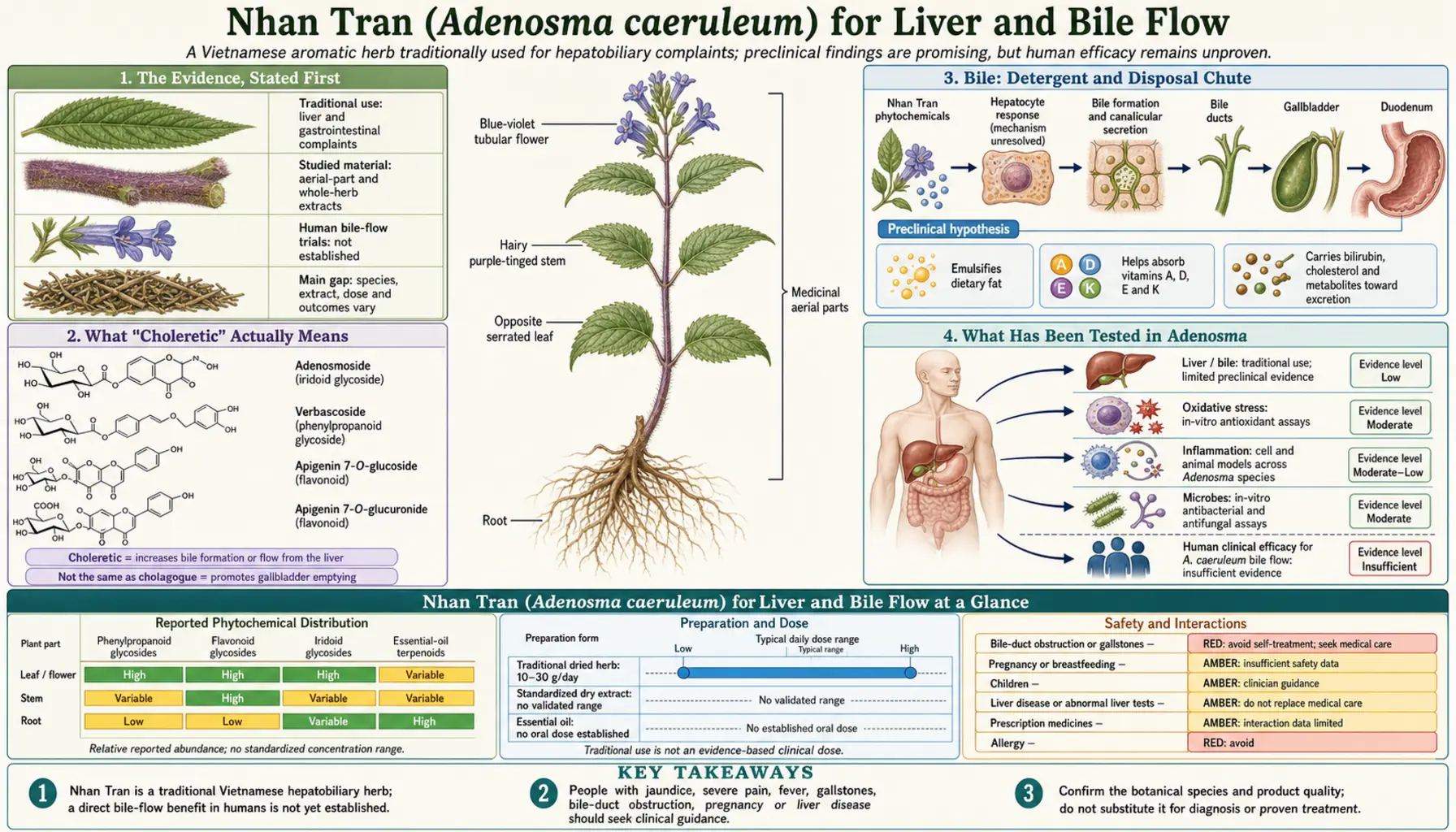
If nhân trần has a reputation, this is it. In Vietnam the tea is drunk for nóng gan — "hot liver" — a folk category that covers yellowish eyes, dark urine, greasy skin, bad breath, poor appetite after rich food, and the general feeling that something in the middle of you is congested. The claimed action is choleretic: it is supposed to make bile move.
Read this before anything else. There are no randomized controlled trials of Adenosma caeruleum in humans — none for liver disease, none for jaundice, none for bile flow. What exists is a modest amount of rodent work, a great deal of traditional use, and a very large research literature on a completely different plant that shares the same Vietnamese name. This page keeps those three things apart on purpose.
Table of Contents
- The Evidence, Stated First
- What "Choleretic" Actually Means
- Bile: Detergent and Disposal Chute
- What Has Been Tested in Adenosma
- The Yin Chen Hao Literature Is a Different Plant
- Jaundice Is a Symptom, Not a Diagnosis
- Where a Bile-Moving Tea Could Plausibly Help
- How It Is Prepared for Liver Complaints
- Cautions and Who Should Avoid It
- Key Research Papers
- Connections
- Featured Videos
The Evidence, Stated First
Three tiers, in descending order of strength:
- Animal work. Extracts of Adenosma species have been evaluated in rodents using bile-duct cannulation — the standard choleretic assay — and in chemically induced liver-injury models where serum ALT and AST are the readout. Reports of increased bile output and reduced enzyme elevation exist, largely in Vietnamese-language pharmacognosy journals. These are hypothesis-generating results in animals, at doses and by routes that do not translate directly to a cup of tea.
- In-vitro work. Antioxidant and cell-protection assays on extracts. Almost every plant extract on earth performs well in these; a positive result is close to uninformative on its own.
- Traditional use. Generations of Vietnamese households. This tells you the tea is broadly tolerated at customary doses by adults who chose to keep drinking it. It does not tell you it works.
What is entirely absent: any human trial with a control group, any measurement of bile flow in people, any before-and-after liver-enzyme study in patients. Anyone who tells you nhân trần is "clinically proven" for the liver is either mistaken or quoting the wrong plant.
What "Choleretic" Actually Means
Two similar-sounding words get muddled constantly, and the difference matters:
- Choleretic — increases the production of bile by liver cells. More bile is made and secreted into the tiny canals between hepatocytes.
- Cholagogue — promotes the emptying of the gallbladder, squeezing stored bile down into the small intestine.
Think of it as a factory and a warehouse. A choleretic raises factory output. A cholagogue opens the warehouse doors. A herb can do one, both, or neither. Traditional descriptions of nhân trần mix the two freely, and the rodent assays used to test it measure the first.
Both effects are, importantly, only useful when the pipe is open. If the bile duct is blocked by a stone or a tumour, stimulating more bile production pushes against a closed door. That is why "increases bile flow" is not automatically a good thing, and why a choleretic tea is not a treatment for obstructive jaundice.
Bile: Detergent and Disposal Chute
Bile does two jobs that have almost nothing to do with each other.
Job one: emulsification. Bile salts are biological detergents. Fat arriving in the small intestine is a blob; lipase can only work on its surface. Bile salts break the blob into a fine suspension of droplets, multiplying the surface area enormously, so fat and the fat-soluble vitamins A, D, E and K can actually be absorbed. People with poor bile flow often report exactly what you would predict — heaviness after fatty meals, pale greasy stools, nausea after fried food.
Job two: excretion. Bile is also the liver's rubbish chute. Bilirubin, excess cholesterol, some hormones, some drug metabolites and various toxins are conjugated in the liver and dumped into bile for removal in the stool. When that chute backs up, those substances accumulate in blood — which is what jaundice is.
Bilirubin deserves its own sentence, because it is the pigment behind every yellow-skin story. Old red blood cells are broken down; haem becomes unconjugated bilirubin, which is fat-soluble and travels bound to albumin. The liver enzyme UGT1A1 attaches glucuronic acid to it, producing water-soluble conjugated bilirubin, which is secreted into bile. Anything that overwhelms production, impairs conjugation, or blocks secretion produces jaundice — by three quite different routes with three quite different treatments.
What Has Been Tested in Adenosma
The Adenosma liver literature is small, old and mostly Vietnamese. Typical study designs you will find:
- Bile-duct cannulation in rats. A cannula is placed in the common bile duct, bile is collected over timed intervals, and volume is compared between treated and control animals. An increase in millilitres per hour is a choleretic signal. This is a real, reproducible assay — but it is an anaesthetised rodent receiving a concentrated extract, often intraduodenally.
- Carbon tetrachloride or paracetamol liver-injury models. Animals are given a hepatotoxin; serum ALT and AST rise; a protective agent blunts that rise. Extracts of many aromatic and flavonoid-rich plants blunt it somewhat. It is a screening model, not a disease model, and dozens of substances that pass it have never shown a human benefit.
- Antioxidant assays. DPPH, ABTS, FRAP. These measure whether a solution can donate electrons in a test tube. They do not measure anything that happens in a liver.
Two honest caveats about this body of work. First, much of it does not distinguish clearly between Adenosma caeruleum and Adenosma bracteosum (bồ bồ, "nhân trần Tây Ninh"), which are traded interchangeably. Second, it is largely inaccessible to outside review — not indexed, not translated, rarely replicated. That is a limitation to state, not a scandal; a great deal of useful regional pharmacognosy lives in journals the English-language world never reads. But it means the reader cannot verify it, and neither can this page.
The Yin Chen Hao Literature Is a Different Plant
Search "nhân trần liver" and you will surface an impressive-looking body of hepatology research. Nearly all of it concerns Artemisia capillaris Thunb. — Chinese 茵陈, yīn chén hāo — a member of the daisy family (Asteraceae) whose Chinese name is also translated "nhân trần" in Vietnamese texts of Chinese medicine.
Artemisia capillaris is not a relative of Adenosma caeruleum. Different family, different growth habit, different chemistry. Its characteristic compounds are coumarins — notably scoparone (6,7-dimethoxycoumarin) — plus the chromone capillarisin and abundant chlorogenic acid. Adenosma's chemistry is essential-oil-dominant: limonene, fenchone, 1,8-cineole, α-humulene. There is no meaningful chemical overlap.
The Artemisia capillaris research is genuinely interesting on its own terms. It is the backbone of the classical formula Yin Chen Hao Tang, used for centuries for jaundice, and there is real mechanistic work showing that constituents of the decoction activate the nuclear receptor CAR (constitutive androstane receptor), which upregulates the bilirubin-clearance machinery including UGT1A1 — a coherent molecular story for why an ancient jaundice remedy might do something.
None of that is evidence for Adenosma caeruleum. Borrowing it would be like citing aspirin trials to support willow-scented soap. Whenever this site cites Yin Chen Hao work, the species is named explicitly and labelled as a different plant. If a supplement label, a blog post or a seller quotes "clinical research on nhân trần for jaundice," check the Latin binomial before you believe it applies to what is in the bag.
Jaundice Is a Symptom, Not a Diagnosis
This is the section that matters most, so it is deliberately blunt: if your skin or the whites of your eyes have turned yellow, you need a doctor and a blood test, not a tea.
Yellowing appears when total bilirubin rises to roughly 2–3 mg/dL (about 34–51 µmol/L), typically visible first in the sclerae. The causes fall into three buckets, and telling them apart requires laboratory work — it cannot be done by how you feel:
- Pre-hepatic — too much bilirubin being made. Haemolysis, from autoimmune disease, G6PD deficiency, transfusion reactions, some infections, some drugs. Unconjugated bilirubin dominates.
- Hepatic — the liver cannot process it. Viral hepatitis A, B, C or E; alcohol-related liver disease; drug and herb-induced liver injury; autoimmune hepatitis; cirrhosis; Gilbert syndrome (benign, common, harmless).
- Post-hepatic — the drain is blocked. Gallstones in the common bile duct, stricture, pancreatic head tumour, cholangiocarcinoma, primary sclerosing cholangitis. Conjugated bilirubin dominates, often with pale clay-coloured stools and dark urine.
The minimum workup is straightforward and cheap in most places: total and direct bilirubin, ALT, AST, alkaline phosphatase, GGT, albumin, INR, a full blood count, viral hepatitis serology, and an abdominal ultrasound. Those tests separate the three buckets in a day.
Go to an emergency department, not a herbalist, if jaundice comes with: fever and shaking chills (possible ascending cholangitis — a surgical emergency), severe right-upper-quadrant pain, confusion or unusual drowsiness, vomiting blood or black stools, or bruising and bleeding gums. In Vietnam and elsewhere, chronic hepatitis B is common and often silent until it is not; jaundice in that setting is a reason for urgent assessment.
Drinking a cooling tea and waiting to see whether the yellow fades is the single most dangerous thing anyone does with this herb. It is not that the tea is toxic — it is that the delay is.
Where a Bile-Moving Tea Could Plausibly Help
Setting aside disease, is there a scenario where a mild aromatic choleretic is reasonable? Honestly, yes — a narrow one, and it is about comfort rather than cure.
Warm bitter-aromatic infusions after a heavy, fatty meal are a near-universal human habit: fennel in India, gentian and artichoke digestifs in Europe, chrysanthemum and hawthorn in China, nhân trần in Vietnam. The plausible mechanism is unremarkable — mild bitter and aromatic stimulation of upper-gut secretion and motility, plus the simple physiology of warm fluid and a pause after eating. If a cup of nhân trần after a rich lunch makes you feel less heavy, that experience is real, and it costs almost nothing.
What it cannot do, on any current evidence: lower liver enzymes in hepatitis, dissolve gallstones, "detox" or "cleanse" a liver (the liver is the detox organ — it does not need one), reverse fatty liver, or substitute for antiviral treatment. Non-alcoholic fatty liver disease, the most common liver problem in the world today, responds to sustained weight loss, reduced added sugar and alcohol, and exercise. No tea has ever matched that.
How It Is Prepared for Liver Complaints
Traditional Vietnamese preparation is simple. Roughly 10–20 g of the dried aerial parts per litre of water, either steeped like tea in just-boiled water for 10–15 minutes, or simmered gently for a similar time, then drunk warm through the day. It is often taken as a daily hot-weather drink rather than as a timed dose.
Commercial forms include loose dried herb, tea bags, and tablets or capsules of dried extract. Extract products are the least transparent: extraction ratio, solvent and species are rarely stated, and an alcohol extract of an oil-rich herb is not the same preparation as a water infusion.
The commonest commercial presentation is nhân trần blended with licorice (cam thảo). That blend has a specific, real safety problem — the two herbs work against each other pharmacologically, and chronic licorice carries a documented risk of pseudoaldosteronism. It is covered in full on the Traditional Tea and Safety page, which anyone drinking this daily should read.
There is no established therapeutic dose, because there is no trial from which to derive one. Any number quoted anywhere, including here, is customary practice rather than a studied dose.
Cautions and Who Should Avoid It
- Known or suspected biliary obstruction — gallstones in the duct, strictures, tumours. Stimulating bile against a blockage is at best pointless. Get imaging.
- Any unexplained jaundice — diagnosis first, always.
- Established liver disease or liver failure — there is no safety data for this herb in a compromised liver, and herb-induced liver injury is a real, under-recognised category. The NIH LiverTox database exists because of it.
- Pregnancy and breastfeeding — Vietnamese traditional practice cautions against habitual daily use, and no modern safety data exists. Treat as not recommended.
- Children — no data. Adult folk dosing does not scale down by guesswork.
- Licorice-blended products in hypertension, heart failure, kidney disease, or with diuretics, digoxin or corticosteroids — this is the practical interaction that actually sends people to hospital.
- Species uncertainty — you may be drinking A. caeruleum, A. bracteosum, or Artemisia capillaris. Buy from sellers who name the botanical species.
One more point, easily missed: if you are taking prescription medication for a liver condition, hepatitis antivirals in particular, do not replace it with herbal tea and do not assume no interaction. Tell your doctor what you drink. Most will not mind; all of them would rather know.
Key Research Papers
Identifiers on this page are given as live PubMed queries rather than quoted PMIDs. Much of the Adenosma literature is Vietnamese-language and not indexed, and a wrong identifier is worse than an honest search link.
- Huang W, Zhang J, Moore DD. A traditional herbal medicine enhances bilirubin clearance by activating the nuclear receptor CAR. Journal of Clinical Investigation. 2004. Species: Artemisia capillaris (Yin Chen Hao) — not Adenosma caeruleum.
- Reviews of Artemisia capillaris phytochemistry and hepatoprotective pharmacology, covering scoparone and capillarisin. Search. Different plant, labelled.
- Clinical and mechanistic literature on Yin Chen Hao Tang for jaundice and cholestasis. Search. Different plant, labelled.
- Essential-oil composition of Adenosma caeruleum — limonene, fenchone, 1,8-cineole, α-humulene. Search.
- Studies on Adenosma bracteosum, the second Vietnamese species sold under the same market name. Search.
- Methodology of choleretic testing by bile-duct cannulation in rodents. Search.
- UGT1A1, bilirubin conjugation, and the genetics of Gilbert syndrome. Search.
- Diagnostic approach to the jaundiced adult: laboratory pattern and imaging. Search.
- Herb-induced liver injury: incidence, causality assessment and reporting. Search.
Live PubMed Searches
- Adenosma caeruleum
- Adenosma hepatoprotective
- Choleretic herbal medicine
- Artemisia capillaris and CAR
- Obstructive jaundice management
- Hepatitis B prevalence in Vietnam
- NAFLD lifestyle intervention
- CCl4 liver-injury model limitations
- Enterohepatic circulation of bile acids
- Vietnamese traditional liver herbs
Connections
- All Herbs
- Nhan Tran (Adenosma caeruleum) — the full research article.
- Nhan Tran: History and Traditional Use — where the name and the confusion came from.
- Milk Thistle — the liver herb with actual human trials, worth comparing.
- Dandelion — the Western bitter choleretic with the same traditional logic.
- Chanca Piedra — folk "stone breaker," another thin-evidence hepatobiliary herb.
- Licorice — the usual blend partner and the real safety issue.
- Artemisia annua — a different Artemisia; useful for keeping species straight.