Nhan Tran (Adenosma caeruleum): History and Traditional Use
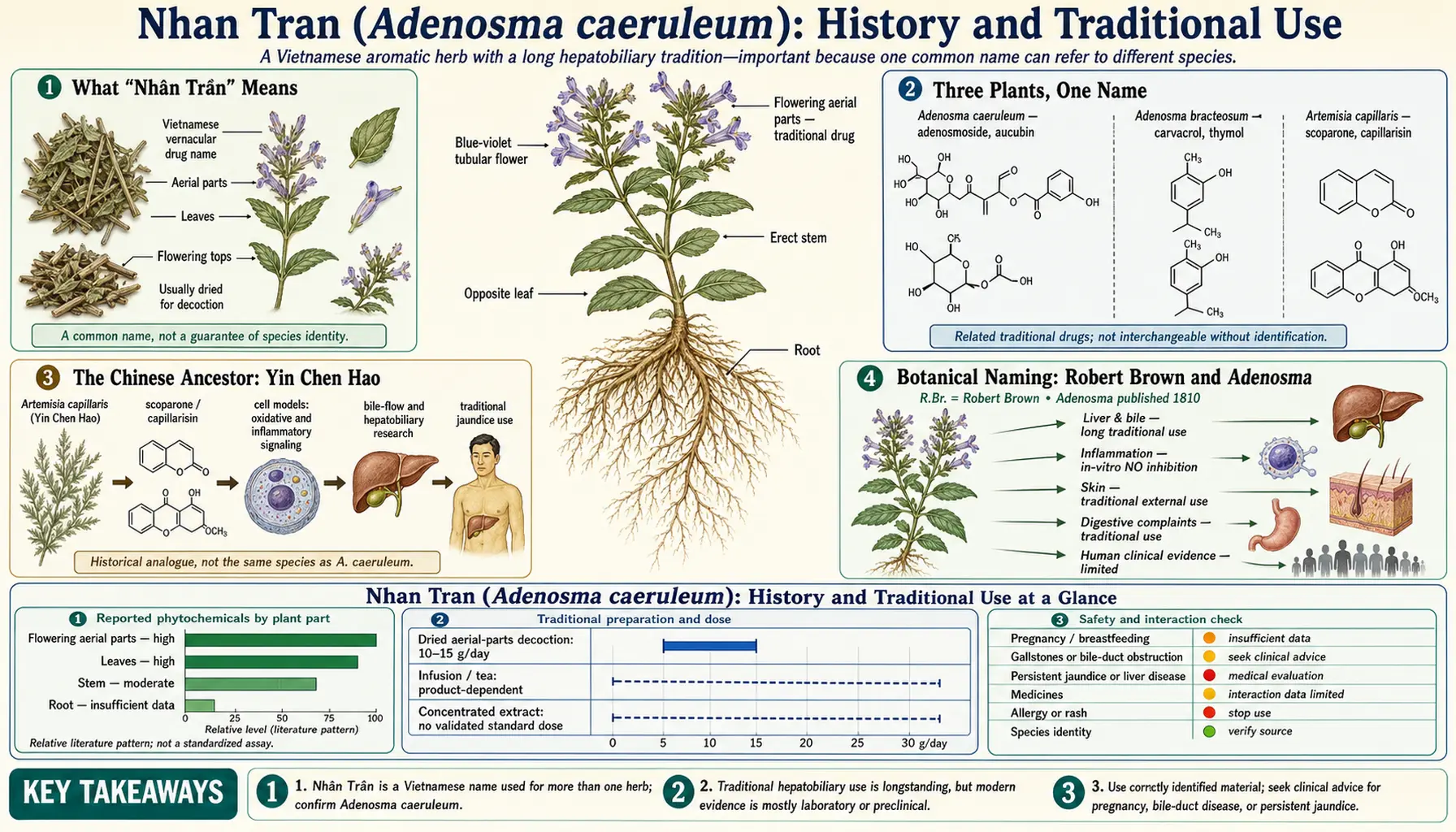
The history of nhân trần is really two histories that collided. One belongs to a Chinese jaundice herb documented for close to two thousand years. The other belongs to a small blue-flowered Vietnamese weed of sandy hillsides. They are not the same plant, they are not in the same family, and at some point in the transmission of Chinese medical texts into Vietnam, one name settled onto both of them.
That collision is the most interesting thing about this herb's past, and it explains almost every confusion you will meet in the present. This page follows the name, the plant, and the research separately, so you can see where each one actually goes.
Table of Contents
- What "Nhân Trần" Means
- Three Plants, One Name
- The Chinese Ancestor: Yin Chen Hao
- Botanical Naming: Robert Brown and Adenosma
- From Scrophulariaceae to Plantaginaceae
- How It Was Gathered and Prepared
- Postpartum Use and the Milk-Supply Belief
- Regional Spread and the Licorice Blend
- How Nhân Trần Entered Modern Research
- What Science Confirmed, and What It Did Not
- Key Research Papers
- Connections
- Featured Videos
What "Nhân Trần" Means
Vietnamese carries a large layer of Sino-Vietnamese vocabulary — words borrowed from Chinese and pronounced through Vietnamese phonology, in the same way English borrowed a scholarly Latin layer. Medical terminology is one of the most heavily borrowed domains, because Vietnamese classical medicine was taught from Chinese texts for centuries.
Nhân trần is the Sino-Vietnamese reading of the Chinese characters 茵陳 (yīn chén). In Chinese materia medica the full drug name is 茵陳蒿, yīn chén hāo, where 蒿 (hāo) means an Artemisia or wormwood-type plant. Vietnamese kept the first two characters and dropped the third — and dropping 蒿 quietly removed the one part of the name that identified the botanical group. What remained, "nhân trần," was a name for a function: the jaundice herb.
A name that describes a function rather than a plant will attach itself to whatever local plant performs that function. That is exactly what happened.
The purely Vietnamese names
Alongside the borrowed name, Adenosma caeruleum carries names that are entirely Vietnamese and entirely descriptive — and these are the ones that actually tell you about the plant:
- Chè cát — "sand tea." It names the habitat (sandy open ground) and the use (a drink). If you wanted a single honest label for this herb, this is it.
- Hoắc hương núi — "mountain patchouli," after the aroma of the crushed leaf.
- Nhân trần cái — "female nhân trần," a folk distinction used in some regions to separate this species from its relative.
The vernacular names describe a sandy-ground aromatic tea plant. The borrowed name describes a classical Chinese jaundice drug. Both are applied to the same herb, and they are telling you about two different things.
Three Plants, One Name
By the twentieth century, three plants were circulating in Vietnamese herbal commerce under some version of the name nhân trần:
| Plant | Family | Origin of the association |
|---|---|---|
| Adenosma caeruleum | Plantaginaceae | The northern Vietnamese folk plant that inherited the classical name. The species in most Vietnamese herbal teas and tablets today. |
| Adenosma bracteosum | Plantaginaceae | A southern Vietnamese relative, known as bồ bồ or nhân trần Tây Ninh after the province where it is gathered. A genuine congener with overlapping traditional use. |
| Artemisia capillaris | Asteraceae | The original Chinese yin chen hao. Enters Vietnamese usage through translation of Chinese medical texts rather than through local gathering. |
The two Adenosma species are close relatives with a real botanical relationship. The Artemisia is not related to either in any meaningful sense — Plantaginaceae and Asteraceae sit far apart on the flowering-plant tree, and they share essentially none of the same secondary chemistry.
Vietnamese pharmacognosy has been aware of this for a long time, which is why the Vietnamese Pharmacopoeia specifies the drug by its Latin name — Herba Adenosmatis caerulei, the dried aerial parts of Adenosma caeruleum. The pharmacopeial name exists precisely because the common name is unreliable. When a Vietnamese herbal product carries that Latin drug name on the label, someone in the supply chain took the identity question seriously.
The Chinese Ancestor: Yin Chen Hao
To understand why nhân trần is so firmly associated with jaundice, you have to look at the herb that gave it its name — even though that herb is not the plant on this site's nhân trần page.
Yin chen hao appears in the Shennong Bencao Jing (神農本草經, the "Divine Farmer's Classic of Materia Medica"), the foundational Chinese herbal, which is generally dated to around the first to second century CE and is traditionally attributed to the mythical figure Shennong. It is listed among the upper-grade herbs.
More consequentially for clinical practice, yin chen hao is the lead herb of Yin Chen Hao Tang (茵陳蒿湯), a three-herb decoction recorded in the Shanghan Lun (傷寒論, "Treatise on Cold Damage Disorders") compiled by Zhang Zhongjing around the end of the Han dynasty, roughly 200 CE. That formula is prescribed for "yang jaundice" — jaundice with heat signs — and it is still in the Chinese pharmacopoeia and still prescribed today. Very few therapeutic formulas of any tradition have that kind of continuity.
So the classical pedigree is genuine, long, and specific. It just belongs to Artemisia capillaris. When Vietnamese practitioners read those texts and needed the herb they named, the plant that filled the role in northern Vietnam was Adenosma caeruleum — locally abundant, aromatic, bitter, cooling, growing on every sandy bank. Botanically it was a substitution. Practically it was a naturalization, and it has held for centuries.
This is not unusual in the history of medicine. Herbal substitution driven by local availability is one of the most common events in materia medica history, and it happened repeatedly wherever Chinese medical texts traveled — into Korea, Japan, and Vietnam. What is unusual here is how completely the substitution erased itself: the two plants share a name so thoroughly that modern writers routinely cite research on one as evidence for the other.
Botanical Naming: Robert Brown and Adenosma
While Vietnamese and Chinese practitioners were arguing implicitly about which plant was the jaundice herb, European botany was cataloguing the plant from an entirely different direction and knew nothing of the medicine.
The genus Adenosma was established by the Scottish botanist Robert Brown in his Prodromus Florae Novae Hollandiae et Insulae Van Diemen (1810) — the pioneering flora of Australia and Tasmania that came out of Brown's voyage with Matthew Flinders. Brown is one of the towering figures of early-nineteenth-century botany; the same man described Brownian motion and named the cell nucleus.
Adenosma caeruleum carries Brown's authority abbreviation, R.Br., and the name is registered in the International Plant Names Index — which is the appropriate place to verify any claim about who published a plant name and when. The epithet is straightforward Latin: caeruleum, sky blue, for the flowers. The genus name comes from Greek roots meaning "gland" and "odor" — glandular and fragrant, an accurate description of a plant covered in oil-bearing glandular hairs.
Note the direction of the naming: the botanical name records what the plant looks and smells like. It records nothing about liver disease. The European and Asian naming traditions were describing the same organism with no awareness of each other, one by morphology and one by therapeutic role, and neither name can be translated into the other.
From Scrophulariaceae to Plantaginaceae
If you consult two references about nhân trần you will very likely find two different plant families. Both may be correct for their date.
For most of the nineteenth and twentieth centuries, Adenosma sat in Scrophulariaceae, the figwort family. Scrophulariaceae had become what taxonomists call a wastebasket taxon — a large, loosely defined family that absorbed anything with the right general flower shape. It was held together by morphology, and morphology can converge.
Molecular phylogenetics dismantled it. Beginning in the late 1990s and culminating in the influential 2001 analysis by Olmstead and colleagues, DNA sequence data showed that the traditional Scrophulariaceae was not a natural group at all — its members descended from several different lineages. The family was broken up, and large blocks of genera were moved. Adenosma, along with familiar plants such as foxglove (Digitalis), snapdragon (Antirrhinum), and speedwell (Veronica), landed in an expanded Plantaginaceae — the plantain family.
Practical takeaway: a Vietnamese herbal text listing nhân trần under Scrophulariaceae is not wrong so much as pre-molecular. Nothing about the plant changed. And the reclassification does not bring nhân trần any closer to Artemisia capillaris — that herb is in Asteraceae, in a different order entirely, under any classification anyone has ever proposed.
How It Was Gathered and Prepared
Nhân trần has historically been a wild-gathered herb, not a cultivated crop. That fact shapes everything about its traditional handling.
Harvest
The whole aerial part is cut when the plant is in flower — the traditional timing, and also the pharmacognostically sensible one, since essential-oil content in aromatic herbs typically peaks around flowering. Roots are discarded. The cut material is dried in shade rather than direct sun, because volatile oil evaporates and flavonoids degrade under strong sunlight. Shade-drying an aromatic herb is one of those pieces of traditional technique that turns out to be exactly right for reasons the tradition could not have articulated.
Preparation
- Everyday infusion. A handful of dried herb, boiling water, covered, left to steep. Drunk warm or, more often in the Vietnamese summer, cooled and drunk through the day.
- Decoction (thuốc sắc). Simmered in a clay pot for a defined complaint, typically as part of a multi-herb prescription rather than alone. This is the therapeutic form in classical practice.
- External wash. A strong decoction cooled and used to wash skin for prickly heat, itching, and minor rashes — especially for children in hot weather.
The herb's place in daily life
What distinguishes nhân trần from most medicinal herbs is that it never stayed inside medicine. It became a beverage. Roadside tea stalls, home kitchens, and market vendors sold it as trà nhân trần, drunk by healthy people in hot weather the way barley tea is drunk in Korea or chrysanthemum tea in southern China. This blurring of the line between food and medicine is characteristic of East and Southeast Asian herbal culture, and it is why the practical questions about nhân trần are questions about long-term daily consumption rather than about a course of treatment.
Postpartum Use and the Milk-Supply Belief
Vietnamese postpartum tradition is elaborate and prescriptive, with detailed rules about warming foods, avoided foods, and recovery drinks. Nhân trần has a place in it: it was given to new mothers to "clear remaining heat," support recovery, and restore appetite in the weeks after birth.
At the same time, Vietnamese practitioners have long advised against habitual daily nhân trần in pregnancy and breastfeeding, with the specific stated concern that it reduces milk supply — a folk belief that circulates widely and is repeated in Vietnamese health media.
These two positions sit uneasily together, and it is worth being honest about the tension rather than smoothing it over. Several readings are possible: that the older use meant a short course immediately after delivery while the caution addresses months of daily drinking; that the caution grew up around the diuretic framing, on the folk logic that a herb which moves fluid out might move milk out too; or that the caution attached later, once the commercial licorice-blended tea became a daily habit rather than a brief postpartum practice.
What the evidence says: nothing. There is no lactation study of Adenosma caeruleum. No milk-volume measurement, no infant outcome data, no pharmacokinetics of transfer into breast milk. The milk-supply concern is a traditional caution, not a demonstrated effect, and anyone telling you it is proven is overstating it. Anyone telling you it is disproven is also overstating it — nobody has looked.
Given that vacuum, and given that most commercial nhân trần tea contains licorice, which does have documented adverse effects in pregnancy, the conservative position on the main page is to avoid nhân trần in pregnancy and breastfeeding. That recommendation rests more on the licorice than on the folk belief.
Regional Spread and the Licorice Blend
Adenosma caeruleum is native across mainland Southeast Asia and adjacent regions — Vietnam, southern China, Laos, Cambodia, and parts of India — but its identity as a medicinal herb is specifically Vietnamese. It did not travel as a drug the way ginseng or turmeric did. There is no significant nhân trần trade outside Vietnamese communities, and it has no established presence in Western herbalism at all.
Within Vietnam, there is a rough north-south split in which species carries the name. In the north, Adenosma caeruleum is the nhân trần. In the south, particularly around Tây Ninh province, Adenosma bracteosum — bồ bồ — fills the same role and is often sold under the same label. Vietnamese diaspora communities in the United States, France, and Australia import whichever product the supply chain provides, which means the plant in a package bought in Little Saigon is not necessarily the plant named on it.
The licorice pairing
The most consequential development in nhân trần's modern history is not pharmacological but commercial: the standardization of the nhân trần + cam thảo blend, nhân trần plus licorice root, as the default ready-made tea.
The reason is flavor. Nhân trần is bitter; licorice is roughly fifty times sweeter than sugar and masks bitterness at trivial weight. From a beverage-manufacturing standpoint it is an obvious move, and it made the tea far more marketable.
From a pharmacological standpoint the pairing is difficult to defend. Nhân trần is used as a diuretic and choleretic; licorice's glycyrrhizin causes sodium and water retention by blocking the renal enzyme that protects the mineralocorticoid receptor from cortisol. Chronic licorice raises blood pressure and lowers potassium — the syndrome called pseudoaldosteronism, which has a substantial case literature including hospitalizations. The two herbs work against each other, and only one of them carries a documented risk.
Vietnamese physicians and health media have repeatedly cautioned against drinking the blend daily over long periods. It is a case where a traditional herb's biggest modern safety issue was introduced not by tradition, and not by the herb, but by a flavoring decision. The Traditional Tea and Safety article works through this in detail.
How Nhân Trần Entered Modern Research
Scientific attention to nhân trần came through Vietnamese pharmacognosy rather than international interest, and it has stayed there.
The pivotal document is Đỗ Tất Lợi's Những cây thuốc và vị thuốc Việt Nam ("Medicinal Plants and Herbs of Vietnam"), a monumental survey first published in the 1960s and revised across many editions. Đỗ Tất Lợi (1919–2008) systematically documented Vietnamese medicinal plants with botanical identification, traditional use, and available chemistry — the single most important reference in the field, and the source most Vietnamese writing on nhân trần ultimately traces back to. Its treatment of nhân trần is careful about the species question in a way that most downstream popular writing is not.
From the 1970s onward, Vietnamese pharmacology institutes ran the standard investigations: essential-oil composition by distillation and chromatography, antimicrobial screening against common test organisms, and — most relevant to the traditional indication — choleretic studies in rodents, measuring bile output through a cannulated bile duct after extract administration.
The eventual formalization was the herb's inclusion in the Vietnamese Pharmacopoeia (Dược điển Việt Nam) as Herba Adenosmatis caerulei, with identification criteria and quality standards. That is meaningful: it means the herb has an official monograph, a defined botanical source, and quality specifications in its own country.
Why you cannot easily read any of this
Most of it is published in Vietnamese, in journals not indexed by PubMed, Web of Science, or Scopus. It is real work that is functionally invisible to anyone searching in English. Search PubMed for "Adenosma caeruleum" and you get a very short list — not because nothing was done, but because the indexing infrastructure never reached it.
This creates a specific and predictable failure. An English-language writer searches for nhân trần research, finds almost nothing on Adenosma, then finds a large and impressive literature on Artemisia capillaris under the same Vietnamese name — including elegant mechanism work on bilirubin clearance through the nuclear receptor CAR — and writes it up as evidence for nhân trần. The citation trail looks solid. It is about a different plant in a different family.
What Science Confirmed, and What It Did Not
Set the two histories side by side and score them honestly.
| Traditional claim | Status | What actually supports or undercuts it |
|---|---|---|
| Aromatic, distinctive, oil-rich plant | Confirmed | The essential oil is real and well characterized — limonene, fenchone, 1,8-cineole, α-humulene at roughly 1% of the dried herb. |
| Promotes bile flow | Plausible, animal-level only | Rodent bile-duct studies from Vietnamese groups report increased output. No human bile-flow study exists. |
| Aids digestion and appetite | Mechanistically reasonable | Bitter-plus-aromatic is a well-understood digestive-bitter profile that works at doses a tea can deliver. Not trial-tested for this species. |
| Antimicrobial | True in vitro, weak in practice | Positive laboratory screens — like nearly every aromatic plant. Inhibitory concentrations are not reachable internally. |
| Treats jaundice | Not established for this species | The bilirubin-clearance evidence belongs to Artemisia capillaris. No study shows Adenosma lowers bilirubin in any species. |
| Cools "hot liver," treats acne and heat signs | Untestable as stated | "Nóng gan" is a syndrome category with no Western diagnostic equivalent. Nothing to measure. |
| Reduces breast-milk supply | Unstudied | A widespread traditional caution with zero lactation research behind it, in either direction. |
| Safe as a daily drink | Depends entirely on the blend | Plain nhân trần has centuries of uncontrolled use and no signal of harm. The common licorice-blended version carries documented cardiovascular and potassium risks. |
The honest summary of nhân trần's history is that it is a well-loved regional beverage herb with a borrowed classical reputation it has never been tested against. The traditional record is long and real. The scientific record is thin, mostly untranslated, and mostly preclinical. And the most famous evidence attached to its name belongs to a plant from another family — which is a historical fact about a word, not a pharmacological fact about a plant.
Key Research Papers
Each paper below has been checked against its PubMed record — author list, title, journal, year, volume and pages all confirmed — and the year/volume/pages link opens that record. Papers marked different species concern Artemisia capillaris or Glycyrrhiza, not Adenosma caeruleum; they are included because they are the evidence most often mis-assigned to this herb, or because they document the risk in its usual commercial blend.
- Olmstead RG, dePamphilis CW, Wolfe AD, Young ND, Elisons WJ, Reeves PA. Disintegration of the Scrophulariaceae. American Journal of Botany. 2001;88(2):348–361. The molecular analysis that broke up Scrophulariaceae. It placed tribe Gratioleae — which contains Adenosma — in the clade the authors named Veronicaceae, the group now called Plantaginaceae. This is the reason older and newer sources disagree about this plant's family.
- Huang W, Zhang J, Moore DD. A traditional herbal medicine enhances bilirubin clearance by activating the nuclear receptor CAR. Journal of Clinical Investigation. 2004;113(1):137–143. Different species — the CAR mechanism for the formula Yin Zhi Huang, which the paper itself describes as "a decoction of Yin Chin (Artemisia capillaris) and three other herbs." The single most frequently misattributed study in writing about nhân trần.
- Farese RV Jr, Biglieri EG, Shackleton CH, Irony I, Gomez-Fontes R. Licorice-induced hypermineralocorticoidism. New England Journal of Medicine. 1991;325(17):1223–1227. Different species — the classic clinical description of how licorice makes cortisol act like aldosterone.
- Sigurjonsdottir HA, Franzson L, Manhem K, Ragnarsson J, Sigurdsson G, Wallerstedt S. Liquorice-induced rise in blood pressure: a linear dose-response relationship. Journal of Human Hypertension. 2001;15(8):549–552. Different species — shows the effect begins at modest habitual intakes, which is what a daily blended tea delivers.
- Størmer FC, Reistad R, Alexander J. Glycyrrhizic acid in liquorice — evaluation of health hazard. Food and Chemical Toxicology. 1993;31(4):303–312. Different species — the risk assessment underpinning most national intake guidance for licorice.
- Omar HR, Komarova I, El-Ghonemi M, Fathy A, Rashad R, Abdelmalak HD, et al. Licorice abuse: time to send a warning message. Therapeutic Advances in Endocrinology and Metabolism. 2012;3(4):125–138. Different species — hypokalemia, arrhythmia and rhabdomyolysis from habitual licorice consumption.
What is deliberately absent: we have not listed Vietnamese-language choleretic or essential-oil studies with invented identifiers. That work exists and is described in the research history above, but it is not indexed in a form we can point you to reliably, and a citation you cannot check is worse than no citation.
Live PubMed Searches
- Adenosma caeruleum
- Adenosma bracteosum (bồ bồ)
- Adenosma essential oil composition
- Artemisia capillaris / yin chen hao (different species)
- Vietnamese traditional medicine and ethnobotany
- Herbal substitution and species adulteration
- DNA barcoding for herbal authentication
- Glycyrrhizin and pseudoaldosteronism
External Resources
- International Plant Names Index — Adenosma caeruleum R.Br.: the authoritative record of the name, its author, and its place of publication.
- International Plant Names Index — Adenosma bracteosum: the southern Vietnamese relative sold under the same common name.
- Biodiversity Heritage Library: scanned historical floras, including Robert Brown's 1810 Prodromus.
- LiverTox (NIH): the reference database for herb- and drug-induced liver injury.
Connections
- All Herbs
- Nhân Trần (Adenosma caeruleum) — the main research article: compounds, evidence, dosage, and cautions.
- Deep dives: Benefits hub · Liver and Bile Flow · Digestive Comfort · Antimicrobial and Skin · Traditional Tea and Safety
- Licorice (cam thảo) — the blend partner whose history reshaped this herb's safety profile.
- Artemisia annua — a relative of the Artemisia that lent nhân trần its classical name.
- Milk Thistle — the liver herb whose traditional claims were actually put through human trials.
- Chanca Piedra — another traditional biliary herb with a long folk record and a thin trial record.
- Phyllanthus Species Comparison — the same one-name-many-species problem traced through another genus.
- Dandelion — the European bitter choleretic and diuretic, a close functional parallel with its own long folk history.
- Fatty Liver Disease — the modern condition that keeps traditional liver teas in demand.