Nhan Tran (Adenosma caeruleum): Antimicrobial and Skin Uses
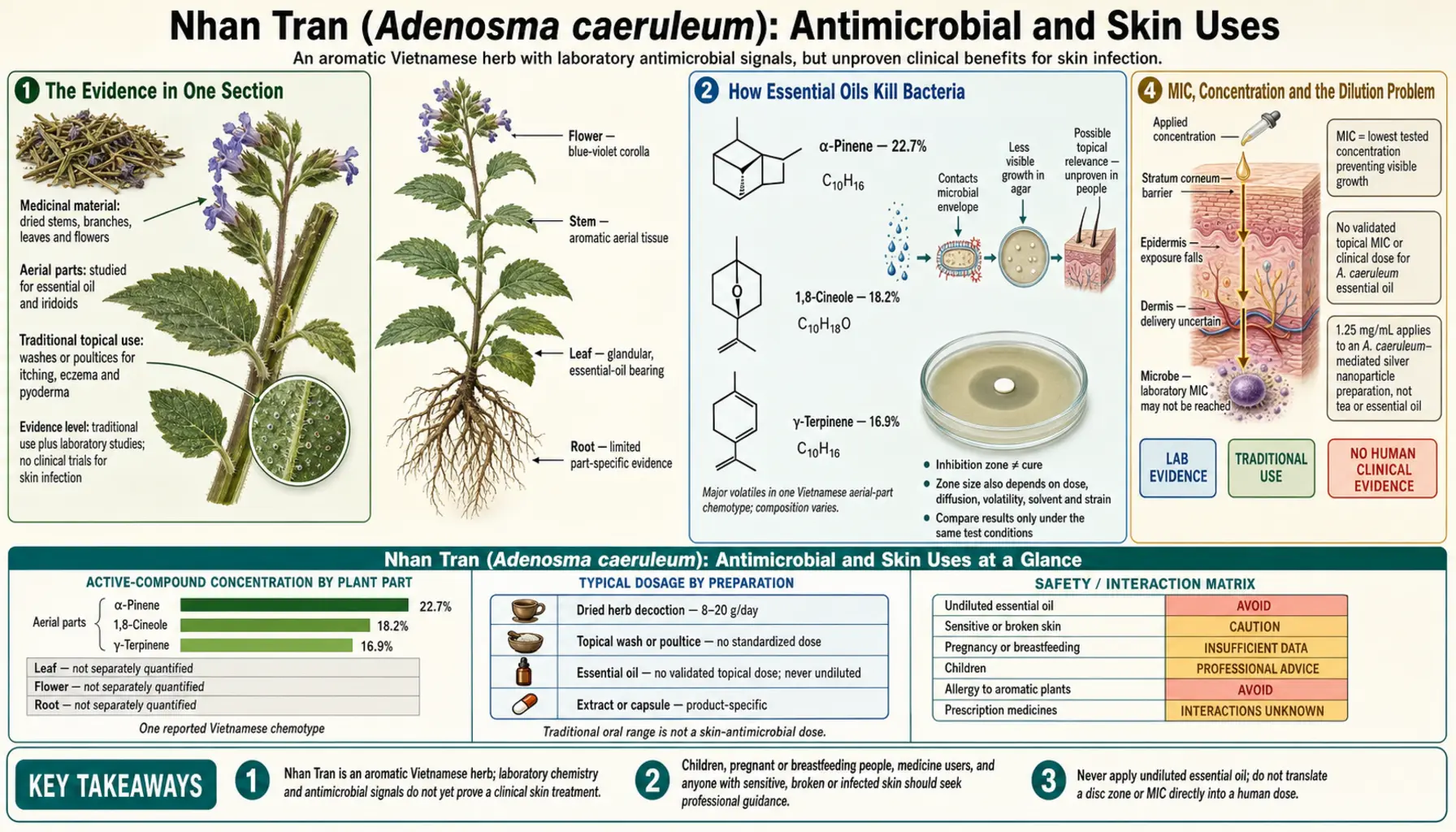
Search any aromatic herb and you will find papers reporting that its essential oil "exhibits significant antibacterial activity." Adenosma caeruleum is no exception: its oil has been through the standard in-vitro screens, and it does inhibit bacteria and fungi in a dish. Traditionally, the fresh or dried plant has also been used in Vietnam as a wash or steam for itchy skin, rashes and postpartum bathing.
The honest summary, first: there is no human trial of Adenosma caeruleum for any infection, internal or topical. Zero. The evidence is in-vitro screening plus traditional topical use. This page explains what those screens actually measure, why a large inhibition halo is much less impressive than it looks, and why "kills bacteria in a petri dish" and "treats an infection in a person" are separated by a gap that most essential oils never cross.
Table of Contents
- The Evidence in One Section
- How Essential Oils Kill Bacteria
- Reading a Disc-Diffusion Result Honestly
- MIC, Concentration and the Dilution Problem
- What Has Been Screened for Adenosma
- Traditional Washes, Steams and Baths
- Skin: Itch, Rash and the Postpartum Bath
- Why In-Vitro Is Not a Treatment
- If You Use It Topically Anyway
- Cautions
- Key Research Papers
- Connections
- Featured Videos
The Evidence in One Section
Ranked from strongest to weakest, which for this topic is a short list:
- In-vitro screening of the essential oil against common test organisms — typically Staphylococcus aureus, Escherichia coli, Pseudomonas aeruginosa, Bacillus subtilis and Candida albicans. Activity is reported, generally in the moderate range typical of monoterpene-rich oils.
- Traditional topical use in Vietnam as a wash, bath or steam for itching, heat rash and postpartum care.
- Animal infection models — essentially absent for this species.
- Human trials, topical or systemic — none.
Note also the recurring species problem: screening papers do not always distinguish Adenosma caeruleum from Adenosma bracteosum (bồ bồ, "nhân trần Tây Ninh"), and material collected in a market as "nhân trần" may be either — or, in a Chinese-medicine context, Artemisia capillaris, a daisy-family plant with completely different chemistry. Antimicrobial results are oil-composition-dependent, so species and even harvest region change the answer.
How Essential Oils Kill Bacteria
Monoterpenes such as limonene, 1,8-cineole and fenchone are small, greasy, lipid-loving molecules. Their antimicrobial action is not a clever lock-and-key like penicillin binding a specific enzyme. It is closer to blunt force chemistry.
These molecules partition into the lipid bilayer of the bacterial cell membrane, wedging between the phospholipid tails. At sufficient concentration the membrane loses its ordered packing. It becomes leaky: potassium ions and protons escape, the proton-motive force that powers ATP synthesis collapses, cell contents drain, and the cell dies. Fungal membranes, which contain ergosterol, are disrupted by a broadly similar mechanism.
Two consequences follow, and they explain everything else on this page.
First, it is broadly non-specific. A membrane is a membrane. What disrupts a bacterial membrane also disrupts human cell membranes at not-very-different concentrations. That is why essential oils have a narrow gap between "kills the germ" and "irritates the tissue" — the therapeutic window is thin. Penicillin, by contrast, attacks a structure humans do not have at all, which is why it can be given at doses thousands of times above its minimum inhibitory concentration.
Second, it is strictly concentration-dependent. There is no catalytic amplification. Dilute the oil enough and the membrane simply reorders itself and the bacteria grow. This is why the dose delivered by a cup of tea is essentially irrelevant to a bacterium living in your bladder.
Reading a Disc-Diffusion Result Honestly
The classic screening image — a plate lawn of bacteria with clear circles around little paper discs — is the Kirby-Bauer disc diffusion assay. A disc is loaded with test substance, placed on inoculated agar, incubated overnight; the substance diffuses outward and the diameter of the clear zone is measured in millimetres.
What it tells you: something in the sample inhibited growth of that organism under those conditions.
What it does not tell you, and this is where most popular reporting goes wrong:
- Zone size is not potency. Diameter depends heavily on how fast the compound diffuses through agar. Essential oils are hydrophobic and diffuse badly in a water-based gel, so an oil can be genuinely potent and produce a small halo, or moderately active and produce a big one. Comparing an oil's zone to an antibiotic's zone is close to meaningless.
- The concentration on the disc is usually enormous. Screens routinely load neat oil or 10–100 mg/mL solutions. Nothing remotely like that concentration reaches any tissue after drinking tea.
- It says nothing about killing versus inhibiting. A clear zone may mean the organism was killed or merely stopped from dividing while the compound was present.
- The solvent matters. Oils need DMSO, ethanol or a surfactant to disperse. Inadequate solvent controls are a common flaw in low-quality screening papers, and the solvent can produce its own halo.
- Laboratory strains are not clinical isolates. Standard collection strains are chosen for reproducibility, not for resembling the organism causing anyone's actual infection.
Thousands of plants have published disc-diffusion activity. The number that became antibacterial drugs is approximately zero. That is not because the assays were fraudulent — it is because the assay is the very first step of a very long road, and most candidates fail at the next one.
MIC, Concentration and the Dilution Problem
A more informative measurement is the minimum inhibitory concentration (MIC): the lowest concentration that prevents visible growth, measured by serial dilution in broth. It gives a real number in µg/mL or mg/mL, and it can be compared across studies.
Typical MICs for monoterpene-rich essential oils against common bacteria fall in the range of roughly 0.5 to 10 mg/mL — that is, hundreds to thousands of micrograms per millilitre. For comparison, clinically useful antibiotics commonly have MICs measured in single-digit µg/mL or lower, a thousandfold difference.
Now run the arithmetic for a cup of tea. Dried nhân trần is about 1% essential oil. A generous 20 g of herb therefore contains at most about 200 mg of oil — and hot water extracts only a small, poorly-quantified fraction of that, because monoterpenes are barely water-soluble. Suppose, very generously, that 20 mg reaches the infusion and is fully absorbed. Distributed through roughly 40 litres of body water, that is about 0.0005 mg/mL — three to four orders of magnitude below the MIC, before accounting for first-pass liver metabolism, which is rapid for terpenes.
This is not a quibble. It is the reason no aromatic herbal tea has ever been shown to treat a systemic bacterial infection. The chemistry cannot reach the required concentration in a living body, and increasing the dose to close that gap would poison the person before it sterilised the bacterium.
Topical application is different in one respect: on skin, you can apply the actual concentration, without dilution into 40 litres of body water. That is why topical antiseptic uses of essential oils are at least mechanistically coherent, while oral antimicrobial claims usually are not.
What Has Been Screened for Adenosma
Published screening of Adenosma essential oils generally reports moderate activity against Gram-positive bacteria such as Staphylococcus aureus and Bacillus subtilis, weaker activity against Gram-negative organisms such as Escherichia coli and especially Pseudomonas aeruginosa, and some activity against Candida yeasts.
That Gram-positive/Gram-negative gradient is not a quirk of this plant — it is the standard pattern for essential oils, and it has a structural explanation. Gram-negative bacteria carry an additional outer membrane rich in lipopolysaccharide, which acts as a permeability barrier to hydrophobic molecules. Terpenes struggle to get through it. Gram-positives have a thick but comparatively porous peptidoglycan wall and no such outer membrane, so the oil reaches the cell membrane more easily.
The practical reading: Adenosma oil behaves like an ordinary monoterpene-rich essential oil. There is no reported activity that would distinguish it from oregano, thyme, tea tree or clove oil, all of which are more potent in the same assays and none of which are systemic antibiotics either.
Traditional Washes, Steams and Baths
Vietnamese folk practice uses aromatic herbs — nhân trần among many others including lemongrass, perilla and various mints — in three topical or semi-topical ways:
- Nước tắm / herbal bath water. A strong decoction added to bath water, used for heat rash, prickly heat and general itching in hot weather, and for infants in some households.
- Xông / steam inhalation. A pot of hot herbal decoction under a blanket. Aromatic and warming, traditionally used for colds and "wind" complaints. Whatever the herbal contribution, warm humid air itself loosens nasal secretions and feels good.
- Washes for skin complaints. Cooled decoction used to bathe rashes or minor irritations.
These uses are old, widespread and — at the dilutions actually used — generally well tolerated in adults. What they have never been is tested. There is no controlled trial of a nhân trần bath for anything.
Skin: Itch, Rash and the Postpartum Bath
Most of what a warm aromatic herbal wash does to itchy skin is probably not antimicrobial at all:
- Temperature. Cool or tepid water reduces itch directly; cooling terpenes such as 1,8-cineole and menthol-type compounds activate TRPM8 receptors, producing a cooling sensation that competes with itch signalling in the spinal cord.
- Cleaning. Washing removes sweat, salt, irritants and allergens. In a hot climate, that alone resolves a lot of "rashes."
- Ritual and relief. Twenty minutes of warm water and attention has genuine, non-mystical value, particularly postpartum.
The postpartum bath deserves a specific caution. Traditional Vietnamese postpartum practice includes hot herbal baths and steams. Modern obstetric advice is more careful here: perineal wounds and caesarean incisions should be kept clean and dry, not soaked in unsterile plant decoctions, and very hot steam near a fresh wound is a burn risk. Warm plain-water washing of the perineum is the standard recommendation. This is a case where the traditional practice and modern wound care genuinely disagree, and the modern advice is better supported.
Why In-Vitro Is Not a Treatment
Between a clear zone on an agar plate and a cure for an infection lie a series of hurdles, each of which eliminates most candidates:
- Concentration. Can the active concentration be achieved at the site of infection without poisoning the patient? For terpenes taken orally, almost never.
- Absorption and metabolism. Terpenes are rapidly oxidised and conjugated by the liver and excreted. Blood levels after oral dosing are low and short-lived.
- Selectivity. Does it harm the bacterium substantially more than the host cell? Membrane-active compounds score poorly here.
- Environment. Plates have no serum proteins, no pus, no biofilm, no immune cells and one organism at a fixed density. Real infections have all of those, and each blunts a hydrophobic compound.
- Proof. Even a compound clearing all of the above must show benefit in a controlled trial. None exists for this plant.
The stakes here are not abstract. Untreated bacterial infections — cellulitis, abscess, pyelonephritis, pneumonia, sepsis — progress. A person who chooses a herbal wash over antibiotics for spreading cellulitis is not making a gentle choice; they are losing time. Nhân trần is not a substitute for an antibiotic in a diagnosed bacterial infection, and nothing on this page should be read as suggesting otherwise.
If You Use It Topically Anyway
For an ordinary itchy heat rash on intact skin, a traditional herbal wash is a low-stakes thing to try. A few practical points:
- Patch test first. Apply the cooled decoction to a small area of forearm and wait 24 hours. Contact dermatitis to plant material is common, and an aromatic oil-bearing plant is a plausible sensitiser.
- Use the decoction, not the essential oil. Never apply undiluted essential oil of any species to skin. If using an oil at all, dilute to about 1% in a carrier — roughly 6 drops per 30 mL.
- Not on broken skin, wounds, burns or surgical incisions. Unsterile plant decoctions do not belong on an open wound.
- Not on infants without paediatric advice. Infant skin is thinner, absorbs more, and 1,8-cineole and camphor-type compounds have caused respiratory problems in young children when applied near the face.
- Stop if it stings, reddens or spreads. Worsening after application is a reason to stop, not to persist.
- See a doctor for spreading redness, warmth, fever, pus, red streaking, a rash that blisters or peels, or any rash in someone immunosuppressed or diabetic.
Cautions
- Not an antibiotic. No systemic antimicrobial use is supported for this herb. Do not delay treatment of a real infection.
- Contact allergy. Aromatic plants are a recognised source of allergic contact dermatitis; limonene in particular oxidises on air exposure into known skin sensitisers.
- Concentrated essential oil should not be swallowed. Terpene ketones such as fenchone are considerably more toxic than the infusion, and no safe oral dose has been established.
- Pregnancy and breastfeeding. Vietnamese tradition cautions against habitual internal use, and no modern data exists. Treat internal use as not recommended; topical use is unstudied.
- Children. No safety data. Avoid essential oil near the face of any infant or young child.
- Licorice blends. If drinking the tea rather than washing with it, read the Traditional Tea and Safety page — the cam thảo blend is the real practical hazard of this herb.
Key Research Papers
Identifiers are given as live PubMed queries rather than quoted PMIDs. Much of the Adenosma literature is Vietnamese-language and unindexed, and a fabricated identifier is worse than an honest search link.
- Essential-oil composition of Adenosma caeruleum, reporting limonene, fenchone, 1,8-cineole and α-humulene. Search.
- Antibacterial and antifungal screening of Vietnamese medicinal plant essential oils. Search.
- Reviews of essential-oil antibacterial mechanism: membrane partitioning, proton-motive force collapse and ion leakage. Search.
- Why Gram-negative bacteria resist hydrophobic agents: the lipopolysaccharide outer-membrane barrier. Search.
- Methodological critiques of disc-diffusion testing for essential oils and the case for MIC-based reporting. Search.
- Tea tree oil (Melaleuca alternifolia) — the best-studied topical essential-oil antiseptic, useful as a benchmark for what a positive human topical result looks like. Search.
- Oxidised limonene as a contact allergen. Search.
- Safety of 1,8-cineole and camphor-type compounds applied near the face in young children. Search.
- Perineal and caesarean wound care after childbirth: evidence-based practice. Search.
Live PubMed Searches
- Adenosma antimicrobial
- Adenosma bracteosum essential oil
- Essential oil MIC vs S. aureus
- Limonene antibacterial activity
- 1,8-Cineole antimicrobial
- Herbal baths and dermatitis
- Delayed antibiotics in cellulitis
- Contact dermatitis from plant oils
- Essential oils and biofilms
- TRPM8 cooling and itch
Connections
- All Herbs
- Nhan Tran (Adenosma caeruleum) — the full research article.
- Nhan Tran: History and Traditional Use — the name and the species confusion.
- Artemisia annua — the rare case where a traditional herb did yield a real drug.
- Licorice — the usual blend partner in nhân trần tea.
- Dandelion — another everyday folk herb with modest evidence.
- Milk Thistle — for comparison, a herb with real human trial data.
- Chanca Piedra — folk remedy, thin evidence, similar reasoning applies.