Nhan Tran (Adenosma caeruleum) for Digestive Comfort
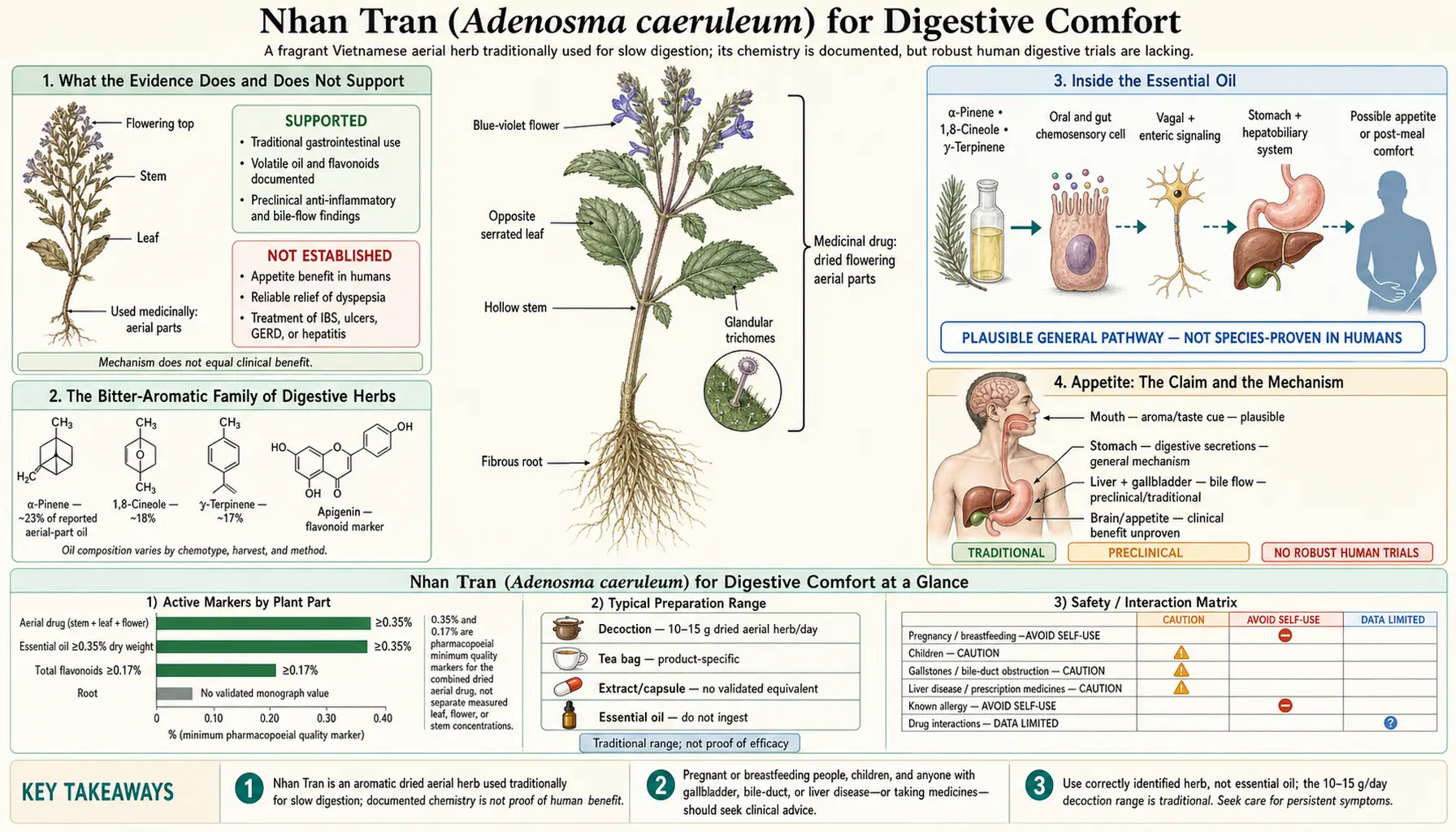
The second traditional use of nhân trần, after the liver, is ordinary digestive comfort: ăn không ngon — food does not taste good — plus fullness, bloating and heaviness after eating, particularly after fatty or fried meals in hot weather. The tea is drunk warm, often after lunch, often as a habit rather than a remedy.
State the evidence plainly before anything else: no controlled human trial supports any digestive claim for Adenosma caeruleum. Not for appetite, not for bloating, not for indigestion. What exists is traditional use plus the general pharmacology of bitter-aromatic essential oils, which is a reason to find the idea plausible — not a reason to believe it works. This page explains the plausible mechanism honestly, then says clearly where the mechanism stops and wishful thinking begins.
Table of Contents
- What the Evidence Does and Does Not Support
- The Bitter-Aromatic Family of Digestive Herbs
- Inside the Essential Oil
- Appetite: The Claim and the Mechanism
- Bloating, Gas and Smooth Muscle
- The Postprandial Tea Habit
- Fat Digestion and the Overlap with Bile
- What a Real Trial Would Have to Look Like
- When Digestive Symptoms Are Not a Tea Problem
- Cautions
- Key Research Papers
- Connections
- Featured Videos
What the Evidence Does and Does Not Support
Here is the whole evidence base for digestive use, honestly inventoried:
- Traditional Vietnamese use — extensive, multigenerational, and consistent in what it claims: appetite, fullness, heaviness after rich food, the postpartum period, hot weather.
- Chemistry — the plant is roughly 1% essential oil, dominated by monoterpenes with known effects on gut smooth muscle and secretion in laboratory preparations.
- Class-level pharmacology — other aromatic monoterpene herbs, notably peppermint, do have human trial data for functional gut symptoms. That is a reason to hypothesise, not a reason to transfer conclusions.
- Controlled human trials of Adenosma caeruleum — none.
- Uncontrolled human studies of Adenosma caeruleum for digestion — none accessible in the indexed literature.
Two of those five lines are "none." An honest reader should weight the page accordingly. Nothing below is a claim of efficacy; it is an explanation of why the traditional use is not absurd, together with the reasons it remains untested.
The Bitter-Aromatic Family of Digestive Herbs
Almost every food culture on earth ends a heavy meal with a bitter, aromatic or both. Italy has amaro and artichoke; France has gentian; Germany has caraway and fennel; India has fennel seed and ajwain; China has hawthorn and tangerine peel; Vietnam has nhân trần and a dozen local infusions. This convergence is not proof of anything, but it is a strong hint that the sensation is worth something to people.
The traditional pharmacology splits into two overlapping ideas:
Bitters. Bitter taste receptors (the TAS2R family) are not confined to the tongue. They are expressed throughout the gastrointestinal tract, in the stomach and intestinal lining, where they participate in the release of gut hormones — including ghrelin, cholecystokinin and GLP-1 — that modulate hunger, gastric emptying and secretion. This is genuine, published receptor biology. What has not been established is that drinking a mildly bitter tea produces a clinically meaningful change in any of those outcomes. The receptors exist; the therapeutic effect is unproven.
Aromatics (carminatives). Volatile monoterpenes have direct relaxant effects on gastrointestinal smooth muscle in isolated tissue preparations, largely through calcium-channel modulation. The classical folk description of a carminative — "expels wind," relieves the trapped, distended feeling — maps neatly onto smooth-muscle relaxation allowing gas to move rather than accumulate behind a spasm.
Nhân trần sits in the second group more than the first. It is faintly bitter but strongly aromatic. Its plausible action is as a mild carminative, not a strong bitter tonic.
Inside the Essential Oil
The reported major constituents of the Adenosma caeruleum oil, and what is known about each:
- Limonene — the dominant monoterpene of citrus peel. Best known in gastroenterology from d-limonene preparations marketed for heartburn, on a mechanism that has never been convincingly demonstrated. It is well tolerated at food-level exposure and it is what gives the tea its bright top-note.
- Fenchone — a bicyclic ketone, the sharp camphor-like note in fennel seed. Fennel is one of the classic carminatives, and fenchone is part of why. Ketone-type terpenes are also the components most worth respecting at high dose; nobody should be drinking concentrated essential oil.
- 1,8-Cineole (eucalyptol) — the cooling eucalyptus note. Studied mostly for airway effects, where it has genuine human data as a mucoactive agent, but it also relaxes smooth muscle in isolated preparations.
- α-Humulene — a sesquiterpene shared with hops and clove. Has anti-inflammatory activity in cell and rodent models. Present at low percentage, so its contribution to a cup of tea is likely small.
One caveat that applies to the entire page: a water infusion is not the essential oil. Monoterpenes are poorly water-soluble. Steeping dried herb in hot water extracts a small, aroma-carrying fraction of that 1% oil — enough to smell clearly, nowhere near the concentrations used in any laboratory experiment. Whenever a page cites in-vitro oil data, mentally divide by a large and unknown number before applying it to a cup.
Appetite: The Claim and the Mechanism
Poor appetite is a real and miserable symptom. It accompanies convalescence, hot weather, chemotherapy, depression, chronic infection, thyroid disease and the postpartum period. Traditional Vietnamese practice reaches for nhân trần in several of those contexts, especially heat and convalescence.
The proposed mechanism runs: aroma and mild bitterness stimulate the cephalic phase of digestion — the anticipatory wave of saliva, gastric acid and enzyme secretion triggered by smell, taste and the expectation of food. The cephalic phase is real, well described, and vagally mediated. Bitter and aromatic stimuli genuinely engage it.
Where the chain breaks: nobody has shown that engaging the cephalic phase with this particular tea produces a measurable increase in food intake or body weight in humans. The step from "receptor engaged" to "person eats more" is exactly the step that trials exist to test, and no trial has tested it.
There is also a non-pharmacological effect worth naming rather than dismissing. A warm drink, a pause, and a familiar ritual before eating change appetite in most people. That is not a placebo to be sneered at — it is a real intervention that happens not to be chemical. It is also, importantly, free.
Bloating, Gas and Smooth Muscle
Bloating is usually not excess gas. Studies using gut gas measurement have repeatedly found that people with severe bloating often have normal gas volumes — what differs is how the gas is distributed, how the abdominal wall responds, and how sensitively the gut reports its own contents to the brain. Visceral hypersensitivity, altered accommodation and abnormal abdominal wall reflexes explain more bloating than fermentation does.
That reframing matters for a carminative herb. If a warm aromatic infusion helps bloating, the more likely route is smooth-muscle relaxation and reduced spasm, allowing normal gas volumes to move along and the abdominal wall to settle — not the "expulsion of wind" of folk description.
The best-evidenced comparison here is peppermint oil, whose main constituent menthol relaxes gut smooth muscle through calcium-channel blockade and which has repeatedly outperformed placebo for irritable bowel syndrome symptoms in randomized trials. Nhân trần's oil is a different mixture and has never been tested that way. Peppermint's success shows the mechanism can produce a real clinical effect; it does not lend nhân trần its results.
The Postprandial Tea Habit
In practice, nhân trần is drunk the way most Vietnamese herbal teas are: a handful of dried herb, roughly 10–20 g, simmered or steeped in about a litre of water, drunk warm across the afternoon, most often after the main meal, most often in hot weather. In the postpartum month it is one of several warm infusions traditionally preferred over cold water.
Three observations about this pattern, none of which require any pharmacology:
- It replaces cold, sugary drinks. A litre of unsweetened herbal infusion instead of iced sweet tea or soda is a genuine dietary improvement, and it plausibly accounts for some of the "I feel lighter" reports on its own.
- It enforces hydration. Vague heaviness, headache and fatigue in hot climates are commonly mild dehydration.
- It builds in a pause after eating. Sitting with a warm drink for fifteen minutes rather than standing up and moving immediately is, for many people, the whole intervention.
None of this is a criticism of the tea. It is an honest accounting of where the benefit most likely comes from, and all three effects are worth having.
Fat Digestion and the Overlap with Bile
Traditional use links appetite and the liver directly — "hot liver" and "no appetite" are described as one complaint, treated with one tea. That link is not as naive as it sounds.
Bile salts are the detergents that emulsify dietary fat so that lipase can act on it. Sluggish or reduced bile delivery produces exactly the symptom cluster traditional medicine describes: heaviness after fatty food, nausea after fried meals, greasy or pale stools, and a distaste for rich dishes. If a herb genuinely increased bile flow, better tolerance of fatty meals would be the predicted consequence.
The honest caveat is that the choleretic claim itself is unproven in humans for this plant, so this is a plausible mechanism resting on an untested premise. The Liver and Bile Flow page works through that evidence in detail, including why almost all published "nhân trần liver" research is actually on Artemisia capillaris, a different plant with different chemistry.
What a Real Trial Would Have to Look Like
It is worth spelling out, because it shows how far the current evidence is from an answer. A credible trial of nhân trần for functional dyspepsia would need:
- Botanical authentication — the batch verified as Adenosma caeruleum, ideally by DNA barcoding, with a voucher specimen deposited. Given three plants share the market name, this is not optional.
- A characterised preparation — stated extraction method, and quantified marker compounds so the dose is reproducible.
- A credible placebo — genuinely difficult for a strongly aromatic tea. Weakly aromatic matched controls are the usual compromise, and they are imperfect.
- Validated outcomes — a scored dyspepsia or bloating instrument, not "patients felt better."
- Adequate size and duration — functional gut symptoms have very high placebo response rates, often 30–40%, so small trials are almost uninterpretable.
Nothing meeting that description exists. Until it does, the correct summary is "traditionally used, mechanistically plausible, untested" — and that summary should not be rounded up.
When Digestive Symptoms Are Not a Tea Problem
Most indigestion is functional and benign. Some is not. See a doctor rather than reaching for a herbal tea if you have:
- Unintentional weight loss
- Difficulty swallowing, or food sticking
- Persistent vomiting
- Vomiting blood, or black tarry stools
- A palpable lump in the abdomen, or new anaemia
- New, persistent symptoms starting after roughly age 55
- Jaundice, or pale stools with dark urine
- A family history of stomach, oesophageal or pancreatic cancer
Gastric cancer incidence is substantially higher in East and Southeast Asia than in Western countries, and Helicobacter pylori infection — which is treatable with a two-week antibiotic course and is a major cause of ulcers and gastric cancer — is common in the same region. Chronic dyspepsia in that setting deserves testing, not tea.
Cautions
- Licorice-blended products. Most commercial nhân trần is sold pre-mixed with cam thảo (licorice). Chronic licorice causes potassium loss and rising blood pressure. This is the practical risk of daily use and is covered fully on the Traditional Tea and Safety page.
- Pregnancy and breastfeeding. Vietnamese traditional practice cautions against habitual daily use; no modern data exists. Treat as not recommended.
- Children. No safety or dosing data.
- Reflux. Some people find aromatic infusions relax the lower oesophageal sphincter and worsen heartburn. Peppermint is well known for this; a cineole- and limonene-rich tea may behave similarly in susceptible people. If it makes your reflux worse, stop.
- Essential oil is not tea. Do not ingest concentrated Adenosma essential oil. Terpene ketones such as fenchone are meaningfully more toxic than the infusion, and no oral dosing has been established.
- Species uncertainty. The bag may contain A. caeruleum, A. bracteosum, or Artemisia capillaris. Prefer sellers who print the botanical name.
Key Research Papers
Identifiers below are given as live PubMed queries rather than quoted PMIDs, because much of the Adenosma literature is Vietnamese-language and unindexed, and an invented identifier is worse than an honest search link.
- Essential-oil composition of Adenosma caeruleum: limonene, fenchone, 1,8-cineole and α-humulene as reported majors. Search.
- Extra-oral bitter taste receptors (TAS2R) in the gastrointestinal tract and their role in gut hormone release. Search.
- Randomized trials and meta-analyses of peppermint oil in irritable bowel syndrome — the best-evidenced aromatic carminative, cited here as mechanism precedent, not as evidence for nhân trần. Search.
- Monoterpene relaxation of gastrointestinal smooth muscle via calcium-channel modulation in isolated tissue. Search.
- Abdominal bloating and distension: gas volume, viscerosomatic reflexes and abdominal wall behaviour. Search.
- Cephalic-phase digestive responses to taste and smell. Search.
- Placebo response rates in functional dyspepsia trials, and why small studies mislead. Search.
- Fennel and its constituents including fenchone in digestive complaints. Search.
- DNA barcoding for authentication of traded herbal material. Search.
Live PubMed Searches
- Adenosma caeruleum
- Adenosma bracteosum
- Carminative herbs and dyspepsia
- d-Limonene and the gut
- 1,8-Cineole and smooth muscle
- α-Humulene anti-inflammatory
- Visceral hypersensitivity and bloating
- H. pylori test-and-treat
- Gastric cancer in Southeast Asia
- Vietnamese herbal teas
Connections
- All Herbs
- Nhan Tran (Adenosma caeruleum) — the full research article.
- Nhan Tran: History and Traditional Use — the name, the texts, the species muddle.
- Dandelion — the classic bitter used the same way in Europe.
- Milk Thistle — a liver herb with real human trial data, for contrast.
- Licorice — the usual blend partner; read before drinking daily.
- Chanca Piedra — another folk hepatobiliary herb with thin evidence.
- Artemisia annua — a different Artemisia, useful for keeping species straight.