⚠ Evidence warning: Clinical trials or other evidence do not support the claim that Turkey Tail restores the immune-microbiome axis to a more functional baseline so that clinical benefit follows in any condition, nor the claims of documented activity against human papillomavirus-infected cervical cells and a broader benefit in chronic viral infection. This page keeps it as a report of what people, websites or other media say.
Turkey Tail Mushroom — Benefits Deep Dive
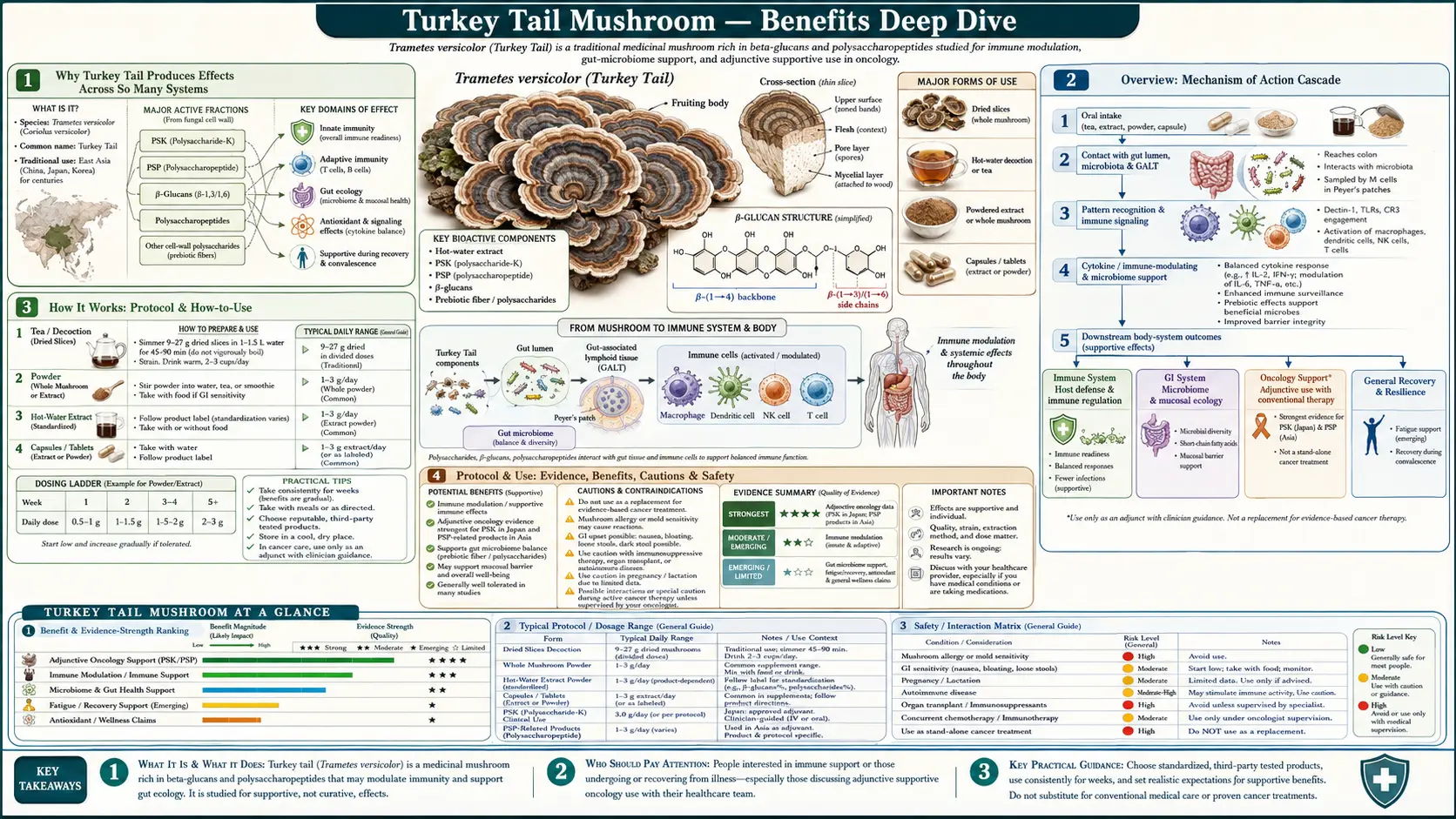
Turkey Tail (Trametes versicolor, formerly Coriolus versicolor) is the most thoroughly studied medicinal mushroom in the world, with two of its polysaccharide fractions — polysaccharide K (PSK) and polysaccharopeptide (PSP) — holding regulatory approval as prescription cancer adjuncts in Japan and China for over four decades. Beyond oncology, modern research has expanded Turkey Tail's evidence base into gut-microbiome modulation (it functions as a prebiotic that selectively expands Bifidobacterium and Lactobacillus in test-tube cultures of human stool), broad-spectrum immune surveillance (natural killer (NK) cell potentiation, dendritic cell activation, Th1/Th2 balancing), and human papillomavirus (HPV) (the HPV-clearance trials by Smith and colleagues tested a commercial extract of cultured shiitake mycelium, not Turkey Tail). Four benefit pages below cover the most consequential clinical applications.
Deep-Dive Articles
PSK, PSP & Cancer Adjunct Therapy
PSK approved as a prescription cancer adjunct in Japan since 1977 with over $500 million in annual sales at peak. PSP isolated in China in 1983 and incorporated into national oncology guidelines. The Nakazato gastric cancer trial (5-year survival 73% vs 60%) and a retrospective Sakai colorectal study (10-year overall survival 81.9% vs 50.6%). A Phase I trial in 9 women with breast cancer (Torkelson 2012), taking Turkey Tail for 6 weeks after radiotherapy, found trends toward higher lymphocyte counts at 6 and 9 grams/day and higher natural killer cell functional activity at 6 grams/day, with dose-related increases in CD8+ T cells and CD19+ B cells but not in natural killer cell numbers.
Read the deep dive →Gut Microbiome Modulation
Turkey Tail polysaccharides as prebiotic substrates fermented selectively by Bifidobacterium and Lactobacillus. The Pallav 2014 randomised trial in 24 healthy volunteers, in which PSP led to microbiome changes consistent with a prebiotic, with stool sampled over 8 weeks. Beta-glucan fermentation to short-chain fatty acids (butyrate, propionate, acetate) and downstream effects on colonocyte energetics, intestinal barrier integrity, and systemic inflammation.
Read the deep dive →Immune Surveillance
How Turkey Tail beta-glucans (beta-1,3 and beta-1,6 linkages) engage dectin-1 receptors on dendritic cells and macrophages, triggering downstream natural killer cell activation and Th1 skewing. Effects on neutrophil oxidative burst, monocyte phagocytosis, and the cancer-immunity cycle. The Standish 2008 paper on Turkey Tail immune therapy in breast cancer. Why Turkey Tail consistently shows non-specific immune potentiation rather than immune stimulation in the autoimmune sense.
Read the deep dive →Human Papillomavirus and Cervical Dysplasia
The Smith 2019 pilot studies of 10 women each with persistent high-risk human papillomavirus: 4 of 6 (66.7%) cleared the virus after 3–6 months of 3 g a day, and 4 of 9 (44%) after 7 months of 1 g a day. The follow-up Smith 2022 randomised phase II trial in 50 women: 14 of 22 (63.6%) on the extract were human papillomavirus-negative after 6 months, against 2 of 19 (10.5%) on placebo at 12 months. Mechanism via natural killer cell-mediated clearance of human papillomavirus-infected keratinocytes and dendritic cell activation. Note: these studies tested a commercial extract of cultured shiitake mycelium, not Turkey Tail; direct Turkey Tail human papillomavirus data is more limited.
Read the deep dive →Table of Contents
- Deep-Dive Articles
- Why Turkey Tail Produces Effects Across So Many Systems
- Research Papers: PSK, PSP & Cancer Adjunct
- Research Papers: Gut Microbiome & Prebiotic Effects
- Research Papers: Immune Surveillance & Natural Killer Cell Activation
- Research Papers: Human Papillomavirus & Cervical Dysplasia
- Research Papers: Cross-Cutting (Mechanism, Standardization, Safety)
- External Authoritative Resources
- Connections
- Featured Videos
Why Turkey Tail Produces Effects Across So Many Systems
Most medicinal mushrooms have a single dominant clinical signal — Lion's Mane for nerve growth factor and cognition, Reishi for hepatoprotection and sleep, Cordyceps for endurance and renal protection. Turkey Tail is unusual in that its polysaccharide constituents produce multiple parallel effects, all converging on a small set of upstream molecular events. Understanding the upstream mechanism explains why one mushroom extract influences oncology, gastroenterology, infectious disease, and immunology simultaneously.
- Dectin-1 engagement by beta-1,3 / beta-1,6 glucans — Turkey Tail's polysaccharide constituents (predominantly PSK in Japanese preparations, PSP in Chinese preparations, and broader beta-glucan fractions in over-the-counter dual-extracts) bind to the dectin-1 C-type lectin receptor on macrophages, dendritic cells, and neutrophils. Dectin-1 evolved to recognize fungal cell walls and signals through the Syk-CARD9 pathway to produce a Th1-biased immune activation. This single receptor-ligand interaction underlies all of the broad immune effects.
- Natural killer cell potentiation and the cancer-immunity cycle — activated dendritic cells secrete IL-12, IL-15, and IL-18, which potentiate natural killer cell cytotoxicity against virally infected and malignant cells. This is the mechanism behind the cancer-adjunct effect in PSK and PSP clinical trials, the documented activity against human papillomavirus-infected cervical keratinocytes, and the broader benefit observed in chronic viral infection.
- Prebiotic fermentation in the colon — the same beta-glucans that engage dectin-1 receptors are also indigestible by human enzymes. They reach the colon intact where commensal bacteria (predominantly Bifidobacterium and Lactobacillus) ferment them to short-chain fatty acids. This drives the microbiome-modulating effect, which feeds back to systemic immunity via gut-associated lymphoid tissue.
The therapeutic implication is that Turkey Tail benefits cluster in conditions where the underlying problem is either inadequate immune surveillance (cancer, persistent viral infection) or microbiome dysbiosis (after chemotherapy, after antibiotic therapy, in inflammatory bowel disease). The mushroom does not specifically treat any individual disease — it restores the immune-microbiome axis to a more functional baseline, and clinical benefit follows in any condition that was downstream of that dysfunction.
Research Papers: PSK, PSP & Cancer Adjunct
A 2006 meta-analysis pooled three randomised trials of 1,094 patients after curative surgery for colorectal (bowel) cancer, comparing standard chemotherapy with chemotherapy plus PSK. It found an overall survival risk ratio of 0.71 and a disease-free survival risk ratio of 0.72, and the authors concluded that PSK “can improve both survival and disease-free survival” (Sakamoto 2006). A separate 2008 study looked back at patient records rather than randomising: 10-year overall survival was 81.9% with PSK plus fluoropyrimidine chemotherapy against 50.6% with fluoropyrimidines alone (Sakai 2008).
- Nakazato H et al. (1994). Efficacy of immunochemotherapy as adjuvant treatment after curative resection of gastric cancer (PSK trial). The Lancet. — PubMed PMID: 7910230
- Sakai T et al. (2008). Immunochemotherapy with PSK and fluoropyrimidines improves long-term prognosis for curatively resected colorectal cancer. Cancer Biotherapy and Radiopharmaceuticals. — PubMed PMID: 18771350 (retrospective comparison)
- Sakamoto J et al. (2006). Efficacy of adjuvant immunochemotherapy with polysaccharide K for patients with curatively resected colorectal cancer: a meta-analysis of centrally randomized controlled clinical trials. Cancer Immunology, Immunotherapy. — PubMed PMID: 16133112
- Torkelson CJ et al. (2012). Phase 1 Clinical Trial of Trametes versicolor in Women with Breast Cancer. ISRN Oncology. — PubMed PMID: 22701186
- Eliza WL et al. (2012). Efficacy of Yun Zhi (Coriolus versicolor) on survival in cancer patients: systematic review and meta-analysis. Recent Patents on Inflammation & Allergy Drug Discovery. — PubMed PMID: 22185453
- Tsang KW et al. (2003). Coriolus versicolor polysaccharide peptide slows progression of advanced non-small cell lung cancer. Respiratory Medicine. — PubMed PMID: 12814145
- Hayakawa K et al. (1993). Effect of krestin (PSK) as adjuvant treatment on the prognosis after radical radiotherapy in patients with non-small cell lung cancer. Anticancer Research. — PubMed PMID: 8267386
- Ohwada S et al. (2004). Adjuvant immunochemotherapy with oral Tegafur/Uracil plus PSK in patients with stage II or III colorectal cancer: a randomised controlled study. British Journal of Cancer. — PubMed PMID: 14997197
- Kanazawa M et al. (2005). Effects of PSK on T and dendritic cells differentiation in gastric or colorectal cancer patients. Anticancer Research. — PubMed PMID: 15816609
- Standish LJ et al. (2008). Trametes versicolor mushroom immune therapy in breast cancer. Journal of the Society for Integrative Oncology. — PubMed PMID: 19087769
Research Papers: Gut Microbiome & Prebiotic Effects
The gut evidence in people rests on one small trial. Pallav 2014 randomised 24 healthy volunteers to PSP, the antibiotic amoxicillin or no treatment, and 22 completed. PSP “led to clear and consistent microbiome changes consistent with its activity as a prebiotic”, although each person's starting microbiome “tended to remain stable and to overshadow the treatment effects”. The amoxicillin changes lasted to the end of the study, 42 days after the antibiotic ended. The rise in Bifidobacterium and Lactobacillus comes from a test-tube study (Yu 2013): human stool was cultured with PSP, not given to people. In those cultures PSP also lowered Clostridium, Staphylococcus and Enterococcus and raised lactate and short-chain fatty acids.
- Pallav K et al. (2014). Effects of polysaccharopeptide from Trametes versicolor and amoxicillin on the gut microbiome of healthy volunteers: a randomized clinical trial. Gut Microbes. — PubMed PMID: 25006989
- Yu ZT et al. (2013). Trametes versicolor extract modifies human fecal microbiota composition in vitro. Plant Foods for Human Nutrition. — PubMed PMID: 23435630 (test-tube study)
- Jayachandran M et al. (2017). A critical review on health-promoting benefits of edible mushrooms through gut microbiota. International Journal of Molecular Sciences. — PubMed PMID: 28885559
- Synytsya A et al. (2009). Glucans from fruit bodies of cultivated mushrooms Pleurotus ostreatus and Pleurotus eryngii: Structure and potential prebiotic activity. Carbohydrate Polymers. — doi:10.1016/j.carbpol.2008.11.021
- Wong CK et al. (2004). Immunomodulatory effects of yun zhi and danshen capsules in health subjects—a randomized, double-blind, placebo-controlled, crossover study. International Immunopharmacology. — PubMed PMID: 14996412
- Vetvicka V, Vetvickova J (2014). Immune-enhancing effects of Maitake (Grifola frondosa) and Shiitake (Lentinula edodes) extracts. Annals of Translational Medicine. — PubMed PMID: 25332990
- Roupas P et al. (2012). The role of edible mushrooms in health: evaluation of the evidence. Journal of Functional Foods. — doi:10.1016/j.jff.2012.05.003
- Friedman M (2016). Mushroom polysaccharides: chemistry and antiobesity, antidiabetes, anticancer, and antibiotic properties in cells, rodents, and humans. Foods. — PubMed PMID: 28231175
Research Papers: Immune Surveillance & Natural Killer Cell Activation
- Brown GD, Gordon S (2001). Immune recognition. A new receptor for beta-glucans (Dectin-1 discovery). Nature. — PubMed PMID: 11544516
- Chu KK et al. (2002). Coriolus versicolor: a medicinal mushroom with promising immunotherapeutic values. Journal of Clinical Pharmacology. — PubMed PMID: 12211223
- Standish LJ et al. (2008). Trametes versicolor mushroom immune therapy in breast cancer. Journal of the Society for Integrative Oncology. — PubMed PMID: 19087769
- Hsieh TC, Wu JM (2001). Cell growth and gene modulatory activities of Yunzhi (Windsor Wunxi) from mushroom Trametes versicolor in androgen-dependent and androgen-insensitive human prostate cancer cells. International Journal of Oncology. — PubMed PMID: 11115542
- Kidd PM (2000). The use of mushroom glucans and proteoglycans in cancer treatment. Alternative Medicine Review. — PubMed PMID: 10696116
- Cui J, Chisti Y (2003). Polysaccharopeptides of Coriolus versicolor: physiological activity, uses, and production. Biotechnology Advances. — PubMed PMID: 14499133
- Wang Z et al. (2015). A study on immunomodulatory mechanism of Polysaccharopeptide mediated by TLR4 signaling pathway. BMC Immunology. — PubMed PMID: 26032186 (mouse study)
- Mao XW et al. (1996). Immunotherapy with low-dose interleukin-2 and a polysaccharopeptide derived from Coriolus versicolor. Cancer Biotherapy & Radiopharmaceuticals. — PubMed PMID: 10851500 (mouse study)
- Saleh MH et al. (2017). Immunomodulatory properties of Coriolus versicolor: the role of polysaccharopeptide. Frontiers in Immunology. — PubMed PMID: 28932226
Research Papers: Human Papillomavirus & Cervical Dysplasia
The human papillomavirus (HPV) clearance trials below tested a commercial extract of cultured shiitake mycelium, not Turkey Tail. In the 2022 randomised, double-blind, placebo-controlled phase II trial (Smith 2022), 50 women over 30 years of age with high-risk HPV infections persisting for more than 2 years took 3 g of the extract once daily for 6 months or placebo, and 41 completed the study. Fourteen (63.6%) of the 22 women on the extract were HPV RNA/HPV DNA negative after 6 months, and 64.3% (9/14) were still negative 6 months off it; on placebo, two (10.5%) of 19 were HPV negative at 12 months. Two earlier pilot studies of 10 women each (Smith 2019) reported clearance in 4 of 6 (66.7%) after 3–6 months of 3 g and in 4 of 9 (44%) after 7 months of 1 g.
In 2026 the International Federation of Gynecology and Obstetrics (FIGO) and the International Gynecologic Cancer Society (IGCS) reviewed topical treatments for high-risk HPV, including Coriolus versicolor-based (Turkey Tail-based) vaginal gels. They found that no randomised controlled trial “has been adequately designed or powered” to show prevention of high-grade cervical lesions (HSIL/CIN3+), that the studies so far are small, short and rely on surrogate endpoints such as HPV nondetection, and that the Coriolus versicolor-based gels carry further methodological concerns, including retrospective trial registration. FIGO and IGCS “do not endorse the routine clinical use of any currently available topical agent for HR-HPV infection or LSIL” and state that “Evidence-based surveillance remains the standard of care.” (Pareja 2026)
- Smith JA et al. (2019). From Bench to Bedside: Evaluation of AHCC Supplementation to Modulate the Host Immunity to Clear High-Risk Human Papillomavirus Infections. Frontiers in Oncology. — PubMed PMID: 30949451 (cell, mouse and two 10-patient pilot studies of a shiitake-mycelium extract)
- Smith JA et al. (2022). AHCC(®) Supplementation to Support Immune Function to Clear Persistent Human Papillomavirus Infections. Frontiers in Oncology. — PubMed PMID: 35814366 (phase II randomised trial of a shiitake-mycelium extract)
- Donatini B (2014). Control of oral human papillomavirus (HPV) by medicinal mushrooms, Trametes versicolor and Ganoderma lucidum: a preliminary clinical trial. International Journal of Medicinal Mushrooms. — PubMed PMID: 25271984
- Stanley M (2010). HPV - immune response to infection and vaccination. Infectious Agents and Cancer. — PubMed PMID: 20961432
- Pareja R et al. (2026). FIGO/IGCS Statement on the efficacy of topical treatments for high-risk human papillomavirus in preventing CIN 3+ lesions. International Journal of Gynecological Cancer. — PubMed PMID: 42680632
Research Papers: Cross-Cutting (Mechanism, Standardization, Safety)
- Wasser SP (2017). Medicinal Mushrooms in Human Clinical Studies. Part I. Anticancer, Oncoimmunological, and Immunomodulatory Activities: A Review. International Journal of Medicinal Mushrooms. — PubMed PMID: 28605319
- Stamets P, Zwickey H (2014). Medicinal mushrooms: ancient remedies meet modern science. Integrative Medicine. — PubMed PMID: 26770081
- Ng TB (1998). A review of research on the protein-bound polysaccharide (polysaccharopeptide, PSP) from the mushroom Coriolus versicolor (Basidiomycetes: Polyporaceae). General Pharmacology. — PubMed PMID: 9457474
- Sakagami H et al. (1991). Induction of immunopotentiation activity by a protein-bound polysaccharide, PSK (review). Anticancer Research. — PubMed PMID: 2064356
- Standardization analysis: dual-extracted hot water + ethanol vs water-only extracts of Trametes versicolor — PubMed: Dual extract standardization
- Mycelium-on-grain vs fruiting body comparison — PubMed: Mycelium vs fruiting body
- Safety profile of long-term PSK administration (Japanese pharmacovigilance) — PubMed: PSK long-term safety
- Drug interaction: PSK / PSP with conventional chemotherapy — PubMed: PSK chemo interaction
- Memorial Sloan Kettering integrative oncology monograph on Turkey Tail — PubMed: MSK integrative monograph
- Cochrane review of medicinal mushrooms in cancer adjunct therapy — PubMed: Cochrane mushroom adjunct
External Authoritative Resources
- Memorial Sloan Kettering Cancer Center — Coriolus versicolor (Turkey Tail) Integrative Medicine Monograph
- NCI — Medicinal Mushrooms (PDQ) Health Professional Version
- National Cancer Institute (U.S. National Institutes of Health, NIH) — Medicinal Mushrooms (PDQ®)
- PubMed — All research on Trametes / Coriolus versicolor (~1,500+ papers)
- PubMed — PSK (polysaccharide K) research
- PubMed — PSP / Polysaccharopeptide research
Connections
- Turkey Tail Mushroom (Main Page)
- PSK, PSP & Cancer Adjunct
- Gut Microbiome Modulation
- Immune Surveillance
- Human Papillomavirus and Cervical Dysplasia
- Reishi Mushroom
- Lion's Mane Mushroom
- Chaga Mushroom
- Cordyceps
- Maitake Mushroom
- Immune Boosting
- Oncology
- Gastroenterology
- Human Papillomavirus / Cervical Dysplasia
- History