⚠ Evidence warning: Clinical trials or other evidence do not support the claims that Turkey Tail improves chronic fatigue, reduces herpes and other latent-virus reactivation, reverses immune ageing (immunosenescence) and is safe for people with autoimmune tendencies. This page keeps it as a report of what people, websites or other media say.
Turkey Tail for Immune Surveillance
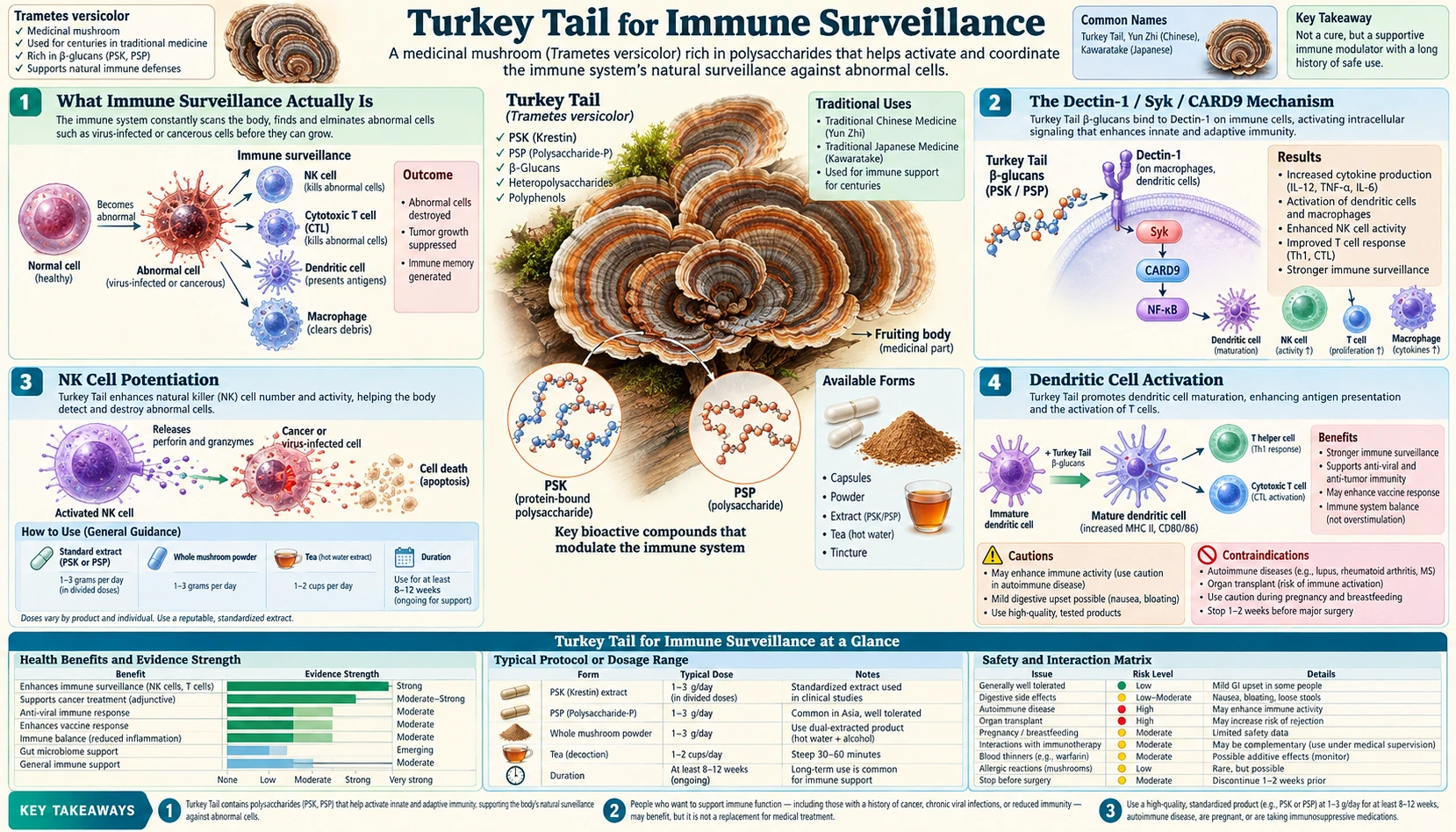
"Immune surveillance" is the body's ongoing process of detecting and eliminating abnormal cells — cells infected with viruses, cells expressing tumor-associated antigens, and cells displaying stress markers from injury or transformation. It is performed primarily by natural killer (NK) cells, cytotoxic CD8+ T cells, and dendritic cells acting as the bridge between innate and adaptive immunity. Turkey Tail's beta-glucan polysaccharides are among the most thoroughly studied immune-surveillance modulators in natural medicine, with consistent demonstrations that they engage dectin-1 receptors on dendritic cells and macrophages, trigger downstream natural killer cell potentiation, and shift the cytokine milieu toward a Th1-biased anti-cancer / anti-viral pattern. This page covers the molecular mechanism, the cell biology, what is reported about chronic immune dysregulation, and how Turkey Tail is used for immune support.
Table of Contents
- What Immune Surveillance Actually Is
- The Dectin-1 / Syk / CARD9 Mechanism
- Natural Killer Cell Potentiation
- Dendritic Cell Activation
- Th1/Th2 Balance and Cytokine Shifts
- Non-Specific Potentiation vs True Immune Stimulation
- Chronic Fatigue / Immune Dysregulation Applications
- Aging and Immunosenescence
- Viral Clearance & Reactivation Prevention
- Doses Used in Practice and Studies
- Cautions (Including Autoimmunity)
- Key Research Papers
- Connections
- Featured Videos
What Immune Surveillance Actually Is
The concept of immune surveillance was first formalized by Burnet and Thomas in the 1950s and 1960s. The hypothesis was that the immune system continuously patrols tissues looking for cells displaying stress markers, viral antigens, or tumor-associated antigens, and eliminates them before they can establish a productive infection or malignancy. Many decades of subsequent research have validated and refined this hypothesis — we now understand immune surveillance as a layered system operating at multiple time scales.
The principal cellular actors:
- Natural killer (NK) cells — large granular lymphocytes that recognize and kill cells lacking major histocompatibility complex (MHC) class I expression (a common immune-evasion strategy of virally infected and malignant cells). Natural killer cells operate on a "missing self" recognition principle: every healthy cell displays MHC class I, and cells that downregulate MHC class I to evade T-cell recognition become natural killer cell targets.
- Cytotoxic CD8+ T cells — antigen-specific killers that recognize specific viral or tumor peptides presented on MHC class I molecules of target cells. These provide the high-specificity arm of surveillance and are the dominant mechanism in established viral infection.
- Dendritic cells — the bridge between innate and adaptive immunity. They sample antigens from tissues, migrate to lymph nodes, and present antigens to T cells to initiate adaptive responses. Dendritic cells also instruct natural killer cells via IL-12 and IL-15 secretion.
- Macrophages — tissue-resident phagocytes that engulf debris, present antigens, and secrete cytokines that orchestrate broader immune responses.
- Gamma-delta T cells and natural killer T (NKT) cells — less well-known unconventional lymphocyte populations that bridge innate and adaptive responses with their own surveillance functions.
The clinical evidence for immune surveillance comes most starkly from immunosuppressed populations — organ transplant recipients live on lifelong immunosuppression, and in a study of 175,732 US solid organ transplants their overall cancer risk was 2.10 times that of the general population, with a risk of non-Hodgkin lymphoma 7.54 times the expected rate and raised risk for 32 different cancers, including virus-related ones such as Kaposi sarcoma. This demonstrates that an active immune system continuously prevents malignant transformation of cells that would otherwise progress to clinical cancer.
The Dectin-1 / Syk / CARD9 Mechanism
The molecular basis of Turkey Tail's immune-modulating activity is the engagement of dectin-1, a C-type lectin receptor expressed on macrophages, dendritic cells, monocytes, and neutrophils. Dectin-1 was first identified in 2000, by Ariizumi and colleagues, as a molecule found on dendritic cells; in 2001 Brown and Gordon (Nature) showed that it is a receptor for beta-glucans on macrophages — it evolved to recognize invading fungal pathogens and mount an appropriate antifungal response.
The signaling cascade after dectin-1 engagement by beta-1,3 / beta-1,6 glucans:
- Receptor clustering — multivalent beta-glucan binding induces dectin-1 receptors to cluster in the cell membrane, bringing their intracellular ITAM-like signaling motifs into proximity
- Syk recruitment and activation — the clustered ITAM motifs recruit spleen tyrosine kinase (Syk), which becomes phosphorylated and activated
- CARD9 / BCL10 / MALT1 complex formation — activated Syk recruits the CARD9 adapter complex, which assembles a signaling scaffold
- NF-kB activation — the CARD9 complex activates the canonical NF-kB pathway, which drives transcription of pro-inflammatory cytokines (tumor necrosis factor-alpha and interleukin-6 (IL-6)) and chemokines
- NFAT activation — parallel signaling activates NFAT transcription factors, driving expression of IL-2, IL-22, and other lymphocyte-supporting cytokines
- Inflammasome priming — dectin-1 signaling primes the NLRP3 inflammasome for subsequent activation, contributing to interleukin-1-beta and IL-18 secretion
The resulting response is not purely Th1. A 2007 study found that dectin-1 signalling through Syk and CARD9 made dendritic cells mature and release interleukin-6, tumor necrosis factor and interleukin-23, but little interleukin-12. These dendritic cells steered T cells toward the interleukin-17-producing (Th17) type in the laboratory, and a dectin-1 agonist promoted both Th17 and Th1 (T helper type 1) cells in living animals. Th17 responses are among those linked with autoimmune disease (see the Th17 entry below), so whether dectin-1 activation is neutral for people with autoimmune tendencies is an open question rather than a settled one.
Beta-glucans are also being studied as cancer drugs. Odetiglucan, an intravenous yeast-derived beta-glucan, has been tested in phase 2 trials with tumour-targeting or anti-angiogenic antibodies, and in a phase Ib/II trial with the checkpoint inhibitor pembrolizumab in advanced non-small cell lung cancer, where the combination was tolerable but did not improve outcomes for patients who had already progressed on checkpoint-inhibitor therapy. Its mechanism differs from the dectin-1 route described above: in human blood, its activity depended on forming immune complexes with naturally occurring anti-beta-glucan antibodies, which activate complement and bind complement receptor 3 and Fc-gamma receptor IIa on neutrophils and monocytes.
Natural Killer Cell Potentiation
Natural killer (NK) cell function is the immune effect most often studied for Turkey Tail. The 2012 phase I trial by Torkelson and colleagues gave women with breast cancer, who had recently finished radiotherapy, 3, 6 or 9 grams a day of a Turkey Tail preparation for 6 weeks (three women per dose; 11 recruited, nine completed). Nine adverse events were reported (7 mild, 1 moderate and 1 severe). The immune results were trends only: higher lymphocyte counts at 6 and 9 grams a day, higher natural killer cell functional activity at 6 grams a day, and dose-related increases in CD8+ T cells and CD19+ B cells, but not in CD4+ T cells or in the number of natural killer (CD16+56+) cells. The authors concluded that up to 9 grams a day of the preparation is safe and tolerable in women with breast cancer after primary treatment.
Natural killer cells themselves do not express dectin-1 in significant quantities, but the effect on them appears to be both direct and indirect. In laboratory work with human blood cells, polysaccharide-K (PSK), an extract of Turkey Tail, acted on the receptor TLR2 (toll-like receptor 2), made natural killer cells produce interferon-gamma and kill K562 tumour cells, and strengthened the killing of breast-cancer cells by the cancer antibody trastuzumab; both direct effects on the natural killer cells and indirect effects that depended on interleukin-12 seemed to be involved. PSK given by mouth also strengthened the antitumour effect of an anti-HER2 antibody in mice. The indirect route runs through dendritic cells and macrophages that DO express dectin-1; once activated by beta-glucan engagement, these cells secrete IL-12, IL-15, and IL-18, which activate natural killer cell cytotoxicity. IL-15 in particular is the dominant natural killer cell survival, proliferation, and activation cytokine.
The clinical relevance:
- Natural killer cell function declines with age — one component of immunosenescence. Restoring natural killer cell function in older adults is associated with reduced infection rates and may reduce cancer incidence.
- Natural killer cell function is depressed by chemotherapy and radiation — recovery can take 6-12 months after standard cytotoxic therapy. Accelerating this recovery is the proposed mechanism of post-cancer benefit.
- Natural killer cell function is the primary effector mechanism for spontaneous viral clearance — especially in herpesvirus reactivation (cytomegalovirus (CMV), Epstein-Barr virus (EBV), herpes simplex virus (HSV), human herpesviruses 6 and 7 (HHV-6, HHV-7)), and in human papillomavirus (HPV) clearance from infected cervical or oropharyngeal epithelium (covered separately in our human papillomavirus deep-dive).
- Low natural killer cell function is a feature of chronic fatigue syndrome (CFS/ME) — consistent finding across multiple research groups.
Dendritic Cell Activation
Dendritic cells are the master regulators of adaptive immunity. They sample antigens from peripheral tissues, undergo maturation, migrate to draining lymph nodes, and present antigens to T cells with co-stimulatory signals that determine the polarity of the resulting T-cell response (Th1, Th2, Th17, Treg).
Beta-glucan engagement of dectin-1 on dendritic cells drives a specific maturation program characterized by:
- Upregulation of CD80, CD86, CD40 co-stimulatory molecules
- Upregulation of MHC class II antigen-presenting machinery
- Secretion of IL-12 (the canonical Th1-polarizing cytokine) — although the 2007 study found that dectin-1 signalling alone produced little IL-12
- Secretion of IL-23 (which supports Th17 responses when paired with interleukin-1-beta and interleukin-6)
- Changes in interleukin-10 (IL-10), which dampens adaptive responses: dectin-1 signalling itself induces IL-10 in dendritic cells, while in the one human PSK study that measured it, IL-10 production fell after PSK therapy
- Migration toward CCL19/CCL21-expressing lymph nodes
The net result is dendritic cells that are competent to drive robust Th1 (and, per the 2007 study, Th17) responses to whatever antigens they happen to be carrying. In a healthy individual exposed to common pathogens, this means more vigorous adaptive responses to incidental antigens. In a cancer patient where dendritic cells are presenting tumor-associated antigens, this means greater priming of antitumor cytotoxic T-cell responses.
The only human dendritic-cell data found come from a 2005 study of 14 patients with gastric or colorectal cancer, compared with 6 healthy adults. The patients started with lower Th1/Th2 and DC1/DC2 ratios than the healthy adults; after PSK therapy their Th1/Th2 balance shifted toward Th1 and their DC1/DC2 dendritic-cell balance toward DC1, and IL-10 production fell significantly. It was a small study, and its comparison group was healthy adults rather than untreated patients.
Th1/Th2 Balance and Cytokine Shifts
One of the recurring themes in medicinal mushroom research is the question of Th1/Th2 balance. The simplified framework (which is genuinely useful even if biologically imperfect):
- Th1 responses are characterized by IFN-gamma, IL-12, and IL-2 production. They support cellular immunity, fight intracellular pathogens (viruses, mycobacteria), and contribute to antitumor immunity. Excess Th1 is associated with autoimmune diseases like multiple sclerosis and rheumatoid arthritis.
- Th2 responses are characterized by IL-4, IL-5, IL-9, and IL-13 production. They support humoral immunity, fight extracellular parasites, and drive immunoglobulin E-mediated allergic responses. Excess Th2 is associated with asthma, atopic dermatitis, and allergic rhinitis.
- Th17 responses are characterized by IL-17 and IL-22 production. They support mucosal defense against extracellular bacteria and fungi. Excess Th17 is associated with psoriasis, ankylosing spondylitis, and inflammatory bowel disease.
- Treg responses are characterized by interleukin-10 and TGF-beta production. They suppress inflammation and maintain peripheral tolerance. Deficient Treg activity allows autoimmunity; excess Treg activity may impair cancer surveillance.
Turkey Tail beta-glucans appear to push the immune system toward a Th1-biased pattern (dectin-1 signalling also promotes Th17 responses, as described above). This is generally favorable for patients with:
- Chronic viral infection (Th1 supports antiviral defense)
- Cancer history (Th1 supports antitumor surveillance)
- Allergic conditions (Th1 partially counteracts excess Th2)
- Chronic candida overgrowth (Th1 supports antifungal defense)
It is theoretically less favorable (though clinical reports are rare) for patients with:
- Active Th1-driven autoimmune disease (multiple sclerosis (MS), rheumatoid arthritis (RA) in flare)
- Patients receiving Th1-suppressing biologics for the same conditions
Practitioners report that most patients tolerate Turkey Tail without exacerbating autoimmune symptoms, and describe the Th1 push as gentle and physiologic, not a crude immune stimulation in the sense of pegylated interferon or IL-2 therapy. Its effect in active autoimmune disease remains a theoretical concern (see Cautions).
Non-Specific Potentiation vs True Immune Stimulation
A useful conceptual distinction in immunology: immune potentiation vs immune stimulation. Potentiation means restoring or amplifying responsiveness to existing stimuli — like turning up the volume on a stereo. Stimulation means activating effector mechanisms in the absence of a specific stimulus — like playing a tone through the stereo whether or not anything is on the input. Turkey Tail acts predominantly through potentiation: it makes the immune system more capable of responding to whatever antigens it encounters, without itself driving inappropriate inflammatory responses.
This is mechanistically distinct from pharmaceutical immune stimulants like:
- Pegylated interferon-alpha (PEG-IFN) — pharmacologic IFN delivery, dramatic broad immune activation, well-known to trigger autoimmune flares and depression
- High-dose IL-2 (aldesleukin) — massive T-cell and natural killer-cell activation used in melanoma and renal cell carcinoma, associated with severe capillary leak syndrome and intensive care unit-level toxicity
- BCG instillation for bladder cancer — live mycobacterial stimulation of bladder wall macrophages, can trigger systemic granulomatous reactions
Turkey Tail is in a different category entirely. It primes the innate immune system to be more responsive without driving the same kind of broad inflammatory cascade. The result is generally well-tolerated immune support that complements (rather than competes with) the body's endogenous regulation. The Cui & Chisti 2003 Biotechnology Advances review explicitly addressed this distinction and noted that the lack of dose-limiting immune toxicity is one of the features that distinguishes medicinal mushroom polysaccharides from pharmaceutical immune stimulants.
Chronic Fatigue / Immune Dysregulation Applications
Chronic fatigue syndrome (CFS), also called myalgic encephalomyelitis (ME/CFS), is characterized by debilitating fatigue, post-exertional malaise, cognitive dysfunction, and a constellation of immune-related findings including reduced natural killer cell function, dysregulated cytokine production, and evidence of chronic herpesvirus reactivation.
The use of Turkey Tail in chronic fatigue rests on a mechanistic rationale rather than a trial: chronic fatigue syndrome patients are reported to show low natural killer cell function, and Turkey Tail is described as a natural killer cell potentiator.
For chronic fatigue, immune dysregulation, or frequent infection, practitioners describe trial courses of Turkey Tail at 1-3 g/day for 8-12 weeks, and expect any benefit to show within 4-8 weeks. For more on chronic fatigue and related conditions, see our Chronic Fatigue Syndrome page.
Aging and Immunosenescence
Immunosenescence is the age-related decline in immune function that contributes to the increased infection susceptibility, reduced vaccine response, and elevated cancer incidence seen in older adults. Key features include:
- Reduced naive T-cell production from the thymus (which involutes after puberty)
- Expansion of late-differentiated effector memory T cells crowding out naive cells
- Reduced natural killer cell function and altered receptor profiles
- Dendritic cell dysfunction with impaired migration and antigen presentation
- Inflammaging — chronic low-grade systemic inflammation with elevated interleukin-6, tumor necrosis factor-alpha, C-reactive protein (CRP)
- Microbial dysbiosis with reduced diversity and butyrate production
Turkey Tail is described as addressing several of these mechanisms in parallel: natural killer cell potentiation, dendritic cell activation, microbiome restoration (via the prebiotic mechanism covered in our gut microbiome deep-dive), and possible reduction of inflammaging markers through restored Th1/Treg balance.
The Asian regulatory approval and clinical experience with PSK in older cancer patients provides indirect evidence of safety and benefit in this population. Long-term continuous use over 1-2 years has been documented in trials with favorable safety profiles. For older adults with frequent infection, reduced vaccine response, or general immune frailty, practitioners describe Turkey Tail as one part of a broader approach that also includes vitamin D, zinc, sleep and resistance exercise.
Viral Clearance & Reactivation Prevention
Natural killer cells are the primary innate defense against viral infection and the dominant mechanism for clearing reactivated latent viruses. Many adults harbor latent infections with one or more herpesviruses (cytomegalovirus, Epstein-Barr virus, HSV-1, HSV-2, varicella-zoster virus (VZV), HHV-6, HHV-7) and the high-risk human papillomaviruses. These viruses are normally held in check by natural killer cell and CD8+ T-cell surveillance — periodic shedding occurs, but typically without symptomatic disease.
When natural killer cell function declines — from age, chronic stress, immunosuppressive medication, chemotherapy, or chronic illness — latent viral reactivation increases. Clinical manifestations include:
- Recurrent oral or genital herpes outbreaks — HSV-1, HSV-2
- Shingles — VZV reactivation
- Mononucleosis-like syndromes in older adults — Epstein-Barr virus reactivation
- Persistent or recurrent human papillomavirus-associated lesions — cervical, anal, oropharyngeal (covered in our human papillomavirus deep-dive)
- Cytomegalovirus reactivation in immunosuppressed patients
Turkey Tail's natural killer cell potentiation and dendritic cell activation theoretically support endogenous viral surveillance and reduce reactivation frequency. Clinical evidence is strongest for human papillomavirus (a dedicated topic with its own deep-dive) and is suggestive for herpesvirus reactivation, though confirmatory trials remain limited.
A 2026 randomized, double-blind, placebo-controlled trial tested a Turkey Tail product around vaccination. Ninety people receiving COVID-19 vaccination took a mycelium product combining Turkey Tail (Trametes versicolor) with another polypore mushroom (Fomitopsis officinalis) (52 people) or a look-alike placebo (38 people), eight 500-mg capsules three times a day for four days. There were no adverse events. In people with no earlier COVID-19 exposure, the mushroom product reduced vaccine side effects on days 3 and 5, and their antibody levels were preserved across 6 months, an effect not seen in the other groups; it did not reduce side effects in people with earlier exposure. Because two mushrooms were combined, the result cannot be credited to Turkey Tail alone.
For frequent recurrent herpes outbreaks, practitioners describe adding Turkey Tail to standard antiviral therapy (acyclovir, valacyclovir), or using it preventively alongside lifestyle measures (stress management, adequate sleep, limiting ultraviolet (UV) triggers, lysine supplementation). For more on herpesvirus management, see Herpes.
Doses Used in Practice and Studies
- Maintenance immune support — practitioners describe 1-2 g/day of a Turkey Tail dual extract, typically taken with breakfast and lunch, and cite Asian pharmacovigilance data for its long-term safety.
- Post-illness recovery — practitioners describe 2-3 g/day for 4-8 weeks following a significant viral illness, surgery, or course of antibiotics.
- Chronic fatigue / immune dysregulation — practitioners describe 3 g/day for 12 weeks, followed by reassessment.
- Cancer adjunct — the 2012 phase I trial in breast cancer used 3, 6 or 9 g/day for 6 weeks; see the polysaccharide-K (PSK) / polysaccharopeptide (PSP) deep-dive.
- Vitamin D and other nutrients — practitioners often pair Turkey Tail with vitamin D3, zinc (15-30 mg/day), vitamin C (500-1,000 mg/day), sleep and stress management, and describe immune support as additive across these. For vitamin D, the Institute of Medicine's tolerable upper intake level is 4,000 international units (IU) a day; its 2011 report found that a blood 25-hydroxyvitamin D level of at least 20 ng/mL (50 nmol/liter) meets the requirements of at least 97.5% of the population, and that higher values were not consistently associated with greater benefit.
- Supplement quality — practitioners look for certified organic, dual-extracted (hot water + ethanol) products with a stated beta-glucan content of at least 15% (ideally 25-45%). A generic "polysaccharide content" figure can include inert grain starch.
Cautions (Including Autoimmunity)
- Active autoimmune disease in flare — theoretical caution, especially with Th1-driven conditions (multiple sclerosis, rheumatoid arthritis, autoimmune thyroiditis, type 1 diabetes). Practitioners report that most patients tolerate Turkey Tail without exacerbation; dectin-1 signalling also promotes Th17 responses (see above).
- Immunosuppressive medication — post-transplant tacrolimus/sirolimus/cyclosporine, biologics for autoimmune disease, or chemotherapy with immunosuppressive intent. The goals of these medicines (damping the immune response) and the goals of Turkey Tail (strengthening it) are partly opposed, which practitioners treat as a relative rather than absolute contraindication.
- Pregnancy and lactation — insufficient safety data.
- Active acute infection — Turkey Tail is not an acute antibiotic / antiviral; it primes the immune system over weeks. Acute sepsis is a medical emergency treated in hospital with conventional treatment.
- Side effects — mild gastrointestinal (GI) upset (nausea, gas, loose stools) in 10-15% of users at higher doses. Usually resolves with dose reduction or food coadministration. Rare allergic reactions in mushroom-allergic patients.
- Drug interactions — broadly compatible with most pharmaceuticals. Theoretical interaction with anticoagulants such as warfarin and direct oral anticoagulants (DOACs), based on mild platelet aggregation effects at high doses; the interaction is theoretical rather than measured.
Key Research Papers
- Ariizumi K, Shen GL, Shikano S, Xu S, Ritter R 3rd, Kumamoto T, Edelbaum D, Morita A, Bergstresser PR, Takashima A (2000). Identification of a novel, dendritic cell-associated molecule, dectin-1, by subtractive cDNA cloning. Journal of Biological Chemistry 275(26):20157-67. — PubMed PMID: 10779524
- Brown GD, Gordon S (2001). Immune recognition. A new receptor for beta-glucans. Nature 413(6851):36-37. — PubMed PMID: 11544516
- LeibundGut-Landmann S, Gross O, Robinson MJ, Osorio F, Slack EC, Tsoni SV, Schweighoffer E, Tybulewicz V, Brown GD, Ruland J, Reis e Sousa C (2007). Syk- and CARD9-dependent coupling of innate immunity to the induction of T helper cells that produce interleukin 17. Nature Immunology 8(6):630-8. — PubMed PMID: 17450144
- Torkelson CJ, Sweet E, Martzen MR, Sasagawa M, Wenner CA, Gay J, Putiri A, Standish LJ (2012). Phase 1 Clinical Trial of Trametes versicolor in Women with Breast Cancer. ISRN Oncology 2012:251632. — PubMed PMID: 22701186
- Lu H, Yang Y, Gad E, Inatsuka C, Wenner CA, Disis ML, Standish LJ (2011). TLR2 agonist PSK activates human NK cells and enhances the antitumor effect of HER2-targeted monoclonal antibody therapy. Clinical Cancer Research 17(21):6742-53. — PubMed PMID: 21918170
- Standish LJ, Wenner CA, Sweet ES, Bridge C, Nelson A, Martzen M, Novack J, Torkelson C (2008). Trametes versicolor mushroom immune therapy in breast cancer. Journal of the Society for Integrative Oncology 6(3):122-8. — PubMed PMID: 19087769
- Chu KK et al. (2002). Coriolus versicolor: a medicinal mushroom with promising immunotherapeutic values. Journal of Clinical Pharmacology. — PubMed PMID: 12211223
- Cui J, Chisti Y (2003). Polysaccharopeptides of Coriolus versicolor: physiological activity, uses, and production. Biotechnology Advances. — PubMed PMID: 14499133
- Saleh MH et al. (2017). Immunomodulatory properties of Coriolus versicolor: the role of polysaccharopeptide. Frontiers in Immunology. — PubMed PMID: 28932226
- Sun C, Rosendahl AH, Wang XD, Wu DQ, Andersson R (2012). Polysaccharide-K (PSK) in cancer—old story, new possibilities? (review) Current Medicinal Chemistry 19(5):757-62. — PubMed PMID: 22204346
- Wang Z, Dong B, Feng Z, Yu S, Bao Y (2015). A study on immunomodulatory mechanism of Polysaccharopeptide mediated by TLR4 signaling pathway. BMC Immunology 16:34. — PubMed PMID: 26032186
- Kanazawa M, Yoshihara K, Abe H, Iwadate M, Watanabe K, Suzuki S, Endoh Y, Takita K, Sekikawa K, Takenoshita S, Ogata T, Ohto H (2005). Effects of PSK on T and dendritic cells differentiation in gastric or colorectal cancer patients. Anticancer Research 25(1B):443-9. — PubMed PMID: 15816609
- Kidd PM (2000). The use of mushroom glucans and proteoglycans in cancer treatment. Alternative Medicine Review. — PubMed PMID: 10696116
- Wasser SP (2017). Medicinal mushrooms in human clinical studies. Part I: Anticancer and immunomodulatory activities. International Journal of Medicinal Mushrooms. — PubMed PMID: 28605319
- Patin EC, Orr SJ, Schaible UE (2017). Macrophage Inducible C-Type Lectin As a Multifunctional Player in Immunity. Frontiers in Immunology 8:861. — PubMed PMID: 28791019
- Chan AS, Jonas AB, Qiu X, et al. (2016). Imprime PGG-Mediated Anti-Cancer Immune Activation Requires Immune Complex Formation. PLoS One 11(11):e0165909. — PubMed PMID: 27812183
- Furqan M, Malhotra J, Shergill A, Liu L, Mott SL, Pasquinelli MM, Hulbert A, Kennedy K, Feldman L (2024). Phase Ib/II study of imprime PGG and pembrolizumab in patients with previously treated advanced non-small cell lung cancer (NSCLC): BTCRC LUN 15-017. Translational Lung Cancer Research 13(11):2998-3009. — PubMed PMID: 39670007
- Engels EA, Pfeiffer RM, Fraumeni JF Jr, et al. (2011). Spectrum of cancer risk among US solid organ transplant recipients. JAMA 306(17):1891-901. — PubMed PMID: 22045767
- Roth DE (2011). Vitamin D supplementation during pregnancy: safety considerations in the design and interpretation of clinical trials. Journal of Perinatology 31(7):449-59. — PubMed PMID: 21252966
- Ross AC, Manson JE, Abrams SA, et al. (2011). The 2011 report on dietary reference intakes for calcium and vitamin D from the Institute of Medicine: what clinicians need to know. Journal of Clinical Endocrinology and Metabolism 96(1):53-8. — PubMed PMID: 21118827
- Saxe G, Smith CN, Golshan S, Shekhtman T, Bair ZJ, Beathard C, Davis RA, MacElhern L, Shubov A, Slater D, Kao LK, Senowitz P, Wilson S (2026). Polypore mushroom mycelia as an adjunct to COVID-19 vaccination: a randomized clinical trial. BMC Immunology 27(1). — PubMed PMID: 41620671