⚠ Evidence warning: Clinical trials or other evidence do not support the claims that turkey tail restores the gut after antibiotics or chemotherapy, improves inflammatory bowel disease, or helps checkpoint-inhibitor cancer immunotherapy. This page keeps it as a report of what people, websites or other media say.
Turkey Tail for Gut Microbiome Modulation
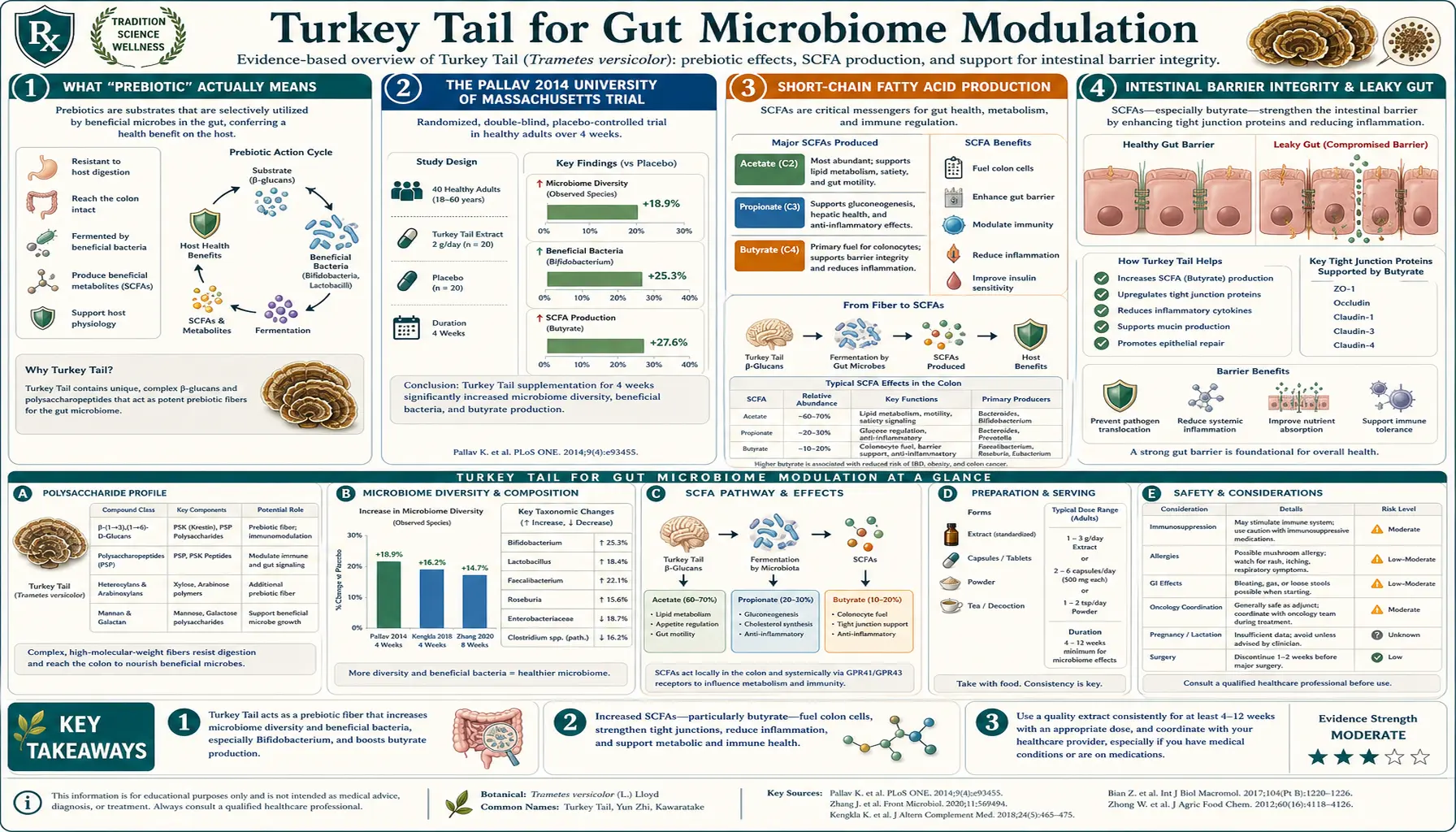
Turkey Tail's beta-glucan polysaccharides function as a true prebiotic — an indigestible substrate that selectively favors growth of Bifidobacterium and Lactobacillus species in the colon. The Pallav 2014 pilot study, the only direct human clinical trial of Trametes versicolor on the gut microbiome to date, followed healthy volunteers for 8 weeks and found that polysaccharopeptide (PSP) led to "clear and consistent microbiome changes consistent with its activity as a prebiotic," although each person's starting gut flora tended to overshadow the treatment effects. The prebiotic effect creates a downstream cascade: bacterial fermentation of beta-glucans yields short-chain fatty acids (butyrate, propionate, acetate) that feed colonocytes, strengthen the intestinal barrier, lower colonic pH, suppress pathogen overgrowth, and signal to the gut-associated lymphoid tissue (GALT) to modulate systemic immune tone. This page explores the prebiotic mechanism, the clinical evidence, and the practical implications for gut-related conditions.
Table of Contents
- What "Prebiotic" Actually Means
- The Pallav 2014 Trial
- Short-Chain Fatty Acid Production
- Intestinal Barrier Integrity & Leaky Gut
- Dysbiosis Correction After Antibiotics or Chemotherapy
- Inflammatory Bowel Disease Applications
- Small Intestinal Bacterial Overgrowth & Functional Gastrointestinal Considerations
- The Gut-Immune-Cancer Axis
- Doses and Combinations Described by Practitioners
- Cautions
- Key Research Papers
- Connections
- Featured Videos
What "Prebiotic" Actually Means
The term "prebiotic" was coined by Gibson and Roberfroid in 1995 to describe a nondigestible food ingredient that selectively stimulates the growth or activity of one or more bacteria in the colon, thereby improving host health. The modern updated definition from the International Scientific Association for Probiotics and Prebiotics (ISAPP) clarifies that a prebiotic must:
- Resist digestion in the upper gastrointestinal (GI) tract — the substrate must not be hydrolyzed by salivary amylase, gastric acid, pancreatic enzymes, or the brush-border disaccharidases of the small intestine
- Be fermented by colonic microbiota — the substrate must reach the colon intact and be metabolized by resident bacteria
- Selectively favor beneficial bacteria — the fermentation must preferentially expand health-associated genera (typically Bifidobacterium and Lactobacillus) rather than pro-inflammatory pathobionts
- Produce a measurable health benefit — the resulting microbial shift must translate to host benefit
Turkey Tail beta-glucans meet all four criteria. The beta-1,3 and beta-1,6 linkages between glucose units are not cleaved by any human enzyme (we lack beta-glucanase). The glucans pass intact through the small intestine, reach the colon, and are fermented by Bifidobacterium and Lactobacillus species (which possess the necessary beta-glucanases) preferentially over Bacteroides and Clostridium species. The fermentation yields short-chain fatty acids and modulates microbial diversity in ways that translate to measurable changes in host inflammatory markers.
Compare this to the more familiar prebiotics: inulin (from chicory root), fructo-oligosaccharides (FOS), galacto-oligosaccharides (GOS), human milk oligosaccharides (HMOs), resistant starch, and partially hydrolyzed guar gum. Turkey Tail beta-glucan sits alongside these as a legitimate prebiotic with the additional immune-modulating effect that the others lack.
The selectivity evidence comes from a laboratory (test-tube) study. Yu and colleagues (2013) cultured human stool bacteria without oxygen together with PSP, the polysaccharide peptide extract of Trametes versicolor. PSP and fructo-oligosaccharides (a common prebiotic), but not cellulose, significantly increased levels of Bifidobacterium species. PSP also raised Lactobacillus species while reducing Clostridium, Staphylococcus and Enterococcus species; Streptococcus, Bacteroides and Escherichia levels did not significantly change. Fermentation of PSP raised the concentration of organic acids (lactate and short-chain fatty acids) and lowered the pH. Because this was a stool-culture lab study, it shows what the extract does to gut bacteria in a culture dish, not inside a person.
The Pallav 2014 Trial
The pivotal direct human evidence comes from Kanwal Pallav et al., published in Gut Microbes in 2014. This was a small randomized pilot trial with three parallel groups, examining how oral PSP (polysaccharopeptide from Trametes versicolor) compared to amoxicillin, and to no treatment, in terms of gut microbiome effects in healthy adult volunteers.
Design: 24 healthy adults were randomized to one of three groups:
- 3.6 g/day PSP for 8 weeks, OR
- Amoxicillin 875 mg twice daily for 7 days (a typical antibiotic course), OR
- No treatment (the control group)
Stool samples were analysed with bTEFAP microbial-ecology (bacterial DNA sequencing) methods on seven occasions over 8 weeks for each person in the two treatment groups, and on three occasions for the controls. Twenty-two of the 24 participants completed the protocol.
Key findings reported by the trial:
- PSP "led to clear and consistent microbiome changes consistent with its activity as a prebiotic"
- Despite the diversity of the human microbiome, the researchers noted strong microbiome clustering among subjects
- Each person's baseline microbiome "tended to remain stable and to overshadow the treatment effects" — in plain words, the differences between people's own gut flora were larger than the changes PSP produced
The bacterial changes often quoted for Turkey Tail — more Bifidobacterium and Lactobacillus, fewer Clostridium and Staphylococcus — come from the Yu 2013 stool-culture lab study described above, not from this human trial's reported results.
By comparison, amoxicillin caused substantial microbiome changes, most notably an increase in Escherichia/Shigella, and the antibiotic-associated changes were still present at the end of the study, 42 days after the antibiotic course ended — the typical antibiotic dysbiosis pattern.
The Pallav trial is small and the results are surrogate (microbiome composition, not clinical endpoints); the authors concluded that PSP from T. versicolor "acts as a prebiotic to modulate human intestinal microbiome composition." It provides direct human evidence that Turkey Tail polysaccharide is a true prebiotic in the rigorous ISAPP definitional sense. Larger confirmatory trials are pending.
Short-Chain Fatty Acid Production
When colonic bacteria ferment beta-glucans, the dominant metabolic products are three short-chain fatty acids: acetate, propionate, and butyrate. Each has distinct downstream effects.
- Butyrate is the preferred energy substrate for colonocytes (the absorptive cells of the colon). 60-70% of a colonocyte's energy requirement is met by butyrate beta-oxidation. Butyrate-deficient colonocytes undergo autophagy and develop a leaky tight-junction phenotype. Butyrate also signals through G-protein-coupled receptors (GPR41, GPR43, GPR109a) and acts as a histone deacetylase (HDAC) inhibitor, altering gene expression in ways that promote Treg differentiation and suppress chronic inflammation.
- Propionate travels through the portal circulation to the liver, where it modulates hepatic gluconeogenesis and cholesterol synthesis. It also signals through GPR43 to promote anti-inflammatory immune effects.
- Acetate reaches the systemic circulation in significant concentrations and signals to peripheral tissues including muscle and adipose; it has been implicated in appetite regulation via central hypothalamic effects.
The clinical implication is that Turkey Tail's benefit is mediated in part through short-chain fatty acid (SCFA) production. Patients with conditions characterized by low butyrate production — ulcerative colitis, irritable bowel syndrome, antibiotic-associated diarrhea, post-chemotherapy gut injury — have the most to gain from prebiotic supplementation that restores fermentation capacity. For more on gut barrier and butyrate physiology, see our Gastroenterology hub.
Intestinal Barrier Integrity & Leaky Gut
The intestinal epithelial barrier is a single-cell-thick layer of enterocytes connected by tight junction protein complexes (claudins, occludin, ZO-1). Disruption of this barrier — commonly called "leaky gut" or, in academic language, increased intestinal permeability — allows bacterial lipopolysaccharide (LPS), partially digested food antigens, and microbial metabolites to translocate from the gut lumen into the lamina propria and systemic circulation, driving low-grade systemic inflammation.
Turkey Tail beta-glucan supports barrier integrity through three convergent mechanisms:
- Direct butyrate supply to colonocytes — well-fed colonocytes maintain robust tight-junction protein expression. Butyrate up-regulates claudin-1 expression and stabilizes the cytoskeletal anchoring of ZO-1.
- Mucus layer thickness — short-chain fatty acids (SCFAs) stimulate goblet cell proliferation and Muc2 secretion. The protective mucus gel layer increases in thickness with prebiotic feeding, creating a physical barrier between luminal contents and the epithelium.
- Selective expansion of barrier-supporting bacteria — Akkermansia muciniphila, a key barrier-supporting species, frequently expands when butyrate-producing fermenters (Bifidobacterium, certain Lactobacillus) increase. Akkermansia consumes mucin and stimulates further mucin production in a balanced feedback loop.
Cohort observational data suggest patients with chronic gut barrier dysfunction (post-infectious irritable bowel syndrome (IBS), fibromyalgia, autoimmune disease, food sensitivities) often have low fecal short-chain fatty acid levels and underrepresented Bifidobacterium / Akkermansia populations. Prebiotic supplementation including Turkey Tail can begin to reverse these patterns, though typically over weeks to months rather than days.
Dysbiosis Correction After Antibiotics or Chemotherapy
One of the most practical applications of Turkey Tail prebiotic activity is restoration of microbiome diversity after a disruptive event — either an antibiotic course or cancer chemotherapy. Both interventions cause substantial reductions in microbial diversity, expansion of opportunistic pathobionts (Enterobacteriaceae, Candida species, C. difficile), and loss of butyrate-producing fermenters.
The recovery trajectory without intervention is slow and incomplete. A single 7-day course of broad-spectrum antibiotics measurably reduces microbial diversity for 6+ months in many subjects, and certain species are lost permanently. Practitioners describe pairing antibiotic therapy with a prebiotic (such as Turkey Tail beta-glucan, combined with a high-CFU probiotic supplying live Lactobacillus and Bifidobacterium strains) to speed recovery.
For chemotherapy patients, the gut microbiome story is increasingly recognized as a determinant of treatment response, not just a side-effect concern. Chemotherapy-induced gut dysbiosis correlates with increased mucositis, diarrhea, infection risk, and possibly reduced response to checkpoint inhibitor immunotherapy. The mechanism behind the cancer-adjunct effect of Turkey Tail discussed in our PSK / PSP page may be partially mediated through this microbiome restoration.
A protocol practitioners describe for post-antibiotic or post-chemotherapy gut restoration:
- Turkey Tail dual extract 1-3 g/day for 4-12 weeks
- A multi-strain probiotic supplying Lactobacillus + Bifidobacterium (≥10 billion CFU/day) for 4-8 weeks
- A diverse plant-fiber diet (target 30+ different plant species per week)
- Fermented foods (yogurt, kefir, sauerkraut, kimchi) daily
Practitioners regard this combination as more effective than any single intervention alone in restoring microbiome diversity after disruption.
Inflammatory Bowel Disease Applications
Inflammatory bowel disease (IBD) — Crohn's disease and ulcerative colitis — is characterized by a reproducible microbiome signature: reduced Faecalibacterium prausnitzii (a major butyrate producer), reduced Roseburia and Eubacterium species, expanded Enterobacteriaceae and Fusobacterium, and reduced microbial diversity overall. The dysbiosis is both cause and consequence of the inflammatory state.
There is no clinical trial evidence for Turkey Tail in inflammatory bowel disease, though the mechanistic rationale is strong. The published studies are in mice with chemically induced colitis, where Turkey Tail (Coriolus versicolor) extract relieved colitis symptoms and lowered inflammatory signals (Lim 2011; Impellizzeri 2022); no human observational study or case series was found. Some practitioners and patients report symptom improvement, reduced fecal calprotectin, and improved quality of life when Turkey Tail dual extract is added to a standard regimen (typically 1-2 g/day for 12+ weeks).
Considerations practitioners describe for people with inflammatory bowel disease:
- Active flare — practitioners describe introducing it slowly, and only in remission or a mild flare. The fermentation of beta-glucans can produce gas and bloating that worsens cramping in severe active disease.
- Strictures — for people with known fibrostenotic Crohn's disease, practitioners describe limiting significant fiber, prebiotics included, during periods of obstructive symptoms.
- Concurrent biologics — practitioners describe Turkey Tail as broadly compatible with biologic therapy (anti-TNF, anti-IL-12/23, anti-integrin). Turkey Tail is studied as an immune stimulant, while these drugs work by suppressing parts of the immune response.
- Steroids — practitioners describe concurrent corticosteroid use as compatible; some patients report easier steroid taper with prebiotic support.
For more on inflammatory bowel disease specifically, see Crohn's Disease and Ulcerative Colitis.
Small Intestinal Bacterial Overgrowth & Functional Gastrointestinal Considerations
Small intestinal bacterial overgrowth (SIBO) is the colonization of the typically sparsely populated small intestine by bacteria that normally reside in the colon. The cardinal symptom is bloating after meals, and the diagnosis is made by hydrogen/methane breath testing or duodenal aspirate culture.
In small intestinal bacterial overgrowth, prebiotics can be a double-edged sword. The same beta-glucans that selectively feed colonic Bifidobacterium and Lactobacillus can also feed the bacteria that have ectopically colonized the small intestine. Patients with active untreated small intestinal bacterial overgrowth commonly report worsened bloating, gas, and abdominal pain when starting prebiotic fiber including Turkey Tail.
The sequence practitioners describe for people with small intestinal bacterial overgrowth:
- Treating the small intestinal bacterial overgrowth first with antimicrobials (rifaximin for hydrogen-predominant small intestinal bacterial overgrowth, rifaximin + neomycin for methane-predominant SIBO/IMO, or botanical antimicrobials such as berberine, allicin, and oregano)
- Addressing the underlying motility cause — ileocecal valve dysfunction, chronic stress with reduced migrating motor complex (MMC) activity, post-infectious autoimmune disruption of the MMC (anti-vinculin antibodies), structural obstruction, or chronic constipation
- Introducing prebiotics including Turkey Tail later, once the small intestine is decolonized and motility has been addressed, to repopulate the colon with beneficial fermenters
For more on small intestinal bacterial overgrowth management, see small intestinal bacterial overgrowth and the small intestinal bacterial overgrowth deep-dive sub-articles.
The Gut-Immune-Cancer Axis
The most exciting frontier in Turkey Tail research is the recognition that the microbiome-modulating and immune-modulating effects are not independent — they are two faces of the same upstream mechanism. Approximately 70% of the body's lymphocytes reside in gut-associated lymphoid tissue (GALT). The microbial composition of the gut is the dominant exogenous signal shaping the systemic immune phenotype.
Recent research in cancer immunotherapy has shown that the gut microbiome substantially influences response to checkpoint inhibitors (anti-PD1/PD-L1, anti-CTLA-4). Patients with diverse, Bifidobacterium-rich, Akkermansia-rich microbiomes have higher response rates to checkpoint inhibitor therapy than patients with low-diversity microbiomes. This finding has triggered active investigation of fecal microbial transplant, probiotic supplementation, and dietary modification as adjuncts to immunotherapy.
Turkey Tail fits neatly into this framework. Its prebiotic activity selectively expands the same Bifidobacterium and Akkermansia populations associated with checkpoint inhibitor response. Its direct immune activity potentiates the natural killer (NK) cell and dendritic cell function that supports tumor antigen presentation. The two mechanisms reinforce rather than compete.
Doses and Combinations Described by Practitioners
Practitioners describe the following for microbiome restoration:
- Dose — Turkey Tail dual extract 1-3 g/day. Higher doses (up to 6 g/day) are described as well tolerated but may cause initial gas/bloating.
- Timing — with food, typically split between two meals. Long-term continuous use is well established in clinical trials of 1-2 year duration.
- Pair with probiotic — the prebiotic effect is said to be amplified when paired with a probiotic delivering live Bifidobacterium and Lactobacillus species. Practitioners favour products that state CFU counts (≥10 billion CFU/day) and name individual strains.
- Pair with dietary fiber diversity — the single highest-impact dietary intervention for microbiome diversity is eating a wide variety of plant foods. The American Gut Project found that subjects eating 30+ different plant species per week had measurably more diverse microbiomes than those eating fewer than 10.
- Pair with fermented foods — yogurt, kefir, sauerkraut, kimchi, miso, tempeh, kombucha all contribute live cultures and additional bioactive metabolites.
- Timing around antibiotics — practitioners describe starting the Turkey Tail / probiotic combination immediately after a broad-spectrum antibiotic course completes, not during it.
Cautions
- Active untreated small intestinal bacterial overgrowth — risk of worsening bloating; practitioners treat the small intestinal bacterial overgrowth first
- Active severe inflammatory bowel disease flare — risk of worsening cramping from fermentation; practitioners introduce it only in remission
- Known fibrostenotic Crohn's disease with obstructive symptoms — practitioners limit significant fiber, prebiotics included, during obstructive symptoms
- Immunosuppressive medication (post-transplant, biologic disease) — Turkey Tail is studied as an immune stimulant, an effect that runs opposite to the purpose of these drugs, which suppress the immune system
- Mild side effects — initial gas, bloating, change in stool frequency; usually resolves within 1-2 weeks as the microbiome adapts
Key Research Papers
- Pallav K et al. (2014). Effects of polysaccharopeptide from Trametes versicolor and amoxicillin on the gut microbiome of healthy volunteers. Gut Microbes 5(4):458-467. — PubMed PMID: 25006989
- Yu ZT, Liu B, Mukherjee P, Newburg DS (2013). Trametes versicolor extract modifies human fecal microbiota composition in vitro. Plant Foods for Human Nutrition 68(2):107-112. A laboratory stool-culture study. — PubMed PMID: 23435630
- Jayachandran M et al. (2017). A critical review on health-promoting benefits of edible mushrooms through gut microbiota. International Journal of Molecular Sciences 18(9):1934. — PubMed PMID: 28885559
- Gibson GR et al. (2017). Expert consensus document: The International Scientific Association for Probiotics and Prebiotics (ISAPP) consensus statement on the definition and scope of prebiotics. Nature Reviews Gastroenterology & Hepatology 14(8):491-502. — PubMed PMID: 28611480
- Wong CK, Tse PS, Wong EL, Leung PC, Fung KP, Lam CW (2004). Immunomodulatory effects of yun zhi and danshen capsules in health subjects—a randomized, double-blind, placebo-controlled, crossover study. International Immunopharmacology 4(2):201-211. — PubMed PMID: 14996412
- Cantarel BL et al. (2012). Complex carbohydrate utilization by the healthy human microbiome. PLoS ONE. — PubMed PMID: 22719820
- Koh A et al. (2016). From dietary fiber to host physiology: short-chain fatty acids as key bacterial metabolites. Cell 165(6):1332-1345. — PubMed PMID: 27259147
- Round JL, Mazmanian SK (2009). The gut microbiota shapes intestinal immune responses during health and disease. Nature Reviews Immunology. — PubMed PMID: 19343057
- Sivan A et al. (2015). Commensal Bifidobacterium promotes antitumor immunity and facilitates anti-PD-L1 efficacy. Science 350(6264):1084-1089. — PubMed PMID: 26541606
- Routy B et al. (2018). Gut microbiome influences efficacy of PD-1-based immunotherapy against epithelial tumors. Science 359(6371):91-97. — PubMed PMID: 29097494
- Friedman M (2016). Mushroom polysaccharides: chemistry and antiobesity, antidiabetes, anticancer, and antibiotic properties. Foods. — PubMed PMID: 28231175
- Lim BO (2011). Coriolus versicolor suppresses inflammatory bowel disease by Inhibiting the expression of STAT1 and STAT6 associated with IFN-γ and IL-4 expression. Phytotherapy Research 25(8):1257-1261. A study in mice. — PubMed PMID: 21796702
- Impellizzeri D, Fusco R, Genovese T, Cordaro M, et al. (2022). Coriolus Versicolor Downregulates TLR4/NF-κB Signaling Cascade in Dinitrobenzenesulfonic Acid-Treated Mice: A Possible Mechanism for the Anti-Colitis Effect. Antioxidants (Basel) 11(2):406. A study in mice. — PubMed PMID: 35204289
PubMed Topic Searches
Connections
- Turkey Tail Overview
- Turkey Tail Benefits Hub
- PSK PSP & Cancer Adjunct
- Immune Surveillance
- Human Papillomavirus and Cervical Dysplasia
- Gastroenterology Hub
- Crohn's Disease
- Ulcerative Colitis
- Small Intestinal Bacterial Overgrowth
- Irritable Bowel Syndrome
- Probiotics
- Fermented Foods
- Yogurt
- Reishi Mushroom
- History