Turkey Tail PSK, PSP & Cancer Adjunct Therapy
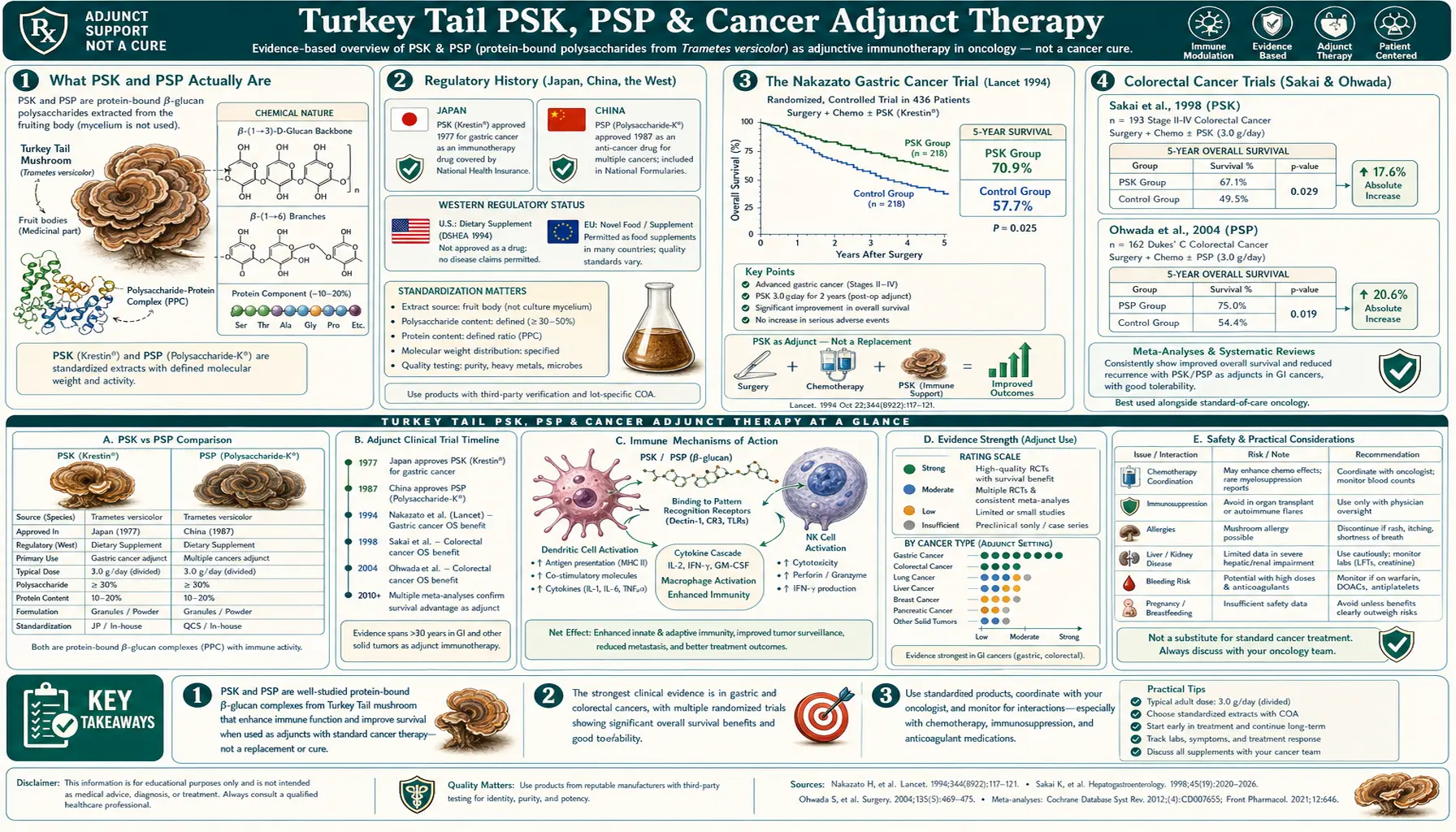
PSK (polysaccharide-K) and PSP (polysaccharopeptide) are the two best-validated medicinal mushroom extracts in the world. PSK was approved by the Japanese Ministry of Health as a prescription cancer adjunct in 1977 and at its peak captured approximately one-quarter of the entire Japanese national pharmaceutical cancer budget. PSP, isolated from a separate Chinese strain at Shanghai Teacher's University in 1983, became standard adjunct therapy in Chinese oncology. Over forty years, randomized trials and their meta-analyses have reported survival improvements in gastric, colorectal, and breast cancer when these extracts are added to surgery, chemotherapy, or radiotherapy; a 2012 meta-analysis found the effect “not in esophageal cancer”. This page walks through the pivotal clinical trials, the proposed mechanisms, the doses used in the trials, and the limits of the evidence.
Table of Contents
- What PSK and PSP Actually Are
- Regulatory History (Japan, China, the West)
- The Nakazato Gastric Cancer Trial (Lancet 1994)
- Colorectal Cancer Trials (Sakamoto, Sakai & Ohwada)
- The Phase I Breast Cancer Trial (Torkelson 2012)
- Lung Cancer Adjunct (Hayakawa, Tsang)
- Mechanism of Action
- Doses Used in the Trials
- Limits of the Evidence
- Cautions and Drug Interactions
- Key Research Papers
- Connections
- Featured Videos
What PSK and PSP Actually Are
Both PSK and PSP are protein-bound polysaccharide complexes extracted from Trametes versicolor mycelium grown in submerged liquid culture. The polysaccharide backbone is a beta-glucan with primary beta-1,4 linkages and beta-1,3 / beta-1,6 branches, complexed with a small protein moiety (approximately 25-38% protein by weight for PSP, 35% for PSK). The protein component appears important for solubility and possibly for receptor binding.
The two extracts differ in three respects:
- Source strain — PSK comes from the CM-101 strain (Japan); PSP comes from the Cov-1 strain (China). Both are Trametes versicolor but with distinct polysaccharide profiles.
- Extraction method — PSK is hot-water extracted then partially purified by ammonium sulfate precipitation and dialysis; PSP undergoes additional chromatographic separation and yields a sharper molecular weight distribution.
- Molecular weight — PSK averages approximately 100 kDa; PSP averages approximately 100 kDa as well, but with a tighter distribution. Both are large enough that absorption across the intact gut epithelium is partial, with most immune signaling occurring via gut-associated lymphoid tissue (GALT) rather than systemic circulation.
Modern over-the-counter Turkey Tail supplements sold in the West are usually neither PSK nor PSP. They are typically dual-extracted (hot-water + ethanol) preparations of the wild fruiting body, with beta-glucan content varying from less than 5% to as high as 45% depending on the manufacturer. The clinical-trial evidence base summarized below applies most directly to the Japanese and Chinese prescription preparations, and only by inference to over-the-counter dual extracts — though the upstream mechanism (beta-glucan engagement of dectin-1 on dendritic cells) is shared.
Regulatory History (Japan, China, the West)
PSK's clinical journey began at its Japanese manufacturer in 1965. By 1977 it had completed sufficient Phase III trials to receive approval from the Japanese Ministry of Health, Labour and Welfare as a prescription adjuvant for gastric, colon, and lung cancers. By the mid-1980s PSK was generating annual sales of approximately $400-500 million USD and accounted for an estimated 25% of Japan's national cancer drug expenditure — an extraordinary commercial penetration for any single oncology agent.
PSP's parallel approval in China followed a similar arc. Yang Qing-Yao at Shanghai Teacher's University isolated PSP in 1983 from the Cov-1 strain, demonstrated antitumor activity in murine models, and shepherded it through Chinese regulatory approval as a Class II prescription medicine for cancer in 1987. PSP became standard adjunct therapy in Chinese oncology and remains so today.
The Western regulatory landscape is different. PSK has never been approved as a prescription drug by the U.S. Food and Drug Administration (FDA) or European Medicines Agency (EMA). Memorial Sloan Kettering Cancer Center includes Turkey Tail in its integrative oncology monograph and acknowledges the supportive trial data. The summary from the National Center for Complementary and Integrative Health (NCCIH), part of the U.S. National Institutes of Health (NIH), states that "there is some evidence" supporting use as a cancer adjunct but that "more rigorous trials are needed." This is the gap between the Asian regulatory acceptance and the Western evidentiary standard for prescription approval — a gap that has more to do with trial-design conventions (Asian trials often used historical controls, open-label designs, or non-standard endpoints by U.S. Food and Drug Administration standards) than with effect size.
The Nakazato Gastric Cancer Trial (Lancet 1994)
The single most cited clinical trial of PSK is Nakazato H et al., published in The Lancet in 1994. The design: 262 Japanese patients at 46 institutions in central Japan with curatively resected gastric cancer (Stage II or III) were randomized after surgery to either standard chemotherapy alone (mitomycin C + 5-FU then 5-FU oral maintenance) or the same chemotherapy plus 3 g/day oral PSK for at least one year.
Results at 5-year follow-up:
- 5-year survival in PSK arm: 73.0%
- 5-year survival in control arm: 60.0%
- Absolute survival difference: 13% (p = 0.044)
- 5-year disease-free rate: 70.7% with PSK vs 59.4% with standard treatment (p = 0.047)
- The benefit was concentrated in Stage III disease and in patients with the strongest preoperative immune response (skin-test reactive to dinitrochlorobenzene)
- Both regimens had only slight toxic effects — nausea, low white-cell counts (leucopenia) and liver function impairment — with no significant differences between the groups
The Nakazato trial established the template for subsequent PSK trials in other cancers: surgically resectable disease, standard chemotherapy in both arms, PSK added orally at 3 g/day for at least one year, primary endpoint disease-free or overall survival at 5 years. A pre-PSK skin-test reactivity has continued to show up as a positive predictor of response across multiple trials — suggesting that PSK is most effective in patients whose baseline immune competence is still partially intact and least effective in profoundly immunosuppressed patients.
A 2007 meta-analysis (Oba 2007) pooled eight randomized controlled trials with 8,009 patients who had curative surgery for stomach cancer. Adding PSK to chemotherapy lowered the risk of death: the overall hazard ratio was 0.88 (95% confidence interval 0.79-0.98; P = 0.018), with no significant heterogeneity between the trials.
Colorectal Cancer Trials (Sakamoto, Sakai & Ohwada)
The colorectal cancer literature is the most extensive for PSK. The pooled figure comes from Sakamoto et al. 2006, a meta-analysis of three centrally randomized trials with 1,094 patients with curatively resected colorectal cancer. In all three trials patients were followed for at least 5 years, and standard chemotherapy was compared with chemotherapy plus PSK:
- Overall survival risk ratio 0.71 (95% confidence interval (CI) 0.55-0.90; P=0.006) favoring PSK
- Disease-free survival risk ratio 0.72 (95% CI 0.58-0.90; P=0.003)
A separate 2008 study by Sakai et al. was a retrospective comparison, not a pooled analysis. Patients treated with oral fluoropyrimidines plus PSK for 24 months had a 10-year overall survival of 81.9%, against 50.6% for the control group treated with oral fluoropyrimidines alone. In Dukes' C cases, 10-year overall survival was also significantly higher with PSK, and in cases with lymphatic invasion graded ly2-ly3 or venous invasion graded v2-v3 it was 80.6% with PSK against 25.9% in the control group.
The Ohwada 2004 trial in the British Journal of Cancer was a randomised controlled study: of 207 registered patients, 205 with stage II (n=123) or III (n=82) colorectal cancer were analysed. After intravenous mitomycin C, they took either 3 g PSK plus 300 mg tegafur/uracil (UFT) or 300 mg UFT alone by mouth each day for 2 years. The 5-year disease-free survival was 73.0% with PSK (n=137) and 58.8% in the controls (n=68) (P=0.016). Overall 5-year survival for stage II and III together was not significantly different (81.8% vs 72.1%, P=0.056). In stage III patients, disease-free survival (60.0% vs 32.1%) and overall survival (74.6% vs 46.4%) were significantly higher with PSK (P=0.002 and 0.003). PSK prevented recurrence, particularly lung metastases (odds ratio 0.27; 95% CI 0.09-0.77), and adverse effects were mild.
The colorectal data are arguably the most compelling subset of PSK evidence: multiple independent trials, large patient numbers, consistent direction of effect, and biological plausibility from the gut-localized polysaccharide-immune mechanism.
The Phase I Breast Cancer Trial (Torkelson 2012)
The Torkelson 2012 ISRN Oncology trial was a phase I, two-center, dose-escalation study of a Trametes versicolor preparation, done to determine the maximum tolerated dose. Eleven women with breast cancer who had recently completed radiotherapy were recruited and nine completed the study. Each group of three took one of three doses (3, 6, or 9 grams a day, in divided doses) for 6 weeks.
Findings:
- Nine adverse events were reported (7 mild, 1 moderate, and 1 severe); the authors described the preparation as well tolerated and concluded that up to 9 grams a day “is safe and tolerable” in women with breast cancer after primary treatment
- Dose-related increases in CD8+ T cells and CD19+ B cells, but not in CD4+ T cells or CD16+56+ natural killer (NK) cells
- Trends in killer cell functional activity at 6 grams a day
The trial was small, had no control group, and was limited to immune measures (no survival data). It does not prove clinical benefit. The authors concluded that this preparation “may improve immune status” in breast cancer patients after standard primary treatment; whether the same applies to over-the-counter extracts in general was not tested.
Lung Cancer Adjunct (Hayakawa, Tsang)
Lung cancer evidence comes primarily from two studies. Hayakawa 1993 (Anticancer Research) was not a randomized trial: it analysed 185 patients with non-small cell lung cancer at stages I-III treated with definitive radiotherapy at one Japanese university hospital from 1976 to 1985. Among patients with epidermoid carcinoma of the lung whose tumours shrank well after radiotherapy, the 5-year survival with PSK as adjuvant treatment was 39% (stages I or II) and 22% (stage III), compared with 16% and 5% in patients not given PSK; the authors reported these differences as statistically significant.
Tsang KW et al. 2003 (Respiratory Medicine) conducted a double-blind, placebo-controlled randomized trial of 28 days of PSP in patients who had completed conventional treatment for advanced non-small cell lung cancer (NSCLC); thirty-four patients were recruited into each of the PSP and control arms. The PSP patients did not improve in NSCLC-related symptoms, but fewer of them were withdrawn because of disease progression (5.9% vs 23.5%; P=0.04). Blood leukocyte and neutrophil counts, serum IgG and IgM, and percent body fat improved with PSP but not with placebo, and no adverse reaction was attributed to the trial medications. The trial was short and had no survival endpoint.
The 2012 Eliza et al. systematic review in Recent Patents on Inflammation & Allergy Drug Discovery pooled 13 clinical trials of Yun Zhi (Coriolus versicolor) and found a 9% absolute reduction in 5-year mortality, “resulting in one additional patient alive for every 11 patients treated.” The effect on 5-year survival was more evident in breast, gastric and colorectal cancer treated with chemotherapy, but not in esophageal cancer or nasopharyngeal carcinoma.
For information on the cancers themselves, see our Oncology hub.
Mechanism of Action
The proposed mechanisms of PSK and PSP antitumor activity are layered:
- Dectin-1 engagement on macrophages, dendritic cells, and neutrophils — the beta-1,3 / beta-1,6 glucan structures bind dectin-1, triggering Syk-CARD9 signaling and activation of pattern-recognition immunity. This is the same receptor that recognizes invading fungal pathogens, and the host response is appropriately Th1-biased.
- Natural killer cell potentiation — activated dendritic cells secrete IL-12, IL-15, and IL-18 which prime natural killer cell cytotoxicity. Natural killer cells are the primary innate cellular response to tumor cells lacking MHC class I (a common immune-evasion mechanism in malignancy), making them a particularly relevant effector population.
- Restoration of immune competence after cytotoxic therapy — the most compelling clinical use case is restoring lymphocyte and natural killer cell function in patients depleted by chemotherapy or radiotherapy, where the slow recovery itself may permit residual tumor cells to expand.
- TLR4 co-stimulation — PSP and PSK can also engage Toll-like receptor 4, contributing additional myeloid cell activation independent of dectin-1.
- Direct cytotoxicity (weak) — in vitro studies show modest direct cytotoxicity of PSK against several tumor cell lines, but the in vivo concentrations required exceed plausible serum levels. The dominant mechanism is immune-mediated.
- Microbiome-mediated immune signaling — as discussed in our gut microbiome page, unabsorbed beta-glucans are fermented in the colon and shape the gut bacterial community in ways that feed back to systemic immune tone.
Doses Used in the Trials
The doses used in the clinical literature are:
- Pharmaceutical PSK (Japan) — 3 g/day orally, divided into 2-3 doses, for at least 12 months and often continued for 2-3 years post-surgery
- Pharmaceutical PSP (China) — 1-3 g/day orally, similar duration
- Whole-mushroom dual extract (over-the-counter) — the Torkelson 2012 phase I trial tested 3, 6 and 9 g/day for 6 weeks; it reported trends in killer cell activity at 6 g/day and dose-related increases in CD8+ T cells and CD19+ B cells, and found up to 9 g/day “safe and tolerable”. Lower doses (1-3 g/day) are commonly marketed.
- Timing relative to chemotherapy — PSK trials universally administered the extract concurrent with chemotherapy or starting shortly after surgery. There is no evidence that holding it during chemotherapy infusion days is necessary; the Japanese protocols administered it daily throughout.
- Product labels — over-the-counter products differ in source (fruiting body or dual-extracted mycelium) and in whether the label states beta-glucan content or only "polysaccharide content," which includes starch from the grain substrate.
PSK and PSP have well-documented safety profiles in the Japanese and Chinese trials: in the gastric trial side effects were slight (nausea, low white-cell counts, liver function impairment) and no different from chemotherapy alone, and in the colorectal trial adverse effects were mild. Interactions with newer cancer drugs are less well studied (see Cautions below).
Limits of the Evidence
The PSK / PSP cancer adjunct evidence has several important limitations worth stating plainly:
- Trial geography — nearly all positive trials were conducted in Japan or China. The largest Western trial (Torkelson Phase I) was uncontrolled and surrogate-endpoint only. The possibility of geographically restricted strains, manufacturing standards, or even genetic-population responsiveness has not been excluded.
- Trial design vintage — many of the Nakazato-era trials used historical controls, open-label designs, or non-standard randomization.
- Publication bias — the literature on Asian medicinal mushroom trials shows a positivity bias that may inflate effect sizes. Independent meta-analyses adjusting for this still find a positive direction but with attenuated magnitude.
- Indication specificity — the evidence is strongest for gastric and colorectal cancer adjunct therapy, weaker for breast and lung, and essentially absent for prostate, pancreatic, ovarian, brain, hematologic, and pediatric cancers despite anecdotal use.
- Modern extract heterogeneity — over-the-counter Turkey Tail supplements vary enormously in beta-glucan content, extraction method, and source material. Inferring clinical benefit from the pharmaceutical Japanese product to a generic supermarket capsule is a substantial assumption.
A 2023 systematic review (Narayanan 2023) of clinical mushroom studies in cancer care published from January 2010 through December 2020 included 39 studies of 12 different mushroom preparations. It found a survival benefit in 4 gastric cancer studies using PSK in the adjuvant setting, and noted that many of the studies were small and observational. Most studies reported side effects of grade 2 or lower, mainly nausea, vomiting, diarrhea, and muscle pain. The review concluded that “the evidence is inconclusive to recommend the routine use of mushrooms for cancer patients.”
Cautions and Drug Interactions
- Immunosuppressive medications — for people on immunosuppressive therapy after organ transplantation, for autoimmune disease, or as part of biologic cancer therapy, the immune-stimulating action of Turkey Tail could antagonize the intended immune suppression.
- Autoimmune disease — a theoretical concern in active autoimmune disease (rheumatoid arthritis, lupus, multiple sclerosis, inflammatory bowel disease (IBD)). Clinical reports of autoimmune flares attributable to Turkey Tail are rare but the theoretical concern exists.
- Pregnancy and breastfeeding — safety data are insufficient.
- Side effects — mild gastrointestinal upset (nausea, loose stools, gas) in approximately 10-15% of users at higher doses (6+ g/day). Usually resolves with dose reduction or food coadministration.
- Drug interactions with chemotherapy — PSK and PSP were specifically tested as concurrent adjuncts to mitomycin C, 5-FU, and tegafur/uracil with no negative interaction. Interactions with modern targeted agents (checkpoint inhibitors, tyrosine kinase inhibitors) are less well studied. Specifically, the theoretical possibility of antagonism with anti-PD1/PD-L1 checkpoint inhibitors via additive but uncoordinated immune activation has been raised in editorials but not formally tested.
- Bleeding risk — case reports of mild prolongation of bleeding time at very high doses, which is why this concern applies to people on warfarin and around surgery.
For more on integrative oncology resources, see Immune Boosting.
Key Research Papers
- Nakazato H et al. (1994). Efficacy of immunochemotherapy as adjuvant treatment after curative resection of gastric cancer. The Lancet 343(8906):1122-1126. — PubMed PMID: 7910230
- Oba K, Teramukai S, Kobayashi M, Matsui T, Kodera Y, Sakamoto J (2007). Efficacy of adjuvant immunochemotherapy with polysaccharide K for patients with curative resections of gastric cancer. Cancer Immunology, Immunotherapy 56(6):905-11. — PubMed PMID: 17106715
- Sakamoto J, Morita S, Oba K, Matsui T, Kobayashi M, Nakazato H, Ohashi Y; Meta-Analysis Group of the Japanese Society for Cancer of the Colon Rectum (2006). Efficacy of adjuvant immunochemotherapy with polysaccharide K for patients with curatively resected colorectal cancer: a meta-analysis of centrally randomized controlled clinical trials. Cancer Immunology, Immunotherapy 55(4):404-11. — PubMed PMID: 16133112
- Sakai T, Yamashita Y, Maekawa T, Mikami K, Hoshino S, Shirakusa T (2008). Immunochemotherapy with PSK and fluoropyrimidines improves long-term prognosis for curatively resected colorectal cancer. Cancer Biotherapy and Radiopharmaceuticals 23(4):461-7. — PubMed PMID: 18771350
- Ohwada S, Ikeya T, Yokomori T, Kusaba T, Roppongi T, Takahashi T, Nakamura S, Kakinuma S, Iwazaki S, Ishikawa H, Kawate S, Nakajima T, Morishita Y (2004). Adjuvant immunochemotherapy with oral Tegafur/Uracil plus PSK in patients with stage II or III colorectal cancer: a randomised controlled study. British Journal of Cancer 90(5):1003-10. — PubMed PMID: 14997197
- Torkelson CJ, Sweet E, Martzen MR, Sasagawa M, Wenner CA, Gay J, Putiri A, Standish LJ (2012). Phase 1 Clinical Trial of Trametes versicolor in Women with Breast Cancer. ISRN Oncology 2012:251632. — PubMed PMID: 22701186
- Hayakawa K et al. (1993). Effect of krestin (PSK) as adjuvant treatment on the prognosis after radical radiotherapy in patients with non-small cell lung cancer. Anticancer Research 13(5C):1815-1820. — PubMed PMID: 8267386
- Tsang KW, Lam CL, Yan C, Mak JC, Ooi GC, Ho JC, Lam B, Man R, Sham JS, Lam WK (2003). Coriolus versicolor polysaccharide peptide slows progression of advanced non-small cell lung cancer. Respiratory Medicine 97(6):618-24. — PubMed PMID: 12814145
- Eliza WL, Fai CK, Chung LP (2012). Efficacy of Yun Zhi (Coriolus versicolor) on survival in cancer patients: systematic review and meta-analysis. Recent Patents on Inflammation & Allergy Drug Discovery 6(1):78-87. — PubMed PMID: 22185453
- Kanazawa M, Yoshihara K, Abe H, Iwadate M, Watanabe K, Suzuki S, Endoh Y, Takita K, Sekikawa K, Takenoshita S, Ogata T, Ohto H (2005). Effects of PSK on T and dendritic cells differentiation in gastric or colorectal cancer patients. Anticancer Research 25(1B):443-9. — PubMed PMID: 15816609
- Standish LJ et al. (2008). Trametes versicolor mushroom immune therapy in breast cancer. Journal of the Society for Integrative Oncology. — PubMed
- Narayanan S, de Mores AR, Cohen L, Anwar MM, Lazar F, Hicklen R, Lopez G, Yang P, Bruera E (2023). Medicinal Mushroom Supplements in Cancer: A Systematic Review of Clinical Studies. Current Oncology Reports 25(6):569-587. — PubMed PMID: 36995535
- Cui J, Chisti Y (2003). Polysaccharopeptides of Coriolus versicolor: physiological activity, uses, and production. Biotechnology Advances 21(2):109-122. — PubMed