⚠ Evidence warning: Clinical trials or other evidence do not support the claim that chaga restores the immune system toward a healthier set-point and helps people with chronic immune dysregulation, autoimmune flares and chronic infection. This page keeps it as a report of what people, websites or other media say.
Chaga Mushroom for Immune Modulation
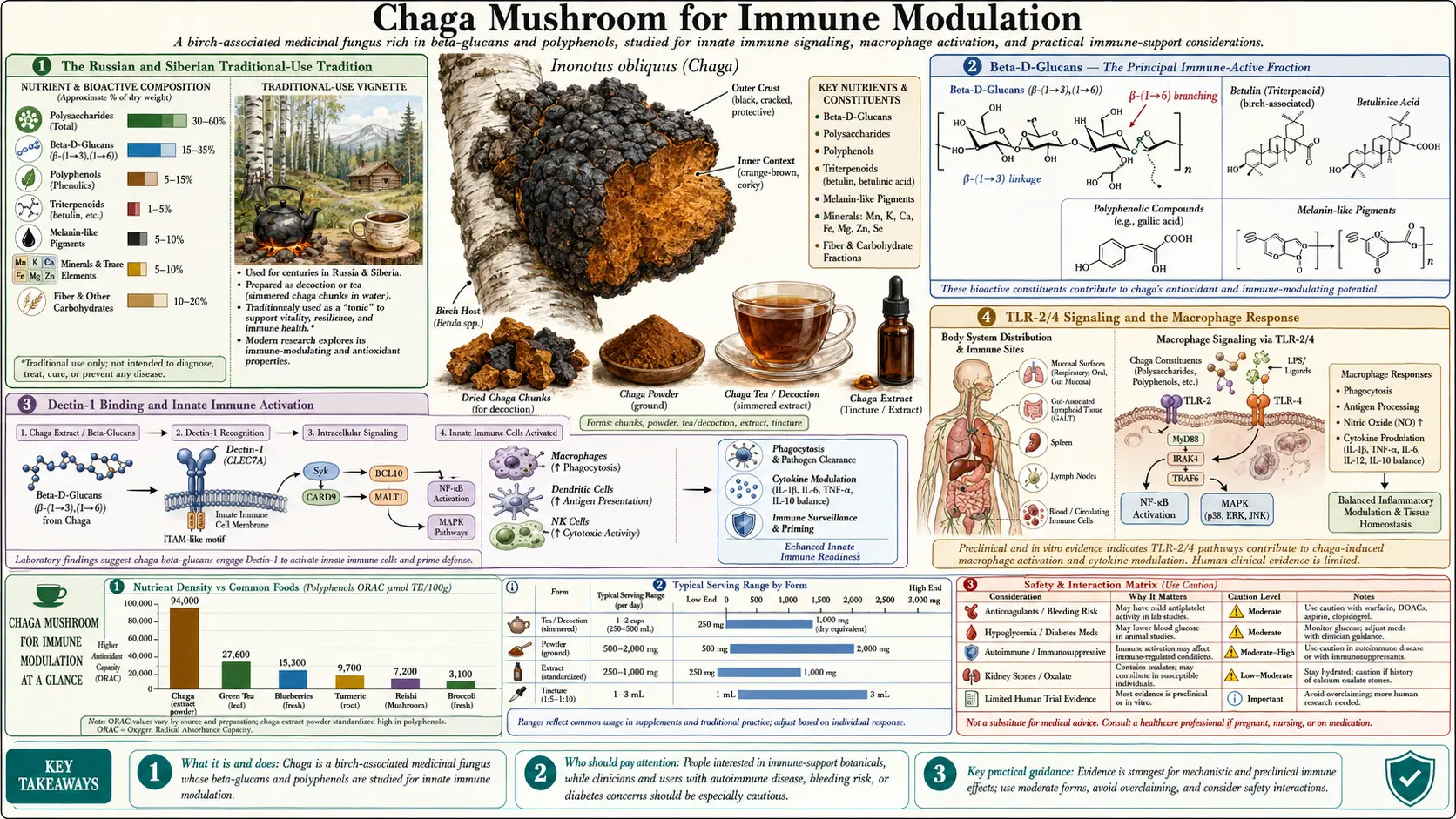
The word immunomodulator is preferable to immune booster for chaga because the underlying mechanism is bidirectional — the beta-D-glucan polysaccharides in chaga's cell wall up-regulate the innate immune response against pathogens through Dectin-1 / TLR-2 / complement-receptor-3 pattern-recognition signaling, while simultaneously down-regulating chronic inflammatory cytokines (tumor necrosis factor-alpha, interleukin-6, NF-kappa-B-driven pathways). This bidirectional activity is the molecular reason why traditional Russian and Siberian folk medicine uses chaga as a long-term daily tonic (a cup of chai chaga every morning) rather than as an acute remedy at the onset of illness. This deep-dive walks through each immune mechanism, the Russian and Siberian traditional-use history, the in vitro and animal data, and the limited but suggestive human evidence.
Table of Contents
- The Russian and Siberian Traditional-Use Tradition
- Beta-D-Glucans — The Principal Immune-Active Fraction
- Dectin-1 Binding and Innate Immune Activation
- TLR-2/4 Signaling and the Macrophage Response
- Natural Killer (NK) Cell Activation
- The Anti-Inflammatory Axis (NF-kB, Tumor Necrosis Factor-alpha, Interleukin-6)
- Why "Dual Immunomodulator" Is the Right Frame
- The Limited Human-Trial Data
- Practical Use: Dosing, Preparation, Quality
- Cautions for Immune-Related Conditions
- Key Research Papers
- Connections
- Featured Videos
The Russian and Siberian Traditional-Use Tradition
Chaga (chaga from the Komi-Permyak language of the Western Urals, meaning literally "the mushroom") has been brewed as a daily tea in Russian and Siberian rural communities for at least 500 years, and there is fragmentary evidence (archaeological wood-ash analysis from medieval birch-charcoal hearths) suggesting an even older tradition. The preparation is consistent across regions: a chunk of the black sclerotium is broken from the tree (always from a living birch, never from a fallen log — dead birch chaga is considered medicinally inferior), dried, ground or chunked, and steeped in hot but not boiling water for hours or overnight.
The traditional indications are striking in their breadth: as a daily tonic to maintain strength through the long winter, as a remedy for "stomach ulcers" and other gastric complaints, as a treatment for tuberculosis (then called chakhotka, "wasting"), for various tumors and growths (the Russian word opukhol covered both benign and malignant lumps), for liver disease (jaundice and what we would now call hepatitis), and for general fatigue and weakness. The 12th-century Russian Grand Prince Vladimir Monomakh reportedly used chaga tea to treat his lip cancer — a frequently-cited though loosely-documented story.
The peasant village observation that drives the modern interest is the apparently anomalous low gastric-cancer rate in birch-rich rural Russian populations. Aleksandr Solzhenitsyn dramatized this observation in his 1968 novel Cancer Ward, where a Russian peasant brings chaga tea to a cancer hospital and a cluster of patients reports remission. The novel came after, not before, the first wave of Russian scientific investigation (Bulatov, Shashkina, Yefimov, and colleagues at the Komarov Botanical Institute in Leningrad), which produced the first chemical characterization of chaga sclerotium between 1955 and 1965 and led to the Russian-pharmacopeia listing of a Soviet-era chaga preparation as an approved adjunct for chronic gastritis; Soviet medical journals of the 1970s and 1980s also describe its use in patients with peptic ulcer disease. The novel then carried the chaga story to a wide Western readership.
The modern scientific question is whether this folk-medical breadth corresponds to anything coherent at the molecular level. The answer, partially and tentatively: yes, through the bidirectional immunomodulatory action of the beta-D-glucan and polysaccharide-protein cell-wall fraction.
Beta-D-Glucans — The Principal Immune-Active Fraction
Beta-glucans are not unique to chaga. They are the principal cell-wall structural carbohydrate of all true fungi (Basidiomycetes and Ascomycetes), the cell walls of all yeasts (including baker's yeast and brewer's yeast), the seed coats of oats and barley, and the cell walls of several seaweeds. What distinguishes the medicinal-mushroom beta-glucans from oat or yeast beta-glucan is the specific branched structure: a backbone of beta-(1→3)-linked D-glucose with frequent beta-(1→6) side branches, sometimes covalently attached to a small protein moiety. The branching frequency and degree of polymerization vary by species; chaga's beta-glucan fraction trends toward higher branching density and lower molecular weight than the equivalent fraction from reishi or maitake.
The biological activity of beta-glucan in mammals depends critically on three structural features:
- The (1→3) backbone — this is what is recognized by the mammalian pattern-recognition receptor Dectin-1. Beta-(1→4) glucans (the structure of cellulose) are immunologically inert; beta-(1→3) glucans are not.
- The (1→6) branching — the branching frequency determines receptor binding affinity. Highly branched beta-glucans bind Dectin-1 more strongly than linear forms.
- The triple-helix tertiary structure — in solution, beta-(1→3) glucans assemble into a right-handed triple helix that is the actual three-dimensional ligand recognized by the immune receptor. Heat denaturation that disrupts the triple helix reduces (but does not eliminate) biological activity. This is one reason for the traditional preparation of chaga as a long hot-water decoction rather than a brief tea infusion or alcohol tincture.
Chaga's beta-glucan content is comparable to or higher than other medicinal mushrooms by weight, and is concentrated in the sclerotium (the black exterior conk) rather than in the mycelium. This is one reason why true wild-harvested sclerotium material is considered superior to cultivated mycelium-on-grain product — the cultivated form is mostly mycelium plus grain residue and contains a lower density of the active fraction.
A 2015 laboratory analysis of chaga from Finland, Russia and Thailand found that oxalic acid was the main organic acid in its water and ethanol extracts, with the highest amount in the water extract from Russia. The same authors note that the fungus itself, Inonotus obliquus, makes up only a limited part of a chaga conk. Oxalate matters for safety: see the kidney-injury entry under Cautions below.
Dectin-1 Binding and Innate Immune Activation
Dectin-1 is a C-type lectin receptor expressed on the surface of mammalian macrophages, dendritic cells, neutrophils, and a subset of monocytes. Its principal natural ligand is the beta-(1→3) glucan triple helix on the cell wall of fungal pathogens (Candida species, Aspergillus, Pneumocystis). Engagement of Dectin-1 by fungal beta-glucan triggers a signaling cascade through the spleen tyrosine kinase (Syk) and the CARD9-Bcl10-MALT1 complex, ultimately activating NF-kappa-B and producing a coordinated innate immune response: phagocytosis, oxidative burst, cytokine release (tumor necrosis factor-alpha, interleukin-1-beta, interleukin-6, IL-23), and induction of Th17-skewed adaptive immunity.
The clever trick that medicinal mushrooms exploit is that the mammalian Dectin-1 receptor cannot distinguish between the beta-glucan on the cell wall of a pathogenic fungus and the beta-glucan on the cell wall of a medicinal mushroom you ate. The receptor binds, the signaling cascade fires, and you get the same coordinated innate-immune activation as if you had a low-grade fungal infection — without actually having one. This is the molecular basis of medicinal mushroom immunomodulation, and the reason why mushroom beta-glucans (chaga, reishi, maitake, turkey tail, lion's mane) all converge on similar immune effects despite their chemical differences in other respects.
Chaga's beta-glucan fraction has been documented in multiple in-vitro studies to activate macrophages in a Dectin-1-dependent manner, increase the production of nitric oxide and inflammatory cytokines, and enhance phagocytic activity. The effect is dose-responsive and saturable, consistent with a specific receptor-mediated mechanism rather than nonspecific toxicity.
TLR-2/4 Signaling and the Macrophage Response
Beyond Dectin-1, the polysaccharide-protein complex in chaga (and other medicinal mushrooms) also engages Toll-like receptors, particularly TLR-2 and TLR-4. TLR-2 typically recognizes lipopeptides and zymosan (a yeast cell-wall preparation that is essentially a crude beta-glucan), and TLR-4 recognizes lipopolysaccharide (LPS) on the outer membrane of gram-negative bacteria. Both TLRs trigger MyD88-dependent signaling cascades that converge on NF-kappa-B activation and production of inflammatory cytokines.
The Won et al. 2011 study in Molecules and Cells used polysaccharides from the chaga fruiting body in a mouse macrophage cell line (RAW264.7). They promoted nitric oxide production, tumor necrosis factor-alpha secretion and phagocytic uptake through the MAPK and NF-kappa-B signaling pathways, and an anti-TLR-2 monoclonal antibody inhibited the tumor necrosis factor-alpha secretion, pointing to the TLR-2 receptor. Given by mouth, the polysaccharides also suppressed melanoma growth in mice. The Kim 2005 paper in Mycobiology was a different kind of study: in mice whose immunity had been suppressed with the chemotherapy drug cyclophosphamide, chaga water extract given daily for 24 days brought bone-marrow progenitor cell counts almost back to normal as early as 8 days after treatment and highly increased serum interleukin-6 (IL-6), while tumor necrosis factor-alpha stayed at background level in the extract-treated mice although it rose in the untreated ones.
Interleukin-10 (IL-10) is the open piece of this puzzle. It is principally an anti-inflammatory cytokine: it suppresses the production of pro-inflammatory cytokines from activated macrophages, dampens Th1 and Th17 responses, and supports the development of regulatory T cells (Tregs). The simultaneous production of pro-inflammatory cytokines (tumor necrosis factor-alpha, interleukin-6) and anti-inflammatory cytokines (interleukin-10) from the same macrophage activation event would be the molecular signature of balanced immune activation — the system alerted but also restrained from runaway inflammation — but none of the chaga studies cited on this page reports interleukin-10. In the Kim 2005 mouse study, the balance appeared instead as raised interleukin-6 with tumor necrosis factor-alpha held at background.
Natural Killer (NK) Cell Activation
Natural killer (NK) cells are the principal innate-immune lymphocyte responsible for surveillance against viral infection and against neoplastic transformation. Natural killer cells recognize "missing self" (cells that have down-regulated MHC class I to evade T-cell recognition, a common immune-evasion tactic of both viruses and tumors) and kill them via perforin and granzyme release.
Multiple medicinal mushrooms have been documented to enhance natural killer cell activity in cell culture and in animal models — the effect is one of the more replicated findings in the medicinal mushroom literature. Chaga is no exception: extracts have been shown to increase natural killer cytotoxicity against tumor cell lines (K562 cells, the standard natural killer activity assay) at concentrations achievable from oral administration in animals.
The mechanism is partly indirect (mushroom beta-glucans activate dendritic cells and macrophages, which release IL-12, IL-15, and IL-18, which in turn activate natural killer cells) and partly direct (some studies show direct binding of beta-glucan to natural killer cell complement receptor 3). The clinical translation to humans is plausible but not demonstrated: a PubMed search finds no clinical trial of chaga and no study of natural killer cell activity in people taking it.
For more on innate immune function and the natural killer-cell axis, see our Immune Boosting page.
The Anti-Inflammatory Axis (NF-kB, Tumor Necrosis Factor-alpha, Interleukin-6)
Chronic systemic inflammation — characterized by sustained low-grade elevation of tumor necrosis factor-alpha, interleukin-6, and high-sensitivity C-reactive protein (CRP) — is now recognized as a driver of multiple chronic diseases including atherosclerosis, type 2 diabetes, several cancers, neurodegenerative disease, and depression. This is distinct from acute inflammation (which is generally beneficial and self-limited), and the therapeutic goal is to dampen the chronic background inflammation without suppressing the acute response to actual infection or injury.
Chaga extracts have been shown in multiple in-vitro and animal studies to inhibit NF-kappa-B activation in chronically inflamed tissue, even though acute exposure to chaga beta-glucan activates NF-kappa-B in resting macrophages. This apparent paradox is reconciled by recognizing that NF-kappa-B is regulated by multiple opposing signals, and the chaga polyphenols (particularly inotodiol and the betulinic-acid-related triterpenoids) are NF-kappa-B inhibitors at concentrations achievable from oral dosing.
A 2005 study by Park and colleagues in the Journal of Ethnopharmacology showed that a methanol extract of chaga reduced carrageenan-induced paw swelling (edema) in rats, had pain-relieving activity in mice, and inhibited lipopolysaccharide-induced nitric oxide, prostaglandin E2 and tumor necrosis factor-alpha production in mouse macrophage cells, by down-regulating NF-kappa-B binding activity. This in-vitro and animal anti-inflammatory activity is the molecular hook on which many of chaga's folk-medical indications (chronic gastritis, hepatitis, inflammatory bowel disease) hang.
For broader context on chronic inflammation as a disease driver, see Oxidative Stress and the related Gastroenterology category.
Why "Dual Immunomodulator" Is the Right Frame
The apparent paradox — chaga both activates innate immunity (beta-glucan binding Dectin-1) and suppresses chronic inflammation (polyphenol inhibition of NF-kappa-B in chronically activated tissue) — is exactly the property that makes the word immunomodulator preferable to immune booster. The right mental model is not "chaga turns the immune system up" but rather "chaga restores the immune system toward a more responsive set-point."
In someone with under-active innate immunity (chronic viral infection, immunosenescence in the elderly, post-chemotherapy recovery), the dominant effect is innate-immune activation: increased natural killer cytotoxicity, increased macrophage phagocytosis, increased Th1/Th17 adaptive response. In someone with over-active chronic inflammation (chronic gastritis, inflammatory bowel disease, atherosclerosis, autoimmune flare), the dominant effect can shift toward inflammation suppression: reduced NF-kappa-B activity, reduced tumor necrosis factor-alpha and interleukin-6, increased Treg numbers.
This bidirectionality is biologically plausible because the immune system has built-in regulatory feedback — activating one arm tends to suppress another, and the relative dominance of one signal versus another shifts with the background state of the immune system. It is also the molecular reason why traditional Russian use of chaga as a chronic daily tonic makes more sense than acute high-dose use at the onset of illness: the immunomodulatory effect takes weeks to months to shift the immune set-point, and short-course high-dose use is a poor match for the mechanism.
It is also the reason why predicting which patients will benefit from chaga is genuinely difficult. Someone with healthy baseline immune function and no chronic inflammation may not perceive any benefit from chaga at all — their immune set-point is already well-regulated, and there is nothing to modulate. Someone with chronic immune dysregulation in either direction may notice substantial benefit, but the time course is slow and the response is variable.
The Limited Human-Trial Data
The honest summary: there is almost no rigorous double-blind placebo-controlled randomized trial evidence for chaga in any human indication. The literature is dominated by in-vitro cell-culture work and mouse and rat studies. PubMed indexes no randomised or controlled clinical trial of chaga; apart from Soviet-era reports of a chaga preparation in patients with peptic ulcer disease, the human data are laboratory tests on blood cells taken from people, and case reports of kidney injury (see Cautions).
The reasons for this gap are several: (1) chaga is not patentable, so there is no commercial incentive for a pharmaceutical-style randomized trial; (2) standardization is difficult given the variability in wild-harvested material; (3) the long time course of the proposed mechanism (weeks to months) makes trial logistics expensive; (4) the principal proposed indications (cancer adjunct, autoimmune adjunct) are ethically and regulatorily challenging in any nutraceutical context.
The Najafzadeh 2007 study examined the effect of an ethanolic chaga extract on hydrogen-peroxide-induced oxidative DNA damage in lymphocytes from 20 inflammatory bowel disease patients and 20 healthy volunteers (treatment in a dish, not clinical administration): the extract reduced the DNA damage by 54.9% in the patients' cells and by 34.9% in the healthy volunteers' cells (p < 0.001). An earlier study by Park and colleagues (2004) found that cells pretreated with a water extract of chaga showed over 40% less DNA fragmentation than human lymphocytes exposed to hydrogen peroxide alone. This is suggestive of antioxidant and immune-modulating activity but is not the same as a clinical trial showing inflammatory bowel disease (IBD) outcome benefit.
The fair statement is: in-vitro and animal evidence for chaga's immunomodulatory activity is substantial and mechanistically coherent; human evidence is preliminary and does not yet support specific clinical claims for any disease indication. In the evidence as it stands, chaga is a traditional tonic with a plausible biological basis, not an evidence-based treatment.
Practical Use: Dosing, Preparation, Quality
Traditional and practitioner sources describe the following practical points (with the sustainability and quality caveats discussed below):
- Form — practitioners regard whole chunk material from documented wild-harvest, broken into thumb-sized pieces, as the gold standard. Powdered material is acceptable but harder to verify. Capsules and tinctures are convenient but lose the slow-extraction process that traditional preparation depends on. Mycelium-on-grain "chaga" products (sometimes labeled as such, sometimes mislabeled) are chemically different from true wild sclerotium and are a separate product with their own evidence.
- Preparation — traditional Russian decoction: 1-2 chunks (about 1 ounce / 28 g total) per quart of water, simmered (not boiled) for 4-8 hours, strained, refrigerated, consumed over 2-3 days at 1-2 cups per day. A chunk can typically be re-decocted 2-3 times before discarding. A common powder preparation: 1-2 teaspoons per cup of hot water, steeped 20-30 minutes, drunk.
- Hot water versus alcohol extraction — the immune-active beta-glucan fraction is water-soluble. The betulinic acid and other triterpenoids are more alcohol-soluble. A "dual extract" (sequential hot-water then alcohol extraction, then combined) is favored by some practitioners as more complete; traditional Russian use is hot-water only.
- Daily dose — traditional Russian tonic use: 1-2 cups of decoction per day, indefinitely. Practitioners give a capsule equivalent of 500-1500 mg dual-extract daily, divided, described as roughly equivalent to 2-5 grams of starting sclerotium material per day.
- Time to effect — the immunomodulatory effect operates on a weeks-to-months time scale. No acute benefit from a single cup is described. Most traditional and modern practitioners suggest 6-8 weeks minimum trial period before evaluating effect.
- Cycling — some practitioners suggest cycling chaga (e.g. 6 weeks on, 2 weeks off) to avoid downregulation of receptors with chronic use. The evidence for benefit from cycling is weak; traditional Russian use is continuous.
Cautions for Immune-Related Conditions
- Autoimmune disease — the bidirectional immunomodulator framing is reassuring in principle, but for patients with active autoimmune flare (lupus, MS, rheumatoid arthritis, psoriasis, inflammatory bowel disease), the response to chaga is genuinely unpredictable. Some patients report subjective improvement; some report worsening. Practitioners describe starting at a very low amount and stopping at any flare-like worsening.
- Transplant recipients and immunosuppressant therapy — the beta-glucan immune-activating effect could plausibly blunt cyclosporine, tacrolimus, mycophenolate, or biologic immunosuppressants, which is the concern the research raises for this group.
- Active malignancy and chemotherapy — many oncologists are cautious about any immunomodulator during active chemotherapy because of the potential for unpredictable interactions with the treatment regimen, and no study has tested chaga alongside chemotherapy in people. Note that this is different from the question of chaga as adjunctive cancer treatment — see the Cancer Research deep-dive for that conversation.
- Pregnancy and lactation — no human safety data, so its safety in pregnancy is unknown either way. The traditional Russian tonic use did not exclude pregnant women, but the historical baseline of pregnancy-outcome surveillance is not informative.
- Children — no formal dosing established. Anecdotal Russian use in children with chronic infection or recovery from illness; not formally studied. A practitioner rule of thumb sometimes given for older children is one-third to one-half of the adult dose by body weight; it has not been studied.
- Kidney injury from oxalate — chaga contains extremely high oxalate concentrations, and case reports describe kidney damage from oxalate crystals (oxalate nephropathy) after months of chaga powder. A 72-year-old woman who took 4-5 teaspoons of chaga powder a day for 6 months for liver cancer needed hemodialysis. A 69-year-old man who took 10-15 g of chaga powder a day with vitamin C (500 mg a day) for 3 months developed acute kidney injury; he was treated with hemodialysis and high-dose steroids, and his kidney function recovered. A 49-year-old man developed end-stage kidney disease after long-term use of chaga powder for skin disease (atopic dermatitis); the powder he had left had an extremely high oxalate content (14.2/100 g).
Key Research Papers
- Kim YR (2005). Immunomodulatory activity of the water extract from medicinal mushroom Inonotus obliquus. Mycobiology 33(3):158-162. — PubMed PMID: 24049493
- Won DP et al. (2011). Immunostimulating activity by polysaccharides isolated from fruiting body of Inonotus obliquus. Molecules and Cells 31(2):165-173. — PubMed PMID: 21191814
- Park YM, Won JH, Kim YH, Choi JW, Park HJ, Lee KT (2005). In vivo and in vitro anti-inflammatory and anti-nociceptive effects of the methanol extract of Inonotus obliquus. Journal of Ethnopharmacology 101(1-3):120-128. — PubMed PMID: 15905055
- Brown GD, Gordon S (2001). Immune recognition. A new receptor for beta-glucans. Nature 413(6851):36-37. — PubMed PMID: 11544516
- Najafzadeh M et al. (2007). Chaga mushroom extract inhibits oxidative DNA damage in lymphocytes of patients with inflammatory bowel disease. Biofactors 31(3-4):191-200. — PubMed PMID: 18997282
- Glamoclija J et al. (2015). Chemical characterization and biological activity of chaga, a medicinal "mushroom". Journal of Ethnopharmacology. — PubMed PMID: 25576897
- Park YK, Lee HB, Jeon EJ, Jung HS, Kang MH (2004). Chaga mushroom extract inhibits oxidative DNA damage in human lymphocytes as assessed by comet assay. Biofactors 21(1-4):109-112. — PubMed PMID: 15630179
- Xu X, Li J, Hu Y (2014). Polysaccharides from Inonotus obliquus sclerotia and cultured mycelia stimulate cytokine production of human peripheral blood mononuclear cells in vitro and their chemical characterization. International Immunopharmacology 21(2):269-278. — PubMed PMID: 24867795
- Akramiene D et al. (2007). Effects of beta-glucans on the immune system. Medicina (Kaunas). — PubMed PMID: 17895634
- Bulatov PK (1959). The chaga mushroom: chemical and pharmacological characterization (Russian, translated). (A Russian source not indexed in PubMed.)
- Rychagov GP, Fedotov AA (1973). [Befungin treatment of patients with ulcer disease] (in Russian). Sovetskaia Meditsina 36(12):81-84. — PubMed PMID: 4798418
- Kikuchi Y, Seta K, Ogawa Y, Takayama T, Nagata M, Taguchi T, Yahata K (2014). Chaga mushroom-induced oxalate nephropathy. Clinical Nephrology 81(6):440-444. — PubMed PMID: 23149251
- Kwon O, Kim Y, Paek JH, Park WY, Han S, Sin H, Jin K (2022). Chaga mushroom-induced oxalate nephropathy that clinically manifested as nephrotic syndrome: A case report. Medicine (Baltimore) 101(10):e28997. — PubMed PMID: 35451393
- Lee S, Lee HY, Park Y, Ko EJ, Ban TH, Chung BH, Lee HS, Yang CW (2020). Development of End Stage Renal Disease after Long-Term Ingestion of Chaga Mushroom: Case Report and Review of Literature. Journal of Korean Medical Science 35(19):e122. — PubMed PMID: 32419395