⚠ Evidence warning: Clinical trials or other evidence do not support the claim that chaga tea explains low stomach-cancer rates in Russian villages and acts as an anticancer and immune tonic in people. This page keeps it as a report of what people, websites or other media say.
Chaga Mushroom — Benefits Deep Dive
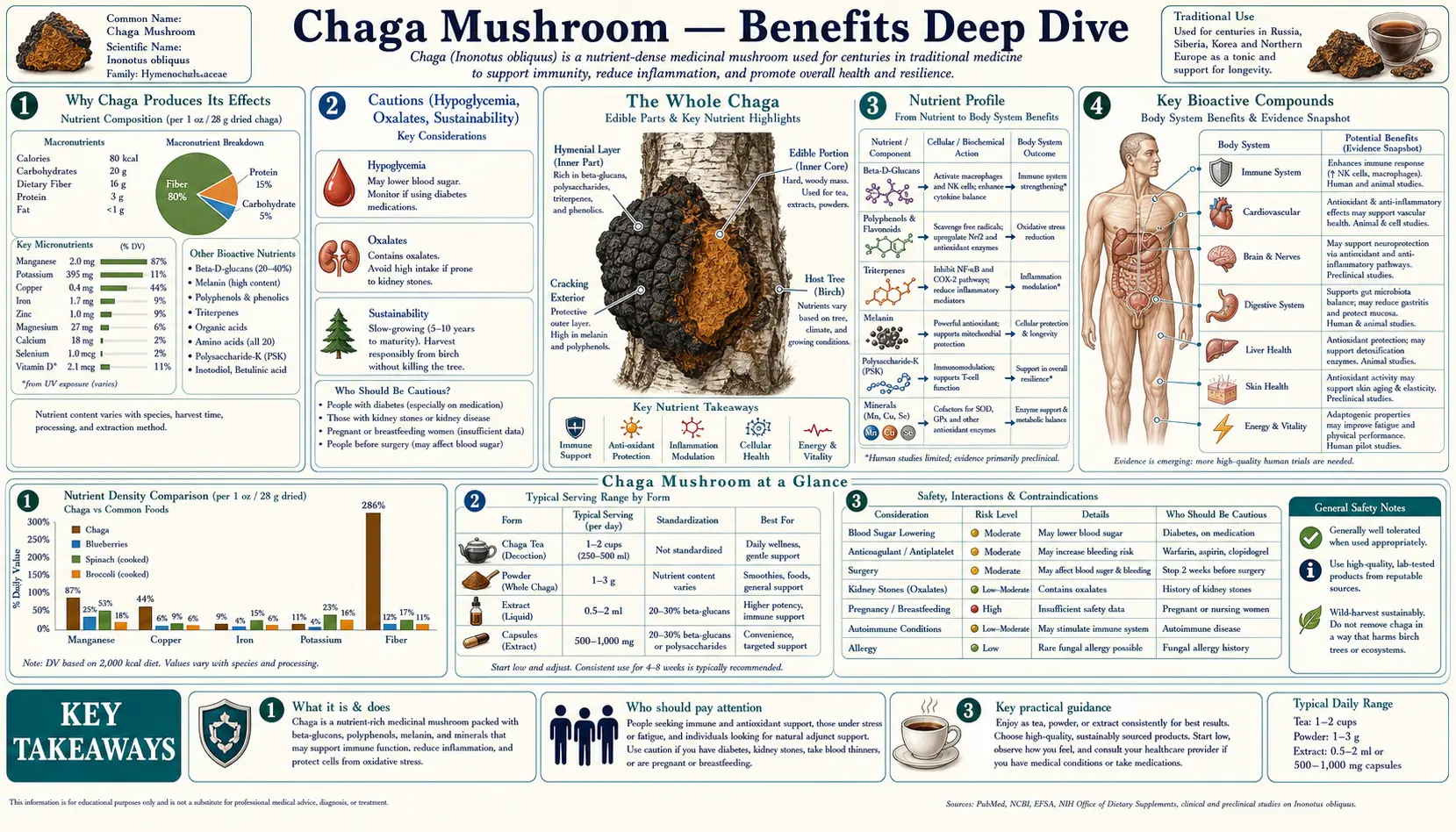
Chaga (Inonotus obliquus) is a parasitic black-charcoal fungus that grows almost exclusively on living birch trees in the boreal forests of Siberia, Northern Europe, Canada, and Alaska. Used in Traditional Chinese Medicine for over 4,000 years and central to Russian and Siberian folk medicine for at least 500 years, chaga concentrates an unusual combination of compounds: betulinic acid (extracted by the fungus from the white birch bark of its host tree, Betula pendula/Betula pubescens), beta-D-glucans and polysaccharides (immune-modulating cell-wall complex carbohydrates), melanin pigment (the black exterior responsible for chaga's color and a substantial fraction of its antioxidant capacity), and a unique concentration of superoxide dismutase (SOD) enzyme. The four deep-dive articles below explore each major use category. Sustainability warning: chaga grows on living birch trees over 15-80+ years, the global supply is finite, and wild-harvesting pressure from the supplement industry has measurably depleted populations in accessible regions. Cultivation alternatives exist but yield a chemically different product. The options described are documented sustainable sourcing or plant-based alternatives.
Deep-Dive Articles
Immune Modulation
Beta-D-glucans and polysaccharide-protein complexes act as the principal immune-active fraction in chaga, binding pattern-recognition receptors (Dectin-1, TLR-2/4, complement receptor 3) on macrophages, dendritic cells, and natural killer cells. The dual immunomodulatory mechanism — up-regulating innate immunity against pathogens while simultaneously suppressing inappropriate inflammation — is the same biological logic that underlies the Russian and Siberian folk-medicine tradition of using chaga tea daily as a tonic rather than as an acute remedy.
Read the deep dive →Antioxidant Capacity
Supplement marketing describes chaga sclerotium as having one of the highest Oxygen Radical Absorbance Capacity (ORAC) values of any food. The U.S. Department of Agriculture (USDA) withdrew its oxygen radical absorbance capacity database entirely because in vitro radical-scavenging numbers do not translate predictably to in vivo cellular antioxidant defense. That caveat noted, chaga's melanin pigment, betulinic acid contribution, and direct content of superoxide dismutase (SOD) enzyme give it a genuinely unusual antioxidant profile worth understanding mechanistically.
Read the deep dive →Cancer Research
Aleksandr Solzhenitsyn's 1968 novel Cancer Ward introduced Western readers to the Russian folk-medical tradition of chaga tea (chai chaga) as a cancer remedy — reportedly common in birch-rich peasant villages where stomach and gastric cancer rates were anomalously low. Modern in vitro and animal data show that betulinic acid induces apoptosis in several tumor cell lines and that crude chaga extracts inhibit tumor growth in mice. Human evidence remains preliminary. Honest framing: chaga is not a cancer treatment, and the historical claims must be read against the immense survivorship bias of folk medicine.
Read the deep dive →Adaptogenic Effects
Traditional Russian usage frames chaga as the «dar Bozhiy» — the "gift of God" — a daily tonic that helps the body endure cold, hunger, exhaustion, and the long Siberian winter. The modern adaptogen literature (Brekhman, Panossian) tries to put that intuition on a pharmacological footing: stress-response modulation, blood-glucose effects in diabetic animal models, fatigue reduction in chronically stressed mice. Plus the sustainability crisis: wild chaga grows back over decades, the wildcrafting boom has stripped accessible birch forests, and the cultivation alternatives produce a chemically different product.
Read the deep dive →Table of Contents
- Deep-Dive Articles
- Why Chaga Produces Its Effects
- Research Papers: Immune Modulation
- Research Papers: Antioxidant Capacity
- Research Papers: Cancer (Cell & Animal)
- Research Papers: Adaptogenic & Metabolic
- Cautions (Hypoglycemia, Oxalates, Sustainability)
- External Authoritative Resources
- Connections
- Featured Videos
Why Chaga Produces Its Effects
Most medicinal mushrooms (reishi, lion's mane, turkey tail, maitake) produce their effects through one principal class of bioactive: cell-wall beta-glucans plus a smaller cocktail of secondary metabolites. Chaga is unusual in that its biological activity rests on at least four distinct chemical families, three of which come from its parasitic relationship with the birch host tree. Each family maps to a different category of clinical effect.
- Beta-D-glucans and polysaccharide-protein complexes (cell-wall carbohydrates) — the standard medicinal-mushroom mechanism. Branched (1→3),(1→6) beta-glucans bind Dectin-1 and complement receptor 3 on macrophages, dendritic cells, and natural killer cells. This is the principal driver of immune modulation and the basis for chaga's use as a daily immune tonic.
- Betulinic acid and betulin (pentacyclic triterpenoids extracted from the birch host) — the fungus parasitizes Betula pendula/pubescens and concentrates birch-bark triterpenes that the tree synthesizes for its own defense. Betulinic acid is the chemical responsible for most of the in vitro apoptosis induction in tumor cell lines and a meaningful share of the anti-inflammatory activity. This is the unique chaga story: a fungus that lives on a tree concentrating the tree's defensive chemistry into its own body.
- Melanin pigment (the black charred-looking exterior of the chaga conk) — chemically a polyphenolic polymer with extensive conjugated double bonds. Melanin contributes a substantial fraction of chaga's total antioxidant capacity and likely accounts for the visible-spectrum color and a meaningful portion of the oxygen radical absorbance capacity value.
- Superoxide dismutase (SOD) enzyme and small polyphenols — chaga sclerotium contains genuine superoxide dismutase enzyme protein at concentrations unusual for any foodstuff, along with smaller polyphenols (caffeic acid derivatives, hispidin, inotodiol). Superoxide dismutase converts superoxide radical to hydrogen peroxide, which catalase then converts to water, and this enzymatic cascade is one of the body's primary defenses against oxidative damage. The clinical relevance of orally consumed superoxide dismutase is debated — protein enzymes are typically digested in the stomach — but chaga's superoxide dismutase content remains one of the cited points of distinction.
The therapeutic complication is that chaga's very breadth of activity makes dose-response prediction difficult, makes pharmaceutical-style standardization nearly impossible, and creates plausible interactions with several drug classes — especially anticoagulants (chaga has measurable anti-platelet effects), oral hypoglycemics and insulin (chaga lowers blood glucose in diabetic animal models), and immunosuppressants (the beta-glucan immune activation could in principle blunt the desired suppression). The fourth deep-dive page covers the adaptogenic and metabolic effects in more detail, including the specific hypoglycemia risk and the sustainability crisis facing wild chaga harvest.
Research Papers: Immune Modulation
- Kim YR (2005). Immunomodulatory activity of the water extract from medicinal mushroom Inonotus obliquus. Mycobiology. — PubMed
- Won DP et al. (2011). Immunostimulating activity by polysaccharides isolated from fruiting body of Inonotus obliquus. Molecules and Cells. — PubMed
- Ko SK, Jin M, Pyo MY (2011). Inonotus obliquus extracts suppress antigen-specific IgE production through the modulation of Th1/Th2 cytokines in ovalbumin-sensitized mice. Journal of Ethnopharmacology, 137(3), 1077–82. Animal (mouse allergy-model) study. — PubMed PMID: 21820502
- Beta-glucan binding to Dectin-1 pattern recognition receptor — PubMed
- Mishra SK, Kang JH, Kim DK, Oh SH, Kim MK (2012). Orally administered aqueous extract of Inonotus obliquus ameliorates acute inflammation in dextran sulfate sodium (DSS)-induced colitis in mice. Journal of Ethnopharmacology, 143(2), 524–32. Animal (mouse colitis) study. — PubMed PMID: 22819687
Research Papers: Antioxidant Capacity
- Cui Y et al. (2005). Antioxidant effect of Inonotus obliquus. Journal of Ethnopharmacology. — PubMed
- Najafzadeh M et al. (2007). Chaga mushroom extract inhibits oxidative DNA damage in lymphocytes of inflammatory bowel disease patients. — PubMed
- USDA withdrawal of ORAC database (2012) discussion — PubMed
- Melanin pigment polyphenolic antioxidant chemistry — PubMed
- Superoxide dismutase (SOD) enzyme content in Inonotus obliquus — PubMed
Research Papers: Cancer (Cell & Animal)
- Pisha E, Chai H, Lee IS, Chagwedera TE, Farnsworth NR, Cordell GA, Beecher CW, Fong HH, Kinghorn AD, Brown DM, et al. (1995). Discovery of betulinic acid as a selective inhibitor of human melanoma that functions by induction of apoptosis. Nature Medicine, 1(10), 1046–51. Cell and animal study of betulinic acid, a birch-bark compound, in human melanoma grown in athymic mice; chaga itself was not tested. — PubMed PMID: 7489361
- Fulda S (2008). Betulinic acid for cancer treatment and prevention. International Journal of Molecular Sciences. — PubMed
- Lemieszek MK, Langner E, Kaczor J, Kandefer-Szerszeń M, Sanecka B, Mazurkiewicz W, Rzeski W (2011). Anticancer effects of fraction isolated from fruiting bodies of Chaga medicinal mushroom, Inonotus obliquus (Pers.:Fr.) Pilát (Aphyllophoromycetideae): in vitro studies. International Journal of Medicinal Mushrooms, 13(2), 131–43. Cell-culture study. — PubMed PMID: 22135889
- Solzhenitsyn AI. Cancer Ward (1968 novel). The source of the chaga folk-medicine story described above; a work of fiction, not a research paper.
- Burczyk J, Gawron A, Slotwinska M, Smietana B, Terminska K (1996). Antimitotic activity of aqueous extracts of Inonotus obliquus. Bollettino Chimico Farmaceutico, 135(5), 306–9. Cell-culture study in human cervical cancer cells (HeLa S3). — PubMed PMID: 8942059
Research Papers: Adaptogenic & Metabolic
- Sun JE, Ao ZH, Lu ZM, Xu HY, Zhang XM, Dou WF, Xu ZH (2008). Antihyperglycemic and antilipidperoxidative effects of dry matter of culture broth of Inonotus obliquus in submerged culture on normal and alloxan-diabetes mice. Journal of Ethnopharmacology, 118(1), 7–13. Animal (mouse) study. — PubMed PMID: 18434051
- Kikuchi Y, Seta K, Ogawa Y, Takayama T, Nagata M, Taguchi T, Yahata K (2014). Chaga mushroom-induced oxalate nephropathy. Clinical Nephrology, 81(6), 440–4. Human case report. — PubMed PMID: 23149251
- Lee S, Lee HY, Park Y, Ko EJ, Ban TH, Chung BH, Lee HS, Yang CW (2020). Development of End Stage Renal Disease after Long-Term Ingestion of Chaga Mushroom: Case Report and Review of Literature. Journal of Korean Medical Science, 35(19), e122. Human case report. — PubMed PMID: 32419395
- Kwon O, Kim Y, Paek JH, Park WY, Han S, Sin H, Jin K (2022). Chaga mushroom-induced oxalate nephropathy that clinically manifested as nephrotic syndrome: A case report. Medicine (Baltimore), 101(10), e28997. Human case report. — PubMed PMID: 35451393
- Sustainability of wild Inonotus obliquus harvest in boreal forests — PubMed
Cautions (Hypoglycemia, Oxalates, Sustainability)
- Hypoglycemia risk — chaga has blood-glucose-lowering activity in diabetic animal models: in alloxan-diabetic mice, a chaga culture-broth extract (500 and 1000 mg/kg body weight for 21 days) lowered blood glucose by 30.07 and 31.30% after 3 weeks (Sun 2008). This raises a concern for people taking insulin, sulfonylureas or metformin, since the effect could add to these drugs. The size of the effect in people is unknown, and dosing is unpredictable.
- Oxalate content and kidney stones — chaga is high in oxalate. A 2014 case report (Kikuchi 2014) describes a 72-year-old Japanese woman with liver cancer who had taken chaga mushroom powder (4–5 teaspoons per day) for 6 months for her cancer; her kidney function fell, hemodialysis was started, and a kidney biopsy showed oxalate nephropathy. The authors note that chaga mushrooms contain extremely high oxalate concentrations. Later reports describe a 49-year-old Korean man with end-stage kidney disease after long-term use of chaga powder for severe atopic dermatitis, whose leftover chaga had an extremely high oxalate content (14.2/100 g) (Lee 2020), and a 69-year-old man who took chaga powder (10–15 g per day) and vitamin C (500 mg per day) for 3 months and developed acute kidney injury with calcium oxalate crystals in the kidney tubules; his kidney function recovered 1 month after hemodialysis and high-dose steroids were started (Kwon 2022). The concern is greatest for people with a history of calcium-oxalate kidney stones, chronic kidney disease, or significant dehydration. Occasional ceremonial use is different from daily tonic use.
- Anticoagulant interaction — chaga has measurable in-vitro anti-platelet activity. This raises a bleeding concern for people taking warfarin, apixaban, rivaroxaban, clopidogrel, or even chronic aspirin; with warfarin, the international normalized ratio (INR) blood test is the measure that shows a change in clotting.
- Immunosuppressant interaction — the beta-glucan immune-stimulating effect could theoretically blunt cyclosporine, tacrolimus, mycophenolate, or biologic immunosuppressants. The concern is greatest for transplant recipients and people on immunosuppression for autoimmune disease.
- Sustainability crisis — chaga is a slow-growing parasitic fungus that takes 15-80 years to reach harvestable size on a single birch tree, and the wildcrafting boom for the international supplement market has stripped accessible birch forests in Northern Europe, Russia, Maine, Vermont, and parts of Alaska and Canada. Cultivated chaga (grown on artificial substrate or via submerged liquid culture) yields a chemically different product — lower in birch-derived betulinic acid and melanin, higher in ergosterol and synthesized polysaccharides. The choice for buyers is between documented sustainable wildcrafted material and cultivated material with its different chemistry.
- Quality and adulteration — the chaga supplement market is poorly regulated. Common adulteration: ground-up burl wood sold as chaga powder, alcohol extracts that have lost the water-soluble polysaccharide fraction, "chaga" products from non-birch hosts (which contain no birch-derived betulinic acid). Whole-chunk material from a verified source is harder to pass off than powder.
External Authoritative Resources
- National Cancer Institute — Complementary and Alternative Medicine in Cancer Care — honest framing on medicinal mushroom claims in oncology
- Memorial Sloan Kettering Cancer Center — Chaga Herb-Drug Interactions and Evidence Summary
- U.S. Department of Agriculture Forest Service (Alaska Region) — Hardwood Stem Decays: chaga (Inonotus obliquus)
- PubMed — All research on Inonotus obliquus / chaga (~600+ papers)
- European Medicines Agency — Herbal Medicinal Products Committee (chaga is not yet an European Medicines Agency (EMA) monograph; useful for comparing to herbs that are)