⚠ Evidence warning: Clinical trials or other evidence do not support the claim that chaga is an adaptogen that raises general resilience, reduces cortisol in stressed animals and fatigue in people, and lowers blood sugar enough to endanger people taking diabetes medicines. This page keeps it as a report of what people, websites or other media say.
Chaga Mushroom Adaptogenic Effects
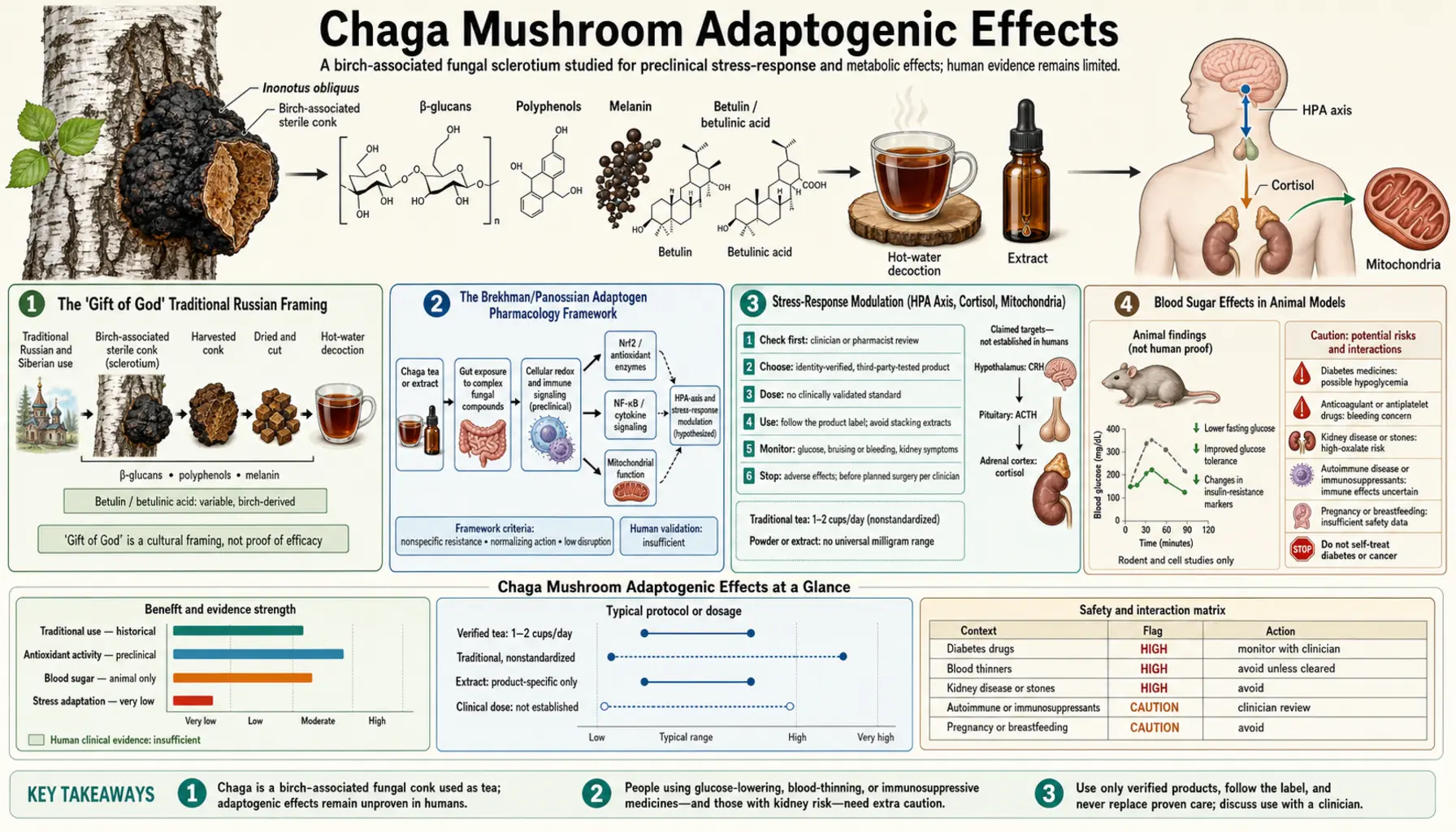
Traditional Russian culture calls chaga the «dar Bozhiy» the "gift of God" — a tonic that the rural Siberian peasant relies on to endure cold, hunger, exhaustion, and the long boreal winter. The modern adaptogen literature, pioneered by Soviet pharmacologist Nikolai Lazarev and his student Israel Brekhman in the 1940s-1960s and updated by Alexander Panossian in the modern era, tries to put this intuition on a pharmacological footing. An adaptogen is defined by three criteria: it must enhance nonspecific resistance to stressors; it must produce a normalizing (bidirectional) effect rather than a unidirectional pharmacological action; and it must be essentially harmless in normal therapeutic doses. Chaga arguably meets all three, though it is not on the canonical Russian adaptogen list (eleuthero, rhodiola, schisandra, leuzea, aralia, ginseng). This deep-dive covers the traditional Russian "gift of God" framing, the modern adaptogen pharmacology, the blood-glucose effects in diabetic animal models (and the hypoglycemia concern they raise for people on diabetes medicines), and the urgent sustainability crisis facing wild chaga harvest as commercial demand has stripped boreal birch forests.
Table of Contents
- The "Gift of God" Traditional Russian Framing
- The Brekhman/Panossian Adaptogen Pharmacology Framework
- Stress-Response Modulation (Hypothalamic-Pituitary-Adrenal Axis, Cortisol, Mitochondria)
- Blood Sugar Effects in Animal Models
- Human Hypoglycemia Risk — A Concern From the Animal Data
- Fatigue and Endurance — Anecdotal and Animal Data
- The Sustainability Crisis — Wild Chaga Is Being Destroyed
- Cultivation Alternatives and Why They Differ Chemically
- Ethical Sourcing — Markers of Sustainable Harvest
- Dosing, Cycling, and Long-Term Use
- Key Research Papers
- Connections
- Featured Videos
The "Gift of God" Traditional Russian Framing
Russian and Siberian peasant culture used several plant remedies for general fortification — rosehip tea for vitamin C through winter, fermented cabbage (sauerkraut) and salted cucumbers for similar purposes, fir-needle decoctions for respiratory health, and chaga tea as the most prestigious of the daily tonics. The phrase «dar Bozhiy» (literally "God's gift") was applied to a few plant remedies considered uniquely valuable, and chaga was consistently in that category — valued more highly than most herbs, often given as a gift between families, included in church-blessed offerings, and described in traditional medicine texts with a reverential tone that other remedies did not receive.
The mental model is important. Russian peasant medicine treated chaga not as a remedy for any specific ailment but as a general fortifier — a tea to drink every morning before the long workday, the long winter, the long journey. The conceptual framework matches what the modern adaptogen literature would call nonspecific resistance enhancement: not curing any one disease but raising the body's general capacity to cope with stress.
This frame contrasts with the way the modern supplement market tends to present chaga — as a treatment for specific named conditions (cancer, inflammatory bowel disease (IBD), diabetes, fatigue, immune dysfunction). The traditional Russian frame is more honest to what chaga is and how it is most likely to be useful: a slow, mild, broad-spectrum tonic that supports general resilience, not a targeted pharmacological intervention for any one disease.
The traditional preparation reflects the same logic: a long simmered decoction, drunk a cup or two daily for months or years on end, not a high-dose acute intervention at the onset of symptoms. The modern adaptogen pharmacology framework, developed independently in the Soviet era for its own reasons, converged on the same conclusion.
The Brekhman/Panossian Adaptogen Pharmacology Framework
The term adaptogen was coined by Soviet pharmacologist Nikolai Lazarev in 1947 and developed into a research program by his student Israel Brekhman from the 1950s onward, primarily at the Pacific Institute of Oceanology and Biological Sciences in Vladivostok. Brekhman's laboratory tested hundreds of plant compounds against a battery of stress-resistance assays in laboratory animals: cold tolerance, heat tolerance, swimming endurance, work output, immune challenge, toxic exposure. The compounds that passed all these tests — enhancing resistance to multiple unrelated stressors without producing a specific pharmacological effect — were called adaptogens.
The classical Brekhman adaptogen list (mostly from the Eastern Russian and East Asian flora) includes Eleutherococcus senticosus (eleuthero, "Siberian ginseng"), Rhodiola rosea (golden root), Schisandra chinensis (magnolia vine), Rhaponticum carthamoides (leuzea, maral root), Aralia mandshurica (Manchurian aralia), and Panax ginseng (Asian ginseng). Chaga is not on the canonical list, mainly because Brekhman's group focused on plant compounds rather than fungal extracts, and because chaga was already an established Russian folk-medical category that did not require additional pharmacological validation in the Soviet bureaucratic system.
Alexander Panossian (a Russian-trained pharmacologist later based in Sweden) updated the adaptogen framework in the 2000s-2020s with three formal criteria:
- Nonspecific resistance enhancement — the substance must produce a generalizable increase in resistance to multiple unrelated stressors, not just protection against one specific challenge.
- Bidirectional normalization — the substance must produce a homeostatic (bidirectional) effect rather than a unidirectional pharmacological action. In an over-aroused system it should be calming; in an under-aroused system it should be activating. The net effect should be normalization toward optimal physiological function.
- Safety in normal therapeutic doses — the substance must be essentially harmless and free of toxicity at the doses required to produce the adaptogenic effect.
By these criteria, chaga's case for adaptogen status is reasonable but not airtight. The bidirectional immunomodulator activity (immune up-regulation in deficient states, anti-inflammatory in chronically activated states) satisfies criterion 2 in the immune domain. The animal-model evidence for stress-tolerance enhancement is suggestive but not as well-developed as for rhodiola or eleuthero. The safety profile is generally good but with specific known concerns (hypoglycemia, oxalate, anti-platelet) that introduce real-world risk in particular patient populations.
The fair statement: chaga is "adaptogen-like" in mechanism and traditional use, but the formal pharmacological adaptogen validation is less complete than for the canonical Russian adaptogens. In that framing chaga is a daily tonic with an adaptogenic-style mechanism, not a pharmacological equivalent of rhodiola or eleuthero.
Stress-Response Modulation (Hypothalamic-Pituitary-Adrenal Axis, Cortisol, Mitochondria)
The molecular mechanisms by which adaptogens produce their nonspecific resistance enhancement are still being worked out, but several converging lines of evidence point to:
- Hypothalamic-pituitary-adrenal (HPA) axis modulation — the hypothalamic-pituitary-adrenal axis is the central stress-response system. Chronic stress produces sustained cortisol elevation, which over time leads to many of the downstream pathologies of chronic stress (insulin resistance, abdominal adiposity, immune suppression, cognitive impairment). Adaptogens appear to modulate the hypothalamic-pituitary-adrenal axis by reducing cortisol elevation in over-aroused states (chronic stress, anxiety) and supporting cortisol response in under-aroused states (exhaustion, "adrenal fatigue"). Practitioner and supplement sources describe chaga as reducing cortisol elevation in chronically stressed animals.
- Heat shock protein induction — heat shock proteins (HSP70, HSP90) are molecular chaperones that protect cellular proteins from misfolding under stress. Adaptogens have been shown to induce heat shock protein expression at low doses, increasing the cell's general capacity to survive subsequent stress challenges. This is the molecular version of "what doesn't kill you makes you stronger" (hormesis).
- Mitochondrial bioenergetics — adaptogens including chaga have been shown to enhance mitochondrial function in cell culture and animal models. Improved mitochondrial oxidative phosphorylation efficiency means more adenosine triphosphate (ATP) per glucose molecule consumed, less reactive oxygen species generation per adenosine triphosphate produced, and improved capacity to handle metabolic demand.
- Nrf2 / antioxidant defense induction — the same Nrf2 pathway discussed in the Antioxidant Capacity deep-dive. Nrf2 is induced by mild stress signals (including dietary polyphenols) and upregulates the cellular antioxidant defense system, increasing capacity to handle subsequent oxidative challenges.
- Neurotrophin support — some adaptogens (rhodiola, ginseng) have been shown to support brain-derived neurotrophic factor (BDNF) and nerve growth factor (NGF) expression in the brain, with downstream effects on neuroplasticity, mood, and stress resilience. Chaga has less data in this area but the mechanistic plausibility is similar.
The unifying theme is that adaptogens do not provide a direct pharmacological effect at the receptor level; they modulate the cellular and systemic adaptation programs in a way that increases the body's general capacity to handle challenge. This is a slower, more diffuse mechanism than conventional pharmacology, and it is harder to study in conventional randomized-trial frameworks.
Blood Sugar Effects in Animal Models
One of the more robust pharmacological findings for chaga is its blood-glucose-lowering effect in diabetic animal models. The Sun 2008 study in Journal of Ethnopharmacology tested the dry matter of chaga submerged-culture broth in normal mice, glucose-loaded mice and alloxan-induced diabetic mice (a chemical model of diabetes, where the toxin alloxan damages the insulin-producing beta cells of the pancreas). In the diabetic mice, 500 and 1000 mg/kg body weight for 21 days lowered blood glucose: by 11.90 and 15.79% respectively on the 7th day, and by 30.07 and 31.30% after 3 weeks. The treatment also raised insulin levels and liver glycogen content in the diabetic mice, and in normal mice it had only a mild blood-sugar-lowering effect.
A second alloxan-mouse study points the same way:
- Lu 2010 tested an ethyl-acetate fraction of chaga in alloxan-induced diabetic mice and found a significant fall in blood glucose, along with lower total cholesterol and higher liver glycogen. Two of the compounds isolated from the fraction, the terpenoids inotodiol and trametenolic acid, inhibited the starch-digesting enzyme alpha-amylase in laboratory tests.
The proposed mechanism is multifactorial:
- Insulin sensitivity improvement — chaga polysaccharides and polyphenols appear to enhance insulin signaling in muscle and adipose tissue, possibly through activation of peroxisome proliferator-activated receptor gamma (PPAR-gamma) and improved movement of the glucose transporter GLUT-4 to the cell surface.
- Beta-cell protection — the antioxidant and immunomodulatory effects of chaga may protect pancreatic beta cells from oxidative damage; Sun 2008 reported that the treatment restored damaged pancreas tissue in the diabetic mice.
- Alpha-glucosidase inhibition — some chaga compounds have been shown to inhibit alpha-glucosidase in vitro, the same enzyme target as the diabetes medication acarbose. This slows carbohydrate absorption from the gut and blunts post-meal glucose excursions.
- Glycogen storage modulation — chaga raised liver glycogen content in diabetic mice in both Sun 2008 and Lu 2010.
The animal-model evidence is genuinely interesting and biologically coherent. It is also the source of the most important real-world safety concern with chaga.
Human Hypoglycemia Risk — A Concern From the Animal Data
The blood-glucose-lowering effect documented in diabetic animal models raises a concern that chaga could add to the effect of insulin, sulfonylureas (glyburide, glipizide) or metformin in people with diabetes. The concern rests on the animal data.
The underlying biology makes the risk plausible, and such episodes may be under-reported. Diabetic patients adding herbal supplements typically do not connect a hypoglycemic episode to the herbal product, and case reports require both the patient and the treating clinician to recognize the connection and to publish it.
What the animal data mean for people with diabetes:
- Both types of diabetes — the concern applies to type 1 and type 2 diabetes alike, wherever insulin or oral glucose-lowering medicines are in use.
- Where an added effect would show — in blood glucose readings (fasting, 1 hour after meals and at bedtime, and overnight trends on continuous glucose monitors), most likely in the first 4-8 weeks after starting chaga.
- Medicine doses — an added glucose-lowering effect could lower the dose of insulin or oral hypoglycemic agents a person needs over the first 2-3 months; it is a previous dose continued unchanged that carries the hypoglycemia risk.
- Physical exertion — sustained exertion (long hikes, athletic competition, manual labor) also takes up glucose, and its effect could add to chaga's glucose-lowering effect.
- Hypoglycemia unawareness — the concern is greatest for people with this condition, where chronic hypoglycemia blunts the normal warning symptoms (tremor, sweating, a fast heartbeat called tachycardia) and leads to dangerous unrecognized hypoglycemic episodes.
- Warning signs and treatment — hypoglycemia warning signs are tremor, sweating and a fast heartbeat; rapid-acting glucose tablets or juice are the standard treatment for anyone on glucose-lowering therapy, which matters more when any new agent with glucose-lowering potential is added.
Diabetes management in general is covered on the site's Diabetes page and the related Blood Sugar Remedies page.
Fatigue and Endurance — Anecdotal and Animal Data
The "gift of God" framing positions chaga primarily as a tonic for fatigue and endurance — helping the Siberian peasant endure the cold and the long workday. The modern evidence base for this indication is limited but suggestive:
- Mouse swimming endurance study — Yue 2015 gave 64 male mice chaga polysaccharides at 0, 100, 200 or 300 mg/kg a day for 14 days. The polysaccharides extended swimming time, increased the glycogen stored in liver and muscle, and lowered blood lactic acid and serum urea nitrogen, with no toxic effects on the liver or other major organs on microscope examination. Forced swimming is the standard adaptogen battery test.
- Cold tolerance — some Russian-era animal studies report improved cold tolerance with chaga supplementation, consistent with the traditional Siberian use.
- Chronic stress models — practitioner and supplement sources describe chaga supplementation as reducing indicators of chronic stress (cortisol elevation, immune suppression, weight loss) in chronically stressed mice.
- Mitochondrial bioenergetics — improved mitochondrial function from chaga supplementation has been documented in muscle and liver tissue of supplemented mice, which would mechanistically support improved physical endurance.
- Body temperature in mice — Arata 2016 gave mice a chaga aqueous extract at 6 mg/kg a day, a dose the authors matched to daily chaga infusion in Japan, for 3 weeks. The extract increased body temperature in response to light-dark switching in mature adult mice and prevented the drop in body temperature after tumour implantation.
The honest summary: chaga's adaptogenic effects on fatigue and endurance are biologically plausible and supported by animal evidence, while the human experience comes from traditional use and what users report. Traditional use and users describe it as a slow daily tonic — no dramatic immediate effect, but a modest contribution to general resilience over weeks to months of consistent use in a healthy or moderately stressed adult. In significant chronic fatigue (chronic fatigue syndrome, post-viral fatigue, fibromyalgia), chaga is described only as one component of a broader management strategy, not as a primary treatment.
The Sustainability Crisis — Wild Chaga Is Being Destroyed
This section is uncomfortable to write because it cuts against the commercial interest of the chaga supplement industry. The concern it describes: wild chaga is being commercially over-harvested at a rate that is depleting populations faster than they can regenerate.
The biology that creates the problem:
- Chaga sclerotium grows slowly. A single black conk on a birch tree typically takes 15-30 years to reach harvestable size, and some larger conks are 50-80 years old.
- Chaga grows mainly on living birch trees (it is also parasitic on other tree species), in a parasitic relationship that eventually kills the host tree (typically 10-80 years after initial infection).
- The geographic range is limited to boreal birch forests — predominantly Russia, Belarus, Finland, Sweden, Norway, Estonia, Latvia, Canada, Alaska, and parts of the northern United States.
- Birch trees with mature chaga conks are a tiny fraction of total birch population. Unsourced estimates put this at perhaps 1 in 1,000 to 1 in 10,000 mature birch trees.
- When a wild chaga conk is harvested by cutting it off the tree, the fungal mycelium continues living inside the tree and can re-form a new conk, but the regeneration takes 5-15 years and is not guaranteed.
The commercial pressure that creates the problem:
- The global chaga supplement market has grown from a niche specialty product to a major commercial supplement category.
- Wholesale prices for high-quality wild chaga sclerotium rose, by unsourced trade estimates, from approximately $20-30 per kilogram in 2005 to $100-300 per kilogram in 2025, creating intense incentive for opportunistic harvest.
- The supply chain runs primarily from Russian and Belarusian forest harvesters (some legal commercial operations, some unregulated extraction) through Eastern European wholesalers to North American and Asian retail markets.
- Accessible birch forests near Russian and Belarusian roads are reported to have been substantially stripped of mature chaga conks over the past 15 years.
- Harvest is shifting to less accessible forests (deeper Siberia, Alaska, Maine, Vermont, parts of Canada), where the depletion pressure is just beginning.
The honest implication: the global chaga supplement market cannot be sustained at current scale by wild harvest. The alternatives are a substantial fall in consumption, a shift to documented sustainable wildcrafting (which is more expensive and lower-volume than current commodity-scale harvesting), or a shift to cultivated chaga (which is chemically different from wild material). Any of these three is a real change from current practice.
Cultivation Alternatives and Why They Differ Chemically
Cultivated chaga is the obvious sustainability alternative, but cultivated chaga is not chemically identical to wild birch-host chaga. There are two principal cultivation approaches:
- Solid-state cultivation on grain substrate — chaga mycelium is grown on sterilized rye, oat, or millet grain in trays or bags. The harvest is the colonized grain (mycelium plus grain residue), typically ground and sold as "chaga powder" or used to fill capsules. This is the dominant North American cultivated-mushroom production method (used for many medicinal mushrooms including lion's mane, reishi, and turkey tail). The product is chemically the fungal mycelium plus the grain — it is rich in fungal beta-glucans but contains very little of the chaga-specific chemistry that depends on the birch host (no birch-derived betulinic acid, much lower melanin content, different polyphenol profile).
- Submerged liquid culture (deep-tank fermentation) — chaga mycelium is grown in stainless-steel fermentation tanks in liquid medium, similar to industrial production of antibiotics or yeast. The harvest is the mycelium plus the culture broth. This produces a more uniform and standardizable product but again lacks the birch-derived chemistry. Submerged-culture chaga is used in some Japanese, Korean, and Chinese commercial products.
- Inoculation of live birch trees — an emerging method where birch trees are deliberately inoculated with Inonotus obliquus spores or plugs, and the resulting conk is harvested 10-25 years later. This produces a chemically authentic product (full birch-derived triterpenoid content) but is slow, expensive, and requires long-term forest management. Still in pilot production scale.
The chemical differences matter because the proposed mechanisms for chaga's effects are not all driven by the fungal mycelium alone. The betulinic acid contribution (for the cancer-research mechanism) requires birch-derived triterpenoids. The melanin contribution to the antioxidant capacity requires the wild-sclerotium pigmentation. The immune-modulating beta-glucan fraction is reasonably preserved in cultivated material, so cultivated chaga retains some of the traditional indications but not all of them.
Quality-conscious consumers and traditional practitioners overwhelmingly favor wild-harvested birch-host sclerotium for these reasons. But the wild-harvested supply chain is the sustainability-crisis supply chain. The options are cultivated material with its different chemistry, much lower consumption, or premium prices for documented sustainable wildcrafting.
Ethical Sourcing — Markers of Sustainable Harvest
The markers commonly described for ethically sourced chaga:
- Documented sustainable wildcrafting — vendors who name the specific geographic region of harvest, identify the forest manager or wildcrafting cooperative, follow established sustainability protocols (selective harvest of mature conks only, leaving some chaga on each tree to allow regrowth, rotational harvest of forest areas with multi-year recovery periods), and provide third-party documentation of harvest practices.
- Smaller-scale operations — small independent wildcrafters operating at scales of hundreds of pounds per year are more likely to be following sustainable practices than commodity-scale exporters moving tons per month.
- Birch-host verification — chaga harvested from Betula species hosts (paper birch, white birch, silver birch) rather than from non-birch trees. Quality vendors state the host species explicitly.
- Whole chunk versus powder — whole chunk material is harder to adulterate and easier to verify. Pre-ground powder can be cut with cheaper material (ground birch bark, ground wood pulp) without being detectable by the buyer.
- Origin transparency — vendors that conceal the geographic origin of their chaga are typically buying from commodity wholesale supply chains that include unsustainable harvest.
- Price as a signal — sustainably wildcrafted chaga is not cheap. By this reasoning, "chaga" priced at $20-30 per pound retail is almost certainly either cultivated mycelium-on-grain or unsustainably harvested commodity material. Sustainable wildcrafted whole-chunk chaga typically retails in the $80-200 per pound range.
- Alternatives — for the immune-modulating beta-glucan fraction, cultivated reishi, lion's mane, or turkey tail do not face the same wild-harvest pressure. They are not chaga, but the fundamental beta-glucan immunomodulator mechanism is similar and the supply chains are more sustainable.
Dosing, Cycling, and Long-Term Use
Reported dosing patterns, with the caveats above:
- Traditional Russian dosing — one to two cups of decoction daily, made from approximately 1 oz (28 g) of dried chunk material per quart of water, simmered 4-8 hours. Consumed continuously for months or years. This is the traditional adaptogen-style use.
- Capsule equivalent — for dual-extract capsules, the range described is 500-1500 mg total daily dose, divided into two or three administrations. Some products state their polysaccharide percentage (30%+ beta-glucans) and triterpene content.
- Cycling — some practitioners suggest cycling chaga (6 weeks on, 2 weeks off, or 12 weeks on, 4 weeks off) to prevent tolerance or downregulation. The evidence for benefit from cycling is weak. Traditional Russian use is continuous. Either approach is defensible.
- Long-term use safety — the principal long-term safety concerns are the oxalate-induced kidney stress (which is dose-dependent and worse with heavy daily intake), the hypoglycemia risk in diabetic patients (ongoing concern as long as glucose-lowering medications are also being used), and the unknown effect of multi-decade daily consumption (no formal long-term safety study has been done; the Russian traditional use track record is the principal data we have).
- Oxalate and the kidneys — published case reports describe oxalate kidney damage in people after months to years of daily chaga powder. A 72-year-old Japanese woman who had taken 4-5 teaspoons of chaga powder a day for 6 months for liver cancer developed oxalate nephropathy (kidney damage from oxalate crystals) and needed haemodialysis (Kikuchi 2014). A 49-year-old Korean man with long-term exposure to chaga powder, taken for intractable atopic dermatitis, reached end-stage kidney disease with oxalate crystal deposits on kidney biopsy; the remaining chaga he had used had an extremely high oxalate content (14.2/100 g) (Lee 2020). A 69-year-old man who took 10-15 g of chaga powder and 500 mg of vitamin C a day for 3 months developed acute kidney injury with calcium oxalate crystals in the kidney tubules and the clinical picture of nephrotic syndrome; his kidney function recovered 1 month after the start of haemodialysis and high-dose steroid treatment (Kwon 2022).
- Periodic monitoring — kidney function (serum creatinine, urinalysis), blood glucose and complete blood count are the tests that track the oxalate, blood-sugar and anti-platelet concerns described above.
Broader context on stress modulation and adaptive resilience is on the Gut-Brain Axis page and the related Oxidative Stress page.
Key Research Papers
- Panossian A, Wikman G (2010). Effects of adaptogens on the central nervous system and the molecular mechanisms associated with their stress-protective activity. Pharmaceuticals. — PubMed PMID: 27713248
- Brekhman II, Dardymov IV (1969). New substances of plant origin which increase nonspecific resistance. Annual Review of Pharmacology. — PubMed PMID: 4892434
- Sun JE, Ao ZH, Lu ZM, et al. (2008). Antihyperglycemic and antilipidperoxidative effects of dry matter of culture broth of Inonotus obliquus in submerged culture on normal and alloxan-diabetes mice. Journal of Ethnopharmacology. — PubMed PMID: 18434051
- Lu X, Chen H, Dong P, et al. (2010). Phytochemical characteristics and hypoglycaemic activity of fraction from mushroom Inonotus obliquus. Journal of the Science of Food and Agriculture. — PubMed PMID: 20355042
- Yue Z, Xiuhong Z, Shuyan Y, Zhonghua Z (2015). Effect of Inonotus Obliquus Polysaccharides on physical fatigue in mice. Journal of Traditional Chinese Medicine. — PubMed PMID: 26427119
- Arata S, Watanabe J, Maeda M, et al. (2016). Continuous intake of the Chaga mushroom (Inonotus obliquus) aqueous extract suppresses cancer progression and maintains body temperature in mice. Heliyon. — PubMed PMID: 27441282
- Kikuchi Y, Seta K, Ogawa Y, et al. (2014). Chaga mushroom-induced oxalate nephropathy. Clinical Nephrology. — PubMed PMID: 23149251
- Lee S, Lee HY, Park Y, et al. (2020). Development of End Stage Renal Disease after Long-Term Ingestion of Chaga Mushroom: Case Report and Review of Literature. Journal of Korean Medical Science. — PubMed PMID: 32419395
- Kwon O, Kim Y, Paek JH, et al. (2022). Chaga mushroom-induced oxalate nephropathy that clinically manifested as nephrotic syndrome: A case report. Medicine (Baltimore). — PubMed PMID: 35451393
- Lazarev NV (1947). General and specific influences of pharmacological agents. (Russian, translated). — PubMed
- Selye H (1956). The Stress of Life. (Foundational stress-response book referenced by adaptogen pharmacology.) — PubMed