Holy Basil (Tulsi): History and Traditional Use
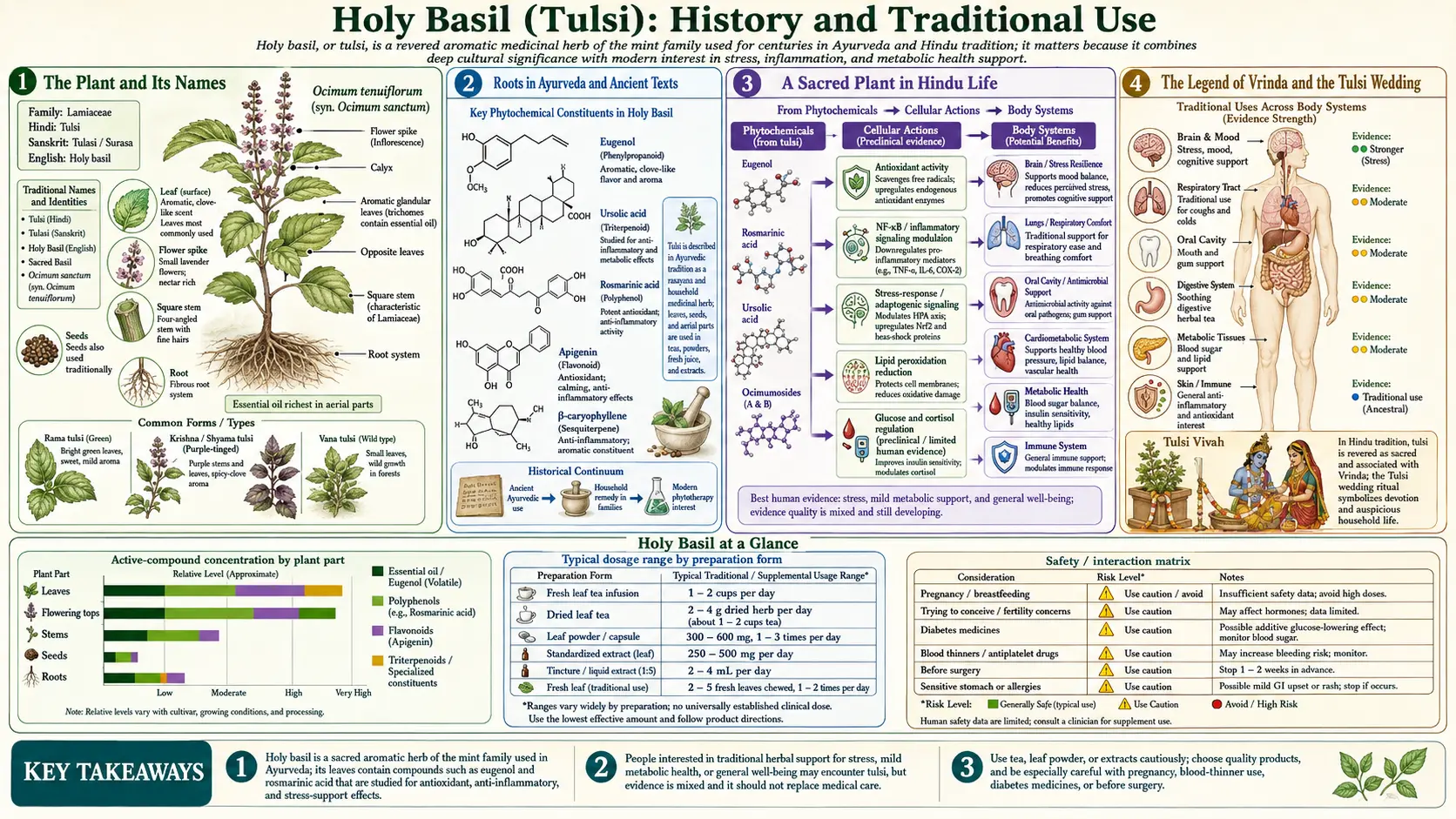
Few plants in the world are loved quite the way Holy Basil is loved in India. Known in Sanskrit as Tulsi (often spelled Tulasi), it is not merely an herb but a sacred presence — grown in courtyards, tended with daily prayers, and honored as a goddess. For thousands of years it has been used as a remedy and a daily tonic, and today modern researchers are beginning to study what generations of households already believed. This page tells that story plainly: where Tulsi comes from, how it has been used across cultures, the legends woven around it, and how its long tradition connects to present-day science. Where something is religious belief or folk tradition rather than established fact, we say so clearly.
Table of Contents
- The Plant and Its Names
- Roots in Ayurveda and Ancient Texts
- A Sacred Plant in Hindu Life
- The Legend of Vrinda and the Tulsi Wedding
- Rama, Krishna, and Vana: The Traditional Types
- Traditional Medicinal Uses
- Travels Beyond India and the Name “Holy Basil”
- From Tradition to Modern Research
- Research Papers and References
- Connections
- Featured Videos
The Plant and Its Names
Holy Basil is the common English name for Ocimum tenuiflorum L., a fragrant member of the mint family (Lamiaceae). The plant was given a formal botanical name by the Swedish naturalist Carl Linnaeus in 1753, and for a long time it was widely known by his later synonym Ocimum sanctum L. — literally “sacred basil.” Both names refer to the same plant, and older research papers in particular still use Ocimum sanctum. It is native to the tropical and subtropical regions of Asia and has been cultivated for so long that pinning down a single wild origin is difficult; botanically and culturally its home is the Indian subcontinent.
The plant’s most important name is not Latin but Sanskrit. Tulsi is traditionally translated as “the incomparable one,” a description that captures the esteem in which it has long been held. In the Ayurvedic tradition it carries further honorifics — it is commonly called the “Queen of Herbs,” and has been described as the “Mother Medicine of Nature” and an “elixir of life” believed to promote long life and well-being. These are traditional epithets rather than scientific claims, but they tell us plainly how the plant has been regarded for generations.
Like many long-cultivated plants, Tulsi acquired a dense layer of local names across the regions where it grows, and the simple fact that it has so many names — and a place in homes, kitchens, and temples alike — is itself a record of how familiar and how valued the plant has been across a very large part of Asia.
Roots in Ayurveda and Ancient Texts
Tulsi’s documented medicinal career belongs above all to Ayurveda, the traditional system of medicine of the Indian subcontinent. Reviews of the plant note that it is referred to in Ayurvedic literature as one of the main pillars of herbal medicine, and one peer-reviewed account dates its first textual mention to the Rig Veda at roughly 1500 BCE — which, if accurate, would make its written record more than three thousand years old. Dates this far back are necessarily approximate and debated among scholars, so it is fairest to say that Tulsi’s use is ancient and runs back thousands of years, rather than to fix it to a precise year.
Tulsi is also recorded in the Charaka Samhita, one of the foundational texts of Ayurveda; the herb is named by Charaka, the figure traditionally associated with that text. Within the Ayurvedic framework Tulsi is classified as a rasayana — a category of rejuvenating tonics taken to nourish the body, support longevity, and strengthen resilience — and it is described as helping to balance the three doshas (Vata, Pitta, and Kapha). It is important to be clear that these are concepts internal to the Ayurvedic tradition; they describe how the herb was understood and prescribed, not findings established by modern laboratory science.
What the historical record shows reliably is a remarkable continuity of use: for as far back as the texts reach, Tulsi has been taken in much the same ways — as a daily tonic and as a remedy for coughs, fevers, digestive complaints, and skin conditions — and that continuity is exactly what has drawn modern researchers to study it.
A Sacred Plant in Hindu Life
What sets Tulsi apart from almost every other medicinal herb is that, in Hinduism, it is not only a medicine but an object of worship. In many Hindu households — particularly within the Vaishnava tradition, which is devoted to the god Vishnu — the plant is treated as sacred, and every part of it is revered. A traditional Hindu home was often said to be incomplete without a Tulsi plant, customarily grown in a special raised pot or masonry planter (the tulsi vrindavan) set in the courtyard, where it is watered, circled, and offered prayers, especially in the evening.
Tulsi is widely understood in this tradition as a manifestation of a goddess. It is associated with the goddess Lakshmi, the consort of Vishnu, and in many tellings the plant is the goddess Vrinda (also called Tulsi) in living form. Devotees of Vishnu, the Vaishnavites, have traditionally been described as “those who bear the tulsi” — beads carved from Tulsi wood are worn and used as prayer rosaries. None of this is medical or scientific; it is religious belief and devotional practice, and it is recorded here because it is inseparable from the plant’s history and explains why Tulsi has been protected, propagated, and kept close to so many homes for so long.
That sacred status had a very practical consequence for the plant’s survival and spread: an herb that is worshipped is an herb that is planted everywhere, tended carefully, and passed from household to household across generations — which is part of why Tulsi remains one of the most widely grown medicinal plants in India today.
The Legend of Vrinda and the Tulsi Wedding
The reverence for Tulsi is anchored in a well-known piece of Hindu mythology — a story, not a historical event, and presented here as the tradition tells it. In the most widely recounted version, a devout woman named Vrinda was married to a powerful demon named Jalandhara. So long as Vrinda remained faithful, her husband could not be defeated. According to the legend the god Vishnu intervened, and from Vrinda’s ashes there sprang a plant; Vishnu named that plant Tulsi and declared that it would be honored forever and worshipped alongside his sacred shaligram stone. In this and related tellings Vrinda is regarded as an incarnation of the goddess Lakshmi, which is why Tulsi is venerated as a goddess in plant form.
This myth is reenacted every year in the festival of Tulsi Vivah — the ceremonial “wedding” of the Tulsi plant to Vishnu (in the form of the shaligram stone or an image of Krishna). It is celebrated in the Hindu month of Kartik, on a day between Prabodhini Ekadashi and Kartik Purnima (falling in October or November), and traditionally marks the opening of the Hindu wedding season. The plant is decorated as a bride, and the rite is performed in homes and temples across India. The festival is a living tradition observed today; the underlying story is sacred legend, and we present it as such rather than as documented history.
Rama, Krishna, and Vana: The Traditional Types
Indian tradition recognizes several distinct types of Tulsi, and the two most consistently named in classical Hindu texts are Rama Tulsi and Krishna Tulsi, both regarded as forms of Ocimum tenuiflorum. Rama (Ram) Tulsi is the most common type, with broad, bright-green leaves and a milder, slightly sweet flavor, and is the one most often grown for everyday use and tea. Krishna (Shyam) Tulsi has darker, purplish-green leaves and a more pungent, peppery taste; research has reported that this purple type tends to carry a higher phenolic content and antioxidant capacity than the paler wild type.
A third traditional type, Vana Tulsi (“forest” or wild Tulsi), is commonly assumed to be a different but related species, Ocimum gratissimum. Here the history meets a genuine modern caution worth stating honestly: recent DNA and chemical work on commercial Tulsi has found that the botanical identity of “Vana Tulsi” is not always clear-cut, and that material sold simply as “Tulsi” sometimes turns out to be O. gratissimum rather than O. tenuiflorum. Researchers suggest this may be partly substitution — O. gratissimum grows readily, including in the wild, and can be mistaken for or used in place of the preferred type. In short, the traditional three-type scheme is real and long-standing, but the precise species behind “Vana Tulsi” is something modern botanists are still clarifying.
From a practical traditional standpoint, the different types were valued for somewhat different emphases, and some herbalists favor blending them; the detailed chemistry and the named active compounds are covered on the main Holy Basil (Tulsi) page and in the Benefits articles.
Traditional Medicinal Uses
Alongside its sacred role, Tulsi has an unusually broad reputation as a household medicine, and the traditional indications recorded for it span a wide range of complaints. In Ayurvedic and folk practice the leaves — chewed fresh, brewed as tea, or prepared as juices, powders, and pastes — were used above all for respiratory complaints: coughs, colds, sore throats, bronchitis, and asthma. This respiratory reputation is one of the oldest and most consistent threads in the plant’s history.
Traditional texts and reviews also record Tulsi’s use for fevers (it was a common ingredient in fever and “tonic” preparations), for digestive complaints, for skin conditions and wounds applied as a paste, and as a general daily rasayana tonic taken to build strength and resilience against illness. It was additionally used in the Ayurvedic tradition for what was called madhumeha, a category corresponding broadly to diabetes. Reviews of the ethnopharmacological literature catalog this same wide span of traditional applications — anti-inflammatory, antimicrobial, digestive, adaptogenic, and more.
It is worth being plain about what such a list does and does not mean. A long history of traditional use tells us that people found a plant helpful enough to keep using it for centuries; it is not, by itself, proof of effectiveness for any specific modern diagnosis. The honest and useful way to read Tulsi’s traditional record is as a well-attested map of where the plant was thought to help — a map that modern studies are now testing point by point. The practical, evidence-reviewed uses and dosing are covered in the dedicated Respiratory Health, Immune Function, Blood Sugar and Diabetes, and Stress Adaptation articles.
Travels Beyond India and the Name “Holy Basil”
Although its spiritual home is India, Tulsi has been grown and used across a wide swath of Asia, and over the centuries it found its way into the cuisines, cosmetics, herbal remedies, and rituals of communities across Asia, Africa, and the Middle East. In Southeast Asia it became a kitchen staple as well as a medicine. In Thailand the plant is known as kaphrao and gives its name to the popular stir-fried dish pad kaphrao, where its strong, peppery, slightly clove-like flavor is prized — a culinary identity quite distinct from the sweet basil of Italian cooking. It is used in other regional cuisines of the area as well.
The English name itself records part of this journey. As Tulsi became known in the West, its sacred standing in India was carried over into the European name: it came to be called “holy” basil — the Latin Ocimum sanctum (“sacred basil”) reflecting the same idea. The name is therefore a small piece of cross-cultural history: a plant venerated as a goddess in one tradition arriving in another and keeping a trace of that reverence in the word chosen for it.
From these many strands — sacred plant, household medicine, daily tonic, and culinary herb — Tulsi entered the modern Western herbal repertoire, most prominently as an adaptogen, a herb taken to help the body cope with stress. That modern role, and the research behind it, is where the long history meets present-day science.
From Tradition to Modern Research
The notable feature of Tulsi’s story is how closely the traditional record lines up with the questions modern science is now asking. For centuries the plant was used for stress and vitality, for the lungs and coughs, for fevers and infections, for digestion, and for blood-sugar complaints — and these are, almost exactly, the areas where contemporary laboratory and clinical research on Tulsi has concentrated. A widely cited 2014 review by Marc Cohen drew on hundreds of published studies and concluded that Tulsi shows meaningful adaptogenic and pharmacological activity across physical, chemical, metabolic, and psychological stress. That review is enthusiastic about the herb’s promise; in fairness it should be read alongside the more cautious literature, because much of the evidence to date comes from laboratory and animal work, and larger, rigorous human trials are still needed before the traditional uses can be considered clinically proven.
Some of that research has now reached the standard of randomized, placebo-controlled human trials. A 2022 trial published in Frontiers in Nutrition, for example, reported that an Ocimum tenuiflorum extract reduced measures of stress — including salivary cortisol and blood pressure responses — and improved subjective sleep quality in stressed adults. Comprehensive 2022 and 2024 reviews have catalogued the plant’s phytochemistry (eugenol, rosmarinic acid, ursolic acid, and others) and its reported anti-inflammatory, antioxidant, antimicrobial, and antidiabetic activities, supplying possible mechanisms for the traditional uses. As always, encouraging early findings are not the same as settled proof, and Tulsi is best understood as a promising, well-tolerated herb that complements — never replaces — appropriate medical care.
The thread that runs from an ancient rasayana tonic, through a goddess worshipped in countless courtyards, to a modern clinical trial measuring cortisol is unbroken. Tradition raised the questions; research is now testing the answers. The detailed mechanisms, dosing, forms, and cautions are taken up on the main Holy Basil (Tulsi) page and across the Benefits articles.
Research Papers and References
The list below combines key peer-reviewed reviews and a clinical trial of Holy Basil (Tulsi) with curated PubMed topic-search links into the ethnobotanical and historical literature. Ancient sources such as the Charaka Samhita and the Rig Veda are named in the article as historical and traditional texts rather than as modern citations, and religious legends are identified as such. Author names, titles, and journals are given as plain text; only stable DOI, PMID, and PubMed links are hyperlinked, and each opens in a new tab.
- Cohen MM. Tulsi — Ocimum sanctum: A herb for all reasons. Journal of Ayurveda and Integrative Medicine. 2014;5(4):251-259. — doi:10.4103/0975-9476.146554 · PMID 25624701
- Bhamra SK, Heinrich M, Johnson MRD, Howard C, Slater A. The Cultural and Commercial Value of Tulsi (Ocimum tenuiflorum L.): Multidisciplinary Approaches Focusing on Species Authentication. Plants (Basel). 2022;11(22):3160. — doi:10.3390/plants11223160 · PMID 36432888
- Pattanayak P, Behera P, Das D, Panda SK. Ocimum sanctum Linn. A reservoir plant for therapeutic applications: An overview. Pharmacognosy Reviews. 2010;4(7):95-105. — doi:10.4103/0973-7847.65323 · PMID 22228948
- Lopresti AL, Smith SJ, Metse AP, Drummond PD. A randomized, double-blind, placebo-controlled trial investigating the effects of an Ocimum tenuiflorum (Holy Basil) extract on stress, mood, and sleep in adults experiencing stress. Frontiers in Nutrition. 2022;9:965130. — doi:10.3389/fnut.2022.965130
- Bhattarai K, et al. A Comprehensive Review of the Phytochemical Constituents and Bioactivities of Ocimum tenuiflorum. The Scientific World Journal. 2024;2024:8895039. — doi:10.1155/2024/8895039 · PMID 39473808
- Ocimum sanctum / Ocimum tenuiflorum ethnobotany and traditional use — PubMed: tulsi ethnobotany and traditional use
- Tulsi history, sacred status, and Ayurvedic use — PubMed: tulsi Ayurveda history and rasayana
External Authoritative Resources
- NCCIH — Herbs at a Glance
- MedlinePlus — Herbs and Supplements
- PubMed — All research on Ocimum tenuiflorum (Holy Basil)
Connections
- All Herbs
- Holy Basil (Tulsi) Hub
- Holy Basil Benefits Deep Dive
- Holy Basil for Stress Adaptation
- Ashwagandha
- Rhodiola Rosea
- Bacopa Monnieri
- Turmeric
- Neem