Chanca Piedra for Uric Acid and Gout
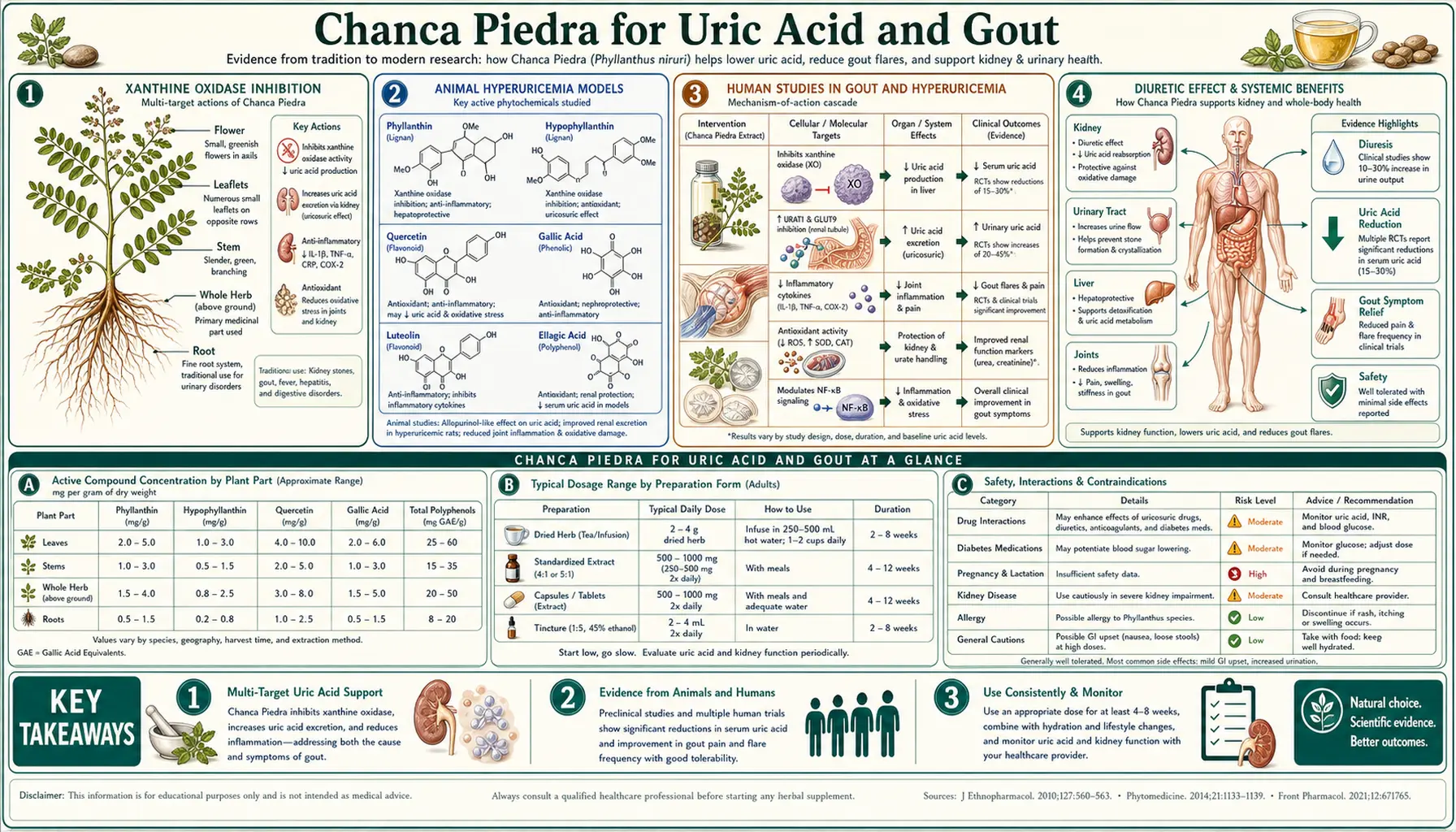
Chanca Piedra has measurable but mild xanthine oxidase inhibition, modest uricosuric effects, a gentle diuretic action, and ACE-inhibitor-like activity from its tannins. None of these effects rival prescription medications, but practitioners describe it as an adjunct for borderline hyperuricemia, mild stage 1 hypertension, or as a complement to standard therapy. This page covers the pharmacology, the human evidence (such as it is), and where practitioners place Chanca Piedra.
Table of Contents
- Xanthine Oxidase Inhibition
- Animal Hyperuricemia Models
- Human Studies in Gout and Hyperuricemia
- Diuretic Effect
- ACE-Inhibitor-Like Activity
- Blood Pressure Effects
- Combination with Conventional Gout Therapy
- Combination with Antihypertensives
- Dosing
- Patient-Facing Reality
- Key Research Papers
- Connections
- Featured Videos
Xanthine Oxidase Inhibition
Xanthine oxidase is the enzyme that produces uric acid from hypoxanthine and xanthine. Inhibiting it lowers serum urate, the basis for the prescription drugs allopurinol and febuxostat. Extracts of P. niruri inhibit xanthine oxidase in vitro: Murugaiyah and Chan (2009) measured an IC50 of 39.39 µg/mL for a methanol extract. In the same study the lignans (phyllanthin, hypophyllanthin, phyltetralin) were poor xanthine oxidase inhibitors; in hyperuricemic rats they lowered uric acid mainly by increasing its excretion in urine (a uricosuric action), and the authors concluded the extract works mainly through that route and partly through xanthine oxidase inhibition. Geraniin, an ellagitannin isolated from P. urinaria, inhibited xanthine oxidase in vitro with an IC50 of 30.49 µM (Lin 2008).
Magnitude vs. allopurinol: 10–100× weaker on a weight basis. Allopurinol IC50 is approximately 0.2–1 µg/mL; febuxostat is sub-nanomolar. Chanca Piedra is a real but mild xanthine oxidase inhibitor.
Animal Hyperuricemia Models
Potassium-oxonate-induced hyperuricemic rodents fed Phyllanthus extracts at 100–400 mg/kg show 20–45% serum urate reduction with dose-response. Allopurinol at 10 mg/kg in the same models drops urate 50–70%. So animal data confirm the in-vitro signal, but at supraphysiologic doses (rodent mg/kg translates roughly 6× smaller in humans, so 400 mg/kg in a rat is approximately 65 mg/kg in a 70 kg adult, or about 4.5 g/day — at the upper end of clinical Chanca Piedra dosing).
Human Studies in Gout and Hyperuricemia
Very thin. A few small open-label or pilot trials, mostly Brazilian or Indian, report:
- Modest serum urate drops of 0.5–1.5 mg/dL over 4–8 weeks
- Effect proportional to baseline urate level (more reduction at higher starting points)
- Improved 24-hour urinary urate excretion
No large randomized controlled trial (RCT) exists for gout or chronic hyperuricemia. It has not been tested as a cure for gout or as a replacement for allopurinol or febuxostat in people with established disease.
Diuretic Effect
Chanca Piedra produces a mild aquaretic / mild natriuretic effect — closest to a weak thiazide-like or osmotic profile, not loop-diuretic-style, not potassium-sparing. Specifically:
- Urine volume increases by approximately 15–25% in rat studies; smaller human data suggest similar mild effect
- Sodium loss is modest
- Potassium loss is minimal — a relative advantage over thiazides and loop diuretics
For stone formers and hypertensives, the diuretic effect is a benefit. For people with low blood pressure or volume depletion, the extra fluid loss can lower blood pressure further.
ACE-Inhibitor-Like Activity
Geraniin and corilagin show in-vitro angiotensin-converting enzyme inhibition with IC50 values around 10–50 µM. The mechanism is tannin-mediated zinc chelation at the ACE active site — a different molecular interaction than prescription angiotensin-converting enzyme inhibitors (which bind the catalytic domain) but similar net effect. This is in-vitro pharmacology, not clinical proof. The translation to human blood pressure-lowering depends on whether enough of the active compounds reach the target tissue at meaningful concentrations.
Blood Pressure Effects
Animal data: in spontaneously hypertensive rats (SHR), P. niruri extracts given by mouth daily for two weeks lowered blood pressure from baseline (Bello 2020), and a single 5 mg/kg oral dose of geraniin lowered systolic and diastolic pressure over 24 hours (Lin 2008).
Human data: no controlled trial of P. niruri for blood pressure is cited here; the plant has a long traditional use for high blood pressure (Bello 2020).
For perspective: a typical thiazide diuretic produces 10–15 mmHg systolic reduction; a single angiotensin-converting enzyme inhibitor (ACE inhibitor) at standard dose produces 10–15 mmHg reduction; combination therapy produces 20+ mmHg reduction.
Combination with Conventional Gout Therapy
No documented dangerous interactions with allopurinol, febuxostat, colchicine, or nonsteroidal anti-inflammatory drugs (NSAIDs). Theoretically additive on urate (allopurinol blocks production via xanthine oxidase; Chanca Piedra mildly does the same plus mildly increases excretion). For most gout patients, the additive effect would be modest.
Caveat: Phyllanthus mildly inhibits CYP3A4 and CYP2C9, which could affect plasma levels of colchicine and certain nonsteroidal anti-inflammatory drugs.
Combination with Antihypertensives
Additive blood-pressure-lowering with angiotensin-converting enzyme inhibitors (ACE inhibitors), angiotensin receptor blockers (ARBs), thiazides, or calcium-channel blockers. Realistic risk: mild hypotension or dizziness, not crisis. Points raised for these combinations:
- The first 2–4 weeks of a combination are when an added drop in blood pressure shows up
- With potassium-sparing diuretics (spironolactone, eplerenone) in chronic kidney disease (CKD), the ACE-like mechanism raises a theoretical risk of high blood potassium (hyperkalemia)
- Older people taking several blood-pressure drugs plus Chanca Piedra are the group most prone to dizziness on standing (orthostatic hypotension)
Dosing
Amounts described in herbal practice and on product labels:
- Standardized extract (4:1 or 10:1, 3–5% phyllanthin): 500 mg twice daily with food is the amount commonly described
- Whole-herb capsules: 1–2 g/day total
- Tea: 1–2 tsp dried herb in 8 oz water, taken twice daily
- Cycling: some practitioners describe 8 weeks on, 2 weeks off for long-term use — long-term safety data are limited
Patient-Facing Reality
Practitioners describe Chanca Piedra as a mild adjunct for these indications, not a primary therapy. Situations where it is described as an adjunct:
- Borderline hyperuricemia (serum urate 7–8 mg/dL) without tophi or recurrent flares
- Stage 1 hypertension (blood pressure (BP) 130–139 / 80–89 mmHg) where lifestyle is the primary intervention and a mild adjunct is welcome
- Already on allopurinol with mild persistent hyperuricemia, looking for additional support
- Already on a single antihypertensive with blood pressure not quite at goal, considering combination options
Situations where it is not used as the main treatment:
- Acute gout flare (Chanca Piedra is preventive/adjunctive, not for flare control — flares are treated with nonsteroidal anti-inflammatory drugs, colchicine, or steroids)
- Serum urate > 10 mg/dL or recurrent gout (the situations in which allopurinol or febuxostat is prescribed)
- Established cardiovascular disease (treated with drugs tested in large trials)
- Pregnancy
Key Research Papers
- Murugaiyah V, Chan KL. Mechanisms of antihyperuricemic effect of Phyllanthus niruri and its lignan constituents. Journal of Ethnopharmacology 2009;124(2):233–9. — PubMed PMID: 19397979
- Lin SY, Wang CC, Lu YL, Wu WC, Hou WC. Antioxidant, anti-semicarbazide-sensitive amine oxidase, and anti-hypertensive activities of geraniin isolated from Phyllanthus urinaria. Food and Chemical Toxicology 2008;46(7):2485–92. — PubMed PMID: 18495318
- Bello I, Usman NS, Dewa A, Abubakar K, Aminu N, Asmawi MZ, Mahmud R. Blood pressure lowering effect and vascular activity of Phyllanthus niruri extract: the role of NO/cGMP signaling pathway and β-adrenoceptor mediated relaxation of isolated aortic rings. Journal of Ethnopharmacology 2020;250:112461. — PubMed PMID: 31830549
PubMed Topic Searches
Connections
- All Herbs
- Chanca Piedra Benefits Hub
- Chanca Piedra Overview
- Kidney Stones
- Liver Protection
- Blood Sugar
- Safety and Drug Interactions
- Active Compounds
- Forms, Dosing and Standardization
- Phyllanthus Species Comparison
- Gout
- Hypertension
- Uric Acid
- Coronary Calcium Score
- Potassium
- Magnesium
- Cardiovascular Disease
- Quercetin
- History