Chanca Piedra Forms, Dosing, and Standardization: Practical Use Guide
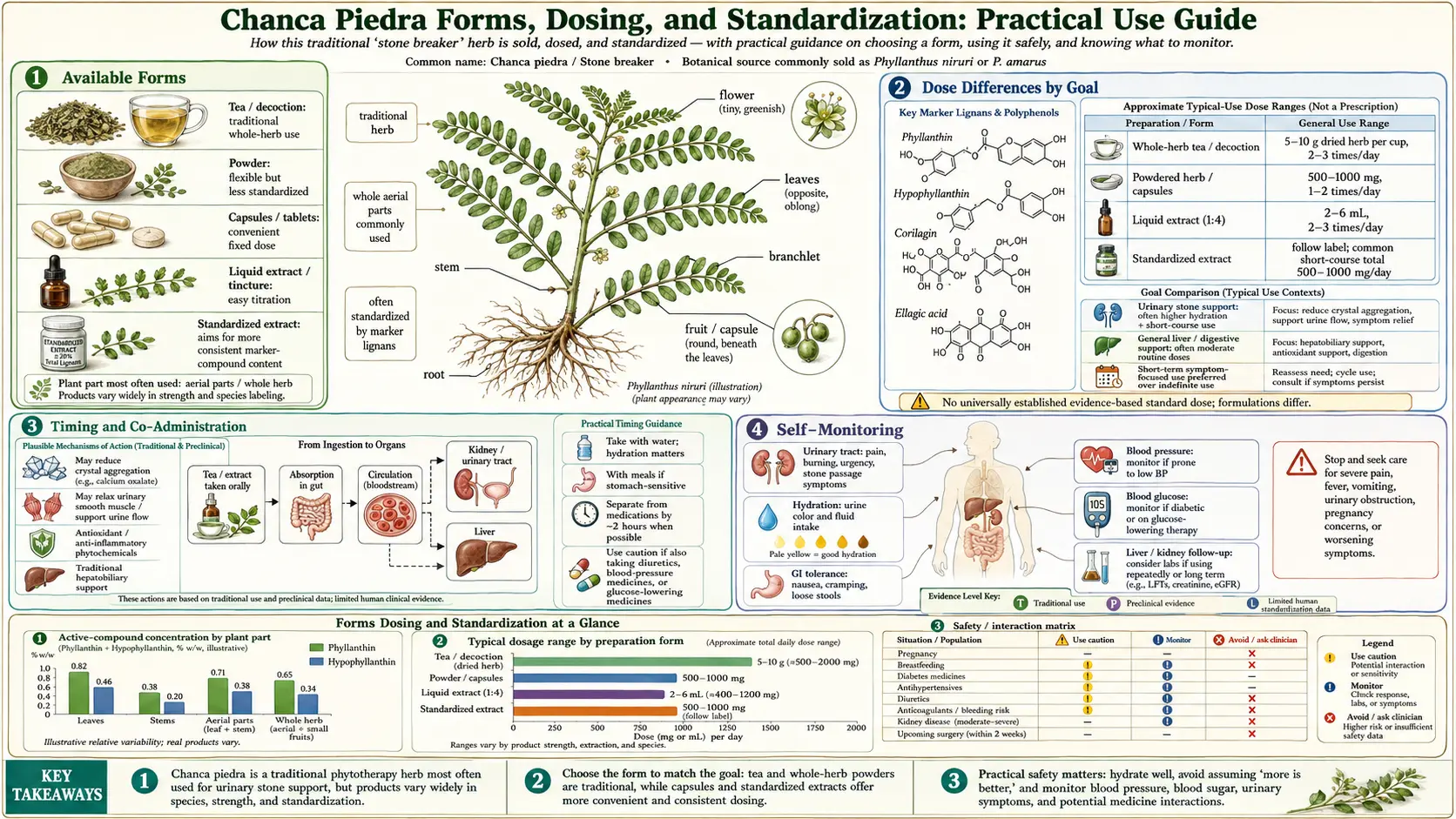
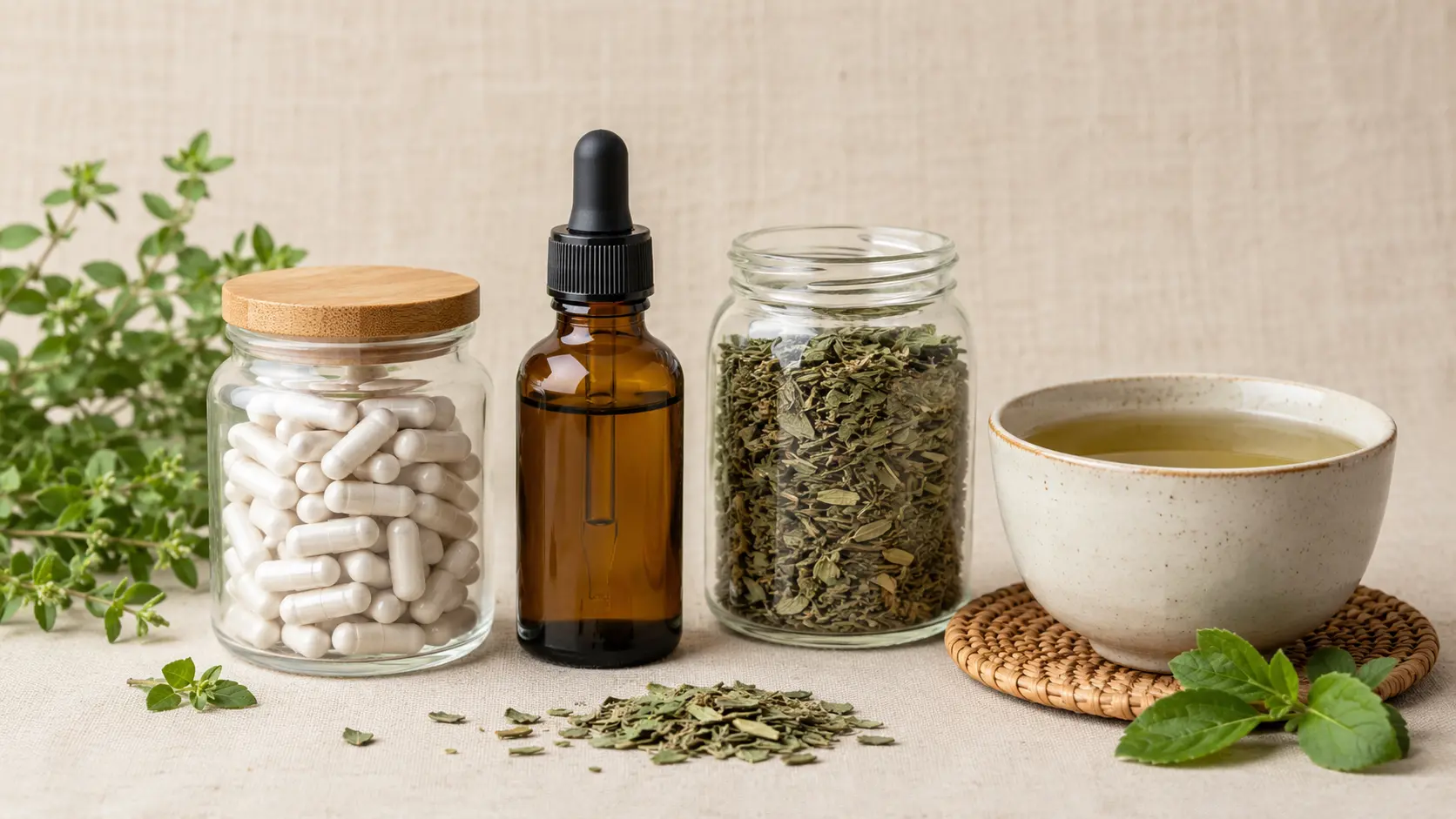
Chanca Piedra is sold in five different forms with widely different bioactive concentrations and a confusing standardization landscape. Which form people use depends on what they are treating, the dose depends on the form, and whether a bottle contains what its label says can only be confirmed by third-party testing. This page sets out the forms, the doses used in traditional practice and in the trials, and the quality markers found on products.
Table of Contents
Available Forms
- Whole-herb capsules (500–800 mg) — the most common retail form. Predictable dose, no taste, but lower bioactive concentration than extracts. Commonly used for general prevention or maintenance.
- Standardized extracts — concentrated to a phyllanthin or lignan marker. More potent per mg; the form used in most clinical trials and in most kidney-stone and liver-support protocols.
- Tinctures (1:5 or 1:3, 30–60% alcohol) — fast absorption, easy to titrate. The alcohol matters with disulfiram: its label lists alcohol-containing preparations (such as cough syrups and tonics) as a contraindication, says even small amounts of alcohol taken with it produce flushing, throbbing headache, nausea, vomiting, chest pain, palpitations and fainting, and warns that reactions can occur up to 14 days after the last dose. The alcohol content also matters for people who are alcohol-sensitive, pregnant, on naltrexone, or keeping off alcohol.
- Tea / decoction — the traditional Amazonian preparation. Highly variable potency depending on plant batch and steep time; less clinically reliable, and the form traditional use is built on.
- Loose dried herb — cheapest; requires accurate scale and consistent preparation. Mostly used by herbalists or traditional preparers.
Standardization Markers
Products that state their standardization specify one of:
- Phyllanthin 3–5% — most common
- Total lignans ≥5% (phyllanthin + hypophyllanthin combined) — alternative
- 10:1 full-spectrum extract — concentration ratio rather than marker compound
- Total polyphenols / tannins percentage — less common but useful for stone-prevention indications
Missing information: some bottles list only "Phyllanthus" or "Chanca Piedra extract" — no marker compound, no extract ratio, and no third-party testing.
Typical Dosing by Form
| Form | Daily Dose | Schedule |
|---|---|---|
| Whole-herb capsule (500 mg) | 1,000–1,600 mg/day | Split 2–3× daily |
| Standardized extract (4–5% phyllanthin) | 400–900 mg/day (3,000 mg/day in one 12-month liver trial) | Split 2–3× daily with meals |
| Tincture (1:5) | 30–50 drops in water, 2–4×/day | Between meals |
| Tea | 1–2 tsp dried herb per cup, 1–2 cups/day | Anytime |
| Loose dried herb (decoction) | 5–10 g/day | Simmered, sipped through the day |
Dose Differences by Goal
Doses used in herbal practice, with the trials noted where they exist:
- Kidney stones (active prevention or recurrence reduction): 450 mg standardized extract three times daily for 3 months, the regimen of a Brazilian trial (Nishiura 2004, 69 calcium stone formers) that found no overall difference from placebo in urinary measurements, stone passage or pain; urinary calcium fell only in people with high urinary calcium, and urinary magnesium fell slightly (within the normal range). An Italian trial (Micali 2006, 150 patients) gave a P. niruri extract, 2 g a day for at least 3 months, after extracorporeal shock wave lithotripsy (SWL — breaking up stones with shock waves sent from outside the body): stone-free rates at 180 days were 93.5% with the extract versus 83.3% without, a difference that was not statistically significant; for stones in the lower part of the kidney (lower calyx) they were 93.7% versus 70.8%, which was significant. Stone protocols commonly pair it with at least 2.5 L water per day.
- Liver support / non-alcoholic fatty liver disease (NAFLD) / persistent alanine aminotransferase (ALT) elevation: Practitioner dosing runs higher — 500–1,500 mg standardized extract twice daily. The one 12-month trial (Abu Hassan 2023, 226 adults with mild-to-moderate non-alcoholic fatty liver disease) gave 3,000 mg/day of a standardized extract and found no difference from placebo in the liver-fat score or liver enzymes; only the liver fibrosis (scarring) score improved.
- Hepatitis B (adjunct only): 500–1,000 mg P. amarus-specific extract three times daily for 3–6 months, used in practice alongside prescribed antivirals. The entecavir label carries a boxed warning that severe flare-ups of hepatitis B (acute exacerbations) have been reported in people who stopped their hepatitis B medicine, with liver function monitored closely for at least several months after stopping.
- Blood-sugar adjunct: Lower end — 500–1,000 mg/day, with glucose monitoring.
- Uric acid / mild hypertension adjunct: 500 mg standardized extract twice daily.
- General prevention: 500 mg/day or 1 cup tea daily.
Cycling and Duration
Traditional protocols typically use one of:
- 2–4 weeks on, 1 week off — for general prevention or mineral conservation
- 12 weeks on, 12 weeks washout — for prevention and stone protocols (matches the Nishiura trial duration)
- Continuous — for active hepatitis B or liver support, with periodic monitoring
The rationale for cycling: prevent any tolerance development, give the kidneys and liver a periodic rest, and limit cumulative effects on minerals (in the Brazilian stone trial, urinary magnesium fell slightly, within the normal range). Continuous use beyond 6 months has limited published human safety data (the 12-month liver trial reported no major adverse events), and traditional protocols build in periodic breaks.
Timing and Co-Administration
- With or after food — reduces gastrointestinal (GI) upset; modestly reduces absorption rate but not total bioavailability
- Spacing from prescription medications — herbal practice commonly spaces doses 2 hours from prescription medicines
- With water — especially in kidney-stone protocols, which commonly target 2.5–3 L/day total fluid intake
- Evening doses — high doses late in the day can disturb sleep through the mild diuretic effect
Quality Issues and Adulteration
Common problems with commercial Chanca Piedra:
- Species substitution — products labeled "P. niruri" may contain P. amarus, P. urinaria, or related species without disclosure. The chemotype matters for therapeutic effect (see Species Comparison).
- Microbial contamination — from poor drying or inadequate sanitation in source-country processing
- Heavy metal contamination — lead and cadmium from contaminated growing soil; tested products show acceptable levels but untested ones can be problematic
- Pesticide residues — less common in wild-harvested herbs but possible in cultivated crops
- Subtherapeutic dosing — some products contain so little Phyllanthus per capsule that the labeled dose can't deliver an effective amount
- Adulteration with non-herbal ingredients — rare but documented in low-quality online supplements
Certification & Quality Criteria
Quality markers found on some products:
- USP Verified Mark — pharmaceutical-grade quality verification
- Certification or product testing by an independent supplement-testing organization
- Current third-party Certificate of Analysis (CoA) showing identity (HPLC), heavy-metal testing, and microbial testing
- Standardization to phyllanthin percentage stated on the label, with HPLC verification
- GMP-certified manufacturer (Good Manufacturing Practices)
- cGMP compliance for pharmaceutical-grade extracts
Products of this kind typically sell for $20–$45 for a 60–120 capsule bottle.
Self-Monitoring
What practitioners track during use:
- Blood pressure daily for the first 2 weeks for people on antihypertensives or with low baseline blood pressure (BP)
- Fasting glucose for people with diabetes, especially on insulin or sulfonylureas (additive hypoglycemia risk)
- International normalized ratio (INR) weekly × 3 for people on warfarin (CYP2C9 inhibition can raise international normalized ratio)
- Stone size via ultrasound or low-dose computed tomography (CT) at 6–12 weeks for kidney-stone protocols
- Liver enzymes (alanine aminotransferase, aspartate aminotransferase (AST), gamma-glutamyl transferase (GGT)) at baseline and 3 months for liver-support protocols
- HBV-DNA at baseline, 3 months, 6 months for hepatitis B virus (HBV) protocols (which run alongside prescribed antivirals)
The warning signs in these protocols are new bruising, dizziness, signs of low blood sugar (shaking, sweating, a fast or pounding heartbeat, unclear thinking), and signs of liver injury — yellowing of the skin or eyes (jaundice) — which hospitals treat as urgent.
Key Research Papers
- Nishiura JL, Campos AH, Boim MA, Heilberg IP, Schor N. Phyllanthus niruri normalizes elevated urinary calcium levels in calcium stone forming (CSF) patients. Urol Res. 2004;32(5):362-366. — PubMed PMID: 15221244
- Micali S, Sighinolfi MC, Celia A, De Stefani S, Grande M, Cicero AF, Bianchi G. Can Phyllanthus niruri affect the efficacy of extracorporeal shock wave lithotripsy for renal stones? A randomized, prospective, long-term study. J Urol. 2006;176(3):1020-1022. — PubMed PMID: 16890682
- Abu Hassan MR, Hj Md Said R, Zainuddin Z, Omar H, Md Ali SM, Aris SA, Chan HK. Effects of one-year supplementation with Phyllanthus niruri on fibrosis score and metabolic markers in patients with non-alcoholic fatty liver disease: A randomized, double-blind, placebo-controlled trial. Heliyon. 2023;9(6):e16652. — PubMed PMID: 37313177
- Standardized extract trials — PubMed
- Oral PK and bioavailability — PubMed
- Quality and adulteration — PubMed
- Long-term safety — PubMed
External Authoritative Resources
Connections
- All Herbs
- Chanca Piedra Overview
- Phyllanthus Species Comparison
- Safety and Drug Interactions
- Active Compounds
- Kidney Stone Protocol
- Liver Protection and Hepatitis B
- Uric Acid, Gout and Hypertension
- Blood Sugar and Metabolic Effects
- History and Traditional Use
- Kidney Stones
- Hepatitis B
- Uric Acid
- Magnesium
- Potassium
- Liver Cleansing