⚠ Evidence warning: Clinical trials or other evidence do not support the traditional and marketed use of Chanca Piedra to lower blood sugar in people with diabetes. This page keeps it as a report of what people, websites or other media say.
Chanca Piedra for Blood Sugar
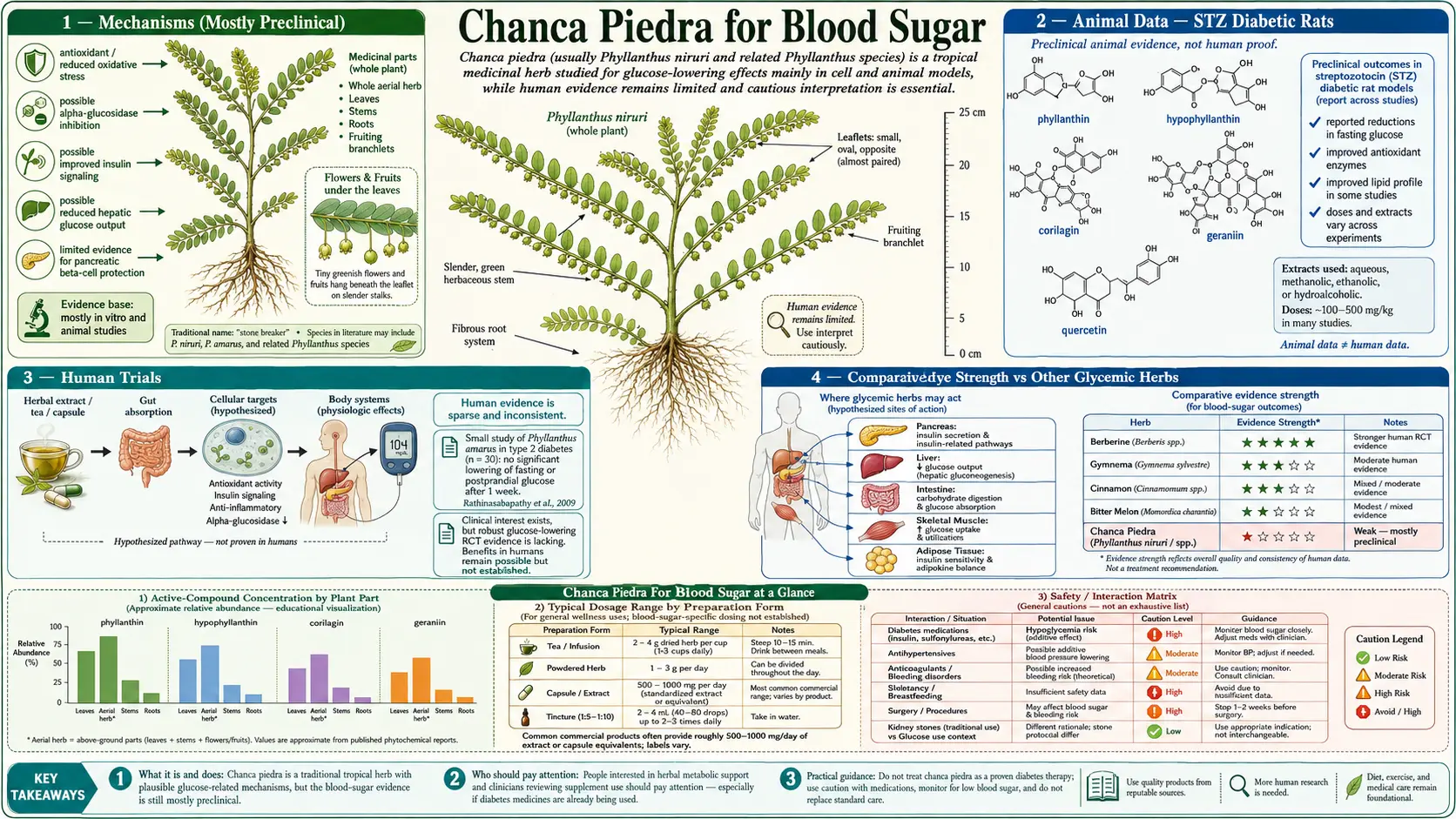
Chanca Piedra is sometimes promoted as a "natural metformin." It is not. The plant has documented glucose-lowering effects in cell culture and rodent models, and two small, short human studies have given mixed results. The human evidence is thin, and compounds from other plants (berberine in particular) have substantially stronger glycemic-control evidence. This page covers the actual mechanisms, the real effect sizes, where Chanca Piedra fits, and where the marketing oversells it.
Table of Contents
- Mechanisms (Mostly Preclinical)
- Animal Data — Streptozotocin (STZ) and Alloxan Diabetic Rats
- Human Trials
- Comparative Strength vs Other Glycemic Herbs
- Lipids, Weight, and Metabolic Syndrome
- Practical Use Case
- Drug Interactions in Diabetics
- Dosing
- Realistic Expectations
- Key Research Papers
- Connections
- Featured Videos
Mechanisms (Mostly Preclinical)
Four mechanisms have been proposed; the first, third and fourth have some support in test-tube or rodent studies:
- Alpha-glucosidase / alpha-amylase inhibition — in a test-tube study, a methanol extract of Phyllanthus niruri aerial parts blocked alpha-glucosidase at a half-blocking concentration (IC50) of 0.2 mg/mL (200 µg/mL) and alpha-amylase at 2.15 mg/mL (2,150 µg/mL) (Okoli 2011). For comparison, the prescription alpha-glucosidase inhibitor acarbose has an IC50 around 10 µg/mL. Real but weak, and untested in the human gut.
- AMP-activated protein kinase (AMPK) activation — proposed for the plant’s tannins corilagin and geraniin by analogy with the metabolic-sensor pathway that metformin and berberine target; no study testing this in liver cells for glucose control was found.
- Insulin sensitization — rodent data only; mechanism via partial activation of the peroxisome proliferator-activated receptor gamma (PPAR-gamma) has been proposed but not confirmed at the molecular level.
- Hepatic gluconeogenesis suppression — lower activity of the liver sugar-making enzymes phosphoenolpyruvate carboxykinase (PEPCK) and glucose-6-phosphatase (G6Pase) in streptozotocin-treated rats; effect smaller than metformin.
The mechanisms are mechanistically plausible. The translation to human clinical effect is what's uncertain.
Animal Data — Streptozotocin (STZ) and Alloxan Diabetic Rats
Streptozotocin-induced diabetic rats are the standard preclinical model. Results from the Phyllanthus literature:
- Methanolic or aqueous extracts at 200–500 mg/kg for 21–45 days reduce fasting glucose by 25–45% from baseline
- Body weight typically preserved or modestly improved (vs untreated diabetic controls who lose weight)
- Hemoglobin A1c (HbA1c) equivalents (rodent fructosamine) drop ~15–25%
- Triglycerides and total cholesterol fall 20–30%; high-density lipoprotein (HDL) rises modestly
Two named rat studies give the detail. In rats made diabetic with alloxan (a chemical that destroys insulin-making cells), a methanol extract of Phyllanthus niruri aerial parts lowered blood sugar, blunted the rise after a glucose meal, reduced hemoglobin glycation, raised liver weight and liver glycogen, and lessened the weight loss caused by the diabetes (Okoli 2011). In alloxan-diabetic rats, a methanol extract of Phyllanthus amarus lowered blood sugar 4 hours after a dose by 6% at 200 mg/kg and by 18.7% at 1,000 mg/kg; after 15 days of daily dosing the reduction was significant, and by day 18 the 1,000 mg/kg group’s values were almost normal (Raphael 2002).
These are clean preclinical results. The translation factor — rat-mg/kg to human equivalent dose — usually shrinks effect size substantially when extrapolated to clinical practice.
Human Trials
The clinical literature is dominated by kidney stones and hepatitis B; diabetes-specific human trials are scarce. What exists:
- No large randomized controlled trials specifically for diabetes
- A 1995 Indian report: 9 people with mild high blood pressure, 4 of whom also had diabetes, took a whole-plant Phyllanthus amarus preparation for 10 days; urine output rose and blood glucose fell significantly, and no harmful effects were noticed. It had no control group (Srividya 1995).
- A 2001 Tanzanian study: 21 people with type 2 diabetes stopped their diabetes tablets for a 1-week washout and then drank 100 mL of a water extract of 12.5 g of the powdered plant twice a day for 1 week. Fasting and after-meal blood glucose stayed about the same as after the washout; the authors concluded the extract did not lower blood glucose over that week (Moshi 2001).
- Quality issues: very small groups, no placebo arm, no blinding, a week or two of use, and no standardization of phyllanthin/hypophyllanthin content
The human signal is mixed and not robustly supported: one uncontrolled 10-day report saw blood glucose fall, one 1-week study saw no fall. No human study found has measured hemoglobin A1c in people taking Chanca Piedra.
Comparative Strength vs Other Glycemic Herbs
Strongest to weakest evidence for glycemic control among the major herbal options:
- Berberine — multiple randomized controlled trials (RCTs), hemoglobin A1c reduction 0.7–1.0%, comparable to metformin in some head-to-head studies. The strongest herbal glycemic agent by a clear margin.
- Gymnema sylvestre — moderate randomized controlled trial (RCT) data, hemoglobin A1c reduction 0.5–0.8%
- Fenugreek — moderate, hemoglobin A1c reduction 0.3–0.9%, dose-dependent (5–10 g/day)
- Cinnamon (cassia) — weak/inconsistent, hemoglobin A1c reduction 0.0–0.3%, meta-analyses split
- Bitter melon — weak, hemoglobin A1c reduction 0.1–0.4%, gastrointestinal (GI) side effects common
- Chanca Piedra — weakest of the group for diabetes specifically. Promising preclinical, sparse clinical.
Of the herbs above, berberine has the most randomized-trial evidence for glucose control; in one 3-month pilot trial in 36 adults with newly diagnosed type 2 diabetes, its glucose-lowering effect was similar to metformin’s (Yin 2008). Chanca Piedra has its strengths elsewhere (kidney stones, liver) but is not a leading diabetes intervention.
Lipids, Weight, and Metabolic Syndrome
Two placebo-controlled trials in people with fatty liver measured blood fats:
- In a 2013 trial, 60 people with non-alcoholic steatohepatitis (NASH, an inflamed fatty liver) took Phyllanthus urinaria (40 people) or placebo (20 people) for 24 weeks; the change in lipid profile did not differ significantly between the groups (Wong 2013).
- In a 2025 trial, 146 people with risk factors for non-alcoholic steatohepatitis took placebo or a low dose (one capsule) or high dose (two capsules) of a product containing 200 mg of Phyllanthus niruri extract and 100 mg of milk thistle extract per capsule for 36 weeks; no significant change in the lipid profile was seen in any group except total cholesterol in the low-dose group, which fell significantly (p = 0.031) (Shaker 2025).
- Negligible weight effect
Chanca Piedra is not a metabolic-syndrome treatment in any meaningful clinical sense. In these two trials, blood-fat changes did not differ from placebo, apart from total cholesterol in one dose group of the combination product.
Practical Use Case
How the evidence above bears on common situations for people with metabolic concerns:
- People already taking it to prevent kidney stones — any glycemic effect would be a side effect of that use; its size in people is unknown
- People already taking it for liver support (non-alcoholic fatty liver disease, NAFLD) — the same applies
- People with prediabetes who decline medication and look for plant-based glucose support — the human glucose evidence is two small studies lasting 1–10 days, with mixed results
- People on metformin with a history of kidney stones who prefer Chanca Piedra over berberine — berberine has the randomized glucose trials; Chanca Piedra has none
Uses the evidence does not support:
- Chanca Piedra in place of metformin, a glucagon-like peptide-1 (GLP-1) agonist, or insulin in type 2 diabetes — no trial has compared them
- Chanca Piedra as the main glucose treatment in newly diagnosed type 2 diabetes
- Chanca Piedra over berberine specifically for glucose control
Drug Interactions in Diabetics
- Sulfonylureas (glyburide, glipizide, glimepiride) — theoretical additive hypoglycemia (low blood sugar); an added effect, if any, would show in glucose readings in the first weeks of combined use
- Insulin — the same theoretical additive effect; no interaction study exists
- Metformin — negligible additive hypoglycemia risk; mechanistically compatible
- Glucagon-like peptide-1 agonists (semaglutide, liraglutide) — no documented interactions; theoretical additive effect minor
- Sodium-glucose cotransporter-2 (SGLT2) inhibitors (empagliflozin, dapagliflozin) — no documented interactions
- Dipeptidyl peptidase-4 (DPP-4) inhibitors (sitagliptin, linagliptin) — no documented interactions
Dosing
Amounts and schedules commonly listed for blood-sugar use (no blood-sugar trial has tested them):
- Standardized extract: 500 mg two or three times daily
- Whole-herb capsules: 1–2 g/day total
- Tea: 1–2 g dried herb in 8 oz water, twice daily
- Duration: 8–12 weeks is the period usually listed before fasting glucose and hemoglobin A1c are rechecked
- Cycling: schedules of 8 weeks on, 2 weeks off are described for long-term use
Realistic Expectations
- Fasting glucose: one uncontrolled 10-day report in 9 people found a significant fall; a 1-week study in 21 people with type 2 diabetes found none
- Hemoglobin A1c: no human study found has measured it, so the size of any long-term effect is unknown
- Hemoglobin A1c reflects about three months of blood sugar, so any change would take weeks to show
- Most online claims of 40% glucose drops or "natural metformin" are extrapolating rat data inappropriately
Key Research Papers
- Raphael KR, Sabu MC, Kuttan R (2002). Hypoglycemic effect of methanol extract of Phyllanthus amarus Schum & Thonn on alloxan induced diabetes mellitus in rats and its relation with antioxidant potential. Indian J Exp Biol. 40(8):905-9. — PubMed PMID: 12597020
- Okoli CO, Obidike IC, Ezike AC, Akah PA, Salawu OA (2011). Studies on the possible mechanisms of antidiabetic activity of extract of aerial parts of Phyllanthus niruri. Pharm Biol. 49(3):248-55. — PubMed PMID: 21323477
- Srividya N, Periwal S (1995). Diuretic, hypotensive and hypoglycaemic effect of Phyllanthus amarus. Indian J Exp Biol. 33(11):861-4. — PubMed PMID: 8786163
- Moshi MJ, Lutale JJ, Rimoy GH, Abbas ZG, Josiah RM, Swai AB (2001). The effect of Phyllanthus amarus aqueous extract on blood glucose in non-insulin dependent diabetic patients. Phytother Res. 15(7):577-80. — PubMed PMID: 11746836
- Yin J, Xing H, Ye J (2008). Efficacy of berberine in patients with type 2 diabetes mellitus. Metabolism. 57(5):712-7. — PubMed PMID: 18442638
- Wong VW, Wong GL, Chan AW, Chu WC, Choi PC, Chim AM, Yiu KK, Yu J, Chan FK, Chan HL (2013). Treatment of non-alcoholic steatohepatitis with Phyllanthus urinaria: a randomized trial. J Gastroenterol Hepatol. 28(1):57-62. — PubMed PMID: 23034128
- Shaker MK, Hassany M, Eysa B, Adel A, Zidan A, Mohamed S (2025). The activity of a herbal medicinal product of Phyllanthus niruri and Silybum marianum powdered extracts (Heptex®) in patients with apparent risk factors for nonalcoholic steatohepatitis: a phase II, multicentered, randomized, double-blind, placebo-controlled clinical trial. BMC Complement Med Ther. 25(1):8. — PubMed PMID: 39789561
PubMed Topic Searches
Connections
- All Herbs
- Chanca Piedra Benefits Hub
- Chanca Piedra Overview
- Kidney Stones
- Liver Protection
- Uric Acid and Gout
- Active Compounds
- Safety and Drug Interactions
- Phyllanthus Species Comparison
- Berberine
- Gymnema
- Bitter Melon
- Fenugreek
- Cinnamon
- Hemoglobin A1C
- Fasting Insulin
- Continuous Glucose Monitor
- Blood Sugar
- Diabetes
- Metabolic Syndrome
- History