Gymnema: History and Traditional Use
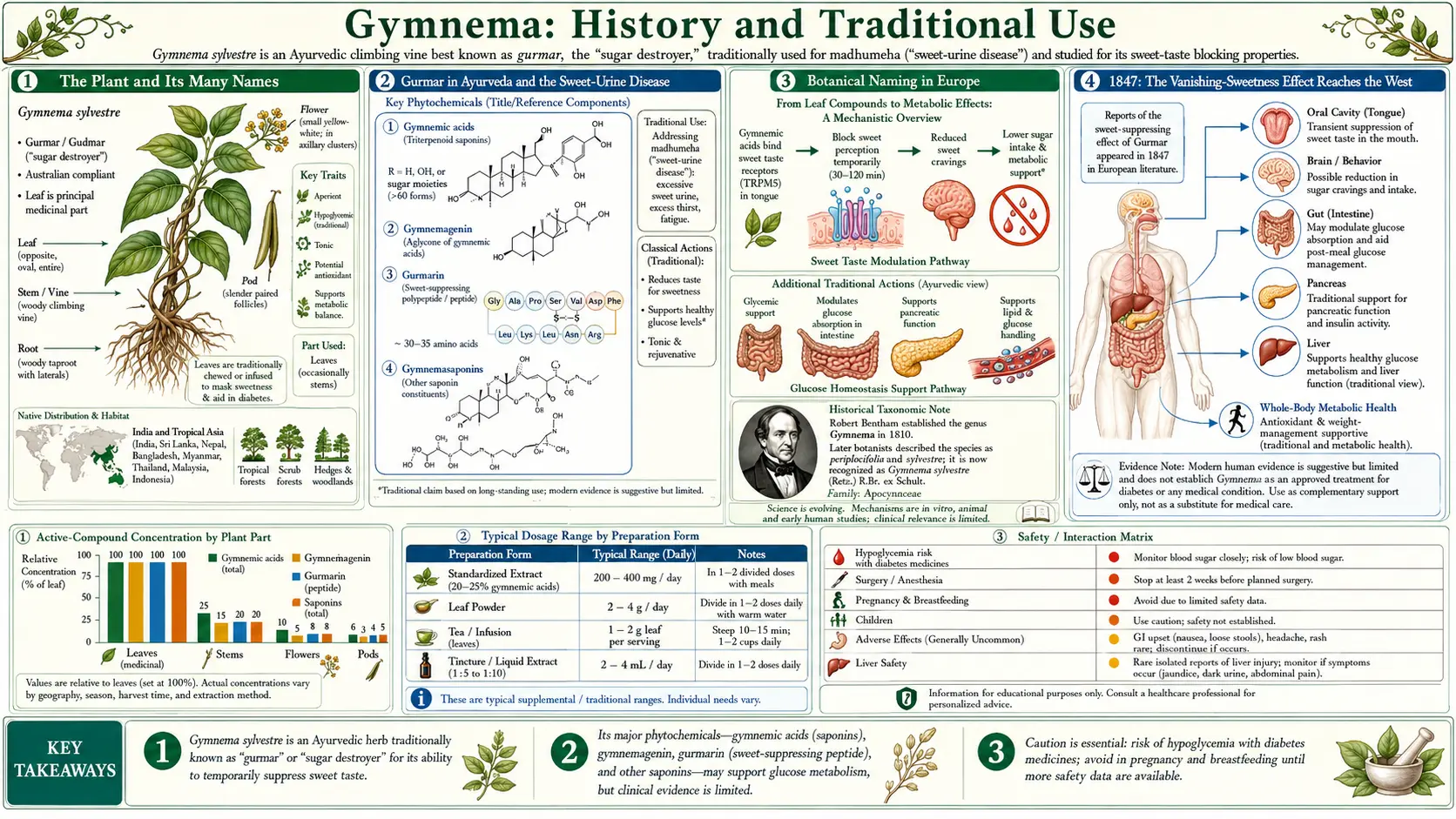
Gymnema is one of those plants whose whole reputation is captured in a single nickname. In India it is called gurmar — “sugar destroyer” — because chewing a few of its leaves makes sweetness vanish from the tongue, so that a spoonful of sugar tastes like grit. That startling party trick is genuinely ancient, and so is the herb's use against the “sweet-urine disease” we now call diabetes. This page traces what is actually documented about that history: where the plant grows, how Ayurvedic physicians classified and named it, the moment a curious traveller first reported the vanishing-sweetness effect to Western science, and the genuine laboratory milestones that followed. Where the record is firm we say so plainly; where something is living tradition or folklore, we name it as tradition rather than as proven fact.
Table of Contents
- The Plant and Its Many Names
- Gurmar in Ayurveda and the Sweet-Urine Disease
- Botanical Naming in Europe
- 1847: The Vanishing-Sweetness Effect Reaches the West
- Naming the Active Principle: The Gymnemic Acids
- The Modern Clinical Milestones
- Folklore and the Wider Traditional Reputation
- What the History Does and Does Not Promise
- Research Papers and References
- Connections
- Featured Videos
The Plant and Its Many Names
Gymnema is the common English name for Gymnema sylvestre, a woody, climbing vine of the milkweed and dogbane family (Apocynaceae, formerly placed in the Asclepiadaceae). It is native to the tropical and subtropical forests of central and southern India, and grows across parts of Sri Lanka, tropical Africa, Australia, and Southeast Asia. The vine bears small yellow flowers and slender, horn-shaped seed pods, and it is the leaves — gathered, dried, and powdered or chewed — that carry the plant's long medicinal reputation.
Few herbs announce their use through their names as plainly as this one. In Hindi it is gurmar (also written gudmar), which translates literally as “sugar destroyer” — a direct reference to the leaf's power to abolish the taste of sweetness. The same idea recurs in two of its Sanskrit names: madhunashini, “destroyer of honey” or “destroyer of sweetness,” and, in southern India, the Malayalam chakkarakolli, again meaning “sugar destroyer.” A second Sanskrit name, meshashringi (also rendered meshasringi), means “ram's horn,” a description of the curved shape of the plant's paired fruits. That a single plant accumulated several independent names all built around the destruction of sweetness is itself a historical clue: the effect was so distinctive, and so widely observed, that culture after culture christened the vine for it.
Gurmar in Ayurveda and the Sweet-Urine Disease
Gymnema's documented medicinal career belongs to Ayurveda, the classical medical tradition of the Indian subcontinent, where it is one of the oldest and most consistently named remedies for diabetes. The herb is associated with the early Ayurvedic textual tradition — the great compendia attributed to Sushruta and Charaka — and is commonly said to have been used for roughly two thousand years. The single most-quoted historical line is that the Sushruta Samhita describes the plant as a destroyer of madhumeha. Madhumeha — literally “honey urine” or “sweet urine” — is the Sanskrit term for the condition we now recognize as diabetes mellitus, named for the sweet taste of a sufferer's urine, a diagnostic sign that ancient physicians on several continents independently noticed.
Within the Ayurvedic framework, gurmar was classed among the bitter and astringent herbs and used not only for the sweet-urine disease but for a wider range of complaints recorded in the traditional literature: for excessive thirst, for sluggish digestion, for jaundice and liver complaints, for cough and respiratory trouble, and as one ingredient in the traditional response to snakebite. These are historical and cultural uses, described here as tradition rather than as endorsed treatments. What stands out across the whole record is the consistency of the diabetes association: long before anyone could measure blood glucose, Ayurvedic physicians had singled out this particular forest vine as the herb for the disease of sweetness, and the name they used for it — the destroyer of sweetness — was the same name ordinary people used for the leaf they chewed.
Botanical Naming in Europe
As with most plants of the colonial-era tropics, gymnema entered the European botanical record through the work of eighteenth- and nineteenth-century naturalists who collected, described, and re-classified specimens sent home from India. The plant was first formally described by the Swedish naturalist Anders Jahan Retzius, who in 1781 named it Periploca sylvestris, placing it in a different genus. The genus Gymnema itself was established later by the Scottish botanist Robert Brown in his early-nineteenth-century work on the milkweed family, and the species came to its modern name through the botanist James Edward Smith — which is why its full botanical citation is written Gymnema sylvestre (Retz.) R.Br. ex Sm.
The names themselves are quietly descriptive. The genus name Gymnema is built from the Greek gymnos, “naked,” and nema, “thread” — a reference to the hairless filaments inside the plant's small flowers. The species epithet sylvestre is simply Latin for “of the forest,” marking it as a wild woodland climber. None of this botanical naming represents a medical discovery; it is the work of cataloguing a plant that Indian physicians had already used for many centuries. But it matters to the history, because it is the formal scientific identity — Gymnema sylvestre — under which the herb would soon attract the attention of European chemists and physiologists fascinated by its strangest property.
1847: The Vanishing-Sweetness Effect Reaches the West
The moment gymnema crossed from Indian tradition into Western scientific literature is, by happy accident, unusually well dated. The first widely cited Western report of the leaf's sweet-suppressing effect is usually credited to 1847, when a British officer and amateur botanist in India — Captain Edgeworth — chewed some of the leaves and was struck that, afterwards, he could no longer taste sweetness. By his account, sugar placed on the tongue seemed to lose its character entirely, tasting like so much flavourless grit. The observation was reported in the British botanical and pharmaceutical literature of the late 1840s, and it is from that 1847 note that essentially every later Western discussion of gymnema's “antisweet” action descends.
It is worth being precise about what was and was not new here. Indian users had clearly known about the effect for a very long time — it is encoded in the very name gurmar — so 1847 marks not the discovery of the phenomenon but its first documentation in Western science. Still, the report did exactly what a good observation should: it posed a sharp, testable question. Why should a leaf selectively erase one of the four or five basic tastes, leaving sour, salt, and bitter intact? That question would occupy taste physiologists for more than a century, and answering it eventually required identifying the chemical responsible — the work taken up in the next section.
Naming the Active Principle: The Gymnemic Acids
Once Western science had a well-defined plant and a well-defined puzzle, the natural next step was chemistry: which substance in the leaf abolishes the taste of sweetness? Across the late nineteenth and twentieth centuries, investigators worked to isolate the leaf's active fraction, and the responsible compounds came to be known collectively as the gymnemic acids — a family of triterpene saponins (more than two dozen related variants have since been catalogued) named directly after the plant. Modern analyses of the leaf have also identified other constituents, including a small protein later named gurmarin and a group of related saponins, but the gymnemic acids remain the best-known signature compounds of the herb.
The mechanism behind the “sugar destroyer” effect was clarified by twentieth- and twenty-first-century taste research. The gymnemic acids are thought to resemble glucose closely enough in shape to occupy the sweet-taste receptors on the tongue, blocking sweet-tasting molecules from registering for a period of perhaps thirty to ninety minutes. A 2014 study in The Journal of Biological Chemistry by Sanematsu and colleagues mapped this interaction at the molecular level, showing how gymnemic acids act on the human sweet-taste receptor (the T1R2–T1R3 complex) — supplying a modern, mechanistic answer to the very puzzle Captain Edgeworth had stumbled onto in 1847. Tradition had described the effect; chemistry had now given it an address.
The Modern Clinical Milestones
The traditional claim that gymnema lowers blood sugar took far longer to reach the clinic than the sweet-taste trick took to reach the laboratory, and the decisive studies are recent enough to name precisely. The work most often cited as the turning point came from a research group in Madras (now Chennai), India, and was published in 1990 in the Journal of Ethnopharmacology. Using a standardized leaf extract they called GS4, Baskaran and colleagues reported that patients with what was then termed non-insulin-dependent (type 2) diabetes, given 400 mg of GS4 daily alongside their conventional oral medication over an eighteen-to-twenty-month period, showed significant reductions in blood glucose and in glycosylated haemoglobin, and that some were able to reduce their conventional drug doses. A companion 1990 paper from the same group, led by Shanmugasundaram, reported on the use of the extract in insulin-dependent (type 1) diabetes as an adjunct to insulin.
These two 1990 papers are the historical hinge between gymnema's ancient reputation and its modern study: they took a remedy named in Sanskrit texts for the sweet-urine disease and put a measurable, standardized extract through a long clinical follow-up. In the decades since, the herb has been examined in further trials and pooled analyses — a 2021 systematic review and meta-analysis in Phytotherapy Research by Devangan and colleagues, gathering ten studies in type 2 diabetes, concluded that gymnema supplementation was associated with reductions in fasting and post-meal blood glucose and in HbA1c, while noting the studies were small and varied in quality. The honest summary the historical record supports is that the traditional antidiabetic reputation has real, if still-maturing, scientific support — the questions raised by tradition are being tested, not yet finally settled.
Folklore and the Wider Traditional Reputation
Beyond the diabetes story, gymnema carried the broader, more diffuse reputation typical of a valued folk herb. In the traditional medicine of the Indian subcontinent its leaves and roots were employed for a scattering of complaints recorded in the ethnobotanical literature: as a remedy for cough and respiratory irritation, for digestive sluggishness and constipation, for jaundice and liver disorders, for water retention, and — a recurring theme for many bitter Indian herbs — as part of the traditional treatment of snakebite, with crushed leaf or root applied to the wound. These are documented historical and cultural uses; they are reported here as tradition and folklore, not as effective or recommended treatments.
The plant's most genuinely remarkable feature, though, was always the one that gave it its name: the way the chewed leaf switches off sweetness. That effect was not merely medical but experiential and almost theatrical — a person who chewed gurmar and then ate sugar, honey, or sweet fruit found the sweetness simply gone, while sour and bitter flavours remained untouched. It is easy to see how such a striking, repeatable sensory event would fix the plant firmly in popular memory and lend its name an air of near-magical power. In gymnema's case the folklore and the pharmacology point at exactly the same thing: a leaf that, quite literally, destroys the taste of sugar.
What the History Does and Does Not Promise
The history of gymnema is, in the end, a history of one consistent claim followed across more than two thousand years and several cultures — that this forest vine is the herb for the disease of sweetness. Ayurvedic physicians named it the destroyer of sweetness and prescribed it for madhumeha; ordinary people chewed it and watched sugar lose its taste; a nineteenth-century traveller carried that observation into Western science in 1847; chemists isolated the gymnemic acids and mapped how they block the sweet receptor; and modern clinicians have begun to test, in standardized form, whether the old antidiabetic reputation holds up under measurement. Tradition raised the question with unusual clarity, and research is steadily working through the answer.
It is important to be plain about the limits of that story, because real people managing diabetes read pages like this one. This history records a long and genuine traditional reputation and some encouraging but still-limited modern evidence; it does not establish gymnema as a cure or as a substitute for proven treatment. Diabetes is a serious, manageable condition for which effective medications, monitoring, and dietary strategies exist, and gymnema can interact with blood-sugar–lowering drugs in ways that need medical supervision. Anyone considering it should treat it as a possible complement to proper care, discussed with their clinician — never as a replacement for insulin or other prescribed therapy. For the practical detail on uses, dosing, and safety, see the companion Gymnema Benefits articles and the main Gymnema page.
Research Papers and References
The list below combines key peer-reviewed papers on Gymnema sylvestre with curated PubMed topic-search links into the ethnobotanical, historical, and clinical literature. Classical sources (the Ayurvedic compendia attributed to Sushruta and Charaka) and the 1847 Western report of the sweet-suppressing effect are named in the article as historical sources rather than as modern citations. Each linked reference opens in a new tab.
- Tiwari P, Mishra BN, Sangwan NS. Phytochemical and pharmacological properties of Gymnema sylvestre: an important medicinal plant. BioMed Research International. 2014;2014:830285. — doi:10.1155/2014/830285
- Kanetkar P, Singhal R, Kamat M. Gymnema sylvestre: a memoir. Journal of Clinical Biochemistry and Nutrition. 2007;41(2):77-81. — doi:10.3164/jcbn.2007010
- Baskaran K, Kizar Ahamath B, Radha Shanmugasundaram K, Shanmugasundaram ER. Antidiabetic effect of a leaf extract from Gymnema sylvestre in non-insulin-dependent diabetes mellitus patients. Journal of Ethnopharmacology. 1990;30(3):295-300. — doi:10.1016/0378-8741(90)90108-6
- Shanmugasundaram ER, Rajeswari G, Baskaran K, Rajesh Kumar BR, Radha Shanmugasundaram K, Kizar Ahmath B. Use of Gymnema sylvestre leaf extract in the control of blood glucose in insulin-dependent diabetes mellitus. Journal of Ethnopharmacology. 1990;30(3):281-294. — doi:10.1016/0378-8741(90)90107-5
- Sanematsu K, Kusakabe Y, Shigemura N, Hirokawa T, Nakamura S, Imoto T, Ninomiya Y. Molecular mechanisms for sweet-suppressing effect of gymnemic acids. The Journal of Biological Chemistry. 2014;289(37):25711-25720. — doi:10.1074/jbc.M114.560409
- Devangan S, Varghese B, Johny E, Gurram S, Adela R. The effect of Gymnema sylvestre supplementation on glycemic control in type 2 diabetes patients: a systematic review and meta-analysis. Phytotherapy Research. 2021;35(12):6802-6812. — doi:10.1002/ptr.7265
- Gymnema sylvestre ethnobotany and traditional use — PubMed: Gymnema sylvestre ethnobotany traditional use
- Gymnemic acid and sweet-taste suppression — PubMed: gymnemic acid sweet taste suppression
- Gymnema sylvestre and diabetes — clinical evidence — PubMed: Gymnema sylvestre diabetes clinical
External Authoritative Resources
- NCCIH — Herbs at a Glance
- MedlinePlus — Herbs and Supplements
- PubMed — All research on Gymnema sylvestre