Baheda for Respiratory and Other Traditional Uses
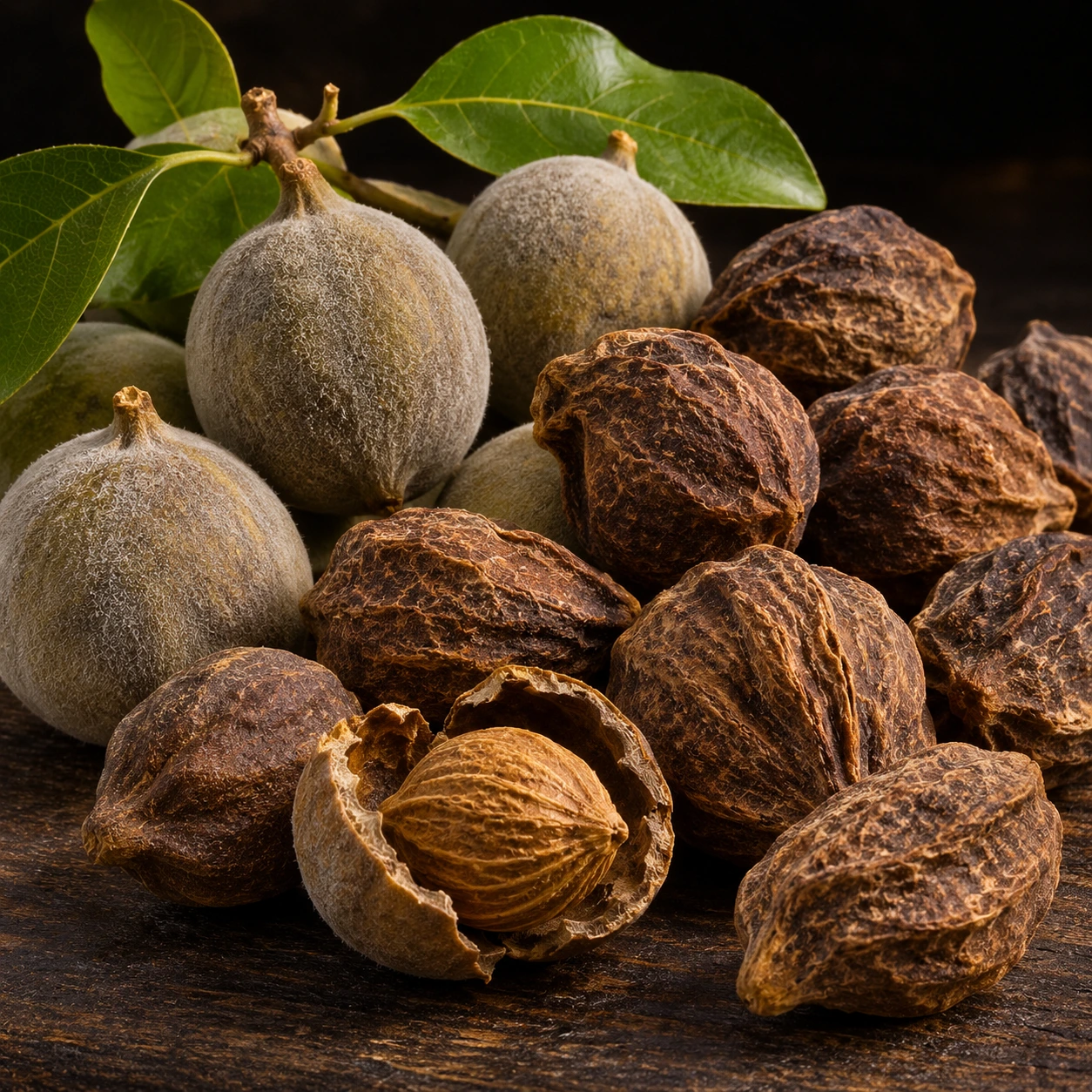
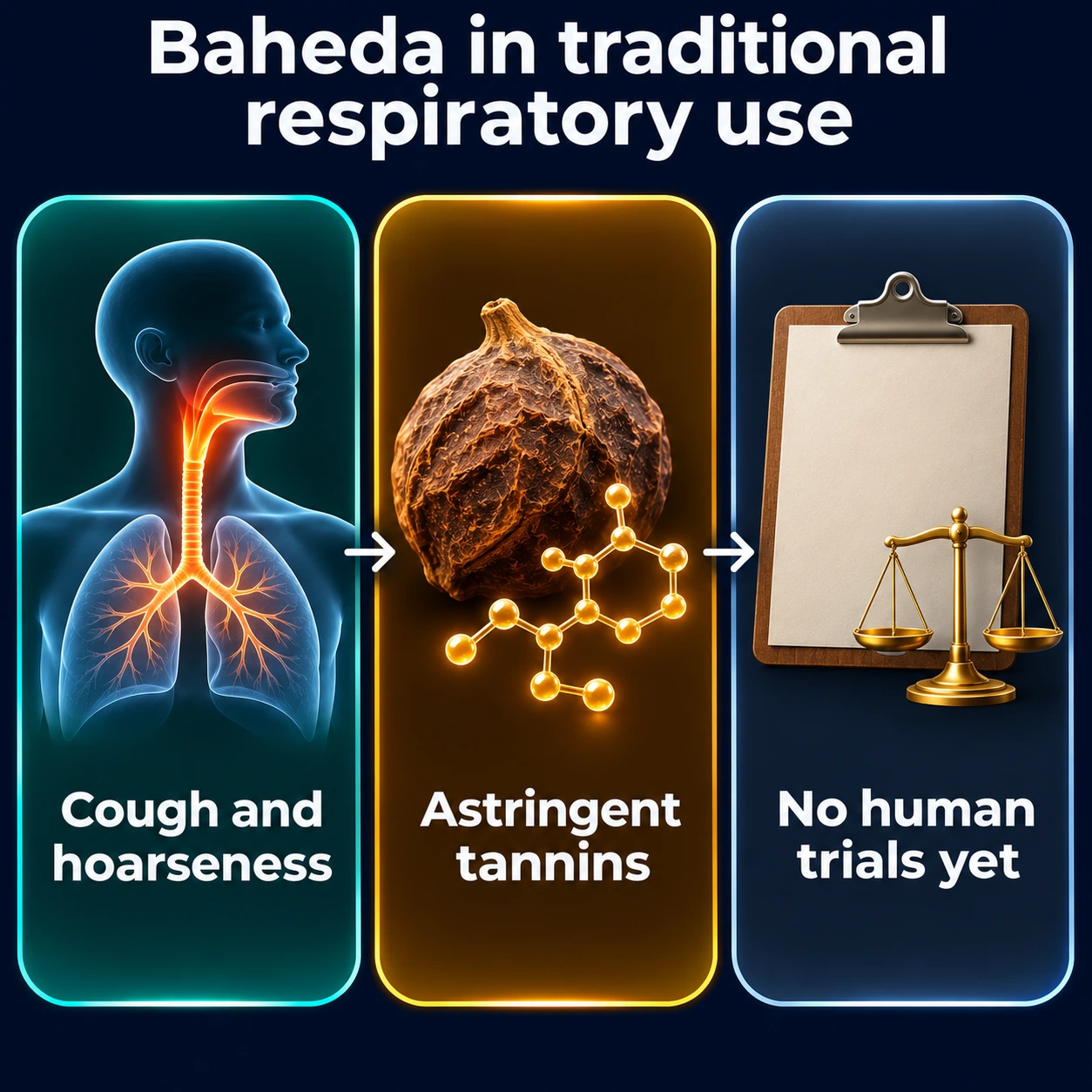
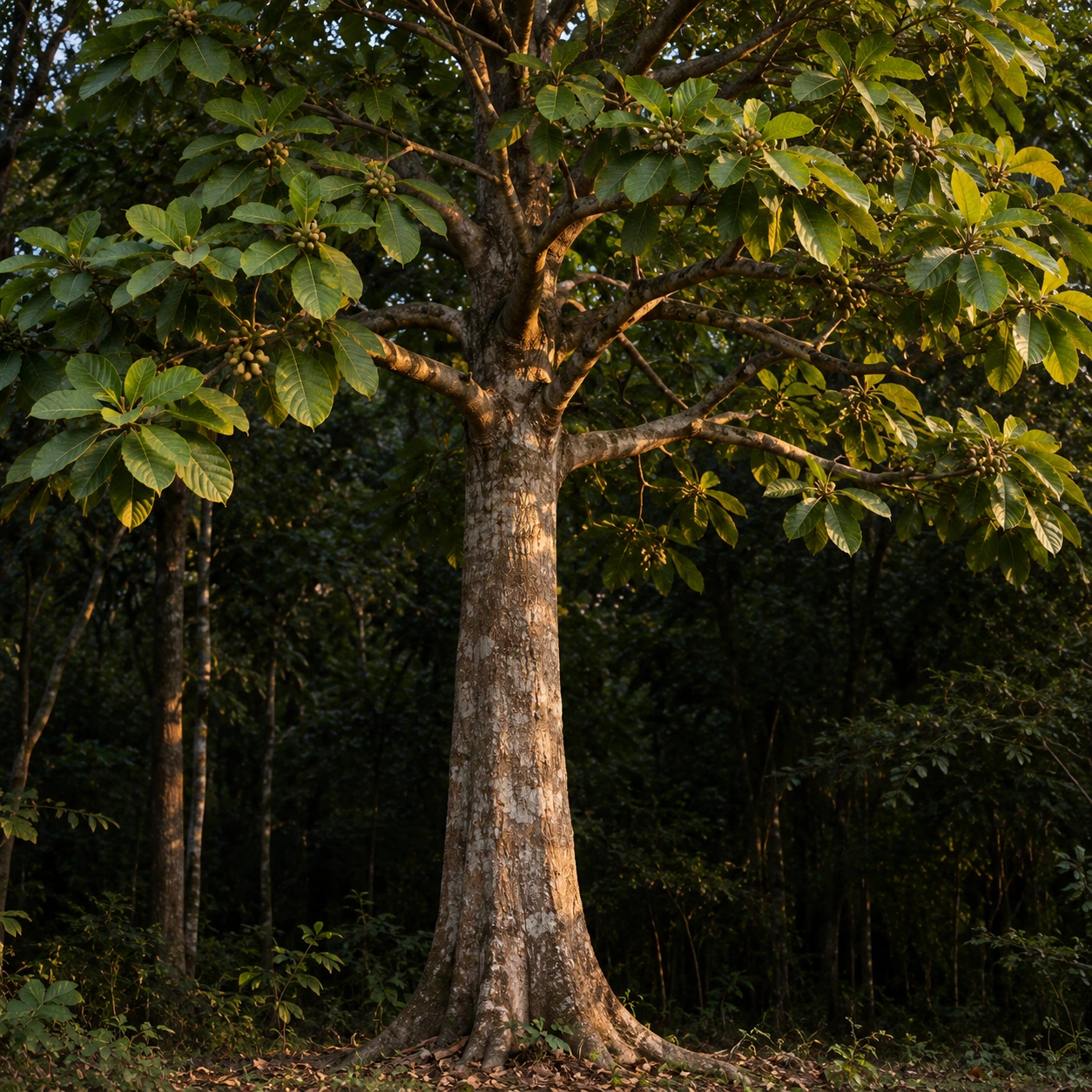
Of everything attributed to baheda, the respiratory use is the herb's own claim — not borrowed from Triphala, not borrowed from haritaki. Across Ayurvedic, Thai, Tibetan and Unani practice, Terminalia bellirica is the fruit reached for when the complaint is cough, hoarseness, a raw throat or chest congestion. It is why the plant has a place in the materia medica at all, independently of the three-fruit formula.
It also has no controlled human evidence behind it whatsoever. This page reports the tradition in detail because the tradition is the interesting part, states the mechanism that plausibly underlies it, and is explicit that the claim is untested rather than disproved. Those are different things, and this page keeps them apart.
Table of Contents
- Evidence Tier for This Page
- Kapha, the Chest, and What Ayurveda Actually Says
- The Traditional Indications, Named
- Thai, Tibetan and Unani Use
- The Plausible Mechanism: Astringency, Not Pharmacology
- “Respiratory” Is Two Different Claims
- Human Evidence: None of Adequate Quality
- Comparators That Do Have Trials
- What This Is Not: Asthma, Pneumonia and Red Flags
- Eyes, Hair and the Other Traditional Uses
- Digestive Use and the Triphala Overlap
- Tanning, Dyeing and What That Tells You
- Pharmacopoeial Status, and How to Read It
- What to Know If You Use It Anyway
- Key Research Papers
- Connections
- Featured Videos
Evidence Tier for This Page
- Traditional use only — the entire respiratory claim, the eye and hair uses, and the fever and voice indications. Documented consistently across four traditions over a long period. Not evidence of effect.
- Mechanism, plausible and unmeasured — astringency from hydrolysable tannins acting on inflamed mucosa. A real physical effect that anyone who has bitten an unripe persimmon has felt; never measured in an airway.
- Preliminary — the antispasmodic and antimicrobial laboratory work that is sometimes offered in support. Animal tissue and culture plates.
- Absent, not negative — there is no controlled human trial of baheda for cough, hoarseness, bronchitis, rhinitis or any other respiratory condition. No trial has failed; none has been run.
- Caution — the tannin–iron interaction and the absorption interference apply to every use on this page, including the throat ones. See the safety article.
Kapha, the Chest, and What Ayurveda Actually Says
Ayurveda organises the three Triphala fruits by which of the three doshas each one predominantly reduces, and the division is not decorative — it maps onto three quite different clinical territories.
- Haritaki is aligned with vata and with downward movement: the bowel, dryness, wind, transit.
- Baheda (bibhitaki) is aligned with kapha — the principle of heaviness, moisture, mucus and accumulation. Its territory is therefore the chest, throat and upper airway, where kapha is understood to gather.
- Amla is aligned with pitta: heat, inflammation, acidity.
Translated out of the system's own vocabulary and into plain description, the claim being made about baheda is that it is a drying, astringent, mucus-clearing remedy for a wet, congested chest and an irritated throat. Whatever one thinks of the underlying theory, that is a clear and testable clinical claim, and it has never been tested.
Note the coherence between the theory and the chemistry, because it is one of the more honest points in favour of taking the tradition seriously as a hypothesis. A fruit dominated by astringent hydrolysable tannins is drying, in a directly physical sense. The tradition and the chemistry agree about what kind of substance this is. They simply do not establish that it helps anyone.
The Traditional Indications, Named
Reported as tradition, in the tradition's own terms where those are more precise than a modern paraphrase. Traditional use only.
- Cough (kasa) — the central indication, and the one that appears in every source.
- Difficult or laboured breathing (swasa) — a broad category in the classical texts that would today be split across several diagnoses.
- Hoarseness and voice disorders (swarabheda) — a specific and unusual indication, and worth noting because it is the one most consistent with a purely local astringent action on the larynx and pharynx rather than any systemic effect.
- Sore throat and throat irritation — typically as a decoction used as a gargle, or the fruit chewed.
- Excess mucus and chest congestion — the kapha indication described above.
- Eye complaints — a traditional use of all three Triphala fruits, and of the formula.
- Hair — the fruit is used in traditional hair oils and washes.
- Digestion and bowel regularity — largely as one-third of Triphala rather than alone.
- Diarrhoea and dysentery — the astringent indication, often specifying roasted fruit.
- Fever and intestinal worms — older indications that appear in the colonial-era materia medica compilations and are rarely emphasised now.
The voice and hoarseness indication is the one worth dwelling on. It is unusual, it is specific, and it is the sort of claim that would be straightforward to test — voice outcomes have validated instruments, including the Voice Handicap Index and acoustic measures of jitter, shimmer and harmonic-to-noise ratio, all routine in laryngology clinics. That combination of specificity and testability makes it the most interesting untested claim in the whole of baheda's tradition.
Thai, Tibetan and Unani Use
Thai traditional medicine knows the fruit as samo phiphek (สมอพิเภก), a name descended directly from the Sanskrit vibhitaki. It sits alongside samo thai (haritaki) in the Thai equivalent of the three-fruit combination, and it appears in Thai expectorant and antitussive formulas. The convergence matters: two traditions that developed largely separately, with different theoretical frameworks, put the same fruit in the same clinical slot. That is not proof of anything, but it is a stronger form of traditional evidence than a single culture's usage, because it is harder to explain as a quirk of one system's internal logic.
Tibetan medicine includes the fruit, chiefly within compound formulas — the Tibetan three-fruits preparation and larger polyherbal recipes — rather than as a single agent. Modern research on Tibetan Triphala preparations exists, and it is research on formulas, which returns us to the attribution problem.
Unani medicine uses the fruit as balela or baleela, alongside halela (haritaki) and amla, again mostly in compound form. The Unani material is graded by size and origin much as the haritaki material is, which is one reason two nominally identical products can differ.
The Plausible Mechanism: Astringency, Not Pharmacology
The most likely explanation for the respiratory tradition is unglamorous, and being unglamorous is a point in its favour rather than against it.
Baheda is intensely astringent. Its hydrolysable tannins — galloyl- and ellagitannin-type molecules — bind and precipitate proteins on contact. On an inflamed, weeping mucous membrane that produces a tightening, drying, slightly numbing sensation, plus a thin precipitated protein layer over the surface. That is a real physical effect. It is what strong black tea, unripe fruit and a great many traditional throat remedies have in common, and it is why astringent gargles have been used for sore throats for as long as there have been sore throats.
Three consequences follow, and they define exactly how much the mechanism can carry:
- It is local. It happens where the preparation touches. A gargle or a chewed fruit reaches the pharynx; a swallowed capsule does not linger there.
- It is short-lived. Saliva and swallowing clear it within minutes to tens of minutes. Anything claimed to last for hours is claiming something else.
- It is almost certainly symptomatic rather than disease-modifying. Making a raw throat feel less raw for twenty minutes is genuinely worth something — it is most of what over-the-counter throat products do — but it is not treating an infection or reversing airway inflammation.
There is a further, more awkward implication. Large hydrolysable tannins are poorly absorbed intact, so what survives to reach the bloodstream after swallowing baheda is mostly small phenolic metabolites produced by gut bacteria, not the tannins themselves. That means the luminal and surface effects — astringency in the mouth and throat, binding in the gut — are the effects most likely to be real, and the systemic claims are the ones least likely to be. It is the same asymmetry noted for haritaki's oral use: the contact effects survive digestion and the systemic ones probably do not.
The single fruit has been tested for a contact effect in people, though in the mouth rather than the airway. In a 2017 double-blind crossover trial in India, people aged 15 to 40 rinsed with 15 ml of a freshly made 10% water extract of baheda, haritaki, amla or Triphala in turn. All four rinses lowered the count of the tooth-decay bacterium Streptococcus mutans in saliva at 5 and 60 minutes; Triphala lowered it most and amla least. It supports a real contact effect in the mouth, not a respiratory one.
Which is a strange conclusion for a respiratory herb. If the mechanism is contact astringency, then the gargle and the chewed fruit are the defensible traditional forms, and the swallowed capsule — which is how baheda is nearly always sold in the West — is the form the mechanism supports least.
“Respiratory” Is Two Different Claims
Marketing collapses them; they need separating, because they predict opposite things.
- Antitussive — suppresses coughing. The endpoint is fewer coughs, and the mechanism would be either a reduced cough-reflex threshold at the airway sensory nerves or a soothing surface effect that removes the irritant stimulus.
- Expectorant — loosens and helps clear mucus. The endpoint is easier, more productive coughing, or measurably improved mucociliary clearance. That is the opposite of suppression.
Baheda's tradition contains both. It is described as antitussive for a dry, irritated cough and as clearing kapha from a wet, congested chest. Both cannot be the primary action in the same patient at the same time, and the classical texts resolve this the way traditional systems usually do — by making the indication depend on the person's constitution and the character of the complaint rather than on the drug having one fixed action.
An astringent, drying tannin fits the antitussive-and-drying reading much better than the expectorant one. Nothing about tannin chemistry suggests mucus thinning; astringency, if anything, would reduce secretion rather than mobilise it. So the internal tension in the tradition is real, it is unresolved, and the chemistry favours one side of it. That is worth saying rather than smoothing over.
Human Evidence: None of Adequate Quality
Stated as plainly as possible: there is no controlled human trial of Terminalia bellirica, alone, for cough, hoarseness, sore throat, bronchitis, rhinitis, asthma or any other respiratory condition.
What does exist, and why none of it fills the gap:
- Multi-herb formulations containing baheda have been studied for allergic rhinitis and related complaints — but those tested proprietary polyherbal products, several were safety rather than efficacy investigations, and none permits an inference about the single fruit. Formula, not baheda alone.
- Triphala's human literature is almost entirely dental and metabolic. The mouthrinse trials are the best of it; they are about plaque and gingivitis, not the airway.
- Antimicrobial activity in culture is frequently offered as respiratory support. It does not work as an argument: an inhibitory concentration in a broth tube says nothing about concentrations achievable in an airway after swallowing, and most acute coughs are viral anyway.
- Antispasmodic work in animal tissue — Tiwari and colleagues, in the Saudi Pharmaceutical Journal in 2023, tested five plant extracts on isolated animal tissue: guinea-pig gut (ileum) made to contract with histamine, and rat uterus made to contract with serotonin (5-hydroxytryptamine). At 50 to 5000 mcg/ml, the T. bellerica extract significantly blocked these contractions, as did long pepper, black pepper and ginger; long pepper and black pepper were the strongest, abolishing the contractions completely, while haritaki's reduction was not statistically significant. That is isolated guinea-pig gut and rat uterus tissue, not bronchial smooth muscle in people. Preliminary (animal).
The instruments to do this properly are ordinary. Objective 24-hour cough-frequency monitoring, the Leicester Cough Questionnaire, cough-severity visual analogue scales, and inhaled capsaicin or citric-acid tussive challenge to measure the reflex threshold directly — all validated, all in routine use, all applied to cheap over-the-counter products. For a mucus claim, sputum measures and mucociliary clearance techniques exist too. None of them has been pointed at this plant. That is the finding, and it is a finding about funding and attention rather than about feasibility.
Comparators That Do Have Trials
The usual defence — that traditional cough remedies simply do not get trialled — is not true, and naming the counterexamples is more useful than arguing about it. Several plant-derived cough treatments carry randomised human evidence, and some are the basis of licensed medicines in Europe:
- Honey — trialled for acute paediatric cough against placebo and against standard antitussives, with a Cochrane review. Cheap, ancient, tested.
- Ivy leaf (Hedera helix) — standardised dry extracts studied for productive cough and used in licensed European products.
- Pelargonium sidoides — a root extract with a body of randomised trials in acute bronchitis and upper respiratory infection.
- Thyme with primrose root — a fixed combination with randomised trials in acute bronchitis. See thyme.
- Mullein and other demulcents — a comparable evidence position to baheda in some respects, examined on mullein for cough, bronchitis and congestion.
Two conclusions follow. First, the trials are doable — the design, endpoints and sample sizes are all established. Second, the plant-derived cough remedies with human evidence behind them are the ones listed above, and baheda is not among them.
What This Is Not: Asthma, Pneumonia and Red Flags
Being explicit here matters more than usual, because “respiratory herb” is a phrase that invites substitution for treatments that keep people alive.
- Baheda is not a bronchodilator and there is no evidence it opens airways. It is not a substitute for a reliever inhaler, a preventer inhaler or any part of an asthma plan. See asthma.
- It does not treat pneumonia, tuberculosis or any bacterial chest infection. In-vitro antimicrobial activity is not treatment.
- It does not treat chronic obstructive pulmonary disease (COPD) or chronic bronchitis, where the interventions that change outcomes are smoking cessation, vaccination, pulmonary rehabilitation and inhaled therapy. See bronchitis.
- Red flags need a diagnosis, not a herb: coughing blood, breathlessness at rest or on minimal exertion, chest pain, a cough lasting more than three weeks, unexplained weight loss, night sweats, fever that does not settle, or a new cough in a smoker or ex-smoker. See chronic cough.
The honest scope of what tradition claims here is symptomatic relief of an irritated throat and an ordinary cough. That is a small claim, and it is the only one the material supports.
Eyes, Hair and the Other Traditional Uses
Eyes. All three Triphala fruits carry a traditional ophthalmic reputation, and Triphala eyewash (netra prakshalana) is a classical practice. Two facts belong here. The eye literature that exists is on the formula, not on baheda alone. And a home-made plant decoction in an eye carries real risks: the eye has no barrier to spare, contamination of a home preparation is easy, and corneal injury and infection are not hypothetical risks. This page does not describe home eye preparations. Traditional use only.
Hair. Baheda appears in traditional Indian hair oils and washes, usually with amla and other ingredients, and is credited with darkening and strengthening hair. This is tradition plus cosmetic plausibility: tannin-rich plant materials do bind to keratin and to proteins generally, and tannin-and-iron chemistry has been used to darken fibres for centuries — which is a dyeing mechanism, not a biological one. There is no controlled trial. The amla cosmetic article covers this family of claims in more depth. Traditional use only.
Fever and worms. These appear in the older compilations and are seldom emphasised in modern usage. There is no supporting evidence for either, and antihelminthic treatment in particular is an area where effective specific drugs exist and a herbal substitute is a poor trade.
Digestive Use and the Triphala Overlap
Baheda's digestive reputation is largely the formula's reputation, and the attribution article deals with that. Two points belong here because they concern the fruit itself.
The direction of effect is genuinely unclear. Triphala is taken as a nightly bowel regulator; baheda alone is traditionally astringent, specified for diarrhoea and dysentery, often roasted. Pandey and colleagues reported in the Journal of Ethnopharmacology in 2017 that grilling T. bellerica fruits enhanced their antidiarrhoeal activity in a rodent model relative to dried (ungrilled) fruit. The study was prompted by the Tharu and Buksa tribes of Uttarakhand, India, who use grilled fruit for diarrhoea. Given by mouth at 100 mg/kg, an extract fraction of the grilled fruit cut castor-oil-induced diarrhoea by 71.7%, against 41.9% for the dried fruit; the grilled fruit also contained more gallic acid (4.92 against 2.8 mg per gram of dry powder) and about the same ellagic acid (4.45 against 4.7 mg/g). Preliminary (rodent); single study. If preparation genuinely shifts the balance, then raw and roasted baheda are two different medicines — which would also explain how two traditions can hold apparently opposite views of the same fruit without either being wrong about its own material.
The astringent effect on the gut is the effect most likely to be real, for the absorption reason given above: tannins that are not absorbed stay in the lumen and act there. That is also why the same chemistry produces the iron problem. The benefit and the hazard are one property described twice, and the safety article takes that up. The same logic is worked through for another tannin-rich astringent in agrimony, diarrhoea and tannins.
Tanning, Dyeing and What That Tells You
Baheda's non-medicinal uses are quietly informative. The fruit has been used in tanning leather and in dyeing, and the tree's timber is used locally. A fruit valued commercially as a tanning agent is, by definition, a fruit with a very high tannin load — that is what the word means, and tanning works by cross-linking protein. So the industrial use is a direct, independent confirmation of the chemistry, arrived at by people with no interest in medicine at all.
It supports the astringent mechanism argued above, since precipitating surface protein is exactly what a tanning agent does. It is also the plainest possible statement of the iron problem, because the same protein- and metal-binding reaction that fixes hide binds non-haem iron in a meal — taken up on the safety page, where it belongs.
Pharmacopoeial Status, and How to Read It
Baheda's official status is often cited as though it settled the efficacy question. It does not, and understanding why is worth more than the citation.
Baheda (bibhitaka) is an official drug of the Ayurvedic Pharmacopoeia of India, and the fruit appears in Thai traditional-medicine formularies. A pharmacopoeial monograph is a quality standard: it defines the correct botanical source, the plant part, macroscopic and microscopic identity, permitted limits for foreign matter, ash and moisture, and often an assay for a marker constituent. Its purpose is to let a regulator or a manufacturer confirm that the powder in the drum is the right plant, reasonably pure, and of consistent grade.
It is not an efficacy finding. A monograph does not assert that the drug works, and it does not rest on clinical trials. What it does is make the material identifiable and reproducible — which is genuinely valuable, and for a wild-collected forest fruit with two competing spellings and several traditional grades, it is arguably the most useful thing a standards body could contribute.
The contrast is instructive: several European herbal products hold a traditional-use registration, an instrument that explicitly requires documented long use plus plausible pharmacology and explicitly does not require efficacy trials. Terminalia bellirica has no published European Medicines Agency herbal monograph and no such registration, so it has not been assessed even against that lower standard. Its position is therefore: identified and quality-controlled in its country of origin, unassessed for efficacy anywhere.
What to Know If You Use It Anyway
People will, and a page that only says “untested” is less useful than one that says what follows from the mechanism. None of this is a treatment recommendation; see the disclaimer.
- The gargle or decoction is the form the mechanism supports for a throat complaint — contact with the sore surface is the whole proposed action. A swallowed capsule bypasses the target.
- Minutes, not hours. If it helps, it helps the way a lozenge helps: a contact effect on the scale of minutes.
- A gargle is spat out, which removes most of the systemic concerns — the iron interaction and the drug-absorption problem are both about swallowing tannins. This is the same distinction that makes the haritaki mouthrinse evidence unusually clean.
- Swallowed tannins bind non-haem iron (the iron in plant foods and supplements) eaten at the same time, and can interfere with the absorption of medicines; the separation described is about two hours. Detail on the safety page.
- The fruit pulp is the medicinal part. The seed kernel is not, and is reported in Indian pharmacognostic literature as intoxicating in quantity.
- A short complaint — the traditional throat use is for an acute complaint lasting days. A cough that persists beyond three weeks is one of the red-flag signs listed above, which doctors investigate.
- No safety data exist for pregnancy, breastfeeding or children, and baheda is not a bronchodilator, so it does not stand in for asthma medication.
- Narrow-margin medicines. The absorption concern matters most for thyroid hormone, anticonvulsants, anticoagulants, glucose-lowering drugs and other medicines where a small change in the amount absorbed changes the effect.
Key Research Papers
Single papers link to their PubMed record where it has been checked; the rest are PubMed topic searches with the paper's own details in prose. Each entry names the species, the preparation and the subject where these are known, and states its evidence tier.
- Pandey G, Gupta SS, Bhatia A, Sidhu OP, Rawat AK, Rao CV. Grilling enhances antidiarrheal activity of Terminalia bellerica Roxb. fruits. J Ethnopharmacol. 2017;202:63-66. PubMed PMID: 28025164 — Species: T. bellerica. Preparation: dried versus grilled fruit (ethyl acetate fractions of 50% ethanol extracts, 100 mg/kg by mouth). Subject: rodent castor-oil diarrhoea model. The single best reason to treat preparation method as a variable. Preliminary (rodent).
- Tiwari BR, Naseeruddin Inamdar M, Orfali R, Alshehri A, Alghamdi A, Almadani ME, Alshehri S, Imam Rabbani S, Mohammed Basheeruddin Asdaq S. Comparative evaluation of the potential anti-spasmodic activity of Piper longum, Piper nigrum, Terminalia bellerica, Terminalia chebula, and Zingiber officinale in experimental animals. Saudi Pharm J. 2023;31(9):101705. PubMed PMID: 37576742 — Species tested separately, which is why it is worth citing at all. Subject: animal; tissue: isolated guinea-pig gut and rat uterus, not airway. Preliminary (animal).
- Saxena S, Lakshminarayan N, Gudli S, Kumar M. Anti Bacterial Efficacy of Terminalia Chebula, Terminalia Bellirica, Embilica Officinalis and Triphala on Salivary Streptococcus Mutans Count - A Linear Randomized Cross Over Trial. J Clin Diagn Res. 2017;11(2):ZC47-ZC51. PubMed PMID: 28384980 — Species: T. bellirica alone, alongside its formula partners and Triphala. Preparation: freshly made 10% water-extract mouth rinse. Subject: people. Small human crossover trial; oral bacteria, not airway.
- Pfundstein and colleagues, Phytochemistry, 2010 — polyphenolic compounds in Terminalia bellerica, Terminalia chebula and Terminalia horrida fruits: characterisation, quantitation and antioxidant capacities. The analytical basis for saying baheda is a tannin-dominated fruit. Analytical chemistry. Find on PubMed
- Hegde and colleagues, Scientific Reports, 2024 — comparative metabolome profiling of Terminalia chebula, Terminalia bellerica and Phyllanthus emblica. Establishes what is chemically distinctive about baheda as against its formula partners. Analytical chemistry. Find on PubMed
- Ethnobotanical surveys recording respiratory use of Terminalia bellirica in India, Nepal, Thailand and Sri Lanka — the documentary basis of the traditional claim, and the right place to check whether a use is widespread or local. Traditional use only. Topic search
- Reviews of the ethnopharmacology, phytochemistry and pharmacology of Terminalia bellirica. Read them for scope, and check each cited claim's species and subject line as you go — this is where formula and congener results tend to be absorbed into the baheda literature. Reviews. Topic search
- Validated cough outcome measures — objective 24-hour cough-frequency monitoring, the Leicester Cough Questionnaire, cough visual analogue scales and inhaled capsaicin or citric-acid tussive challenge. The tools that would settle the antitussive claim and have never been applied to this plant. Methodology. Topic search
- Randomised trials of honey for acute cough in children, including the Cochrane review — the plainest demonstration that a cheap traditional remedy can be, and has been, properly trialled. Randomized clinical trials, other species. Topic search
- Randomised trials of ivy leaf (Hedera helix) extract and of thyme–primrose combinations in acute bronchitis — licensed European herbal products with trial evidence, and the standard baheda would have to meet. Randomized clinical trials, other species. Topic search
- Randomised trials of Pelargonium sidoides extract in acute bronchitis and upper respiratory tract infection. Same point, a different plant. Randomized clinical trials, other species. Topic search
- Astringent and tannin-containing preparations for sore throat and oral mucosal irritation — the general literature on the mechanism proposed here, which is thin in a way readers should see for themselves. Mixed tiers. Topic search
- Polyherbal Ayurvedic formulations containing Terminalia bellirica studied in allergic rhinitis and upper respiratory complaints — formula studies, several of them safety rather than efficacy investigations. Formula, not baheda alone. Topic search
- Voice-outcome instruments — the Voice Handicap Index and acoustic measures used in laryngology. Named because hoarseness is baheda's most specific traditional indication and the most straightforwardly testable one. Methodology. Topic search
Connections
- All Herbs
- Baheda (Terminalia bellirica) — the main topic page, including the uric-acid trials and the kernel warning.
- Baheda — Benefits Deep Dive — the hub for these four articles.
- Baheda, Triphala and the Attribution Problem — why almost every other claim for this fruit is borrowed.
- Baheda: Tannins, Gallic Acid and the Research — the chemistry behind the astringency argued here.
- Baheda Safety: Iron, Dose and Unknowns — what swallowing tannins costs.
- Chronic Cough — the red flags and the causes that need finding before any remedy.
- Sore Throat — where an astringent gargle plausibly belongs, and where it does not.
- Bronchitis and Asthma — conditions baheda does not treat.
- Mullein for Cough, Bronchitis and Congestion — a demulcent herb in a comparable evidence position.
- Thyme — Benefits Deep Dive — the thyme–primrose combination is one of the few plant cough treatments with randomised trials.
- Licorice — the other classical throat and cough herb, with its own quite separate safety problem.
- Peppermint for Respiratory Complaints and Cough — a different mechanism for the same symptom.
- Haritaki for Oral Health and Gums — the contact-versus-systemic distinction worked out on the congener.
- Agrimony for Sore Throat and Topical Use — the same astringent-gargle argument for a European herb.
- Amla — Hair, Skin and Traditional Cosmetic Use — context for baheda's hair-oil tradition.
Safety and disclaimer. This article is health information, not medical advice. Baheda's respiratory use is traditional only: no controlled human trial of the single herb exists for cough, hoarseness, sore throat or any other respiratory condition. It is not a bronchodilator and does not replace asthma medication. Home-made plant preparations in the eye carry contamination, corneal-injury and infection risks. The seed kernel, unlike the fruit pulp, is reported as intoxicating. No safety data exist for baheda in pregnancy, breastfeeding or children. Its tannins bind iron from meals and supplements and can interfere with the absorption of medicines; the separation usually described is at least two hours. A cough lasting more than three weeks, coughing blood, breathlessness, chest pain, fever that does not settle, night sweats or unexplained weight loss are warning signs that doctors investigate.