Mullein for Cough, Bronchitis, and Congestion
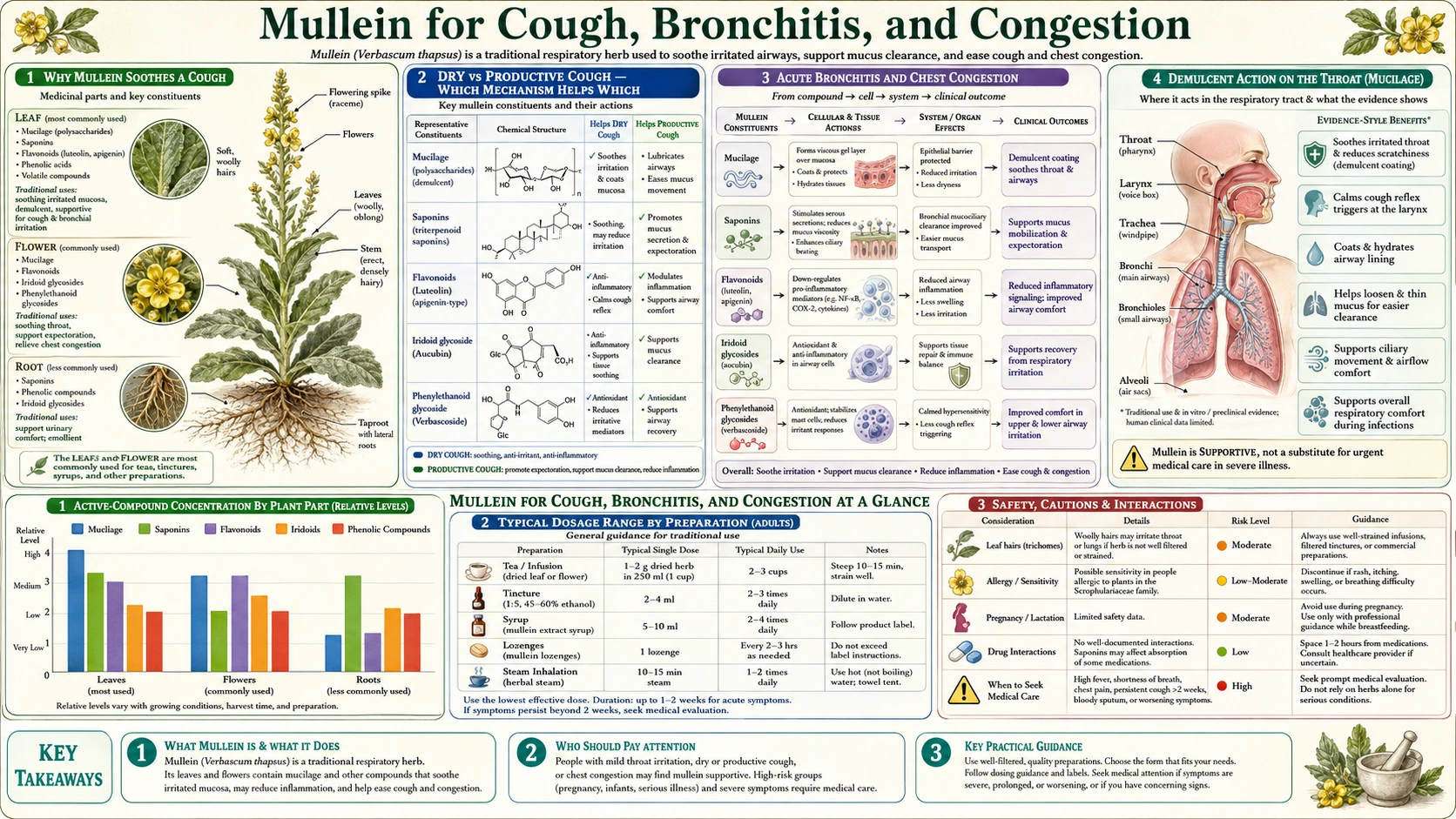
Table of Contents
- Why Mullein Soothes a Cough
- Dry vs Productive Cough — Which Mechanism Helps Which
- Acute Bronchitis and Chest Congestion
- Demulcent Action on the Throat (Mucilage)
- Expectorant Action (Saponins Loosen Phlegm)
- Mullein Cough Tea — and Why the Leaf Hairs Are Strained Out
- Mullein Cough Syrup and Tincture
- Steam Inhalation for Congestion
- Pairing Mullein with Thyme, Licorice, Marshmallow, and Peppermint
- Evidence and Limitations
- When a Cough Needs a Doctor
- Key Research Papers
- Connections
- Featured Videos
Why Mullein Soothes a Cough
Mullein (Verbascum thapsus) has been used as a cough and chest remedy across European, Native American, and Appalachian folk medicine for centuries, and its reputation rests on two complementary actions that target the two main reasons a cough lingers. The first is a soothing, coating action on irritated tissue; the second is a loosening action on thick mucus. The soft, woolly leaves and the bright yellow flowers are the medicinal parts, and both are traditionally steeped into teas, simmered into syrups, or extracted into tinctures.
The plant's soothing reputation comes largely from its mucilage — a class of water-soluble polysaccharides that swell into a slippery gel when steeped in warm water. When you drink a mullein tea, this gel forms a thin protective layer over the inflamed lining of the throat and upper airway. A cough that is driven by raw, irritated tissue (the tickle at the back of the throat that keeps setting off the cough reflex) often eases once that irritation is buffered. This places mullein in the herbalist's category of a demulcent — an agent that soothes and protects mucous membranes.
The plant's second action comes from its saponins, soap-like compounds that help thin and mobilize respiratory secretions. By making thick, sticky phlegm easier to move, saponins give mullein a gentle expectorant character, helping a productive cough do its job more efficiently. The combination of a demulcent coat and a mild expectorant push is exactly why mullein has been favored for the dry, hacking, irritated coughs that accompany the tail end of a cold or a bout of bronchitis. Mullein is supportive and symptomatic; it does not replace antibiotics for a confirmed bacterial infection, nor inhalers for asthma.
Dry vs Productive Cough — Which Mechanism Helps Which
Coughs fall broadly into two types, and understanding which one you have helps you understand which of mullein's actions is doing the work. A dry cough (non-productive) brings up little or no mucus. It is usually driven by irritation or inflammation of the airway lining — the kind of tickly, hacking cough that follows a cold, lingers after a viral infection, or flares from dry indoor air. For a dry cough, the relevant action is mullein's demulcent mucilage, which coats and calms the irritated tissue so the cough reflex is triggered less often.
A productive cough (wet or chesty) brings up phlegm. Here the cough is a useful clearing mechanism, and the goal is not to suppress it but to make it more efficient so the chest clears faster and with less effort. For a productive cough, the relevant action is mullein's mild expectorant effect from its saponins, which help loosen and thin secretions so they can be moved out of the airways more easily.
Because mullein offers both actions at once, it is used across the spectrum — soothing the rawness of a dry cough while gently helping a wet cough clear. This dual character is part of why traditional cough formulas pair mullein with herbs that lean more strongly one way or the other (a marshmallow for extra demulcent soothing, a thyme for stronger expectorant and antimicrobial action). One practical caution: fully suppressing a strongly productive cough that is doing its job can trap mucus in the lower airways and worsen a chest infection. Mullein's gentleness is an advantage here, as it eases discomfort without shutting the reflex down.
Acute Bronchitis and Chest Congestion
Acute bronchitis is inflammation of the bronchial tubes — the airways that carry air into the lungs — and it is overwhelmingly viral in origin. The hallmark is a cough that can persist for one to three weeks, often starting dry and becoming productive of clear, yellow, or greenish mucus as the illness evolves. Because most acute bronchitis is viral, antibiotics are usually not indicated, and major guidelines discourage routine antibiotic use for the otherwise-healthy adult with an acute cough. This is precisely the situation where soothing, supportive herbal measures have a sensible role: the body clears the virus on its own, and the goal in the meantime is to make the cough less miserable.
Mullein fits this supportive niche on both fronts. In the early, dry, raw-throat phase, its mucilage buffers the irritated airway lining and can take the edge off the relentless tickle. As the cough turns productive and the chest feels congested, its saponin-driven expectorant action helps loosen and move the thicker secretions. Warm mullein tea also delivers the simple but genuine benefits of warm fluids and steam — hydration thins mucus, and warmth and moisture soothe inflamed passages.
Chest congestion — that heavy, full feeling with rattly or productive coughing — responds best to a layered approach: staying well hydrated, breathing humidified air, and using gentle expectorant support. Mullein is often combined with thyme for this purpose, and steam inhalation of mullein (covered below) adds a direct topical route to the upper airway. If a bronchitis cough is accompanied by high fever, breathlessness, chest pain, or blood in the sputum, or if it drags on beyond three weeks, those are among the warning signs listed at the end of this article, which move a cough out of self-care territory.
Demulcent Action on the Throat (Mucilage)
The word demulcent describes an agent that soothes and protects irritated mucous membranes, and mullein owes this property to its mucilage. Mucilage is a family of long-chain water-soluble polysaccharides (sugars) that, when steeped in warm water, absorb that water and swell into a viscous, slippery gel. Mullein leaf and flower both contain mucilage, and a properly prepared infusion has a faintly slick, smooth quality on the tongue that signals the mucilage is present.
When that gel reaches the back of the throat, it forms a thin protective film over the inflamed surface. Physically, this does two things. It creates a barrier between the raw tissue and the air, food, and irritants passing over it, and it provides a layer of lubrication that reduces the mechanical friction that can keep retriggering the cough reflex. The effect is comparable to how a lozenge or a spoonful of honey coats a sore throat — soothing the surface so the underlying irritation has a chance to settle.
A practical consequence of this mechanism is that mucilage works best on contact and is relatively short-lived, so demulcent teas are typically sipped warm and repeated through the day rather than taken once. It also means the mucilage must actually be extracted into the water: a long steep in covered, hot-but-not-boiling water draws out more mucilage than a quick dunk. Mullein's demulcent action is gentle and local, which is part of why it has such a long record of safe traditional use for sore, scratchy throats and the dry coughs that go with them.
Expectorant Action (Saponins Loosen Phlegm)
An expectorant is an agent that helps clear mucus from the airways, either by increasing the volume and reducing the thickness of secretions or by helping the body move them outward. Mullein's expectorant reputation is attributed mainly to its saponins — naturally occurring glycosides named for their soap-like ability to lower surface tension and create foam when shaken in water. Mullein also contains other constituents studied for respiratory relevance, including flavonoids, iridoid glycosides such as aucubin, and the phenylethanoid verbascoside.
The traditional rationale for saponins as expectorants is that, by reducing the surface tension of the fluid lining the airways and irritating the mucosa slightly, they prompt a more watery secretion and help break up thick, tenacious phlegm into a form that is easier to cough up. Thinner, more mobile mucus clears more readily, which is why a productive cough often feels more effective — less straining, more results — when supported with a gentle expectorant. This contrasts with a cough suppressant, which dampens the reflex; an expectorant instead aims to make each cough count.
It is worth being candid about the strength of evidence here: mullein's expectorant action is well established in traditional practice and supported by its known saponin chemistry, but the rigorous clinical trial data quantifying it in humans are limited. Mullein is best understood as a mild, supportive expectorant rather than a powerful pharmaceutical mucolytic. For that reason it is frequently combined with stronger expectorant and aromatic herbs such as thyme, which contributes its own essential-oil-based loosening and antimicrobial effects.
Mullein Cough Tea — and Why the Leaf Hairs Are Strained Out
A mullein infusion is the simplest and most traditional preparation. A common approach is to use roughly one to two teaspoons of dried mullein leaf or flower per cup of hot (not vigorously boiling) water, cover the cup, and let it steep for ten to fifteen minutes. Covering matters: it keeps the volatile aromatics in and gives the mucilage time to fully draw out into the water. The resulting tea is mild and slightly sweet, and it can be sipped warm two to three times a day during a cough, often with a little honey, which adds its own demulcent soothing.
The single most important practical step with mullein tea is to strain it thoroughly. The leaves are covered in fine, branching woolly hairs (trichomes), and these hairs break loose into the infusion as it steeps. If swallowed, those tiny hairs can irritate the throat and mouth and, ironically, set off the very tickle and cough you are trying to calm. Traditional preparations pour the finished tea through a fine-mesh strainer, a paper coffee filter, a tightly woven cloth, or several layers of cheesecloth so that the liquid comes through clear and hair-free; coarse mesh lets the hairs through.
A few practical pointers improve the result. Flowers tend to make a milder, slightly sweeter, less hairy tea, while leaves are more robustly mucilaginous; many people blend the two. Mucilage-rich teas do not keep well, so they are usually made fresh each day. And because the soothing mucilage acts on contact and fades, frequent small warm cups through the day generally beat a single large dose.
Mullein Cough Syrup and Tincture
Beyond tea, mullein is commonly taken as a syrup or a tincture, each suited to a slightly different need. A cough syrup is made by preparing a strong, well-strained mullein infusion or decoction and then combining it with honey (and sometimes a little glycerine or sugar) to thicken and preserve it. The thick, sweet base is itself demulcent, clinging to the throat longer than a thin tea, which makes syrups especially comforting for a raw, tickly cough. Syrups are taken by the teaspoon as needed. As with tea, the liquid is strained free of leaf hairs before it is sweetened. Honey is not given to infants under one year of age because it can cause infant botulism.
Honey, the base of these syrups, has its own evidence. A 2021 systematic review and meta-analysis of 14 studies found that, compared with usual care, honey improved cough frequency and cough severity in upper respiratory tract infections such as colds, with an overall moderate risk of bias in the studies. Its authors describe honey as a widely available and cheap alternative to antibiotics for symptom relief, and call for further high-quality, placebo-controlled trials. That review tested honey itself, not mullein syrup.
A tincture is an alcohol (or sometimes glycerine) extract of mullein, valued for its convenience, long shelf life, and concentrated, portable dosing. A few dropperfuls in a little warm water can be taken several times a day. One trade-off worth knowing: alcohol-based tinctures capture mullein's saponins, flavonoids, and other constituents well, but the water-soluble mucilage does not extract fully into high-proof alcohol. In practical terms, a tincture leans toward mullein's expectorant and overall supportive character, while a tea or syrup better delivers the soothing demulcent coat. Some herbalists therefore use a tincture for general respiratory support and a warm tea or syrup specifically when the throat is raw.
Glycerine-based extracts (glycerites) are an alcohol-free alternative often chosen for those avoiding alcohol, with a naturally sweet taste; they keep some mucilage character while still concentrating the herb. Commercial products state their own dosing on the label, and these preparations are traditionally used as short-term support for an acute cough rather than taken indefinitely.
Steam Inhalation for Congestion
Steam inhalation is a direct, topical way to bring warmth and moisture — and any volatile plant aromatics — to the nose, throat, and upper airways, which is useful when congestion is the dominant complaint. The traditional method adds a handful of dried mullein (leaf and/or flower) to a bowl of just-boiled water, with a towel draped over the head and the bowl to form a tent, eyes closed, and the warm vapor breathed gently for five to ten minutes. The warmth and humidity help soothe inflamed passages and can loosen mucus in the nose and upper chest, making it easier to clear.
Much of the benefit of steam comes from the heat and moisture themselves, which is why even plain steam offers relief; the mullein and any companion herbs add their aromatic character on top of that. Mullein is frequently combined in a steam with more strongly aromatic, essential-oil-rich herbs — thyme, eucalyptus, or peppermint — whose vapors carry a stronger decongestant, opening sensation. Those aromatic herbs are potent, so a little goes a long way in a steam.
Scalds are the main risk of steam inhalation: the first roiling steam is the hottest and can scald the face or airways, and young children leaning over a bowl of hot water unsupervised can be badly burned. Strong aromatic vapors (especially peppermint or eucalyptus) can occasionally trigger airway tightening in people with asthma, and breathing that feels worse during a steam is the sign of that reaction. Steam is a comfort measure for upper-airway and congestion symptoms, not a treatment for a lower respiratory infection.
Pairing Mullein with Thyme, Licorice, Marshmallow, and Peppermint
Mullein is rarely used alone in traditional cough formulas; it is a team player that pairs naturally with herbs that complement its two main actions. The most common partner is thyme, whose essential oil (rich in thymol and carvacrol) brings stronger expectorant and antimicrobial activity to the blend. Mullein soothes while thyme loosens and helps fight the microbial side of a chest infection, which is why mullein-and-thyme is a classic bronchitis tea combination.
Thyme is also the partner with the stronger clinical evidence. In a 2006 double-blind, placebo-controlled trial, 361 adults with acute bronchitis and a wet (productive) cough took a fluid extract combining thyme herb and ivy leaves, or a matched placebo syrup, for about 11 days. By days 7 to 9, daytime coughing fits had fallen by 68.7% from the start with the thyme-ivy syrup, compared with 47.6% with placebo, and side effects were no more frequent or severe than with placebo. That trial tested thyme with ivy, not mullein.
For extra soothing, mullein is paired with two more demulcents. Licorice root adds its own mucilage along with anti-inflammatory and mildly expectorant constituents and a pleasant sweetness, although licorice carries an important caution: regular or high intake can raise blood pressure and lower potassium, so the research raises a concern for people with high blood pressure, heart, or kidney disease, and in pregnancy. Marshmallow root (Althaea officinalis) is one of the most mucilage-rich demulcent herbs and is a natural companion when the throat is especially raw, layering even more of the protective, coating action that mullein provides.
Peppermint contributes a different quality: its menthol provides a cooling, opening sensation that many people find decongestant and refreshing, and it can ease the throat and settle the stomach when a nagging cough has become tiresome. Peppermint is especially common in steam blends and in teas aimed at congestion. A traditional, well-rounded cough tea combines mullein (soothe and gently loosen), thyme (loosen and antimicrobial), and a small amount of peppermint (cooling and opening), with marshmallow added for a particularly raw throat — and licorice left out for people with the cautions above. No drug interactions are documented for mullein in the sources cited here, and there is no good safety data for mullein in pregnancy or breastfeeding; licorice, by contrast, has the blood-pressure and potassium effects described above.
Evidence and Limitations
It is important to set realistic expectations. Mullein's use for coughs and respiratory complaints is deeply rooted in traditional herbal medicine and is supported by a coherent rationale — documented mucilage content explaining the demulcent action, and saponins explaining the mild expectorant effect. Modern laboratory research has also examined mullein extracts for antimicrobial, anti-inflammatory, and antioxidant activity, and reviews of Verbascum thapsus catalogue a range of constituents (mucilage, saponins, flavonoids, iridoid glycosides such as aucubin, and the phenylethanoid verbascoside) with biological activity in test-tube and animal studies. One study cited below, for example, tested a flower extract of a related species, Verbascum phlomoides, rather than common mullein: in the laboratory it cut an inflammation signal (ICAM-1) by 55-58.8% in human blood-vessel lining cells, but it did not reduce paw swelling in rats, and it measured no breathing or cough outcome at all.
The honest limitation is that high-quality human clinical trials evaluating mullein specifically for cough, bronchitis, or congestion are scarce. Much of the support is traditional, mechanistic, or based on laboratory studies rather than randomized controlled trials in people. A literature search for this page found no randomized trial of mullein on its own for cough or bronchitis; the herbal cough trials that do exist test other remedies, such as the thyme-and-ivy trial and the honey review described above. Authoritative bodies such as the U.S. National Center for Complementary and Integrative Health (NCCIH) and MedlinePlus accordingly describe many herbal cough remedies as having limited rigorous evidence even where traditional use is extensive. This does not mean mullein is ineffective — it means the formal evidence base is thinner than the long history of use, and effects are best described as gentle and supportive.
In traditional practice, mullein is regarded as a low-risk supportive remedy for the discomfort of an everyday cough or mild chest congestion — most usefully the lingering, irritated cough after a cold or a bout of viral bronchitis. It is a comfort and support measure, not a cure for infection and not a substitute for medical treatment of asthma, pneumonia, chronic obstructive pulmonary disease (COPD), or any serious or persistent respiratory illness. There is no good safety data for mullein in pregnancy or breastfeeding, and no drug interactions are documented in the sources cited here; in people with a chronic lung condition or a weakened immune system, a cough is more likely to signal something serious.
When a Cough Needs a Doctor
Most coughs from a cold or acute viral bronchitis are self-limited and improve within one to three weeks, and gentle remedies like mullein are reasonable support in the meantime. But certain features are recognised as warning signs that a cough is no longer a self-care situation and needs prompt medical attention:
- Coughing up blood (even small streaks of blood in the mucus) — always treated as a sign needing evaluation.
- A cough lasting more than three weeks, or one that is getting worse rather than better over time.
- High or persistent fever, shaking chills, or drenching night sweats.
- Shortness of breath, wheezing, or difficulty breathing, or a feeling that you cannot catch your breath.
- Chest pain with breathing or coughing.
- Thick, discolored, or foul-smelling sputum with feeling unwell, which can suggest pneumonia or a bacterial infection.
- Unexplained weight loss, or a cough in someone who smokes or has known lung disease.
- Bluish lips or fingertips, confusion, or severe weakness — signs that hospitals treat as an emergency.
Infants, young children, older adults, pregnant people, and anyone with a chronic illness (asthma, chronic obstructive pulmonary disease, heart disease, diabetes, or a weakened immune system) have a lower threshold for needing care, because a cough that would be minor in a healthy adult can signal something more serious in these groups. A cough that interferes with sleep, breathing, or daily life, or that does not fit the expected pattern of a passing cold, falls outside the everyday, self-limited cough that mullein and other herbal measures are traditionally used for.
Key Research Papers
The following references combine verified peer-reviewed sources with curated PubMed topic-search links. Each search link opens directly in PubMed at the U.S. National Library of Medicine. Mullein has a strong traditional record but a limited rigorous clinical evidence base, so most entries are entry points into the broader literature rather than definitive trials.
- Turker AU, Gurel E. Common mullein (Verbascum thapsus L.): recent advances in research. Phytotherapy Research. 2005;19(9):733–739. — doi:10.1002/ptr.1653
- Verbascum thapsus — phytochemistry, pharmacology, and traditional uses (review). Phytotherapy Research — Search PubMed
- Verbascum thapsus antimicrobial and antiviral activity — PubMed: Verbascum thapsus antimicrobial antiviral
- Grigore A, Colceru-Mihul S, Litescu S, Panteli M, Rasit I. Correlation between polyphenol content and anti-inflammatory activity of Verbascum phlomoides (mullein). Pharmaceutical Biology. 2013;51(7):925–929 (cell and rat study of a related species; no respiratory outcome). — PubMed PMID: 23627472
- Verbascoside (acteoside) pharmacology — PubMed: verbascoside pharmacology
- Saponins as expectorants — mechanism and evidence — PubMed: saponins expectorant
- Mucilage demulcent action on mucous membranes — PubMed: mucilage demulcent cough
- Herbal medicine for acute bronchitis and acute cough — PubMed: herbal medicine acute bronchitis
- Thyme (Thymus vulgaris) for cough and bronchitis — PubMed: thyme cough bronchitis
- Kemmerich B, Eberhardt R, Stammer H. Efficacy and tolerability of a fluid extract combination of thyme herb and ivy leaves and matched placebo in adults suffering from acute bronchitis with productive cough. A prospective, double-blind, placebo-controlled clinical trial. Arzneimittelforschung. 2006;56(9):652–660. — PubMed PMID: 17063641
- Abuelgasim H, Albury C, Lee J. Effectiveness of honey for symptomatic relief in upper respiratory tract infections: a systematic review and meta-analysis. BMJ Evidence-Based Medicine. 2021;26(2):57–64. — PubMed PMID: 32817011
- Aucubin (iridoid glycoside) anti-inflammatory activity — PubMed: aucubin anti-inflammatory lung
- Steam inhalation for upper respiratory symptoms — PubMed: steam inhalation respiratory