Hair, Skin and Traditional Cosmetic Use
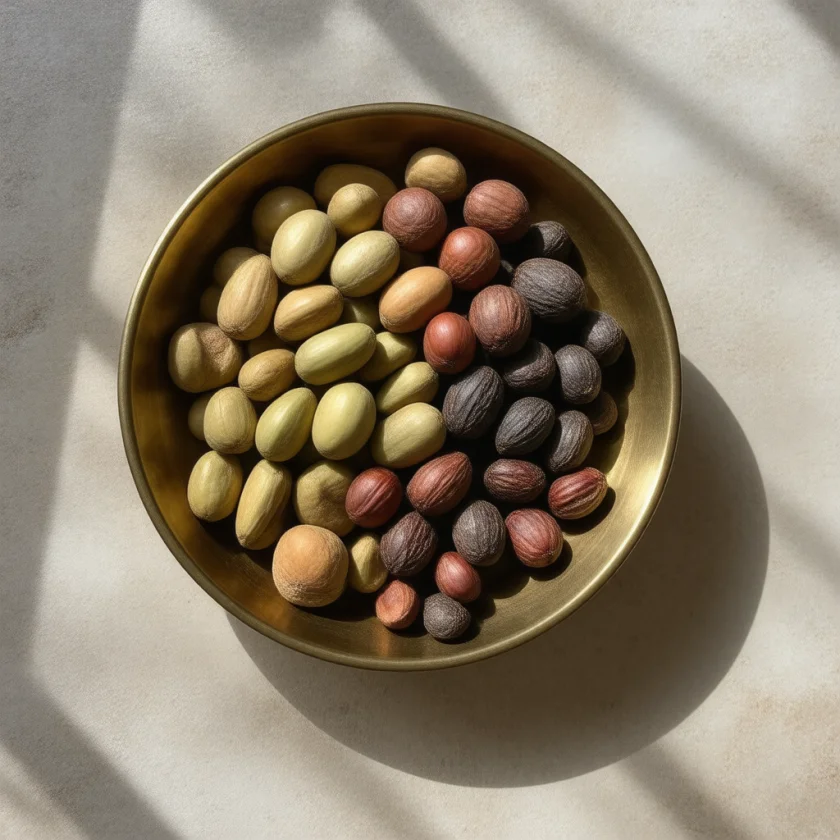
Amla hair oil is not a wellness-industry invention. It is a genuine, continuous, multi-generational practice across India, Nepal, Sri Lanka and Bangladesh — fruit steeped in coconut or sesame oil, massaged into the scalp, left overnight, washed out. Amla powder appears in traditional hair washes and in henna mixtures. Grandmothers have opinions about it. That kind of tradition is worth taking seriously as a reason to investigate.
It is not, on its own, evidence that it works. So this article separates three things that get run together in every article about amla and hair: what the tradition actually is, what the one human trial actually measured, and what the laboratory studies do and do not show. There is more real evidence here than for most cosmetic botanicals, and considerably less than the marketing implies. There is also one detail that almost every source repeating “amla is proven for skin ageing” has missed, and it is in the branch section below.
Table of Contents
- The Tradition, Described Accurately
- The One Human Hair Trial
- Why “More Anagen” Is Not Yet “More Hair”
- The 5-Alpha-Reductase Screen
- How Amla Darkens Grey Hair: Staining, Not Repigmentation
- How Amla Hair Oil Is Actually Made and Used
- Skin: Procollagen and MMP-1 in Cell Culture
- The Study That Used the Branch, Not the Fruit
- Vitamin C and Skin — the Real Mechanism
- Amla Taken by Mouth for Acne
- Amla Products, the Evidence Behind Each, and What a Label Shows
- Cautions
- Key Research Papers
- Connections
- Featured Videos
The Tradition, Described Accurately
Amla — amalaki in Sanskrit, nellikai in Tamil and Kannada, nelli in Malayalam and Sinhala — occupies a specific place in South Asian hair care that is worth describing precisely rather than romantically.
- Amla oil (amla tel). Dried fruit pieces or powder infused in coconut oil (south India) or sesame oil (north India), sometimes with other herbs such as bhringraj or brahmi. Warmed, massaged into the scalp, left for an hour or overnight, then washed out. Used weekly or more often, from childhood.
- Amla in hair washes. Powder mixed with shikakai (Acacia concinna) and reetha or soapnut (Sapindus) as a traditional cleansing paste — the pre-shampoo hair wash of much of the subcontinent.
- Amla with henna. Added to henna paste, where it darkens and cools the resulting colour, reducing henna's orange-red toward a browner tone.
- Amla eaten. In Ayurveda, amalaki is a rasayana — a rejuvenative — and hair quality is one of the things a rasayana is traditionally expected to improve from the inside.
- Traditional Persian Medicine. Amla appears there too, described specifically as a hair tonic, recommended both orally and topically. That is what motivated the one modern randomised trial discussed below.
Traditional use is history, not proof. It tells you a practice persisted, which usually means people found it pleasant, affordable and at least not harmful. It does not tell you the fruit did anything a plain oil massage would not. Scalp massage with any oil reduces breakage, improves the appearance of dry hair, and feels good — and disentangling that from a specific amla effect is exactly what a controlled trial is for.
The One Human Hair Trial
In 2024, Akhbari and colleagues published the only randomised controlled trial of amla for hair loss in the peer-reviewed literature. It is small, but it was done properly, and it deserves to be reported in detail rather than summarised as “studies show amla helps hair growth”.
The design
- Triple-blind, randomised, placebo-controlled. Triple-blind means participants, those delivering the intervention, and those assessing outcomes were all kept unaware of allocation — a stronger design than most botanical trials manage.
- Sixty women with female androgenetic alopecia (female-pattern hair loss), randomised 30 and 30.
- Intervention: 10 mL of amla syrup three times daily for 12 weeks. Note that this was an oral product, not a topical one.
- Control: matching placebo, same dose and duration.
- Outcomes: hair growth parameters by a phototrichogram hair-counting method — digital image analysis that counts hairs and classifies them by growth phase — plus clinician (CGI-I) and patient (PGI-I) global impression of improvement.
- Completion: 27 of 30 in the amla group and 25 of 30 on placebo finished.
The result
- The anagen-to-telogen ratio increased significantly in the amla group compared with placebo (F = 10.4, p = 0.002).
- Both physician and patient satisfaction scores improved significantly against placebo (p < 0.001 for both).
- Safety was good. The only adverse event reported was one case of mild constipation after a month.
- The authors concluded amla syrup could help treat androgenic hair loss in women by increasing the anagen phase, and that further studies are needed.
What to hold against it
- Fifty-two people completed. That is a small trial for a condition with a large placebo response and slow, noisy natural variation.
- Twelve weeks is short for hair. A full hair cycle runs years; anagen alone typically lasts two to six years. Twelve weeks captures a shift in the proportion of follicles in each phase, not a change you would see in the mirror.
- One centre, one country, never replicated. Same caution as everywhere else in this literature.
- The product was an amla syrup, not amla oil and not capsules. No dose of dried fruit or extract is stated in a form you can shop for.
- Global-impression scales are subjective even under blinding, and are the softest of the endpoints reported.
Fair verdict: a genuinely positive, well-blinded small trial — better evidence than most cosmetic botanicals have, and a long way from establishing amla as a hair-loss treatment. For female-pattern hair loss, minoxidil and other treatments have far larger evidence bases behind them.
Why “More Anagen” Is Not Yet “More Hair”
The trial's main finding is worth unpacking, because “increases the anagen phase” sounds like a proven benefit and is really a mechanism-shaped clue.
Each hair follicle cycles through three phases:
- Anagen — active growth. Lasts two to six years on the scalp. About 85–90% of your follicles are here at any moment.
- Catagen — a short transitional shutdown, a couple of weeks.
- Telogen — resting, then shedding. About two to three months, and roughly 10–15% of follicles.
In androgenetic alopecia, follicles spend progressively less time in anagen and more in telogen, and each cycle produces a finer, shorter hair — the process called miniaturisation. So the anagen-to-telogen ratio is a sensible and standard thing to measure, and it moving in the right direction is a real result.
But three caveats decide how much it means:
- A ratio can shift because the numerator rose or because the denominator fell. Fewer follicles shedding produces the same ratio change as more follicles growing, and the two feel very different to the person whose hair it is.
- Density and thickness are what people notice. The visible result of hair loss is scalp showing through and hair feeling thin. A phase-ratio shift over twelve weeks does not tell you those changed.
- Hair-cycle measures fluctuate seasonally and with stress, illness, dieting and iron status — which is exactly why the placebo arm matters, and why this trial having one is what makes it worth citing at all.
One more practical point that belongs here: iron deficiency is a well-recognised contributor to hair shedding in women, and amla's tannins inhibit iron absorption. If you are taking amla for your hair and you are also iron-deficient, the timing of your doses could matter more than the amla does. No study has set a spacing interval between amla and iron; a ferritin blood test shows whether iron stores are low. See the Triphala article for the numbers.
The 5-Alpha-Reductase Screen
The mechanism claim you will meet most often is that amla inhibits 5-alpha-reductase, the enzyme that converts testosterone into dihydrotestosterone (DHT). DHT drives follicle miniaturisation in androgenetic alopecia, and blocking that enzyme is exactly how finasteride works. So an amla product claiming 5-alpha-reductase inhibition is claiming the finasteride mechanism.
There is a real study behind the claim, and it is more specific than most such claims manage. Kumar and colleagues screened seventeen Thai plants traditionally used for hair treatment. They made ethanol extracts, tested them against 5-alpha-reductase from rat liver, and separately tested hair growth in C57BL/6 mice.
Their results, stated as finasteride-equivalent activity (FEA) — milligrams of finasteride equivalent per gram of crude extract:
- Carthamus tinctorius (safflower): 24.30 ± 1.64 — the most potent inhibitor and the best hair-growth promoter in mice
- Phyllanthus emblica (amla): 18.99 ± 0.40 — the second most potent
- Rhinacanthus nasutus: 10.69 ± 0.96 — the least potent of those reported
The authors found strong relationships between enzyme inhibition and hair-growth promotion across the plants tested, which is a more useful finding than either measure alone.
What this does not establish
The distance between this and a hair product:
- The enzyme came from rat liver. There are two main isoforms of 5-alpha-reductase, distributed differently across tissues and species. Inhibiting a rat liver preparation is not the same as inhibiting the isoform in a human hair follicle.
- It is a test-tube result. An extract in direct contact with a purified enzyme at whatever concentration the assay used bears no fixed relationship to what reaches a follicle from a capsule or an oil.
- “Finasteride-equivalent” is a units convention, not a clinical equivalence. It says nothing about how many grams of extract would equal a 1 mg tablet in a person, and the honest answer is that nobody knows.
- The mouse model was C57BL/6 hair-cycle induction — a standard screening model for anything that stimulates follicles, not a model of androgenetic alopecia.
Where this fact fits: as a reasonable explanation for why amla might be worth studying for hair, sitting alongside a single small positive human trial. Not as evidence that amla is a natural finasteride. Anyone selling it as one is skipping four steps.
How Amla Darkens Grey Hair: Staining, Not Repigmentation
This is one of amla's most persistent claims, and it deserves a direct answer: there is no evidence that amla reverses grey hair, and there is a mundane explanation for why people believe it does.
Grey hair happens when the melanocyte stem cells in the follicle bulge are depleted and the follicle stops making pigment. Restoring that would require regenerating a stem cell population — a hard problem that no topical botanical has solved. Nothing in the published literature shows amla doing it.
What amla demonstrably does do is stain. It is loaded with hydrolysable tannins, and tannins react with iron to form dark blue-black complexes — the same chemistry as iron gall ink, which was the standard writing ink of Europe for a thousand years and was made from oak galls, iron sulphate and water. Amla in an iron pot, or amla in a henna paste, deposits colour onto the hair shaft. Traditional amla-and-henna mixtures darken and cool henna's orange precisely because of this.
So the observation behind the claim is real. Hair does look darker. But the mechanism is staining the outside of existing hair, not restoring pigment production inside the follicle, and the two behave completely differently: staining washes out gradually, does not affect new growth at the root, and is not a treatment for anything.
The colour effect is real as a colour effect; it does not stop new grey hair from arriving.
How Amla Hair Oil Is Actually Made and Used
Since it is the form most people will actually use, here is the practice described properly — presented as tradition, since no trial has tested it.
Making it
- Dried amla, not fresh. Water in fresh fruit will make the oil go rancid or grow mould. Traditional oils use dried pieces or powder.
- Warm, not hot. The oil is heated gently with the amla — well below frying temperature. Traditional practice is a low heat until the fruit darkens, then off the heat to steep. High heat destroys ascorbate and can degrade the oil.
- Coconut oil in the south, sesame in the north. Both are traditional. Coconut oil has the better evidence base as a hair oil in its own right, having been shown to reduce protein loss from hair.
- Strained and stored dark. A sealed bottle away from light, in small batches.
Using it
- Massaged into the scalp, not just the lengths — the follicle is the only thing alive.
- Left for at least an hour, or overnight on a towel.
- Washed out thoroughly. Amla oil is heavy, and residue makes hair look greasy and limp, which people then read as damage.
- Once or twice a week is the common rhythm.
What it can honestly be expected to do
- Condition and reduce breakage. Oil pre-wash treatments reduce hygral fatigue — the swelling and shrinking cycle that damages hair when it gets wet — and that means less snapping. This is a real, mechanical benefit of oiling, not an amla-specific one.
- Improve appearance and manageability. Genuine and immediate.
- Feel good. Scalp massage is pleasant and is not nothing.
What it has not been shown to do
- Regrow hair in androgenetic alopecia. The only trial that reported a hair-cycle benefit used an oral syrup, not an oil.
- Reverse greying, beyond staining.
- Deliver meaningful vitamin C anywhere. Ascorbic acid is water-soluble and does not partition well into oil, and skin is a poor route for it in that form.
Skin: Procollagen and MMP-1 in Cell Culture
The most-cited amla skin paper is Fujii and colleagues, 2008. Working with human skin fibroblasts in culture, they reported that amla extract promoted procollagen production and inhibited matrix metalloproteinase-1 (MMP-1). The extract also raised tissue inhibitor of metalloproteinase-1 (TIMP-1) and had no evident effect on MMP-2.
Why those two endpoints matter: procollagen is the precursor your fibroblasts secrete and then assemble into collagen, the protein that gives skin its structure. MMP-1 is the enzyme that breaks collagen down, and it is upregulated by ultraviolet light — a central part of why sun exposure ages skin. So a compound that raises collagen synthesis while lowering collagen breakdown is targeting both halves of photoageing at once. It is a sensible thing to look for.
Adil and colleagues followed in 2010 with a study of amla fruit extract against ultraviolet B-induced photoageing in human skin fibroblasts — again, cells in a dish. At 10–40 micrograms per mL, the fruit extract protected procollagen 1 against ultraviolet B-induced depletion, and in a test-tube assay it inhibited hyaluronidase, an enzyme that breaks down hyaluronic acid.
The limitation is the same in both, and it is not a small one. Fibroblasts in culture sit in a plastic well and are bathed directly in whatever concentration the experimenter chooses. Human skin has a stratum corneum — a layer of dead, tightly packed, lipid-sealed cells evolved specifically to stop things getting in. Most water-soluble polyphenols cross it poorly. A compound that works beautifully on fibroblasts may never reach a fibroblast through intact skin, and taking it by mouth introduces digestion, liver metabolism and dilution across the whole body.
There is no randomised controlled trial of amla fruit alone on human skin ageing; there is one of amla fruit combined with lingonberry, taken by mouth. In that randomized, double-blind, placebo-controlled trial, 99 healthy women drank 50 mL a day of a drink containing 25 mg of lingonberry extract and 30 mg of amla fruit extract, a drink with double those amounts, or a placebo, for 12 weeks. Skin elasticity improved in a dose-dependent way (P < 0.01), and skin thickness, stratum corneum water content and wrinkles around the eyes also improved (P < 0.001). Because two fruits were combined, the trial cannot show the effect of amla alone (Uchiyama 2019).
Cell culture tells you the biology is worth pursuing. It does not tell you a cream works.
The Study That Used the Branch, Not the Fruit
Here is the detail that gets lost every time this literature is summarised, and it is worth stating loudly.
Chaikul and colleagues published a 2021 paper in the Journal of Traditional and Complementary Medicine titled “Phyllanthus emblica L. (amla) branch: A safe and effective ingredient against skin aging”. It is frequently cited as evidence that amla works for skin ageing. Read the title again.
The study is about the branch. Not the fruit. A different plant part, with a different chemical profile, prepared differently, at a different concentration. The branch extract consisted mainly of the phenolic acids sinapic acid and ferulic acid. In people, the study tested a topical gel containing 0.1% branch extract in a randomized, double-blind, placebo-controlled study of 20 volunteers for 84 days, and reported lighter skin colour, better skin elasticity and hydration, and fewer wrinkles — a branch-gel result, not a fruit result.
This matters for entirely practical reasons. Nothing you can buy as “amla” in a food or supplement shop is branch material — amla products are fruit products, because the fruit is the edible part and the part every other study on this site is about. Citing a branch-extract cosmetic study to support a fruit-based claim is a plant-part substitution, and it is the same class of error as citing a bilberry-leaf study to support a bilberry-fruit supplement.
None of which is a criticism of the paper, which says clearly what it studied. The error belongs to everyone who cites it without reading past the species name. A claim of “clinically proven amla for skin” depends on which part of the plant was in the trial.
Vitamin C and Skin — the Real Mechanism
The strongest scientific link between amla and skin is not any amla study. It is vitamin C itself, and the biochemistry is genuinely solid — which makes it worth separating carefully from what it does not imply.
Pullar, Carr and Vissers reviewed the roles of vitamin C in skin health in 2017. The essentials:
- Ascorbate is an essential cofactor for prolyl and lysyl hydroxylase, the enzymes that hydroxylate proline and lysine residues in newly made collagen. Without that hydroxylation, the triple helix is unstable and the collagen is useless.
- This is why scurvy looks the way it does — bleeding gums, poor wound healing, skin haemorrhages, corkscrew hairs. Scurvy is collagen failure, and it is the most direct demonstration in medicine that vitamin C is required for skin integrity.
- Skin normally holds high concentrations of vitamin C, particularly in the epidermis, and levels fall with age and ultraviolet exposure.
- Vitamin C also regenerates vitamin E from its oxidised form, extending antioxidant protection in the skin's lipid layers.
Now the honest limit. That vitamin C is required for collagen synthesis does not mean more vitamin C produces more collagen in someone already replete. Enzyme cofactors saturate. Once the enzyme has enough, additional cofactor does nothing — the same logic as the plasma saturation described in the chemistry article. The people whose skin improves measurably with more vitamin C are the people who did not have enough.
And topical is a different question again. Cosmetic vitamin C serums use ascorbic acid or its derivatives at specific concentrations and pH values chosen to get the molecule through the stratum corneum, because plain ascorbic acid crosses skin poorly and oxidises fast. An amla product is not a vitamin C serum, and there is no reason to expect amla oil to deliver ascorbate to the dermis.
So amla's place here is as a nutrient-dense fruit that is eaten; topical vitamin C comes from formulated vitamin C products, which amla oil is not. See Vitamin C.
Amla Taken by Mouth for Acne
A 2026 randomized, double-blind, placebo-controlled, dose-ranging trial gave 88 adults with post-adolescent acne an oral formula of amla fruit and Tinospora cordifolia stem at 300, 400 or 500 mg a day, or a placebo, for 12 weeks. Acne lesion counts fell with dose, but the differences between the treatment and placebo groups did not reach statistical significance. Quality of life improved from baseline in all three dose groups, laboratory safety tests stayed within normal ranges, and no serious or treatment-related adverse events were reported. Because the formula combined two plants, the trial cannot show what amla alone did (Liyanage 2026).
Amla Products, the Evidence Behind Each, and What a Label Shows
| Goal | Option | Evidence behind it |
|---|---|---|
| The trial intervention for hair | An oral amla product taken daily for 12 weeks | One triple-blind randomized controlled trial (RCT), 60 women, oral syrup |
| Conditioning and less breakage | Amla oil in coconut or sesame, pre-wash, weekly | Tradition, plus general evidence for pre-wash oiling |
| Darker-looking hair now | Amla with henna | Real, but it is staining, not pigment restoration |
| Topical vitamin C for skin | A formulated vitamin C serum, not amla | Skin penetration is a formulation problem amla does not solve |
| Serious hair loss | Diagnosis of the cause, including ferritin, thyroid and vitamin D testing | Treatable causes are common and get missed |
Label checklist
- Species and part: Phyllanthus emblica fruit. A label that does not name the part says nothing about it.
- For an oil: what carrier oil, and whether amla is actually infused or merely a fragrance. Many “amla oils” are mineral oil with fragrance and a green dye.
- Mineral oil versus plant oil. Mineral oil coats hair and is not harmful, but it is not the traditional preparation and it does not carry plant constituents.
- Added colourants. Some products contain hair dye ingredients. The full ingredient list shows them, which matters for anyone who has reacted to hair colour.
- Third-party heavy-metal testing for anything imported and taken by mouth.
Cautions
- Patch testing topical amla products. A patch test applies a small amount to the inner forearm and waits 48 hours before use on the scalp. Botanical extracts cause contact dermatitis in a minority of people, and a scalp reaction is miserable and slow to settle.
- Hidden dye ingredients. Products sold as “herbal hair colour” containing amla have on occasion been found to contain synthetic dyes including PPD (para-phenylenediamine), which is a significant allergen. This matters most for anyone who has reacted to hair dye before.
- Amla is astringent and drying. Powder-based hair washes strip more than a conditioning shampoo. Hair that is already dry, coarse or chemically treated is stripped less by an oil than by a powder wash.
- Iron and hair loss interact. Amla's galloyl tannins inhibit non-haem iron absorption, and iron deficiency itself causes shedding. No study has set a spacing interval between oral amla and iron supplements or iron-rich meals; a ferritin blood test shows whether iron stores are low.
- Thinning hair has many causes. Female-pattern hair loss, telogen effluvium, thyroid disease, iron deficiency, scarring alopecias and drug side effects all present as “my hair is thinning” and are managed completely differently. Scarring alopecias in particular cause permanent follicle loss, and time spent on a syrup is time not spent stopping that.
- Bleeding risk with oral products. Amla extract has demonstrated antiplatelet activity in a human crossover study: in 10 people with type 2 diabetes, 500 mg of extract decreased platelet aggregation and prolonged bleeding and clotting time. For people taking an anticoagulant or antiplatelet drug, or with surgery planned, the interaction detail is in the metabolic health article.
- Pregnancy and breastfeeding. Topical use of an oil is low risk. Oral concentrated products have no safety data in pregnancy.
- Heavy metals. Contamination of imported Ayurvedic products has been documented in peer-reviewed testing. This applies to anything taken by mouth.
- Timescale. Hair changes slowly. Nothing — amla, minoxidil or anything else — shows a visible result in under three months, and a judgment of any hair treatment made before six months can mislead in both directions.
Key Research Papers
Every identifier below was checked live against NCBI E-utilities before publication — first author, title, journal and year all had to match. Study type is labelled on every entry, because the difference between a dish of fibroblasts and a randomised trial is the whole point of this article.
Hair
- Akhbari M, Firooz A, Rahimi R, Shirzad M, Esmaealzadeh N, Shirbeigi L. The effect of an oral product containing Amla fruit (Phyllanthus emblica L.) on female androgenetic alopecia: a randomized controlled trial. Journal of Ethnopharmacology. 2024;318(Pt A):116958 — PubMed PMID: 37487962 — Human RCT — triple-blind, 60 women, 10 mL syrup three times daily for 12 weeks; anagen-to-telogen ratio increased vs placebo (F = 10.4, p = 0.002); one case of mild constipation.
- Kumar N, Rungseevijitprapa W, Narkkhong NA, Suttajit M, Chaiyasut C. 5α-reductase inhibition and hair growth promotion of some Thai plants traditionally used for hair treatment. Journal of Ethnopharmacology. 2012;139(3):765–771 — PubMed PMID: 22178180 — Enzyme assay (rat liver) plus mouse model — P. emblica second most potent of 17 plants, FEA 18.99 ± 0.40 vs safflower's 24.30.
Skin
- Fujii T, Wakaizumi M, Ikami T, Saito M. Amla (Emblica officinalis Gaertn.) extract promotes procollagen production and inhibits matrix metalloproteinase-1 in human skin fibroblasts. Journal of Ethnopharmacology. 2008;119(1):53–57 — PubMed PMID: 18588964 — Cell culture.
- Adil MD, Kaiser P, Satti NK, Zargar AM, Vishwakarma RA, Tasduq SA. Effect of Emblica officinalis (fruit) against UVB-induced photo-aging in human skin fibroblasts. Journal of Ethnopharmacology. 2010;132(1):109–114 — PubMed PMID: 20688142 — Cell culture — fruit extract, UVB model.
- Chaikul P, Kanlayavattanakul M, Somkumnerd J, Lourith N. Phyllanthus emblica L. (amla) branch: a safe and effective ingredient against skin aging. Journal of Traditional and Complementary Medicine. 2021;11(5):390–399 — PubMed PMID: 34522633 — Branch extract — not the fruit. Read the title before citing this as evidence for an amla fruit product.
- Pullar JM, Carr AC, Vissers MCM. The roles of vitamin C in skin health. Nutrients. 2017;9(8) — PubMed PMID: 28805671 — Review — ascorbate as cofactor for prolyl and lysyl hydroxylase; the real biochemistry behind “vitamin C for skin”.
- Uchiyama T, Tsunenaga M, Miyanaga M, Ueda O, Ogo M. Oral intake of lingonberry and amla fruit extract improves skin conditions in healthy female subjects: a randomized, double-blind, placebo-controlled clinical trial. Biotechnology and Applied Biochemistry. 2019;66(5):870–879 — PubMed PMID: 31342566 — Human RCT — 99 women, amla plus lingonberry drink, 12 weeks.
- Liyanage A, Darshana N, Chandraratne N, Perera J. Efficacy and safety of Phyllanthus emblica and Tinospora cordifolia in postadolescence acne: a randomized double-blind placebo-controlled trial. Journal of Integrative and Complementary Medicine. 2026 — PubMed PMID: 42487522 — Human RCT — 88 adults, amla plus Tinospora by mouth, 12 weeks; no significant difference from placebo in lesion counts.
Chemistry, background and safety
- Scartezzini P, Antognoni F, Raggi MA, Poli F, Sabbioni C. Vitamin C content and antioxidant activity of the fruit and of the Ayurvedic preparation of Emblica officinalis Gaertn. Journal of Ethnopharmacology. 2006;104(1–2):113–118 — PubMed PMID: 16226416 — Analytical — 0.4% ascorbic acid in raw fruit.
- Majeed M, Bhat B, Jadhav AN, Srivastava JS, Nagabhushanam K. Ascorbic acid and tannins from Emblica officinalis Gaertn. fruits — a revisit. Journal of Agricultural and Food Chemistry. 2009;57(1):220–225 — PubMed PMID: 19063633 — Analytical — disputes emblicanin content and the ascorbic acid figures.
- Fatima N, Pingali U, Muralidhar N. Study of pharmacodynamic interaction of Phyllanthus emblica extract with clopidogrel and ecosprin in patients with type II diabetes mellitus. Phytomedicine. 2014;21(5):579–585 — PubMed PMID: 24291054 — Human crossover, n = 10 — the antiplatelet caution for oral products.
- Brune M, Rossander L, Hallberg L. Iron absorption and phenolic compounds: importance of different phenolic structures. European Journal of Clinical Nutrition. 1989;43(8):547–557 — PubMed PMID: 2598894 — Human absorption study — relevant because iron deficiency itself causes hair shedding.
- Saper RB, Phillips RS, Sehgal A, et al. Lead, mercury, and arsenic in US- and Indian-manufactured Ayurvedic medicines sold via the Internet. JAMA. 2008;300(8):915–923 — PubMed PMID: 18728265 — Product-quality testing.
- Al-Rehaily AJ, Al-Howiriny TA, Al-Sohaibani MO, Rafatullah S. Gastroprotective effects of ‘Amla’ Emblica officinalis on in vivo test models in rats. Phytomedicine. 2002;9(6):515–522 — PubMed PMID: 12403160 — Animal — included as an example of amla's broader pharmacology.
PubMed Topic Searches
- PubMed: Amla and hair
- PubMed: Female androgenetic alopecia trials
- PubMed: Plant 5α-reductase inhibitors and hair
- PubMed: Hair oiling and protein loss
- PubMed: Iron deficiency and hair loss in women
- PubMed: Amla, fibroblasts and collagen
- PubMed: Topical vitamin C and skin penetration
- PubMed: PPD in “herbal” hair dyes
- PubMed: Hair greying and melanocyte stem cells
- PubMed: Botanical extracts and contact dermatitis
Connections
- All Herbs
- Amla Benefits — the hub, with the evidence map.
- Amla / Indian Gooseberry (Phyllanthus emblica) — the main article.
- Vitamin C and Antioxidant Chemistry — why saturation matters for the collagen claim.
- Cholesterol and Metabolic Health — the bleeding-risk interaction in full.
- Triphala and Digestive Use — the tannin-and-iron numbers.
- Vitamin C — requirements, deficiency and forms.
- Haritaki (Terminalia chebula) — the first Triphala fruit.
- Baheda (Terminalia bellirica) — the second Triphala fruit.
- Chanca Piedra (Phyllanthus niruri) — same genus, entirely different plant.