Turmeric for Anti-Inflammatory and Joint Health
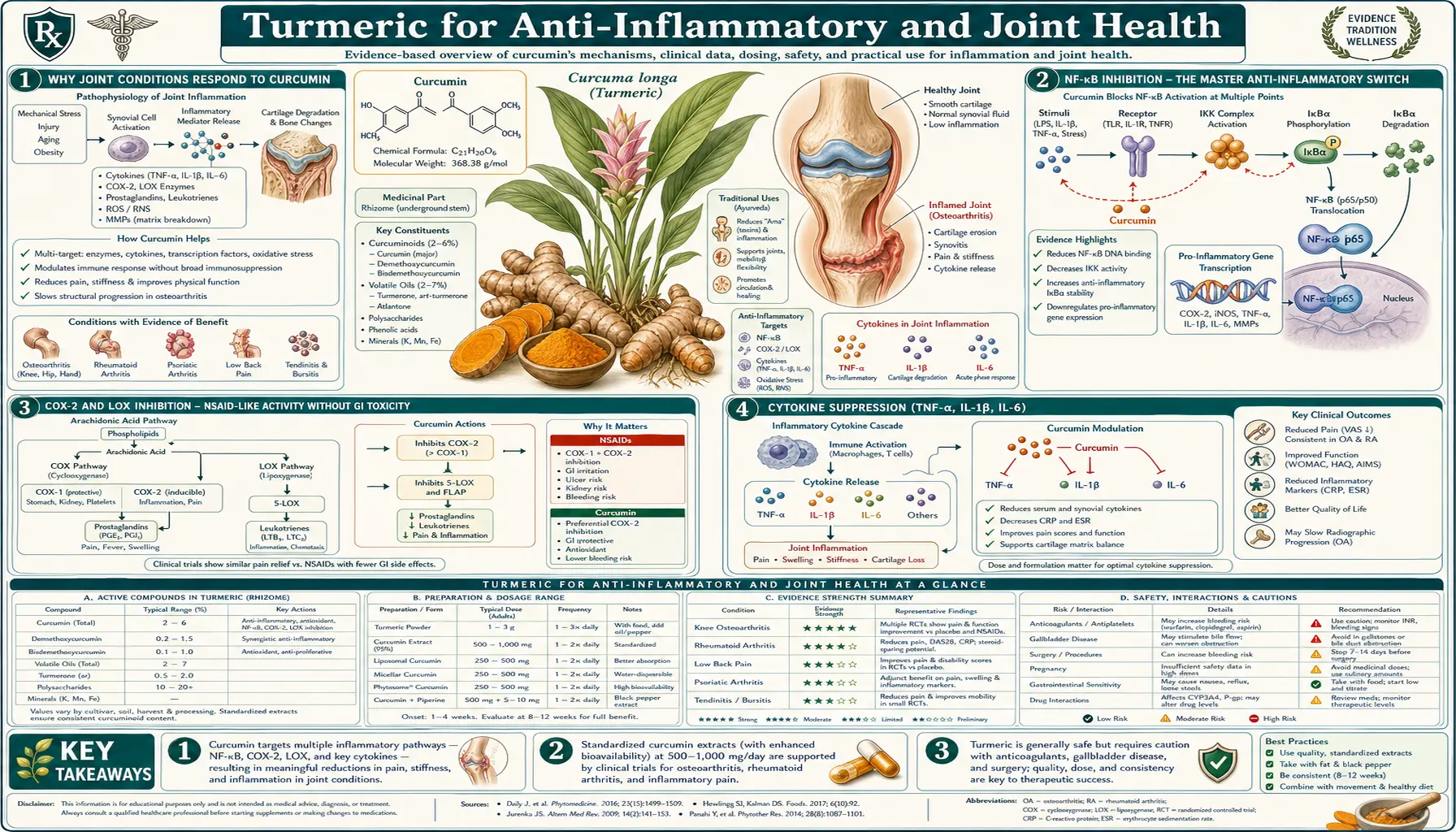
Joint pain — particularly osteoarthritis of the knee — is where the curcumin clinical evidence base is strongest and most consistent. The pivotal Daily et al. 2016 meta-analysis pooled eight randomized controlled trials (n=606 participants) and found that turmeric extracts at approximately 1000 mg/day curcumin improved pain and WOMAC scores against placebo, and that pain scores were no different from those with pain-relief drugs such as the nonsteroidal anti-inflammatory drugs (NSAIDs) ibuprofen and diclofenac in a pooled analysis of five studies, with a markedly lower rate of gastrointestinal side effects. In rheumatoid arthritis, a small 2012 pilot trial (Chandran and Goel, 45 patients) found that improvement in DAS-28 disease activity and ACR scores was significantly better with curcumin than with diclofenac. The multi-target mechanism — NF-kB inhibition, cyclooxygenase-2 (COX-2) and LOX suppression, downregulation of tumor necrosis factor-alpha and interleukin-6 (IL-6), and inhibition of cartilage-degrading matrix metalloproteinases — explains both why curcumin works on multiple inflammatory joint conditions and why most clinical trials use bioavailability-enhanced formulations such as a curcumin-phospholipid complex rather than crude turmeric powder.
Table of Contents
- Why Joint Conditions Respond to Curcumin
- NF-kB Inhibition — The Master Anti-Inflammatory Switch
- Cyclooxygenase-2 and LOX Inhibition — Nonsteroidal Anti-Inflammatory Drug-Like Activity Without Gastrointestinal Toxicity
- Cytokine Suppression (Tumor Necrosis Factor-alpha, IL-1beta, Interleukin-6)
- Matrix Metalloproteinase Inhibition and Cartilage Preservation
- The Daily 2016 Meta-Analysis (Osteoarthritis)
- The Henrotin 2013 Osteoarthritis Review and the Chandran Rheumatoid Arthritis Trial
- The Belcaro Long-Term Osteoarthritis Trials of a Curcumin-Phospholipid Complex
- Curcumin vs Ibuprofen and Diclofenac Head-to-Head
- Doses Used in the Joint Trials and Supplement Forms
- Cautions and Drug Interactions
- Key Research Papers
- Connections
- Featured Videos
Why Joint Conditions Respond to Curcumin
Osteoarthritis (OA) and rheumatoid arthritis (RA), despite their different pathogenesis, share a common downstream pathway of joint destruction driven by inflammatory cytokines, prostaglandins, and matrix-degrading enzymes. In OA, the initiating insult is typically mechanical — cartilage wear that triggers a chondrocyte stress response, releasing IL-1beta and interleukin-6, which in turn drive matrix metalloproteinase (MMP-3, MMP-13) production and further cartilage breakdown. In rheumatoid arthritis, the initiating insult is autoimmune, with synovial fibroblasts and T cells driving tumor necrosis factor-alpha and IL-17 production, recruiting neutrophils, and producing pannus tissue that erodes cartilage and bone.
Standard pharmacotherapy targets specific nodes of this cascade: nonsteroidal anti-inflammatory drugs block cyclooxygenase-1 (COX-1) and cyclooxygenase-2 to reduce prostaglandin-mediated pain and inflammation; biologics (etanercept, infliximab, adalimumab) directly neutralize tumor necrosis factor-alpha; interleukin-6 inhibitors (tocilizumab) block the interleukin-6 receptor; JAK inhibitors (tofacitinib, baricitinib) interrupt cytokine signaling. The single-target precision of these drugs is also their vulnerability — blocking one cytokine often shifts the inflammatory program to another pathway, requiring drug rotation or combination therapy.
Curcumin's appeal in this context is its multi-target action. The same molecule that inhibits NF-kB also inhibits cyclooxygenase-2 and 5-LOX, suppresses tumor necrosis factor-alpha and interleukin-6 production, downregulates MMP-3 and MMP-13, and activates Nrf2-mediated antioxidant defenses. No single mechanism is as potent as a targeted biologic, but the combined effect on the inflammatory cascade is clinically meaningful in osteoarthritis and modestly effective in rheumatoid arthritis as monotherapy — with a side-effect profile that resembles placebo rather than ibuprofen or methotrexate.
NF-kB Inhibition — The Master Anti-Inflammatory Switch
NF-kB (nuclear factor kappa-light-chain-enhancer of activated B cells) is the master transcription factor controlling inflammatory gene expression. In the resting state, NF-kB is held in the cytoplasm by its inhibitor IkB. When a cell receives an inflammatory signal — via TLR receptors, tumor necrosis factor (TNF) receptor, interleukin-1 (IL-1) receptor, or oxidative stress — IkB is phosphorylated by the IKK complex and tagged for proteasomal degradation. Free NF-kB then translocates to the nucleus and binds promoter regions of hundreds of inflammatory target genes: tumor necrosis factor-alpha, IL-1beta, interleukin-6, IL-8, cyclooxygenase-2, iNOS, MMP-9, ICAM-1, VCAM-1, and many more.
Curcumin blocks this cascade at multiple points. Most importantly, curcumin inhibits IKK activation, preventing IkB phosphorylation and keeping NF-kB sequestered in the cytoplasm. The downstream effect is broad suppression of inflammatory gene transcription — not just one cytokine but the entire NF-kB-controlled program. The Singh 1995 paper in Journal of Biological Chemistry was an early demonstration; the Aggarwal group has published dozens of mechanistic papers since.
This NF-kB inhibition is what unifies curcumin's effects across osteoarthritis, rheumatoid arthritis, inflammatory bowel disease, atopic dermatitis, and several other chronic inflammatory conditions. The same molecular switch is dysregulated in all of them.
Cyclooxygenase-2 and LOX Inhibition — Nonsteroidal Anti-Inflammatory Drug-Like Activity Without Gastrointestinal Toxicity
Beyond gene transcription, curcumin directly inhibits the enzymes that produce inflammatory lipid mediators. Cyclooxygenase-2 (COX-2) converts arachidonic acid to prostaglandin H2, the precursor of PGE2, PGI2, and thromboxane — the prostanoid family that drives pain, fever, and vasodilation in inflamed tissue. Nonsteroidal anti-inflammatory drugs (aspirin, ibuprofen, naproxen, diclofenac, celecoxib) work through COX inhibition. Curcumin produces similar prostaglandin reductions but through a different binding mode that does not appear to compromise the gastric mucosal protective effect of cyclooxygenase-1.
5-Lipoxygenase (5-LOX) is the parallel enzyme that converts arachidonic acid to the leukotriene family (LTB4, LTC4, LTD4, LTE4) — mediators of bronchoconstriction, neutrophil chemotaxis, and vascular permeability. Curcumin inhibits 5-LOX in addition to cyclooxygenase-2, giving it a broader anti-inflammatory profile than purely COX-targeted nonsteroidal anti-inflammatory drugs. (Boswellia is a more potent and selective 5-LOX inhibitor; the combination of curcumin and boswellia is a common synergistic anti-inflammatory pairing — see our Boswellia page.)
The crucial clinical distinction from nonsteroidal anti-inflammatory drugs: curcumin does not cause gastric mucosal injury and does not increase cardiovascular risk. In fact, curcumin appears mildly protective to gastric mucosa in animal models, possibly through its antioxidant and Nrf2-mediated cytoprotective effects. The gastrointestinal bleeding, ulceration, and renal toxicity that limit chronic nonsteroidal anti-inflammatory drug (NSAID) use are not features of curcumin therapy. The trade-off is that curcumin's analgesic potency per dose is lower than nonsteroidal anti-inflammatory drugs — it works but takes longer and requires higher daily milligram quantities.
Cytokine Suppression (Tumor Necrosis Factor-alpha, IL-1beta, Interleukin-6)
Through its NF-kB inhibition and additional direct effects, curcumin reduces production of the three cytokines most central to chronic inflammatory disease:
- Tumor necrosis factor-alpha (TNF-α) — the central cytokine in rheumatoid arthritis pathogenesis. Anti-TNF biologics (etanercept, infliximab, adalimumab) revolutionized rheumatoid arthritis treatment in the 1990s. Curcumin produces dose-dependent tumor necrosis factor-alpha reductions in human peripheral blood mononuclear cells and reduces serum tumor necrosis factor-alpha in rheumatoid arthritis patients in controlled trials.
- IL-1beta (interleukin-1 beta) — the primary driver of chondrocyte stress in osteoarthritis. IL-1beta directly induces MMP-3 and MMP-13 production by chondrocytes, accelerating cartilage breakdown. Curcumin suppresses IL-1beta production in synovial macrophages and chondrocytes.
- interleukin-6 (IL-6) — the principal acute-phase cytokine, driving liver production of C-reactive protein. Elevated serum interleukin-6 and C-reactive protein (CRP) are biomarkers of chronic inflammation and predictors of cardiovascular events. Curcumin reduces both interleukin-6 and C-reactive protein in multiple meta-analyses of cardiometabolic trials.
The Sahebkar 2014 meta-analysis of 6 trials in 342 people (172 on curcuminoids, 170 on placebo) found curcuminoids lowered circulating C-reactive protein by an average of 6.44 mg/L compared with placebo. The effect held only in the trials that used bioavailability-improved preparations and lasted 4 weeks or longer, not in the trials without these features.
Matrix Metalloproteinase Inhibition and Cartilage Preservation
Articular cartilage is composed of type II collagen and aggrecan (a large proteoglycan) embedded in a network of glycosaminoglycans. When chondrocytes are stressed — by mechanical loading in OA or by inflammatory cytokines in rheumatoid arthritis — they upregulate production of matrix metalloproteinases (MMPs) and aggrecanases (ADAMTS-4, ADAMTS-5) that cleave the cartilage extracellular matrix. MMP-13 is particularly destructive because it has high specific activity against type II collagen, and once collagen network integrity is lost, cartilage cannot regenerate.
Curcumin directly inhibits MMP-3 and MMP-13 transcription in chondrocyte cultures, both at the protein production level and at the enzymatic activity level. This effect distinguishes curcumin from pure analgesic therapy — symptomatic nonsteroidal anti-inflammatory drugs reduce pain perception without slowing cartilage loss, while curcumin may modestly slow the structural progression of OA in addition to its symptomatic effect. Long-term radiographic outcome data are still limited, but the mechanism is biologically plausible and consistent with the favorable WOMAC-Function scores in the longer trials of a curcumin-phospholipid complex.
The Daily 2016 Meta-Analysis (Osteoarthritis)
The Daily JW, Yang M, Park S meta-analysis published in the Journal of Medicinal Food in 2016 is the most widely cited consolidation of curcumin osteoarthritis data. The authors pooled eight randomized controlled trials totaling 606 participants, all of whom had clinically diagnosed knee osteoarthritis (Kellgren-Lawrence grade II-III on radiographs in most studies). Interventions varied across the trials but the median curcumin dose was approximately 1000 mg/day, often in the form of standardized 95%-curcuminoid extracts with piperine, or as a curcumin-phospholipid complex at equivalent curcumin content.
Key findings:
- Pain reduction — in the three trials that compared turmeric or curcumin with placebo, pain on the visual analog scale (VAS, a 0–10 line) fell by 2.04 points more than with placebo.
- Function improvement — in a pooled analysis of four studies, WOMAC (Western Ontario and McMaster Universities Osteoarthritis Index) scores fell by 15.36 points with turmeric or curcumin.
- Comparison with pain medicine — in a pooled analysis of five studies comparing turmeric or curcumin with pain medicine, pain scores (VAS) did not differ significantly; the abstract reports this comparison for pain only, not for function.
- Side-effect advantage — gastrointestinal adverse events were markedly lower with curcumin than with nonsteroidal anti-inflammatory drug comparators; dropout rates due to side effects were lower.
- Time to effect — clinical benefit became measurable after approximately 4 weeks, slower than nonsteroidal anti-inflammatory drugs (which work within hours) but cumulative through 12 weeks of treatment.
The authors' conclusion was cautious but supportive: "these RCTs provide scientific evidence that supports the efficacy of turmeric extract (about 1000 mg/day of curcumin) in the treatment of arthritis. However, the total number of RCTs included in the analysis, the total sample size, and the methodological quality of the primary studies were not sufficient to draw definitive conclusions." They add that more rigorous and larger studies are needed.
The Daily meta-analysis is the citation most often given in discussions of curcumin for mild-to-moderate knee OA, particularly for people who cannot tolerate nonsteroidal anti-inflammatory drugs because of gastrointestinal (GI) bleeding history, renal insufficiency, or cardiovascular risk.
The Henrotin 2013 Osteoarthritis Review and the Chandran Rheumatoid Arthritis Trial
The Henrotin Y, Priem F, Mobasheri A 2013 review in SpringerPlus is about osteoarthritis, not rheumatoid arthritis: it gathered results from laboratory (in vitro) models of cartilage and osteoarthritis and describes curcumin as having preclinical evidence of efficacy. For rheumatoid arthritis, the most informative single trial is the Chandran B and Goel A 2012 study in Phytotherapy Research, a small (n=45) randomized active-comparator trial of curcumin 500 mg twice daily vs diclofenac 50 mg twice daily vs the combination, in patients with active rheumatoid arthritis.
Chandran results at 8 weeks:
- The curcumin-only group had the largest reduction in DAS-28 (Disease Activity Score in 28 joints), the gold-standard composite rheumatoid arthritis disease activity measure
- Curcumin produced significant reductions in swollen joint count and tender joint count, both individual components of DAS-28
- ACR-20 response rate (American College of Rheumatology criteria for 20% improvement) was higher in the curcumin arm than the diclofenac arm
- Side effects in the curcumin group were minimal; the diclofenac arm had the expected nonsteroidal anti-inflammatory drug gastrointestinal effects
The study was a small (45-patient), short pilot trial, and its authors call for large-scale trials to confirm the findings. It compared curcumin with diclofenac, not with disease-modifying antirheumatic drugs (DMARDs) such as methotrexate or biologics, the treatments used to slow joint destruction in moderate-to-severe rheumatoid arthritis.
See our Rheumatoid Arthritis page for the broader treatment landscape.
The Belcaro Long-Term Osteoarthritis Trials of a Curcumin-Phospholipid Complex
The longest-duration human curcumin trials in osteoarthritis are the Belcaro G et al. studies of a curcumin-phospholipid complex (curcumin bound to soy phosphatidylcholine). The Belcaro 2010 Panminerva Medica registry study followed 50 patients with OA on 1000 mg/day of the complex (delivering ~200 mg curcumin) for 3 months; a second Belcaro 2010 study, in Alternative Medicine Review, extended observation to 8 months in 100 OA patients.
Findings:
- Mean WOMAC score decreased by approximately 58% over 3 months in the Belcaro 2010 cohort
- Walking distance on the treadmill test rose from 76 m to 332 m in 3 months (the control group went from 82 m to 129 m)
- Concomitant nonsteroidal anti-inflammatory drug use dropped by 63%
- Significant reductions in inflammatory biomarkers (C-reactive protein, erythrocyte sedimentation rate (ESR), plasma peroxide)
- No serious adverse events; the authors describe the complex as having excellent tolerability over the 8-month period
The Belcaro trials were not blinded and did not have a placebo comparator, which limits the strength of the conclusions — some of the magnitude of improvement is likely placebo effect plus regression to the mean. But the long duration and the consistency with the smaller randomized trials are why they are cited for long-term tolerability, and the trials provide the practical observation that bioavailability-enhanced curcumin can reduce nonsteroidal anti-inflammatory drug requirement in OA patients.
Trials of this curcumin-phospholipid complex make up a large share of the published OA literature on curcumin. Other phytosome and submicron-particle formulations have similar mechanisms but less long-term human safety and efficacy data.
Curcumin vs Ibuprofen and Diclofenac Head-to-Head
Several randomized active-comparator trials have pitted curcumin directly against nonsteroidal anti-inflammatory drugs in OA:
- Kuptniratsaikul 2014 — the largest head-to-head, randomized 367 patients with knee OA to Curcuma domestica extract 1500 mg/day vs ibuprofen 1200 mg/day for 4 weeks. WOMAC scores improved equivalently in both groups. Gastrointestinal adverse events were significantly more common in the ibuprofen arm.
- Kuptniratsaikul 2009 — the earlier 107-patient trial gave Curcuma domestica extracts 2 g/day or ibuprofen 800 mg/day for 6 weeks. Pain and knee function outcomes did not differ between the groups except pain on stairs (p = 0.016), and side effects were not significantly different (33.3% with the extracts vs 44.2% with ibuprofen).
- Shep 2019 — randomized 139 knee OA patients to curcumin 500 mg three times daily vs diclofenac 50 mg twice daily for 28 days. Both groups showed similar reductions in VAS pain in this open-label trial. Side effects were significantly fewer with curcumin (13% vs 38%), and none of the curcumin group needed stomach-acid-reducing drugs (H2 blockers), against 28% of the diclofenac group.
- Madhu 2013 — a randomized, single-blind, placebo-controlled trial of 120 patients given placebo, a Curcuma longa extract 500 mg twice daily, glucosamine sulphate 750 mg twice daily, or the extract plus glucosamine, for 42 days. The extract lowered pain (VAS), WOMAC and clinician-rated scores more than placebo and reduced use of rescue pain medication.
The pooled message across these trials is consistent: for knee OA, curcumin at 1000–2000 mg/day of standardized extract (or comparable doses of a curcumin-phospholipid complex, a colloidal nanoparticle curcumin, or a curcumin-turmeric oil formulation) produced pain and function outcomes similar to ibuprofen or diclofenac, with fewer side effects in some trials (fewer abdominal pain and discomfort events in the 2014 trial, fewer side effects overall in Shep 2019). This is unusual in nutritional and herbal medicine and is largely what has made curcumin a mainstream integrative-medicine option rather than a fringe choice.
A 2026 umbrella review (Shi and colleagues) of 10 meta-analyses and systematic reviews found that curcumin forms improved pain (VAS) and joint function and stiffness (WOMAC) in osteoarthritis, with “efficacy signals comparable to” nonsteroidal anti-inflammatory drugs and better tolerability in the available studies. Only 3 of the 10 reviews were rated high quality, and the authors write that the large differences between studies, the lack of head-to-head comparisons and incomplete safety reporting rule out firm conclusions about superiority over nonsteroidal anti-inflammatory drugs or about which formulation is best.
The caveat that requires repeating: this evidence base is largely with bioavailability-enhanced formulations or with piperine co-administration. Plain turmeric powder in food does not achieve these effects.
Doses Used in the Joint Trials and Supplement Forms
Doses and forms used in the joint studies or sold for osteoarthritis and rheumatoid arthritis:
- A curcumin-phospholipid complex, 500 mg twice daily — delivering ~100 mg actual curcumin per dose. Used in the Belcaro long-term OA trials. Typical effect onset 2–4 weeks.
- A colloidal nanoparticle curcumin, 90 mg twice daily — equivalent systemic curcumin exposure to higher milligram doses of standard extract. Less long-duration joint-specific data than the phospholipid complex, but proven absorption.
- 95% curcuminoid extract 500 mg + 5–20 mg piperine, three times daily — the most cost-effective regimen. Mimics the Kuptniratsaikul trials. Curcumin dissolves in fat rather than water, and these products are commonly taken with a meal that contains fat to help absorption.
- A curcumin-turmeric oil formulation (curcumin + turmeric essential oil), 500 mg twice daily — the turmeric essential oil fraction acts as a self-emulsifying absorption enhancer. Used in the Chandran rheumatoid arthritis trial; the Shep 2019 OA trial used it at 500 mg three times daily.
- A solid lipid curcumin particle, 400–1000 mg/day — the highest free-curcumin bioavailability formulation. More commonly used for cognitive applications; growing OA literature.
The joint trials described on this page lasted from 4 weeks to 8 months. Curcumin is not an acute analgesic like ibuprofen — it does not relieve pain within an hour. The mechanism is progressive reduction of joint inflammation, and the pain reduction is consequence rather than direct effect.
Combination with other anti-inflammatory herbs may be synergistic: boswellia for additional 5-LOX inhibition, ginger for cyclooxygenase-2 inhibition and prokinetic gut effect, and omega-3 fatty acids for resolvin and protectin production that actively resolves inflammation. Many commercial joint-support formulations combine these.
Cautions and Drug Interactions
- Anticoagulants and antiplatelets — curcumin has mild antiplatelet effect in vitro and may add to the effect of warfarin, clopidogrel, aspirin, and direct oral anticoagulant (DOAC) drugs, which raises the chance of bleeding. With warfarin, a rise in the international normalized ratio (INR) blood test means the blood takes longer to clot and the bleeding risk is higher. The interaction is modest but real.
- Surgery — because of this bleeding effect, surgical teams commonly ask patients to stop curcumin supplements 1–2 weeks before planned surgery so platelet function can return to normal, the same practice used for fish oil, garlic extract, and ginkgo.
- Gallbladder disease — curcumin is a cholagogue (it stimulates gallbladder contraction). In people with symptomatic gallstones or a blocked bile duct, high-dose curcumin could trigger biliary colic (gallbladder pain).
- Iron absorption interference — very high doses of curcumin chelate iron in the gut and may worsen iron-deficiency anemia. Taking curcumin and iron supplements 2–4 hours apart is the spacing commonly described to limit this.
- Drug metabolism (cytochrome P450 3A4 (CYP3A4), P-glycoprotein) — curcumin inhibits cytochrome P450 3A4 and P-glycoprotein at higher doses, which can elevate plasma levels of drugs that depend on these pathways for clearance (some statins, calcium channel blockers, immunosuppressants). Clinically meaningful at gram-scale daily doses; minor at typical supplement doses.
- Pregnancy and breastfeeding — culinary turmeric is safe in normal food quantities. Safety data on high-dose curcumin supplements in pregnancy are insufficient, and there are theoretical uterine-stimulant concerns.
- Rare drug-induced liver injury (DILI) cases — see the Liver Health page for discussion of the rare drug-induced liver injury reports with high-dose bioavailability-enhanced curcumin formulations. This appears to be idiosyncratic rather than dose-related, with the highest signal in patients with the human leukocyte antigen-B*35:01 allele. The US Drug-Induced Liver Injury Network found 10 cases of turmeric-linked liver injury, all enrolled since 2011: 5 people were hospitalized and 1 died of acute liver failure; the injury appeared 1 to 4 months after starting; 3 of the 7 products tested also contained black pepper (piperine), as in the piperine regimen above; and 7 of the 10 carried HLA-B*35:01 (allele frequency 0.450, against 0.056–0.069 in population controls). Yellowing of the skin or eyes (jaundice), dark urine and pain under the right ribs are signs of liver injury that hospitals treat as urgent.
Key Research Papers
- Daily JW, Yang M, Park S (2016). Efficacy of turmeric extracts and curcumin for alleviating the symptoms of joint arthritis: A systematic review and meta-analysis of randomized clinical trials. Journal of Medicinal Food. — PubMed PMID: 27533649
- Henrotin Y, Priem F, Mobasheri A (2013). Curcumin: A new paradigm and therapeutic opportunity for the treatment of osteoarthritis. SpringerPlus. — PubMed PMID: 23487030
- Chandran B, Goel A (2012). A randomized, pilot study to assess the efficacy and safety of curcumin in patients with active rheumatoid arthritis. Phytotherapy Research 26(11):1719–25. — PubMed PMID: 22407780
- Belcaro G, Cesarone MR, Dugall M, Pellegrini L, Ledda A, Grossi MG, Togni S, Appendino G (2010). Product-evaluation registry of Meriva®, a curcumin-phosphatidylcholine complex, for the complementary management of osteoarthritis. Panminerva Medica 52(2 Suppl 1):55–62. — PubMed PMID: 20657536
- Belcaro G, Cesarone MR, Dugall M, Pellegrini L, Ledda A, Grossi MG, Togni S, Appendino G (2010). Efficacy and safety of Meriva®, a curcumin-phosphatidylcholine complex, during extended administration in osteoarthritis patients. Alternative Medicine Review 15(4):337–44. — PubMed PMID: 21194249
- Kuptniratsaikul V et al. (2014). Efficacy and safety of Curcuma domestica extracts compared with ibuprofen in patients with knee osteoarthritis: A multicenter study. Clinical Interventions in Aging. — PubMed PMID: 24672232
- Kuptniratsaikul V et al. (2009). Efficacy and safety of Curcuma domestica extracts in patients with knee osteoarthritis. Journal of Alternative and Complementary Medicine. — PubMed PMID: 19678780
- Shep D et al. (2019). Safety and efficacy of curcumin versus diclofenac in knee osteoarthritis: A randomized open-label parallel-arm study. Trials. — PubMed PMID: 30975196
- Sahebkar A (2014). Are curcuminoids effective C-reactive protein-lowering agents in clinical practice? Evidence from a meta-analysis. Phytotherapy Research. — PubMed PMID: 23922235
- Singh S, Aggarwal BB (1995). Activation of transcription factor NF-kappa B is suppressed by curcumin (diferuloylmethane). Journal of Biological Chemistry 270(42):24995–5000. — PubMed PMID: 7559628
- Madhu K et al. (2013). Safety and efficacy of Curcuma longa extract in the treatment of painful knee osteoarthritis: A randomized placebo-controlled trial. Inflammopharmacology. — PubMed PMID: 23242572
- Panahi Y et al. (2014). Curcuminoid treatment for knee osteoarthritis: A randomized double-blind placebo-controlled trial. Phytotherapy Research. — PubMed PMID: 24853120
- Aggarwal BB, Harikumar KB (2009). Potential therapeutic effects of curcumin against neurodegenerative, cardiovascular, pulmonary, metabolic, autoimmune and neoplastic diseases. International Journal of Biochemistry & Cell Biology. — PubMed PMID: 18662800
- Shi C, Zhang T, Xie Y, Li J, Chen C, Liu J (2026). Efficacy and safety of different curcumin formulations in osteoarthritis: an umbrella review of systematic reviews. Frontiers in Medicine (Lausanne) 13:1801273. — PubMed PMID: 42254374
- Halegoua-DeMarzio D, Navarro V, Ahmad J, Avula B, Barnhart H, Barritt AS, Bonkovsky HL, Fontana RJ, Ghabril MS, Hoofnagle JH, Khan IA, Kleiner DE, Phillips E, Stolz A, Vuppalanchi R (2023). Liver injury associated with turmeric — a growing problem: ten cases from the Drug-Induced Liver Injury Network [DILIN]. American Journal of Medicine 136(2):200–206. — PubMed PMID: 36252717
PubMed Topic Searches
Connections
- All Herbs
- Turmeric Benefits Hub
- Turmeric Overview
- Turmeric for Liver Health
- Turmeric for Brain Health
- Bioavailability & Forms
- Boswellia (5-LOX Inhibitor)
- Ginger
- Black Pepper (Piperine)
- Omega-3 Fatty Acids
- Arthritis
- Rheumatoid Arthritis
- Osteoarthritis — the joint condition behind the Daily 2016 curcumin meta-analysis.
- Anti-Inflammatory Diet
- Aspirin (Nonsteroidal Anti-Inflammatory Drug Comparison)
- History