Sorrel — Benefits Deep Dive
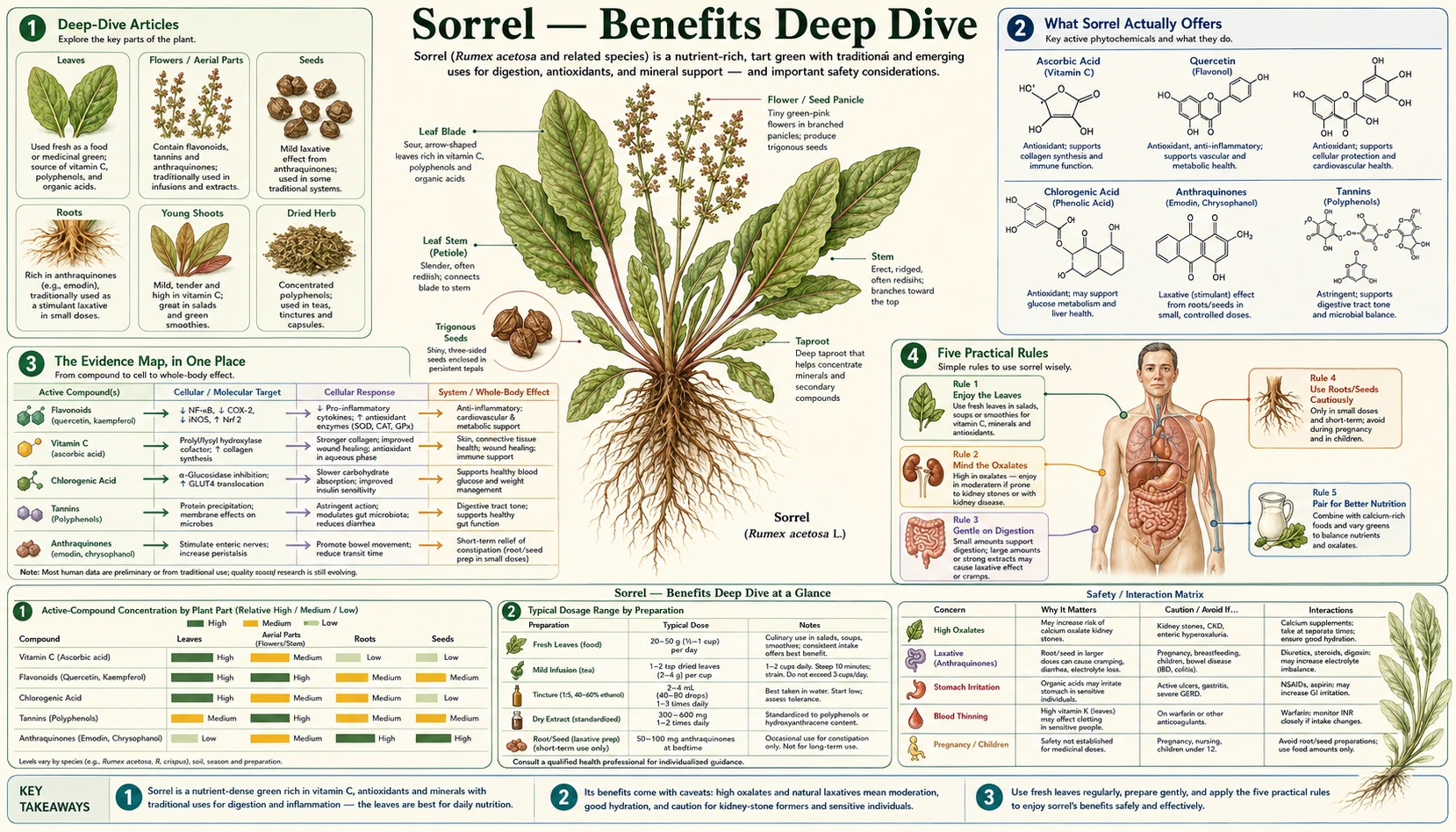
Sorrel is a small herb with an outsized capacity to confuse. It is a tart, lemony leafy green that cooks have loved for centuries in spring soups and sauces for oily fish — and it is also a plant whose defining chemistry is the same compound that forms kidney stones. Both of those things are true at once, and a page that tells you only one of them has not done its job. These four articles set out what sorrel genuinely offers, in the portions people actually eat, and give the oxalate question the space it deserves rather than the hedged sentence it usually gets.
First, the naming problem, because it decides whether anything here applies to you. "Sorrel" names at least four different plants. Garden or common sorrel is Rumex acetosa, a leafy green in the buckwheat and dock family, alongside French sorrel (Rumex scutatus) and the wild sheep's or red sorrel (Rumex acetosella). Wood sorrel is an Oxalis species, a clover-like plant from a different family altogether. And "Jamaican sorrel" — the deep-red Caribbean Christmas drink, also sold as hibiscus tea, agua de Jamaica, karkade or bissap — is Hibiscus sabdariffa, the roselle, which is not related to the others in any way. Readers searching "sorrel tea benefits" are very often after that last one, and it is the only sorrel with randomized human blood-pressure trials behind it. If the drink is what you came for, go to Hibiscus and specifically to Hibiscus and Blood Pressure; nothing on these pages applies to it. Everything in this Benefits section is about Rumex acetosa unless it says otherwise, and every page names its plant in the first paragraph.
Second, the oxalate risk, because it is the single most important fact about this herb. Sorrel's sourness is oxalic acid — the flavor and the hazard are the same molecule, and there is no way to have one without the other. Rumex leaf sits among the highest-oxalate foods people actually eat, in the same tier as spinach, rhubarb and chard, and much of its oxalate is in the soluble form that is absorbed. Oxalate binds calcium; in susceptible people that means calcium-oxalate kidney stones, and at extreme intakes it means acute oxalate nephropathy — kidney injury from crystals inside the kidney itself. The medical literature contains documented human poisonings, including reported fatalities, after ingestion of soup made with very large quantities of sorrel leaf. Proportion matters in both directions: a garnish or a normal culinary portion is not the hazard, and millions of people have eaten sorrel for centuries without harm. A large bowl of leaf-heavy sorrel soup as a repeated main dish, or foraged bulk eating, is the pattern of concern — and anyone with kidney-stone history, chronic kidney disease, gout, or a prescribed low-oxalate diet should treat this herb as one to avoid. Start with the oxalate and kidney-risk article.
Deep-Dive Articles
Which Sorrel Do You Mean? Three Different Plants
Garden sorrel, French sorrel, sheep's sorrel, wood sorrel and Caribbean hibiscus "sorrel" — one name, four plants, and genuinely different safety profiles. How to tell them apart from the leaf, the recipe and the label, which page you actually want, and why the blood-pressure evidence belongs to Hibiscus sabdariffa and to nothing in the genus Rumex.
Read the deep dive →Sorrel: Nutrients and Culinary Use
The per-100-gram figures that every nutrition article quotes, converted into the handful you actually eat — which turns "excellent source" into single-digit percentages for most nutrients, with vitamin C the one real claim. Plus the flavor chemistry, why the green turns olive the instant it hits heat, and how to cook, buy, store and grow it.
Read the deep dive →Sorrel: Traditional and Digestive Uses
The folk record — spring tonic, digestive bitter, folk diuretic, cooling herb for fevers, poultice — sorted into what has a plausible mechanism, what is tradition alone, and the one tradition (scurvy) that turned out to be right. Includes the single licensed combination product containing sorrel that reached randomized trials, and an honest account of Essiac.
Read the deep dive →Sorrel Safety: Oxalates, Kidney Risk and Who Should Avoid It
The most important article here. What oxalate does in the body, how much is in sorrel and how it compares with spinach and rhubarb, calcium-oxalate stones, acute oxalate nephropathy, the documented poisoning cases reported proportionately, the two intake patterns that matter, who should avoid it outright, and what genuinely reduces absorption.
Read the deep dive →Table of Contents
What Sorrel Actually Offers
Stated without inflation, garden sorrel gives you three things.
- An acid you can wilt. This is the real reason to grow and cook sorrel, and nothing else quite substitutes. It delivers lemon-like sourness as a leaf — something you can purée into a sauce, melt into a soup, fold through eggs or scatter raw over a salad. For cutting the richness of butter, cream and oily fish it is superb, and that is a genuine culinary contribution that needs no health claim attached.
- A modest, real dose of vitamin C when eaten raw or lightly cooked — roughly 5 to 15 percent of a day's vitamin C in a realistic portion. This is the basis of sorrel's historical reputation as an antiscorbutic spring green, and it is the one traditional use with a confirmed mechanism.
- Small amounts of carotenoids, magnesium and potassium — single-digit percentages of the daily value per handful. Its calcium and iron figures should be heavily discounted, because the leaf's own oxalate binds them before you can absorb them.
What it does not offer: any demonstrated treatment for any condition, any nutrient you cannot get more cheaply and safely from something else, and any benefit that improves if you eat more of it. That last point is the structural fact worth holding on to. Every nutrient in sorrel arrives packaged with oxalate, and the ratio does not improve with quantity — so "eat more for the nutrition" is precisely the wrong conclusion. Use it as a seasoning and get your nutrition from foods you eat by the plateful.
The Evidence Map, in One Place
This site labels the tier of every claim. For the sorrels, the map looks like this — and note the asymmetry at the bottom, which is unusual and worth seeing plainly.
- Randomized clinical trial evidence — Hibiscus sabdariffa only. Modest blood-pressure reductions in prehypertensive and mildly hypertensive adults, across small randomized trials pooled in published meta-analyses. Weaker and less consistent data on lipids and glucose. None of this belongs to garden sorrel.
- Randomized trial evidence for a combination product containing sorrel. A licensed European five-herb preparation for acute rhinosinusitis, containing Rumex herb alongside gentian, primrose, elder and verbena, has been tested against placebo. It does not show that sorrel treats sinusitis — no trial has isolated its contribution — but it shows the genus is not inert and that a standardized herbal product can be tested properly.
- Established nutrition. Vitamin C, carotenoids, some magnesium and potassium; the oxalate-driven discount on calcium and iron. All ordinary leafy-green nutrition.
- Preliminary laboratory and animal evidence. Reviews of the genus Rumex describe polyphenols, flavonoids, tannins and anthraquinones with antioxidant and antimicrobial activity in test tubes and animal models. This is chemistry shared with a great many edible plants. It is a reason to study, not a reason to dose.
- Traditional use only. Spring tonic and "cleansing," digestive bitter, folk diuretic, cooling herb for fevers and thirst, topical poultice. A real historical record, not a demonstrated effect — and in the case of the diuretic and cleanse traditions, the ones most worth not reviving, because they deliver concentrated oxalate to the organ they claim to help.
- No credible clinical evidence. Essiac, the blend containing sheep's sorrel, as a cancer treatment.
- Documented harm. Acute oxalate poisoning and oxalate nephropathy from large ingestions, in case reports and forensic reviews; dietary oxalate as a contributor to calcium-oxalate stones, in large prospective cohorts. For garden sorrel, the harm evidence is stronger and better documented than the benefit evidence. That is not a reason to fear the herb. It is a reason to treat it as a flavoring rather than a remedy.
Five Practical Rules
- Know which plant you have. Green arrow-shaped leaves are Rumex and these pages apply. Dried red calyces or a ruby drink are Hibiscus sabdariffa and they do not — go to Hibiscus.
- Treat sorrel as a seasoning, not a vegetable serving. A handful in a soup, a few leaves in a salad, a spoonful of purée on fish. Do not build a main course out of the leaf, and do not eat leaf-heavy sorrel soup as a regular staple.
- Eat it with calcium, in the same meal. Cream, sour cream, cheese, yogurt or milk binds oxalate in the gut so less is absorbed. The classic recipes already do this — do not remove the dairy. And do not restrict dietary calcium to prevent stones; the cohort evidence points the other way.
- Cook it, and for large portions blanch and discard the water. This reduces soluble oxalate meaningfully but does not eliminate it, and it costs vitamin C. It is a trade, and for a big serving it is usually the right one.
- Opt out entirely if you are in a risk group, and drink water regardless. Calcium-oxalate stone history, chronic kidney disease, primary hyperoxaluria, fat malabsorption or prior malabsorptive bowel surgery, gout, or a prescribed low-oxalate diet: no dish is worth a stone. Ask your doctor or dietitian, and say the word "sorrel" out loud — most patient handouts list spinach and rhubarb and never mention it.
Key Research Papers
Following this site's convention, every entry names the real paper — title, journal, year — and links a PubMed topic search rather than a numeric identifier, so the links stay valid and you can see the surrounding literature rather than a single record.
1. Oxalate content, measurement and food composition
- Siener R, Hönow R, Seidler A, Voss S, Hesse A. "Oxalate contents of species of the Polygonaceae, Amaranthaceae and Chenopodiaceae families." Food Chemistry, 2006. Direct measurement across sorrel's own plant family and its high-oxalate neighbours. Tier: analytical food-composition study. PubMed search: oxalate content Polygonaceae Rumex acetosa
- Holmes RP, Kennedy M. "Estimation of the oxalate content of foods and daily oxalate intake." Kidney International, 2000. The framework for treating oxalate as a cumulative daily total across the whole diet rather than a property of one food. Tier: analytical and dietary-intake study. PubMed search: estimation of oxalate content of foods
- Noonan SC, Savage GP. "Oxalate content of foods and its effect on humans." Asia Pacific Journal of Clinical Nutrition, 1999. How dietary oxalate distributes across plant foods and what it does to mineral absorption. Tier: review. PubMed search: oxalate content of foods and its effect on humans. — Search PubMed
- Massey LK. "Food oxalate: factors affecting measurement, biological variation, and bioavailability." Journal of the American Dietetic Association, 2007. Why published oxalate values disagree with each other, and why these pages give ranges rather than a single confident number. Tier: review. PubMed PMID: 17604750
2. Kidney stones, oxalate nephropathy and documented sorrel poisonings
- Farré M, Xirgu J, Salgado A, Peracaula R, Reig R, Sanz P. "Fatal oxalic acid poisoning from sorrel soup." The Lancet, 1989. The anchoring case report: death from acute oxalic-acid poisoning after soup made with a very large quantity of sorrel leaf. Tier: human case report. PubMed PMID: 2574796
- Sanz P, Reig R. "Clinical and pathological findings in fatal plant oxalosis: a review." The American Journal of Forensic Medicine and Pathology, 1992. Forensic review of fatal plant-oxalate poisonings, sorrel included, with the tissue findings. Tier: case-series review. PubMed PMID: 1288268
- Getting JE, Gregoire JR, Phul A, Kasten MJ. "Oxalate nephropathy due to 'juicing': case report and review." The American Journal of Medicine, 2013. Acute kidney injury from oxalate crystals after heavy consumption of oxalate-rich greens as juice. Tier: case report with review. PubMed search: oxalate nephropathy juicing
- Taylor EN, Curhan GC. "Oxalate intake and the risk for nephrolithiasis." Journal of the American Society of Nephrology, 2007. Large prospective cohort analysis of dietary oxalate against incident stones, including the interaction with calcium intake. Tier: prospective cohort. PubMed search: oxalate intake and risk for nephrolithiasis
- Holmes RP, Assimos DG. "The impact of dietary oxalate on kidney stone formation." Urological Research, 2004. How much of urinary oxalate is dietary versus made by the body — which sets the ceiling on what any diet change can achieve. Tier: review. PubMed search: impact of dietary oxalate on kidney stone formation. — Search PubMed
3. Reducing absorption: cooking, calcium and other modifiers
- Curhan GC, Willett WC, Speizer FE, Spiegelman D, Stampfer MJ. "Comparison of dietary calcium with supplemental calcium and other nutrients as factors affecting the risk for kidney stones in women." Annals of Internal Medicine, 1997. The counterintuitive finding that dietary calcium eaten with food is associated with lower stone risk — the science that vindicates the cream in sorrel soup. Tier: prospective cohort. PubMed search: dietary calcium and kidney stone risk in women. — Search PubMed
- Chai W, Liebman M. "Effect of different cooking methods on vegetable oxalate content." Journal of Agricultural and Food Chemistry, 2005. Boiling versus steaming versus baking — the evidence behind blanching and discarding the water, and behind the honest caveat that it reduces rather than eliminates. Tier: controlled laboratory food study. PubMed PMID: 15826055
- Savage GP, Vanhanen L, Mason SM, Ross AB. "Effect of cooking on the soluble and insoluble oxalate content of some New Zealand foods." Journal of Food Composition and Analysis, 2000. Separates the soluble fraction — the one that is actually absorbed — from the insoluble, before and after cooking. Tier: analytical food study. PubMed search: cooking soluble insoluble oxalate content
- Topic search — enteric hyperoxaluria after fat malabsorption or bariatric surgery. Why unabsorbed fat frees oxalate for absorption, and why this under-recognised group must take high-oxalate foods seriously. Tier: clinical literature. PubMed search: enteric hyperoxaluria fat malabsorption
- Topic search — ascorbic acid supplementation and urinary oxalate excretion. High-dose vitamin C supplements as an additional oxalate source; food vitamin C is not the issue. Tier: mixed clinical and metabolic studies. PubMed search: ascorbic acid supplementation urinary oxalate
4. The Rumex genus: chemistry, traditional use and Essiac
- Vasas A, Orbán-Gyapai O, Hohmann J. "The genus Rumex: review of traditional uses, phytochemistry and pharmacology." Journal of Ethnopharmacology, 2015. The standard reference on sorrel's genus, and candid that the pharmacology is overwhelmingly preliminary laboratory and animal work. Tier: review of traditional use and preliminary evidence. PubMed PMID: 26384001
- Zick SM, Sen A, Feng Y, Green J, Olatunde S, Boon H. "Trial of Essiac to ascertain its effect in women with breast cancer." The Journal of Alternative and Complementary Medicine, 2006. The human study of the sheep's-sorrel-containing blend that found no quality-of-life benefit. Tier: human clinical study. PubMed PMID: 17212569
- Leonard SS, Keil D, Mehlman T, Proper S, Shi X, Harris GK. "Essiac tea: scavenging of reactive oxygen species and effects on DNA damage." Journal of Ethnopharmacology, 2006. The kind of in-vitro antioxidant result quoted in marketing — instructive as an example of the distance between a dish and a patient. Tier: in-vitro. PubMed PMID: 16226859
- Topic search — BNO 1016 in acute rhinosinusitis (randomized, placebo-controlled trials). The trials of the standardized five-herb extract containing Rumex herb. Read them for what they actually test: a fixed combination, not sorrel. Tier: randomized controlled trials of a combination product. PubMed search: BNO 1016 acute rhinosinusitis randomized
- Magiorkinis E, Beloukas A, Diamantis A. "Scurvy: past, present and future." European Journal of Internal Medicine, 2011. The history behind sorrel's one vindicated traditional use. Tier: historical review. PubMed PMID: 21402244
5. The other sorrel: Hibiscus sabdariffa and the randomized blood-pressure evidence
These papers are listed here for one reason: to keep them attached to the right plant. Every finding below belongs to Hibiscus sabdariffa, the roselle behind Caribbean sorrel drink, and none of it belongs to Rumex acetosa.
- Serban C, Sahebkar A, Ursoniu S, Andrica F, Banach M. "Effect of sour tea (Hibiscus sabdariffa L.) on arterial hypertension: a systematic review and meta-analysis of randomized controlled trials." Journal of Hypertension, 2015. Pools the randomized trials; modest but real reductions in blood pressure. Tier: meta-analysis of randomized controlled trials. PubMed search: Hibiscus sabdariffa hypertension meta-analysis. — Search PubMed
- McKay DL, Chen CY, Saltzman E, Blumberg JB. "Hibiscus sabdariffa L. tea (tisane) lowers blood pressure in prehypertensive and mildly hypertensive adults." The Journal of Nutrition, 2010. One of the individual randomized trials behind the pooled result. Tier: randomized controlled trial. PubMed PMID: 20018807
- Da-Costa-Rocha I, Bonnländer B, Sievers H, Pischel I, Heinrich M. "Hibiscus sabdariffa L. — a phytochemical and pharmacological review." Food Chemistry, 2014. What roselle actually contains — anthocyanins and organic acids including hibiscus acid — and therefore why its sourness has nothing to do with oxalic acid. Tier: review. PubMed search: Hibiscus sabdariffa phytochemical review
- Hopkins AL, Lamm MG, Funk JL, Ritenbaugh C. "Hibiscus sabdariffa L. in the treatment of hypertension and hyperlipidemia: a comprehensive review of animal and human studies." Fitoterapia, 2013. Broader review spanning the animal and human literature, useful for seeing where the evidence is thinner. Tier: review of mixed evidence. PubMed search: Hibiscus sabdariffa hypertension hyperlipidemia review. — PubMed PMID: 23333908
External Resources
- PubMed — the primary biomedical literature. Search by species name (Rumex acetosa, Hibiscus sabdariffa) rather than by the word "sorrel," which is exactly how the confusion these pages are about gets into the search results.
- USDA FoodData Central — reference food-composition data behind the per-100-gram figures. Note that oxalate is not a standard field in most food databases, which is part of why oxalate values are harder to find than vitamins.
- National Institute of Diabetes and Digestive and Kidney Diseases (NIDDK) — authoritative patient information on kidney stones, chronic kidney disease and diet.
- National Kidney Foundation — practical patient guidance on oxalate, calcium and stone prevention.
- American Urological Association — professional guidelines on the medical management of kidney stones.
- National Center for Complementary and Integrative Health (NCCIH) — plain-language, evidence-based assessments of herbal products, including Essiac.
- NIH Office of Dietary Supplements — reference intakes and fact sheets for the vitamins and minerals discussed here.
- European Medicines Agency — herbal monographs and the framework under which combination herbal medicines are licensed in Europe.
Safety Note and Disclaimer
These pages are educational and are not medical advice. Garden, French and sheep's sorrel, and wood sorrel, are high-oxalate plants. Culinary amounts are safe for most healthy adults with normal kidney function; large leaf-heavy portions, daily intake, concentrated leaf teas, extracts and green juices are not, and documented human poisonings — including reported fatalities — have followed very large ingestions. If you have a history of calcium-oxalate kidney stones, chronic kidney disease, primary hyperoxaluria, fat malabsorption or prior malabsorptive bowel surgery, gout, or have been prescribed a low-oxalate diet, do not add sorrel to your diet without speaking to your doctor or a registered dietitian. Do not restrict dietary calcium in an attempt to prevent stones — the cohort evidence points the other way. Nothing here should be used to treat any condition, and no herb should replace treatment recommended by your clinician. Any blood-pressure benefit you have read about "sorrel" belongs to Hibiscus sabdariffa, is modest, and is not a substitute for prescribed treatment. Seek urgent care for severe abdominal or flank pain, persistent vomiting, blood in the urine or a marked fall in urine output after a large sorrel meal, and tell the clinician exactly what and how much was eaten.
Connections
- All Herbs
- Sorrel — the main topic page for Rumex acetosa: culinary detail, the Essiac history and the safety recap.
- Which Sorrel Do You Mean? — four plants, one name, different risk profiles.
- Sorrel: Nutrients and Culinary Use — portion arithmetic instead of per-100-gram inflation.
- Sorrel: Traditional and Digestive Uses — the folk record, sorted by evidence tier.
- Sorrel Safety: Oxalates, Kidney Risk and Who Should Avoid It — start here if you have any kidney history.
- Hibiscus — Hibiscus sabdariffa, the roselle behind Caribbean sorrel drink.
- Hibiscus and Blood Pressure — where the randomized "sorrel" evidence properly belongs.
- Hibiscus: Brewing, Dosing and Cautions — the other plant's separate safety conversation.
- Kidney Stones — calcium-oxalate stones, the central risk.
- Kidney Disease — why impaired kidneys change the calculation.
- Kidney Function Tests — how to find out whether you are in a risk group.
- Gout — a different crystal, overlapping risk factors.
- Calcium — the mineral oxalate binds; pair it with sorrel, and do not restrict it.
- Vitamin C — sorrel's one genuine nutrient claim, and a caution about high-dose supplements.
- Magnesium — real but small in a herb-sized portion.
- Spinach: Iron Absorption and Oxalates — the same chemistry in a food most readers already know.
- Kale: Oxalates and Cooking — the lower-oxalate dark green to reach for instead.
- Rhubarb — sorrel's relative in the same family, and the classic warning case.
- Swiss Chard — another high-oxalate leaf feeding the same daily total.
- Salmon — the classic partner for a sorrel sauce.
- Dandelion — a spring-greens and folk-diuretic tradition without the oxalate load.
- Chanca Piedra: Kidney Stone Protocol — a herb approached from the stone-prevention side.
- Interactive: Kidney Stone Formation — watch supersaturated urine crystallize.