Cinnamon: History and Traditional Use
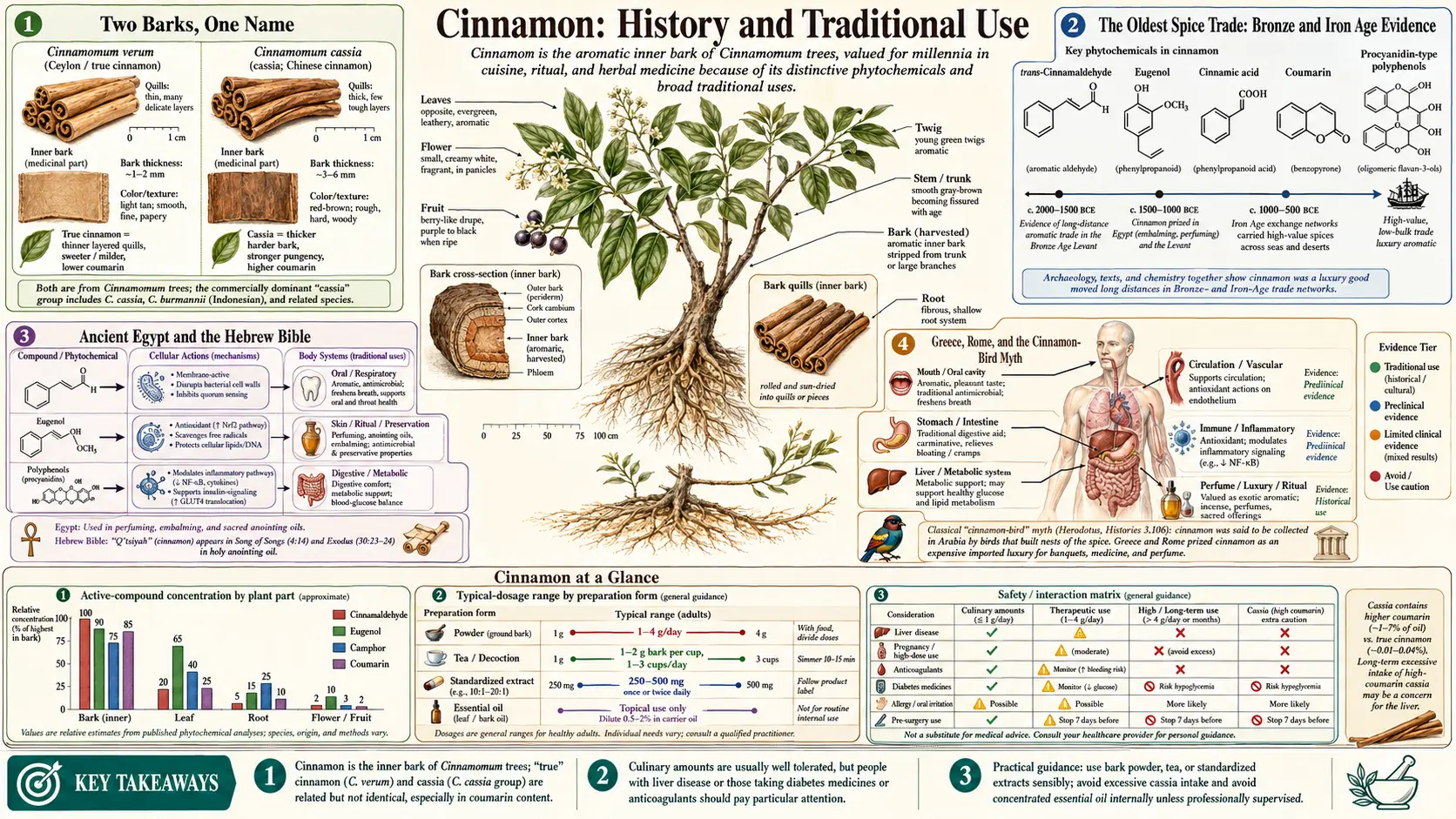
Cinnamon is one of the oldest traded spices in the world, and for most of that history its story was a story of distance, secrecy, and value. The fragrant bark grew only in South and Southeast Asia, yet it turns up in Bronze and Iron Age Mediterranean sites thousands of miles away — carried west along trade routes the buyers never saw, by merchants who guarded the secret of its origin with deliberately invented myths. From Egyptian embalming and the holy anointing oil of the Hebrew Bible, through a price in ancient Rome that rivaled silver, to the colonial wars that three European empires fought over a single island, cinnamon's history is unusually well documented — and unusually entangled with the history of long-distance trade itself.
Table of Contents
- Two Barks, One Name
- The Oldest Spice Trade: Bronze and Iron Age Evidence
- Ancient Egypt and the Hebrew Bible
- Greece, Rome, and the Cinnamon-Bird Myth
- Cinnamon in Ayurveda and Chinese Medicine
- Medieval Europe and the Hunt for the Source
- The Colonial Cinnamon Wars: Portugal, the Dutch, and Britain
- Folklore, Ritual, and Symbolism
- From Tradition to Modern Science
- Research Papers and References
- Connections
- Featured Videos
Two Barks, One Name
Before tracing cinnamon's history it helps to know that the English word "cinnamon" has always covered more than one plant, and this ambiguity runs straight through the ancient record. The spice we now call true or Ceylon cinnamon is the dried inner bark of Cinnamomum verum (older botanical name Cinnamomum zeylanicum), a small evergreen tree native to Sri Lanka and southern India. The cheaper, more pungent bark sold as cinnamon in most of North America is cassia, chiefly Cinnamomum cassia (Chinese cinnamon) and related species from China, Vietnam, and Indonesia. Both belong to the laurel family and both owe their warm aroma to the same headline compound, cinnamaldehyde, but they are distinct plants with a safety-critical difference in coumarin content covered in the companion Cassia vs Ceylon and Coumarin article.
Classical and biblical writers often listed "cinnamon" and "cassia" side by side as two separate goods, and scholars still debate exactly which species the oldest texts meant. For that reason this article treats the early record honestly: where a source clearly distinguishes the two, that distinction is kept; where it does not — as in much of the ancient evidence — the bark is simply called cinnamon, with the understanding that it may have been cassia, true cinnamon, or a trade mixture of Cinnamomum barks. What matters for the history is that all of these came from the same corner of Asia and reached the West along the same long, secretive routes.
The Oldest Spice Trade: Bronze and Iron Age Evidence
Cinnamon is often called one of the oldest spices in human commerce, and there is now hard chemical evidence behind the claim. In a 2013 study published in Mediterranean Archaeology and Archaeometry, Dvory Namdar, Ayelet Gilboa, and colleagues analyzed the residues inside 27 small ceramic flasks of Phoenician type recovered from five archaeological sites in Israel, including Tel Dor and Tell Qasile. Using gas chromatography–mass spectrometry, they found cinnamaldehyde — the chemical signature of cinnamon — in ten of the flasks. Because Cinnamomum is essentially the only plant group that accumulates large amounts of cinnamaldehyde, and because those trees grew only in South and Southeast Asia, the finding is strong evidence that cinnamon was being carried thousands of miles to the Levant in the early Iron Age, roughly the eleventh to ninth centuries BCE — about three thousand years ago, and centuries before the well-known Greco-Roman maritime spice routes.
This single result reframes how old the long-distance spice trade really is. To reach the eastern Mediterranean three millennia ago, cinnamon had to pass through a chain of traders and middlemen spanning the Indian Ocean and the Arabian Peninsula, none of whom needed to know the route's far end. The same picture is supported by other finds of Asian spices in the ancient West — black peppercorns, for instance, were recovered from the mummified remains of the Egyptian pharaoh Ramesses II. Cinnamon, in other words, was not merely an old spice; it was one of the very first goods to be moved across the whole breadth of the known world, and it stayed a luxury precisely because that journey was so long.
Ancient Egypt and the Hebrew Bible
In ancient Egypt, cinnamon and cassia were prized aromatics, valued both for ritual and for the practical work of preserving the dead. Tradition and many histories hold that the bark was imported to Egypt by around 2000 BCE and used in embalming mixtures, perfumed oils, and temple offerings, its preservative quality — which we now partly understand as antimicrobial — making it useful in mummification. It is commonly stated that cinnamon appears in the Ebers Papyrus, the great Egyptian medical text of about 1550 BCE; readers should know that identifying specific plants in these ancient texts is genuinely difficult, and scholars do not always agree on whether a given entry means true cinnamon, cassia, or another aromatic. The safe summary is that fragrant Cinnamomum bark was part of Egyptian ritual and funerary practice from a very early date.
Cinnamon also appears in the Hebrew Bible, and here the references are explicit. In the Book of Exodus (chapter 30, verses 22–25), Moses is instructed to compound a sacred anointing oil from "sweet cinnamon" and "sweet calamus," together with myrrh and cassia and olive oil, to consecrate the Tent of Meeting and its priests — notably listing cinnamon and cassia as two separate ingredients. Cinnamon is named again in the Song of Songs (Song of Solomon 4:14) among a catalogue of the finest spices and perfumes. These passages, traditionally associated with the era of the Israelite monarchy roughly three thousand years ago, line up strikingly well with the archaeological flask evidence: both point to fragrant Asian bark circulating in the Levant in the early Iron Age. The biblical texts are cited here as historical and scriptural sources rather than as dated trade records.
Greece, Rome, and the Cinnamon-Bird Myth
By the classical period cinnamon was a famous and fabulously expensive import, and the Greeks and Romans wrote about it at length — including some memorable misinformation. One of the earliest Greek references comes from a fragment of the poet Sappho in the seventh century BCE — though, strictly, what Sappho names is cassia rather than true cinnamon, one of the recurring two-barks ambiguities noted above. Two centuries later the historian Herodotus, in his Histories, repeated the tales the spice merchants told to disguise cinnamon's true origin: that it grew in Arabia, guarded by fierce winged serpents, or that great "cinnamon birds" gathered the sticks to build their nests on inaccessible cliffs, from which collectors had to lure or trick the bark loose. These stories were almost certainly deliberate fictions, spread by traders to justify cinnamon's price and to keep its real Asian source a closely held secret. They are folklore, not natural history — but they are folklore the ancient world genuinely recorded and believed.
In the Roman world cinnamon was a true luxury. Pliny the Elder, writing his Natural History in the first century CE, described the spice as extraordinarily costly — by his account a Roman pound of the bark could command a price on the order of a labourer's wages for many months (the exact figures vary between manuscripts and translations) — and he scorned the cinnamon-bird legend as a merchant's invention. Roman writers also recorded a famous act of conspicuous extravagance: the emperor Nero is said to have burned a year's supply of the city's cinnamon at the funeral of his wife Poppaea Sabina around 65 CE, a gesture whose whole point was the staggering expense of the spice. Cinnamon, in the classical mind, was something between a medicine, a perfume, and a form of portable wealth.
Cinnamon in Ayurveda and Chinese Medicine
Closer to where the trees actually grew, cinnamon was not an exotic rarity but a working medicine, and it holds an established place in the great Asian healing traditions. In Ayurveda, the classical medical system of the Indian subcontinent, cinnamon (Sanskrit tvak; Hindi dalchini) is classed as a warming, pungent-and-sweet spice traditionally used to support digestion, ease coughs and colds, and warm a sluggish constitution. The very name dalchini — from roots meaning roughly "Chinese wood" — is itself a fossil of the trade routes by which the bark reached India.
In Traditional Chinese Medicine, cassia cinnamon is one of the long-recognized core herbs and appears in two distinct forms. The thick bark, rou gui ('flesh of the cinnamon'), is regarded as a strongly warming remedy traditionally used to "warm" the body's interior, while the young twigs, gui zhi, are considered milder and gentler, used in classical formulas to address more superficial chills and to harmonize a recipe. Cassia is counted among the fundamental herbs of Chinese herbal practice and has been described in Chinese pharmacopeias for many centuries. As with all of the historical material on this page, these are traditional indications recorded by long-standing medical systems, described here to document the herb's cultural history — they are not modern clinical recommendations, and anyone considering cinnamon for a health condition should talk with a qualified clinician.
Medieval Europe and the Hunt for the Source
Through the Middle Ages cinnamon remained one of the most coveted spices in Europe, a marker of wealth and refinement on the tables of the rich and a sought-after ingredient in cookery, mulled wine, and the medicine of the day. European buyers obtained it through a long relay of Arab and Venetian intermediaries, and for centuries Europeans still had no reliable knowledge of where the bark truly came from; the ancient myths of Arabian origin lingered, and the middlemen had every reason not to correct them. It was only gradually, through medieval Jewish and Arab geographers, that more accurate knowledge filtered through — the twelfth-century scholar Maimonides and the thirteenth-century geographer Zakariya al-Qazwini are among those who placed the spice's origin in India and, in al-Qazwini's case, specifically in Sri Lanka.
That growing certainty about cinnamon's real source — the island then known to Europeans as Ceylon — had enormous consequences. The spice was so valuable that controlling its supply promised immense profit, and the desire to reach the source directly, cutting out the chain of Arab and Venetian middlemen, was one of the powerful commercial motives behind the European Age of Exploration. When Portuguese ships finally rounded Africa and entered the Indian Ocean at the turn of the sixteenth century, Ceylon's cinnamon was one of the great prizes they were looking for — and finding it set off two centuries of colonial conflict over a single fragrant bark.
The Colonial Cinnamon Wars: Portugal, the Dutch, and Britain
The finest wild cinnamon grew on the island of Ceylon (modern Sri Lanka), and from the early sixteenth century three successive European powers fought to monopolize it. The Portuguese arrived first: a fleet under Lourenço de Almeida reached Ceylon in 1505, and over the following decades Portugal built coastal forts and pressed the island's rulers and the traditional cinnamon-peeling caste to deliver the bark as tribute, establishing the first European stranglehold on the trade. Cinnamon in this period was worth a fortune in Europe — contemporary accounts describe it selling for prices comparable to precious metals — and that value made the island a target.
In the seventeenth century the Dutch East India Company (VOC) displaced the Portuguese, allying with the inland Kingdom of Kandy and finally expelling the last Portuguese from the coast by 1658. The Dutch ran the cinnamon trade with famous severity, enforcing the harvest, restricting cultivation to protect prices, and guarding their monopoly so jealously that they are reported to have destroyed surplus stock rather than let it depress the market. It was also under Dutch rule that cinnamon began to be deliberately cultivated in plantations rather than only stripped from wild trees, an important shift in how the spice was produced.
Finally, during the Napoleonic Wars, the British took Ceylon from the Dutch in 1796, folding the cinnamon trade into their own colonial empire and maintaining the monopoly into the nineteenth century before the trade was eventually opened to private merchants. By then cinnamon's extraordinary scarcity was fading: plantations spread, cassia from China and Southeast Asia supplied a cheaper everyday substitute, and the bark that had once been burned at an emperor's funeral became an affordable jar in the ordinary kitchen. The long arc from priceless rarity to pantry staple is, in the end, the central economic story of cinnamon.
Folklore, Ritual, and Symbolism
Because cinnamon was for so long rare, fragrant, and costly, it gathered a thick layer of symbolic and folk meaning across many cultures. In the ancient world its strongest associations were with the sacred and the dead: it perfumed Egyptian embalming, scented the holy anointing oil of the Hebrew Bible, rose as smoke in temple offerings, and — in the Roman story of Nero and Poppaea — was burned in vast quantity as the ultimate funeral tribute. To use cinnamon was to spend something precious, and that made it a natural language for honour, devotion, and mourning.
In later folk tradition cinnamon's warm, "hot" character carried it into household and folk-magical custom, where it became broadly associated with warmth, prosperity, protection, and good fortune — a reputation that survives today in homely customs and in the simple fact that the smell of cinnamon still reads as comforting and celebratory, especially around winter festivals and holiday baking. These beliefs are recorded here as cultural folklore, not as claims of any real magical or medicinal power. What they document is something true and human: that for thousands of years cinnamon was treasured far beyond its weight, and that people wove it into their rituals of the sacred, the festive, and the precious precisely because it was so hard to come by.
From Tradition to Modern Science
The remarkable thing about cinnamon's long history is how often the old uses point toward questions modern science can actually test. Egyptian embalmers and pre-refrigeration cooks relied on cinnamon to keep things from spoiling; we now know that cinnamaldehyde and related compounds have genuine antimicrobial activity, which is the subject of the companion Antimicrobial and Antifungal article. Ayurvedic and other traditional practitioners reached for cinnamon in the management of what we would now call blood-sugar and digestive complaints; modern researchers have run controlled trials on cinnamon and glucose metabolism, examined in Blood Sugar Control, and on its effects on lipids and the heart, covered in Cardiovascular Health.
It is important to be honest about the limits of this continuity. A long history of traditional use is a reason to investigate a plant, not proof that it works, and the modern evidence for cinnamon is genuinely mixed — promising in some areas, modest or inconsistent in others, and shadowed by the real safety question of coumarin in cassia. Peer-reviewed reviews such as Ranasinghe and colleagues' systematic review of true cinnamon and Rao and Gan's overview of cinnamon as a medicinal plant gather what the laboratory and clinical literature actually shows. Read in that light, cinnamon's history is best understood as a four-thousand-year invitation: a spice that humans treasured, traded, fought over, and built myths around — and that science is still, carefully, trying to understand.
Research Papers and References
The list below combines the key peer-reviewed and scholarly sources behind this history with curated PubMed topic-search links into the broader cinnamon literature. Ancient and scriptural primary sources — Herodotus' Histories, Pliny's Natural History, the Book of Exodus and the Song of Songs, and the traditional Ayurvedic and Chinese pharmacopeias — are named in the article as historical sources rather than as modern citations. Author names, titles, and journals are given as plain text; only stable links (DOI, PMID, or archival URLs) are hyperlinked and open in a new tab.
- Namdar D, Gilboa A, Neumann R, Finkelstein I, Weiner S. Cinnamaldehyde in Early Iron Age Phoenician flasks raises the possibility of Levantine trade with Southeast Asia. Mediterranean Archaeology and Archaeometry. 2013;12(3):1-19. (News summary: Live Science — Evidence of 3,000-Year-Old Cinnamon Trade Found in Israel.)
- Ranasinghe P, Pigera S, Premakumara GAS, Galappaththy P, Constantine GR, Katulanda P. Medicinal properties of 'true' cinnamon (Cinnamomum zeylanicum): a systematic review. BMC Complementary and Alternative Medicine. 2013;13:275. — doi:10.1186/1472-6882-13-275 · PMID 24148965
- Rao PV, Gan SH. Cinnamon: a multifaceted medicinal plant. Evidence-Based Complementary and Alternative Medicine. 2014;2014:642942. — doi:10.1155/2014/642942 · PMC4003790
- Kawatra P, Rajagopalan R. Cinnamon: mystic powers of a minute ingredient. Pharmacognosy Research. 2015;7(Suppl 1):S1-S6. — doi:10.4103/0974-8490.157990 · PMID 26109781
- Ancient cinnamon trade and the archaeology of early spice routes — PubMed: cinnamon ancient trade and spice routes
- Cinnamomum ethnobotany, traditional and historical medicinal use — PubMed: Cinnamomum ethnobotany and traditional use
External Authoritative Resources
- NCCIH — Herbs at a Glance
- MedlinePlus — Herbs and Supplements
- PubMed — All research on Cinnamomum verum
Connections
- All Herbs
- Cinnamon Hub
- Cinnamon Benefits Deep Dive
- Cassia vs Ceylon and Coumarin
- Clove
- Ginger
- Turmeric
- Fenugreek
- Myrrh