Chiretta: Hepatoprotective and Liver Claims
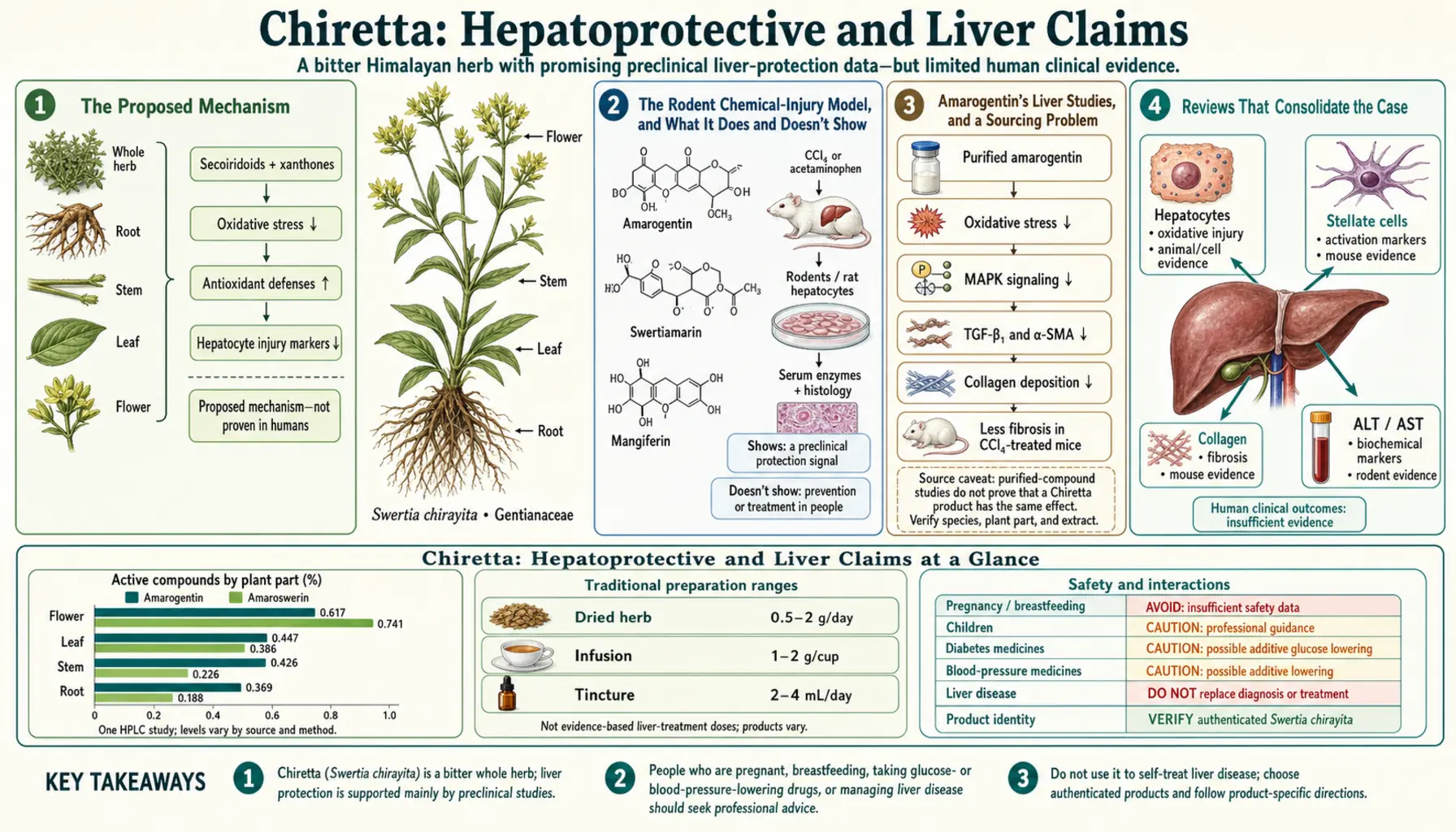
Liver disorders are one of chiretta’s oldest and most consistently repeated Ayurvedic indications. Classical practice lists it for kamala — jaundice — and for liver complaints generally, usually named in the same breath as its use for fever and sluggish digestion. The proposed mechanism draws on the same pair of compounds that carries most of chiretta’s other claims: swertiamarin and the xanthone fraction are credited with antioxidant activity and with limiting the rise in liver enzymes and the tissue damage that follows a toxic insult to the liver — the standard “hepatoprotective” profile claimed for a great many bitter herbs, not this one alone.
What actually backs the claim, read directly rather than taken on faith, is a rodent literature — carbon tetrachloride and paracetamol (acetaminophen) chemical-injury models, repeated across several papers with a broadly consistent direction of effect. There is no human trial of chiretta, or of either of its marker compounds, for any liver condition. That much would be true of most single-herb hepatoprotective claims on this site, and by itself it would not be a new finding.
What is less obvious, and is the actual subject of this page, is that even the animal evidence carries a wrinkle beyond the ordinary “it’s only rodent data” caveat. Amarogentin — chiretta’s own signature bitter compound, the one used analytically to identify and standardise the plant — turns up in the mouse liver-fibrosis literature sourced not from Swertia chirayita specifically but from a generic commercial supply described as coming from “Swertia and Gentiana roots.” That is a sourcing-level substitution sitting underneath the species-level one this Benefits set keeps finding elsewhere, and it means the usual compound-level fallback — “well, at least the marker compound itself has been shown to work” — cannot always be cashed in for this particular species. This page also names the herb on this site with real, if contested, human liver-trial data (milk thistle), and reports one genuinely serious liver-injury case report from an adjacent bitter herbal product — carefully labelled as a different product, because a hazard should not be borrowed across species or products any more than a benefit should.
Table of Contents
- The Proposed Mechanism
- The Rodent Chemical-Injury Model, and What It Does and Doesn’t Show
- Amarogentin’s Liver Studies, and a Sourcing Problem
- Reviews That Consolidate the Case
- Human Evidence: None for Chiretta — and the Comparator That Does Have Some
- A Caution From an Adjacent Product (Not Chiretta)
- What Is Not Known: A Numbered List
- Verdict and Evidence Tier
- Key Research Papers
- Connections
The Proposed Mechanism
The mechanism proposed for chiretta’s liver claim is not unique to this herb. It is the standard “hepatoprotective” story told about a long list of bitter, phenolic-rich plants, and it is worth stating plainly what the claim actually asserts before turning to the evidence for it.
Swertiamarin and the xanthone fraction — the same compound classes that carry chiretta’s bitterness and much of its other pharmacology — are credited with two linked effects: antioxidant activity, meaning scavenging or limiting the reactive oxygen species generated when liver cells are damaged, and reduction of hepatocellular injury markers, meaning a smaller rise in the liver enzymes alanine aminotransferase (ALT) and aspartate aminotransferase (AST) that leak into the bloodstream when hepatocytes are injured, alongside less visible damage on liver histology. Several of the papers below frame this specifically through the Nrf2/HO-1 pathway, a cell’s own antioxidant-response system that is a common target across this whole category of hepatoprotection research, not something specific to Swertia.
In practice, “hepatoprotective” in this literature means one specific, narrower thing than the phrase suggests: a smaller rise in ALT/AST and less histological damage in an animal that has just been poisoned, compared with an animal poisoned without the plant extract or compound on board. That is a real, measurable, legitimate laboratory endpoint. It is not the same claim as “supports liver health” in the general, ongoing sense the phrase is marketed with, and the next section covers exactly what this endpoint can and cannot tell a reader about a human liver.
The Rodent Chemical-Injury Model, and What It Does and Doesn’t Show
The standard experiment behind chiretta’s liver claim follows the same design study after study. Rats or mice are given a liver toxin — most often carbon tetrachloride (CCl4) or a paracetamol (acetaminophen, APAP) overdose — with or without the plant extract or isolated compound, typically dosed before or alongside the toxin. Researchers then measure serum ALT and AST and examine liver tissue under a microscope for necrosis, inflammation and fibrosis.
Two papers anchor this literature for swertiamarin specifically. Wu and colleagues, “Antioxidant and Hepatoprotective Effect of Swertiamarin on Carbon Tetrachloride-Induced Hepatotoxicity via the Nrf2/HO-1 Pathway,” Cellular Physiology and Biochemistry, 2017, used the rat CCl4 model and reported that swertiamarin blunted both the enzyme rise and the histological damage, tracking activation of the Nrf2/HO-1 antioxidant pathway. Zhou and colleagues, “Swertiamarin or heat-transformed products alleviated APAP-induced hepatotoxicity via modulation of apoptotic and Nrf-2/NF-κB pathways,” Heliyon, 2023, ran the paracetamol-overdose version and reported a broadly similar protective pattern, adding an apoptosis angle through the Nrf-2/NF-κB pathways.
Both are legitimate, standard toxicology screening assays, and both are a poor stand-in for the liver diseases most readers of this page actually have. Carbon tetrachloride is an industrial solvent that is directly hepatotoxic through free-radical generation; a paracetamol overdose is an acute, massive dose of a specific drug that depletes glutathione and generates a reactive, protein-binding metabolite. Neither resembles the mechanism or the time course of fatty liver disease, viral hepatitis, or alcohol-related liver disease — the three conditions that actually account for most chronic liver injury in the human population reading this page. A compound that blunts a single acute chemical insult in a rodent has not thereby been shown to do anything for a slow, metabolically driven, years-long disease process in a person.
No human trial of chiretta, swertiamarin, or amarogentin exists for any liver condition — not fatty liver disease, not viral hepatitis, not alcohol-related liver disease, not drug-induced liver injury. That absence is worth stating in one plain sentence, because it is easy to lose track of amid a real and reasonably consistent rodent literature.
Amarogentin’s Liver Studies, and a Sourcing Problem
This is the section that makes this page more than a repeat of “it’s only rodent data,” and it concerns chiretta’s other signature compound: amarogentin, one of the most intensely bitter substances ever measured and, alongside swertiamarin, one of the two marker compounds used to identify and standardise Swertia chirayita material.
Two related papers carry amarogentin’s liver-fibrosis evidence. Zhang and colleagues, “Protective Effects of Amarogentin against Carbon Tetrachloride-Induced Liver Fibrosis in Mice,” Molecules, 2017, gave mice repeated low-dose CCl4 over several weeks to produce fibrosis rather than a single acute injury, then tested amarogentin against it. A 2018 companion paper by the same group, in the Journal of Pharmaceutical and Biomedical Analysis, ran serum metabonomics — GC-TOF-MS metabolite profiling — on the same model to characterise what amarogentin shifted biochemically. Both reported a protective effect on fibrosis markers and liver histology.
Read the 2017 paper’s own description of its test material, and a problem appears that the usual species-substitution check does not catch. The paper describes amarogentin as “a secoiridoid glycoside that is mainly extracted from Swertia and Gentiana roots” — a generic, genus-and-sister-genus sourcing statement, not a specification that the test material came from S. chirayita in particular. Gentiana is chiretta’s sister genus within the same family, Gentianaceae; amarogentin and swertiamarin both occur across multiple species in both genera, which is exactly why a generic commercial extract described this way is unremarkable as chemistry — and exactly why it is a problem for attributing the result to one named species.
Here is why that matters more for chiretta than it would for an ordinary compound study. Amarogentin is chiretta’s own signature marker compound — the substance used in analytical chemistry to confirm that a given sample actually is S. chirayita and not something else. A reader skimming this literature could reasonably assume that any study of amarogentin is automatically evidence for chiretta, on the logic that the marker compound and the plant are effectively the same thing for citation purposes. That logic fails the moment the compound itself is a generic commercial extract pooled from “Swertia and Gentiana roots” rather than isolated from verified S. chirayita material. The mouse liver-fibrosis protection reported in 2017, and the metabolomic shifts reported in the 2018 companion paper, are real findings about amarogentin the molecule. They are not confidently findings about Swertia chirayita the plant.
This is a subtler version of the species-substitution problem that recurs across this Benefits set — subtler because it is not a case of the wrong species surfacing in a PubMed search under an overlapping common name, which is the pattern documented on the blood-sugar page. It is a case of the right compound, correctly named and correctly studied, whose supply chain is not specified closely enough in the published record to say which of several source plants it actually came from. This site’s doctrine is to label a substitution at the point where it applies rather than once in a preamble a reader arriving mid-page would never see, so it is repeated here rather than left to the introduction: neither the 2017 fibrosis paper nor its 2018 metabonomics companion can be read as chirayita-specific evidence on the sourcing information available in the published abstract.
One more design detail is worth reading correctly rather than skimming past. The 2017 mouse study used colchicine, a real anti-fibrotic drug, as a positive control arm. A positive control exists to validate that the assay responds to something already known to work — it demonstrates the fibrosis model is sensitive, not that amarogentin matches or exceeds colchicine’s real-world therapeutic value. Reading a positive-control comparison as a head-to-head efficacy contest is the same design error covered in more depth on the blood-sugar page, where acarbose plays the equivalent role for the glycaemic claim.
Reviews That Consolidate the Case
Beyond the individual injury-model papers, four reviews gather chiretta’s — and its relatives’ — liver and general pharmacology literature into one place, and each needs the same species-level reading applied to it that the primary papers do.
Yang and colleagues published a comprehensive review of swertiamarin’s pharmacokinetics and pharmacological mechanisms in Cells, 2025, consolidating the hepatoprotective, antidiabetic and anti-inflammatory literature for that one compound across its several plant sources. Singh and colleagues, writing in Current Topics in Medicinal Chemistry, 2025, updated the pharmacology, patent and toxicity picture for amarogentin specifically — useful for tracking what has, and has not, been established about the compound’s safety margin, independent of any single species. Muhamad Fadzil and colleagues produced an earlier comprehensive swertiamarin review in Drug Design, Development and Therapy, 2021 — the same review chiretta’s main page cites for its general pharmacology summary.
The fourth review most needs a caveat attached, because of its scope rather than any fault in its quality. Guo and colleagues, “Swertia L.: A comprehensive review of its genetic relationship, chemical compositions, pharmacological effects, toxicities, and applications,” Phytotherapy Research, 2023, is exactly what its title says: a genus-wide review of Swertia pharmacology broadly, not a chirayita-specific one. Liver and gallbladder protection appears in that review as a claim supported across the genus, pooling data from S. chirayita alongside S. mussotii, S. japonica, S. punicea and other species covered elsewhere in this Benefits set. That is a legitimate and useful way to summarise a large, related literature, and it is also, by construction, not species-specific evidence for S. chirayita alone. Treat any liver claim sourced to this review as genus-level unless the underlying primary paper it draws on has been checked and confirmed to use chirayita material specifically.
None of these four reviews reports a new primary finding beyond what the injury-model papers above already show. Their value here is narrower: they confirm that the rodent and cell-culture liver literature for swertiamarin and amarogentin is real, reasonably consistent in direction, and still entirely preclinical — the point the next section addresses directly.
Human Evidence: None for Chiretta — and the Comparator That Does Have Some
Stated plainly, because it is easy to lose amid a genuinely substantial rodent literature: there are no human trials of chiretta, swertiamarin, or amarogentin for any liver condition. Not a pilot study, not an open-label case series, not even a pharmacokinetic study in healthy volunteers. The claim rests entirely on chemical-injury rodent models plus a modest amount of supporting cell-culture and metabolomic work, all covered above.
Readers who want a herb with actual human liver-trial data have one available on this site, and it is not chiretta. Milk thistle (Silybum marianum, active compound silymarin) has been through a real randomised-trial programme in humans. Shahsavari and colleagues published a meta-analysis of randomised silymarin trials targeting liver injury in BMC Complementary Medicine and Therapies, 2025, and Handu and colleagues published a systematic scoping review of bioactive interventions — silymarin among them — for MASLD (metabolic dysfunction-associated steatotic liver disease, the current name for fatty liver disease) in Nutrients, 2025.
This is a relative comparison, not an endorsement. Both of those reviews describe the human silymarin evidence as mixed and contested — trial quality varies, effect sizes are inconsistent across studies, and silymarin is not established as a treatment for any liver disease in the way a pharmaceutical would need to be. Milk thistle has not been proven. What it has, that chiretta does not, is an actual body of randomised human trials to be mixed and contested about. Chiretta’s liver claim has not reached the stage where a human literature even exists to critique — it remains entirely upstream of that, sitting in the rodent-and-cell-culture tier described throughout this page.
For anyone with an actual liver concern rather than a general interest in the research, the appropriate next step is not choosing between two herbs. It is diagnosis: see liver function tests for what the standard blood panel measures, and liver disease for what abnormal results, jaundice, dark urine or pale stools can mean. Chiretta’s own main page makes the same point in brief: these symptoms need a diagnosis, not a bitter herb.
A Caution From an Adjacent Product (Not Chiretta)
This section needs to be read precisely, because it is easy to misuse in either direction — dismissed as irrelevant, or worse, mistaken for evidence against chiretta itself. It is neither. It is a caution about marketing logic, illustrated with a real case report about a different product entirely.
Iberogast (STW 5) is a proprietary German multi-herb bitter formula sold for functional dyspepsia and general digestive complaints. Its ingredients are bitter candytuft (Iberis amara), angelica root, chamomile flower, caraway fruit, milk thistle fruit, lemon balm leaf, peppermint leaf, celandine herb and liquorice root — it contains no chiretta and no Swertia species of any kind. It appears elsewhere in this Benefits set, on the bitterness and digestion page, as an example of a bitter polyherbal product that has actually been through randomised trials — unlike chiretta alone.
Leroy and colleagues published “Iberogast®-Induced Acute Liver Injury — A Case Report” in Gastro Hep Advances, 2022, describing a patient who developed acute liver injury temporally associated with taking the product. A case report of this kind establishes an association worth taking seriously and investigating further; it does not, by itself, establish causation with the certainty a controlled study would, and a single case report is exactly that — one case, not a rate.
Here is the point, stated as narrowly as it should be read. Iberogast is marketed on the same general appeal that surrounds chiretta and many other bitter herbs — bitter, herbal, traditional, digestive-supportive — and it has produced at least one published, serious hepatic adverse-event report despite that marketing. The lesson is about the category, not about chiretta: “bitter” and a loosely “hepatoprotective” marketing claim are not the same thing as demonstrated liver safety, and a polyherbal product combining several plants at once — candytuft, celandine and liquorice among Iberogast’s ingredients each carry their own individual hepatic-caution histories in the wider literature — is not automatically safer for the liver merely because one of its nine ingredients, milk thistle, has supportive human data.
What this section is explicitly not saying: it is not evidence that chiretta causes liver injury. Chiretta contains none of Iberogast’s ingredients, this case report does not mention chiretta or any Swertia species, and borrowing a hazard signal from an unrelated product would be the same error this site refuses to make in the opposite direction — crediting chiretta with a benefit that actually belongs to a different formula or a different species. The honest reading is narrower and, arguably, more useful: it is a reminder that the bitter-herbal-liver-support category as a whole has not earned a blanket presumption of safety, chiretta included, precisely because so little of that category — chiretta least of all — has been through the kind of monitoring that would catch a rare event if one occurred.
What Is Not Known: A Numbered List
- No human trial of chiretta, swertiamarin, or amarogentin for any liver outcome or endpoint — not fatty liver disease, not viral hepatitis, not alcohol-related liver disease, not drug-induced liver injury.
- No human pharmacokinetics for swertiamarin or amarogentin. Absorption, distribution, metabolism and elimination in a person are all unmeasured, so there is no basis for translating any rodent dose into a human-equivalent one.
- No dose-finding data of any kind in humans, and no minimum or maximum effective dose systematically established even within the rodent literature.
- No confirmation, for the amarogentin liver-fibrosis papers specifically, that the test material was Swertia chirayita rather than a generic commercial extract pooled from Swertia and Gentiana roots — the sourcing gap covered in detail above.
- No chronic-dosing safety data in any species at the sustained, indefinite intake a liver-support supplement regimen would imply, as opposed to the short pre-treatment or co-treatment windows used in the injury-model studies.
- No data on chiretta specifically in the liver conditions that actually affect most readers — fatty liver disease, viral hepatitis, alcohol-related liver disease — as opposed to acute chemical-toxin models that share little mechanism or time course with any of them.
- No rodent dose translated to a human-equivalent dose for any of the positive findings above, and therefore no way to know whether a typical chiretta supplement delivers a pharmacologically active amount of either marker compound.
- No interaction data between chiretta and hepatically metabolised medications, which matters for anyone taking the herb alongside a drug cleared through the liver.
Verdict and Evidence Tier
- Tier: preclinical only. Rodent chemical-injury models (carbon tetrachloride, paracetamol overdose) plus supporting in-vitro and metabolomic work. No human tier exists for this claim at all.
- Verdict: absent in humans, not negative. Nothing has been tested in people and failed; nothing has been tested in people and passed, either. The rodent literature has not been contradicted by human data — there simply is no human data sitting alongside it in either direction.
- Verdict on the rodent literature itself: real and reasonably consistent across swertiamarin’s two injury models (CCl4 and paracetamol overdose) and amarogentin’s fibrosis model, all pointing the same direction on ALT/AST and histology.
- The added wrinkle: even the compound-level fallback is not fully secure. The ordinary response to “it’s only animal data” is to point at the marker compound and argue the chemistry itself is validated even where a whole-plant human trial is missing. For amarogentin’s liver-fibrosis studies specifically, that fallback is weaker than it looks, because the published test material is described generically as sourced from Swertia and Gentiana roots rather than confirmed as S. chirayita. The compound has evidence; confidently attributing that evidence to this exact species is not fully supported by the sourcing information on record.
- Comparator context: milk thistle has reached the human-trial stage; chiretta has not. That is a difference in evidence maturity, not a claim that milk thistle’s human evidence is settled — its own reviewers describe it as mixed and contested.
- Adjacent-product caution, explicitly not chiretta’s own signal: a different bitter polyherbal product, Iberogast, has a published acute liver injury case report. This does not transfer to chiretta, which shares no ingredient with that formula; it is reported here only to note that the broader bitter-herbal-liver category has not earned a blanket safety presumption.
Practical reading: the hepatoprotective claim is a real research direction, not a settled fact and not a debunked one. It has not been tested in people. Anyone with an actual liver concern needs the diagnostic workup described above, not a chiretta supplement, and anyone specifically wanting a herb with human liver-trial data — contested as that data still is — should look at milk thistle rather than chiretta.
Key Research Papers
All links are live PubMed searches rather than fixed records, so you can see each return’s size and currency for yourself, and check the sourcing question in the abstracts directly.
- Wu and colleagues, “Antioxidant and Hepatoprotective Effect of Swertiamarin on Carbon Tetrachloride-Induced Hepatotoxicity via the Nrf2/HO-1 Pathway”, Cellular Physiology and Biochemistry, 2017 — the rat CCl4 model anchoring swertiamarin’s liver claim.
- Zhou and colleagues, “Swertiamarin or heat-transformed products alleviated APAP-induced hepatotoxicity via modulation of apoptotic and Nrf-2/NF-κB pathways”, Heliyon, 2023 — the paracetamol-overdose version of the same model.
- Zhang and colleagues, “Protective Effects of Amarogentin against Carbon Tetrachloride-Induced Liver Fibrosis in Mice”, Molecules, 2017 — the paper whose own abstract describes amarogentin as sourced generically from Swertia and Gentiana roots; see the sourcing section above.
- Zhang and colleagues, serum metabonomics of amarogentin’s hepatoprotective effect by GC-TOF-MS, Journal of Pharmaceutical and Biomedical Analysis, 2018 — the companion paper; the same sourcing caveat applies.
- Yang and colleagues, comprehensive review of swertiamarin pharmacokinetics and pharmacological mechanisms, Cells, 2025.
- Singh and colleagues, amarogentin pharmacology, patents and toxicity update, Current Topics in Medicinal Chemistry, 2025.
- Muhamad Fadzil and colleagues, comprehensive swertiamarin review, Drug Design, Development and Therapy, 2021.
- Guo and colleagues, “Swertia L.: A comprehensive review of its genetic relationship, chemical compositions, pharmacological effects, toxicities, and applications”, Phytotherapy Research, 2023 — genus-wide; its liver and gallbladder claim is not species-specific evidence for chirayita alone.
- Shahsavari and colleagues, meta-analysis of randomised silymarin trials targeting liver injury, BMC Complementary Medicine and Therapies, 2025 — the human comparator evidence chiretta itself does not have.
- Handu and colleagues, systematic scoping review of bioactive substances, including silymarin, for MASLD, Nutrients, 2025.
- Leroy and colleagues, “Iberogast®-Induced Acute Liver Injury — A Case Report”, Gastro Hep Advances, 2022 — a different, unrelated bitter polyherbal product; not evidence about chiretta itself.
- All indexed chiretta hepatoprotective research — run this search yourself and check how much of the return is rodent work, and how much specifies chirayita material versus a related species or genus.
Connections
- All Herbs
- Chiretta Benefits Deep Dive — the hub, with the evidence ledger for all four claims and the genus-wide species note.
- Chiretta: Bitterness and Digestive Stimulant Action — the one claim with a genuinely solid human mechanism, and where Iberogast reappears as a bitter comparator with real trials.
- Chiretta: Fever and Traditional Antimalarial Use — the same rodent-to-formula pattern, traced through AYUSH-64.
- Chiretta: Blood Sugar and Antidiabetic Claims — the species-substitution problem in its more familiar, search-level form.
- Chiretta (Main Page) — species identification, the Andrographis mix-up, and the adulteration problem.
- Milk Thistle — the liver herb with actual, if contested, human randomised-trial data.
- Liver Function Tests — how liver injury is actually measured, rather than assumed from a symptom or a supplement claim.
- Liver Disease — what jaundice, dark urine and abnormal enzymes can mean, and why they need a diagnosis.