Chamomile: History and Traditional Use
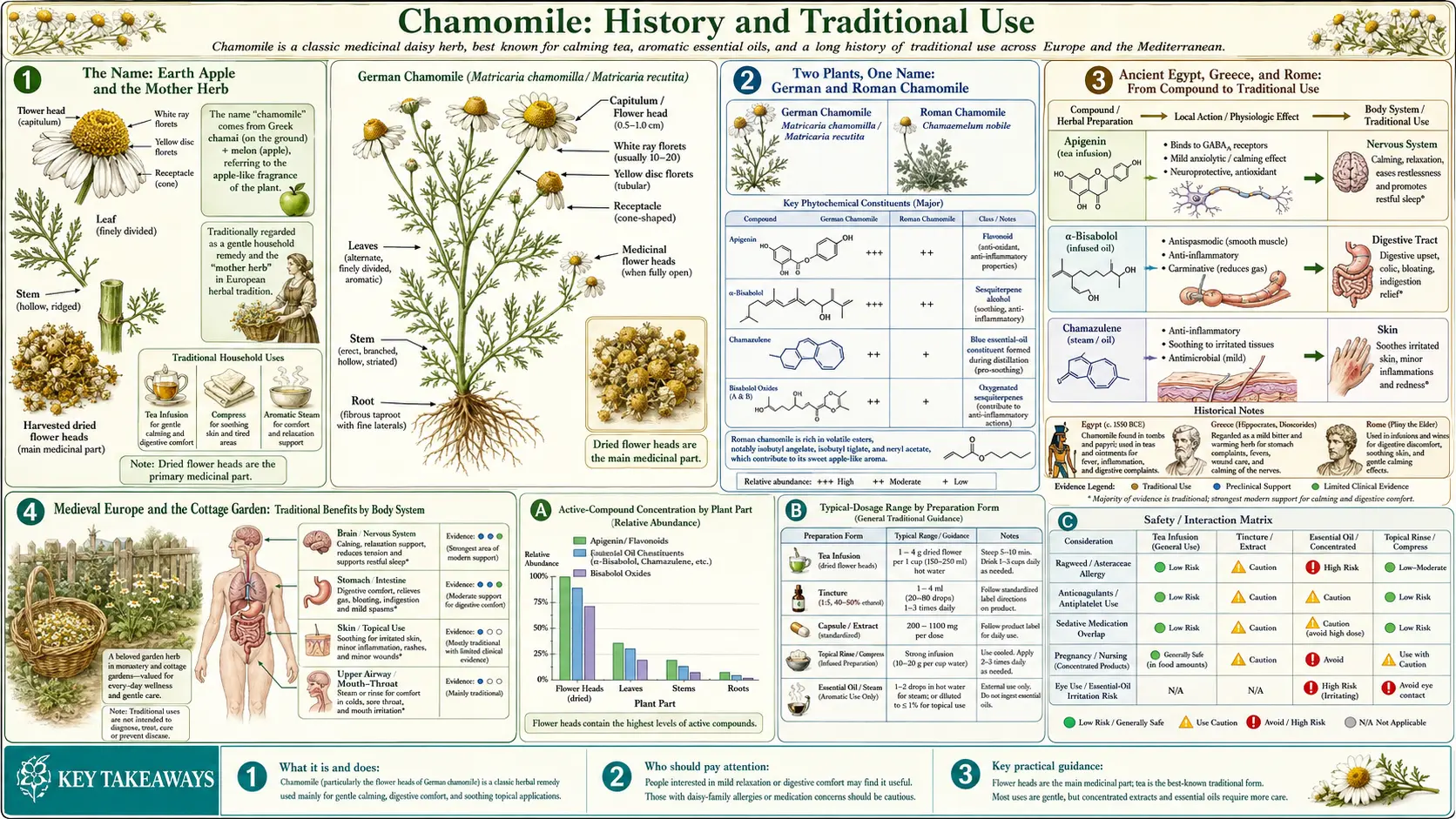
Few flowers are as familiar, or as gently woven into daily life, as chamomile — the small white-and-gold daisy whose dried heads have been steeped into a soothing bedtime tea for many centuries. Its very name is a small history lesson: it comes from the Greek for “earth apple,” after the sweet, apple-like scent of the crushed flowers. This page follows chamomile from the classical Mediterranean physicians through the monastery garden and the cottage still-room to the modern laboratory bench where its calming compound, apigenin, was traced to the same brain receptors that anti-anxiety drugs target. Throughout, we are careful to separate what the historical record solidly documents from what is beloved tradition and folklore — and to say plainly which is which.
Table of Contents
- The Name: Earth Apple and the Mother Herb
- Two Plants, One Name: German and Roman Chamomile
- Ancient Egypt, Greece, and Rome
- Medieval Europe and the Cottage Garden
- Traditional Uses Across Cultures
- Folklore and Symbolism
- From Tradition to Modern Research
- Research Papers and References
- Connections
- Featured Videos
The Name: Earth Apple and the Mother Herb
The English word chamomile (also spelled camomile in British usage) descends, by way of Latin and Old French, from the ancient Greek khamaimelon (χαμαιμηλον), literally “earth apple” or “ground apple” — from khamai, “on the ground,” and melon, “apple.” The name records a simple sensory fact anyone can confirm: crush the little flower heads between your fingers and they release a soft, sweet, distinctly apple-like fragrance. The same observation survives in the Spanish name manzanilla, “little apple,” still used for chamomile tea today. This much is solidly documented in the history of the language.
The botanical genus name of German chamomile, Matricaria, is usually traced to the Latin matrix, meaning “womb” or “mother” — a reference to the herb's long folk reputation for easing women's complaints, especially menstrual cramps. This etymology is widely repeated and plausible, though it describes a traditional association rather than a proven clinical action, and it is fair to treat it as folk reasoning embedded in the plant's name rather than as a medical claim. What the name undeniably tells us is that, from very early on, chamomile was identified above all as a gentle, domestic, “mothering” sort of remedy — the herb you reached for at home, for ordinary aches and restless nights.
Two Plants, One Name: German and Roman Chamomile
One source of endless confusion, then and now, is that “chamomile” is not a single plant but a common name shared by two different daisy-family species, both in the family Asteraceae (the daisies and sunflowers, also called Compositae). Understanding which is which makes the historical record far easier to read.
German chamomile (Matricaria chamomilla, long known by the synonym Matricaria recutita) is an annual that grows roughly 15 to 60 cm tall, native to southern and eastern Europe and western Asia and now naturalized across much of the world. It is the upright, self-seeding plant with hollow, domed yellow flower centres, and it is the chamomile most studied in modern research and most often sold as tea. Roman chamomile (Chamaemelum nobile, formerly classified as Anthemis nobilis) is a low, creeping perennial of western Europe and the Mediterranean, more bitter to the taste, traditionally grown as fragrant lawns and walked-on paths and used heavily in aromatherapy and essential-oil work.
The two were not always carefully distinguished in older herbals, and many a historical recipe simply says “chamomile” without specifying which. In modern herbal medicine and in the scientific literature, the unqualified word “chamomile” almost always means German chamomile, and that is the plant this history mainly follows. Where a tradition specifically belongs to Roman chamomile — as with the scented English chamomile lawn — we say so.
Ancient Egypt, Greece, and Rome
Chamomile is routinely described as one of the oldest documented medicinal herbs, and the classical Mediterranean is where its written record most clearly begins. The Greek physicians and naturalists of antiquity — among them Hippocrates, Dioscorides, and Galen — wrote about a chamomile-type daisy and recommended it for fevers and for a range of everyday complaints. Dioscorides' great first-century herbal De Materia Medica and the encyclopaedic Natural History of Pliny the Elder are real surviving primary texts that discuss the plant; they are named here as historical sources rather than as modern citations, in keeping with how ancient works are handled throughout this site. From these classical roots flows much of the later European tradition of chamomile as a soothing, anti-inflammatory, fever-easing herb.
A great deal more is popularly told about chamomile's antiquity, and here it is worth being honest about the limits of the evidence. It is very commonly said that the ancient Egyptians revered chamomile, dedicated it to the sun god Ra, used it for fevers and in embalming, and recorded it in the Ebers Papyrus (a real Egyptian medical scroll dated to about 1550 BCE). This is a widely repeated tradition, but the specific identification of chamomile in the Ebers Papyrus rests on popular and secondary retellings rather than on a clear, easily verifiable scholarly source, so it is best treated as traditional lore rather than as established fact. Likewise, the often-repeated image of Roman soldiers carrying chamomile to dress wounds and calm their nerves before battle is a charming and frequently told story whose firm documentary basis is hard to pin down; we pass it on as tradition, not as a verified historical record.
What can be said with confidence is the larger pattern: across the classical world, a chamomile-type flower was recognized as a gentle, broadly useful remedy for fevers, inflammation, and unsettled stomachs and nerves — precisely the cluster of uses that would carry forward, almost unchanged, into the medicine of medieval and early-modern Europe.
Medieval Europe and the Cottage Garden
Through the medieval and early-modern centuries, chamomile passed from the classical authorities into the monastery physic gardens, the printed herbals, and the everyday practice of ordinary households. The great English herbalist Nicholas Culpeper, in his widely read seventeenth-century Complete Herbal (1653), gave chamomile several entries, recommending it for aches, agues (fevers), colic and griping pains, and stone, and describing the warmed herb as a remedy for weariness and pain — a typical example of how the soothing, antispasmodic reputation of the plant was written down and handed on. Culpeper's herbal is named here as a historical text.
It is in this period that chamomile becomes, above all, a cottage-garden and dooryard herb. Roman chamomile in particular was planted as fragrant, springy lawns and along garden paths and seats, so that walking or sitting on it released its sweet apple scent — a practice associated with English gardens and famously alluded to in Shakespeare, where the more the herb is trodden, the faster it grows. German chamomile, easy to grow and quick to self-seed, became a staple of the kitchen garden, gathered and dried each summer for the household tea caddy and medicine shelf. Strewn on floors, tucked among linens, and brewed as a daily drink, chamomile was the kind of plant nearly every European household knew and trusted.
This domestic familiarity is the real engine of chamomile's history. It was cheap or free, easy to grow, pleasant to take, and gentle enough to give to children and the elderly — so it became the default comfort remedy for the small, recurring miseries of ordinary life: a fretful baby, an upset stomach, a sleepless night, a sore or inflamed patch of skin. That is the role it carried, largely unbroken, from the medieval garden into the present-day tea aisle.
Traditional Uses Across Cultures
By the time chamomile reached the modern era it had accumulated a remarkably consistent set of traditional uses, and these are well summarized in the peer-reviewed literature. The widely cited review by Srivastava, Shankar, and Gupta records that “chamomile preparations are commonly used for many human ailments such as hay fever, inflammation, muscle spasms, menstrual disorders, insomnia, ulcers, wounds, gastrointestinal disorders, rheumatic pain, and hemorrhoids” — a tidy catalogue of the same complaints the classical and medieval sources had named.
Read together, the traditional indications cluster into a few clear themes that any chamomile drinker would recognize:
- Calming and sleep. A warm cup of chamomile at bedtime to settle the nerves and ease into sleep is among the most universal of all herbal customs, recorded across European folk practice and carried worldwide.
- Digestive comfort. Chamomile tea was, and remains, a household standby for upset stomachs, colic, cramping, bloating, and indigestion — the herb's antispasmodic, “wind-easing” reputation.
- Inflammation and the skin. Compresses, washes, baths, and ointments of chamomile were used on wounds, sores, inflamed eyes, and irritated skin, and to soothe aches and rheumatic pain.
- Women's and children's complaints. Embedded in the very name Matricaria, chamomile's folk use for menstrual cramps and for soothing fretful, teething infants is one of its oldest associations.
These uses appear, with local variation, far beyond Europe wherever the plant was grown or traded, and the modern herbal traditions of many countries inherit them directly. They are described here as documented tradition; the modern clinical evidence behind several of them — particularly for anxiety, sleep, and digestion — is taken up in the dedicated Chamomile Benefits articles.
Folklore and Symbolism
Alongside its medicine, chamomile gathered a gentle layer of folklore. In the “language of flowers” popular in the nineteenth century, chamomile came to stand for patience in adversity and energy in misfortune — a meaning often linked to the Roman-chamomile lawn that grows back all the more vigorously the more it is trodden underfoot. The plant's reputation as a hardy, ever-returning grower fed naturally into this symbolism of quiet resilience.
European garden lore also cast chamomile as a kind of good neighbour among plants. Gardeners traditionally called it the “plants' physician,” holding that a chamomile set beside a sickly or drooping plant would help revive it — a piece of garden folklore that persists in companion-planting advice to this day. These beliefs are best enjoyed as cultural tradition rather than as horticultural fact.
There is, finally, a strand of household and folk-magical lore in which chamomile was associated with calm, comfort, sleep, and modest good fortune — washed over the hands or sprinkled about for luck, and steeped into the bedtime drink that quiets a worried mind. As with the symbolism above, this lore is part of how communities felt about a deeply familiar plant; it is not a medical claim. What unites all of it is the same gentle character that runs through chamomile's entire history: a small, sweet, resilient flower associated with soothing, patience, and rest.
From Tradition to Modern Research
The most satisfying part of chamomile's story is how neatly its oldest reputation — a calming, sleep-friendly, anti-inflammatory comfort herb — has been met by modern science with a plausible chemical explanation. Chamomile is unusually complex chemically, with well over a hundred identified constituents, but a few stand out. The flavonoid apigenin is the compound most often credited with the herb's soothing effect: as the Srivastava review puts it, chamomile's “sedative effects may be due to the flavonoid, apigenin that binds to benzodiazepine receptors in the brain” — the very same class of receptors targeted by pharmaceutical anti-anxiety and sleep medicines. In other words, the ancient bedtime cup turns out to have a chemical address.
The deep blue colour of German chamomile's essential oil tells another story from tradition to laboratory. That colour comes from chamazulene, which the plant does not actually contain ready-made: as Ramadan and colleagues documented in 2006, chamazulene is formed during steam distillation from a colourless precursor in the flower called matricin, and a related breakdown product, chamazulene carboxylic acid, behaves like a natural anti-inflammatory “profen” that selectively inhibits the COX-2 enzyme. This is a genuine, documented scientific milestone — a clear chemical mechanism standing behind chamomile's age-old anti-inflammatory reputation, with real named researchers and a verifiable publication.
Clinical research has begun to test the traditional uses head-on. In a landmark randomized, placebo-controlled trial published in 2009, Amsterdam and colleagues found that a standardized German-chamomile extract produced a significantly greater reduction in symptoms of generalized anxiety disorder than placebo over eight weeks; a 2016 long-term trial by Mao and colleagues found the extract was safe and well tolerated over many months. A 2016 randomized trial by Chang and Chen reported that postnatal women who drank chamomile tea daily for two weeks had better sleep quality and fewer depressive symptoms than a control group. None of this means chamomile is a cure-all — it is a gentle herb, and serious anxiety, insomnia, or illness deserves proper medical care — but it does mean that the thread running from a classical physician's fever remedy, through a medieval cottage tea, to a modern controlled trial is real and continuous. Tradition raised the questions; research is now, carefully, testing the answers.
Research Papers and References
The list below combines key peer-reviewed sources on Matricaria chamomilla with curated PubMed topic-search links into the historical, ethnobotanical, and clinical literature. Historical primary texts (Dioscorides' De Materia Medica, Pliny's Natural History, and Culpeper's Complete Herbal) are named in the article as historical sources rather than as modern citations. Author names, titles, and journals are given as plain text; only the stable identifier (DOI or PMID) is linked, and each opens in a new tab.
- Srivastava JK, Shankar E, Gupta S. Chamomile: a herbal medicine of the past with bright future. Molecular Medicine Reports. 2010;3(6):895-901. — doi:10.3892/mmr.2010.377 (PMID: 21132119)
- Ramadan M, Goeters S, Watzer B, et al. Chamazulene carboxylic acid and matricin: a natural profen and its natural prodrug, identified through similarity to synthetic drug substances. Journal of Natural Products. 2006;69(7):1041-1045. — doi:10.1021/np0601556 (PMID: 16872141)
- Amsterdam JD, Li Y, Soeller I, Rockwell K, Mao JJ, Shults J. A randomized, double-blind, placebo-controlled trial of oral Matricaria recutita (chamomile) extract therapy for generalized anxiety disorder. Journal of Clinical Psychopharmacology. 2009;29(4):378-382. — doi:10.1097/JCP.0b013e3181ac935c (PMID: 19593179)
- Mao JJ, Xie SX, Keefe JR, Soeller I, Li QS, Amsterdam JD. Long-term chamomile (Matricaria chamomilla L.) treatment for generalized anxiety disorder: a randomized clinical trial. Phytomedicine. 2016;23(14):1735-1742. — doi:10.1016/j.phymed.2016.10.012 (PMID: 27912875)
- Chang SM, Chen CH. Effects of an intervention with drinking chamomile tea on sleep quality and depression in sleep-disturbed postnatal women: a randomized controlled trial. Journal of Advanced Nursing. 2016;72(2):306-315. — doi:10.1111/jan.12836 (PMID: 26483209)
- Matricaria chamomilla ethnobotany and traditional use — PubMed: Matricaria chamomilla ethnobotany and traditional use
- Chamomile history and historical medicinal use — PubMed: chamomile history and traditional medicine
External Authoritative Resources
- NCCIH — Chamomile
- MedlinePlus — Herbs and Supplements
- PubMed — All research on Matricaria chamomilla
Connections
- All Herbs
- Chamomile Hub
- Chamomile Benefits Deep Dive
- Lavender
- Lemon Balm
- Passionflower
- Valerian
- Fennel