Ajwain (Trachyspermum ammi) — Benefits Deep Dive
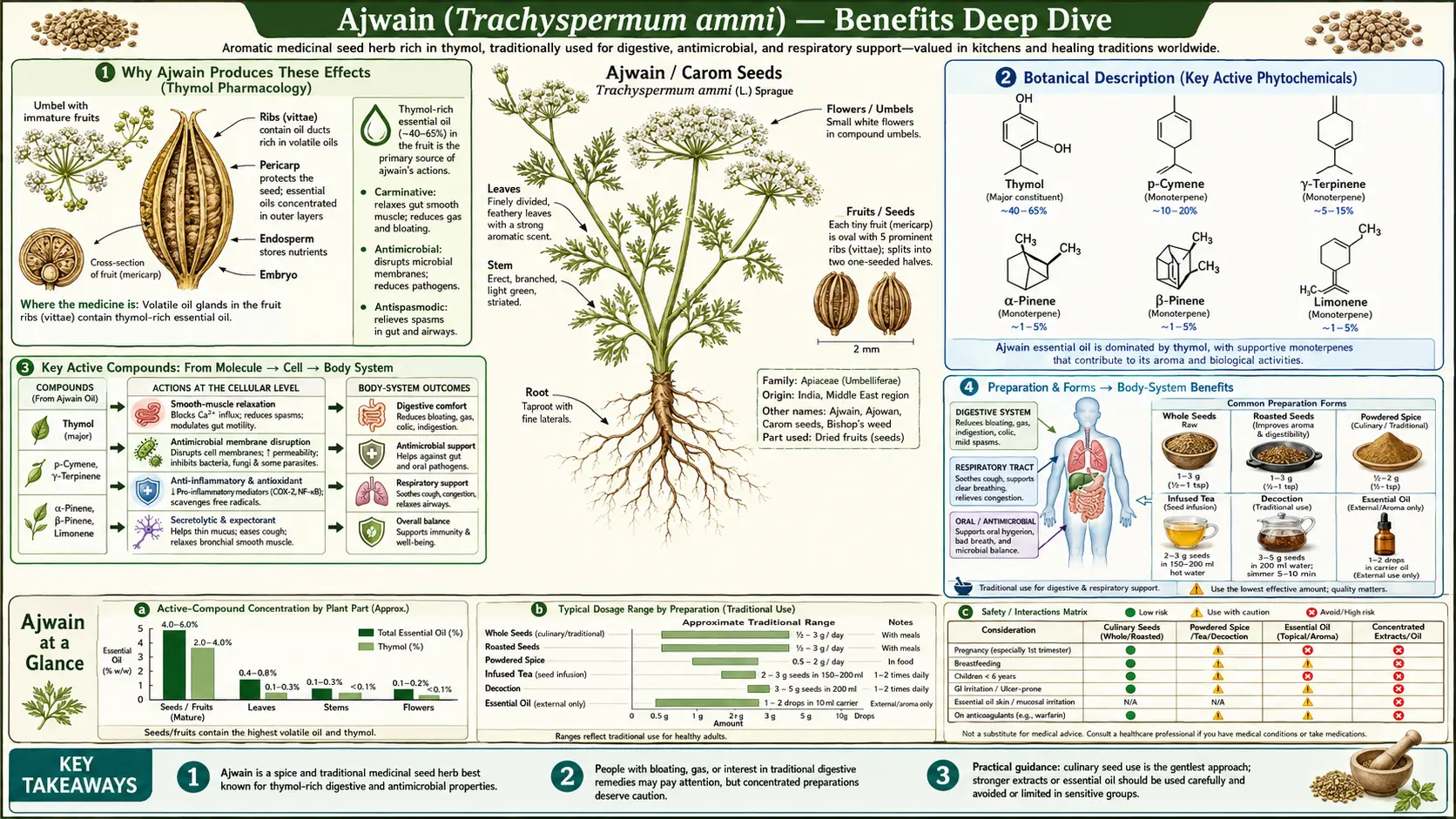
Ajwain (Trachyspermum ammi), also known as bishop's weed, ajowan caraway, or carom seed, is a small ridged umbelliferous seed from the Apiaceae family — the same botanical family as cumin, fennel, caraway, dill, and coriander. What sets ajwain apart is the unusually high concentration of thymol in its essential oil — commonly 35-60% of the volatile fraction, the highest reliable natural source of thymol on the spice rack. Ajwain is simultaneously a staple of Indian cuisine (the warm bite in paratha, samosa pastry, dal tadka, and pakora batter), the foundational Ayurvedic carminative for trapped gas and dyspepsia, and a traditional galactagogue given to nursing mothers across South Asia. Four deep-dive pages below explore the conditions where ajwain produces the most reliable clinical effect — the rapid postprandial carminative response that the seed is famous for, the expectorant and bronchodilator activity of its thymol-rich vapor, the broad-spectrum antimicrobial activity against gut pathogens and food-spoilage organisms, and the analgesic and anti-inflammatory effects that underlie its traditional use for joint pain and nursing-mother recovery.
Deep-Dive Articles
Digestive Aid
The thymol-driven carminative mechanism (smooth-muscle antispasmodic action on the gastrointestinal tract), the traditional Indian postprandial use of a pinch of toasted ajwain with rock salt, modern controlled-trial data in functional dyspepsia and irritable bowel syndrome (IBS-related gas and bloating), and the protective effect of ajwain extract on the gastric mucosa in animal peptic ulcer models. Why ajwain works in 15-30 minutes when most herbal carminatives take hours.
Respiratory Health
Thymol as an expectorant and mucolytic, the traditional Ayurvedic potali (steam inhalation pouch) for cough and chest congestion, the bronchodilator activity demonstrated in asthmatic animal models and small human trials, and how ajwain compares to its more famous botanical cousin thyme (Thymus vulgaris) — same dominant compound, different dose-delivery geometry from a seed-vapor versus leaf-vapor preparation.
Antimicrobial
Published minimum inhibitory concentration (MIC) data for ajwain essential oil and isolated thymol + carvacrol against Escherichia coli, Staphylococcus aureus, Candida albicans, and key food-spoilage organisms. The traditional preservation role of ajwain in spiced pickles and ghee preparations, its emerging research use as a gut-dysbiosis adjunct, and the mechanism by which thymol disrupts the bacterial and fungal membrane.
Pain and Inflammation
Antinociceptive (pain-relieving) animal data using hot-plate, tail-flick, and acetic-acid writhing models, the COX inhibition profile of thymol that places ajwain in the natural NSAID category, traditional Ayurvedic use for arthritic joint pain (warming carminative seeds applied externally or taken internally), and the centuries-old galactagogue role giving toasted ajwain water to nursing mothers in the postpartum period.
Table of Contents
- Deep-Dive Articles
- Why Ajwain Produces These Effects (Thymol Pharmacology)
- Key Research Papers
- External Authoritative Resources
- Connections
- Featured Videos
Why Ajwain Produces These Effects (Thymol Pharmacology)
Almost the entire clinical reputation of ajwain comes down to one molecule: thymol (2-isopropyl-5-methylphenol), a monoterpene phenol that makes up 35-60% of ajwain's essential oil. This is the same molecule that gives common thyme (Thymus vulgaris) its medicinal profile, but ajwain delivers more thymol per gram than dried thyme leaf does, and the seed format concentrates it into a much smaller cooking pinch. The remainder of the ajwain essential-oil profile is dominated by carvacrol (a structural isomer of thymol that shares most of its pharmacology), p-cymene (the biosynthetic precursor to both phenols), and gamma-terpinene (an antioxidant terpene). The four compounds act synergistically, which is why isolated thymol does not fully reproduce the clinical effect of whole ajwain oil in head-to-head animal studies.
Thymol is unusual among plant phenols because it is volatile, oil-soluble, and small — properties that let it reach four distinct compartments where most herbal compounds cannot:
- Smooth-muscle membranes of the gastrointestinal tract — thymol crosses the gut epithelium rapidly and produces a calcium-channel-blocking effect on enteric smooth muscle, relaxing intestinal spasm. This is the mechanism behind the 15-30 minute carminative effect ajwain is famous for, and the documented benefit in IBS-related cramping and gas.
- The bronchial mucosa via vapor inhalation — volatile thymol carried on warm steam reaches the bronchioles, where it acts as a mucolytic (thinning trapped mucus), an expectorant (stimulating ciliary clearance), and a mild bronchodilator. This is the mechanism behind the traditional ajwain potali and the modern bronchodilator research data in asthmatic animal models.
- The microbial cell membrane — thymol and carvacrol both insert into the lipid bilayer of bacterial and fungal cells, increasing membrane permeability, collapsing the proton motive force, and killing the organism. This is the basis for the documented broad-spectrum activity against E. coli, S. aureus, and Candida and the traditional food-preservation role of ajwain in spiced ghee and pickles.
- The arachidonic-acid inflammation cascade — thymol partially inhibits cyclooxygenase (COX) and lipoxygenase (LOX) enzymes, reducing prostaglandin and leukotriene synthesis. This is the molecular footing for the antinociceptive and anti-inflammatory effects that put ajwain in the natural-NSAID conversation.
The therapeutic complication is that the same volatility and membrane-active properties that make ajwain effective also make it potent in small doses and irritating in large ones. Ajwain essential oil at undiluted high doses can cause mucosal irritation, nausea, and in laboratory animal models hepatotoxicity at sustained doses far above culinary levels. The traditional preparation forms — toasted seeds, ajwain water (ajwain ka pani), and the steam-inhalation potali — deliver therapeutic doses while avoiding the irritation seen with the concentrated essential oil. The four deep-dive pages below cover the dosage windows, contraindications (pregnancy, certain reflux phenotypes), and traditional preparation methods for each clinical use.
Key Research Papers
- Boskabady MH et al. (2014). Pharmacological effects of Trachyspermum ammi and its constituents (a comprehensive review). Iranian Journal of Basic Medical Sciences. — PubMed
- Bairwa R et al. (2012). Trachyspermum ammi. Pharmacognosy Reviews. — PubMed
- Marongiu B et al. (2012). Chemical composition of the essential oil and supercritical CO2 extract of Trachyspermum ammi. — PubMed
- Marsik P et al. (2005). In vitro inhibitory effects of thymol and quinones from Trachyspermum ammi. — PubMed
- Goyal R, Goyal D, Mahajan S (2012). Anti-asthmatic potency of Trachyspermum ammi in patients with chronic bronchial asthma. Indian Journal of Pharmacology. — PubMed
External Authoritative Resources
- PubMed — All research on Trachyspermum ammi (the full scientific literature on ajwain)
- PubMed — Thymol and carvacrol pharmacology (the active-constituent literature shared with thyme and oregano)
- NCCIH — Herbs at a Glance (National Center for Complementary and Integrative Health)
- MedlinePlus — Herbs and Supplements (NIH consumer-facing herb monographs)
- EMA Herbal Monograph — Thymus vulgaris (the closest regulated thymol-source monograph, relevant to ajwain's shared pharmacology)
Connections
- All Herbs
- Ajwain (Main Page)
- Ajwain for Digestion
- Ajwain for Respiratory Health
- Ajwain Antimicrobial Effects
- Ajwain for Pain & Inflammation
- Cumin
- Fennel
- Coriander Seeds
- Fenugreek
- Ginger
- Irritable Bowel Syndrome
- Bloating
- Gut Healing
- Arthritis