St. John's Wort for Depression
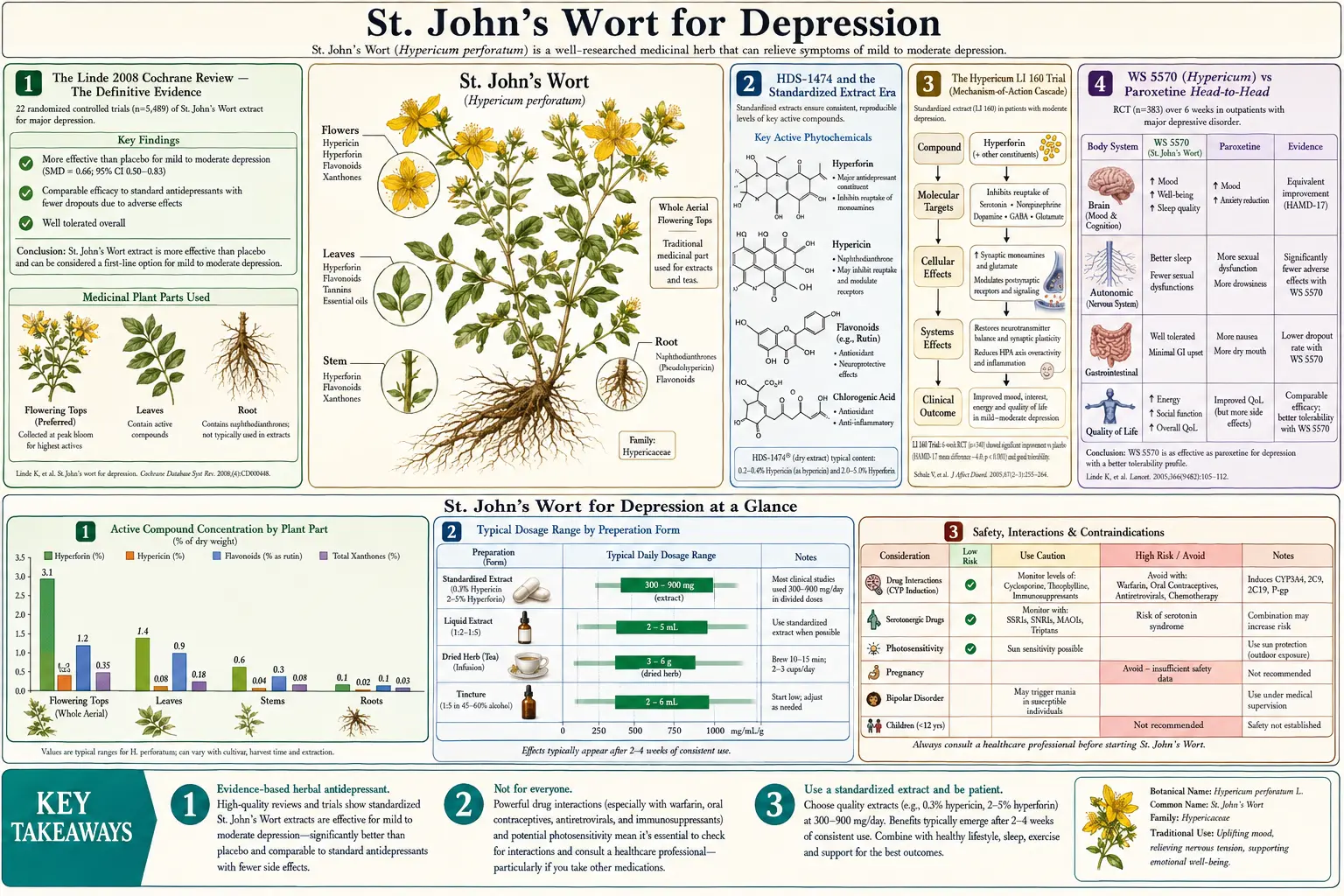
St. John's Wort is the single most rigorously studied herbal antidepressant in modern medicine. The 2008 Cochrane systematic review by Klaus Linde and colleagues pooled 29 randomized double-blind trials (18 comparisons with placebo and 17 with standard antidepressants) covering 5,489 patients and concluded that the hypericum extracts tested were superior to placebo and similarly effective as standard selective serotonin reuptake inhibitor (SSRI) and tricyclic antidepressants in major depression — with fewer side effects. This deep-dive walks through the pivotal trials of standardized hypericum extracts, the molecular mechanism worked out by Walter Müller's laboratory at the University of Frankfurt (hyperforin's activation of TRPC6 ion channels, identified in 2007, producing non-selective monoamine reuptake inhibition), the clinical considerations that distinguish a 4-6 week botanical onset window from same-day pharmacokinetic activity, and the patient groups in which the trials found benefit versus the groups for whom the herb is contraindicated.
Table of Contents
- The Linde 2008 Cochrane Review — The Definitive Evidence
- Standardized Extracts and Hyperforin Content
- Trials of Standardized Extracts Against Imipramine, Fluoxetine and Placebo
- Hypericum vs Paroxetine Head-to-Head
- Hyperforin and the TRPC6 Mechanism
- Hypericin and Monoamine Oxidase
- Mild-Moderate Depression vs Severe Depression
- The 4-6 Week Onset Window and Titration
- Discontinuation, Tapering, and Maintenance
- Patient Groups: Where Hypericum Is Used and Where It Is Contraindicated
- Side-Effect Profile vs Selective Serotonin Reuptake Inhibitors
- Key Research Papers
- Connections
- Featured Videos
The Linde 2008 Cochrane Review — The Definitive Evidence
The Cochrane Collaboration is the gold standard for systematic-review methodology in evidence-based medicine, applying pre-specified search strategies, blinded duplicate trial selection, formal risk-of-bias assessment, and quantitative meta-analytic pooling. The 2008 update by Klaus Linde and colleagues (Cochrane Database of Systematic Reviews, Issue 4, CD000448) was the third iteration of an ongoing Cochrane review of hypericum extracts for major depression and remains the definitive synthesis of the evidence base.
The methodology was rigorous:
- Search of CENTRAL, MEDLINE, EMBASE, PsycINFO, AMED, CINAHL, and reference lists from inception through 2008
- Inclusion criteria: randomized double-blind trials of mono-preparation hypericum extracts in adults with major depression (DSM-III, DSM-IV, or ICD-10)
- Comparators: placebo, standard antidepressants (selective serotonin reuptake inhibitors (SSRIs), tricyclics, monoamine oxidase inhibitors (MAOIs)), or other active treatments
- Primary outcomes: response rate (50% reduction in Hamilton Depression Rating Scale), remission rate, and dropout for adverse events
- Sensitivity analyses by trial size, duration, severity of baseline depression, and country of origin
The pooled analysis included 29 trials with 5,489 patients:
- vs Placebo (18 comparisons): hypericum was superior, but the placebo-controlled results showed marked heterogeneity. In nine larger trials the combined response rate ratio (relative risk of response) was 1.28 (95% confidence interval (CI) 1.10-1.49), and in nine smaller trials it was 1.87 (95% CI 1.22-2.87) — larger trials showing more modest effects than smaller trials, an association the authors say complicates interpretation
- vs Standard Antidepressants (selective serotonin reuptake inhibitors and tricyclics) (17 comparisons): results were statistically homogeneous. Relative risk of response 1.02 (95% confidence interval 0.90-1.15; 5 trials) vs tri- or tetracyclic antidepressants and 1.00 (95% confidence interval 0.90-1.11; 12 trials) vs selective serotonin reuptake inhibitors, meaning similar efficacy
- Adverse-event dropouts: patients given hypericum dropped out because of adverse effects less often than those given standard antidepressants. Odds ratio 0.24 (95% confidence interval 0.13-0.46) vs older antidepressants, and 0.53 (95% confidence interval 0.34-0.83) vs selective serotonin reuptake inhibitors
The Linde authors' conclusion was carefully worded but unambiguous: hypericum extracts tested in the included trials are superior to placebo in patients with major depression, are similarly effective to standard antidepressants, and have fewer side effects. The notable caveats: trials from German-speaking countries reported findings more favorable to hypericum than other trials, possibly reflecting differences in extract preparation and patient populations, and the heterogeneity of hypericum products (different manufacturers, different extraction processes, different hyperforin and hypericin content) makes any single-product generalization risky.
A 2017 meta-analysis by Ng and colleagues reviewed 27 clinical trials with a total of 3,808 patients comparing St. John's Wort with selective serotonin reuptake inhibitors. St. John's Wort showed a comparable response rate (pooled relative risk 0.983, 95% confidence interval 0.924-1.042) and remission rate (pooled relative risk 1.013, 95% confidence interval 0.892-1.134), and a significantly lower discontinuation/dropout rate (pooled odds ratio 0.587, 95% confidence interval 0.478-0.697). The authors note that every available study lasted only 4 to 12 weeks, so evidence on long-term efficacy and safety is limited, and that it is unclear whether St. John's Wort would help people with severe depression or a high suicide risk.
Standardized Extracts and Hyperforin Content
Early hypericum clinical trials in the 1980s and early 1990s used variable, often non-standardized preparations, which produced inconsistent results and limited regulatory acceptance. The modern era of rigorous hypericum research began with the development of standardized extracts in German pharmaceutical companies in the late 1980s and early 1990s. The most influential of these standardized extracts have been:
- Dual-standardized extracts — extracts standardized for both hypericin and hyperforin. The dual standardization for both marker compounds was an important advance because earlier extracts standardized only for hypericin (the marker compound) sometimes had near-zero hyperforin content (the actually-active compound), explaining why some trials of "0.3% hypericin extract" showed no benefit
- A standardized hypericum extract — one of the most widely studied standardized hypericum extracts in clinical trials, also standardized for hypericin and hyperforin
- A second standardized extract — the extract used in the most rigorous head-to-head selective serotonin reuptake inhibitor comparison trials, including the Szegedi 2005 BMJ paroxetine comparison
- A third standardized extract — standardized for hyperforin content specifically
- A low-hyperforin extract — hyperforin content less than 0.2%, developed to reduce the cytochrome P450 3A4 (CYP3A4) drug-interaction burden while preserving antidepressant efficacy. Some clinical trials have suggested this low-hyperforin extract may have a more favorable drug-interaction profile, though its antidepressant efficacy data are more limited than the higher-hyperforin extracts
Evidence that hyperforin content matters comes from a 1998 trial by Laakmann and colleagues in 147 outpatients with mild or moderate depression. Two extracts made by an identical manufacturing process, differing only in hyperforin content (5% versus 0.5%), were compared with placebo over 42 days, one 300 mg tablet three times daily. Hamilton depression scores fell by 10.3 points on the 5%-hyperforin extract, 8.5 points on the 0.5%-hyperforin extract and 7.9 points on placebo. Only the 5%-hyperforin extract was superior to placebo (p = 0.004), and the fall in scores rose with hyperforin dose (trend test p = 0.017). The authors concluded that the therapeutic effect of St. John's Wort in mild to moderate depression depends on its hyperforin content.
The clinical implication: not all hypericum products are equivalent. A consumer picking up a bottle labeled "St. John's Wort, standardized to 0.3% hypericin" at a U.S. supermarket has no way to know whether the product contains 0.5% or 5% hyperforin, and the antidepressant efficacy depends primarily on the hyperforin content. Products differ in whether the label states hyperforin content at all, while the major clinical trials tested specific standardized extracts with stated content.
Trials of Standardized Extracts Against Imipramine, Fluoxetine and Placebo
The trial program of one widely studied standardized hypericum extract produced more than a dozen randomized controlled trials between 1993 and 2005, establishing the modern standard for hypericum antidepressant efficacy data. The pivotal multicenter trials in Germany typically used 300 mg three times daily of this extract (total 900 mg/day, standardized to approximately 0.3% hypericin and 3-6% hyperforin) against either placebo or active comparator.
Representative findings from trials of standardized extracts:
- vs Imipramine (tricyclic) (Vorbach et al., 1994): the standardized extract at 900 mg/day was compared with imipramine 75 mg/day over 6 weeks in 135 depressed patients treated in 20 centers (diagnoses included single or recurrent depressive episodes, depressive neurosis and adjustment disorder with depressed mood). Hamilton scores fell in parallel in both groups (from 20.2 to 8.8 on hypericum, from 19.4 to 10.7 on imipramine), and the hypericum group had fewer and milder side effects
- vs Fluoxetine (Schrader, 2000): the low-hyperforin extract was compared with fluoxetine 20 mg/day over 6 weeks in 240 outpatients with mild-to-moderate depression; the author concluded the two were equipotent on the main measures, and adverse events occurred in 8% on hypericum versus 23% on fluoxetine
- Dose comparison (Kasper et al., 2006): a placebo-controlled trial of 332 adults with mild or moderate major depression gave the second standardized extract at 600 mg once daily, 1,200 mg daily (600 mg twice daily), or placebo for 6 weeks. Hamilton depression scores fell 11.6, 10.8 and 6.0 points respectively; both doses were statistically superior to placebo, more patients remitted on 1,200 mg/day than on 600 mg/day, and the incidence of adverse events was low in all groups
- Long-term continuation: 26-week and 52-week extensions of standardized-extract trials demonstrated sustained efficacy and a tolerability profile that did not deteriorate with chronic use, in contrast to the increasing dropout for adverse events that often emerges with chronic selective serotonin reuptake inhibitor use
That extract's trial program collectively contributed approximately one-quarter of the patient data pooled in the 2008 Cochrane review and was instrumental in moving hypericum from a folk-medicine status to an evidence-based option for mild-to-moderate depression in Germany, where hypericum prescriptions still outnumber selective serotonin reuptake inhibitor prescriptions in the depression indication.
Hypericum vs Paroxetine Head-to-Head
The Szegedi et al. 2005 BMJ trial of a standardized hypericum extract versus paroxetine remains the methodologically most rigorous head-to-head comparison of hypericum against a modern selective serotonin reuptake inhibitor. Design:
- 21 psychiatric primary care practices in Germany
- 251 adult patients with moderate to severe major depression (Hamilton Depression Rating Scale baseline 22 or higher)
- Randomized double-blind double-dummy design (each patient took both an active drug and a matching placebo for the other arm)
- Treatment: hypericum extract 900 mg/day (three times a day) versus paroxetine 20 mg once daily; in initial non-responders, doses were increased after two weeks to 1,800 mg/day hypericum or 40 mg/day paroxetine
- Six-week treatment period
- Primary outcome: change in Hamilton Depression Rating Scale (HAM-D) score from baseline
Results: the hypericum extract was non-inferior to paroxetine and statistically superior. Mean reduction in HAM-D was 14.4 points in the hypericum arm versus 11.4 points in the paroxetine arm (intention-to-treat analysis). The lower one-sided 97.5% confidence limit for the difference (hypericum minus paroxetine) was 1.5 points (0.7 points in the per-protocol analysis), above both the pre-specified non-inferiority margin of -2.5 points and the superiority margin of 0. The incidence of adverse events was 0.035 events per day of exposure on hypericum versus 0.060 on paroxetine.
The strength of this trial — that it included patients with moderate-to-severe depression rather than restricting to mild — partially answered the lingering criticism that earlier hypericum trials may have included patients whose depression was mild enough to remit spontaneously. The Szegedi trial demonstrated that even in patients meeting criteria for moderate-to-severe major depression, the hypericum extract produced a fall in depression scores at least as large as the widely used selective serotonin reuptake inhibitor paroxetine — statistically larger in this trial.
Hyperforin and the TRPC6 Mechanism
The molecular mechanism of hypericum's antidepressant effect was a subject of considerable debate through the 1990s. Early researchers focused on hypericin (the colored marker compound), proposing weak inhibition of monoamine oxidase as the principal mechanism. The MAO-inhibition hypothesis was problematic for two reasons: in vitro MAO inhibition by hypericin requires concentrations 10-100x higher than what is achieved with oral therapeutic dosing, and combining hypericum with the foods and drugs that produce hypertensive crises with pharmaceutical MAO inhibitors has not produced such crises clinically.
The breakthrough came from Walter Müller's laboratory at the University of Frankfurt from the late 1990s. Müller's group identified hyperforin (not hypericin) as the principal antidepressant compound and, in laboratory studies, showed that it blocks serotonin uptake by raising the sodium level inside nerve cells. The molecular target came later: in 2007 the same Frankfurt group (Leuner and colleagues) found that hyperforin specifically activates TRPC6 channels, letting sodium and calcium into cells grown in the laboratory. In plain words, the sodium build-up weakens the pumps that pull serotonin and noradrenaline (norepinephrine) back into nerve endings, so more of these messengers stay active between nerve cells; the authors describe the sodium-gradient breakdown as the likely explanation ("may be the rationale") for the uptake inhibition. The mechanism as described:
- Hyperforin binds to and activates the TRPC6 (transient receptor potential canonical 6, a cation channel) ion channel in presynaptic neuronal membranes
- TRPC6 activation permits sodium entry into the presynaptic terminal, raising intracellular sodium concentration
- Presynaptic reuptake of neurotransmitters (serotonin, norepinephrine, dopamine, gamma-aminobutyric acid (GABA), L-glutamate) is powered by the sodium gradient across the presynaptic membrane — the sodium-coupled transporter (SERT for serotonin, NET for norepinephrine, DAT for dopamine, GAT for GABA, EAAT for glutamate) uses the energy of sodium flowing down its concentration gradient to pump neurotransmitter against its gradient back into the presynaptic terminal
- By dissipating the sodium gradient (raising intracellular sodium), hyperforin reduces the thermodynamic drive for reuptake of all five neurotransmitters simultaneously
- The net effect is broad-spectrum monoamine, gamma-aminobutyric acid, and glutamate reuptake inhibition from a single molecular interaction
This mechanism is fundamentally different from conventional reuptake inhibitor drugs (selective serotonin reuptake inhibitors, serotonin-norepinephrine reuptake inhibitors (SNRIs), norepinephrine-dopamine reuptake inhibitors (NDRIs), norepinephrine reuptake inhibitors (NRIs)), which bind directly to the substrate-binding site of one or two specific transporters. The TRPC6/sodium-gradient mechanism explains why hyperforin produces effects on essentially all monoamine systems simultaneously, why it also produces gamma-aminobutyric acid-system effects (which pure pharmaceutical reuptake inhibitors do not), and why the side-effect profile is qualitatively different from pharmaceutical agents that hit a single transporter.
Hyperforin is also behind the herb's most consequential adverse effect, through a different target: it is a potent agonist of the pregnane X receptor (PXR), which is the master transcription factor regulating expression of CYP3A4, CYP1A2, CYP2C9, and P-glycoprotein. PXR activation by hyperforin upregulates these drug-metabolizing enzymes and transporters by 50-300% over baseline, which is the molecular basis for the herb's extensive drug-interaction profile. The same molecule, hyperforin, drives both the antidepressant effect and the interaction risk, but through two different targets: TRPC6 for reuptake inhibition and PXR for enzyme induction.
Hypericin and Monoamine Oxidase
Despite hyperforin's primacy in the antidepressant mechanism, hypericin retains a role that contributes secondarily to mood effects. Hypericin is a weak inhibitor of monoamine oxidase, both MAO-A and MAO-B, in vitro — though the half-maximal inhibitory concentrations (IC50) required are 5-50 micromolar, which are well above plasma concentrations achieved with oral hypericum dosing (typical peak plasma hypericin after a 300 mg dose of standardized extract is approximately 0.01-0.05 micromolar, more than 100-fold lower than the in vitro MAO-inhibition concentration).
The clinical relevance: hypericin's MAO inhibition is essentially negligible at therapeutic doses, and the dietary tyramine restrictions that apply to pharmaceutical MAO inhibitors (avoidance of aged cheese, cured meats, red wine, fermented foods) do not apply to St. John's Wort. On this reasoning, eating these foods while taking hypericum is not expected to cause a tyramine-induced hypertensive crisis.
Hypericin's more clinically relevant role at oral doses is as a contributor to the photosensitization side effect — some patients on high-dose hypericum develop sunburn-like reactions after sun exposure, particularly fair-skinned individuals taking doses above 1,800 mg/day. The mechanism is hypericin absorbing visible light, generating reactive oxygen species, and damaging skin proteins and lipids. At standard 900 mg/day dosing the photosensitization is mild and uncommon, but it is dose-dependent.
The traditional therapeutic use of topical hypericum-infused oil for skin conditions (covered in the Antiviral and Wound Healing deep-dive) deliberately exploits hypericin's photoactivation properties, but the oral mood applications mostly do not depend on hypericin.
Mild-Moderate Depression vs Severe Depression
The clinical evidence for hypericum is strongest in mild-to-moderate major depression. For severe depression and depression with psychotic features, the evidence is weaker and the role of hypericum more controversial.
The pivotal trial that shaped American skepticism about hypericum efficacy was the Hypericum Depression Trial Study Group 2002 JAMA paper — a 340-patient U.S. multicenter trial of the widely studied standardized extract described above versus sertraline versus placebo in patients with moderate-to-severe major depression (mean baseline HAM-D 22.7, threshold for "severe" usually 23 or higher). The trial found neither hypericum nor sertraline statistically superior to placebo on the primary endpoint, an unexpected null result that became the most-cited piece of evidence against hypericum efficacy in the U.S. literature.
The trial's own numbers: 340 adult outpatients with a baseline Hamilton score of at least 20 were treated for 8 weeks at 12 academic and community psychiatric research clinics. Full response occurred in 31.9% of placebo-treated patients, 23.9% of hypericum-treated patients and 24.8% of sertraline-treated patients. The authors concluded that the study "fails to support the efficacy of H perforatum in moderately severe major depression", and wrote that the result "may be due to low assay sensitivity of the trial, but the complete absence of trends suggestive of efficacy for H perforatum is noteworthy."
Subsequent re-analysis of the JAMA 2002 trial revealed important context: the placebo response rate was unusually high (32%), suggesting either methodological problems with patient enrollment or a high background rate of expected response in the trial sample. The fact that the active comparator sertraline (a well-established effective selective serotonin reuptake inhibitor) also failed to beat placebo strongly suggests the trial had failed to detect treatment effect generally, not that hypericum specifically was ineffective. Methodological reviewers have largely interpreted the JAMA 2002 trial as an example of "failed trial" rather than "negative trial."
The Szegedi 2005 BMJ trial discussed above (a standardized hypericum extract vs paroxetine in moderate-to-severe depression) provides the strongest counter-evidence, showing hypericum non-inferior to paroxetine and statistically superior in patients with HAM-D baseline 22 or higher. The two trials are not directly comparable (different extracts, different populations, different methodological controls), but Szegedi 2005 demonstrates that hypericum can produce meaningful effects in moderate-to-severe depression when the trial design and product quality are adequate.
What this means: the trial evidence for hypericum is strongest for mild-to-moderate depression, and the authors of the 2017 meta-analysis write that it is unclear whether St. John's Wort would help people with severe depression or a high suicide risk. For severe major depression, psychotic depression, depression with active suicidal ideation, or depression requiring rapid response (e.g., hospitalized patients), conventional pharmaceutical treatment (or in severe cases, electroconvulsive therapy (ECT) or ketamine) remains the standard of care. Combining hypericum with conventional antidepressants carries a risk of serotonin syndrome, and hyperforin's induction of cytochrome P450 3A4 can lower the blood levels of many other medicines.
The 4-6 Week Onset Window and Titration
One of the most clinically important practical considerations: hypericum's full antidepressant effect develops over 4 to 6 weeks of consistent daily use, similar to selective serotonin reuptake inhibitors and unlike same-day-acting anxiolytics. This delayed onset is the single most common reason for treatment failure — patients discontinue after 1-2 weeks expecting an immediate effect that does not come.
The typical time course described for people starting hypericum:
- Week 1-2: minimal or no mood effect expected. Some patients notice subtle improvements in sleep quality, anxiety, or energy in the first 1-2 weeks, but the full antidepressant effect is not yet present
- Week 3-4: emerging mood improvement in responders. Patients may notice the depression is "lifting" but the change is gradual rather than dramatic
- Week 4-6: full therapeutic effect typically reached. If no meaningful improvement has occurred by week 6 at adequate dose (900-1200 mg/day of standardized extract), the patient is unlikely to respond to hypericum
- Week 6-12: continued consolidation of response. Patients who responded by week 6 generally continue to improve through week 12
Dose in the trials: most clinical trials used 300 mg three times daily of standardized extract (total 900 mg/day) as the primary dose. In the Szegedi 2005 trial, initial non-responders had the dose increased after two weeks to 1,800 mg/day, and the 2002 U.S. trial allowed 900 to 1,500 mg/day depending on response. Doses above 1,200 mg/day increase the risk of photosensitivity and gastrointestinal side effects.
Many trials split the daily dose across three administrations. Taking it with meals is described as aiding absorption because hyperforin is fat-soluble and absorption is enhanced by food, and three-times-daily dosing maintains more stable plasma levels than once-daily dosing of the rapidly cleared hyperforin.
Discontinuation, Tapering, and Maintenance
For an isolated depressive episode treated successfully with hypericum, the standard duration of treatment is 6 to 12 months from the time of full remission, consistent with the guideline recommendations for conventional antidepressants. Premature discontinuation (within 4-6 months) is associated with substantially higher relapse rates.
Tapering: while hypericum does not produce the dramatic discontinuation syndrome seen with short-half-life pharmaceutical antidepressants (paroxetine, venlafaxine), gradual tapering over 2-4 weeks rather than abrupt cessation is the approach commonly described. Some patients report a return of mild mood symptoms in the first 1-2 weeks after stopping that resolves with resumed dosing, suggesting some neuroadaptation has occurred.
An important pharmacokinetic consideration for discontinuation: hyperforin's induction of cytochrome P450 3A4 and P-glycoprotein takes approximately 2 weeks to develop fully at therapeutic dosing and approximately 2 weeks to dissipate after discontinuation. For a new medication that is a cytochrome P450 3A4 substrate started after stopping hypericum, this means normal drug metabolism can take about 2 weeks to return. Conversely, patients who restart hypericum after a break may experience reduced efficacy of other concurrent medications within 1-2 weeks as cytochrome P450 3A4 induction re-establishes.
For recurrent depression (a second or third major depressive episode), practitioners describe maintenance hypericum therapy for 1-2 years or longer, particularly when the patient has demonstrated good initial response and tolerability. Long-term safety data on chronic hypericum use are favorable — no signal of organ toxicity, hematologic effects, or cognitive impairment has emerged from the 26-week and 52-week trial extensions or post-marketing surveillance in Germany.
Patient Groups: Where Hypericum Is Used and Where It Is Contraindicated
Groups for whom trials and practitioners describe hypericum as an option:
- Mild-to-moderate major depression in adults without serious suicidal ideation
- Patients who explicitly prefer botanical/natural treatment and would otherwise refuse pharmaceutical therapy
- Patients with prior selective serotonin reuptake inhibitor intolerance (significant sexual dysfunction, weight gain, emotional blunting, or gastrointestinal side effects) who still need depression treatment
- Mild seasonal affective disorder (covered in detail on the Mood and Seasonal Depression deep-dive)
- Mixed depression-anxiety presentations where the gamma-aminobutyric acid-system effects of hyperforin may provide additional benefit
- Mild menopausal mood symptoms
Groups for whom the research raises concerns, or for whom hypericum is contraindicated:
- Severe major depression, psychotic depression, or depression requiring hospitalization
- Active suicidal ideation or recent suicide attempt (the 4-6 week onset window is too slow)
- Bipolar depression (hypericum may precipitate manic episodes, like selective serotonin reuptake inhibitors)
- Patients taking any selective serotonin reuptake inhibitor, serotonin-norepinephrine reuptake inhibitor (SNRI), tricyclic, monoamine oxidase inhibitor (MAOI), triptan, tramadol, or other serotonergic medication (serotonin syndrome risk)
- Women using hormonal contraception (oral pill, patch, ring, implant) who depend on it for pregnancy prevention — documented contraceptive failures with hypericum, see drug-interaction deep-dive
- Patients on warfarin, cyclosporine, tacrolimus, human immunodeficiency virus (HIV) antiretrovirals, immunosuppressants, chemotherapy, or other cytochrome P450 3A4-substrate medications where loss of drug efficacy could be catastrophic
- Pregnancy and breastfeeding (insufficient safety data, theoretical concern for fetal cytochrome P450 3A4 induction)
- Children and adolescents under 18 (insufficient safety and efficacy data)
- Patients with a planned surgery within the next 30 days (stopping 5 days before surgery is commonly described, to reduce anesthetic interactions)
Side-Effect Profile vs Selective Serotonin Reuptake Inhibitors
The favorable side-effect profile is one of hypericum's principal clinical advantages. Compared head-to-head against selective serotonin reuptake inhibitors in the Linde Cochrane meta-analysis and the Szegedi 2005 BMJ trial, hypericum produced significantly fewer of the following common selective serotonin reuptake inhibitor adverse effects:
- Sexual dysfunction — decreased libido, delayed orgasm, anorgasmia, erectile dysfunction. These are common with selective serotonin reuptake inhibitors (incidence 30-70% depending on study methodology), often persistent through treatment, and are a leading cause of selective serotonin reuptake inhibitor discontinuation. Hypericum produces these effects far less commonly
- Weight gain — a significant selective serotonin reuptake inhibitor adverse effect with chronic use, particularly with paroxetine and citalopram. Hypericum is weight-neutral
- Emotional blunting — the subjective sense of "feeling flat" or unable to experience normal emotional range that some selective serotonin reuptake inhibitor patients report. Less common with hypericum, possibly because of the multi-monoamine mechanism preserving dopamine activity
- Gastrointestinal effects — nausea, diarrhea, and dyspepsia are common with selective serotonin reuptake inhibitor initiation. Hypericum is generally well tolerated gastrointestinal-wise
- Insomnia and activation — some patients experience selective serotonin reuptake inhibitor activation, restlessness, or insomnia particularly early in treatment. Hypericum is comparatively neutral on sleep
The adverse effects hypericum can produce, in approximate order of frequency:
- Mild gastrointestinal upset (5-10% of patients) — usually resolves with continued use or by taking with food
- Photosensitivity (1-3% at standard doses, higher at doses above 1,800 mg/day) — sunburn-like reactions in fair-skinned individuals after sun exposure
- Mild headache (3-5%)
- Mild fatigue or sedation (2-3%) — typically transient
- Rare allergic skin reactions (less than 1%)
- Mania induction in patients with undiagnosed bipolar disorder (rare but reported, same as with selective serotonin reuptake inhibitors)
The drug-interaction burden, while extensive and clinically critical, is not a "side effect" in the conventional sense — it does not affect patients who are not taking interacting medications. For patients on no other medications, hypericum is one of the best-tolerated antidepressants in clinical use.
Key Research Papers
- Linde K, Berner MM, Kriston L (2008). St John's wort for major depression. Cochrane Database of Systematic Reviews, Issue 4: CD000448. The definitive meta-analysis of 29 trials and 5,489 patients. — PubMed PMID: 18843608
- Szegedi A, Kohnen R, Dienel A, Kieser M (2005). Acute treatment of moderate to severe depression with hypericum extract WS 5570 (St John's wort): randomised controlled double blind non-inferiority trial versus paroxetine. BMJ, 330(7490):503. The pivotal head-to-head with SSRI. — PubMed PMID: 15708844
- Müller WE (2003). Current St John's wort research from mode of action to clinical efficacy. Pharmacological Research, 47(2):101-9. Mechanism review describing hyperforin's effect on the sodium gradient as the basis of its broad reuptake inhibition (written before TRPC6 was identified as the target in 2007). — PubMed PMID: 12543057
- Vorbach EU, Hubner WD, Arnoldt KH (1994). Effectiveness and tolerance of the hypericum extract LI 160 in comparison with imipramine: randomized double-blind study with 135 outpatients. Journal of Geriatric Psychiatry and Neurology, 7 Suppl 1:S19-23. — PubMed PMID: 7857502
- Schrader E (2000). Equivalence of St John's wort extract (Ze 117) and fluoxetine: a randomized, controlled study in mild-moderate depression. International Clinical Psychopharmacology, 15(2):61-8. — PubMed PMID: 10759336
- Hypericum Depression Trial Study Group (2002). Effect of Hypericum perforatum (St John's wort) in major depressive disorder: a randomized controlled trial. JAMA, 287(14):1807-14. The controversial U.S. multicenter trial in moderate-to-severe depression. — PubMed PMID: 11939866
- Chatterjee SS, Bhattacharya SK, Wonnemann M, Singer A, Müller WE (1998). Hyperforin as a possible antidepressant component of hypericum extracts. Life Sciences, 63(6):499-510. The original identification of hyperforin as the principal antidepressant compound. — PubMed PMID: 9718074
- Wonnemann M, Singer A, Müller WE (2000). Inhibition of synaptosomal uptake of 3H-L-glutamate and 3H-GABA by hyperforin, a major constituent of St. John's Wort: the role of amiloride sensitive sodium conductive pathways. Neuropsychopharmacology, 23(2):188-97. The sodium-conductance mechanism paper, in mouse brain preparations (before TRPC6 was identified in 2007). — PubMed PMID: 10882845
- Singer A, Wonnemann M, Müller WE (1999). Hyperforin, a major antidepressant constituent of St. John's Wort, inhibits serotonin uptake by elevating free intracellular Na+. Journal of Pharmacology and Experimental Therapeutics, 290(3):1363-8. — PubMed PMID: 10454515
- Moore LB, Goodwin B, Jones SA, Wisely GB, Serabjit-Singh CJ, Willson TM, Collins JL, Kliewer SA (2000). St. John's wort induces hepatic drug metabolism through activation of the pregnane X receptor. PNAS, 97(13):7500-2. The PXR/CYP3A4 induction mechanism. — PubMed PMID: 10852961
- Kasper S, Anghelescu IG, Szegedi A, Dienel A, Kieser M (2006). Superior efficacy of St John's wort extract WS 5570 compared to placebo in patients with major depression: a randomized, double-blind, placebo-controlled, multi-center trial. BMC Medicine, 4:14. — PubMed PMID: 16796730
- Anghelescu IG, Kohnen R, Szegedi A, Klement S, Kieser M (2006). Comparison of Hypericum extract WS 5570 and paroxetine in ongoing treatment after recovery from an episode of moderate to severe depression: results from a randomized multicenter study. Pharmacopsychiatry, 39(6):213-9. Long-term continuation study. — PubMed PMID: 17124643
- Laakmann G, Schüle C, Baghai T, Kieser M (1998). St. John's wort in mild to moderate depression: the relevance of hyperforin for the clinical efficacy. Pharmacopsychiatry, 31 Suppl 1:54-9. Two extracts differing only in hyperforin content. — PubMed PMID: 9684948
- Leuner K, Kazanski V, Müller M, Essin K, Henke B, Gollasch M, Harteneck C, Müller WE (2007). Hyperforin--a key constituent of St. John's wort specifically activates TRPC6 channels. FASEB Journal, 21(14):4101-11. The TRPC6 target paper. — PubMed PMID: 17666455
- Ng QX, Venkatanarayanan N, Ho CY (2017). Clinical use of Hypericum perforatum (St John's wort) in depression: A meta-analysis. Journal of Affective Disorders, 210:211-221. 27 trials, 3,808 patients, St. John's Wort vs selective serotonin reuptake inhibitors. — PubMed PMID: 28064110