Boswellia for Joint Pain & Osteoarthritis
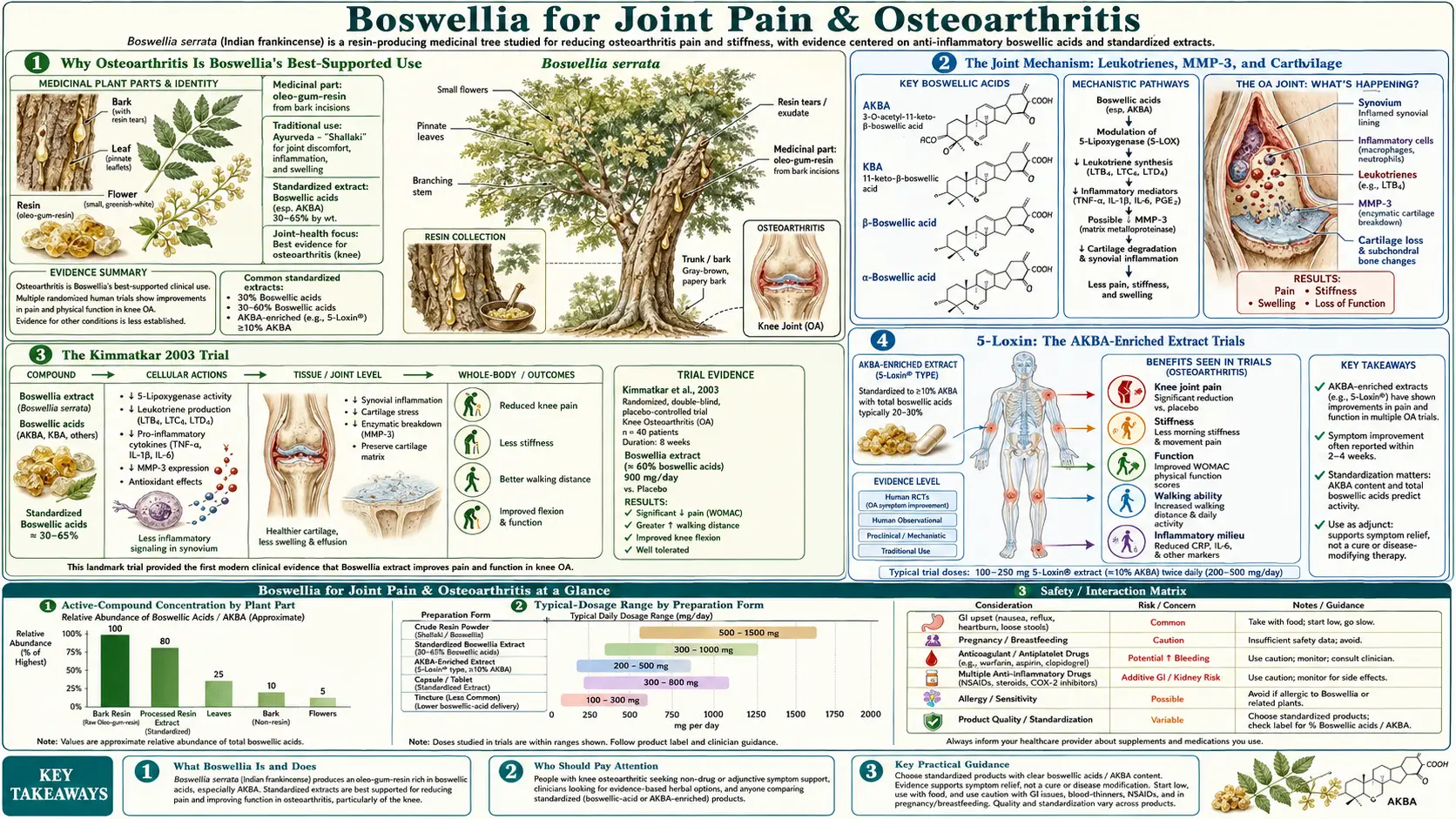
If Boswellia has one use where the human evidence is genuinely convincing, it is knee osteoarthritis. Several independent randomized, placebo-controlled trials — using standardized extracts such as 5-Loxin (enriched to 30% AKBA) and the faster-acting Aflapin — have reported meaningful reductions in pain and stiffness and improvements in physical function, sometimes within a week. A 2020 systematic review and meta-analysis pooling seven trials in 545 patients concluded that Boswellia may relieve pain and stiffness and improve joint function. This page walks through what each trial actually measured, how large the effect is, how it compares to NSAIDs and other joint supplements, and the honest limitations — small sample sizes, heterogeneous extracts, and frequent manufacturer sponsorship.
Table of Contents
- Why Osteoarthritis Is Boswellia's Best-Supported Use
- The Joint Mechanism: Leukotrienes, MMP-3, and Cartilage
- The Kimmatkar 2003 Trial
- 5-Loxin: The AKBA-Enriched Extract Trials
- Aflapin and AprèsFlex: Faster Onset
- The 2019 Pilot Trial and the 2020 Meta-Analysis
- How Boswellia Compares to NSAIDs and Other Supplements
- Dosing, Onset, and What to Realistically Expect
- Cautions and Limitations of the Evidence
- Key Research Papers
- External Resources
- Connections
- Featured Videos
Why Osteoarthritis Is Boswellia's Best-Supported Use
Osteoarthritis is often described as a simple wear-and-tear disease, but that picture is incomplete. Modern rheumatology recognizes a substantial inflammatory component: the synovium (the membrane lining the joint) becomes inflamed, inflammatory cells release enzymes that degrade cartilage, and pro-inflammatory signaling molecules amplify pain. This inflammatory dimension is exactly where a 5-lipoxygenase inhibitor like Boswellia has a plausible role, and it is why Boswellia has been tested more heavily in osteoarthritis than in almost any other condition.
The result is that osteoarthritis has accumulated the strongest clinical evidence base for Boswellia. Rather than one isolated study, there are multiple randomized, double-blind, placebo-controlled trials from different research groups, using several different standardized extracts, and a 2020 meta-analysis that pooled them. When several independent trials point the same direction, confidence rises — even if each individual trial is modest in size.
This does not mean Boswellia is a cure or that it reverses the underlying joint damage. What the evidence supports is symptomatic relief: less pain, less stiffness, better function. For a chronic condition where the mainstay drugs (NSAIDs) carry real long-term risks to the stomach, kidneys, and heart, a reasonably effective and well-tolerated botanical adjunct is worth taking seriously.
The Joint Mechanism: Leukotrienes, MMP-3, and Cartilage
The proposed mechanism in the joint follows directly from Boswellia's core pharmacology, covered in depth on the mechanism page. Acetyl-11-keto-β-boswellic acid (AKBA) inhibits 5-lipoxygenase, reducing the synthesis of leukotrienes such as leukotriene B4. Leukotriene B4 is a potent recruiter of neutrophils and a driver of inflammatory signaling within the inflamed synovium.
A particularly interesting finding comes from the 5-Loxin osteoarthritis trial, which reported a reduction in matrix metalloproteinase-3 (MMP-3) in the synovial fluid of treated patients. MMP-3 is one of the cartilage-degrading enzymes implicated in the structural progression of osteoarthritis. If Boswellia genuinely lowers MMP-3 activity in the joint, that raises the possibility of an effect beyond pure symptom relief — a potential influence on the degradative process itself. This remains a hypothesis rather than a proven disease-modifying effect; it has not been confirmed by long-term structural imaging trials, and it should be described as promising rather than established.
What the mechanism does clearly explain is why the side-effect profile differs from NSAIDs. Because Boswellia works mainly on the leukotriene arm rather than by blocking the COX enzymes that protect the stomach lining and kidney blood flow, it does not carry the same signature risk of gastric ulceration seen with chronic NSAID use.
The Kimmatkar 2003 Trial
One of the earliest rigorous trials was published by Kimmatkar and colleagues in Phytomedicine in 2003. It was a randomized, double-blind, placebo-controlled crossover study of a standardized Boswellia serrata extract in 30 patients with osteoarthritis of the knee. The crossover design is a useful feature: each patient received both Boswellia and placebo in sequence, so each person effectively served as their own control.
Patients taking the Boswellia extract reported a decrease in knee pain, an increase in knee flexion (range of motion), and an increase in walking distance, along with a reduced frequency of joint swelling. When patients were switched to placebo, the benefits regressed. The extract was well tolerated, with only minor gastrointestinal complaints.
The trial is small, and it was published in a specialty phytomedicine journal rather than a major rheumatology journal, so it should be weighted accordingly. But as the first well-designed placebo-controlled crossover study, it set the direction that later, better-standardized trials would confirm.
5-Loxin: The AKBA-Enriched Extract Trials
A significant advance came with 5-Loxin, a Boswellia extract deliberately enriched to contain 30% AKBA — concentrating the single most potent boswellic acid. Sengupta and colleagues published a double-blind, randomized, placebo-controlled trial of 5-Loxin in Arthritis Research & Therapy in 2008, enrolling 75 patients with knee osteoarthritis over 90 days at two dose levels (100 mg and 250 mg once daily).
Both doses produced statistically significant improvements in pain and physical-function scores compared with placebo. Notably, the 250 mg group showed measurable improvement as early as seven days — unusually fast for a botanical. The trial also reported the reduction in synovial-fluid MMP-3 discussed above. The extract was well tolerated across the study period.
Publication in Arthritis Research & Therapy, a peer-reviewed rheumatology journal, gave this trial more visibility and credibility than most earlier Boswellia studies. It is fair to note that the study was connected to the manufacturer of the standardized extract, which is common in supplement research and is a reason to seek independent replication — but the double-blind, placebo-controlled design and the objective synovial-fluid biomarker are meaningful strengths.
Aflapin and AprèsFlex: Faster Onset
Aflapin (marketed in some products as AprèsFlex) is a next-generation preparation that combines AKBA with the non-volatile oil of Boswellia to improve absorption — a response to the well-known bioavailability problem of boswellic acids. Two trials examined it:
- Sengupta 2010 (International Journal of Medical Sciences) directly compared 100 mg of 5-Loxin, 100 mg of Aflapin, and placebo in 60 knee-osteoarthritis patients over 90 days. Both active extracts significantly improved pain and function versus placebo, and Aflapin tended to work somewhat faster and to a somewhat greater degree at the same dose — consistent with its absorption-enhancing design.
- Vishal 2011 (International Journal of Medical Sciences) tested 100 mg of Aflapin against placebo in 60 patients over 30 days, and reported significant improvements in pain scores and functional ability as early as five days into treatment. The trial carried a clinical-trial registration number, a marker of methodological rigor.
The recurring theme — rapid onset within days — is one of the more distinctive features of the Boswellia osteoarthritis literature and separates it from supplements like glucosamine that typically require many weeks. As with the 5-Loxin study, these Aflapin trials were connected to the extract manufacturer, so independent confirmation strengthens the case.
The 2019 Pilot Trial and the 2020 Meta-Analysis
More recent work has continued to support the joint indication. A 2019 pilot randomized, double-blind, placebo-controlled trial by Majeed and colleagues in Phytotherapy Research tested a standardized Boswellia serrata extract in 48 knee-osteoarthritis patients over 120 days. The treatment group showed improvements in physical function with reduced pain and stiffness compared with placebo, and the authors reported changes in some imaging measures and inflammatory markers alongside a good safety profile. As a small pilot, its imaging findings should be considered exploratory rather than definitive.
The most useful single reference for a lay reader is the 2020 systematic review and meta-analysis by Yu and colleagues in BMC Complementary Medicine and Therapies, which pooled seven randomized controlled trials involving 545 patients. Its conclusion was measured and honest: Boswellia and its extracts may relieve pain and stiffness and improve joint function, with a suggested treatment duration of at least four weeks at doses of 100–250 mg. The authors also flagged the limitations of the underlying evidence — relatively small trials, variability in the extracts used, and methodological weaknesses in some studies — which is why they framed the benefit as probable rather than certain.
How Boswellia Compares to NSAIDs and Other Supplements
A common practical question is how Boswellia stacks up against the alternatives. Here honesty requires acknowledging what the trials do and do not show:
- Versus NSAIDs — most Boswellia trials compared it to placebo, not to a full dose of an NSAID, so there is limited direct head-to-head data proving equivalent pain relief. What can be said is that the symptomatic improvements are clinically meaningful and that Boswellia lacks the characteristic COX-1-related gastric and renal risks of long-term NSAID use. It is reasonable to view Boswellia as a gentler option for people who cannot tolerate NSAIDs, not as a proven equal in analgesic power.
- Versus glucosamine and chondroitin — Boswellia's trials tend to show faster onset (days to weeks) than glucosamine, whose evidence is contested and whose benefit, if any, appears slowly.
- Combined with curcumin — several products pair Boswellia with curcumin, and some small trials of the combination report benefit. The two act on overlapping but distinct inflammatory pathways, which is a reasonable rationale, though combination trials cannot separate which ingredient does the work.
- Alongside other botanicals — ginger and turmeric have their own osteoarthritis evidence and are frequently stacked with Boswellia in joint formulas.
Dosing, Onset, and What to Realistically Expect
Aligning with the trials, reasonable dosing looks like this:
- AKBA-enriched extracts (5-Loxin, Aflapin/AprèsFlex) — roughly 100–250 mg once daily, the range used in the positive trials.
- Broadly standardized Boswellia serrata extract — roughly 300–400 mg two to three times daily, standardized to a stated boswellic-acid percentage.
- Take with food — boswellic acids are fat-soluble, and absorption improves with a meal containing some fat.
- Give it a fair trial — while some patients in trials improved within a week, the meta-analysis suggests at least four weeks to judge the effect. If there is no benefit after six to eight weeks, it is unlikely to help.
Realistic expectations matter. Boswellia is a symptom-reliever for osteoarthritis, not a regenerative therapy. The honest goal is a noticeable reduction in day-to-day pain and stiffness and improved ability to walk and move — not a reversal of joint damage on X-ray.
Cautions and Limitations of the Evidence
- Trial size and sponsorship — the osteoarthritis trials are individually small (typically 30–75 patients) and several were connected to extract manufacturers. This does not invalidate them, but it widens the uncertainty and makes independent replication valuable.
- Extract heterogeneity — different studies used different extracts with different AKBA content, so results are not perfectly interchangeable across products. Choosing a named, studied extract with a stated AKBA percentage is the most evidence-aligned approach.
- Gastrointestinal side effects — usually mild (nausea, reflux, occasional diarrhea), but not absent.
- Medication interactions — discuss with a clinician if you take anticoagulants, immunosuppressants, or other anti-inflammatory drugs.
- Not a substitute for medical care — persistent or worsening joint pain deserves proper evaluation. Boswellia is best used as an adjunct within a broader plan that may include exercise, weight management, physical therapy, and clinician-directed medication.
Key Research Papers
- Kimmatkar N, Thawani V, Hingorani L, Khiyani R (2003). Efficacy and tolerability of Boswellia serrata extract in treatment of osteoarthritis of knee — a randomized double blind placebo controlled trial. Phytomedicine. — PubMed 12622457
- Sengupta K, Alluri KV, Satish AR, et al. (2008). A double blind, randomized, placebo controlled study of the efficacy and safety of 5-Loxin for treatment of osteoarthritis of the knee. Arthritis Research & Therapy. — PubMed 18667054
- Sengupta K, Krishnaraju AV, Vishal AA, et al. (2010). Comparative efficacy and tolerability of 5-Loxin and Aflapin against osteoarthritis of the knee. International Journal of Medical Sciences. — PubMed 21060724
- Vishal AA, Mishra A, Raychaudhuri SP (2011). A double blind, randomized, placebo controlled clinical study evaluates the early efficacy of Aflapin in subjects with osteoarthritis of knee. International Journal of Medical Sciences. — PubMed 22022214
- Majeed M, Majeed S, Narayanan NK, Nagabhushanam K (2019). A pilot, randomized, double-blind, placebo-controlled trial to assess the safety and efficacy of a novel Boswellia serrata extract in the management of osteoarthritis of the knee. Phytotherapy Research. — PubMed 30838706
- Yu G, Xiang W, Zhang T, et al. (2020). Effectiveness of Boswellia and Boswellia extract for osteoarthritis patients: a systematic review and meta-analysis. BMC Complementary Medicine and Therapies. — PubMed 32680575
- Safayhi H, Mack T, Sabieraj J, et al. (1992). Boswellic acids: novel, specific, nonredox inhibitors of 5-lipoxygenase. Journal of Pharmacology and Experimental Therapeutics. — PubMed 1602379
- Ammon HP (2006). Boswellic acids in chronic inflammatory diseases. Planta Medica. — PubMed 17024588
- Abdel-Tawab M, Werz O, Schubert-Zsilavecz M (2011). Boswellia serrata: an overall assessment of in vitro, preclinical, pharmacokinetic and clinical data. Clinical Pharmacokinetics. — PubMed 21553931
PubMed Topic Searches
- PubMed: Boswellia serrata osteoarthritis knee (randomized trials)
- PubMed: AKBA, MMP-3, and cartilage
- PubMed: Aflapin / 5-Loxin osteoarthritis
- PubMed: Boswellia + curcumin joint pain
- PubMed: Boswellia serrata arthritis meta-analyses
External Resources
- LiverTox (NIH) — Boswellia serrata
- MedlinePlus — Boswellia (Indian Frankincense)
- Arthritis Foundation — Supplements and Vitamins
- PubMed — Boswellia serrata osteoarthritis (all)
Connections
- All Herbs
- Boswellia Overview
- Boswellia Benefits Hub
- Boswellia Anti-Inflammatory Mechanism
- Boswellia for Inflammatory Bowel Disease
- Osteoarthritis
- Rheumatoid Arthritis
- Gout
- Orthopedics
- Turmeric for Joint Health
- Curcumin for Inflammation & Joints
- Ginger for Osteoarthritis
- Omega-3 Fatty Acids