Atractylodes (Bai Zhu): History and Traditional Use
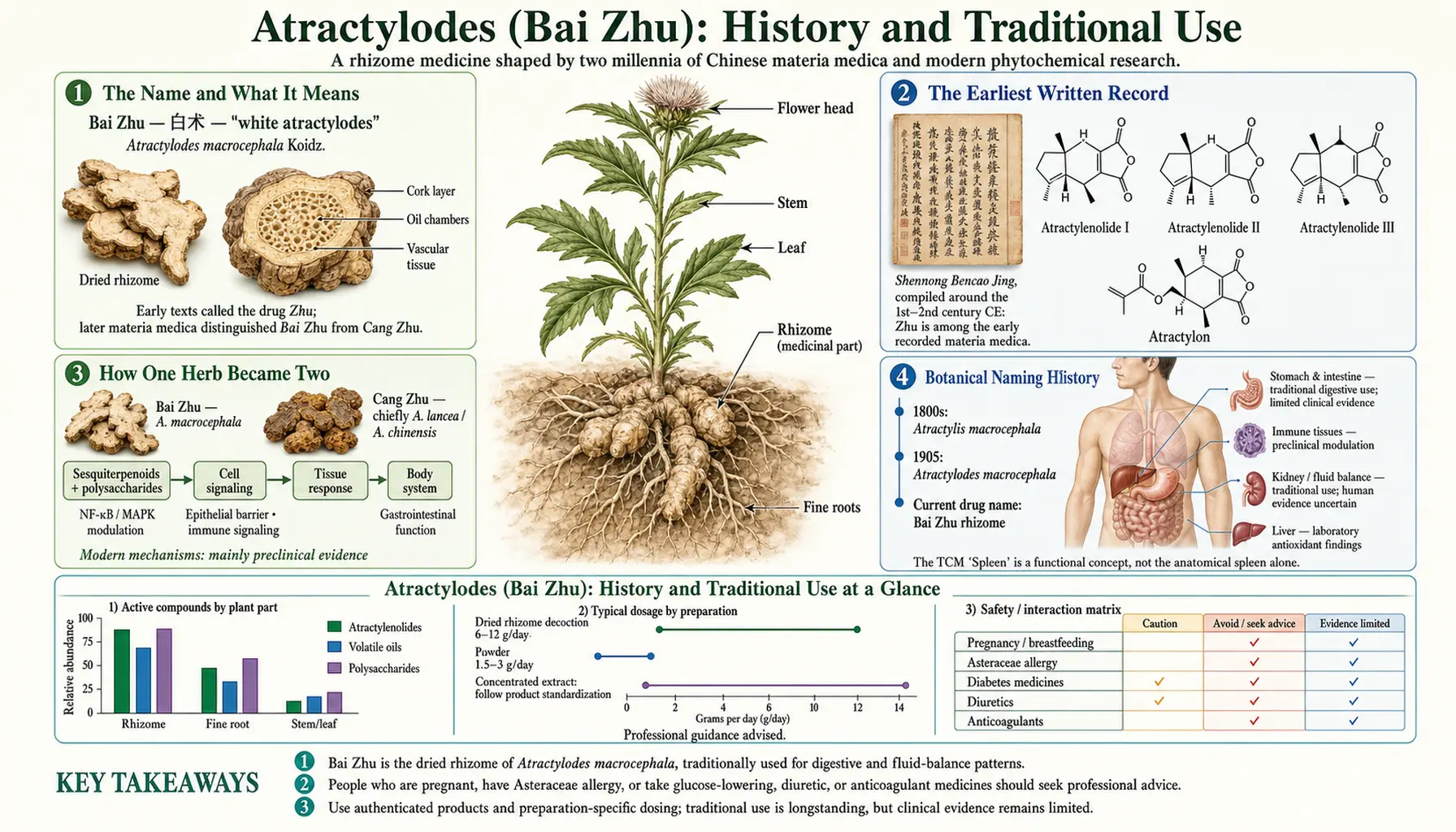
Bai zhu has one of the longest continuous documentary trails of any Chinese herb — roughly two thousand years from its first appearance in a Han-dynasty materia medica to its listing in the modern Chinese Pharmacopoeia. Along the way it acquired a second identity (the split into "white" and "grey" atractylodes), a botanical name given by a Japanese taxonomist, a regional monopoly in one Chinese province, and a set of frying techniques whose logic modern chemistry can actually explain.
This page tells that story, with dates where they are solid and honest hedging where they are not. Chinese medical bibliography is a serious scholarly field with genuine disputes about authorship and compilation dates, and we would rather flag an uncertainty than smooth it over.
Table of Contents
- The Name and What It Means
- The Earliest Written Record
- How One Herb Became Two
- Botanical Naming History
- The Formulas That Made Its Reputation
- Cultivation and the Zhejiang Trade
- Why the Frying Methods Exist
- Beyond China: Japan, Korea and Vietnam
- "Calming the Fetus" — A Tradition and Its Evidence Gap
- How It Entered Modern Research
- What Modern Science Confirmed — and What It Did Not
- Key Research Papers
- Connections
- Featured Videos
The Name and What It Means
The Chinese name is 白术, romanized bái zhú in modern pinyin. It is two characters and both are doing work.
白 (bái) means "white," and it is descriptive: the cut surface of the dried rhizome is pale, creamy, starchy-looking. It is white in the specific sense of "the pale one" — distinguishing it from its darker relative, which is exactly why the character was added.
术 (zhú) is the older and more interesting character. In the earliest medical texts it stands alone as the name of the herb, with no colour qualifier at all. In modern simplified Chinese the same graph 术 also carries an entirely unrelated meaning — "technique" or "art," as in 技术 (technology) or 武术 (martial arts) — because two historically distinct characters were merged during script simplification. In traditional characters the herb is written 白朮, with a different graph. It is a small piece of orthographic history that occasionally confuses machine translation, and it is why you sometimes see the herb rendered as "white technique" by software.
The name travelled with the herb across East Asia and is recognisable in each language:
- Chinese: bái zhú (白术 / 白朮)
- Japanese (Kampo): byakujutsu — the same two characters read with Sino-Japanese pronunciation
- Korean: baekchul (백출)
- Vietnamese: bạch truật — a Sino-Vietnamese reading of the identical pair
In pharmacy Latin it is Rhizoma Atractylodis Macrocephalae, or in the newer convention Atractylodis Macrocephalae Rhizoma. Both name the genus and the part; neither is ambiguous, which is more than can be said for the English "Atractylodes root" you find on supplement bottles.
The Earliest Written Record
The herb's first documented appearance is in the Shennong Bencao Jing (神农本草经), the Divine Farmer's Classic of Materia Medica — the foundational text of Chinese pharmacology. It is traditionally attributed to the legendary emperor Shennong, which is to say it has no known author; scholars generally place its compilation in the Han dynasty period, roughly between 200 BCE and 200 CE, assembled from older oral and written material. The original is lost, and the text as we have it was reconstructed from quotations preserved in later works.
In that text the herb is listed simply as 术 (zhu) — no "white," no "grey." It is placed in the upper class of the text's three-tier system, which is a meaningful classification: upper-class herbs were understood to be nourishing, suitable for long-term use, and non-toxic, in contrast with the middle class (therapeutic, use with care) and the lower class (potent, toxic, short-term use only). Two thousand years later, that upper-class placement still describes how the herb is used: a daily-use tonic, not a drug of last resort.
The indications attributed to it there are already recognisable — dispelling dampness, treating conditions of the digestive centre, and easing heaviness. From that point on it appears in essentially every major Chinese materia medica down to the present, including Tao Hongjing's commentaries of around 500 CE, the Tang-dynasty Xinxiu Bencao (659 CE, often described as the world's first state-sponsored pharmacopoeia), and Li Shizhen's monumental Bencao Gangmu, completed in 1578 and first printed posthumously in 1596, which remains the most famous work in the tradition.
How One Herb Became Two
The most consequential event in this herb's textual history is the moment it stopped being one herb. Early sources use the single name 术 for material that we now know came from more than one Atractylodes species. At some point Chinese physicians decided that the pale, sweeter, denser rhizome and the darker, fiercely aromatic one behaved differently enough to need separate names and separate indications.
The received account — and it is worth stating as a received account rather than a documented event — is that the distinction begins to appear in the commentarial literature attributed to Tao Hongjing around the turn of the sixth century CE, where the material is described as coming in more than one kind, and that the two names bai zhu (白术) and cang zhu (苍术) become standard usage during the Song dynasty (960–1279). Song-era materia medica works are routinely cited as the point at which the separation settles into mainstream practice, though some scholars put the full settling later still, in the Ming. Different sources name different texts for the decisive step — Tao Hongjing's Bencao Jing Jizhu of around 500, the Bencao Tujing of 1061, the Bencao Yanyi of 1116, the Ming Bencao Pin Hui Jing Yao of 1505 — and we are not going to pick a winner among them. It is worth adding that Tao Hongjing's book is itself lost but for its preface, and survives only through quotation in later works, which is precisely why his role here can be reported but not documented.
What the split fixed is a real difference, and it survives unchanged into modern pharmacopoeia:
- Bai zhu = Atractylodes macrocephala. Pale. Tonifying. Builds digestive function and mildly dries.
- Cang zhu = Atractylodes lancea or A. chinensis. Darker, far more aromatic. Strongly drying and dispersing, and explicitly not a tonic.
Traditional practice treats swapping one for the other as a real clinical error, not a rounding difference. The irony is that a distinction Chinese medicine took several centuries to establish and then guarded for a millennium is routinely erased on Western supplement labels that say only "Atractylodes." The main Atractylodes page covers how to tell which one you have actually bought.
Botanical Naming History
Western botany came to this plant much later than Chinese medicine did, and made a considerable mess of it on the way.
The genus Atractylodes was established by the Swiss botanist Augustin Pyramus de Candolle in the 1830s, in his great catalogue of the plant kingdom, the Prodromus Systematis Naturalis Regni Vegetabilis — hence the author abbreviation "DC." attached to the genus. The name derives from Greek roots referring to a spindle, describing the shape of parts of the flower head. Before that, and for some time after, material from this group was shuffled between Atractylis, Atractylodes and other Asteraceae genera by different authors working from incomplete herbarium specimens shipped from East Asia.
The result was a tangle of names, and one of them is still a live trap. Atractylis macrocephala and several other combinations were applied to bai zhu at various points and are unambiguous synonyms of it. Atractylodes ovata is not. The major taxonomic databases — NCBI, Kew and Catalogue of Life among them — now treat Atractylodes ovata (Thunb.) DC. as a synonym of A. lancea, which is to say cang zhu, the other herb entirely. Yet a good deal of twentieth-century pharmacology published under the name A. ovata plainly concerns pale, bai-zhu-type material, reporting atractylenolide III and atractylon from it, and Korean and Japanese sources have often used the same name for A. japonica, a third species again.
The practical rule follows from the mess rather than resolving it: do not infer the herb from the binomial in an older paper. Where it matters, check what the authors actually measured — the marker compounds separate the species far more reliably than the names on the title page do. Given that this page has just spent a section explaining that substituting one for the other is a real clinical error, it would be careless to tell you to read every A. ovata paper as a bai zhu paper. Some are. Some are not.
The accepted name today is Atractylodes macrocephala Koidz. The authority "Koidz." is Gen'ichi Koidzumi, a Japanese botanist who worked extensively on East Asian flora; the combination is generally dated to 1930. The specific epithet macrocephala is straightforward Greek — makros (large) plus kephale (head) — describing the flower head, which is conspicuously larger than that of A. lancea. Taxonomically the plant sits in the tribe Cardueae of the Asteraceae, the thistle group, which is why the flower head looks like a small thistle and why the family's characteristic sesquiterpene-lactone chemistry shows up in the rhizome.
One historical footnote worth keeping: the fact that a Japanese botanist named the species is not incidental. Japan had by the early twentieth century a large, well-funded programme in the botany and chemistry of Kampo medicinal plants, and much of the early modern scientific work on Atractylodes — including the first isolation of its aromatic constituents — was Japanese.
The Formulas That Made Its Reputation
Bai zhu is famous less for what it does alone than for the company it keeps. It is a structural herb — the one that holds a formula's digestive foundation together while other herbs do the specialised work. These are the formulas that carried its reputation.
Ling Gui Zhu Gan Tang (苓桂术甘汤) is among the oldest. It appears in the works of Zhang Zhongjing, the physician whose Shanghan Zabing Lun — later transmitted as the Shang Han Lun and the Jin Gui Yao Lue — was compiled around 200–220 CE at the end of the Han dynasty. The formula pairs bai zhu with poria, cinnamon twig and licorice for what the text describes as fluid accumulating in the middle of the body, with dizziness and palpitations. It is a four-herb formula that has been in continuous use for roughly eighteen centuries.
Si Jun Zi Tang (四君子汤), the Four Gentlemen Decoction, is the archetypal qi tonic and the formula most students learn first. It is four herbs: ginseng (or, far more commonly today, codonopsis), bai zhu, poria, and licorice. It is recorded in the Taiping Huimin Heji Ju Fang, the great Song imperial pharmacy formulary compiled from the early twelfth century and expanded over subsequent decades — one of the first state-issued standardised formularies anywhere. The "four gentlemen" name reflects the idea of four mild, well-behaved herbs working in balance. Nearly every later digestive tonic in the tradition is a modification of this base, which is a large part of why bai zhu appears in so many formulas.
Shen Ling Bai Zhu San (参苓白术散), also from the Song formulary tradition, expands Four Gentlemen with lotus seed, coix, Chinese yam, cardamom and other ingredients for chronic loose stools and poor appetite. It is the bai zhu formula most often tested in modern clinical trials.
Bu Zhong Yi Qi Tang (补中益气汤) — "Tonify the Middle and Augment the Qi" — comes from Li Gao (Li Dongyuan), whose Pi Wei Lun (Treatise on the Spleen and Stomach) was completed in 1249. The formula also appears in his earlier Nei Wai Shang Bian Huo Lun of 1247, which formula scholarship generally treats as its first record; the Pi Wei Lun is simply the book it became famous through. Neither was printed in his lifetime — he died in 1251 and his students collated the rest. Li Gao founded the school of thought that treated digestive function as the root of general vitality, and bai zhu with astragalus sits at the centre of his signature formula. It is used for fatigue with poor digestion and, classically, for sensations of downward sagging.
Yu Ping Feng San (玉屏风散), the Jade Windscreen Powder, is only three herbs — astragalus, bai zhu and siler — and is the classic prescription for someone who sweats spontaneously and catches every passing cold. The name is a beautiful piece of imagery: a folding screen of jade set between the person and the wind. Its textual origin is genuinely disputed, and the dispute is wider than it is usually presented. The formula is most often attributed to Yuan-dynasty sources of the thirteenth to fourteenth century, with the Danxi tradition and Wei Yilin's Shi Yi De Xiao Fang (1337) both frequently named; textual scholars have also traced it to the Southern Song Jiu Yuan Fang, a lost work surviving only in quotation, which would push it back a century or more. Three sources, three origins. The attribution is not secure and we will not pretend otherwise.
The pattern across all five is the same: bai zhu is never the star. It is the herb that steadies the digestive foundation so the rest of the formula can act — which is also why isolating its individual contribution in a modern trial is so difficult.
Cultivation and the Zhejiang Trade
Bai zhu is unusual among classical Chinese herbs in having been a cultivated crop for centuries rather than a wild-gathered one. Demand from the formula trade was simply too large for wild collection to supply, and the plant took reasonably well to field cultivation.
The centre of that trade is Zhejiang Province, on China's east coast. Zhejiang is the home of a group of herbs marketed collectively as the Zhe ba wei — the "eight flavours of Zhejiang," a regional brand of long standing — and bai zhu is one of them. Within Zhejiang, rhizomes from the Yuqian area have historically commanded the highest prices, sold under the trade name "Yu Zhu" (于术). Anhui, Hunan, Hubei and Jiangxi are the other major producing provinces, and today the largest volumes do not necessarily come from Zhejiang at all.
This is an example of daodi (道地) — the Chinese pharmacy doctrine that a herb from its authentic historical region is superior to the same species grown elsewhere. It is the same idea as terroir in wine, and like terroir it mixes real environmental chemistry with real marketing. Soil, altitude, climate and cultivation practice genuinely do affect secondary-metabolite content in medicinal plants. Whether the difference between Yuqian bai zhu and Anhui bai zhu is large enough to change a clinical outcome has never been demonstrated, and the price premium has always run well ahead of the evidence.
The traditional cultivation cycle is worth knowing because it explains the product. Plants are grown for two to three years before harvest, lifted in late autumn or early winter once the aerial parts have died back and the rhizome has stored maximum reserves. Younger rhizomes are smaller and traditionally considered weaker. After lifting, the rhizomes are cleaned, the fibrous roots trimmed, and the material dried — historically by sun-drying or slow smoke-drying, now more often in heated drying rooms. Only then is it sliced and, in most cases, processed by frying.
Why the Frying Methods Exist
Chinese pharmacy has an entire technical discipline devoted to preparing raw plant material, called paozhi (炮制). For most herbs, the modern explanation of paozhi is speculative. For bai zhu it is unusually well-grounded, because the traditional logic maps cleanly onto a measurable chemical change.
Bai zhu's chemistry has two halves. The aromatic volatile-oil fraction — atractylon, the atractylenolides, β-eudesmol — is the part associated in traditional theory with moving, drying and dispersing. The bulk of the rhizome is starch and polysaccharide, associated with building and nourishing. Heat drives off volatile oil. So the more the rhizome is fried, the less of the "moving" fraction remains and the more the preparation shifts toward the "building" one.
That is precisely what the classical indications say, arrived at centuries before anyone could run a gas chromatograph:
- Raw (生白术) — nothing but slicing and drying. The most draining and diuretic form; also the form traditionally chosen, at higher doses, for constipation from sluggish transit.
- Dry-fried (炒白术) — stir-fried in a dry wok until faintly coloured. Milder, more tonifying. The everyday form.
- Bran-fried (麸炒白术) — fried with wheat bran, which was held to buffer the herb's harshness. The gentlest on the stomach.
- Charred (焦白术) — fried until scorched. The most astringent, least draining form, used traditionally for diarrhea.
- Earth-fried (土炒白术) — fried with a prepared ochre earth, also for loose stools.
Two honest caveats. First, the chemical direction is well documented, but no clinical trial has compared these preparations head to head in humans — the differentiation is traditional pharmacology with a plausible chemical rationale, not proven clinical differentiation. Second, this entire body of craft knowledge is invisible in most Western retail products, which do not state which preparation is in the bottle.
Beyond China: Japan, Korea and Vietnam
Chinese medical texts travelled through East Asia along with Buddhism, writing and administrative practice, and bai zhu travelled with them.
Japan. Chinese formulas reached Japan by the medieval period and developed into Kampo (漢方), a distinct tradition with its own formula selection and its own dosing conventions — generally lighter than Chinese practice. Bai zhu is byakujutsu; cang zhu is sojutsu. A quirk worth knowing if you read Kampo literature: some Kampo schools substitute sojutsu where a Chinese source specifies byakujutsu, or treat the two as more interchangeable than Chinese practice does, so a Kampo formula and its Chinese namesake are not always chemically identical. Japan is also, as noted above, where much of the early modern chemistry on the genus was done, and Kampo formulas are covered by the Japanese national health insurance system, which is why Japanese clinical data on some of these formulas exists at all.
Korea. Bai zhu is baekchul and appears throughout traditional Korean medicine. It is included in the Dongui Bogam, the encyclopaedic Korean medical compilation completed by Heo Jun in 1610 and first printed in 1613, which was inscribed on UNESCO's Memory of the World register in 2009.
Vietnam. The herb is bạch truật, part of the thuốc bắc ("northern medicine") tradition — the Chinese-derived stream of Vietnamese herbalism, distinguished from thuốc nam, the indigenous southern tradition using local plants. Vietnam historically imported bai zhu from China and has also cultivated it in the cooler northern highlands, where the climate suits a temperate perennial that does poorly in lowland heat.
"Calming the Fetus" — A Tradition and Its Evidence Gap
Among bai zhu's four classical functions, the one that most needs careful handling is an tai (安胎), usually translated "calms the fetus" or "quiets the fetus." It refers to a traditional obstetric use: bai zhu appears in classical formulas given during pregnancy for restlessness, nausea, and threatened miscarriage, on the reasoning that a well-nourished digestive centre supports the pregnancy.
The tradition is genuine, old, and widely documented across the classical literature. It would be easy to describe it warmly and move on. We are not going to, because doing so would leave a reader with a false impression of safety.
There is no reliable modern human safety data for bai zhu in pregnancy. No controlled studies of pregnancy outcomes. No teratogenicity data adequate to support a recommendation. No established safe dose. What exists is centuries of traditional use, which is weak, indirect evidence: it suggests that obvious, immediate, catastrophic harm would probably have been noticed and recorded, and it establishes nothing about the outcomes modern obstetrics actually measures — birth defects, growth restriction, preterm birth, subtle developmental effects. Historical populations were not followed for those outcomes because nobody was measuring them.
There is a second problem specific to this indication. "Threatened miscarriage" in the classical literature covers a range of situations, most of which have identifiable modern causes and some of which are obstetric emergencies. Treating early-pregnancy bleeding or pain with a herbal formula rather than an assessment is a serious mistake regardless of what any text says.
Reporting a tradition is not the same as endorsing it. If you are pregnant, trying to conceive, or breastfeeding, this is a decision for your obstetric provider, informed by the fact that the safety data does not exist rather than by the fact that the tradition does.
How It Entered Modern Research
The scientific study of bai zhu proceeded in three fairly distinct waves.
The chemistry wave (early-to-mid twentieth century). Japanese and later Chinese natural-product chemists set about isolating and characterising the aromatic constituents of the Atractylodes genus. Atractylon and related sesquiterpenes were identified, and the structural work that eventually produced the atractylenolides was carried out over subsequent decades. This was straightforward, classical phytochemistry: extract, separate, crystallise, determine structure.
The pharmacology wave (1970s–1990s). With named compounds in hand, laboratories began testing them in animal and tissue models — gastrointestinal motility, gastric-lining protection, diuresis, liver protection. Some of this work was published under the name Atractylodes ovata, so searching only the modern name will miss it — but see the naming section above before assuming which species any such paper actually used. In parallel, work on the polysaccharide fraction began, driven partly by the broader interest in immunomodulating plant and fungal polysaccharides that also produced the research literature on medicinal mushrooms.
The molecular wave (2000s onward). Cell-signalling tools made it possible to ask how a compound acted rather than only whether. Atractylenolide I became a favourite subject in macrophage immunology — NF-κB, TLR4, inflammatory cytokines — and from there spread into tumour-immunology laboratories studying tumour-associated macrophages. Simultaneously, Chinese agricultural science took up the polysaccharides as feed additives for gut health in poultry and pigs, which is why a surprising share of the intestinal-barrier literature on this herb is veterinary.
Two institutional facts shaped the modern record. The herb is monographed in the Chinese Pharmacopoeia, which fixes its identity, quality standards and dose range and gives researchers a defined material to work with. And China's substantial state investment in traditional-medicine research from the late twentieth century onward means the volume of publication on bai zhu is large — while the proportion of that volume that is randomized, placebo-controlled human work on the single herb remains close to zero.
What Modern Science Confirmed — and What It Did Not
Set the traditional claims beside the modern evidence and a clear pattern appears: the mechanisms are often plausible and sometimes well supported in the laboratory, while the clinical outcomes are almost entirely untested.
| Traditional claim | Status of the modern evidence |
|---|---|
| Strengthens digestion ("tonifies the spleen") | Partly supported, preclinically. Animal data on motility and gastric-lining protection is consistent. Human data exists only for multi-herb formulas, so it cannot be attributed to this herb. |
| Promotes urination, resolves dampness | Mechanism plausible, outcome untested. Rodent diuresis and aquaporin findings exist. No human trial has measured edema as an outcome. |
| Reduces inflammation | Strong cell-culture evidence, no human evidence. Atractylenolides reliably damp macrophage inflammatory signalling in vitro. Nobody has measured inflammatory markers in people taking it. |
| Protects and strengthens the digestive lining | Animal and poultry data only. Polysaccharide effects on tight-junction proteins are consistent across models — all non-human. |
| Stops spontaneous sweating, prevents colds | Not established. Formula-level studies of Yu Ping Feng San are mixed and generally low quality. No single-herb evidence. |
| Calms a restless fetus | No modern safety or efficacy data at all. See the section above. |
| Raw vs. fried preparations differ | Chemically confirmed, clinically untested. Volatile-oil content really does fall with frying. No head-to-head human comparison exists. |
| Bai zhu and cang zhu are different herbs | Fully confirmed. Different species, different marker compounds, different pharmacology. The classical distinction was correct. |
One further caution that belongs on a history page. A large modern laboratory literature has grown up around atractylenolide I in cancer cell lines and mouse tumour models, and some sellers now present it as though bai zhu were an anticancer agent. It is not. That work is preclinical, the doses and delivery bear no relationship to swallowing a decoction, and the overwhelming majority of compounds that look promising in mouse tumour models fail in humans. The main page goes through why in detail.
The fair summary of two thousand years is this: Chinese physicians identified a plant with real chemistry, correctly separated it from its more aggressive cousin, developed processing methods whose logic modern analysis vindicates, and built it into formulas that are still in daily clinical use across East Asia. What they did not do — and what the modern research community has still not done — is run the trials that would tell you whether the herb, by itself, changes an outcome you can measure in a person.
Key Research Papers
Where a specific paper is named, the link goes to its verified PubMed record — the identifier was checked against the live index so that the authors, title, journal and year all match. Where the entry points at a body of work rather than a single study, the link runs a PubMed search instead, so it stays current and cannot point at the wrong paper.
- The standard modern review. Zhu B, Zhang QL, Hua JW, Cheng WL, Qin LP. The traditional uses, phytochemistry, and pharmacology of Atractylodes macrocephala Koidz.: A review. Journal of Ethnopharmacology. 2018;226:143–167. Covers the traditional indications alongside the chemistry and pharmacology — the best single entry point for the history-to-science bridge.
- Ethnopharmacology and classical indications. Reviews connecting the classical materia medica record for Atractylodes to modern pharmacological findings. Browse this literature on PubMed.
- Distinguishing bai zhu from cang zhu analytically. Chemical-fingerprint and marker-compound work separating A. macrocephala from A. lancea and A. chinensis. Browse this literature on PubMed. The modern confirmation of a classical distinction.
- Processing chemistry (paozhi). Analytical comparisons of raw, dry-fried and bran-fried bai zhu, including volatile-oil and atractylenolide content. Browse this literature on PubMed.
- Daodi and regional variation. Studies of how growing region and cultivation affect the chemistry of Chinese medicinal materials, including atractylodes. Browse this literature on PubMed.
- Atractylenolide anti-inflammatory mechanism. Li CQ, He LC, Jin JQ. Atractylenolide I and atractylenolide III inhibit lipopolysaccharide-induced TNF-α and NO production in macrophages. Phytotherapy Research. 2007;21(4):347–353. Cell culture only.
- Shen Ling Bai Zhu San clinical literature. The formula-level human studies, mostly Chinese, mostly small. Browse this literature on PubMed. Read them with the formula-versus-herb problem in mind.
- Yu Ping Feng San and infection prevention. Trials and reviews of the Jade Windscreen formula for respiratory infection. Browse this literature on PubMed. Mixed results, generally low methodological quality.
- Kampo and the byakujutsu/sojutsu question. Japanese literature on formula composition and species selection within Kampo. Browse this literature on PubMed.
Live PubMed Searches
- Atractylodes macrocephala — everything
- Atractylodes ovata — an ambiguous older name; check the species before citing
- Bai zhu in traditional Chinese medicine
- Cang zhu (Atractylodes lancea)
- Si Jun Zi Tang — Four Gentlemen Decoction
- Bu Zhong Yi Qi Tang
- Ling Gui Zhu Gan Tang
- Atractylon and the sesquiterpene chemistry
- Pharmacopoeial standards for the rhizome
- Herbal medicine safety in pregnancy — the wider evidence gap
Connections
- All Herbs
- Atractylodes (Bai Zhu) — main research page
- Atractylodes Benefits — hub
- Digestion and Spleen Qi
- Fluid Balance and Edema
- Immune and Inflammation
- Gut Barrier and Microbiome
- Codonopsis (Dang Shen) — a Four Gentlemen partner
- Poria (Fu Ling) — paired with bai zhu since the Han dynasty
- Licorice — the harmonizing fourth gentleman
- Astragalus — the Jade Windscreen partner
- White Peony — frequent classical formula partner
- Ginger — the other great warming digestive herb
- SIBO — a modern diagnosis behind old digestive complaints