Atractylodes (Bai Zhu) Benefits
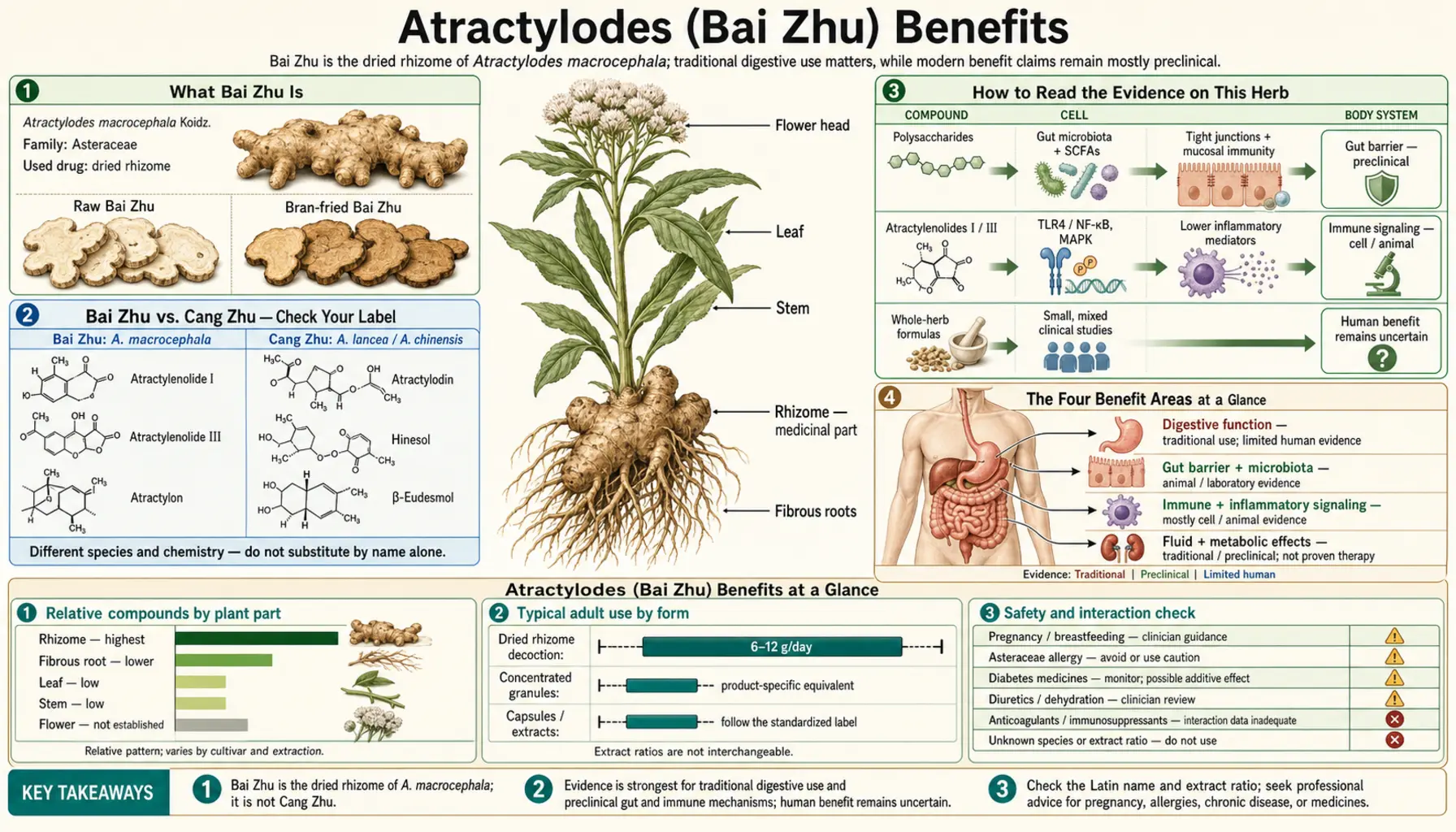
Atractylodes — Atractylodes macrocephala Koidz., known in Chinese medicine as bai zhu (白术, “white atractylodes”) and in Vietnamese as bạch truật — is one of the most heavily prescribed herbs in the entire East Asian materia medica. The part used is the dried rhizome, Rhizoma Atractylodis Macrocephalae, harvested from cultivated plants that are usually two to three years old; Zhejiang province is the classic production region. It sits at the centre of the formulas a traditional practitioner reaches for when someone has a poor appetite, bloats after eating, passes loose stools, and feels heavy and tired after meals.
Read this before anything else on these pages. Human clinical evidence for bai zhu as a single herb is very limited. Nearly everything published is cell-culture work, rodent work, or trials of multi-herb formulas in which this one plant’s individual contribution cannot be separated out. That is not a reason to dismiss it — two thousand years of continuous clinical use is a serious signal — but it is a reason to be honest about what we know. Where a claim rests on mice, these pages say “mice.” Where the best evidence is a small trial of a six-herb decoction, they say that too.
Digestion and Spleen Qi
What “Spleen qi deficiency” actually describes in recognisable symptoms, why the TCM Spleen is not the anatomical organ, and how frying the rhizome changes what it does.
Fluid Balance and Edema
The “drains dampness” claim, what the rodent diuretic data really shows, why swelling always needs a cause identified first, and the additive risk with prescription diuretics.
Immune and Inflammation
Atractylenolide I and macrophage signalling, the Jade Windscreen tradition and its small respiratory-infection trials, and why the cancer cell-line literature must not be read as treatment.
Gut Barrier and Microbiome
The AMP and PAMK polysaccharide work on tight-junction proteins and mucin in rodents, prebiotic framing, and the poor translation record of animal gut-barrier findings.
Table of Contents
- What Bai Zhu Is
- Bai Zhu vs. Cang Zhu — Check Your Label
- How to Read the Evidence on This Herb
- The Four Benefit Areas at a Glance
- Active Compounds
- Processing: Raw, Bran-Fried, Charred
- The Classical Formulas
- Forms, Dose, and Label Checks
- Cautions and Contraindications
- Key Research Papers
- External Resources
- Connections
- Featured Videos
What Bai Zhu Is
Atractylodes macrocephala Koidz. is a perennial in the daisy family, Asteraceae — the same family as sunflowers, chamomile, ragweed, marigold and chrysanthemum. That family membership matters for one practical reason, and we will return to it in the Cautions section: if you react to those plants, you may react to this one.
The medicinal part is the underground rhizome — a thickened, knobbly stem that grows horizontally, not a true root. Commercial material comes from cultivated fields rather than wild collection, and the plants are typically lifted in their second or third autumn. Younger rhizomes are small and thin; older ones accumulate more of the volatile oil and starch that give the drug its character. After lifting, the rhizomes are cleaned, the fibrous rootlets trimmed, and the material dried — traditionally in the sun or over gentle fire — then sliced crosswise into the pale, faintly aromatic discs you see in a dispensary drawer.
The classic production area is Zhejiang province in eastern China, and dispensary material from there is sometimes sold at a premium as yu zhu or “Zhejiang bai zhu.” Whether growing region measurably changes the chemistry is an open question; what is documented is that volatile-oil content varies substantially with cultivar, age at harvest, drying method and storage time.
Bai Zhu vs. Cang Zhu — Check Your Label
This is the single most useful thing a Western reader can learn about this herb, and Western labels almost never explain it.
There are two different medicinal atractylodes, and they are not interchangeable:
- Bai zhu (白术, “white atractylodes”) is Atractylodes macrocephala. It is described as sweet, bitter and warm, and its traditional job is to tonify — to strengthen a weak digestion while gently moving fluid. It is the herb in the Four Gentlemen decoction and in Jade Windscreen powder.
- Cang zhu (苍术, “grey” or “black atractylodes”) is Atractylodes lancea or Atractylodes chinensis. It is markedly more aromatic and more strongly drying. Its traditional job is to dry dampness and disperse, not to tonify. It is chosen when a practitioner wants a stronger, more dispersing action and is not trying to build up a depleted patient.
A bottle labelled simply “Atractylodes” — which is most of what is sold in Western shops — could be either. To find out, look on the label for the binomial: you want Atractylodes macrocephala for bai zhu. If the label says A. lancea, A. chinensis, or gives no species at all, you do not have bai zhu, and the traditional indications described on these pages do not apply. Reputable suppliers print the species and the plant part (“rhizome”). If a supplier will not tell you the species, that is your answer about the supplier.
How to Read the Evidence on This Herb
Search PubMed for “Atractylodes macrocephala” and you will get well over a thousand records. It looks like a deeply studied plant. It is not — not in the way that word usually means. Sort those records by study type and the picture changes:
- Cell culture. The largest single block. Isolated compounds — usually atractylenolide I — applied to macrophage lines, cancer lines, or intestinal epithelial lines, at concentrations that a person swallowing a decoction is very unlikely to achieve in the relevant tissue. These studies generate hypotheses. They are not evidence that anything happens in a human being.
- Rodent and poultry models. The second largest block, and the source of most of the diuretic, gut-barrier and immune claims. Mice, rats, and — strikingly often — geese and broiler chickens, because agricultural feed additives are a real commercial application of the polysaccharide fraction. Useful for mechanism. Not efficacy data for humans.
- Multi-herb clinical trials. Where human data exists at all, bai zhu is almost always one ingredient among six to twelve. A positive result for Shen Ling Bai Zhu San tells you something about that formula. It tells you nothing quantifiable about bai zhu on its own, because the design cannot separate them.
- Single-herb human trials. Vanishingly rare, generally small, and generally not registered, blinded or replicated to the standard that would let you act on them confidently.
So the honest summary is: a strong, coherent traditional indication; a plausible and reasonably well-mapped set of mechanisms in animals and cells; and almost no direct human efficacy data for the isolated herb. Every sub-article on this site repeats that framing where it applies, because it is the thing most easily lost when a herb gets marketed.
The Four Benefit Areas at a Glance
| Area | Traditional claim | Strongest available evidence | Honest verdict |
|---|---|---|---|
| Digestion and appetite | Tonifies Spleen qi; restores appetite, firms loose stools | Rodent gastric-emptying and motility work; multi-herb trials of Si Jun Zi Tang and Shen Ling Bai Zhu San | The best-supported traditional use, but no single-herb human trial establishes it |
| Fluid balance | Drains dampness; reduces oedema | Rodent urine-output studies, inconsistent in direction and magnitude | Weak and inconsistent; never a substitute for finding the cause of swelling |
| Immune modulation | Stabilises the exterior; fewer recurrent colds | Atractylenolide I macrophage signalling; small, mostly Chinese-language trials of Yu Ping Feng San | Formula-level signal only; single-herb effect unquantified |
| Gut barrier | — (a modern reframing, not a classical claim) | Polysaccharide fractions raising tight-junction proteins and mucin in mice and poultry | Preclinical only; this class of finding has a poor record of translating to humans |
Active Compounds
Two chemically unrelated groups do most of the work in the research literature, and they behave very differently.
Sesquiterpene lactones. The signature compounds are the atractylenolides — atractylenolide I, II and III — along with atractylon and β-eudesmol. These are lipophilic, live in the volatile-oil fraction, and are what a chemist uses to authenticate the drug. Atractylenolide I is the main modern research target: it is the compound most often applied to macrophages in inflammation studies and the one behind most of the signalling papers. Because these compounds are volatile, they are the fraction that heat processing depletes — which is the pharmacognostic basis for the traditional distinction between raw and fried bai zhu.
Polysaccharides. The water-soluble fraction, usually abbreviated AMP (Atractylodes macrocephala polysaccharide) or PAMK in the agricultural literature. These are large sugar polymers, not absorbed intact, and they are the fraction behind essentially all of the immune and intestinal-barrier work. Their proposed mode of action is local: interaction with gut immune tissue and with the microbiota, rather than systemic distribution of a drug-like molecule.
The practical consequence: a water decoction and an ethanol tincture do not contain the same medicine. Decoction favours the polysaccharides; alcohol extraction favours the lactones and volatile oil. Traditional practice is overwhelmingly decoction.
Processing: Raw, Bran-Fried, Charred
Chinese pharmacy has always insisted that how you prepare bai zhu changes what it does. This is one of the cases where the traditional claim maps cleanly onto measurable chemistry — volatile-oil content falls with frying, and the volatile oil is where the lactones live.
- Raw (生白术, sheng bai zhu). Highest volatile-oil content. Traditionally the more diuretic, more damp-draining form — chosen when fluid retention is the target.
- Dry-fried or bran-fried (炒白术, chao bai zhu). The rhizome slices are stir-fried in a dry wok, often with wheat bran, until the surface turns golden. Volatile-oil content drops; the drug is regarded as milder, less drying, and more focused on tonifying digestion. This is the default form in most digestive formulas.
- Charred (焚白术, jiao bai zhu). Fried until the surface is scorched. Traditionally reserved for diarrhoea, on the general principle that charring makes a herb more astringent and stopping.
Western supplements almost never specify which form they used. If a product does say “dry-fried” or “stir-fried,” that is a sign the manufacturer is following traditional processing rather than simply milling raw rhizome.
The Classical Formulas
Bai zhu is rarely used alone. Knowing the formulas it lives in tells you more about how practitioners actually use it than any single-herb description:
- Si Jun Zi Tang (Four Gentlemen Decoction) — ginseng or codonopsis, bai zhu, poria, licorice. The base formula for a weak digestion; nearly every other qi-tonifying formula is built on it.
- Bu Zhong Yi Qi Tang (Tonify the Middle and Augment Qi) — adds astragalus and lifting herbs; used for fatigue with a sense of downward heaviness.
- Shen Ling Bai Zhu San — Four Gentlemen plus food-grade ingredients such as lotus seed, coix and cardamom; the classical choice for chronic loose stools with poor appetite.
- Yu Ping Feng San (Jade Windscreen Powder) — astragalus, bai zhu and siler; the “stabilise the exterior” formula given for people who catch every cold going around.
- Ling Gui Zhu Gan Tang — poria, cinnamon twig, bai zhu, licorice; the classical fluid-metabolism formula.
The typical decoction dose of bai zhu within these formulas is 6–12 g of dried rhizome per day, simmered with the other ingredients.
Forms, Dose, and Label Checks
Dried sliced rhizome for decoction is the traditional and best-documented form; 6–12 g/day is the standard range, at the lower end for long-term tonifying use. Granules (spray-dried concentrated decoction) are the practical modern equivalent and are dosed per the manufacturer’s stated concentration ratio. Capsules of milled raw powder deliver far less material than a decoction — a 500 mg capsule is a fraction of a traditional dose — and should not be assumed equivalent. Tinctures extract a different compound profile than water and have essentially no traditional precedent for this herb.
Four things to check on any label: (1) the binomial — Atractylodes macrocephala, not lancea; (2) the plant part — rhizome; (3) whether processing is stated; (4) whether the product is a single herb or a formula, since many products sold as “Atractylodes” are actually Four Gentlemen or Jade Windscreen blends.
Cautions and Contraindications
- Diuretics. Bai zhu is traditionally used to move fluid, and rodent data — inconsistent as it is — points the same way. Taken alongside furosemide, hydrochlorothiazide, spironolactone or any other prescription diuretic, the theoretical effect is additive: more fluid loss, and potential shifts in sodium and potassium. This is the interaction to take most seriously.
- Pregnancy. Classical texts list bai zhu as an herb that “calms the fetus,” and it appears in traditional pregnancy formulas. There is no reliable human safety data supporting that use. Absence of a documented harm signal in centuries of use is genuinely reassuring, but it is not the same as a safety study, and no adequate one exists. That gap should be stated, not papered over with tradition. Do not self-prescribe in pregnancy.
- Asteraceae allergy. If you react to ragweed, chrysanthemum, chamomile, marigold, echinacea or feverfew, treat atractylodes as a plausible cross-reactor and approach it cautiously or not at all.
- Autoimmune disease and immunosuppressant drugs. The polysaccharide fraction is studied specifically for immune stimulation. If you take tacrolimus, ciclosporin, azathioprine, methotrexate or a biologic, that is a theoretical conflict worth raising with your prescriber before starting.
- Traditional contraindication. Practitioners avoid bai zhu in patterns described as yin deficiency with heat — dryness, thirst, night sweats — on the grounds that a warm, drying herb makes those worse.
- Undiagnosed symptoms. Unexplained swelling, persistent diarrhoea, unintentional weight loss or blood in the stool need a diagnosis first. A digestive tonic is not a substitute for finding out why.
Key Research Papers
Every link below resolves to a live PubMed record set for the paper or topic named, rather than to a hand-typed identifier. Author, title and journal are given in plain text so you can verify each one independently.
Reviews and Phytochemistry
- Zhu B, Zhang QL, Hua JW, Cheng WL, Qin LP. The traditional uses, phytochemistry, and pharmacology of Atractylodes macrocephala Koidz.: a review. Journal of Ethnopharmacology. 2018;226:143–167.
- Reviews of the chemical constituents and quality markers of Rhizoma Atractylodis Macrocephalae, including atractylenolide profiling. PubMed record set.
- Comparative phytochemistry of Atractylodes macrocephala and Atractylodes lancea (bai zhu vs. cang zhu). PubMed record set.
Digestion and Gastrointestinal Motility
- Studies of Atractylodes macrocephala extracts on gastric emptying and small-intestinal transit in rodents. PubMed record set.
- Clinical and mechanistic literature on Si Jun Zi Tang (Four Gentlemen Decoction) in functional gastrointestinal disorders. PubMed record set.
- Trials and reviews of Shen Ling Bai Zhu San for chronic diarrhoea and Spleen-deficiency patterns. PubMed record set.
Immune Modulation and Inflammation
- Atractylenolide I and macrophage activation, TLR4 signalling and NF-κB modulation. PubMed record set.
- Systematic reviews of Yu Ping Feng San (Jade Windscreen Powder) for recurrent respiratory tract infection. PubMed record set.
- Immunomodulatory activity of Atractylodes macrocephala polysaccharide (AMP/PAMK) in animal models. PubMed record set.
Intestinal Barrier and Microbiota
- PAMK and intestinal tight-junction proteins (occludin, ZO-1, claudin) in rodent and poultry models. PubMed record set.
- Atractylodes macrocephala polysaccharide effects on gut microbiota composition and short-chain fatty acids. PubMed record set.
Fluid Balance and Safety
- Diuretic and aquaporin-related effects of atractylodes extracts in rodents. PubMed record set.
- Toxicology and safety evaluation of Atractylodes macrocephala preparations. PubMed record set.
Live PubMed Searches
- Atractylodes macrocephala
- bai zhu traditional Chinese medicine
- atractylenolide
- atractylon beta-eudesmol
- Sijunzi decoction
- Buzhong Yiqi Tang
- Yupingfeng San
- Lingguizhugan decoction
- Atractylodes processing and volatile oil
- Asteraceae cross-reactivity allergy
External Resources
- NCCIH — Traditional Chinese Medicine: What You Need To Know
- Memorial Sloan Kettering — About Herbs, Botanicals & Other Products
- Plants of the World Online (Kew) — Atractylodes macrocephala
- PubChem — atractylenolide compound records
- LiverTox (NCBI Bookshelf) — herbal hepatotoxicity monographs
- NIH Office of Dietary Supplements
Connections
- All Herbs
- Atractylodes (Bai Zhu) — the main research article
- Atractylodes: History and Traditional Use
- Digestion and Spleen Qi
- Fluid Balance and Edema
- Immune and Inflammation
- Gut Barrier and Microbiome
- Codonopsis — the other Four Gentlemen qi tonic
- Astragalus — partner herb in Jade Windscreen
- Poria Mushroom — the fluid-moving partner herb
- Licorice — the fourth Gentleman
- Ginger — warming digestive herb
- SIBO — a modern diagnosis behind many bloating patterns