Atractylodes (Bai Zhu) for Fluid Balance and Edema
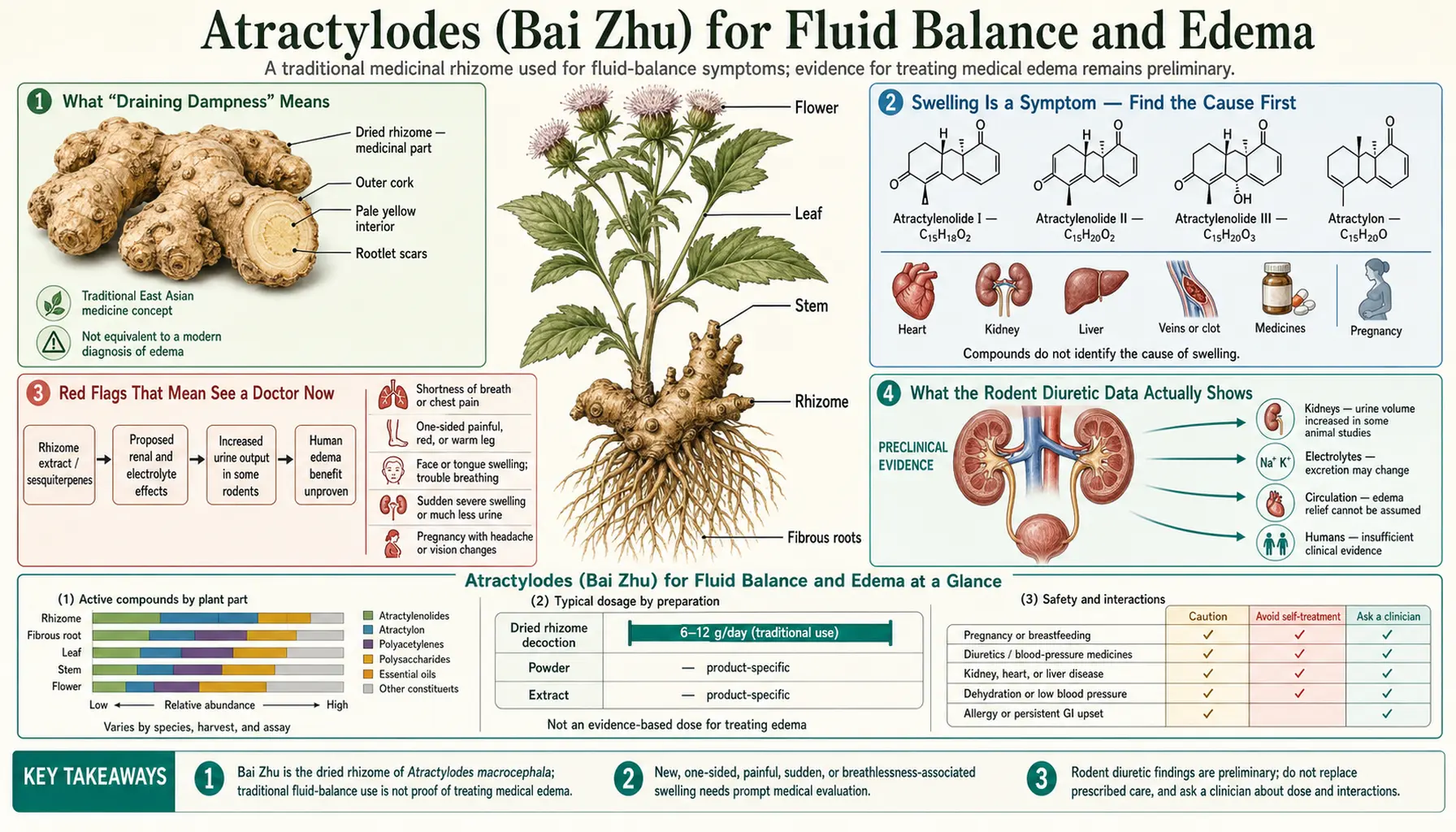
The second stated action of bai zhu — Atractylodes macrocephala Koidz., the dried rhizome Rhizoma Atractylodis Macrocephalae, Vietnamese bạch truật — is to “dry dampness and promote urination.” That is the traditional basis for using it where fluid seems to be pooling: puffy ankles, a swollen abdomen, a heavy waterlogged feeling in the limbs. It is the reason the herb appears in every classical fluid-metabolism formula.
Two things have to be said before anything else. First, human clinical evidence for bai zhu as a single herb is very limited — the diuretic claim rests almost entirely on rodent experiments and on multi-herb formula use, and the rodent data is not as clean as it is usually presented. Second, and more important: swelling is a symptom, not a diagnosis. Oedema that is new, one-sided, or accompanied by breathlessness is a reason to see a doctor today, not a reason to buy a herb.
Table of Contents
- What “Draining Dampness” Means
- Swelling Is a Symptom — Find the Cause First
- Red Flags That Mean See a Doctor Now
- What the Rodent Diuretic Data Actually Shows
- Proposed Mechanisms: Aquaporins and Sodium Handling
- The Classical Fluid Formulas
- Raw vs. Fried: Which Form for Fluid
- The Prescription-Diuretic Interaction
- What Would Actually Settle This
- Practical Use and Non-Herbal Basics
- Cautions and Contraindications
- Key Research Papers
- Connections
- Featured Videos
What “Draining Dampness” Means
“Dampness” (湿, shī) is a traditional Chinese medical category, not a fluid compartment you can measure. It describes a cluster of complaints: heaviness in the limbs, a foggy dull head, a greasy or thick tongue coating, sticky or loose stools, a swollen puffy quality to the face or ankles, symptoms that worsen in humid weather, and a general sense of being weighed down and slowed. Practitioners further divide it into “damp-cold” and “damp-heat” depending on accompanying signs.
In the traditional model, dampness accumulates when the Spleen — the digestive-and-fluid-handling function, not the anatomical organ under your left ribs — fails to transform and transport fluids. So dampness and digestive weakness are two faces of one problem, which is exactly why bai zhu, described as doing both jobs, sits at the centre of these formulas.
Notice what that category is not. It is not oedema in the clinical sense — pitting fluid in the tissues from heart failure, kidney disease, low albumin or venous insufficiency. There is overlap, and traditional practitioners certainly did treat visible swelling. But most of what a modern practitioner labels “dampness” would show nothing on a physical exam. Conflating the two — treating documented pitting oedema as if it were a TCM pattern — is how people get hurt.
Swelling Is a Symptom — Find the Cause First
Oedema means fluid has left the bloodstream and accumulated in tissue. There are only a handful of ways that happens, and each one points at a different organ that needs attention:
- Heart. Heart failure raises venous pressure; fluid backs up into the legs (right-sided) or the lungs (left-sided). Typically both ankles, worse through the day, better overnight, often with breathlessness on exertion or when lying flat.
- Kidney. Nephrotic syndrome loses protein into the urine, dropping the oncotic pressure that holds water in the vessels; nephritic and end-stage disease retains sodium and water. Often facial or periorbital puffiness on waking, and frothy urine.
- Liver. Cirrhosis reduces albumin production and raises portal pressure — abdominal ascites plus leg swelling.
- Thyroid. Severe hypothyroidism produces a non-pitting swelling (myxoedema) from mucopolysaccharide deposition, which is a completely different mechanism and does not respond to diuretics at all.
- Venous insufficiency and lymphoedema. Local plumbing failure. Usually asymmetric, often with skin changes; lymphoedema is characteristically non-pitting and involves the toes.
- Drugs. Amlodipine and other dihydropyridine calcium-channel blockers, NSAIDs, pioglitazone, gabapentin and pregabalin, corticosteroids, and some hormones all cause oedema. This is a common and completely reversible cause that gets missed constantly.
- Deep vein thrombosis. Sudden swelling of one leg, often with pain, warmth and redness. A medical emergency.
Herbal treatment of oedema without knowing which of these is operating is not conservative — it is the opposite. Reducing visible swelling while heart failure or nephrotic syndrome progresses underneath is worse than doing nothing, because it removes the symptom that would have driven you to get investigated.
Red Flags That Mean See a Doctor Now
- Swelling of one leg only, especially with calf pain, warmth or redness — possible DVT.
- Swelling with breathlessness, at rest, on mild exertion, or when lying flat.
- Rapid weight gain — more than about 2 kg in a few days.
- Swelling with chest pain, palpitations, or fainting.
- Facial or periorbital swelling on waking, or frothy urine.
- Swelling with abdominal distension and jaundice.
- Any swelling that appeared after starting a new medication — talk to the prescriber before adding anything.
What the Rodent Diuretic Data Actually Shows
The modern diuretic claim comes from a body of animal experiments, mostly in rats, in which atractylodes extract is given orally or by injection and urine output is collected over several hours. This literature is genuinely inconsistent, and the inconsistency is usually left out of supplement marketing.
Points a careful reader should know:
- The direction of effect is not stable. Some studies report increased urine output; others report no significant change; a few report reduced output. Results vary with extract type (water vs. ethanol vs. volatile oil), dose, dosing duration, and whether the animals were normal or had experimentally induced fluid retention.
- Effect sizes, where positive, are modest. Nothing in this literature approaches the magnitude of a loop diuretic. If bai zhu has a diuretic action in humans, the animal data suggests it is gentle rather than dramatic.
- Acute vs. chronic differ. Some reports find an effect on single dosing that does not persist with repeated dosing, which is a common pattern with weak natriuretic agents.
- Species and model choice matter enormously. Rodent renal handling of sodium and water differs from human handling, and a “dampness model” rat — typically produced by a high-humidity environment, a fat-and-sugar diet, and forced swimming — is a construct designed to match a traditional syndrome, not a validated model of human oedema.
The honest read: there may be a mild diuretic or fluid-redistributing action, the evidence for it is preclinical and inconsistent, and no human trial has quantified it.
Proposed Mechanisms: Aquaporins and Sodium Handling
Where investigators have looked for a mechanism, three ideas dominate:
Aquaporins. Aquaporins are protein channels that let water cross cell membranes; AQP2 in the kidney’s collecting duct is the one vasopressin regulates, and AQP3 and AQP4 sit alongside it. Several rodent studies of atractylodes-containing formulas report altered renal aquaporin expression, which would be a coherent way for a herb to nudge water handling. This is expression data in animal kidneys, not a demonstrated clinical effect.
Sodium and the renin-angiotensin-aldosterone system. Water follows sodium; any real diuretic effect ultimately means changed sodium handling. Some studies report changes in serum aldosterone or in renal sodium transporters after atractylodes formulas. The findings are scattered and not consistently replicated.
Oncotic pressure and gut function. A third and more traditional-sounding line of reasoning: if the herb improves digestion and nutrient absorption, and if oedema is partly driven by low protein intake or malabsorption, then better absorption raises serum albumin and pulls fluid back into the vessels. That is plausible in a malnourished patient and largely irrelevant in a well-fed one.
All three are hypotheses generated in animals. None has been confirmed in humans taking bai zhu.
The Classical Fluid Formulas
Bai zhu almost never appears alone in this context. Its constant partner is poria, a fungus regarded as bland, neutral and purely fluid-draining. The classical formulas are:
- Ling Gui Zhu Gan Tang — poria, cinnamon twig, bai zhu, licorice. Four ingredients, aimed at “phlegm-fluid” retention with dizziness, palpitations and a fullness below the ribs. One caution worth naming: licorice in meaningful quantity can cause sodium and water retention and potassium loss through mineralocorticoid-like activity — the opposite of what the formula is aiming for, and a real drug-safety issue in its own right if taken at high dose or for long periods.
- Wu Ling San (Five Ingredient Powder with Poria) — poria, polyporus, alisma, bai zhu, cinnamon twig. The most explicitly diuretic classical formula, used for fluid retention with thirst and reduced urination.
- Zhen Wu Tang (True Warrior Decoction) — aconite, poria, bai zhu, white peony, fresh ginger. For oedema with marked cold signs. Contains prepared aconite, a genuinely toxic herb requiring correct processing and expert prescribing — this is not a self-treatment formula under any circumstances.
- Si Jun Zi Tang — the digestive base formula, used where fluid symptoms are secondary to digestive weakness.
Bai zhu’s dose within these is the usual 6–12 g/day of dried rhizome.
Raw vs. Fried: Which Form for Fluid
Processing genuinely changes this drug, and for the fluid indication the traditional choice is clear.
Raw bai zhu (sheng bai zhu) retains the most volatile oil — the fraction containing atractylenolides I, II and III, atractylon and β-eudesmol — and is regarded as the more diuretic, more strongly damp-draining form. Bran-fried bai zhu (chao bai zhu) has measurably lower volatile-oil content after stir-frying and is regarded as milder and more digestion-tonifying; it is the default in appetite formulas, not fluid formulas. Charred bai zhu (jiao bai zhu) is reserved for diarrhoea.
The chemistry supports the distinction: analytical comparisons of raw and fried material consistently show volatile-oil loss with heating. This is real pharmacognosy. Whether the resulting clinical difference is detectable in a person is untested.
The Prescription-Diuretic Interaction
This is the single most important safety point on this page.
If bai zhu has any diuretic action — and both tradition and the rodent data say it may — then taking it alongside a prescription diuretic produces a theoretically additive effect. The drugs in question include:
- Loop diuretics — furosemide, bumetanide, torasemide.
- Thiazides — hydrochlorothiazide, indapamide, chlortalidone, often inside combination blood-pressure pills where people do not realise they are taking a diuretic at all.
- Potassium-sparing agents — spironolactone, eplerenone, amiloride.
- SGLT2 inhibitors — dapagliflozin, empagliflozin — which have a real diuretic component.
The risks of over-diuresis are dehydration, low blood pressure with dizziness on standing and a resulting fall risk, kidney injury from underperfusion, and electrolyte disturbance — low sodium (confusion, weakness, in severe cases seizures) and low or high potassium depending on the drug (muscle weakness and heart-rhythm disturbance). Older people on multiple medications are the group most at risk, and are also the group most likely to be taking a herb for “puffy ankles.”
Anyone on a prescription diuretic who wants to try an atractylodes formula should say so to the prescriber first, and the practical safeguard is a daily weight and a basic metabolic panel — sodium, potassium, urea and creatinine — rather than judging by how the ankles look.
What Would Actually Settle This
It would not take much. A randomised, placebo-controlled crossover trial in healthy volunteers, measuring 24-hour urine volume and urinary sodium after a standardised decoction of a known quantity of authenticated raw bai zhu, would answer the basic question — does this herb increase urine output in humans, and by how much — in a few dozen participants. Nothing of that design and quality has been published.
Until it is, the correct statement is: traditional texts describe a diuretic action, rodent data is suggestive but inconsistent, and the human effect size is unknown — possibly small, possibly zero. Any product claiming that atractylodes “flushes excess water” is going well beyond what anyone has demonstrated.
Practical Use and Non-Herbal Basics
If a doctor has excluded the serious causes and what remains is mild dependent swelling — ankles at the end of a long day on your feet, or in hot weather — the things with the best evidence are not herbal:
- Compression stockings, properly fitted. The single most effective intervention for venous-origin swelling.
- Elevation above heart level for 20–30 minutes a few times a day.
- Movement. The calf muscle pump is the main mechanism returning fluid from the legs; ankle pumps during long sitting genuinely help.
- Dietary sodium. A meaningful reduction — mostly from processed food, bread and restaurant meals rather than the salt cellar.
- Review your medication list with a pharmacist for amlodipine, NSAIDs, pioglitazone, gabapentinoids and steroids.
If a herbal formula is used, it is used as a formula — typically Wu Ling San or Ling Gui Zhu Gan Tang from a trained practitioner — not as single-herb atractylodes capsules, for which there is no traditional precedent and no evidence. Buy on the binomial: Atractylodes macrocephala is bai zhu; A. lancea or A. chinensis is cang zhu, a more aromatic and more strongly drying herb used to dry dampness rather than tonify, and not what these formulas specify. Track a concrete measure — morning weight, or ankle circumference at a marked point — rather than impressions.
Cautions and Contraindications
- Diuretics. Theoretically additive fluid and electrolyte loss. The interaction to take most seriously. See above.
- Lithium. Anything that alters sodium and water handling can alter lithium levels, and lithium has a narrow therapeutic window. Do not combine without monitoring.
- Kidney or heart failure. Fluid management in these conditions is a prescribing decision with narrow margins. A herb with an unquantified diuretic action does not belong in it unsupervised.
- Pregnancy. Classical texts describe bai zhu as calming the fetus, and it appears in traditional pregnancy formulas. There is no reliable human safety data supporting that use, and pregnancy oedema in particular can signal pre-eclampsia — which needs blood pressure and urine protein checked, not a herb. Flag the evidence gap rather than repeating the tradition uncritically.
- Asteraceae allergy. Atractylodes is in the daisy family; cross-reaction is plausible if you react to ragweed, chrysanthemum, chamomile or marigold.
- Licorice in the formula. Ling Gui Zhu Gan Tang and Si Jun Zi Tang both contain licorice, which at higher doses or prolonged use can raise blood pressure, retain sodium and lower potassium. Relevant to anyone taking these formulas long term.
- Traditional contraindication. Avoided in yin deficiency with heat — dryness, thirst, night sweats — where a warm drying herb is expected to worsen things.
Key Research Papers
Each link resolves to a live PubMed record set for the paper or topic named, rather than to a hand-typed identifier. Author, title and journal are plain text so you can verify each independently.
- Zhu B, Zhang QL, Hua JW, Cheng WL, Qin LP. The traditional uses, phytochemistry, and pharmacology of Atractylodes macrocephala Koidz.: a review. Journal of Ethnopharmacology. 2018;226:143–167.
- Diuretic effects of Atractylodes macrocephala extracts in rodent models. PubMed record set.
- Renal aquaporin expression after atractylodes-containing decoctions in animal models. PubMed record set.
- Wu Ling San (Poria Five Powder) and renal water handling: experimental and clinical literature. PubMed record set.
- Ling Gui Zhu Gan Tang in fluid-retention and cardiovascular models. PubMed record set.
- Effects of processing (raw vs. bran-fried) on volatile oil and atractylenolide content. PubMed record set.
- Herb–diuretic interactions and electrolyte disturbance with herbal preparations. PubMed record set.
- Licorice, glycyrrhizin, pseudohyperaldosteronism and potassium loss. PubMed record set.
- Evaluation and differential diagnosis of peripheral oedema. PubMed record set.
Live PubMed Searches
- Atractylodes macrocephala diuretic
- bai zhu dampness edema
- Wuling San
- Lingguizhugan decoction
- Zhenwu Tang edema
- aquaporin 2 collecting duct regulation
- amlodipine-induced peripheral edema
- compression stockings and venous oedema
Connections
- All Herbs
- Atractylodes (Bai Zhu) — the main research article
- Atractylodes Benefits hub
- Atractylodes: History and Traditional Use
- Digestion and Spleen Qi
- Immune and Inflammation
- Gut Barrier and Microbiome
- Poria Mushroom — the constant partner in fluid formulas
- Licorice — and its own sodium-retaining caution
- Codonopsis
- Astragalus
- Ginger — warming herb in Zhen Wu Tang
- SIBO — bloating that is gas, not fluid