Zucchini
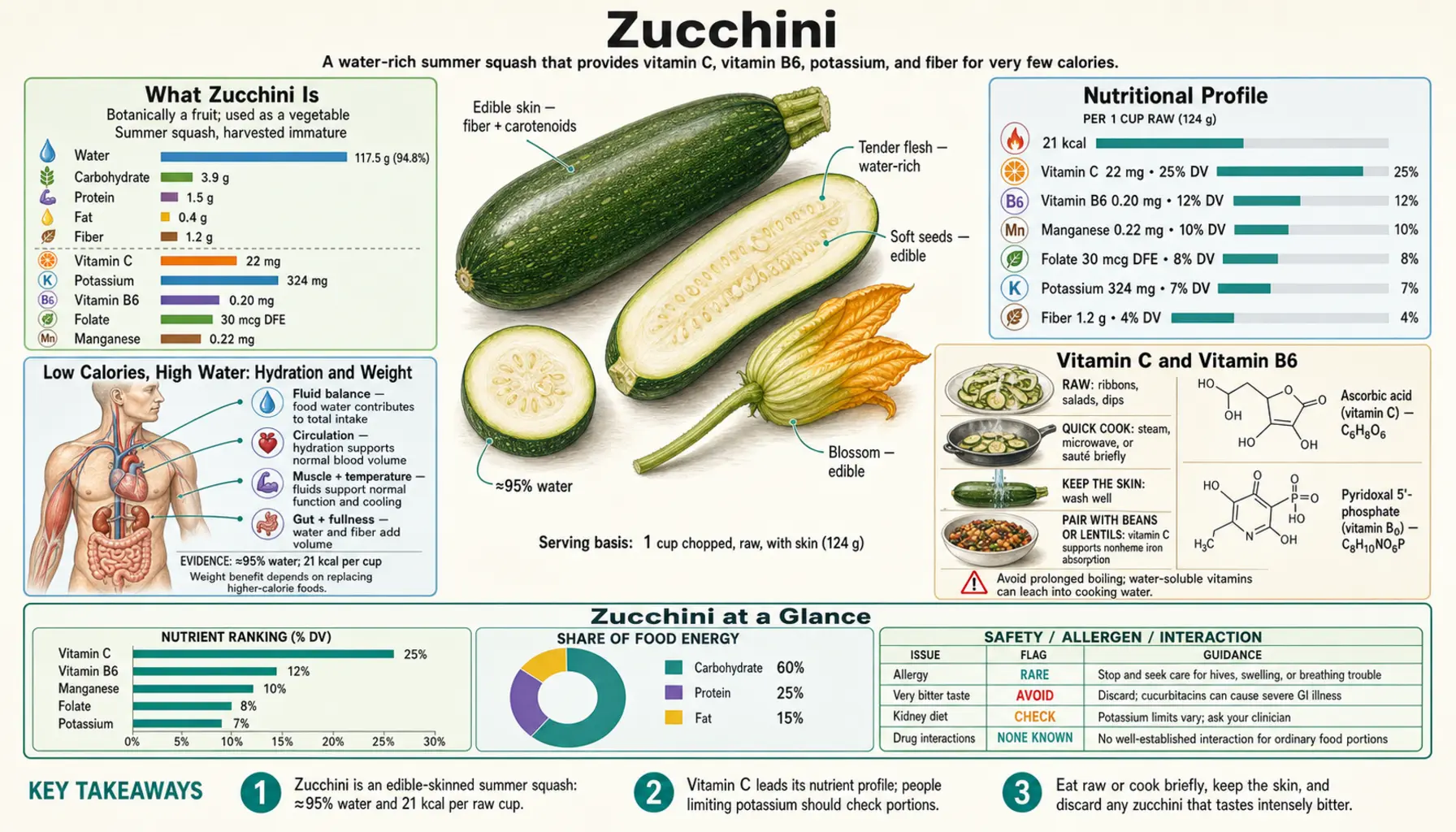
Zucchini (Cucurbita pepo), known as courgette in Britain, France, and much of the Commonwealth, is a summer squash picked and eaten while young and tender. Unlike winter squashes such as pumpkin or butternut — which are left to mature until their skins harden — zucchini is harvested immature, so its skin, flesh, and small seeds are all soft and completely edible. It is one of the most forgiving vegetables in the kitchen: mild, watery, quick to cook, and happy to soak up whatever flavors you cook it with.
Nutritionally, zucchini is a gentle, low-calorie, high-water vegetable rather than a nutrient powerhouse. It will not single-handedly transform your health, and it is honest to say the evidence for eating one specific vegetable is modest. But it is a genuinely useful food: filling for very few calories, a decent source of vitamin C, vitamin B6, and potassium, and a carrier of the eye-protective pigments lutein and zeaxanthin. This page explains what zucchini is, what it contains, where it fits in a balanced diet, and one uncommon but real safety point — the intensely bitter squash you should never eat.
Table of Contents
- What Zucchini Is
- Nutritional Profile
- Low Calories, High Water: Hydration and Weight
- Vitamin C and Vitamin B6
- Antioxidants: Lutein, Zeaxanthin, Carotenoids
- Fiber and Digestion
- Blood Sugar and Glycemic Response
- How to Select, Store, and Cook It
- The Bitter Zucchini Warning
- Safety and Everyday Use
- Research Papers
- Connections
- Featured Videos
What Zucchini Is
Zucchini is a cultivated variety of Cucurbita pepo, the same species that gives us many pumpkins, acorn squash, and ornamental gourds. Botanically, the part we eat is a fruit — it grows from the flower and holds the plant's seeds — but in the kitchen it is treated as a vegetable in every way. It belongs to the gourd family, Cucurbitaceae, alongside cucumbers, melons, and pumpkins.
The name "zucchini" comes from the Italian zucchino, a diminutive of zucca (squash or gourd). Although Cucurbita pepo originated in the Americas, the slender green summer squash we now call zucchini was largely developed in Italy, and Italian immigrants carried it worldwide. "Courgette," the French and British word, is likewise a diminutive — of the French courge, meaning gourd or marrow. They are the same vegetable under two names.
What makes zucchini a summer squash is that it is eaten young. Left on the plant, the fruit keeps growing into a large, tough-skinned marrow with hard seeds and a woody core. Picked small — roughly the size of a large finger up to about eight inches — it is at its best: fine-grained, mild, and tender all the way through. The most common type is the familiar dark-green cylinder, but zucchini also comes in golden-yellow varieties, pale striped ones, and round shapes bred for stuffing. The yellow and green kinds taste much the same; the color difference is mostly cosmetic.
Nutritional Profile
Zucchini's defining feature is how little it contains relative to its bulk. About 94 to 95 percent of raw zucchini is water, which is why it is so low in calories and why it shrinks so dramatically when cooked. A one-cup serving of sliced raw zucchini (roughly 120 grams) has only around 20 calories, and a whole medium zucchini has about 30 to 35. The rest of its makeup is modest amounts of carbohydrate, a little fiber, a small amount of protein, and almost no fat.
Per 100 grams (about two-thirds of a cup, sliced), raw zucchini with the skin on provides approximately:
- Calories: about 17 kcal
- Water: about 94–95 grams
- Carbohydrate: about 3.1 grams, of which roughly 1 gram is fiber and about 2.5 grams natural sugars
- Protein: about 1.2 grams
- Fat: about 0.3 grams
Its most notable micronutrients, per 100 grams, are:
- Vitamin C: about 18 mg — roughly 20 percent of a day's target
- Vitamin B6: about 0.16 mg — roughly 10 percent
- Potassium: about 260 mg
- Manganese: about 0.18 mg — roughly 8 percent
- Folate: about 24 micrograms — roughly 6 percent
- Lutein and zeaxanthin: a meaningful amount, largely concentrated in the green skin
There are also smaller quantities of riboflavin, vitamin K, magnesium, and thiamine. None of these figures is dramatic, and that is the point: zucchini is a "background" vegetable that adds volume, water, and a spread of small nutritional contributions to a meal without adding many calories. A useful habit is to leave the skin on, because the green peel carries much of the fiber and most of the antioxidant pigment. A laboratory analysis of zucchini and its components confirmed that its distinctive compounds are concentrated in the peel rather than the watery inner flesh.
Low Calories, High Water: Hydration and Weight
The clearest, most defensible benefit of zucchini is that it is a food of very low energy density — few calories packed into a large, satisfying volume. Because it is mostly water and fiber, you can eat a generous portion and feel full for almost no caloric cost. This is exactly the property that dietary research links to easier weight control.
Careful feeding studies led by Barbara Rolls and colleagues have shown that people tend to eat a fairly consistent weight or volume of food at a meal, largely regardless of how many calories that food contains. When meals are built around low-energy-density foods — especially water-rich vegetables — people feel just as satisfied while taking in fewer calories overall. Zucchini is a textbook example: it bulks up soups, stir-fries, pasta dishes, and casseroles with satisfying volume while adding almost nothing to the calorie total.
Its high water content also contributes modestly to daily hydration. We think of drinking as the way we get fluid, but water-dense foods like zucchini, cucumber, and melon genuinely add to the total. This is a small effect, not a substitute for drinking water, but it is real.
One popular use deserves an honest look: "zoodles," or zucchini noodles made by spiralizing raw zucchini into pasta-like strands. As a swap for wheat pasta they cut calories and carbohydrate sharply — a cup of zoodles has around 20 calories against roughly 200 for a cup of cooked spaghetti. That is a legitimate tool for anyone watching carbohydrates or calories. Be realistic about the trade-off, though: zoodles are far more watery and less filling in the way starch is, so they work best with a substantial sauce, beans, or protein rather than as a straight one-for-one replacement.
Vitamin C and Vitamin B6
Zucchini's standout vitamin is vitamin C. A 100-gram serving supplies roughly a fifth of the daily target, and a whole medium zucchini gets you a good way toward it. Vitamin C is an antioxidant that the body cannot make or store, so a steady dietary supply matters. It supports the normal function of immune cells, helps the body build collagen for skin and connective tissue, and improves the absorption of iron from plant foods eaten in the same meal. Because vitamin C is water-soluble and heat-sensitive, gentle or brief cooking — and eating some zucchini raw — preserves more of it.
Zucchini is also a modest source of vitamin B6 (pyridoxine). B6 is a workhorse coenzyme involved in more than a hundred reactions in the body, particularly the metabolism of amino acids and the making of neurotransmitters and hemoglobin. It also has a documented role in the body's inflammation and immune pathways. No single serving of zucchini meets your B6 needs, but it is one of many small vegetable contributions that add up across a varied diet.
Antioxidants: Lutein, Zeaxanthin, and Carotenoids
The green color of zucchini skin is a clue to one of its more interesting contents. Alongside chlorophyll, the peel carries lutein and zeaxanthin — two carotenoid pigments that the human eye actively concentrates in the macula, the central part of the retina responsible for sharp vision. There they act as a natural filter for damaging blue light and as antioxidants that protect delicate retinal tissue.
Diets rich in lutein and zeaxanthin are associated with better long-term eye health, and these pigments are the reason many green and yellow vegetables are described as good for the eyes. In the large AREDS2 clinical trial, lutein and zeaxanthin were studied as part of a supplement formula for people with age-related macular degeneration; the pigments were a sensible component of the eye-health formula tested. It is important to be honest about scale: zucchini is a contributor of these pigments, not a concentrated source like spinach or kale. But every serving helps build the dietary pattern that supports the macula over a lifetime, and once again the message is to keep the skin on, since that is where most of the pigment sits.
More broadly, the phenolic compounds and carotenoids in zucchini give it a measurable antioxidant capacity in the laboratory. Antioxidants help the body manage oxidative stress — the ordinary wear-and-tear of metabolism — and a diet full of colorful plants is consistently linked in population studies with lower rates of chronic disease. That benefit belongs to the overall pattern of eating vegetables, not to any one vegetable, and zucchini is a reliable, easy member of that pattern.
Fiber and Digestion
Zucchini is not a high-fiber food — it holds only about a gram of fiber per 100 grams — but that fiber, together with its large water content, still does useful work for digestion. Fiber and water add bulk and softness to stool, supporting regularity, and the fiber feeds beneficial gut bacteria. Because zucchini is so gentle and low in the fermentable sugars that trigger bloating in sensitive people, it is one of the vegetables often tolerated well by those with irritable or easily upset digestion.
The fiber is concentrated in the skin, so peeling zucchini — which some recipes call for — removes much of it. For everyday cooking, leaving the peel on keeps both the fiber and the antioxidants. Broad reviews of dietary fiber consistently link higher intakes across the whole day with better digestive health, steadier blood sugar, and lower cholesterol. Zucchini is one small, painless way to nudge your daily fiber upward without adding calories.
Blood Sugar and Glycemic Response
Zucchini has very little effect on blood sugar, which makes it a friendly food for people managing diabetes, prediabetes, or simply trying to keep their energy steady. It contains only about 3 grams of carbohydrate per 100 grams, much of it offset by water and fiber, so a normal serving delivers a very small carbohydrate load. Non-starchy vegetables like zucchini are considered low-glycemic foods — they do not cause the sharp rises in blood glucose that refined starches and sugars do.
This is also what makes zucchini useful as a substitute for higher-carbohydrate ingredients. Replacing part of the pasta, rice, or potato on a plate with zucchini — whether as zoodles, grilled slices, or grated into a dish — lowers the meal's total carbohydrate and blunts the blood-sugar spike, while keeping the plate full and satisfying. Systematic reviews of carbohydrate quality find that shifting toward higher-fiber, less-refined carbohydrate sources is one of the more dependable dietary levers for metabolic health, and low-starch vegetables fit squarely into that shift.
How to Select, Store, and Cook It
Choose zucchini that is firm, glossy, and heavy for its size, with smooth unblemished skin. Smaller squashes — roughly six to eight inches — are the sweetest and most tender, with fewer developed seeds. Very large, dull, or spongy zucchini has usually been left on the plant too long and turns watery, seedy, and bland. Store it unwashed in the refrigerator, ideally in the crisper drawer, where it keeps for about a week; it does not need a sealed bag and can turn slimy if trapped in trapped moisture.
In the kitchen, zucchini is remarkably versatile:
- Raw: thinly sliced or shaved into salads, or spiralized into zoodles. Fresh and crisp, with the most vitamin C intact.
- Grilled or roasted: high, dry heat drives off water and concentrates flavor, giving zucchini a savory, lightly caramelized edge. One of the best ways to cook it.
- Sautéed or stir-fried: quick cooking over medium-high heat keeps some bite.
- Grated: squeezed of excess water and folded into fritters, breads, muffins, and soups.
- Stuffed: halved or hollowed and baked with fillings.
The single most common mistake is overcooking. Because zucchini is mostly water, long or wet cooking turns it into a soft, gray mush and washes out both flavor and heat-sensitive vitamin C. Cook it briefly, use higher dry heat when you can, and salt it just before serving rather than long in advance — salt pulls out water and can leave it limp. A pinch of oil helps too: the eye-protective carotenoids are fat-soluble, so a little olive oil improves how well your body absorbs them.
The Bitter Zucchini Warning
Here is the one genuine safety point worth knowing, even though it is uncommon. Zucchini and other members of the gourd family naturally contain bitter defensive compounds called cucurbitacins. Over centuries, cultivated squash has been bred to keep these compounds extremely low, which is why the zucchini you buy tastes mild. But occasionally — through cross-pollination with wild or ornamental gourds, from seeds saved off a stressed plant, or through certain growing conditions — a plant can produce fruit with high cucurbitacin levels. That fruit tastes intensely, unmistakably bitter.
Eating such a squash can cause what is sometimes called "toxic squash syndrome": nausea, vomiting, stomach cramps, and diarrhea, sometimes severe enough to cause dehydration. In a documented case series in a dermatology journal, two women even experienced significant temporary hair loss weeks after eating bitter squash-based meals. Cucurbitacins are not destroyed by cooking, so heat does not make a bitter squash safe.
The practical rule is simple and reliable: taste before you commit, and if a raw or cooked zucchini is strikingly bitter, do not eat it. Spit it out and discard the whole squash. Normal zucchini is mild to faintly sweet; a genuinely bitter one is a clear warning sign, not a matter of preference. This mostly affects home-grown and seed-saved squash rather than store-bought fruit, and cases are rare — but the signal is unmistakable, so it costs nothing to heed it. Cucurbitacins are the same class of compounds that researchers study for their strong biological activity, which is exactly why you do not want them in food quantities.
Safety and Everyday Use
Setting aside the bitter-squash exception, zucchini is one of the safest, gentlest foods you can eat. It is very low in allergenic potential, low in the fermentable sugars that upset sensitive stomachs, and free of the oxalate and other concerns attached to some greens. It suits nearly every eating pattern — low-calorie, low-carbohydrate, plant-based, and diabetic-friendly alike — and both the skin and seeds of young zucchini are fully edible, so there is no waste and no special preparation required.
A sensible way to think about zucchini is as a dependable everyday vegetable rather than a superfood. It will not cure anything, and honest nutrition science does not credit any single vegetable with dramatic effects. What it does — add volume and water for almost no calories, contribute vitamin C, B6, potassium, and eye-friendly pigments, and slot into a colorful, high-vegetable diet — is genuinely worthwhile. Large studies consistently tie diets rich in vegetables to lower rates of heart disease and premature death, and zucchini is one of the easiest vegetables to eat often. Enjoy it freely; just never swallow the rare bitter one.
Research Papers
- Martínez-Valdivieso D, Font R, Fernández-Bedmar Z, et al. Role of Zucchini and Its Distinctive Components in the Modulation of Degenerative Processes: Genotoxicity, Anti-Genotoxicity, Cytotoxicity and Apoptotic Effects. Nutrients. 2017;9(7):755. doi:10.3390/nu9070755 — a direct analysis of zucchini and its parts, confirming that its bioactive compounds are concentrated in the peel.
- Slavin JL, Lloyd B. Health Benefits of Fruits and Vegetables. Advances in Nutrition. 2012;3(4):506–516. doi:10.3945/an.112.002154 — a broad review of why vegetable-rich diets support health, the context zucchini fits into.
- Rolls BJ. The relationship between dietary energy density and energy intake. Physiology & Behavior. 2009;97(5):609–615. doi:10.1016/j.physbeh.2009.03.011 — explains why low-energy-density foods like zucchini help people eat fewer calories while feeling full.
- Carr AC, Maggini S. Vitamin C and Immune Function. Nutrients. 2017;9(11):1211. doi:10.3390/nu9111211 — reviews the roles of vitamin C, one of zucchini's most useful nutrients.
- Ueland PM, McCann A, Midttun Ø, et al. Inflammation, vitamin B6 and related pathways. Molecular Aspects of Medicine. 2017;53:10–27. doi:10.1016/j.mam.2016.08.001 — details the metabolic and immune roles of vitamin B6.
- Aburto NJ, Hanson S, Gutierrez H, et al. Effect of increased potassium intake on cardiovascular risk factors and disease: systematic review and meta-analyses. BMJ. 2013;346:f1378. doi:10.1136/bmj.f1378 — evidence for the value of dietary potassium, which zucchini supplies.
- Age-Related Eye Disease Study 2 (AREDS2) Research Group. Lutein + Zeaxanthin and Omega-3 Fatty Acids for Age-Related Macular Degeneration. JAMA. 2013;309(19):2005–2015. doi:10.1001/jama.2013.4997 — the landmark trial of the eye pigments zucchini carries in its skin.
- Eisenhauer B, Natoli S, Liew G, et al. Lutein and Zeaxanthin—Food Sources, Bioavailability and Dietary Variety in Age-Related Macular Degeneration Protection. Nutrients. 2017;9(2):120. doi:10.3390/nu9020120 — reviews dietary sources and absorption of lutein and zeaxanthin.
- Reynolds A, Mann J, Cummings J, et al. Carbohydrate quality and human health: a series of systematic reviews and meta-analyses. The Lancet. 2019;393(10170):434–445. doi:10.1016/S0140-6736(18)31809-9 — supports higher-fiber, less-refined carbohydrate patterns that low-starch vegetables fit.
- Aune D, Giovannucci E, Boffetta P, et al. Fruit and vegetable intake and the risk of cardiovascular disease, total cancer and all-cause mortality. International Journal of Epidemiology. 2017;46(3):1029–1056. doi:10.1093/ije/dyw319 — a large dose-response meta-analysis linking vegetable intake to lower mortality.
- Kaushik U, Aeri V, Mir SR. Cucurbitacins — An insight into medicinal leads from nature. Pharmacognosy Reviews. 2015;9(17):12–18. doi:10.4103/0973-7847.156314 — reviews the bitter cucurbitacin compounds behind toxic squash syndrome.
- Assouly P. Hair Loss Associated With Cucurbit Poisoning. JAMA Dermatology. 2018;154(5):617–618. doi:10.1001/jamadermatol.2017.6128 — documents the real, if rare, harm from eating intensely bitter squash.
Connections
- All Food
- Cucumber
- Pumpkin
- Butternut Squash
- Spinach
- Kale
- Broccoli
- Lutein
- Zeaxanthin
- Vitamin C
- Vitamin B6
- Potassium
- Manganese