Butternut Squash
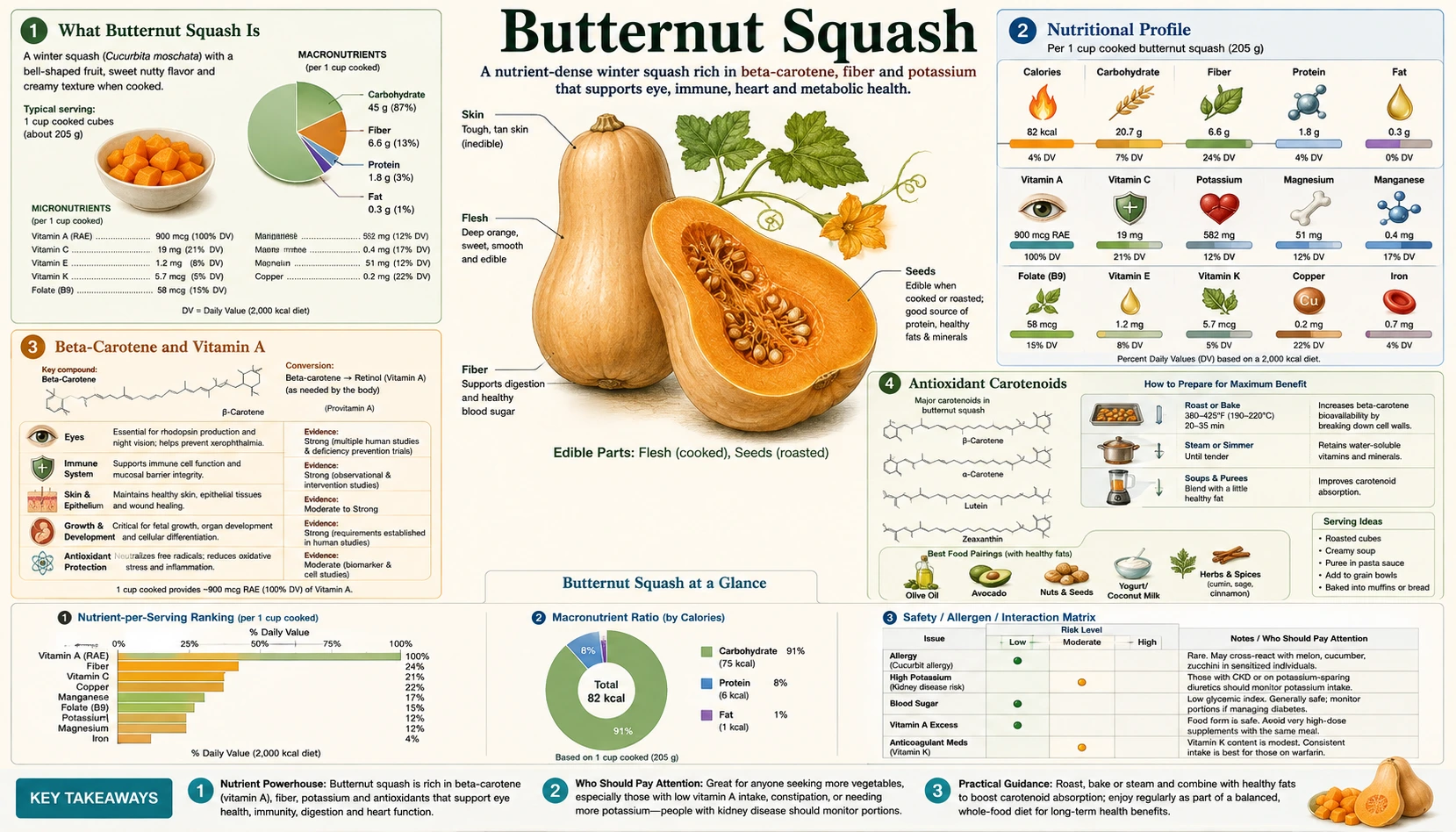
Butternut squash is one of the most useful vegetables you can keep in the kitchen through the colder months. It is a winter squash — a member of the gourd family known to botanists as Cucurbita moschata — with a smooth tan skin, a long solid neck, and a rounded bulb at the base that holds the seeds. Slice it open and you find dense, deep-orange flesh that roasts up sweet and nutty. That orange color is not just pretty: it comes from beta-carotene, the plant pigment your body turns into vitamin A. A single cup delivers far more than a day's worth of vitamin A along with useful amounts of vitamin C, potassium, magnesium, and fiber, all for very few calories. This page explains what is actually in butternut squash, what the science does and does not show about its benefits, how it stacks up against pumpkin and sweet potato, and simple, practical tips for choosing, peeling, roasting, and storing it. Where the evidence comes from studies of squash's individual nutrients rather than the whole vegetable, we say so plainly.
Table of Contents
- What Butternut Squash Is
- Nutritional Profile
- Beta-Carotene and Vitamin A
- Antioxidant Carotenoids
- Heart Health and Fiber
- Blood Sugar and Carbohydrates
- Butternut vs. Pumpkin and Sweet Potato
- How to Choose, Peel, Roast, and Store
- Is It Safe? Bitterness and Rare Cautions
- Research Papers
- Connections
- Featured Videos
What Butternut Squash Is
Butternut squash is a winter squash, which is a bit of a misnomer: it grows through the summer and is harvested in autumn, but it earns the name because its hard rind lets it store for months into winter. Unlike summer squash such as zucchini, which is picked young and eaten skin and all, winter squash is left on the vine until fully mature, so the skin toughens and the flesh grows dense and sweet.
The shape is distinctive and easy to recognize: a long, straight neck widening into a bulbous bottom, a little like a tan bell or a bowling pin. The skin is a smooth, matte beige-tan; the flesh inside is a rich orange. One of butternut's practical virtues is that the seeds and stringy pulp are packed only into the round base, so the entire neck is solid, seedless flesh — which makes it far easier to peel and cube than a knobby, hollow pumpkin.
Botanically, butternut belongs to the species Cucurbita moschata, the same species as several vegetables sold as “pumpkin.” In fact, much of the canned pumpkin puree sold in the United States is not the round orange jack-o’-lantern type at all but a tan, butternut-like C. moschata squash grown for its smooth, sweet flesh. So when a recipe treats butternut and canned pumpkin as interchangeable, that is closer to the botanical truth than it first appears.
Nutritional Profile
Butternut squash is a case of a food giving you a lot of nutrition for very little energy. It is roughly 87–90 percent water, so it fills a plate and satisfies without loading on calories. A generous one-cup serving of cooked, cubed squash (about 205 grams) provides, in round numbers:
- About 80 calories — low for such a filling, satisfying portion.
- Vitamin A: several hundred percent of the Daily Value — almost entirely as provitamin A carotenoids (chiefly beta-carotene) that your body converts as needed. This is butternut's standout nutrient.
- Vitamin C: roughly 30 milligrams (about a third of the Daily Value) — an antioxidant vitamin that supports the immune system and helps the body build collagen.
- Potassium: around 580 milligrams — a mineral most people fall short on, important for blood pressure and muscle function.
- Fiber: about 6–7 grams — close to a quarter of the daily target, mostly the gentle, bulking kind.
- Magnesium: roughly 60 milligrams — a meaningful contribution toward a mineral involved in hundreds of enzyme reactions.
On top of those headline nutrients, butternut supplies smaller but real amounts of vitamin E, vitamin B6, folate, and manganese. It contains no cholesterol, almost no fat, and only a trace of sodium. Because the vitamin A and vitamin E in squash are fat-soluble, eating it with a little olive oil, butter, or other fat helps your body absorb more of them — one reason roasting with a drizzle of oil is not just tastier but also more nutritious.
Exact figures vary with the size of the squash, how it is grown, and how it is cooked, so treat these numbers as a reliable ballpark rather than a lab measurement. Analyses of different Cucurbita species confirm that the deep-orange flesh of moschata squashes like butternut is consistently among the richest in carotenoids.
Beta-Carotene and Vitamin A
The reason butternut squash is such a nutritional heavyweight comes down to its color. The orange pigment is beta-carotene, a member of the carotenoid family. Beta-carotene is called a provitamin A carotenoid because the body splits it into retinol — active vitamin A — on demand. A key advantage of getting vitamin A this way, from plants, is that the conversion is self-limiting: your body makes only as much vitamin A as it needs and leaves the rest as beta-carotene, so you cannot overdose on vitamin A from eating squash the way you could from high-dose retinol supplements.
Vitamin A earns its keep in several parts of the body:
- Vision. Vitamin A is a building block of rhodopsin, the light-sensitive pigment in the retina that makes low-light and night vision possible. Deficiency is a leading cause of preventable childhood blindness worldwide.
- Immune defense. Vitamin A helps maintain the moist linings of the eyes, airways, and gut — the body's first physical barriers against infection — and supports the white blood cells that fight invaders.
- Skin and tissue renewal. Vitamin A guides the healthy turnover of skin and epithelial cells.
Researchers have carefully measured how efficiently the body turns plant beta-carotene into vitamin A. The conversion is real and worthwhile but less than one-to-one, and it depends on the food, its preparation, and the fat eaten with it. Expert reviews conclude that provitamin A vegetables like squash remain an important, safe source of vitamin A for most people, especially where animal foods are scarce. This is one benefit where the science is genuinely strong: the vitamin A in a serving of butternut is well established, not a marketing claim.
Antioxidant Carotenoids
Beta-carotene is the most famous pigment in butternut squash, but it travels with company. Analyses of Cucurbita moschata flesh find a mix of carotenoids — principally beta-carotene and alpha-carotene, along with smaller amounts of lutein and zeaxanthin. These compounds are antioxidants, meaning they help neutralize reactive molecules called free radicals that can damage cells over time.
Lutein and zeaxanthin are of particular interest for the eyes. They concentrate in the macula, the central part of the retina, where they act as a kind of internal filter for damaging blue light. Observational research links higher dietary intake of lutein and zeaxanthin with a modestly lower risk of age-related macular degeneration, a common cause of vision loss in older adults. A large clinical trial testing lutein and zeaxanthin supplements found benefit mainly for people who ate little of these nutrients to begin with, which points to the sensible takeaway: rather than reaching for high-dose pills, most people are better served by regularly eating colorful vegetables — leafy greens, corn, and orange squashes among them — that supply these pigments naturally.
A fair note of caution about carotenoid science: while eating carotenoid-rich foods is consistently associated with good health, isolated high-dose beta-carotene supplements have not delivered the same benefits in trials and were even linked to harm in smokers. The lesson is that whole foods like butternut squash, which package carotenoids together with fiber, vitamin C, and hundreds of other plant compounds, are the trustworthy way to get them.
Heart Health and Fiber
Butternut squash supports heart health through several ordinary but well-supported mechanisms, chiefly its fiber and potassium.
Its fiber — about 6 to 7 grams per cooked cup — is the gentle, bulking kind that slows digestion, feeds beneficial gut bacteria, and helps carry cholesterol out of the body. Large reviews of many studies find that people who eat more dietary fiber have measurably lower rates of heart disease and stroke. A pooled analysis of prospective studies estimated that each additional 7 grams of fiber a day — roughly what a cup of squash provides — was associated with a meaningful reduction in cardiovascular risk.
Its potassium helps counterbalance sodium and relax blood-vessel walls, which supports healthy blood pressure. Systematic reviews of controlled trials show that increasing potassium intake lowers blood pressure in adults, particularly those who eat a lot of salt, and is associated with a lower risk of stroke. Because most people eat too little potassium and too much sodium, foods like squash quietly help correct that imbalance.
Stepping back, butternut squash also fits the single most reliable dietary pattern for a long, healthy life: eating plenty of vegetables and fruit. Large dose-response analyses consistently link higher vegetable and fruit intake with lower death rates from heart disease and other causes. No one food is a magic bullet, but a colorful, fiber-rich vegetable like butternut is exactly the kind of everyday choice that adds up.
Blood Sugar and Carbohydrates
People sometimes lump butternut squash in with “starchy” foods and worry about its effect on blood sugar. It is worth being precise here. Butternut does contain carbohydrate — roughly 20 grams per cooked cup — but because 6 to 7 of those grams are fiber and much of the rest comes bundled with water and nutrients, the digestible carbohydrate load per satisfying serving is lower than that of starchier foods like white potatoes, rice, or bread.
Butternut squash is generally rated as having a moderate glycemic index — not as low as most non-starchy vegetables, but not the sharp spike of refined starch either. How it is cooked matters: mashing and prolonged cooking make its sugars a bit more available than roasting firm cubes does. In practical terms, a portion of butternut on the plate delivers vitamins, minerals, and fiber alongside its modest carbohydrate, which is a very different proposition from the “empty” carbohydrate of refined grains.
The broader science reinforces this. Studies of carbohydrate quality — not just quantity — find that people who eat higher-fiber, less-refined carbohydrate foods have better long-term health, including lower rates of heart disease and type 2 diabetes. Research on dietary glycemic load likewise links diets built on rapidly digested, low-fiber carbohydrates with higher heart-disease risk. Butternut squash sits on the favorable side of that divide. For most people, including many managing blood sugar, a sensible portion of squash is a nutrient-dense upgrade over refined starch — though anyone counting carbohydrates closely should simply account for it as they would any starchy vegetable.
Butternut vs. Pumpkin and Sweet Potato
Butternut squash is often mentioned in the same breath as pumpkin and sweet potato. They overlap in color and sweetness, but they are not the same thing, and the differences are useful to know.
Butternut and pumpkin
These two are close cousins — both are winter squashes in the genus Cucurbita, and butternut is actually the same species (C. moschata) as many culinary pumpkins and most canned pumpkin puree. Nutritionally they are similar: both are low in calories, high in water, and rich in beta-carotene. In everyday cooking they are largely interchangeable, though butternut tends to be denser, sweeter, and less watery than a big field pumpkin, which is why it holds up so well to roasting. See our Pumpkin page for a closer look at that relative.
Butternut and sweet potato
Here the difference is bigger. A sweet potato is not a squash at all — it is the starchy root of a morning-glory relative (Ipomoea batatas). Both are superb sources of beta-carotene, so both give you plenty of vitamin A. But sweet potato is considerably starchier and higher in calories — a cup of cooked sweet potato carries roughly twice the calories and carbohydrate of a cup of butternut. That makes butternut a lighter, lower-carbohydrate way to get a similar dose of vitamin A and orange-vegetable goodness, while sweet potato is the better pick when you want more sustaining energy and starch. Neither is “better” — they simply suit different needs, and eating a variety of both is the easiest path to a broad range of nutrients.
How to Choose, Peel, Roast, and Store
Butternut is one of the friendliest winter squashes to cook with, mostly thanks to that long, seedless neck.
Choosing a good one
- Pick a squash that feels heavy for its size — a sign of dense, moist flesh.
- Look for matte, hard, unblemished tan skin. A glossy or greenish tint means it was picked underripe and will taste bland; a matte, deep-tan skin means it is ripe and sweet.
- Avoid soft spots, cuts, cracks, or mold. A dry, intact stem is a good sign.
Peeling and cutting
- The raw skin is tough. A sturdy Y-shaped vegetable peeler removes it easily; take off the pale layer just under the skin too. To make peeling even easier, microwave the whole squash for 2–3 minutes first to soften the rind slightly.
- Slice off both ends, then cut the squash where the neck meets the bulb. The neck cubes cleanly. Halve the bulb and scoop out the seeds and strings with a spoon — they are all in that lower chamber.
- Don't toss the seeds: rinse, dry, toss with a little oil and salt, and roast them like pumpkin seeds for a crunchy snack.
Roasting
- Toss 1-inch cubes with a little olive oil (which also helps you absorb the fat-soluble carotenoids), a pinch of salt, and any spices you like. Roast at about 400–425 °F (200–220 °C) for 25–35 minutes, turning once, until the edges caramelize.
- For soups or purees, you can instead halve the squash, rub the cut faces with oil, and roast cut-side down until soft, then scoop out the flesh.
Storing
- A whole, uncut butternut keeps for weeks to a couple of months in a cool, dry, well-ventilated spot — not the refrigerator. A pantry or cellar around 50–60 °F is ideal.
- Once cut, wrap it and refrigerate for up to about 5 days. Peeled cubes also freeze well, raw or roasted, for several months.
Is It Safe? Bitterness and Rare Cautions
For the overwhelming majority of people, butternut squash is a wholesome, low-risk food with no meaningful downsides. A few honest points are worth knowing.
The one real rule: never eat squash that tastes intensely bitter. Squashes and their relatives naturally contain defensive compounds called cucurbitacins, which are extremely bitter. Cultivated butternut has been bred to contain only trace, harmless amounts. Very rarely — usually when a plant is stressed, or when seeds cross-pollinate with wild or ornamental gourds — a squash can accumulate high cucurbitacin levels. Eating such a squash causes “toxic squash syndrome”: nausea, vomiting, cramps, and diarrhea, and in a handful of documented cases even temporary hair loss. The safeguard is simple and reliable: cucurbitacins taste unmistakably, mouth-puckeringly bitter, so if a bite of raw or cooked squash tastes bitter, spit it out and discard the whole squash. Ordinary sweet, nutty butternut is not a concern.
A couple of minor notes: eating very large amounts of beta-carotene-rich foods over time can tint the skin a harmless orange-yellow (a condition called carotenemia) that fades when intake drops — it is cosmetic, not dangerous, and quite different from jaundice. And as with any food, a true squash allergy is possible but uncommon. None of this changes the bottom line: butternut squash is one of the safest, most nourishing vegetables you can put on your table.
Research Papers
- Kim MY, Kim EJ, Kim YN, Choi C, et al. Comparison of the chemical compositions and nutritive values of various pumpkin (Cucurbitaceae) species and parts. Nutrition Research and Practice. 2012;6(1):21–27. doi:10.4162/nrp.2012.6.1.21 — Documents the nutrient and antioxidant content of several Cucurbita species, confirming the orange flesh is rich in carotenoids.
- Provesi JG, Dias CO, Amante ER. Changes in carotenoids during processing and storage of pumpkin puree. Food Chemistry. 2011;128(1):195–202. doi:10.1016/j.foodchem.2011.03.027 — Shows that C. moschata flesh is dominated by beta- and alpha-carotene and how cooking affects them.
- Grune T, Lietz G, Palou A, Ross AC, Stahl W, et al. β-Carotene is an important vitamin A source for humans. The Journal of Nutrition. 2010;140(12):2268S–2285S. doi:10.3945/jn.109.119024 — Expert consensus review on how the body converts plant beta-carotene into vitamin A.
- Weber D, Grune T. The contribution of β-carotene to vitamin A supply of humans. Molecular Nutrition & Food Research. 2012;56(2):251–258. PubMed 21957049 — Reviews how efficiently dietary beta-carotene meets human vitamin A needs.
- Ma L, Dou HL, Wu YQ, Huang YM, et al. Lutein and zeaxanthin intake and the risk of age-related macular degeneration: a systematic review and meta-analysis. British Journal of Nutrition. 2012;107(3):350–359. doi:10.1017/S0007114511004260 — Links higher dietary lutein and zeaxanthin with lower risk of late macular degeneration.
- Age-Related Eye Disease Study 2 (AREDS2) Research Group. Lutein + zeaxanthin and omega-3 fatty acids for age-related macular degeneration: the AREDS2 randomized clinical trial. JAMA. 2013;309(19):2005–2015. PubMed 23644932 — Large trial finding lutein/zeaxanthin benefit chiefly in people with low baseline dietary intake.
- Threapleton DE, Greenwood DC, Evans CEL, Cleghorn CL, et al. Dietary fibre intake and risk of cardiovascular disease: systematic review and meta-analysis. BMJ. 2013;347:f6879. doi:10.1136/bmj.f6879 — Higher fiber intake is associated with lower cardiovascular and coronary heart disease risk.
- Aburto NJ, Hanson S, Gutierrez H, Hooper L, Elliott P. Effect of increased potassium intake on cardiovascular risk factors and disease: systematic review and meta-analyses. BMJ. 2013;346:f1378. doi:10.1136/bmj.f1378 — Increasing potassium lowers blood pressure and is linked to lower stroke risk.
- Reynolds A, Mann J, Cummings J, Winter N, Mete E, Te Morenga L. Carbohydrate quality and human health: a series of systematic reviews and meta-analyses. The Lancet. 2019;393(10170):434–445. doi:10.1016/S0140-6736(18)31809-9 — Fiber-rich, less-refined carbohydrate foods are tied to lower rates of chronic disease.
- Liu S, Willett WC, Stampfer MJ, Hu FB, et al. A prospective study of dietary glycemic load, carbohydrate intake, and risk of coronary heart disease in US women. The American Journal of Clinical Nutrition. 2000;71(6):1455–1461. doi:10.1093/ajcn/71.6.1455 — Diets high in rapidly digested, low-fiber carbohydrate were linked with higher heart-disease risk.
- Wang X, Ouyang Y, Liu J, Zhu M, Zhao G, et al. Fruit and vegetable consumption and mortality from all causes, cardiovascular disease, and cancer: systematic review and dose-response meta-analysis of prospective cohort studies. BMJ. 2014;349:g4490. doi:10.1136/bmj.g4490 — Higher vegetable and fruit intake is associated with lower death rates.
- Assouly P. Hair loss associated with cucurbit poisoning. JAMA Dermatology. 2018;154(5):617–618. — Search PubMed — Documents rare “toxic squash syndrome” from bitter, high-cucurbitacin squash — the reason to discard any bitter-tasting squash.
Connections
- All Food
- Pumpkin
- Sweet Potatoes
- Carrots
- Vitamin A
- Vitamin C
- Beta-Carotene
- Lutein
- Zeaxanthin
- Potassium
- Magnesium
- All Antioxidants