Probiotics — Benefits Deep Dive
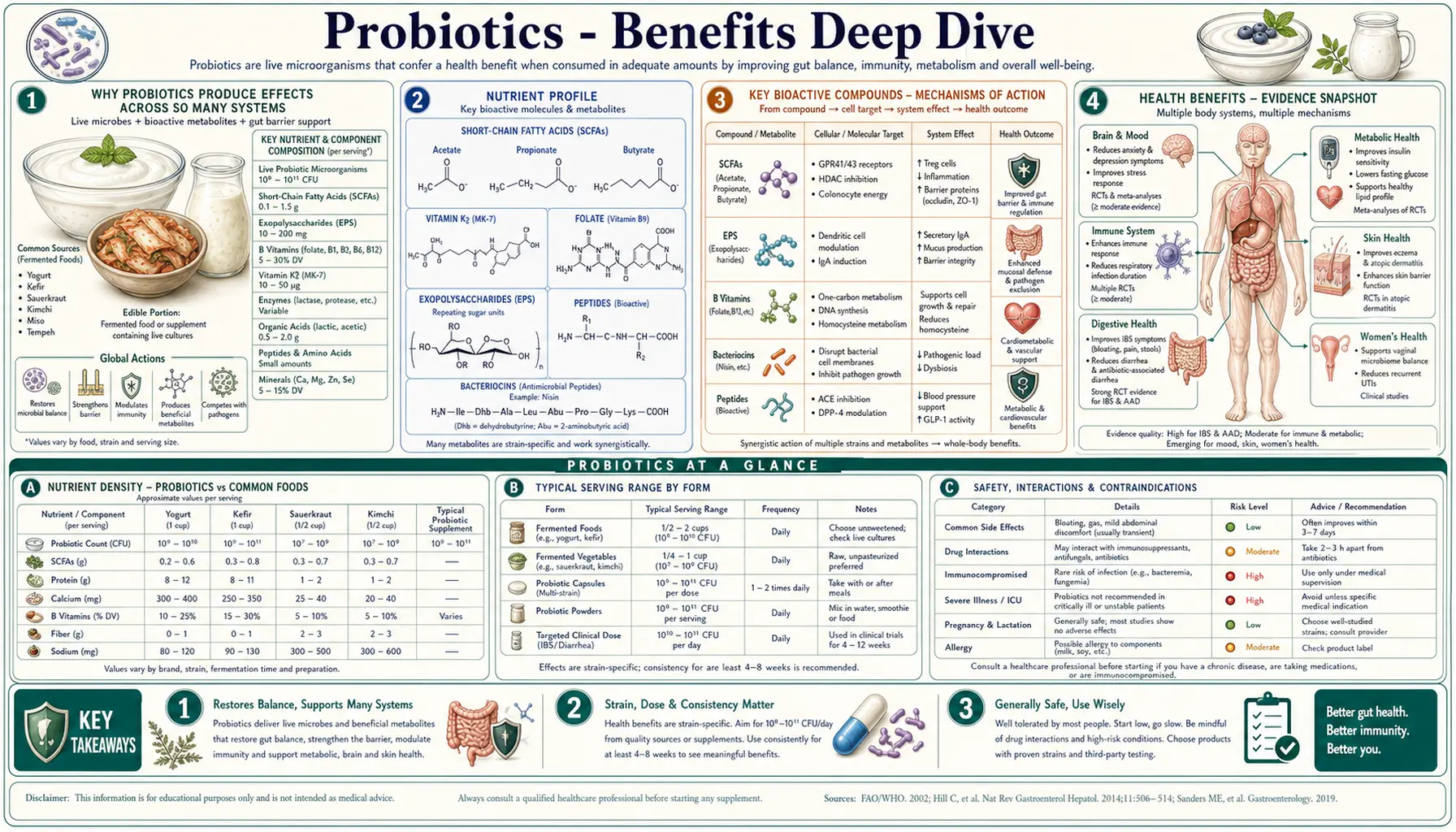
Probiotics — Lactobacillus, Bifidobacterium, Saccharomyces boulardii, and the more recently appreciated spore-formers like Bacillus coagulans — constitute the most rigorously studied dietary-supplement category in the modern medical literature. Thousands of randomized trials, dozens of Cochrane meta-analyses, and consensus guidelines from the World Gastroenterology Organisation and the American Gastroenterological Association have mapped which strain helps which condition at which dose. The headline finding is unambiguous: probiotics are most valuable when targeted — specific strains for antibiotic-associated diarrhea, Clostridioides difficile prevention, irritable bowel syndrome, infant colic, atopic eczema, vaginal dysbiosis, depression-anxiety adjunct therapy — and least valuable when used generically as a "more bacteria, more better" health-food supplement. The four deep-dive pages below cover the four areas where probiotic evidence is strongest and most clinically actionable: gut-health clinical applications, immune-system modulation, the strain-specific evidence map that shows which strains were tested for which conditions, and the rapidly maturing gut-brain axis literature on psychobiotics.
Deep-Dive Articles
Gut Health
The clinical-gastroenterology evidence map. Antibiotic-associated diarrhea (number needed to treat 9 in the Guo 2019 Cochrane review of children, and 6 with high doses of at least 5 billion colony-forming units a day), Clostridioides difficile prevention (Goldenberg Cochrane 2017, ~60% relative risk reduction overall, with the benefit seen in trials where the starting risk was above 5%), irritable bowel syndrome (the 2020 American Gastroenterological Association guideline recommends probiotics for irritable bowel syndrome only in the context of a clinical trial), inflammatory bowel disease (a high-dose eight-strain mixture for pouchitis, the only inflammatory bowel disease use the 2020 American Gastroenterological Association guideline suggests outside a clinical trial), Helicobacter pylori adjunct therapy, and the 2014 International Scientific Association for Probiotics and Prebiotics consensus statement, which kept the Food and Agriculture Organization of the United Nations and World Health Organization definition of a probiotic and distinguishes a true probiotic from a generic dietary microbe.
Read the deep dive →Immune Function
Why 70% of the immune system lives in the gut and how transient probiotic colonization tilts it. The gut-immune axis (gut-associated lymphoid tissue, Peyer's patches, M cells), secretory immunoglobulin A (IgA) induction, T-cell Th17/Treg balance via short-chain fatty acid signaling through the G-protein-coupled receptor 43 (GPR43) and histone deacetylase pathways, the Hao 2015 Cochrane review on upper respiratory tract infections (fewer people with at least one infection, odds ratio 0.53, but no significant change in the rate of episodes, rate ratio 0.83) and its 2022 update (risk ratio 0.76 for at least one infection), the King 2014 meta-analysis on duration of illness, atopic eczema prevention with Lactobacillus rhamnosus GG in the Kalliomäki 2001 trial, and the maturing literature on probiotics for allergic rhinitis and asthma.
Read the deep dive →Strains and Selection
The strain-specific evidence map: which strains were tested for which conditions. The genus-species-strain naming convention (Lactobacillus rhamnosus GG is not the same as Lactobacillus rhamnosus HN001), colony-forming unit counts and what a meaningful dose actually looks like, refrigerated vs shelf-stable, enteric coating and acid-resistance, single-strain vs multi-strain formulas, the rise of spore-based probiotics (Bacillus coagulans, Bacillus subtilis DE111), Saccharomyces boulardii as the only yeast probiotic and why it is uniquely useful, person-to-person differences in how well probiotics take hold in the gut lining (Zmora 2018), and the regulatory wild-west of probiotic labeling that means the strain on the label may not match what is in the capsule.
Read the deep dive →Saccharomyces boulardii
The probiotic yeast: antibiotic-associated diarrhea, Clostridioides difficile, and fungemia reports.
Read the deep dive →Mental Health & Gut-Brain Axis
The rapidly maturing psychobiotic literature. The vagus nerve as the bidirectional gut-brain superhighway (90% of vagal fibers are afferent, sensing the gut and informing the brain), gamma-aminobutyric acid (GABA) production by Lactobacillus brevis and Bifidobacterium dentium at concentrations measurable in cerebrospinal fluid, serotonin precursors and 90% of body serotonin synthesized in enterochromaffin cells, the Liu 2019 meta-analysis on probiotics for depression (Hedges' g around 0.24), the Lactobacillus rhamnosus JB-1 cortisol-attenuation findings, the Bifidobacterium longum 1714 stress-cognition trial, and the Slykerman 2017 trial of Lactobacillus rhamnosus HN001 in postpartum depression.
Read the deep dive →Table of Contents
- Deep-Dive Articles
- Why Probiotics Produce Effects Across So Many Systems
- Research Papers: Gut Health & Clinical Gastrointestinal
- Research Papers: Immune Function
- Research Papers: Strains, Colony-Forming Units, and Quality Control
- Research Papers: Gut-Brain Axis & Psychobiotics
- Research Papers: Cross-Cutting (Safety, Mechanism, Guidelines)
- External Authoritative Resources
- Connections
- Featured Videos
Why Probiotics Produce Effects Across So Many Systems
Most therapeutic agents act through a single molecular mechanism — a receptor agonist, an enzyme inhibitor, a transporter blocker. Probiotics are biological entities that simultaneously deploy several distinct mechanisms in parallel, and the relative weight of each mechanism varies by strain and by clinical context. Understanding the four mechanism families is the key to making sense of why a given strain works for one condition and not another.
- Competitive exclusion of pathogens — probiotic bacteria compete with pathogens for receptor binding sites on the gut epithelium, for niche space in the mucus layer, and for limiting nutrients in the colonic lumen. Lactobacillus rhamnosus GG and Saccharomyces boulardii in particular are well-characterized for displacing Clostridioides difficile from epithelial binding sites, which is the proximate mechanism behind their efficacy in Clostridioides difficile infection prevention. The same principle operates against Helicobacter pylori in the stomach, where adjunct Lactobacillus reuteri DSM 17938 modestly improves eradication rates over triple therapy alone.
- Bacteriocin and antimicrobial-metabolite production — many Lactobacillus strains produce narrow-spectrum antimicrobials (bacteriocins like nisin, plantaricin, and reuterin) that selectively inhibit pathogen growth without disturbing the commensal flora. Saccharomyces boulardii additionally produces a protease that cleaves both C. difficile toxin A and the cell-surface receptor it binds, providing dual protection against the most severe Clostridioides difficile infection complication. The gut-health deep-dive walks through the Clostridioides difficile infection prevention literature in detail, including the Goldenberg Cochrane meta-analysis that established the inpatient indication.
- Immune modulation through pattern-recognition receptor signaling — the surface molecules of probiotic bacteria (lipoteichoic acid, peptidoglycan, exopolysaccharides) are sensed by Toll-like receptors (TLR2, TLR4, TLR9) and NOD-like receptors on intestinal epithelial cells and dendritic cells. This signaling shapes the downstream balance of regulatory and effector T-cell populations, induces secretory immunoglobulin A class switching in B cells, and modulates systemic cytokine production. The immune-function deep-dive covers the Hao Cochrane respiratory-infection meta-analyses and the atopic eczema prevention literature that flow from this mechanism.
- Short-chain fatty acid production and the gut-brain axis — probiotic fermentation of dietary fiber and resistant starch produces short-chain fatty acids (acetate, propionate, butyrate) that fuel colonocytes, induce regulatory T cells through G-protein-coupled receptor 43, and signal to the brain through the vagus nerve. A subset of probiotic strains additionally produce gamma-aminobutyric acid, serotonin precursors, and other neuroactive metabolites that have measurable effects on mood, anxiety, and cognitive function in randomized trials. The mental-health deep-dive covers this rapidly expanding psychobiotic literature.
The strain-specificity of these mechanisms is the single most important practical point. The popular phrase "probiotics are good for you" is true in the same sense that "antibiotics are good for you" is true — technically accurate but useless without specifying which strain at which dose for which condition. Lactobacillus rhamnosus GG has trial evidence in antibiotic-associated diarrhea and in infant atopic eczema prevention (in the Kalliomäki 2001 trial, atopic eczema at age 2 in 23% of the probiotic group vs 46% of the placebo group). Bifidobacterium infantis 35624 has clinical evidence in irritable bowel syndrome but not in Clostridioides difficile infection prevention. Saccharomyces boulardii CNCM I-745 is uniquely effective in Clostridioides difficile infection prevention and traveler's diarrhea because it is a yeast and is unaffected by concurrent antibiotic therapy. A high-dose eight-strain mixture is the only probiotic the 2020 American Gastroenterological Association guideline suggests for pouchitis (over no or other probiotics). A strain used for a condition it has no evidence in typically produces no benefit at all. The strains-and-selection deep-dive provides the strain-by-condition evidence map to navigate this.
What the largest reviews and the largest single trial found, in numbers:
- Clostridioides difficile diarrhea. The 2017 Cochrane review by Goldenberg and colleagues (31 trials, 8,672 people) found C. difficile diarrhea in 1.5% of people given probiotics vs 4.0% of controls (risk ratio 0.40). The benefit was seen in trials where the starting risk was above 5% (3.1% vs 11.6%); trials with a starting risk of 5% or less showed no difference.
- The largest single trial found no benefit. The PLACIDE trial (Lancet 2013) gave hospital patients aged 65 and older who were taking antibiotics either a multistrain lactobacilli and bifidobacteria preparation (1,493 people) or a placebo (1,488 people), one dose a day for 21 days. Antibiotic-associated diarrhea occurred in 10.8% vs 10.4%, and C. difficile diarrhea in 0.8% vs 1.2%; neither difference was statistically significant.
- Depression and anxiety. A 2019 meta-analysis by Liu and colleagues of 34 controlled trials found small but significant effects of probiotics on depression (d = -0.24) and anxiety (d = -0.10); prebiotics did not differ from placebo. The effect on depression was larger in clinical or medical groups (d = -0.45) and, in a preliminary analysis, medium-to-large in psychiatric groups (d = -0.73).
Research Papers: Gut Health & Clinical Gastrointestinal
- Goldenberg JZ, Yap C, Lytvyn L, Lo CK, Beardsley J, Mertz D, Johnston BC (2017). Probiotics for the prevention of Clostridium difficile-associated diarrhea in adults and children. Cochrane Database Syst Rev. 2017;12:CD006095 — PubMed PMID: 29257353
- Guo Q, Goldenberg JZ, Humphrey C, El Dib R, Johnston BC (2019). Probiotics for the prevention of pediatric antibiotic-associated diarrhea. Cochrane Database Syst Rev. 2019;4:CD004827 — PubMed PMID: 31039287
- Whelan K, Quigley EM (2013). Probiotics in the management of irritable bowel syndrome and inflammatory bowel disease — PubMed: Probiotics IBS/IBD review
- Whorwell PJ et al. (2006). Efficacy of an encapsulated probiotic Bifidobacterium infantis 35624 in women with IBS — PubMed: Whorwell B. infantis 35624
- Sniffen JC et al. (2018). Choosing an appropriate probiotic product: ISAPP probiotic chart — PubMed: Sniffen probiotic chart
- Mimura T, Rizzello F, Helwig U, Poggioli G, Schreiber S, Talbot IC, Nicholls RJ, Gionchetti P, Campieri M, Kamm MA (2004). Once daily high dose probiotic therapy (VSL#3) for maintaining remission in recurrent or refractory pouchitis. Gut. 2004;53(1):108-14 — PubMed PMID: 14684584
- McFarland LV (2010). Saccharomyces boulardii systematic review — PubMed: McFarland S. boulardii
- Sazawal S et al. (2006). Efficacy of probiotics in prevention of acute diarrhoea: meta-analysis — PubMed: Sazawal acute diarrhea
- Su GL, Ko CW, Bercik P, Falck-Ytter Y, Sultan S, Weizman AV, Morgan RL (2020). AGA Clinical Practice Guidelines on the Role of Probiotics in the Management of Gastrointestinal Disorders. Gastroenterology. 2020;159(2):697-705 — PubMed PMID: 32531291
- Allen SJ, Wareham K, Wang D, et al. (2013). Lactobacilli and bifidobacteria in the prevention of antibiotic-associated diarrhoea and Clostridium difficile diarrhoea in older inpatients (PLACIDE): a randomised, double-blind, placebo-controlled, multicentre trial. Lancet. 2013;382(9900):1249-57 — PubMed PMID: 23932219
Research Papers: Immune Function
- Hao Q, Dong BR, Wu T (2015). Probiotics for preventing acute upper respiratory tract infections. Cochrane Database Syst Rev. 2015;(2):CD006895 — PubMed PMID: 25927096
- Zhao Y, Dong BR, Hao Q (2022). Probiotics for preventing acute upper respiratory tract infections. Cochrane Database Syst Rev. 2022;8:CD006895 — PubMed PMID: 36001877
- King S et al. (2014). Effectiveness of probiotics on the duration of illness in healthy children and adults — PubMed: King 2014 duration
- Kalliomäki M, Salminen S, Arvilommi H, Kero P, Koskinen P, Isolauri E (2001). Probiotics in primary prevention of atopic disease: a randomised placebo-controlled trial. Lancet. 2001;357(9262):1076-9 — PubMed PMID: 11297958
- Kim NY, Ji GE (2012). Effects of probiotics on the prevention of atopic dermatitis — PubMed: Kim atopic dermatitis
- Smith TJ, Rigassio-Radler D, Denmark R, Haley T, Touger-Decker R (2013). Effect of Lactobacillus rhamnosus LGG® and Bifidobacterium animalis ssp. lactis BB-12® on health-related quality of life in college students affected by upper respiratory infections. Br J Nutr. 2013;109(11):1999-2007 — PubMed PMID: 23020819
- Forsythe P, Bienenstock J (2010). Immunomodulation by commensal and probiotic bacteria — PubMed: Immunomodulation review
- Wang Y et al. (2016). Probiotics for prevention and treatment of respiratory tract infections in children meta-analysis — PubMed: Children RTI meta-analysis
- Maldonado J et al. (2012). Human milk probiotic Lactobacillus fermentum CECT5716 reduces the incidence of gastrointestinal and upper respiratory tract infections in infants — PubMed: L. fermentum infants
- Kekkonen RA et al. (2008). Probiotic intervention has strain-specific anti-inflammatory effects in healthy adults — PubMed: Kekkonen anti-inflammatory
- Sanders ME et al. (2013). An update on the use and investigation of probiotics in health and disease — PubMed: Sanders 2013 update
The 2022 Cochrane update by Zhao, Dong and Hao (23 trials, 6,950 children, adults and older people) found that probiotics may reduce the number of people with at least one upper respiratory tract infection (risk ratio 0.76) and likely reduce the number with three or more (risk ratio 0.59). Side effects from probiotics were minor, most often stomach and bowel symptoms.
Research Papers: Strains, Colony-Forming Units, and Quality Control
- Hill C, Guarner F, Reid G, et al. (2014). Expert consensus document. The International Scientific Association for Probiotics and Prebiotics consensus statement on the scope and appropriate use of the term probiotic. Nat Rev Gastroenterol Hepatol. 2014;11(8):506-14 — PubMed PMID: 24912386
- Zmora N, Zilberman-Schapira G, Suez J, et al. (2018). Personalized Gut Mucosal Colonization Resistance to Empiric Probiotics Is Associated with Unique Host and Microbiome Features. Cell. 2018;174(6):1388-1405.e21 — PubMed PMID: 30193112
- Sanders ME (2008). Probiotics: definition, sources, selection, and uses — PubMed: Sanders probiotic selection
- Konuray G, Erginkaya Z (2018). Potential use of Bacillus coagulans in the food industry — PubMed: B. coagulans review
- Czerucka D et al. (2007). Review article: yeast as probiotics — Saccharomyces boulardii — PubMed: S. boulardii review
- Capurso L (2019). Thirty years of Lactobacillus rhamnosus GG: a review — PubMed: LGG 30-year review
- Cassir N, Benamar S, La Scola B (2016). Clostridium butyricum: from beneficial to a new emerging pathogen. Clin Microbiol Infect. 2016;22(1):37-45 — PubMed PMID: 26493849
- Vinderola CG, Reinheimer JA (2003). Lactic acid starter and probiotic bacteria: a comparative “in vitro” study of probiotic characteristics and biological barrier resistance. Food Research International. 2003;36(9-10):895-904 — doi:10.1016/S0963-9969(03)00098-X
- Sanders ME, Merenstein DJ, Ouwehand AC, Reid G, Salminen S, Cabana MD, Paraskevakos G, Leyer G (2016). Probiotic use in at-risk populations. J Am Pharm Assoc. 2016;56(6):680-686 — PubMed PMID: 27836128
Research Papers: Gut-Brain Axis & Psychobiotics
- Liu RT, Walsh RFL, Sheehan AE (2019). Prebiotics and probiotics for depression and anxiety: A systematic review and meta-analysis of controlled clinical trials. Neurosci Biobehav Rev. 2019;102:13-23 — PubMed PMID: 31004628
- Bravo JA et al. (2011). Ingestion of Lactobacillus strain regulates emotional behavior and central GABA receptor expression in a mouse via the vagus nerve — PubMed: Bravo L. rhamnosus JB-1
- Slykerman RF et al. (2017). Effect of Lactobacillus rhamnosus HN001 in pregnancy on postpartum symptoms of depression and anxiety — PubMed: Slykerman postpartum
- Allen AP et al. (2016). Bifidobacterium longum 1714 as a translational psychobiotic — PubMed: B. longum 1714 trial
- Sarkar A et al. (2016). Psychobiotics and the manipulation of bacteria-gut-brain signals — PubMed: Sarkar psychobiotics review
- Cryan JF et al. (2019). The microbiota-gut-brain axis — PubMed: Cryan gut-brain axis
- Tillisch K, Labus J, Kilpatrick L, et al. (2013). Consumption of fermented milk product with probiotic modulates brain activity. Gastroenterology. 2013;144(7):1394-401 — PubMed PMID: 23474283
- Wallace CJK, Milev R (2017). The effects of probiotics on depressive symptoms in humans: systematic review — PubMed: Wallace depression
- Pinto-Sanchez MI et al. (2017). Probiotic Bifidobacterium longum NCC3001 reduces depression scores and alters brain activity in IBS — PubMed: Pinto-Sanchez B. longum IBS
- Foster JA, McVey Neufeld KA (2013). Gut-brain axis: how the microbiome influences anxiety and depression — PubMed: Foster gut-brain
Research Papers: Cross-Cutting (Safety, Mechanism, Guidelines)
- Doron S, Snydman DR (2015). Risk and safety of probiotics — PubMed: Doron probiotic safety
- Reid G et al. (2019). The development, application, and regulation of probiotics for human use — PubMed: Reid regulation
- Salminen S et al. (2021). The International Scientific Association of Probiotics and Prebiotics (ISAPP) consensus statement on the definition and scope of postbiotics — PubMed: ISAPP postbiotics
- Gibson GR et al. (2017). Expert consensus document: The ISAPP consensus statement on the definition and scope of prebiotics — PubMed: ISAPP prebiotics
- World Gastroenterology Organisation (2017). Global Guidelines: Probiotics and prebiotics — PubMed: WGO global guidelines
- Reid G, Hammond JA (2005). Probiotics: some evidence of their effectiveness — PubMed: Reid 2005 effectiveness
- Suez J et al. (2018). Post-antibiotic gut mucosal microbiome reconstitution is impaired by probiotics and improved by autologous FMT — PubMed: Suez Cell 2018
- Sanders ME et al. (2019). Probiotics and prebiotics in intestinal health and disease: from biology to the clinic — PubMed: Sanders 2019 review
- Quigley EMM (2017). Gut microbiome as a clinical tool in gastrointestinal disease management: are we there yet? — PubMed: Quigley microbiome clinic
- Yelin I et al. (2019). Genomic and epidemiological evidence of bacterial transmission from probiotic capsule to blood in ICU patients — PubMed: Yelin ICU bacteremia
- van den Akker CHP, Embleton ND, Lapillonne A, et al. (2024). Reevaluating the FDA's warning against the use of probiotics in preterm neonates: A societal statement by ESPGHAN and EFCNI. J Pediatr Gastroenterol Nutr. 2024;78(6):1403-1408 — PubMed PMID: 38572770
The United States Food and Drug Administration issued an advisory cautioning against the routine use of probiotics in preterm newborns. A 2024 statement from the European Society for Paediatric Gastroenterology, Hepatology and Nutrition and the European Foundation for the Care of Newborn Infants argued for a more nuanced and supportive approach to the use of certain probiotics in this vulnerable group, balancing the demonstrated benefits and risks.
External Authoritative Resources
- International Scientific Association for Probiotics and Prebiotics (ISAPP) — consensus definitions, infographic library, and the most authoritative scientific guidance on probiotics
- World Gastroenterology Organisation — Probiotics and Prebiotics Global Guidelines (strain-by-condition evidence table)
- American Gastroenterological Association — Probiotics Clinical Practice Guidelines (2020)
- U.S. National Institutes of Health (NIH) Office of Dietary Supplements — Probiotics Fact Sheet (Health Professionals)
- Clinical Guide to Probiotic Products Available in USA (strain-by-condition evidence chart, maintained by Sniffen, Sanders, et al.)
- PubMed — All research on probiotics (~50,000+ papers)
Connections
- All Food
- Probiotics (Main Page)
- Probiotics for Gut Health
- Probiotics for Immune Function
- Probiotic Strains and Selection
- Saccharomyces boulardii
- Probiotics for Mental Health
- Fermented Foods
- Fermented Foods Benefits
- Resistant Starches
- Nattokinase
- Yogurt
- Kefir
- Kimchi
- Gut Healing
- Gut-Brain Axis
- Immune Boosting
- Irritable Bowel Syndrome
- Depression
- Eczema
- History