Probiotics for Immune Function
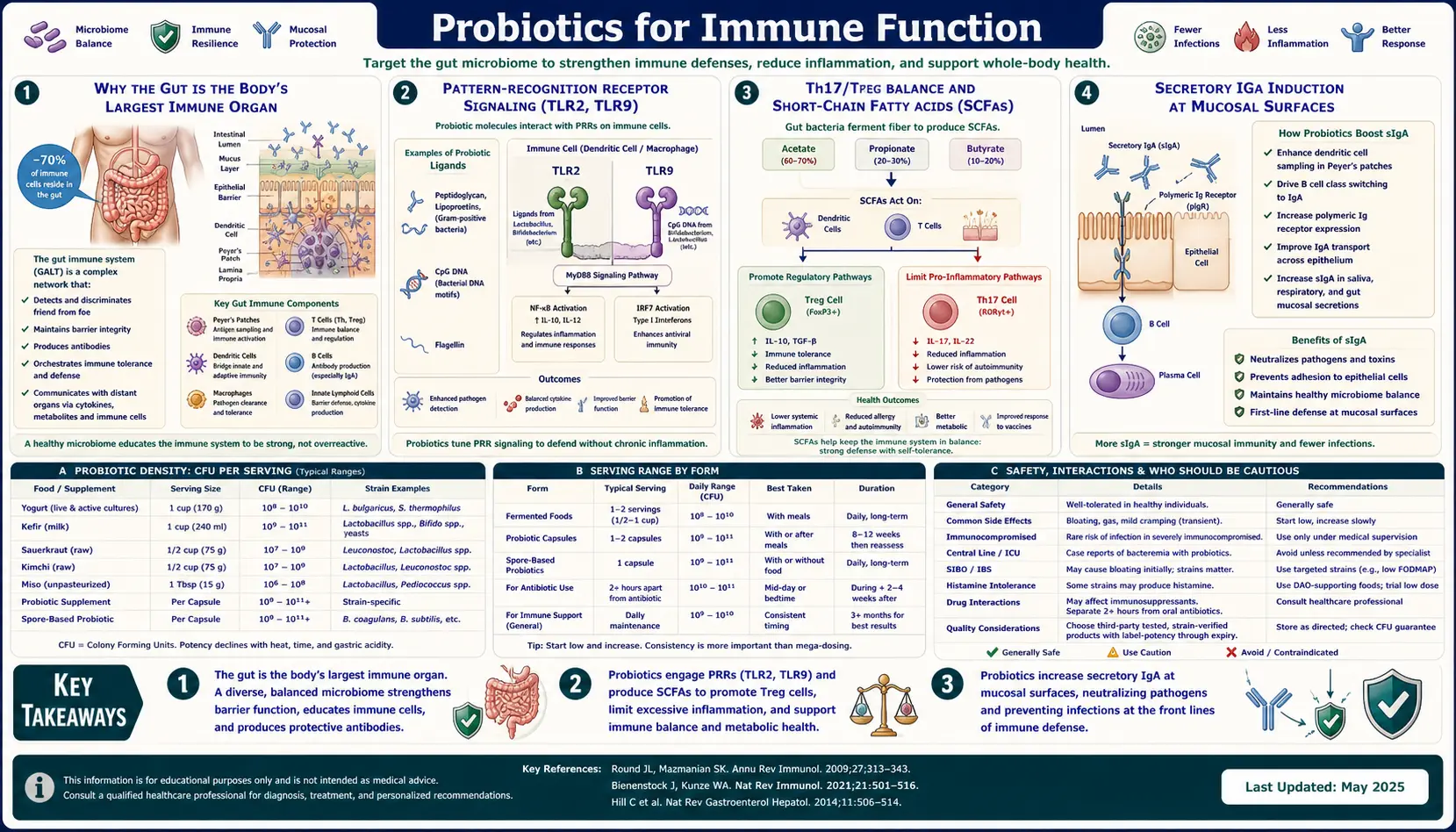
Approximately 70% of the body's immune tissue resides in or adjacent to the gut, packed into the gut-associated lymphoid tissue (GALT) that monitors the gut's microbial community on the lumen side of a single epithelial cell layer. Probiotics modulate that immune system in concrete, measurable ways: they induce secretory immunoglobulin A (IgA) production at mucosal surfaces, tilt T-cell differentiation toward the Treg pole through short-chain fatty acid signaling, signal through Toll-like receptors on dendritic cells, and produce bacteriocins that selectively suppress pathogens without disturbing commensals. The clinical research is most developed in two areas: prevention of upper respiratory tract infections (Cochrane reviews by Hao and colleagues: fewer people with at least one infection, odds ratio 0.53 across all ages in the 2015 version and risk ratio 0.76 in the 2022 update, with most of the evidence graded low quality) and prevention of atopic eczema in high-risk infants (the Kalliomaki 2001 Lancet trial and later trials). This deep-dive walks through the gut-immune axis architecture, the cytokine and antibody mechanisms, the key respiratory infection meta-analyses, the atopic disease prevention literature, and the practical implications.
Table of Contents
- Why the Gut Is the Body's Largest Immune Organ
- Pattern-Recognition Receptor Signaling (TLR2, TLR9)
- Th17 / Treg Balance and Short-Chain Fatty Acids
- Secretory Immunoglobulin A Induction at Mucosal Surfaces
- Bacteriocins and Direct Pathogen Defense
- Upper Respiratory Tract Infections (Children)
- Upper Respiratory Tract Infections (Adults)
- Atopic Eczema Prevention in High-Risk Infants
- Allergic Rhinitis and Asthma
- Autoimmunity Modulation (Conditional Evidence)
- Elderly Immune Senescence and Vaccine Response
- Cautions and Caveats
- Key Research Papers
- Connections
- Featured Videos
Why the Gut Is the Body's Largest Immune Organ
The gut is the largest immune organ in the body by tissue mass and by cell count. The gut-associated lymphoid tissue (GALT) includes Peyer's patches in the small intestine (organized lymphoid follicles overlain by specialized M cells that sample luminal antigens), isolated lymphoid follicles scattered along the colon, the mesenteric lymph nodes draining the entire gut, and the lamina propria densely populated with effector and regulatory B cells, T cells, dendritic cells, macrophages, and innate lymphoid cells. Estimates of the fraction of total-body immune cells residing in or adjacent to the gut vary from approximately 60% to 80%, with the most commonly cited figure being 70%.
The reason is biological necessity. The gut interfaces with the outside world through a single layer of epithelial cells. On the luminal side: a vast bacterial community (a 2016 estimate by Sender and colleagues put the bacteria in a 70 kg “reference man” at 3.8×10¹³ against 3.0×10¹³ human cells, updating the widely cited 10:1 ratio and showing the two numbers are of the same order), a continuous stream of dietary antigens (peanut proteins, gluten, casein, every molecule of every meal), occasional pathogens (Salmonella in undercooked chicken, Norovirus in shellfish, rotavirus from a contaminated surface). On the basolateral side: the bloodstream and the entire rest of the body. The immune system must continuously make the right call about each luminal item — tolerate commensal Bacteroides and tolerate this morning's eggs, attack a Salmonella invader — and a wrong call in either direction is catastrophic.
Probiotics participate in this decision-making in several ways simultaneously. They occupy ecological niches and binding sites that would otherwise be available to pathogens (competitive exclusion). They display surface molecules (lipoteichoic acid, peptidoglycan, certain exopolysaccharides) that are recognized by pattern-recognition receptors on epithelial and immune cells, biasing the local immune environment toward tolerogenic responses. They produce short-chain fatty acids (acetate, propionate, butyrate) that act on the GPR43 receptor and as histone deacetylase inhibitors to drive regulatory T-cell differentiation. They induce secretory immunoglobulin A production. And they produce bacteriocins that selectively kill specific pathogens. The four mechanisms operate in parallel and synergize.
Pattern-Recognition Receptor Signaling (TLR2, TLR9)
Pattern-recognition receptors (PRRs) are the immune system's molecular sensors for microbial "shapes." Toll-like receptors (TLRs) are the best-characterized family, with TLR2 sensing lipoteichoic acid and peptidoglycan from Gram-positive bacteria (most Lactobacillus and Bifidobacterium), TLR4 sensing lipopolysaccharide from Gram-negative bacteria, TLR9 sensing unmethylated CpG bacterial DNA motifs, and TLR3 sensing double-stranded viral RNA. NOD-like receptors (NLRs) are the intracellular complement, sensing peptidoglycan fragments that have entered the cytoplasm.
The functional consequence of PRR signaling depends entirely on context. The same TLR2 signal that triggers a powerful pro-inflammatory response when delivered systemically (TLR2 activation in the bloodstream during sepsis) triggers a tolerogenic response when delivered to gut dendritic cells in the presence of normal commensal organisms. The context-dependent integration is mediated by additional sensors: the local cytokine milieu, the presence or absence of complement activation, co-stimulatory signals on the dendritic cell surface, and other PRR signals received at the same time.
Probiotic strains differ measurably in their PRR signaling profiles. Lactobacillus rhamnosus GG and Lactobacillus plantarum WCFS1 are relatively "loud" TLR2 stimulators that induce more vigorous immune responses. Bifidobacterium species tend to be quieter TLR2 stimulators and stronger inducers of regulatory pathways. This signaling-profile difference is part of why Lactobacillus rhamnosus GG is one of the best-studied strains for active immune responses (atopic eczema prevention, antibiotic-associated diarrhea) while Bifidobacterium infantis 35624 is best-studied for low-grade inflammatory conditions (irritable bowel syndrome, IBS). Which strains have been studied for which goals therefore follows their signaling profiles. The strains-and-selection deep-dive walks through the strain-by-condition map in detail.
Th17 / Treg Balance and Short-Chain Fatty Acids
Naive CD4+ T cells encountering antigen can differentiate down several functional paths, including Th1 (intracellular pathogens, cellular immunity), Th2 (parasites, humoral immunity), Th17 (mucosal defense against extracellular bacteria and fungi), and Treg (regulatory cells that suppress inflammation and maintain tolerance to self-antigens and commensals). The Th17 / Treg balance is particularly important at mucosal surfaces because it determines whether the local immune response is in attack mode or tolerance mode.
Short-chain fatty acids (SCFAs) — acetate, propionate, and especially butyrate — produced by colonic fermentation of dietary fiber and resistant starch are powerful inducers of Treg differentiation. They act through two parallel mechanisms: signaling through the G-protein-coupled receptors GPR43 and GPR109A on T cells and epithelial cells, and direct inhibition of histone deacetylase (HDAC) activity that drives chromatin remodeling at the Treg-promoting transcription factor FOXP3 locus. The Smith 2013 paper and the Arpaia 2013 Nature paper independently established this mechanism, and it is now considered one of the most well-mapped microbiome-immune signaling axes.
Probiotic strains contribute to this axis in two ways. Some strains are themselves short-chain fatty acid (SCFA) producers (lactate is the primary Lactobacillus product, and is cross-fed by other species to become butyrate). Other strains do not produce short-chain fatty acids directly but support the broader commensal community that does. The net effect of probiotic supplementation, particularly when combined with prebiotic fiber intake, is increased short-chain fatty acid delivery to the colon and increased local Treg induction.
The clinical implications of this Treg-promoting effect are most measurable in conditions where excess Th17 activity drives pathology — inflammatory bowel disease, certain autoimmune conditions, atopic disease, and chronic inflammatory conditions associated with aging.
Secretory Immunoglobulin A Induction at Mucosal Surfaces
Secretory immunoglobulin A (sIgA) is the dominant antibody class at mucosal surfaces — the gut, respiratory tract, lacrimal and salivary glands, mammary glands during lactation, and the genitourinary tract. Total sIgA production exceeds total immunoglobulin G (IgG) production by mass. The molecule is secreted as a dimer joined by a J-chain and protected by a secretory component that helps it survive proteolysis in the gut lumen and at other mucosal interfaces. It functions both by direct antigen neutralization (binding bacterial adhesins and viral capsid proteins to block attachment to epithelium) and by immune exclusion (cross-linking microbes in the mucus layer and trapping them away from the epithelium).
Probiotic supplementation reliably increases sIgA production. The mechanism involves dendritic cell sensing of probiotic surface molecules, induction of TGF-beta and APRIL/BAFF cytokines that drive B-cell class switching to immunoglobulin A, and trafficking of newly committed immunoglobulin A-producing B cells back to mucosal surfaces. The Saavedra 1994 trial of Bifidobacterium bifidum + Streptococcus thermophilus in infants aged 5-24 months in a chronic-care hospital measured diarrhoea and rotavirus shedding rather than sIgA: diarrhoea developed in 8 of 26 infants (31%) on the standard formula and 2 of 29 (7%) on the supplemented formula, and rotavirus shedding in 39% and 10%. The Kaila 1992 trial of Lactobacillus rhamnosus GG in 39 children with acute rotavirus diarrhea showed faster mounting of rotavirus-specific immunoglobulin A and faster recovery: diarrhea lasted a mean of 1.1 days versus 2.5 days on placebo, and at convalescence 90% versus 46% had developed an IgA-specific antibody-secreting-cell response to rotavirus. The Maldonado 2012 trial of Lactobacillus fermentum CECT5716 in infants demonstrated reduced gastrointestinal and upper respiratory infection incidence consistent with the sIgA mechanism.
The lactating-mother application is particularly elegant. When a mother takes a probiotic that increases her mucosal sIgA, that increased immunoglobulin A is secreted into breast milk and passed to the infant. The infant receives both passive antibody protection and indirect microbial signaling. In a New Zealand trial of maternal-only Lactobacillus rhamnosus HN001 supplementation, however, HN001 could not be detected in the mothers' breast milk and breast-milk TGF-beta/IgA profiles were unchanged (Wickens and colleagues, 2018).
Bacteriocins and Direct Pathogen Defense
Bacteriocins are narrow-spectrum antimicrobial peptides produced by bacteria to inhibit other bacteria competing for the same ecological niche. Many Lactobacillus strains are prolific bacteriocin producers: nisin from Lactococcus lactis, plantaricin from Lactobacillus plantarum, sakacin from Lactobacillus sakei, reuterin from Lactobacillus reuteri. These molecules act through pore formation in target-cell membranes (similar to host antimicrobial peptides like defensins) but with much narrower target ranges than broad-spectrum antibiotics — typically inhibiting closely related Gram-positive bacteria while sparing the broader microbiome.
The narrow spectrum is a feature, not a bug. The reason broad-spectrum antibiotics cause Clostridioides difficile infection (CDI) and other dysbiosis-driven complications is precisely that they eliminate the commensal flora that normally outcompetes pathogens. Probiotic bacteriocins provide targeted inhibition of specific pathogens (Listeria, certain pathogenic E. coli, certain enterococci, in some cases C. difficile) without the collateral damage. S. boulardii's antimicrobial mechanism is different (it is a yeast, not a bacterium) and includes a protease that cleaves C. difficile toxin A directly.
Beyond bacteriocins, probiotic organisms acidify the local environment through lactate production, which inhibits acid-sensitive pathogens. They produce hydrogen peroxide and antimicrobial fatty acids. And they compete for receptor sites on epithelium that pathogens would otherwise use for attachment. The composite effect is meaningful targeted pathogen suppression.
Upper Respiratory Tract Infections (Children)
Children average 6-10 upper respiratory tract infections per year, with each typically lasting 7-14 days. The aggregate impact on school attendance, parental work absences, and antibiotic prescribing (most childhood URIs are viral but get treated with antibiotics anyway) is substantial. Probiotics have been studied as a prevention strategy in multiple randomized trials and meta-analyses.
The Hao Q et al. 2015 Cochrane meta-analysis pooled 12 trials of probiotics versus placebo for prevention of acute upper respiratory tract infections, with 3,720 participants total, including children, adults and older people. The findings:
- Probiotics reduced the number of participants experiencing at least one acute URI episode (odds ratio (OR) 0.53, 95% confidence interval 0.37 to 0.76; low-quality evidence)
- Probiotics reduced the mean duration of URI episodes by approximately 1.9 days (mean difference −1.89 days; low-quality evidence)
- Probiotics reduced antibiotic prescription for URIs (OR 0.65; moderate-quality evidence), a meaningful population-level benefit on antibiotic stewardship
- The rate of episodes was not significantly different (rate ratio 0.83, 95% confidence interval 0.66 to 1.05), and the authors graded the overall evidence low or very low quality
- The benefit was seen with multiple strains; Lactobacillus rhamnosus GG, Lactobacillus casei Shirota, and combinations were all positive
- The number-needed-to-treat to prevent one URI episode varied by season and population but was generally in the single digits
The 2022 update of the same Cochrane review (Zhao, Dong and Hao) pooled 23 trials with 6,950 participants of all ages. Probiotics may reduce the number of people with at least one upper respiratory infection (risk ratio (RR) 0.76; low-certainty evidence), may reduce the yearly rate of infections (rate ratio 0.82) and may shorten an episode by about 1.2 days (mean difference −1.22 days), and likely reduce the number of people using prescribed antibiotics for these infections (RR 0.58; moderate-certainty evidence). Side effects were minor, most commonly stomach and bowel symptoms such as vomiting, flatulence, diarrhoea and bowel pain.
The Maldonado J et al. 2012 trial gave infants a follow-on formula containing Lactobacillus fermentum CECT5716 (a strain originally isolated from breast milk) plus galactooligosaccharide, or the same formula with galactooligosaccharide only, between the ages of 6 and 12 months. The probiotic group had a 46% lower incidence rate of gastrointestinal infections (incidence rate ratio 0.54), a 27% lower incidence of upper respiratory tract infections (ratio 0.729) and 30% fewer infections in total (ratio 0.70) over the 6 months.
The collective evidence is strong enough that the World Gastroenterology Organisation lists URI prevention as one of the indications where probiotic strain-specific evidence supports use, and several pediatric societies have included probiotics as a conditional recommendation for prevention in children with frequent URIs.
Upper Respiratory Tract Infections (Adults)
The adult URI prevention evidence is smaller in magnitude than the pediatric evidence but still positive. The King 2014 systematic review and meta-analysis of probiotics for the duration of common acute respiratory infections in healthy children and adults pooled 20 trials and found:
- Probiotics shortened illness duration by an average of approximately 0.77 days (about 18 hours) per episode
- Participants had fewer days of illness per person (standardised mean difference (SMD) −0.31)
- Days absent from day care, school or work were reduced (SMD −0.17)
- Heterogeneity between studies could not be explained, which the authors read as a sign that effect sizes may differ between population groups
Several individual adult trials have looked at probiotics in specific populations under immune stress. The Tubelius 2005 trial of Lactobacillus reuteri in 262 healthy employees (day-workers and three-shift workers) over 80 days looked at sick leave for respiratory or gastrointestinal infections: among the 181 who followed the protocol, 26.4% on placebo reported such sick leave compared with 10.6% on L. reuteri, and sick days made up 0.9% versus 0.4% of the time; among the 53 shift-workers, 33% on placebo reported sick compared with none on L. reuteri. The Cox 2010 crossover trial of L. fermentum VRI-003 in 20 elite male distance runners over 4 months of winter training recorded 30 days of respiratory symptoms during probiotic treatment versus 72 days during placebo, with no significant change in salivary IgA. In a 2013 trial, 231 college students living in residence halls took Lactobacillus rhamnosus GG plus Bifidobacterium animalis ssp. lactis BB-12 or placebo for 12 weeks; among those who caught an upper respiratory infection, the median illness was 2 days shorter and the median severity score 34% lower with the probiotics than with placebo (Smith and colleagues).
Adult URI prevention is less consistently positive than pediatric prevention, perhaps because baseline rates are lower (giving less room for relative benefit) and adult immune function is more variable. The adult trials that found benefit were run in groups under some form of immune stress — employees including shift workers, college students living in residence halls, elite runners in winter training — over periods of 80 days to 4 months.
Atopic Eczema Prevention in High-Risk Infants
Atopic eczema (atopic dermatitis) is the chronic relapsing inflammatory skin condition that affects approximately 20% of children in Western countries. It is the typical first manifestation of the atopic march — the progression from infant eczema through childhood food allergy to school-age allergic rhinitis to adolescent asthma. Preventing eczema in high-risk infants (those with a first-degree relative with atopic disease) is therefore not just dermatologically valuable but potentially modifies the long-term allergic disease trajectory.
The Kalliomaki M et al. 2001 Lancet trial was the landmark study. 159 pregnant women with strong family history of atopy were randomized to Lactobacillus rhamnosus GG (LGG; 10 billion colony-forming units (CFU) a day) versus placebo, starting 2-4 weeks before delivery and continuing 6 months postpartum (through the lactating mother, or directly to the formula-fed infant). At age 2 years, the cumulative incidence of atopic eczema was:
- Placebo group: 46%
- LGG group: 23%
- Relative risk: 0.51 (statistically significant)
The benefit was sustained at 4-year and 7-year follow-up. At 4 years, 14 of 53 children who had received the lactobacillus had atopic eczema compared with 25 of 54 on placebo (relative risk 0.57), but skin-prick test reactivity was the same in both groups (10 of 50 versus 9 of 50). Subsequent trials of LGG and related strains have not all replicated the magnitude of effect, but the 2015 World Allergy Organization guidelines reviewed the evidence and made a conditional recommendation for probiotic supplementation in pregnant women whose infants are at high risk of atopic disease, in breastfeeding mothers of high-risk infants, and in high-risk infants themselves, specifically for eczema prevention. The same panel stated that currently available evidence “does not indicate that probiotic supplementation reduces the risk of developing allergy in children”, judged a likely net benefit mainly from preventing eczema, and described all its recommendations as “conditional and supported by very low quality evidence.”
The 2025 Cochrane review of probiotics given to infants (24 studies, 7,077 mother-infant pairs) found that probiotics “may result in a slight reduction in eczema by two years of age” (risk ratio 0.87, 95% confidence interval 0.78 to 0.97; low-certainty evidence), but the studies at low risk of bias showed little or no difference (risk ratio 0.86, 0.69 to 1.07), and there was little to no difference for asthma, allergic rhinitis or cow's milk protein allergy. The authors judged the evidence insufficient to draw conclusions; no serious adverse events related to probiotics were reported.
In a New Zealand trial of 474 infants at risk of allergic disease (Wickens and colleagues), mothers took Lactobacillus rhamnosus HN001, a second probiotic or placebo from 35 weeks of pregnancy until 6 months after birth if breastfeeding, and their infants received the same from birth to 2 years. HN001 reduced the risk of eczema by age 2 (hazard ratio 0.51) but not atopy; by age 6 it was associated with a lower cumulative prevalence of eczema (hazard ratio 0.56) and of skin-prick-test sensitization (hazard ratio 0.69). Giving the probiotic to mothers alone may not be enough: in a second New Zealand trial of 423 women, HN001 taken from 14-16 weeks of pregnancy until 6 months after birth if breastfeeding, but not given to the babies, did not significantly reduce infant eczema, wheeze or atopic sensitization by 12 months (Wickens and colleagues, 2018). The Slykerman 2017 report from that same 423-woman trial documented lower postpartum depression and anxiety scores in the supplemented mothers, an early sign of the gut-brain effect covered in the mental-health deep-dive.
The mechanism appears to involve Treg induction and Th2 suppression in the developing immune system during the critical "immune programming" window of late pregnancy and early infancy. Once atopic disease is established, the same probiotics have much smaller effect — prevention is much more powerful than treatment for this indication.
For deep coverage of atopic eczema, see our Eczema page.
Allergic Rhinitis and Asthma
The downstream allergic conditions on the atopic march — allergic rhinitis and asthma — have been studied with probiotics with smaller but generally positive effects. The Guvenc 2016 meta-analysis of probiotics for allergic rhinitis pooled 22 trials and found significant reduction in nasal and ocular symptom scores (standardized mean differences −1.23 and −1.84); all five studies using Lactobacillus paracasei strains showed clinically significant improvements, and the authors noted that heterogeneity was high.
For asthma, the evidence is more mixed. Several trials have found probiotic supplementation reduces exacerbation frequency or improves symptom control modestly, but the effect is generally smaller than for prevention of new atopic disease in infants. Probiotics are not a substitute for inhaled corticosteroids or other guideline-recommended asthma therapy.
The conceptual framework that ties these conditions together is the "hygiene hypothesis" or more accurately the "old friends hypothesis" — the idea that early-life exposure to a diverse microbial environment programs the developing immune system toward appropriate Th1/Treg balance, and that the reduced microbial exposure of modern Western childhood biases the immune system toward Th2-dominant atopic responses. Probiotic supplementation in the prenatal and early postnatal period is one way to partially restore that programming signal.
Autoimmunity Modulation (Conditional Evidence)
The same Treg-promoting mechanism that drives the atopic-prevention benefit has been hypothesized to help autoimmune conditions, where excess effector T-cell activity drives pathology. The evidence is mixed and condition-specific.
- Rheumatoid arthritis — small trials of Lactobacillus casei 01 and Bacillus coagulans GBI-30 have shown modest reductions in disease activity scores and inflammatory markers, but probiotics are not part of guideline therapy for rheumatoid arthritis (RA).
- Multiple sclerosis — a 2017 trial of a probiotic in 60 multiple sclerosis (MS) patients (Kouchaki and colleagues) had reported improved disability scores, but that paper was retracted in 2025 and no longer counts as evidence; the field is still in early-trial stages.
- Type 1 diabetes — observational data link early probiotic exposure to reduced type 1 diabetes risk, but interventional trials are not yet definitive.
- Hashimoto's thyroiditis and other autoimmune endocrinopathies — biologically plausible mechanism through Treg modulation, but specific trial evidence is limited.
Probiotics for autoimmune disease are an area of active research and biological plausibility but not yet an evidence-based primary intervention.
Elderly Immune Senescence and Vaccine Response
Immune function declines with age (immunosenescence), and vaccination responses are typically blunted in elderly recipients. Several trials have studied probiotics as a vaccine response adjuvant in older adults, with positive results for influenza vaccination in particular. Bifidobacterium lactis HN019, Lactobacillus rhamnosus GG, and several multi-strain formulations have been shown to enhance influenza vaccine antibody responses in adults aged 60+. The clinical translation to reduced influenza incidence is harder to demonstrate but biologically plausible.
Beyond vaccination, the broader question of whether probiotic supplementation reduces all-cause infection risk in elderly community-dwelling adults is being explored with generally modest positive effects. The benefit appears greater in elderly populations with established dysbiosis (post-antibiotic, post-hospitalization, in long-term care facilities) than in healthy community-dwelling elders.
Cautions and Caveats
- Severe immunocompromise — probiotic-derived bacteremia and fungemia have been documented in immunocompromised hosts (advanced human immunodeficiency virus (HIV), post-transplant, central venous catheters, neutropenia).
- Critical illness — the PROPATRIA trial documented increased mortality with multi-strain probiotics in predicted severe acute pancreatitis: 24 of 152 patients (16%) given the probiotic died compared with 9 of 144 (6%) on placebo, and nine probiotic patients developed bowel ischaemia (eight fatal) against none on placebo; the authors concluded that probiotic prophylaxis “should therefore not be administered in this category of patients” (Besselink and colleagues, 2008). The Lancet published an expression of concern about the trial report in 2010. The trial did not test other intensive care unit (ICU) settings.
- Probiotics are not interchangeable with antibiotics — for established active bacterial infection, probiotics are not a substitute for appropriate antimicrobial therapy. They are adjunct or preventive, not first-line treatment.
- Strain specificity matters — "probiotic" is a category like "drug." Specific strain at specific dose for specific condition is the appropriate level of precision. Generic multi-strain blends marketed for "immune support" without strain-specific trial evidence are weaker than well-studied single strains for specific indications.
- Quality control variability — independent testing has found probiotic products containing fewer CFU than labeled, different strains than labeled, and contaminating organisms. Third-party testing and full strain-identifier disclosure are what make it possible to check what a product contains.
- Drug timing — oral antibiotics can directly kill the supplemented organism, which is why probiotic doses are commonly spaced at least 2 hours apart from antibiotic doses.
- Histamine intolerance — some Lactobacillus strains produce histamine; in patients with mast cell activation syndrome or histamine intolerance, practitioners favour histamine-degrading strains (Bifidobacterium infantis, Lactobacillus plantarum, Lactobacillus rhamnosus) over histamine-producing ones.
Key Research Papers
- Hao Q, Dong BR, Wu T (2015). Probiotics for preventing acute upper respiratory tract infections. Cochrane Database of Systematic Reviews. (2):CD006895. — PubMed PMID: 25927096
- Zhao Y, Dong BR, Hao Q (2022). Probiotics for preventing acute upper respiratory tract infections. Cochrane Database of Systematic Reviews. 8(8):CD006895. — PubMed PMID: 36001877
- King S et al. (2014). Effectiveness of probiotics on the duration of illness in healthy children and adults who develop common acute respiratory infectious conditions: a systematic review and meta-analysis. British Journal of Nutrition. — PubMed PMID: 24780623
- Kalliomaki M et al. (2001). Probiotics in primary prevention of atopic disease: a randomised placebo-controlled trial. The Lancet. — PubMed PMID: 11297958
- Slykerman RF et al. (2017). Effect of Lactobacillus rhamnosus HN001 in pregnancy on postpartum symptoms of depression and anxiety: a randomised double-blind placebo-controlled trial. EBioMedicine. 24:159-165. — PubMed PMID: 28943228
- Wickens K et al. (2018). Maternal supplementation alone with Lactobacillus rhamnosus HN001 during pregnancy and breastfeeding does not reduce infant eczema. Pediatric Allergy and Immunology. 29(3):296-302. — PubMed PMID: 29415330
- Wickens K et al. (2008). A differential effect of 2 probiotics in the prevention of eczema and atopy: a double-blind, randomized, placebo-controlled trial. Journal of Allergy and Clinical Immunology. 122(4):788-794. — PubMed PMID: 18762327
- Wickens K et al. (2013). Early supplementation with Lactobacillus rhamnosus HN001 reduces eczema prevalence to 6 years: does it also reduce atopic sensitization? Clinical and Experimental Allergy. 43(9):1048-1057. — PubMed PMID: 23957340
- Maldonado J et al. (2012). Human milk probiotic Lactobacillus fermentum CECT5716 reduces the incidence of gastrointestinal and upper respiratory tract infections in infants. Journal of Pediatric Gastroenterology and Nutrition. — PubMed PMID: 21873895
- Smith TJ, Rigassio-Radler D, Denmark R, Haley T, Touger-Decker R (2013). Effect of Lactobacillus rhamnosus LGG and Bifidobacterium animalis ssp. lactis BB-12 on health-related quality of life in college students affected by upper respiratory infections. British Journal of Nutrition. 109(11):1999-2007. — PubMed PMID: 23020819
- Arpaia N et al. (2013). Metabolites produced by commensal bacteria promote peripheral regulatory T-cell generation. Nature. — PubMed PMID: 24226773
- Smith PM et al. (2013). The microbial metabolites, short-chain fatty acids, regulate colonic Treg cell homeostasis. Science. — PubMed PMID: 23828891
- Kaila M et al. (1992). Enhancement of the circulating antibody secreting cell response in human diarrhea by a human Lactobacillus strain. Pediatric Research. — PubMed PMID: 1324462
- Saavedra JM et al. (1994). Feeding of Bifidobacterium bifidum and Streptococcus thermophilus to infants in hospital for prevention of diarrhoea and shedding of rotavirus. The Lancet. 344(8929):1046-1049. — PubMed PMID: 7934445
- Kalliomaki M et al. (2003). Probiotics and prevention of atopic disease: 4-year follow-up of a randomised placebo-controlled trial. The Lancet. 361(9372):1869-1871. — PubMed PMID: 12788576
- Fiocchi A et al. (2015). World Allergy Organization-McMaster University Guidelines for Allergic Disease Prevention (GLAD-P): Probiotics. World Allergy Organization Journal. 8(1):4. — PubMed PMID: 25628773
- Wang HZ, Hayles EH, Fiander M, Sinn JK, Osborn DA (2025). Probiotics in infants for prevention of allergic disease. Cochrane Database of Systematic Reviews. 6(6):CD006475. — PubMed PMID: 40511642
- Tubelius P, Stan V, Zachrisson A (2005). Increasing work-place healthiness with the probiotic Lactobacillus reuteri: a randomised, double-blind placebo-controlled study. Environmental Health. 4:25. — PubMed PMID: 16274475
- Cox AJ, Pyne DB, Saunders PU, Fricker PA (2010). Oral administration of the probiotic Lactobacillus fermentum VRI-003 and mucosal immunity in endurance athletes. British Journal of Sports Medicine. 44(4):222-226. — PubMed PMID: 18272539
- Sender R, Fuchs S, Milo R (2016). Revised estimates for the number of human and bacteria cells in the body. PLoS Biology. 14(8):e1002533. — PubMed PMID: 27541692
- Forsythe P, Bienenstock J (2010). Immunomodulation by commensal and probiotic bacteria. Immunological Investigations. — PubMed PMID: 20450286
- Cuello-Garcia CA et al. (2015). Probiotics for the prevention of allergy: a systematic review and meta-analysis of randomized controlled trials. Journal of Allergy and Clinical Immunology. — PubMed PMID: 26044853
- Guvenc IA et al. (2016). Do probiotics have a role in the treatment of allergic rhinitis? A comprehensive systematic review and meta-analysis. American Journal of Rhinology and Allergy. — PubMed PMID: 27442711
PubMed Topic Searches
Connections
- All Food
- Probiotics Overview
- Probiotics Benefits Hub
- Probiotics for Gut Health
- Strains and Selection
- Mental Health and Gut-Brain Axis
- Fermented Foods
- Fermented Foods for Immune Function
- Immune Boosting
- Gut Healing
- Vitamin A for Immune Function
- Vitamin D3
- Vitamin C
- Zinc
- Eczema (Atopic Dermatitis)
- Asthma
- Pneumonia
- Allergy & Immunology
- Yogurt
- History