⚠ Evidence warning: Clinical trials or other evidence do not support the claim that starting a probiotic within 1-2 days of the first antibiotic dose, at more than 10 billion CFU a day, concentrates the benefit against Clostridioides difficile infection. This page keeps it as a report of what people, websites or other media say.
Probiotics for Gut Health
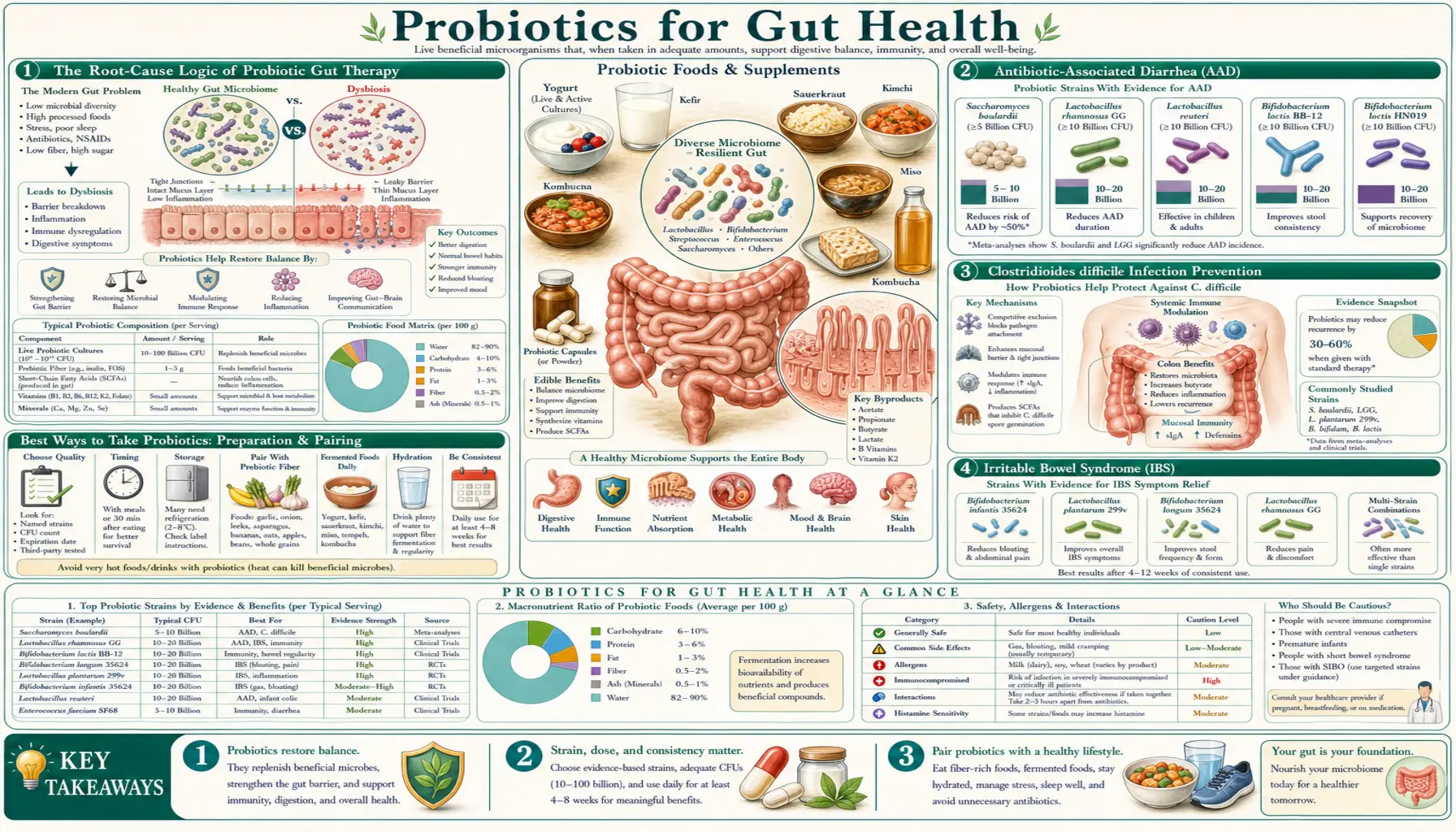
Gut health is the area where probiotic evidence is strongest, oldest, and most clinically actionable. Three indications carry guideline-level recommendations from major gastroenterology bodies: prevention of antibiotic-associated diarrhea (number-needed-to-treat around 13 in a 2012 pooled analysis of adult and child trials by Hempel and colleagues), prevention of Clostridioides difficile infection in inpatients receiving antibiotics (the 2017 Cochrane review reported a 60% relative risk reduction; its 2025 update reports 1.6% versus 3.2%, a risk ratio of 0.50 on low-certainty evidence, or one case prevented for every 65 people taking probiotics), and maintenance of remission in chronic pouchitis (a high-dose eight-strain formula, the only inflammatory bowel disease (IBD) indication with consistent positive Cochrane-level evidence). For irritable bowel syndrome, the 2020 American Gastroenterological Association guideline makes no recommendation outside clinical trials, although some strains, particularly Bifidobacterium infantis 35624, show modest symptom benefit in randomized trials. This deep-dive walks through each indication with its evidence, the strains and doses studied, and what is known about using them.
Table of Contents
- The Root-Cause Logic of Probiotic Gut Therapy
- Antibiotic-Associated Diarrhea (AAD)
- Clostridioides difficile Infection Prevention
- Irritable Bowel Syndrome (IBS)
- Inflammatory Bowel Disease and Pouchitis
- Helicobacter pylori Eradication Adjunct
- Traveler's Diarrhea Prevention
- Infant Colic and Functional Bowel Symptoms
- Probiotics and Small Intestinal Bacterial Overgrowth — The Controversy
- Intestinal Permeability ("Leaky Gut")
- Cautions and Contraindications
- Key Research Papers
- Connections
- Featured Videos
The Root-Cause Logic of Probiotic Gut Therapy
The standard pharmacologic approach to most gut conditions is to suppress a symptom — loperamide for diarrhea, proton pump inhibitors for reflux, antispasmodics for cramping, antibiotics for bacterial overgrowth. Each of these can be necessary and appropriate in the right clinical context, but none of them addresses why the gut became symptomatic in the first place. Probiotics occupy a different therapeutic niche. They do not block a receptor or shut off a secretion. They reintroduce specific microbial inputs into a system that has lost them — through antibiotic exposure, dietary impoverishment, infection, surgery, age, or stress — and they let the gut's own homeostatic machinery do the work.
This is why probiotic therapy is most useful in conditions defined by microbial disturbance (dysbiosis, post-antibiotic dysbiosis, post-infectious irritable bowel syndrome) and least useful in conditions defined by structural pathology (mechanical bowel obstruction, ischemic colitis, primary motility disorders). It is also why strain specificity matters so much: each strain has a particular ecological niche it can occupy and a particular signaling profile it brings to the host, which is why trial results are read strain by strain and condition by condition.
The flip side of this logic is that probiotics work best as part of a broader gut-restoration strategy. Replacing the lost microbes is necessary but typically not sufficient. Feeding them (prebiotic fiber from fruits, vegetables, legumes, whole grains), removing what is suppressing them (sometimes processed foods, sometimes alcohol, sometimes a specific food trigger), and addressing the upstream cause (stress, sleep deprivation, sedentary lifestyle) all matter. The gut-healing remedies page covers the broader strategy that probiotics fit inside.
The restoration idea has been tested directly. A 2018 study in Cell sampled the gut lining itself, in people and in mice, after antibiotics. Compared with recovery on its own, a multi-strain probiotic "induced a markedly delayed and persistently incomplete" return of the gut's own microbes, while a transplant of the person's own stored stool brought a rapid, near-complete recovery within days. The authors write that potential probiotic benefits after antibiotics "may be offset by a compromised gut mucosal recovery."
Antibiotic-Associated Diarrhea (AAD)
Antibiotic-associated diarrhea is the single most-studied probiotic indication. Approximately one in five adults and one in three children develop diarrhea during or shortly after a course of broad-spectrum antibiotics. The mechanism is straightforward — antibiotics disturb the colonic microbial community, eliminating the bacteria that normally ferment undigested carbohydrates into short-chain fatty acids and that compete with opportunistic pathogens. The result is osmotic diarrhea (undigested carbohydrate in the colon), inflammatory diarrhea (opportunistic C. difficile overgrowth in a minority of cases), and disrupted gut motility.
The Guo 2019 Cochrane meta-analysis on pediatric AAD pooled 33 trials in 6,352 children. The findings:
- Probiotics reduced the incidence of AAD from approximately 19% to 8% — an absolute risk reduction of 11% and a relative risk of 0.45
- The number-needed-to-treat to prevent one case of AAD was approximately 9
- The strongest evidence supported Lactobacillus rhamnosus GG at 10-20 billion CFU/day and Saccharomyces boulardii at 250-500 mg/day (approximately 5 billion CFU)
- Lower doses (less than 5 billion CFU/day) showed no clear benefit; at 5 billion CFU/day or more, the number needed to treat was 6 (95% confidence interval 5 to 9)
- Adverse events were rare and not different from placebo
The corresponding adult evidence is similar in magnitude but smaller in trial number. The PLACIDE trial (Allen 2013), the largest single adult AAD probiotic trial, did not show benefit: antibiotic-associated diarrhea occurred in 10.8% on the probiotic and 10.4% on placebo (relative risk 1.04, 95% confidence interval 0.84 to 1.28), and C. difficile diarrhea in 0.8% and 1.2% (relative risk 0.71, 0.34 to 1.47). The multi-strain formula used was different from the well-studied L. rhamnosus GG and S. boulardii preparations, and the population was elderly inpatients, where competing factors may have masked the effect. The dose does not explain the result: at 60 billion organisms a day it was well above the 5 billion threshold in the Guo review.
Pooled data covering adults and children also exist. Hempel and colleagues (2012, 63 trials, 11,811 people) reported a relative risk of 0.58 (0.50 to 0.68) and a number needed to treat of 13, with significant differences between trials. The 2025 Cochrane update (40 studies, 13,419 people) reported 23% versus 27.4%, a risk ratio of 0.67 (0.57 to 0.78), on low-certainty evidence.
How it has been used: with broad-spectrum antibiotics (amoxicillin-clavulanate, fluoroquinolones, clindamycin in particular), the regimens described are L. rhamnosus GG at 10-20 billion CFU/day or S. boulardii 250 mg twice daily, starting on day 1 of antibiotics and continuing for at least a week after the antibiotics finish. Practitioners describe spacing the probiotic at least 2 hours from the antibiotic dose to limit direct kill of the supplemented organism.
Clostridioides difficile Infection Prevention
Clostridioides difficile (formerly Clostridium difficile, the same organism with an updated taxonomic classification) is the most consequential complication of post-antibiotic gut dysbiosis. It accounts for hundreds of thousands of healthcare-associated infections per year in the United States, tens of thousands of deaths, and a per-case treatment cost in the high four figures. The infection is driven by overgrowth of toxin-producing C. difficile in an antibiotic-disrupted colonic community that has lost the normal commensal organisms that would otherwise outcompete it.
Goldenberg JZ et al. (2017), the Cochrane meta-analysis on probiotics for C. difficile infection prevention, included 39 trials in 9,955 adults and children at risk of C. difficile infection (typically hospitalized patients receiving antibiotics); its main analysis covered 31 trials and 8,672 people. The findings:
- Probiotics reduced the incidence of C. difficile infection from approximately 4.0% to 1.5% — a relative risk of 0.40 (60% relative risk reduction)
- The number-needed-to-treat to prevent one C. difficile infection case was approximately 42 in the overall analysis, and 12 in a later subgroup analysis of trials with a baseline risk above 5%; trials with a baseline risk of 5% or lower showed no difference
- The review's abstract reports similar results across probiotic species and for lower versus higher doses, and baseline risk is the only subgroup effect it names. The claim that the benefit is concentrated in an early start (within 1-2 days of the first antibiotic dose) and a dose above 10 billion CFU/day is not from this abstract
- Both S. boulardii and combinations of Lactobacillus + Bifidobacterium were effective
- Adverse events were reported in 32 studies (8,305 people) and were less common with probiotics (risk ratio 0.83, 0.71 to 0.97; very low certainty). The authors describe short-term use as appearing safe in people who are not immunocompromised or severely debilitated. The statement that the trials specifically monitored for probiotic bacteremia and found no excess in non-immunocompromised patients is not in the abstract
The 2025 Cochrane update (47 studies, 15,260 people) reports a smaller relative effect than the 2017 version. In 38 trials and 13,179 people, the infection occurred in 1.6% on probiotics and 3.2% on control (risk ratio 0.50, 0.38 to 0.64; low certainty), or one case prevented for every 65 people taking probiotics (95% confidence interval 48 to 97). The authors say probiotics "may be effective" with "a small absolute benefit," and they note affiliation with or funding from probiotic companies in 28 studies.
The ACG (American College of Gastroenterology) 2021 C. difficile infection guideline gives a conditional recommendation against routine probiotic prophylaxis, citing residual uncertainty and concerns about implementation feasibility in hospital pharmacies. The AGA (American Gastroenterological Association) 2020 probiotic guideline gives a conditional recommendation for probiotic use in hospitalized adults and children receiving antibiotics for C. difficile infection prevention. The two guidelines, looking at largely the same evidence base, weighted the considerations differently.
The number needed to treat is 12 to 42 in the 2017 review, depending on baseline risk, and 65 in the 2025 update. The cost is low (a few dollars per day), and the 2025 update reports that short-term use is likely not associated with adverse effects in people who are not immunocompromised. Many hospitalists add S. boulardii 250 mg twice daily or a high-quality Lactobacillus/Bifidobacterium formula at greater than 10 billion CFU/day for the duration of antibiotic exposure, particularly in patients with prior C. difficile infection history, prolonged antibiotic courses, or high-risk antibiotics (clindamycin, fluoroquinolones, third-generation cephalosporins).
The mechanism is well-characterized: S. boulardii produces a protease that cleaves both C. difficile toxin A and the cell-surface receptor toxin A binds, blocking the proximal toxic event. Lactobacillus strains contribute through competitive exclusion at the colonic epithelium and through bacteriocin production that selectively inhibits C. difficile growth.
For infection that keeps coming back, a different kind of product exists. An oral capsule of purified bacterial spores, tested as SER-109 (four capsules daily for 3 days after standard antibiotics), was compared with placebo in a trial funded by its maker: of 182 people who had already had three or more episodes, 12% on the capsule and 40% on placebo had a recurrence within 8 weeks (relative risk 0.32, 0.18 to 0.58). The FDA approved it in April 2023 for people 18 and older after antibiotic treatment for recurrent infection. It is an FDA-approved fecal microbiota product, separate from store-bought probiotics.
Irritable Bowel Syndrome (IBS)
Irritable bowel syndrome is a functional gastrointestinal disorder characterized by chronic abdominal pain, bloating, and altered bowel habits, in the absence of structural pathology. It affects approximately 10-15% of adults in Western countries. The gut microbiome has been implicated through multiple lines of evidence: post-infectious irritable bowel syndrome (Campylobacter or Salmonella gastroenteritis triggers irritable bowel syndrome in approximately 10% of patients), the association of irritable bowel syndrome with small intestinal bacterial overgrowth (SIBO) in a subset of patients, and the symptomatic response to manipulation of the microbiome with antibiotics (rifaximin) and probiotics.
The AGA 2020 probiotic clinical practice guideline reviewed the irritable bowel syndrome literature and made no recommendation for routine use: it recommends probiotics for symptomatic irritable bowel syndrome only in the context of a clinical trial, describing a knowledge gap and citing high heterogeneity across trials and concerns about strain-product variability. However, the AGA noted that individual patients could try specific well-studied strains, and the World Gastroenterology Organisation 2017 guidelines were more positive, listing several strains with strain-specific evidence.
The strongest single-strain irritable bowel syndrome trial is Whorwell PJ et al. (2006), a multicenter randomized controlled trial of Bifidobacterium infantis 35624 (now reclassified as Bifidobacterium longum subsp. infantis 35624) in 362 women with irritable bowel syndrome. The 100 million CFU dose was significantly better than placebo and the other doses for the primary outcome, abdominal pain or discomfort, and also for a composite score and for bloating, bowel dysfunction, incomplete evacuation, straining, and gas. The 1 million and 10 billion CFU doses were not significantly different from placebo. The mechanism appears to involve modulation of mucosal cytokine production — particularly the IL-10/IL-12 ratio — rather than ecological displacement of pathogenic organisms.
Other strains with positive irritable bowel syndrome trial data include Lactobacillus plantarum 299v, Saccharomyces boulardii, and an eight-strain formula. The Bifidobacterium longum NCC3001 trial (Pinto-Sanchez 2017), a pilot in 44 adults, is also notable because it measured both irritable bowel syndrome symptoms and depression scores. Depression scores fell by 2 points or more in 14 of 22 patients versus 7 of 22 on placebo (P=.04), but the strain "had no significant effect on anxiety or IBS symptoms" — an early demonstration of the gut-brain crossover for irritable bowel syndrome-associated mood symptoms.
How it has been used: practitioners describe a trial of a single specific strain (not a generic "irritable bowel syndrome support" multi-strain blend) for 4-8 weeks at the labeled dose, continued only if clearly helpful. The strains with the best individual-trial evidence are Bifidobacterium longum subsp. infantis 35624, Lactobacillus plantarum 299v, and Saccharomyces boulardii CNCM I-745. Our Irritable Bowel Syndrome page has deep coverage of irritable bowel syndrome as a clinical entity.
Inflammatory Bowel Disease and Pouchitis
Inflammatory bowel disease — Crohn's disease and ulcerative colitis — is a relapsing chronic inflammatory condition of the gastrointestinal tract with substantial genetic and microbiome components. Patients and clinicians have long hoped that probiotic therapy could replace or supplement the immunosuppressive drugs that form the modern inflammatory bowel disease treatment standard. The actual evidence is more nuanced.
For active Crohn's disease, probiotics have not demonstrated benefit for inducing or maintaining remission in randomized trials. The European Crohn's and Colitis Organisation guidelines do not recommend probiotics for Crohn's disease at any stage.
For ulcerative colitis, the evidence is mixed but slightly more promising. Several trials of Escherichia coli Nissle 1917 (a non-pathogenic strain isolated in 1917 from a soldier who remained healthy during a dysentery outbreak) have shown comparable efficacy to low-dose mesalazine for maintenance of remission in mild-to-moderate ulcerative colitis; that is keeping remission, not treating an active flare. In Kruis 2004 (327 patients), relapse occurred in 36.4% on the probiotic and 33.9% on mesalazine over 12 months. E. coli Nissle is widely used in Germany for this indication; it is harder to obtain in the United States.
For pouchitis — inflammation of the surgically created ileal pouch after total colectomy for ulcerative colitis or familial adenomatous polyposis — the evidence is the clearest in inflammatory bowel disease. An eight-strain formula (8 strains of Lactobacillus, Bifidobacterium, and Streptococcus salivarius ssp. thermophilus) at high dose (approximately 900 billion CFU/day) maintains remission in chronic pouchitis significantly better than placebo. The Mimura 2004 trial (36 patients, 6 g once daily for a year; remission held in 85% versus 6% on placebo) and several subsequent randomized controlled trials (RCTs) and meta-analyses support this. This is the single strongest inflammatory bowel disease probiotic indication.
The American Gastroenterological Association's 2024 pouchitis guideline conditionally suggests probiotics to prevent recurrent pouchitis in people whose episodes respond to antibiotics. For pouchitis that relapses shortly after antibiotics stop, it suggests long-term antibiotics, or advanced immune-suppressing drugs for those who cannot tolerate them or are concerned about long-term antibiotic risks; for pouchitis that responds poorly to antibiotics, it suggests advanced immune-suppressing drugs.
The bigger picture for inflammatory bowel disease is that the microbiome contribution is being explored more aggressively through fecal microbiota transplantation (FMT), defined-consortium therapies, and microbiome-targeted small molecules. Single-strain or even multi-strain probiotics may be too low-dimensional an intervention for the complex dysbiosis of inflammatory bowel disease.
Helicobacter pylori Eradication Adjunct
Helicobacter pylori is the spiral-shaped bacterial colonizer of the gastric mucosa, present in approximately half of the world's population, and the proximate cause of most peptic ulcer disease and a substantial fraction of gastric adenocarcinoma. Eradication therapy is typically a 10-14-day "triple" or "quadruple" antibiotic regimen, with eradication rates around 70-85% in the modern era of rising antibiotic resistance.
Multiple meta-analyses have shown that adding specific probiotic strains to standard eradication therapy modestly improves the eradication rate (typically by 7-13 percentage points) and substantially reduces the gastrointestinal side effects of the antibiotics. The best-studied strains are Lactobacillus reuteri DSM 17938, Saccharomyces boulardii, and Lactobacillus rhamnosus GG. The mechanism appears to combine direct anti-H. pylori activity (some Lactobacillus strains produce antibacterial substances active against H. pylori), maintenance of gastric mucus integrity, and reduction of antibiotic-induced AAD that would otherwise lead patients to discontinue the eradication course early.
The regimens described alongside H. pylori eradication add L. reuteri DSM 17938 100 million CFU twice daily or S. boulardii 250 mg twice daily for the duration of the antibiotic course plus 2-4 weeks afterward, a low-cost addition with the efficacy and tolerability benefits reported above.
Traveler's Diarrhea Prevention
Traveler's diarrhea affects 30-70% of travelers to high-risk destinations and is caused by enteric bacterial pathogens (enterotoxigenic E. coli, Campylobacter, Shigella, Salmonella), enteric viruses, and protozoa. The standard prevention measures (food and water precautions, hand hygiene) have a real but incomplete benefit; antibiotic prophylaxis is generally not recommended because of the resistance and side-effect concerns.
Probiotic prophylaxis has been studied with modest positive results. Saccharomyces boulardii at 250-1000 mg/day starting 5 days before travel and continuing throughout the trip reduces the incidence of traveler's diarrhea by approximately 20-25% in meta-analyses. A 2019 meta-analysis by McFarland and Goh (12 trials reviewed, 6 pooled) reported a relative risk of 0.79 (0.72 to 0.87) for S. boulardii. Lactobacillus rhamnosus GG showed only a trend in that analysis (p=0.08), and L. acidophilus no significant reduction (p=0.16). A 2024 network analysis of 31 trials (10,879 people) found bismuth subsalicylate and rifaximin more effective than placebo and the other options, with more adverse events on bismuth subsalicylate. The probiotic effect is not large enough to substitute for food and water precautions, but it is used as an adjunct by travelers to high-risk destinations, particularly those with a history of severe traveler's diarrhea or with conditions that would make a bout particularly disruptive (immunosuppression, pregnancy, inflammatory bowel disease).
Infant Colic and Functional Bowel Symptoms
Infant colic — the syndrome of prolonged, inconsolable crying in an otherwise-well infant in the first three months of life — affects approximately 20% of infants and is one of the most distressing conditions in early infancy. The cause is multifactorial and includes immature gut motility, gut microbiome composition differences, and feeding/temperament factors.
Lactobacillus reuteri DSM 17938 has been studied in multiple randomized trials in colicky infants, with conflicting results that, in the words of the Sung 2018 authors, "prevented a consensus." The Sung 2018 individual-participant-data meta-analysis pooled four randomized trials (345 infants) and found that L. reuteri DSM 17938 at 100 million CFU/day for 21-28 days reduced crying time by approximately 25 minutes per day at day 21 compared to placebo, with the largest effect in exclusively breastfed infants (number needed to treat for treatment success at day 21: 2.6, 95% confidence interval 2.0 to 3.6). The effect was insignificant in formula-fed infants, with too little data to conclude. A 2014 community trial of 167 breastfed and formula-fed infants went the other way: at 1 month the probiotic group cried or fussed 49 minutes more than placebo (8 to 90 minutes, P=0.02). The European Society for Pediatric Gastroenterology, Hepatology and Nutrition (ESPGHAN) conditionally recommends L. reuteri DSM 17938 for breastfed infants with colic.
Beyond colic, L. reuteri DSM 17938 has shown benefit in functional constipation and regurgitation in infants, though the evidence base is smaller.
Probiotics and Small Intestinal Bacterial Overgrowth — The Controversy
Small intestinal bacterial overgrowth (SIBO) is the proliferation of bacteria in the small intestine, normally a relatively low-bacterial environment, producing bloating, abdominal pain, gas, and diarrhea or constipation. It overlaps significantly with the irritable bowel syndrome-with-bloating phenotype and is diagnosed by breath testing (hydrogen or methane breath response to glucose or lactulose) or by jejunal aspirate culture.
The role of probiotics in small intestinal bacterial overgrowth is genuinely controversial. The theoretical argument against probiotic use is that adding more bacteria to a small intestine that already has too many bacteria is intuitively counterproductive. The competing argument for probiotic use is that selective addition of beneficial strains (which transit through and do not colonize) may displace the problematic overgrowth organisms and modulate mucosal immunity.
The clinical evidence is mixed. Some small trials have shown symptom benefit from Lactobacillus-based formulas; others have shown worsening, particularly with D-lactate producing strains in patients with D-lactic acidosis susceptibility (rare). The 2018 Rao study suggesting probiotics could trigger D-lactic acidosis and "brain fog" in patients with small intestinal bacterial overgrowth has been widely cited. It compared 30 patients with brain fog with 8 without (small intestinal bacterial overgrowth 68% versus 28%, D-lactic acidosis 77% versus 25%), and brain fog resolved in 23 of the 30 after stopping probiotics and taking antibiotics. The authors write "possibly related" to probiotic use; the study is small and does not establish causation. Our small intestinal bacterial overgrowth page and its deep-dive sub-articles cover the controversy in more detail.
A conservative approach some clinicians describe holds probiotics in active symptomatic small intestinal bacterial overgrowth until after the initial antibiotic eradication phase (typically rifaximin, with or without neomycin or metronidazole). After eradication, Saccharomyces boulardii (a yeast, unaffected by the bacterial overgrowth concern) or a low-dose targeted single-strain Lactobacillus is sometimes tried if symptoms recur.
Intestinal Permeability ("Leaky Gut")
Increased intestinal permeability — the phenomenon where the tight junctions between intestinal epithelial cells become looser, allowing larger molecules (bacterial lipopolysaccharide, food antigens) to cross from the gut lumen into the lamina propria and bloodstream — is a measurable physiologic state with implications for systemic inflammation and autoimmune disease. The popular term "leaky gut" has been overused and oversimplified, but the underlying biology is real.
Probiotics modulate intestinal permeability through several mechanisms: Lactobacillus rhamnosus GG and L. plantarum upregulate the tight junction proteins occludin and claudin-1, Bifidobacterium infantis reduces tumor necrosis factor-alpha-induced barrier disruption, and short-chain fatty acid production from probiotic fermentation supports colonocyte energy metabolism and barrier function. In randomized trials in conditions associated with elevated permeability (alcoholic liver disease, exercise-induced permeability, nonsteroidal anti-inflammatory drug (NSAID)-induced gut injury), probiotic supplementation has measurably reduced lactulose/mannitol ratio markers of permeability.
The clinical translation to specific disease outcomes is less established — reducing a permeability biomarker is not the same as preventing disease. But for patients with conditions associated with chronic barrier disruption (inflammatory bowel disease, alcoholic liver disease, intensive endurance training), targeted probiotic use is described as one option alongside work on the upstream cause.
Cautions and Contraindications
- Severely immunocompromised patients — case reports of probiotic-derived bacteremia, fungemia, and endocarditis exist for patients with central venous catheters, severe neutropenia, advanced human immunodeficiency virus (HIV), post-transplant immunosuppression, and critical illness. The Yelin 2019 study reported a markedly higher risk of Lactobacillus bacteremia in intensive care unit (ICU) patients treated with probiotics, with genomic evidence that the blood isolates came from the probiotic product. The research raises a concern for probiotic use in these populations.
- Critically ill patients with severe pancreatitis — the PROPATRIA trial (Besselink 2008 Lancet) found increased mortality with multi-strain probiotic supplementation in predicted severe acute pancreatitis: 16% died on the probiotic versus 6% on placebo (relative risk 2.53, 1.22 to 5.25), and nine patients on the probiotic developed bowel ischemia (eight fatal) versus none on placebo. The authors concluded that probiotic prophylaxis should not be given to this category of patients. The Lancet published an Expression of Concern about this paper in 2010.
- Central venous catheter in place — relative contraindication due to risk of catheter colonization and bacteremia.
- Short bowel syndrome — D-lactate-producing Lactobacillus strains can cause D-lactic acidosis in patients with short bowel and excessive carbohydrate fermentation. S. boulardii (yeast) or non-D-lactate-producing strains are described as lower-risk.
- Drug interactions — immunosuppressants (probiotic theoretical interaction with response, though not clinically validated); aminoglycoside antibiotics (will kill the probiotic if taken at the same time; the spacing described is at least 2 hours).
- Product quality variability — independent testing has repeatedly documented probiotic products containing fewer CFU than labeled, different strains than labeled, or contaminating organisms. Some products publish third-party testing and list specific strain designations (genus, species, AND strain identifier) on the label.
- Pregnancy and lactation — most well-studied probiotic strains are considered safe in pregnancy and lactation, and several have been specifically studied in these populations. L. rhamnosus HN001, given from 14-16 weeks of pregnancy, was followed by lower postpartum depression scores (7.7 versus 9.0, p=0.037) and anxiety scores in the Slykerman 2017 trial and reduced infant atopic eczema in earlier trials. Novel or poorly characterized strains lack this kind of study in pregnancy.
- Preterm newborns — the US Food and Drug Administration has issued an advisory cautioning against routine probiotics in preterm newborns. In 2024, authors from European pediatric nutrition and newborn-care groups responded by arguing for "a more nuanced and supportive approach" to certain probiotics in these infants.
Key Research Papers
- Goldenberg JZ et al. (2017). Probiotics for the prevention of Clostridium difficile-associated diarrhea in adults and children. Cochrane Database. — PubMed PMID: 29257353
- Guo Q et al. (2019). Probiotics for the prevention of pediatric antibiotic-associated diarrhea. Cochrane Database. — PubMed PMID: 31039287
- Whorwell PJ et al. (2006). Efficacy of an encapsulated probiotic Bifidobacterium infantis 35624 in women with irritable bowel syndrome. American Journal of Gastroenterology. — PubMed PMID: 16863564
- Mimura T et al. (2004). Once daily high dose probiotic therapy (VSL#3) for maintaining remission in recurrent or refractory pouchitis. Gut 53:108-114. — PubMed PMID: 14684584
- Allen SJ et al. (2013). Lactobacilli and bifidobacteria in the prevention of antibiotic-associated diarrhoea and Clostridium difficile diarrhoea in older inpatients (PLACIDE). The Lancet. — PubMed PMID: 23932219
- Su GL et al. (2020). AGA Clinical Practice Guidelines on the Role of Probiotics in the Management of Gastrointestinal Disorders. Gastroenterology 159:697-705. — PubMed PMID: 32531291
- McFarland LV (2010). Systematic review and meta-analysis of Saccharomyces boulardii in adult patients. World Journal of Gastroenterology. — PubMed PMID: 20458757
- Sung V et al. (2018). Lactobacillus reuteri to treat infant colic: a meta-analysis of individual participant data. Pediatrics. — PubMed PMID: 29279326
- Besselink MG et al. (2008). Probiotic prophylaxis in predicted severe acute pancreatitis (PROPATRIA). The Lancet 371:651-659. — PubMed PMID: 18279948 Note: an Expression of Concern about this paper appeared in The Lancet 2010;375:875-876.
- Suez J et al. (2018). Post-antibiotic gut mucosal microbiome reconstitution is impaired by probiotics and improved by autologous FMT. Cell. — PubMed PMID: 30193113
- Kruis W et al. (2004). Maintaining remission of ulcerative colitis with the probiotic Escherichia coli Nissle 1917 is as effective as with standard mesalazine. Gut. — PubMed PMID: 15479682
- Hill C et al. (2014). The International Scientific Association for Probiotics and Prebiotics consensus statement on the scope and appropriate use of the term probiotic. Nature Reviews Gastroenterology & Hepatology 11:506-514. — PubMed PMID: 24912386
- Esmaeilinezhad Z et al. (2025). Probiotics for the prevention of Clostridioides difficile-associated diarrhea in adults and children. Cochrane Database 9:CD006095. — PubMed PMID: 40931979
- Hempel S et al. (2012). Probiotics for the prevention and treatment of antibiotic-associated diarrhea: a systematic review and meta-analysis. JAMA 307:1959-1969. — PubMed PMID: 22570464
- Feuerstadt P et al. (2022). SER-109, an oral microbiome therapy for recurrent Clostridioides difficile infection. New England Journal of Medicine 386:220-229. — PubMed PMID: 35045228
- Barnes EL et al. (2024). AGA Clinical Practice Guideline on the Management of Pouchitis and Inflammatory Pouch Disorders. Gastroenterology 166:59-85. — PubMed PMID: 38128971
- Pinto-Sanchez MI et al. (2017). Probiotic Bifidobacterium longum NCC3001 reduces depression scores and alters brain activity: a pilot study in patients with irritable bowel syndrome. Gastroenterology 153:448-459. — PubMed PMID: 28483500
- Sung V et al. (2014). Treating infant colic with the probiotic Lactobacillus reuteri: double blind, placebo controlled randomised trial. BMJ 348:g2107. — PubMed PMID: 24690625
- Szajewska H et al. (2023). Probiotics for the management of pediatric gastrointestinal disorders: position paper of the ESPGHAN Special Interest Group on Gut Microbiota and Modifications. Journal of Pediatric Gastroenterology and Nutrition 76:232-247. — PubMed PMID: 36219218
- Rao SSC et al. (2018). Brain fogginess, gas and bloating: a link between SIBO, probiotics and metabolic acidosis. Clinical and Translational Gastroenterology 9:162. — PubMed PMID: 29915215
- Yelin I et al. (2019). Genomic and epidemiological evidence of bacterial transmission from probiotic capsule to blood in ICU patients. Nature Medicine 25:1728-1732. — PubMed PMID: 31700189
- Slykerman RF et al. (2017). Effect of Lactobacillus rhamnosus HN001 in pregnancy on postpartum symptoms of depression and anxiety: a randomised double-blind placebo-controlled trial. EBioMedicine 24:159-165. — PubMed PMID: 28943228
- McFarland LV, Goh S (2019). Are probiotics and prebiotics effective in the prevention of travellers' diarrhea: a systematic review and meta-analysis. Travel Medicine and Infectious Disease 27:11-19. — PubMed PMID: 30278238
- Fan H, Liu IC, Gao L, Wu L (2024). Bismuth subsalicylate, probiotics, rifaximin and vaccines for the prevention of travelers' diarrhea: a systematic review and network meta-analysis. Frontiers in Pharmacology 15:1361501. — PubMed PMID: 38698820
- van den Akker CHP et al. (2024). Reevaluating the FDA's warning against the use of probiotics in preterm neonates: a societal statement by ESPGHAN and EFCNI. Journal of Pediatric Gastroenterology and Nutrition 78:1403-1408. — PubMed PMID: 38572770
PubMed Topic Searches
Connections
- All Food
- Probiotics Overview
- Probiotics Benefits Hub
- Probiotics for Immune Function
- Strains and Selection
- Mental Health and Gut-Brain Axis
- Fermented Foods
- Resistant Starches (Prebiotic Fuel)
- Gut Healing
- Gut-Brain Axis
- Irritable Bowel Syndrome
- Small Intestinal Bacterial Overgrowth
- Crohn's Disease
- Ulcerative Colitis
- Celiac Disease
- Yogurt
- Kefir
- Kimchi
- History