Turnip
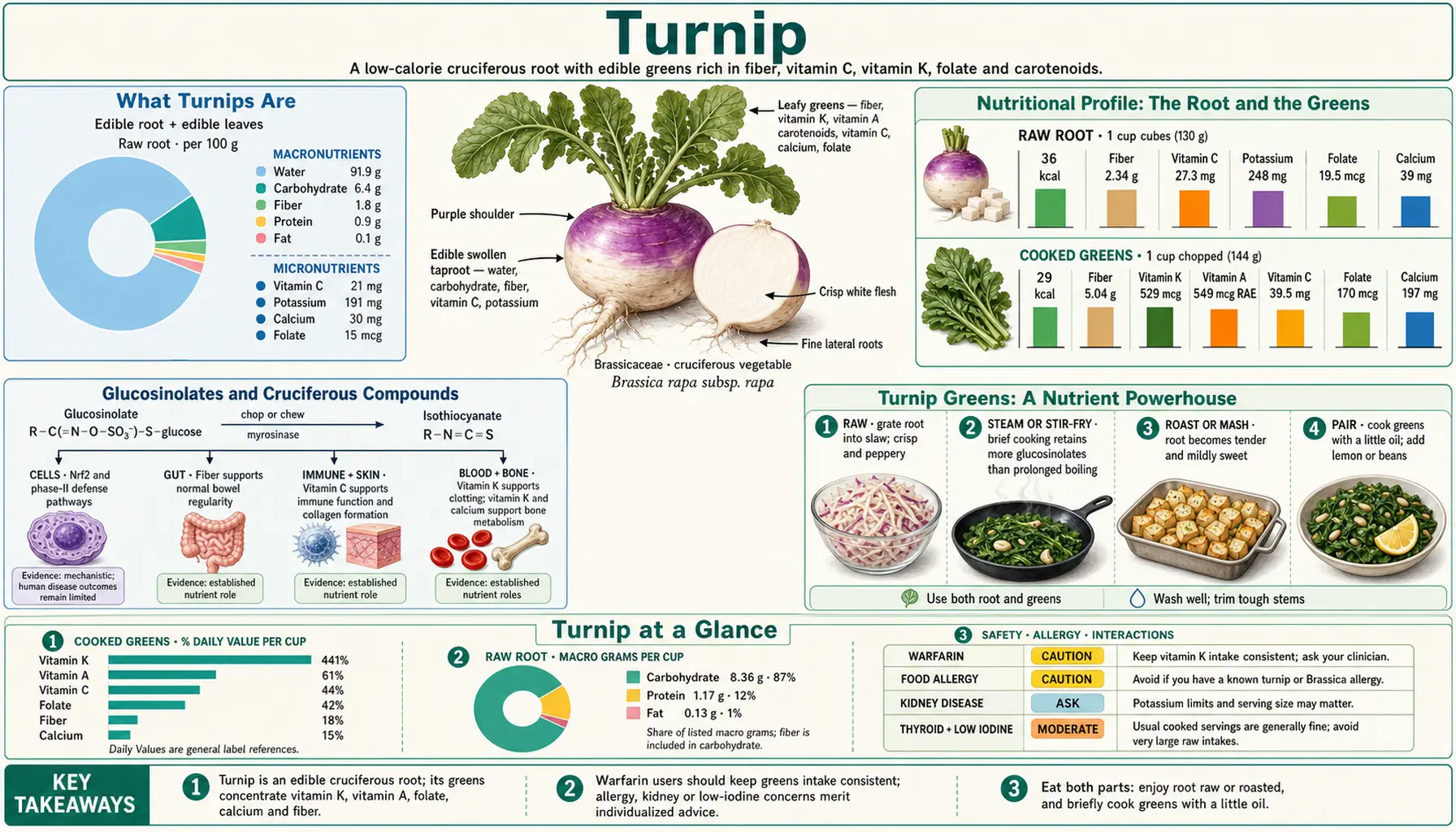
The turnip (Brassica rapa) is a humble, hardy root vegetable that has fed people through cold winters for thousands of years — and it is really two foods in one. Below ground grows the familiar round root, usually creamy white with a blush of purple where its shoulders pushed up toward the sun. Above ground grow the leafy turnip greens, which are far more nutritious than the root itself and are a cornerstone of Southern-American and East-Asian cooking. Both parts are eaten, and it is a shame to toss the tops. Turnips belong to the cabbage family (the crucifers, or brassicas), so they share the same sulfur-based plant compounds — the glucosinolates — found in broccoli, kale, and mustard. This page explains what a turnip is (and how it differs from the larger rutabaga it is often confused with), what is actually in the root versus the greens, what the research on cruciferous vegetables and glucosinolates does and does not show, and the practical side: how to pick, cook, and store both parts, plus a few honest cautions.
Table of Contents
- What Turnips Are
- Nutritional Profile: The Root and the Greens
- Glucosinolates and Cruciferous Compounds
- Turnip Greens: A Nutrient Powerhouse
- Gut Health and Fiber
- Blood Sugar, Weight, and Energy Density
- How to Select and Cook Turnips and Greens
- How to Store Turnips and Greens
- Safety and Who Should Be Cautious
- Research Papers
- Connections
- Featured Videos
What Turnips Are
A turnip is the swollen root of Brassica rapa, a member of the mustard or cabbage family — the group botanists call the Brassicaceae and cooks call the cruciferous or brassica vegetables. That family tie matters: it makes the turnip a close relative of cabbage, broccoli, kale, bok choy, and mustard greens, and it is the reason a raw turnip has that faint peppery, radish-like bite. The root is typically round to slightly flattened, with smooth white skin that turns purple or reddish where the top of the root was exposed to light. Inside, the flesh is white and crisp when raw, turning tender and mild when cooked.
The whole plant is edible. The root can be eaten raw or cooked, while the leafy turnip greens on top are a distinct vegetable in their own right — more nutritious than the root and prized in Southern-American soul food (often simmered with a smoked ham hock) and across East Asian cuisines. Younger, smaller turnips are sweeter and more delicate; large, old turnips can turn woody, fibrous, and sharply pungent, which is part of the vegetable's mixed reputation.
Turnip versus rutabaga (swede)
Turnips are frequently confused with rutabagas, also called swedes — but they are different vegetables. A rutabaga (Brassica napus) is thought to be a natural cross between a turnip and a cabbage. Compared with a turnip, a rutabaga is usually larger, denser, and sweeter, with yellowish-orange flesh rather than white, a browner or bronze-purple skin, and it is often sold coated in food-grade wax to keep it from drying out. In short: small, white-fleshed, purple-shouldered, faintly peppery is the turnip; big, yellow-fleshed, sweeter, and waxed is the rutabaga. They can often be swapped in recipes, but they are not the same plant.
Nutritional Profile: The Root and the Greens
The most important thing to understand about turnip nutrition is that the root and the greens are nutritionally very different foods, so it helps to look at each on its own. All figures below are approximate values for the raw edible portion per 100 grams (about three and a half ounces); real numbers shift with variety, growing conditions, and especially cooking. The point is not to memorize milligrams but to see the pattern.
The turnip root
The root is a light, watery, low-calorie vegetable — roughly 28 calories per 100 grams — whose nutritional headline is vitamin C and fiber for very few calories. In a typical serving of raw turnip root you get:
- Vitamin C — the root's standout, on the order of 20–21 milligrams per 100 grams, a meaningful share of a day's need and useful for immune function and collagen.
- Dietary fiber — roughly 1.8–2 grams per 100 grams, contributing to fullness and digestive health.
- Potassium — a modest but real amount (around 190 milligrams), the mineral that helps balance sodium and support blood pressure.
- Small contributions of calcium, folate, vitamin B6, and manganese.
- Very little fat or protein, and notably little vitamin A or vitamin K — those belong almost entirely to the green tops.
The turnip greens
The leafy tops are on a different level. Gram for gram they are a genuine dark-leafy-green vegetable, comparable to kale or collards, and they carry nutrients the root barely has. Approximate values for raw turnip greens per 100 grams include:
- Vitamin K — the greens are exceptionally rich, delivering several hundred micrograms per 100 grams, which is well over a full day's requirement. (This is the basis of the warfarin note in the safety section.)
- Vitamin A (as carotenoids) — abundant beta-carotene and other pigments that the body converts toward vitamin A, important for vision and skin.
- Folate (vitamin B9) — a strong source, valuable for cell division and, in pregnancy, fetal development.
- Calcium — a plant source of this bone mineral, on the order of 190 milligrams per 100 grams, which is high for a vegetable.
- Vitamin C — even higher than the root, around 60 milligrams per 100 grams raw.
- Lutein and zeaxanthin — carotenoids concentrated in the eye that are linked to long-term eye health.
The takeaway is simple and practical: if you buy turnips with their tops attached, you are getting two vegetables. The root gives you crisp, low-calorie fiber and vitamin C; the greens give you a dark-leafy-green nutrient load. Cooking both is the frugal, nutritious move.
Glucosinolates and Cruciferous Compounds
What sets turnips apart from a generic root vegetable is the chemistry they inherit from the cabbage family: the glucosinolates. These are sulfur-and-nitrogen-containing compounds stored intact inside the plant's cells. On their own they do little, but when you cut, crush, or chew the tissue, a plant enzyme called myrosinase is released and converts them into active breakdown products — chiefly isothiocyanates (and, for certain glucosinolates, compounds such as goitrin). That enzymatic conversion is the same mechanism that gives mustard, horseradish, and radish their sharp bite, and it is why a raw turnip tastes peppery while a long-cooked one tastes mild — heat deactivates the enzyme and mellows the flavor.
Glucosinolates are the reason nutrition scientists study crucifers as a group. In laboratory and animal research, isothiocyanates such as sulforaphane influence the body's own detoxification and antioxidant defense systems and show anti-inflammatory activity. Turnips and turnip greens have been shown to contain a characteristic mix of these glucosinolates, and the amount varies considerably with the plant part, the variety, and how it is grown and cooked. It is worth being honest about the state of the evidence: much of the exciting isothiocyanate research is preclinical — done in cells or animals, often at concentrations higher than a plate of turnips provides — so it describes plausible mechanisms rather than proven cures. What it does justify is the sensible, well-supported message that regularly eating a variety of cruciferous vegetables, turnips among them, is a smart part of a healthy diet.
Turnip Greens: A Nutrient Powerhouse
Turnip greens deserve their own section because they are, quietly, one of the most nutrient-dense foods in the produce aisle — and one of the most overlooked, since so many shoppers buy trimmed roots and never see the tops. As the nutrition section showed, the greens combine a large dose of vitamin K, generous vitamin A carotenoids, folate, a plant source of calcium, and vitamin C, all for almost no calories. That combination lands them among the dark leafy greens like kale, collards, and spinach.
Because they are a cruciferous leaf, the greens also carry the family's glucosinolates and a good supply of antioxidant plant compounds — flavonoids and other phenolics that help neutralize reactive molecules in laboratory tests. Turnip greens have been specifically assessed for their antioxidant chemistry and found to be a rich source of these protective phenolic compounds. Practically speaking, the greens are the reason to buy turnips with the tops still on: a bunch of turnips is a two-for-one deal, and the leafy half is the more nutritious one. Sautéed with garlic, stirred into soups, or simmered Southern-style, they turn a cheap root vegetable into a genuinely powerful plate of greens.
Gut Health and Fiber
Both the root and the greens contribute dietary fiber, and fiber is one of the most reliably beneficial things any vegetable offers. Fiber adds bulk that keeps digestion moving and helps prevent constipation, and the fermentable portion becomes food for the beneficial bacteria living in the colon. When those microbes ferment fiber, they produce short-chain fatty acids such as butyrate, which nourish the cells lining the gut and help maintain a healthy gut barrier. Large reviews of human studies consistently link higher fiber intake to better digestive health and lower rates of several chronic diseases, which is a big part of why vegetables like turnips belong on the plate.
There is a second, more specific angle for crucifers. The isothiocyanates released from turnip glucosinolates have measurable effects on bacteria, and researchers have examined how these compounds interact with the microbes of the human intestinal tract. This is an area of active study rather than settled advice, so the honest framing is modest: turnips and their greens supply fiber that supports a healthy microbiome, and they add cruciferous compounds whose interaction with gut bacteria is genuinely interesting but still being worked out. Either way, eating them is a food-first way to feed your gut — no supplement required.
Blood Sugar, Weight, and Energy Density
Turnips fit comfortably into a way of eating aimed at steady blood sugar and healthy weight, mainly because they have very low energy density — a lot of food volume for very few calories. The root is roughly 90 percent water, so a satisfying portion of roasted or mashed turnip fills you up while adding far fewer calories than the same volume of potato, rice, or bread. That combination of water, fiber, and bulk supports fullness and can help with appetite control and weight management as part of a balanced plate.
For blood sugar, the fiber in turnips slows digestion and blunts the speed at which carbohydrate is absorbed, which supports a gentler rise in blood glucose than refined starches produce. It is important not to overstate this: eating turnips is not a treatment for diabetes, and no single vegetable controls blood sugar on its own. The reasonable, evidence-consistent message is that turnips — low in calories, high in water and fiber — are a smart swap for higher-starch sides for anyone watching their weight or blood sugar, within an overall dietary pattern rather than as a stand-alone fix.
How to Select and Cook Turnips and Greens
A little care in choosing and cooking turns turnips from a bland afterthought into a genuinely good vegetable. The key rules: choose them small and young, and use both parts.
Selecting
- Pick roots that are firm, heavy for their size, and smooth-skinned, ideally small to medium (about the size of a golf ball to a tennis ball). Smaller turnips are sweeter and more tender; very large ones can be woody, pithy, and harsh.
- If the greens are still attached, that is a bonus — look for tops that are fresh, crisp, and deep green rather than yellowed, wilted, or slimy. Fresh greens are also a sign the roots are recently harvested.
- Avoid roots that feel soft, light, or spongy, or that are heavily cracked or blemished.
Cooking the root
Turnip root is versatile and takes well to almost any method:
- Raw: young, small turnips can be peeled and sliced thin or grated into salads and slaws for a crisp, mildly peppery bite — a bit like a milder radish.
- Roasted: peeled and cut into chunks, tossed with a little oil and salt, and roasted until caramelized at the edges. Roasting is arguably the best treatment — the heat concentrates the natural sweetness and tames the pungency.
- Mashed: boiled or steamed until tender, then mashed, either on their own or blended with potato for a lighter, lower-carb mash.
- In soups and stews: turnips add gentle body and flavor to broths, and they hold up well to slow simmering.
Cooking the greens
- Sautéed: the quick, everyday method — cook the washed leaves in a little oil with garlic until wilted and tender, finishing with a squeeze of lemon or a splash of vinegar to brighten them.
- Southern-style simmered: the classic soul-food preparation slow-cooks the greens with a smoked ham hock, onion, and a little vinegar until meltingly tender — a deeply traditional way to eat them.
- In soups and stir-fries: chopped turnip greens fold easily into bean soups, stews, and East-Asian stir-fries, where they wilt down like any hearty green.
Wash the greens well, since grit clings to the leaves, and remove tough stems if they are thick. Because gentle cooking preserves more of the vitamin C and glucosinolates than long boiling, quick methods and using the cooking liquid (as in soup) help keep the nutrition in the pot rather than pouring it down the drain.
How to Store Turnips and Greens
Because the root and the tops keep differently, the first step is to separate them:
- Separate on arrival: if you bought turnips with their greens attached, cut the tops off before storing. Left attached, the leaves keep drawing moisture out of the root, so both go limp faster.
- The roots store like most sturdy root vegetables. Keep them unwashed in the refrigerator — loose or in a perforated bag in the crisper drawer — where firm turnips will typically stay good for a couple of weeks or more. A cool, dark, humid place such as a root cellar works too. They can also be peeled, cut, and frozen (blanch first) for use in cooked dishes.
- The greens are perishable like any leafy green. Store them unwashed, loosely wrapped or in a bag in the refrigerator, and use them within a few days, since they wilt far sooner than the root. Wash them only when you are ready to cook. They can be blanched and frozen for longer keeping.
Safety and Who Should Be Cautious
For the overwhelming majority of people, turnips and turnip greens are a very safe, wholesome, inexpensive food. A few honest, specific cautions are worth knowing:
- Goitrogens and the thyroid: like all cruciferous vegetables, turnips contain glucosinolates whose breakdown products (such as goitrin and thiocyanate) can, in principle, interfere with the thyroid's uptake of iodine. In practice this is a concern only at extreme, sustained intakes of raw crucifers combined with iodine deficiency. For a person eating a normal, varied diet with adequate iodine, ordinary amounts of cooked turnips pose no meaningful thyroid risk — and cooking further reduces the goitrogenic compounds. Research measuring these compounds in people who eat brassica vegetables found the levels unlikely to cause hypothyroidism in the general population. If you already have a thyroid condition, simply favor cooked over large amounts of raw, and follow your clinician's guidance.
- Vitamin K and blood thinners (warfarin): this applies to the greens, which are very high in vitamin K — the nutrient the anticoagulant warfarin works against. The issue is not that turnip greens are dangerous; it is consistency. People on warfarin are advised to keep their intake of vitamin-K-rich foods steady week to week rather than swinging from none to a big serving, so their dose stays balanced. If you take warfarin, you do not need to avoid turnip greens — just be consistent and follow your clinician's advice. (Newer anticoagulants such as apixaban or rivaroxaban are not affected by dietary vitamin K, and the turnip root is low in vitamin K regardless.)
- Oxalates: turnip greens contain some oxalate, a compound that can contribute to kidney stones in susceptible people. Their oxalate level is generally milder than spinach's, so for most people it is a minor consideration, but anyone prone to calcium-oxalate kidney stones may want to keep leafy-green portions moderate and stay well hydrated.
- Gas and digestion: as with other cruciferous vegetables, some people find turnips produce gas or bloating. Cooking them thoroughly and introducing them gradually usually helps.
None of these caveats change the basic picture: turnips and their greens are a nutritious, affordable, versatile pair of vegetables that most people can enjoy freely.
Research Papers
- Paul S, Geng CA, Yang TH, Yang YP, Chen JJ. Phytochemical and Health-Beneficial Progress of Turnip (Brassica rapa). J Food Sci. 2019;84(1):19–30. doi:10.1111/1750-3841.14417 — a turnip-specific review of its nutrients, glucosinolates, and studied health effects.
- Fernandes F, Valentao P, Sousa C, Pereira JA, Seabra RM, Andrade PB. Chemical and antioxidative assessment of dietary turnip (Brassica rapa var. rapa L.) Food Chem. 2007;105(3):1003–1010. doi:10.1016/j.foodchem.2007.04.063 — measured the antioxidant phenolic compounds in turnip root and greens.
- Padilla G, Cartea ME, Velasco P, de Haro A, Ordas A. Variation of glucosinolates in vegetable crops of Brassica rapa. Phytochemistry. 2007;68(4):536–545. doi:10.1016/j.phytochem.2006.11.017 — catalogued how glucosinolate content varies across turnip and related B. rapa crops.
- Francisco M, Velasco P, Moreno DA, Garcia-Viguera C, Cartea ME. Cooking methods of Brassica rapa affect the preservation of glucosinolates, phenolics and vitamin C. Food Res Int. 2010;43(5):1455–1463. doi:10.1016/j.foodres.2010.04.024 — shows how boiling versus gentler cooking changes the nutrients you actually keep.
- Fahey JW, Zalcmann AT, Talalay P. The chemical diversity and distribution of glucosinolates and isothiocyanates among plants. Phytochemistry. 2001;56(1):5–51. doi:10.1016/S0031-9422(00)00316-2 — the foundational map of glucosinolate chemistry across the cabbage family.
- Cartea ME, Velasco P. Glucosinolates in Brassica foods: bioavailability in food and significance for human health. Phytochem Rev. 2008;7(2):213–229. doi:10.1007/s11101-007-9072-2 — reviews how much of these compounds the body actually absorbs from brassica vegetables.
- Higdon JV, Delage B, Williams DE, Dashwood RH. Cruciferous vegetables and human cancer risk: epidemiologic evidence and mechanistic basis. Pharmacol Res. 2007;55(3):224–236. doi:10.1016/j.phrs.2007.01.009 — weighs the observational evidence and proposed mechanisms for crucifers and cancer.
- Zhang X, Shu XO, Xiang YB, Yang G, Li H, Gao J, et al. Cruciferous vegetable consumption is associated with a reduced risk of total and cardiovascular disease mortality. Am J Clin Nutr. 2011;94(1):240–246. doi:10.3945/ajcn.110.009340 — large cohort linking higher cruciferous intake to lower mortality.
- Aires A, Mota VR, Saavedra MJ, Rosa EAS, Bennett RN. The antimicrobial effects of glucosinolates and their respective enzymatic hydrolysis products on bacteria isolated from the human intestinal tract. J Appl Microbiol. 2009;106(6):2086–2095. doi:10.1111/j.1365-2672.2009.04180.x — examined how cruciferous breakdown products interact with human gut bacteria.
- Reynolds A, Mann J, Cummings J, Winter N, Mete E, Te Morenga L. Carbohydrate quality and human health: a series of systematic reviews and meta-analyses. Lancet. 2019;393(10170):434–445. doi:10.1016/S0140-6736(18)31809-9 — large synthesis showing why the fiber in vegetables like turnips matters for health.
- Felker P, Bunch R, Leung AM. Concentrations of thiocyanate and goitrin in human plasma, their precursor concentrations in brassica vegetables, and associated potential risk for hypothyroidism. Nutr Rev. 2016;74(4):248–258. doi:10.1093/nutrit/nuv110 — puts the cruciferous "goitrogen" thyroid concern in realistic, dose-based perspective.
- Booth SL. Vitamin K: food composition and dietary intakes. Food Nutr Res. 2012;56:5505. doi:10.3402/fnr.v56i0.5505 — documents why leafy greens like turnip tops are among the richest dietary vitamin K sources.
Connections
- All Food
- Kale
- Spinach
- Cabbage
- Broccoli
- Brussels Sprouts
- Cauliflower
- Beets
- Carrots
- Vitamin K
- Vitamin C
- Calcium
- Endocrinology