Sunflower Seeds - Beneficial Foods
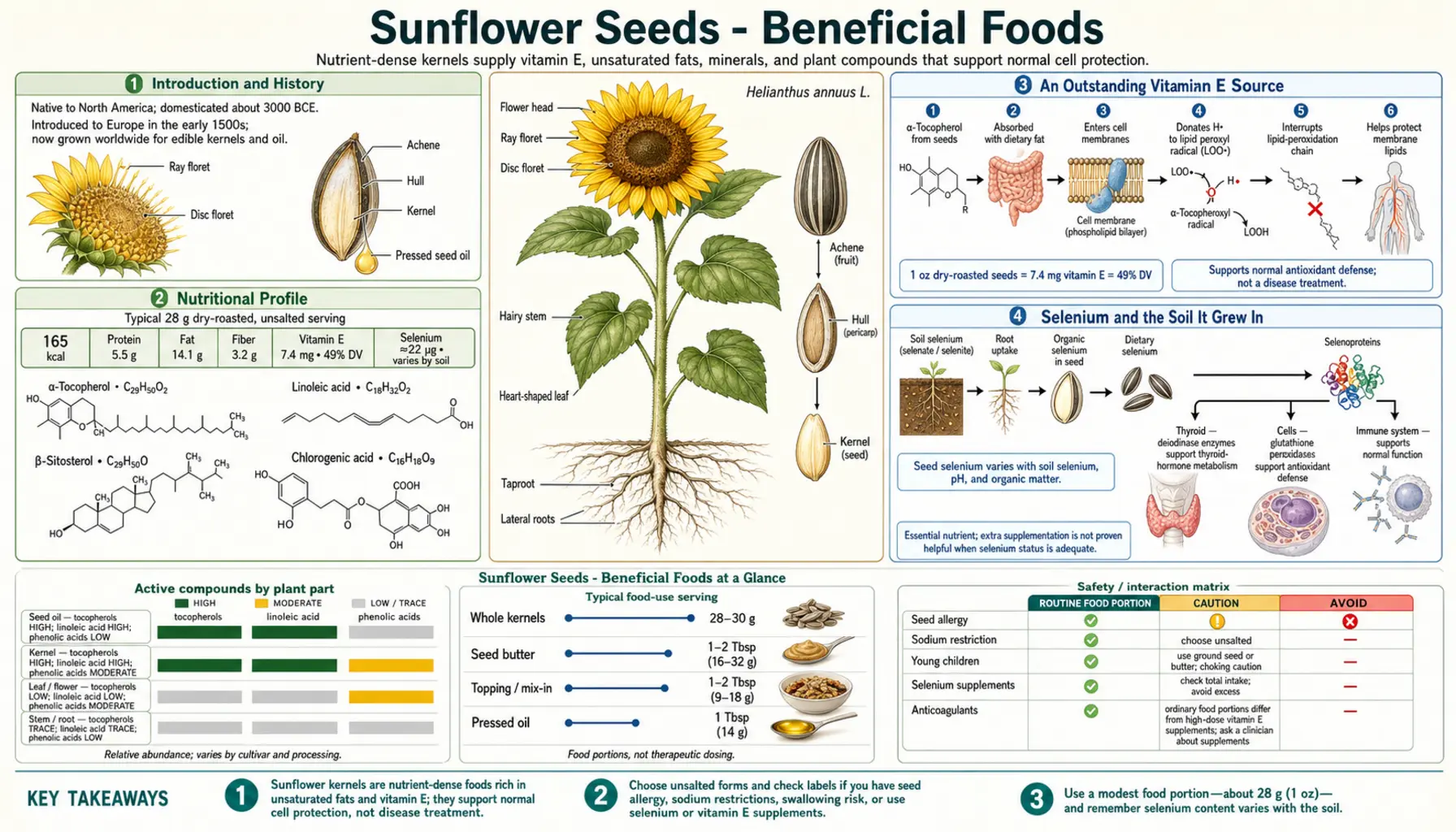
Sunflower seeds are one of the very few staple foods in the modern pantry that were domesticated in North America. They are also the richest common whole-food source of vitamin E, a serious supplier of copper, magnesium, selenium and thiamin, and — because sunflowers pull cadmium out of soil more eagerly than most crops — a food that deserves a portion size rather than an open bag.
Table of Contents
- Introduction and History
- Nutritional Profile
- An Outstanding Vitamin E Source
- Selenium and the Soil It Grew In
- Magnesium and Copper
- B Vitamins, Protein, Fiber and Phytosterols
- The Whole Seed Versus Industrial Sunflower Oil
- Cadmium: An Honest Accounting
- Buying and Storing
- Preparing and Eating
- How Much to Eat
- Who Should Be Careful
- Connections
- References & Research
- Featured Videos
Introduction and History
The common sunflower, Helianthus annuus, is native to North America and is one of only a handful of crops fully domesticated north of Mexico. Wild sunflowers grew across the middle of the continent as weedy colonizers of disturbed ground. Over centuries of harvesting the biggest heads and replanting the biggest seeds the plant changed: the archaeological record shows seeds growing steadily larger while the wild multi-branched habit collapsed into a single thick stalk carrying one enormous head.
Charred and desiccated sunflower seeds from sites in present-day Tennessee, Kentucky, Illinois and Arkansas push cultivation back roughly five thousand years, with clearly domesticated-size seeds by around 3000 to 2500 BC. Sunflower belonged to what archaeobotanists call the Eastern Agricultural Complex — a homegrown farming system based on squash, goosefoot, marsh elder, erect knotweed, little barley and maygrass. Most of those crops were abandoned once maize and beans arrived from the south; sunflower survived because the seed is so densely nourishing. Genetic work in the 2000s and 2010s settled a long argument about origins: a competing claim placed an independent domestication in Mexico, but analyses of domestication alleles pointed to a single origin in eastern North America. Indigenous use went well beyond snacking — seeds were parched and ground into meal for cakes and gruel, boiled so the oil could be lifted off the surface, and pressed for cooking and body oil.
Spanish ships carried sunflower to Europe in the early 1500s, where for two centuries it was mostly an ornamental curiosity. The transformation into a world oilseed happened in the Russian Empire — one widely repeated explanation is that Orthodox fasting rules restricted the traditional oils but had no entry for a New World newcomer, so sunflower oil became the permitted fat during Lent. Russian growers began selecting for oil content at scale, and twentieth-century breeding at Krasnodar led by Vasilii Pustovoit lifted seed oil content from roughly a quarter of the seed's weight to more than half. Those high-oil varieties came back across the Atlantic in the late 1800s under names like Mammoth Russian, and modern North American sunflower agriculture descends from them.
Sunflower is now a top-four oilseed globally, with Ukraine and Russia together accounting for a very large share of world production. Crucially, the crop splits into two market classes grown, priced and used differently: small, thin-shelled, black-hulled oilseed types destined for crushing, and larger, thick-shelled, grey-and-white-striped confection types grown to be eaten. The handful you eat and the bottle of refined oil on the shelf come from different fields and different varieties.
One botanical note: a sunflower head is not a flower but an inflorescence of disc florets, each producing one dry, one-seeded fruit called an achene — so the striped shell you spit out is the fruit wall and the pale kernel inside is the true seed.
Nutritional Profile
Figures below are for raw, dried, hulled kernels per 100 grams — roughly three-quarters of a cup, far more than a normal serving. A realistic serving is about 28 grams: one ounce, three level tablespoons, a small cupped handful. Multiply by 0.28 for a serving. Every plant food varies with cultivar, season and soil, and the mineral numbers — selenium above all — swing widely with where the crop grew.
Macronutrients per 100 g, raw kernels
- Energy: about 584 kcal; water about 4.7 g
- Protein: about 20.8 g
- Total fat: about 51.5 g — saturated about 4.5 g, monounsaturated about 18.5 g (mostly oleic acid), polyunsaturated about 23.1 g (almost entirely linoleic acid)
- Total carbohydrate: about 20 g, of which fiber about 8.6 g and sugars about 2.6 g
Vitamins per 100 g, raw kernels
- Vitamin E as alpha-tocopherol: about 35 mg — roughly 234 percent of the 15 mg daily value
- Thiamin, vitamin B1: about 1.5 mg — roughly 123 percent DV
- Vitamin B6: about 1.35 mg — roughly 79 percent DV
- Folate: about 227 micrograms of dietary folate equivalents — roughly 57 percent DV
- Niacin: about 8.3 mg — roughly 52 percent DV
- Riboflavin about 0.36 mg; pantothenic acid about 1.1 mg; choline about 55 mg
- Vitamin C and vitamin K: traces only — sunflower seeds are not a source of either
Minerals per 100 g, raw kernels
- Copper: about 1.8 mg — roughly 200 percent DV
- Manganese: about 1.95 mg — roughly 85 percent DV
- Magnesium: about 325 mg — roughly 77 percent DV
- Selenium: about 53 micrograms — roughly 96 percent DV, but see the soil caveat below
- Phosphorus: about 660 mg — roughly 53 percent DV, largely phytate-bound
- Zinc: about 5.0 mg — roughly 45 percent DV
- Iron: about 5.25 mg — roughly 29 percent DV, non-heme
- Potassium about 645 mg; calcium about 78 mg
- Sodium: about 9 mg unsalted; salted roasted kernels can run 200 to 400 mg per ounce
What one realistic ounce delivers
A 28-gram serving of raw kernels supplies, in round numbers: 165 kcal, 5.8 g protein, 2.4 g fiber, about 10 mg vitamin E (two-thirds of a day), 0.5 mg copper (more than half a day), 91 mg magnesium (over a fifth), 0.42 mg thiamin (a third), 0.55 mg manganese, 0.38 mg vitamin B6, 15 micrograms selenium and 1.4 mg zinc. Very few foods put that many nutrients into 165 calories.
An Outstanding Vitamin E Source
If you want vitamin E from food rather than a capsule, sunflower seeds are the answer, and the margin over the runners-up is not close. Vitamin E is a family of eight molecules — four tocopherols, four tocotrienols — and human physiology strongly prefers exactly one. Alpha-tocopherol transfer protein, which decides what gets loaded onto lipoproteins in the liver, binds alpha-tocopherol far more tightly than the rest; the gamma form, dominant in many vegetable oils and in walnuts, is largely metabolized and excreted. So the useful question about a food is not how much vitamin E but how much alpha-tocopherol.
Sunflower kernels are roughly 90 percent alpha-tocopherol by tocopherol composition, at about 35 mg per 100 grams. Almonds, the usual second place, come in near 26 mg and are also alpha-dominant; hazelnuts run about 15 mg and peanuts about 8 mg. Walnuts and pecans contribute very little usable alpha-tocopherol despite being excellent foods for other reasons, and spinach, avocado and broccoli supply one to three milligrams per serving. One ounce of sunflower kernels covers about two-thirds of an adult's 15 mg requirement.
Alpha-tocopherol's established job is to stop the chain reaction of lipid peroxidation in membranes and lipoproteins, quenching the propagating radical before oxidative damage spreads along the membrane like a fuse. Frank deficiency produces a neurological syndrome — ataxia, loss of position sense, peripheral neuropathy — but almost always in people with fat-malabsorption disorders or a genetic defect in the transfer protein, not in otherwise healthy eaters. Meanwhile large randomized trials of high-dose alpha-tocopherol supplements have repeatedly failed to prevent cardiovascular events or cancer, and some found harm at high doses. This is one of the clearest cases in nutrition where a nutrient is genuinely essential, food sources are genuinely valuable, and the isolated high-dose pill does not deliver. There is also a logic to getting vitamin E from a seed: the seed carries the polyunsaturated fat that needs protecting, and packages the antioxidant with the substrate — about 23 g of linoleic acid to 35 mg of alpha-tocopherol per 100 g. The corollary is that a rancid bag has already spent much of its vitamin E, so freshness is not a fussy detail.
Selenium and the Soil It Grew In
Selenium is the mineral where an honest food page has to add a caveat to its own numbers. Standard databases list sunflower kernels near 53 micrograms per 100 grams, making an ounce about a quarter of the 55-microgram daily value. That is an average, and the real range is enormous — plausibly under 5 micrograms per 100 grams to several hundred, depending entirely on the selenium content and chemistry of the soil.
Selenium enters plants as selenate or selenite through the sulfur uptake machinery, which cannot distinguish the two elements well. Where soil selenium is high — parts of the North American Great Plains, some regions of Ireland and Venezuela, seleniferous shales — crops load up. Where it is low, as in much of northern Europe, large parts of China, New Zealand and parts of the Balkans, the same variety yields a fraction of the selenium. Alkaline, well-oxidized soils make selenium available; acidic, waterlogged soils lock it into insoluble forms. Sunflower is a reasonably efficient accumulator, but it cannot conjure selenium that is not in the ground.
Because sunflower selenium is a soil lottery, treat seeds as a contributor rather than a guarantee. In a varied diet that includes eggs, fish such as sardines, and organ meats, selenium status is very likely fine and seeds help; in a documented low-selenium region on an almost entirely local plant diet, seeds alone will not fix it. In the opposite direction selenium has a real ceiling — the adult tolerable upper intake is 400 micrograms a day.
Magnesium and Copper
Magnesium
At about 325 mg per 100 grams, sunflower kernels put roughly 91 mg of magnesium into an ounce — more than a fifth of the daily value from a small handful. Pumpkin seeds beat them handily at roughly 550 mg per 100 grams and are the better choice if magnesium is the specific goal; almonds are comparable to sunflower at about 270 mg, and dark chocolate, spinach, beans and lentils fill out the same tier.
Magnesium is a cofactor for hundreds of enzymes, including every reaction that uses ATP — ATP is biologically active as the magnesium complex, so magnesium is not optional for energy metabolism at all. It gates calcium channels and acts as a physiological calcium antagonist in smooth and cardiac muscle, which is why low magnesium shows up as cramping, twitching, arrhythmia and elevated blood pressure, and it is required by the enzyme that activates vitamin D. Dietary surveys in industrialized countries consistently find a large fraction of adults below the estimated average requirement — one of the better arguments for a daily seed habit. Some of the magnesium in seeds is bound to phytic acid and not fully absorbed, and whole-food magnesium is a nutrition strategy rather than a treatment for a diagnosed deficiency.
Copper
Copper is where sunflower seeds are genuinely remarkable and rarely credited. At roughly 1.8 mg per 100 grams — about 200 percent of the daily value — an ounce delivers over half a day's copper. Only a short list of foods does better: organ meats such as beef liver are in a class of their own, oysters and shellfish are excellent, and cashews, dark chocolate and sesame sit in the same tier as sunflower. For someone who does not eat liver, seeds and cacao are the practical backbone of copper intake.
Copper is the catalytic metal in cytochrome c oxidase, the final complex of the mitochondrial electron transport chain, so no copper means no aerobic energy production. It is also required by superoxide dismutase 1, by lysyl oxidase to cross-link collagen and elastin, and by ceruloplasmin, the ferroxidase that oxidizes iron so it can be loaded onto transferrin — which is why copper deficiency produces an anemia that does not respond to iron. Copper and zinc compete for absorption, so months of high-dose zinc supplementation can produce copper deficiency; sunflower kernels carry the two together at roughly one to three, a far saner balance than a zinc lozenge habit.
B Vitamins, Protein, Fiber and Phytosterols
The B vitamins get overshadowed by vitamin E, which is a shame, because the thiamin content is exceptional. At about 1.5 mg per 100 grams sunflower seeds outrank almost every other plant food, and an ounce supplies roughly a third of the daily requirement. Thiamin is the cofactor for the gateway enzymes that let glucose enter the citric acid cycle, its requirement scales with carbohydrate intake, and it is the vitamin most reliably depleted by heavy alcohol use, chronic diuretic therapy and refined-carbohydrate diets. Vitamin B6 at about 1.35 mg per 100 grams is likewise strong: as pyridoxal 5-phosphate it is the workhorse cofactor of amino acid metabolism, serotonin and GABA synthesis, heme synthesis and the transsulfuration pathway that clears homocysteine. Folate at about 227 micrograms of dietary folate equivalents feeds the one-carbon metabolism that builds nucleotides, and manganese at about 1.95 mg is the metal in mitochondrial superoxide dismutase 2 and in the enzymes that build cartilage.
The 20.8 grams of protein per 100 grams is high for a plant food, and sunflower protein is notably rich in the sulfur amino acids methionine and cysteine — unusual among plant proteins, and a useful complement to legumes, which are typically methionine-limited. Its weak point is lysine, which matters only for someone whose protein comes almost entirely from seeds. The 8.6 grams of fiber per 100 grams, about 2.4 grams per ounce, is mostly insoluble cellulose and lignin; if fiber is the goal, chia seeds and flaxseed are in a different league. Sunflower fiber's real contribution is structural — it slows the release of the seed's fat and helps explain why a handful satisfies out of proportion to its volume.
The Whole Seed Versus Industrial Sunflower Oil
This is the most important distinction on the page and it gets collapsed constantly. A sunflower kernel and a bottle of refined sunflower oil are not the same food in different packaging — they are two different products from two different crop types, and confusing them leads people either to fear the seed or to trust the oil.
What the whole seed is
In a kernel, fat sits inside intact cells, inside oil bodies wrapped in phospholipid and protein, behind cellulose cell walls that human enzymes cannot break. It arrives with 20 grams of protein, 8.6 grams of fiber, 35 mg of alpha-tocopherol, 325 mg of magnesium and 1.8 mg of copper per 100 grams. Chewing ruptures only some of those cells, which is why measured energy availability from whole nuts and seeds is consistently lower than the Atwater calorie factors predict — careful human balance studies with almonds found roughly 20 percent fewer metabolizable calories than the label claimed, and the mechanism (intact cell walls carrying fat through to the stool) applies to sunflower kernels too. Grinding them into butter or flour erases that discount.
What the industrial oil is
Commodity sunflower oil comes from the small black oilseed type. Seeds are cleaned, dehulled, flaked, heat-conditioned and expeller-pressed; the oil left in the press cake is extracted with hexane; and the crude oil is then refined — degummed, alkali-neutralized, bleached with activated clay, winterized, and deodorized by steam stripping at temperatures typically in the 220 to 260 degree Celsius range. The result is a neutral, pale, long-shelf-life fat that is 100 percent of calories from fat and carries essentially none of the seed's protein, fiber or minerals. Refining also strips much of the crude oil's tocopherols and phytosterols, and deodorization generates small quantities of trans isomers of the polyunsaturated fatty acids.
Three varietal classes are sold and the label rarely says which you have: traditional high-linoleic oil at roughly 65 percent linoleic acid, mid-oleic types at 55 to 75 percent oleic, and high-oleic oil at over 80 percent oleic acid, which is far more oxidation-resistant. High-linoleic oil is a poor choice for frying, because heated frying oils accumulate reactive aldehydes including 4-hydroxy-2-nonenal — a genuine concern in repeatedly reused restaurant oil.
The linoleic acid question, honestly
Sunflower oil is one of the main reasons linoleic acid intake in industrialized diets rose several-fold over the twentieth century. Whether that shift is harmful is genuinely unsettled, and anyone who tells you it is settled in either direction is overstating. Pooled analyses of trials replacing saturated fat with polyunsaturated vegetable oil have generally shown lower LDL cholesterol and, in several meta-analyses, fewer coronary events; a Cochrane review specifically of omega-6 fats found little or no effect on mortality or cardiovascular events, with low-certainty evidence; and reanalyses of recovered data from the Sydney Diet Heart Study and the Minnesota Coronary Experiment found lowered cholesterol without a mortality benefit.
The safe conclusion is narrower and more useful: eating the whole seed in normal portions is a completely different exposure from getting a large fraction of daily calories as refined high-linoleic oil in fried and ultra-processed food. An ounce of kernels contains about 6.5 grams of linoleic acid packaged with 10 mg of the antioxidant that protects it; a single restaurant fried meal can carry several times that in oil held hot for hours. For cooking, olive oil for most purposes and coconut oil where higher heat and a solid fat are wanted are the better defaults; sunflower oil, if used at all, should be high-oleic and never reused.
Cadmium: An Honest Accounting
Sunflowers take up cadmium from soil more readily than most crops and move it efficiently into the seed. This is not a fringe claim — it is established well enough that sunflower is deliberately planted to strip cadmium out of contaminated land in phytoremediation projects. The trait that makes the plant useful for cleaning soil is the trait that makes the seed reflect the soil's cadmium load.
Reported concentrations in kernels commonly fall between roughly 0.1 and 1.0 milligram per kilogram of dry weight, clustering in the low hundreds of micrograms per kilogram for seed grown on ordinary agricultural soil and running higher on acidic soils, on soils amended with phosphate fertilizers or sewage sludge, and near industrial contamination. Because oilseeds sit at the high end of the food supply for this contaminant, European Union maximum-level rules cap cadmium in oilseeds including sunflower seed, in the region of 0.5 mg/kg. Sunflower shares the trait with flaxseed, cacao, some leafy greens including spinach, rice, and root vegetables such as salsify and celeriac. It is a category of foods, not a lone offender.
Why cadmium matters
Cadmium has no biological function in humans, is absorbed at only a few percent from the diet, and is then retained for decades — its half-life in the kidney is commonly cited as ten to thirty years, so intake accumulates across a lifetime in the renal cortex. The first measurable consequence is renal tubular dysfunction; chronic exposure is also associated with reduced bone mineral density and fracture risk, the extreme historical example being the itai-itai disease outbreaks in cadmium-polluted Japanese river basins. The International Agency for Research on Cancer classifies cadmium as carcinogenic to humans.
The arithmetic, done out loud
The European Food Safety Authority set a tolerable weekly intake of 2.5 micrograms per kilogram of body weight — for a 70-kilogram adult, 175 micrograms a week, about 25 micrograms a day averaged out. The international JECFA figure is less strict: a provisional tolerable monthly intake of 25 micrograms per kilogram of body weight, roughly 0.8 micrograms per kilogram per day, about 56 micrograms a day for the same adult. Take the stricter number:
- At a typical 0.2 mg/kg, a 28-gram serving delivers about 5.6 micrograms of cadmium — roughly 22 percent of the stricter daily allowance.
- At 0.5 mg/kg, the regulatory cap, the same serving delivers about 14 micrograms — roughly 56 percent of the allowance from one small handful, before any other food.
- At a heavy 100 grams a day at 0.5 mg/kg, intake is 50 micrograms a day: twice the stricter allowance and close to the looser one, sustained.
That is the honest picture. An ounce a day is a sensible food choice whose cadmium contribution is real but manageable and well inside tolerable intake alongside a varied diet. Half a cup a day for years — particularly stacked on a diet already heavy in other accumulator foods — is a genuinely different proposition, and there is no good reason to eat that much of one seed.
Three modifiers that change the risk
Iron status. Cadmium is absorbed largely through the divalent metal transporter DMT1, the route iron uses. When body iron stores are low DMT1 is upregulated and cadmium absorption rises substantially — studies in women with depleted ferritin found roughly double the absorption of iron-replete controls. So the people most likely to eat a large seed-heavy plant diet may be the people absorbing the most cadmium from it, and keeping iron and zinc status adequate is a concrete protective step.
Smoking. Tobacco is itself a cadmium accumulator, and inhalation absorption is roughly ten times more efficient than intestinal absorption. Smokers carry several times the body cadmium burden of non-smokers, so a pack-a-day habit dwarfs any dietary contribution from seeds. If cadmium is the concern, this is the lever.
Variety. Rotating seeds is the simplest mitigation available — pumpkin seeds, sesame, hemp hearts, walnuts, almonds and cashews bring different mineral and contaminant profiles. This matters most for children, since sunflower butter is now a widespread school-safe replacement for peanut butter and some children eat substantial quantities daily at low body weight. That is not a reason to avoid it, but it is a reason to treat it as one of several spreads rather than the only one.
Buying and Storing
Kernels are more than half polyunsaturated-rich fat, which makes them one of the faster-spoiling items in a pantry. Most people who dislike sunflower seeds have only ever eaten stale ones.
What to buy
- In-shell versus hulled. The intact hull keeps oxygen off the fat, so in-shell seeds keep far longer; hulled kernels are more convenient but start degrading the day they are hulled.
- Raw versus roasted. Roasting degrades some thiamin and vitamin E, so raw kernels test higher in both and are what you need for sprouting — but not by enough to make raw versus roasted a health decision. What matters is what they were roasted in: "dry roasted" means no added fat, while "roasted in oil" usually means fried in refined seed oil, which defeats much of the point of eating the whole seed. Keep kernels cool and airtight either way.
- Salted versus unsalted. Buy unsalted and salt to taste — salted kernels can carry 200 to 400 mg of sodium per ounce, and salted in-shell seeds carry more salt per gram of food actually eaten because the salt is on the shell you discard.
- Sunflower seed butter: read the label — many brands add cane sugar and extra refined sunflower oil, while a good one lists sunflower seeds and possibly salt. Refrigerate after opening; natural versions separate and want stirring.
How to store
- Airtight glass, or a sealed bag with the air pressed out. Oxygen, light and heat are the three enemies, in that order.
- Hulled kernels: roughly two to three months in a cool dark pantry, six months refrigerated, up to a year frozen — and usable straight from the freezer. In-shell seeds keep longer.
How to tell they have gone off
Rancid seed fat is unmistakable once you know it: bitter, sharp, faintly like oil paint or crayons. A fresh kernel tastes sweet, faintly grassy and nutty and finishes clean. Taste one before committing a whole bag to a recipe and throw out anything bitter — the oxidation products that make rancid fat taste bad are exactly the compounds the seed's vitamin E existed to prevent. Discard anything musty or discolored too — humid-stored oilseeds can grow mold.
Preparing and Eating
Toasting
Toasting is transformative and takes minutes. In a dry skillet over medium heat, stir constantly for three to five minutes until the kernels smell nutty and go pale gold, then tip them out of the pan immediately — residual heat will burn them if they stay. In the oven, spread on a dry sheet at about 300 to 325 degrees Fahrenheit, 150 to 165 Celsius, for 10 to 15 minutes, stirring once or twice. Salt while hot if you want salt. Doing it yourself is cheaper and controls both the salt and the added oil.
Soaking and sprouting
Soaking raw hulled kernels 8 to 12 hours in salted water, then draining, softens the texture and reduces phytic acid somewhat. Sprouting goes further: soak, then rinse and drain twice a day for one to two days until a small tail appears. Sprouted kernels are higher in free amino acids and phenolic compounds, and many people find them easier to digest. Only raw, un-roasted, hulled kernels will sprout, and any seed sprouted at room temperature over days is a microbiological risk — rinse frequently, refrigerate promptly, and skip sprouting if anyone in the household is pregnant, elderly or immunocompromised.
Ways to actually use them
- Scattered over a green salad instead of croutons.
- Stirred into whole-milk yogurt with berries and a little honey.
- Folded into oatmeal or barley porridge at the end of cooking so they stay crunchy.
- On top of roasted vegetables — carrots, cauliflower, Brussels sprouts, butternut squash — added in the last five minutes so they toast without burning.
- Ground with garlic, olive oil, basil and hard cheese into a pesto, or pressed into a crust for baked fish such as cod or salmon.
- Blended into butter: toasted kernels in a food processor for 8 to 12 minutes, scraping down — no added oil needed.
- Whole in-shell seeds, cracked and spat, as the original slow snack: the shelling enforces a portion size.
The one thing to skip is the shell. Sunflower hulls are indigestible lignified fruit wall, and swallowing a large quantity of them — mainly children, and distracted adults working through a bag — has caused documented cases of intestinal impaction and bezoar formation.
How Much to Eat
The sensible answer is about one ounce, 28 grams, three level tablespoons of kernels, a small cupped handful, on most days. That is not a hedge — it is the portion the evidence and the arithmetic both point at:
- It is the nutrition sweet spot. One ounce delivers two-thirds of a day's vitamin E, over half a day's copper, a third of the thiamin, a fifth of the magnesium and a quarter of the selenium for 165 calories. Doubling the portion does not double the benefit.
- It is the portion used in research. Nut and seed intervention trials, including the large Mediterranean-diet trials, have generally used about 30 grams a day — the intake at which favorable associations with cardiovascular outcomes and all-cause mortality show up in cohort studies.
- It keeps cadmium in bounds. An ounce a day contributes roughly 6 to 14 micrograms of cadmium depending on the crop — real, but comfortably inside even the strict European tolerable intake alongside everything else you eat. A half-cup daily habit is not.
- It respects the calorie density. Kernels run 584 calories per 100 grams and a cup is over 800 calories — seeds eaten absent-mindedly from a bag add several hundred calories a day without your noticing.
Two ounces on a day when seeds do real work in a meal — as a crust, in a pesto, as the protein in a salad lunch — is entirely reasonable. What is worth avoiding is the open-bag pattern, and the pattern of eating one seed exclusively for years: rotate sunflower with pumpkin seeds, sesame, hemp, flaxseed, chia, almonds and walnuts. For children a tablespoon or two is a serving, and whole seeds are a choking hazard under about age four.
Who Should Be Careful
Sunflower seed allergy
Sunflower seed allergy is uncommon but real, IgE-mediated, and capable of causing anaphylaxis. It is being reported more often, and the likely reason is straightforward: sunflower butter is now the default nut-free school spread across much of North America, so exposure has risen sharply in exactly the population most likely to develop food allergy. The principal seed allergen is a heat-stable 2S albumin storage protein, which means roasting does not reliably destroy it and reactions can be systemic rather than confined to the mouth. Other identified allergens include a profilin and a non-specific lipid transfer protein, with documented cross-reactivity to mugwort pollen.
Sunflower is not one of the major allergens that United States labeling law requires to be declared, so it is not flagged the way milk, egg or peanut is — you have to read the ingredient list. And highly refined sunflower oil has had essentially all protein removed and is tolerated by most people with sunflower allergy, whereas cold-pressed unrefined oil retains protein and has caused reactions.
Phytic acid and mineral binding
Kernels contain phytic acid at roughly 1.5 to 2.5 grams per 100 grams. Phytate chelates zinc, iron, calcium and magnesium in the gut lumen and reduces their absorption, and humans lack meaningful phytase activity. In a mixed diet this is a minor accounting adjustment, not a problem — sunflower seeds supply generous zinc, iron and magnesium in the first place, so the net contribution stays positive. It matters more for someone whose diet is built almost entirely on seeds, nuts, grains and legumes, and for anyone already iron- or zinc-deficient. Soaking, sprouting and toasting each reduce phytate modestly; vitamin C in the same meal substantially improves non-heme iron absorption.
Selenium overload
The adult tolerable upper intake for selenium is 400 micrograms a day. Reaching it from average sunflower seed alone would take an implausible quantity, but it becomes achievable by stacking: high-selenium seed from seleniferous soil, plus Brazil nuts at 70 to 90 micrograms each, plus a selenium-containing multivitamin, plus a separate supplement. Early selenosis is recognizable — garlic odor on the breath, metallic taste, brittle or shedding nails, hair loss, nausea. If you take a selenium supplement, count the food.
Kidney disease
Kernels are high in potassium at about 645 mg per 100 grams and high in phosphorus at about 660 mg. For someone with advanced chronic kidney disease on a potassium-restricted diet that is a portion to discuss with a renal dietitian rather than add freely. The phosphorus question often favors seeds: because plant phosphorus is largely phytate-bound, its absorption is considerably lower than that of the inorganic phosphate additives in processed food, which are absorbed nearly completely.
Vitamin E, selenium and medications
Vitamin E at food intakes has no clinically significant drug interaction. High-dose supplemental alpha-tocopherol, from about 400 international units up, can potentiate warfarin and other anticoagulants and is usually stopped before surgery — but that is a supplement issue, not a seed issue, since a handful of kernels does not approach those doses. The distinction is worth keeping straight if a clinician tells you to avoid vitamin E.
Digestive considerations
The old clinical advice to avoid nuts, seeds, corn and popcorn with diverticulosis has been abandoned: a large prospective cohort following men for nearly two decades found no increase in diverticulitis or diverticular bleeding, and in fact found inverse associations. Sunflower seeds are fibrous and fatty, though, so someone unaccustomed to them who eats several ounces at once may get bloating or loose stools — start small.
Connections
- All Food
- Pumpkin Seeds — more magnesium and zinc
- Chia Seeds — more soluble fiber
- Flaxseed — another cadmium accumulator
- Almonds — runner-up for vitamin E
- Walnuts — mostly gamma-tocopherol
- Cashews — the other seed-tier copper source
- Vitamin E — why the alpha form counts
- Selenium — and the soil problem
- Magnesium
- Copper — the zinc-copper balance
- Cadmium — the accumulator problem
- Olive Oil — the better default cooking fat
References & Research
- Guo S, Ge Y, Na Jom K. A review of phytochemistry, metabolite changes, and medicinal uses of the common sunflower seed and sprouts (Helianthus annuus L.). Chemistry Central Journal, 2017. Search PubMed
- Adeleke BS, Babalola OO. Oilseed crop sunflower (Helianthus annuus) as a source of food: nutritional and health benefits. Food Science & Nutrition, 2020. Search PubMed
- Blackman BK, Scascitelli M, Kane NC, et al. Sunflower domestication alleles support single domestication center in eastern North America. Proceedings of the National Academy of Sciences, 2011. Search PubMed
- Traber MG, Atkinson J. Vitamin E, antioxidant and nothing more. Free Radical Biology and Medicine, 2007. Search PubMed
- Rayman MP. Selenium and human health. The Lancet, 2012. Search PubMed
- Satarug S, Vesey DA, Gobe GC. Current health risk assessment practice for dietary cadmium: data from different countries. Food and Chemical Toxicology, 2017. Search PubMed
- Berglund M, Akesson A, Nermell B, Vahter M. Intestinal absorption of dietary cadmium in women depends on body iron stores and fiber intake. Environmental Health Perspectives, 1994. Search PubMed
- Ukleja-Sokolowska N, Gawronska-Ukleja E, Zbikowska-Gotz M, et al. Sunflower seed allergy. International Journal of Immunopathology and Pharmacology, 2016. Search PubMed
- Hooper L, Al-Khudairy L, Abdelhamid AS, et al. Omega-6 fats for the primary and secondary prevention of cardiovascular disease. Cochrane Database of Systematic Reviews, 2018. Search PubMed
- Strate LL, Liu YL, Syngal S, Aldoori WH, Giovannucci EL. Nut, corn, and popcorn consumption and the incidence of diverticular disease. JAMA, 2008. Search PubMed
Nutrient figures here come from standard national food-composition reference values for raw, dried, hulled sunflower seed kernels, and are representative averages rather than a measurement of the bag in your kitchen. This page is general nutrition information about a whole food, not medical advice and not a supplement protocol; if you have kidney disease, a diagnosed food allergy, an anticoagulant prescription, or any condition that makes diet a clinical matter, talk it through with your own clinician.