High Resistant Starch Foods: Food Rankings, the Cook-and-Cool Protocol, and a 20g Daily Meal Plan
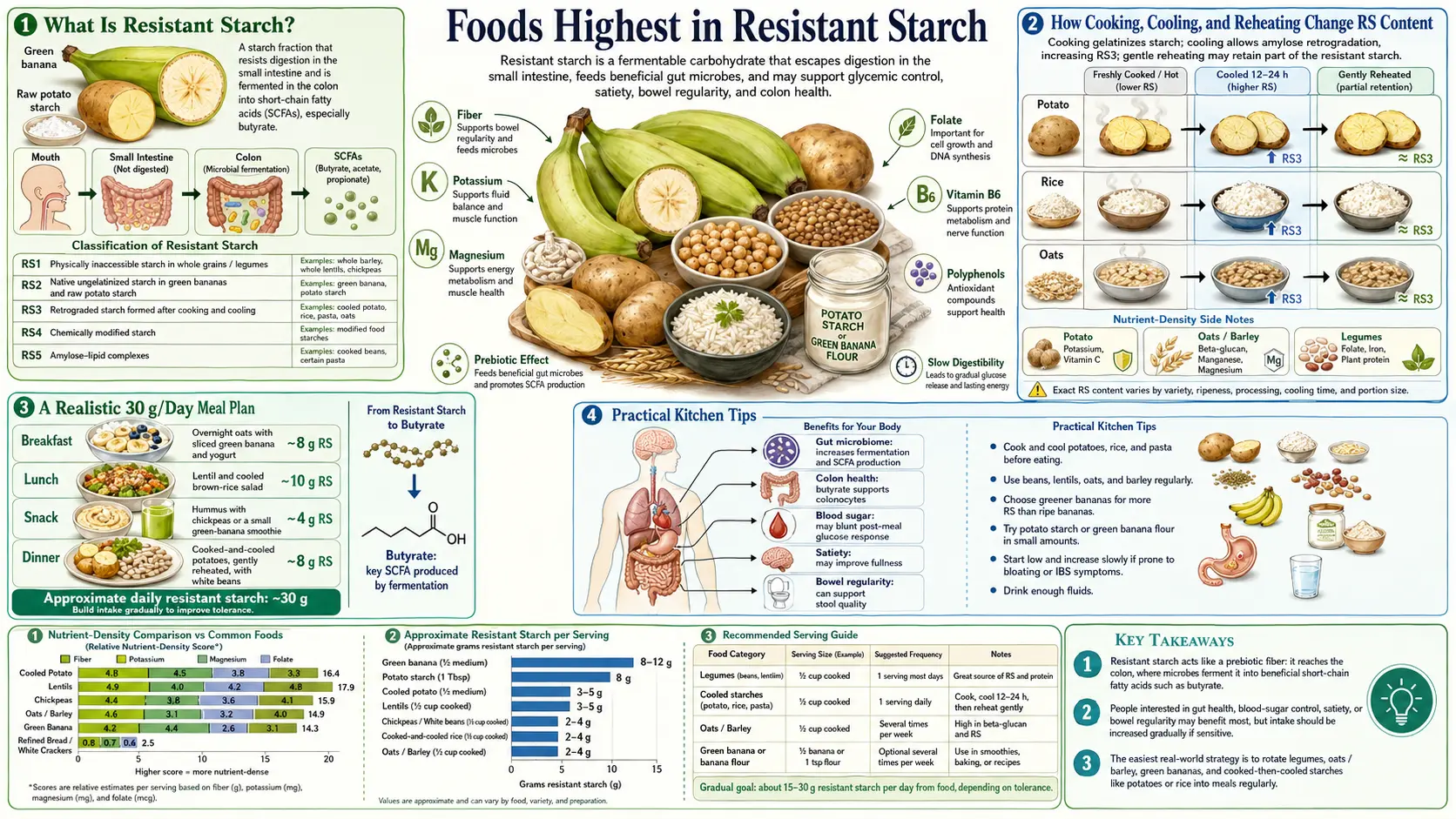
You probably already eat resistant starch (RS) most days — just not enough of it, and not in the forms that survive the trip to your colon. The average Western adult gets 3–5 grams a day; the dose used in clinical trials to move insulin sensitivity, liver fat, satiety hormones, and microbiome diversity is 15–40 grams a day. The gap is closeable with cooked-and-cooled potato salad, a slightly underripe banana, last night's rice tossed cold into a bowl, and a cup of lentils. This page is the practical food guide: which foods carry the most RS per realistic serving, how the four RS classes (RS1, RS2, RS3, RS4) actually show up on your plate, why cooling cooked starch is the single most powerful kitchen trick for boosting RS, how to pace your introduction so you don't bloat, and a worked one-day meal plan that lands around 20 grams.
Table of Contents
- Why Resistant Starch Is a Fermentable Fiber
- RS1, RS2, RS3, RS4 — Translated for the Kitchen
- Top Whole-Food Sources, Ranked by Grams Per Serving
- The Cook-and-Cool Protocol for RS3
- Daily Target Math: Building Toward 20g
- A Sample One-Day Meal Plan Delivering ~20g RS
- Easing In: How to Avoid Bloating and Gas
- FODMAP Considerations and IBS Overlap
- Butyrate, Colon Cells, and Why This Matters Biologically
- Practical Pantry and Shopping List
- Research Papers and References
- Connections
- Featured Videos
1. Why Resistant Starch Is a Fermentable Fiber
Most of the starch in your diet — the soft middle of a baked potato, fresh white rice, white bread, mashed potatoes — is broken down by amylase in your saliva and small intestine into glucose within minutes. It hits your bloodstream as sugar. Resistant starch behaves differently. Its physical structure or chemistry stops digestive enzymes from cleaving it, so the starch travels intact past the stomach and small intestine and arrives in your colon, where gut bacteria treat it as a feast. Functionally it is a soluble, fermentable fiber, even though chemically it is still glucose polymers.
This category was formalized by Hans Englyst and John Cummings in the late 1980s, after laboratory starch-digestion assays kept underestimating how much starch actually reached the terminal ileum in healthy humans (PMID 1330528). The "missing" fraction was being fermented in the colon, and the metabolic consequences of that fermentation — especially the production of short-chain fatty acids like butyrate, acetate, and propionate — turned out to be substantial. Resistant starch is now considered one of the most reliably butyrogenic substrates known, meaning it pushes butyrate production higher than almost any other fiber type (PMID 11427691).
The practical takeaway: every gram of resistant starch you swallow gets converted by your microbes into compounds that feed your colon lining, quiet inflammation, suppress liver fat production, blunt post-meal glucose, and modulate appetite hormones. The kitchen choices that increase RS therefore matter more than they look.
2. RS1, RS2, RS3, RS4 — Translated for the Kitchen
Researchers divide resistant starch into four classes (some sources add an RS5 for amylose-lipid complexes; we'll mention it briefly). Each class is formed by a different mechanism, comes from different foods, and behaves differently when you cook it. Knowing which class is which makes shopping and meal-planning much easier.
- RS1 — Physically Inaccessible. Starch trapped inside intact plant cell walls, bran layers, or hulls. Your enzymes literally can't reach it. Found in whole or coarsely cracked grains, seeds, and legumes. Examples: steel-cut oats, pearl barley, hulled wheat berries, lentils, chickpeas, and most beans. Chewing thoroughly releases some; pureeing or grinding into fine flour destroys most of it.
- RS2 — Native Granular. Raw, uncooked starch granules whose crystalline structure (B-type or C-type starch) is impenetrable to amylase. Found in raw potatoes, raw potato starch (the powder), green/unripe bananas, green banana flour, raw plantains, and high-amylose maize starch (Hi-Maize). The moment you cook these foods past roughly 60–70°C the granules gelatinize and the RS2 collapses into ordinary digestible starch — which is why a baked potato is glucose and a raw potato is RS.
- RS3 — Retrograded. The single most kitchen-relevant class. RS3 forms when a starch is cooked (gelatinized), then cooled below about 5–8°C, during which the amylose chains recrystallize into a new structure that resists digestion. This is why cold potato salad has substantially more RS than a hot baked potato, and why day-old rice reheated still carries more RS than freshly cooked rice. Pasta, oats, sweet potatoes, peas, and beans all generate RS3 when cooled.
- RS4 — Chemically Modified. Starch that has been cross-linked, esterified, or etherified during food processing to resist enzymatic digestion. Found almost exclusively in processed foods labeled as containing modified starch or in dedicated supplement powders. These work physiologically (RS4 ferments and produces SCFAs) but you have far less control over the source. Most clinicians focus diet advice on RS1–RS3 from whole foods.
- RS5 — Amylose-Lipid Complex. A bonus class formed when amylose binds to fatty acids (for example during cooking high-amylose grains with oil), creating helical structures resistant to digestion. Less well-quantified in food tables; mention it mostly for completeness.
If you remember only one thing: RS1 = whole intact plants, RS2 = raw, RS3 = cooked-and-cooled. RS3 is the lever you control in your own kitchen.
3. Top Whole-Food Sources, Ranked by Grams Per Serving
The table below is the single most useful artifact on this page: a rough quantification of how much resistant starch you actually get per realistic serving of common foods, with the predominant RS class noted. Values are conservative midpoints assembled from peer-reviewed food-composition studies (PMID 24228189; PMID 25770258; PMID 27885944); actual values can vary 20–40% by variety, ripeness, and cooling time, so treat them as guideposts rather than gospel.
| Food | Serving | RS (grams) | Class | Notes |
|---|---|---|---|---|
| Raw potato starch (Bob's Red Mill) | 1 tablespoon (10 g) | ~8.0 | RS2 | Most concentrated whole-food source. Stir into water, kefir, smoothies. Never bake or cook. |
| Green/unripe banana | 1 medium (~120 g) | ~12–13 | RS2 | Greenest bananas only; RS drops sharply as the skin yellows. Best blended into a smoothie because raw they are starchy. |
| Green banana flour | 2 tablespoons (~14 g) | ~6–8 | RS2 | Same RS as the fruit, concentrated. Add to yogurt, oatmeal, baked goods (keep below 60°C to preserve). |
| Cooked & cooled white rice | 1 cup cooked (~158 g) | ~1.5–1.8 | RS3 | Cool overnight at refrigerator temp. Reheating does NOT destroy RS3. |
| Cooked & cooled parboiled (converted) rice | 1 cup cooked | ~3.5–5.0 | RS3 | Parboiling pre-gelatinizes; cooling locks in retrograded starch. Roughly double regular white rice. |
| Cooked & cooled long-grain brown rice | 1 cup cooked | ~1.7–2.0 | RS3 + RS1 | Cell-wall RS1 adds to retrograded RS3. |
| Cold potato salad (cooled red or Yukon) | 1 cup (~150 g) | ~3.0–3.5 | RS3 | Boil, cool overnight, dress with vinaigrette. Reheating gently keeps most RS intact. |
| Cooked & cooled white pasta | 1 cup cooked | ~1.5–2.0 | RS3 | Pasta salad, leftover spaghetti reheated. Al dente cooking preserves a touch more. |
| Lentils (cooked) | 1 cup (~198 g) | ~3.4 | RS1 + RS3 | RS roughly doubles when cooled then reheated. |
| Black beans (cooked) | 1 cup (~172 g) | ~3.0–4.0 | RS1 + RS3 | Same cool-and-reheat effect as lentils. |
| Chickpeas (cooked) | 1 cup (~164 g) | ~3.0–4.0 | RS1 + RS3 | Hummus made from cooled chickpeas retains RS. |
| Cooked plantain (boiled, slightly underripe) | 1 cup sliced (~150 g) | ~3.0–4.0 | RS2 residual + RS3 | Greener plantains retain more RS2 through cooking than bananas do. |
| Rolled oats (overnight-soaked, no heat) | 1/2 cup dry (~40 g) | ~1.5–2.0 | RS1 | Overnight oats in the fridge beat hot oatmeal for RS retention. |
| Steel-cut oats (cooked & cooled) | 1/2 cup dry yielded cooked | ~1.5–2.0 | RS1 + RS3 | Cooler oat porridge held overnight retrogrades nicely. |
| Hi-Maize (high-amylose maize starch) | 1 tablespoon (~9 g) | ~4.5–5.0 | RS2 | Heat-stable up to ~120°C, can be used in baking. |
| Pearl barley (cooked & cooled) | 1 cup cooked | ~2.5–3.0 | RS1 + RS3 | Barley salads are excellent vehicles. |
| Wheat berries (cooked & cooled) | 1 cup cooked | ~2.0–2.5 | RS1 + RS3 | Intact bran layer drives RS1. |
| Cooked & cooled sweet potato | 1 cup cubes (~200 g) | ~2.0–3.0 | RS3 | Less RS than white potato but still meaningful. |
| Cashews (raw) | 1 oz (~28 g) | ~1.5 | RS1 | Small but adds up across a day. |
Two observations matter. First, the biggest hits per serving come from a green banana (~12 g), a tablespoon of raw potato starch (~8 g), or a tablespoon of green banana flour (~6 g). Each of those, by itself, is roughly half your daily target. Second, cooked-and-cooled white rice gives only about 1.6 g per cup — meaningful only when stacked with other RS sources across the day.
4. The Cook-and-Cool Protocol for RS3
Of all the kitchen variables that change RS content, temperature history is the most powerful. The mechanism is straightforward: cooking gelatinizes starch granules (amylose and amylopectin chains swell, hydrate, and lose their crystalline structure). When the cooked starch is then cooled below roughly 5–8°C for several hours, the amylose chains retrograde — they realign into a new, tighter crystalline arrangement that pancreatic amylase can no longer break down efficiently ( — Search PubMed). This is RS3.
The protocol for maximum RS3 yield:
- Cook normally. Boil potatoes, simmer rice, cook pasta al dente, prepare oats. Method doesn't matter much; what matters is that gelatinization happens.
- Cool to refrigerator temperature within an hour. Spread on a sheet pan so the cooling is fast and even. Slow cooling at room temperature for too long is a food-safety risk and also doesn't maximize retrogradation.
- Hold cold for at least 12 hours, ideally 24. Retrogradation continues for at least a day; the longer you wait, the more RS3 forms (with diminishing returns past about 48 hours).
- Reheat to whatever temperature you like — up to about 130°C. RS3 is largely heat-stable up to that range, so reheating leftover rice, potatoes, or pasta does NOT destroy the retrograded starch. This is the most counterintuitive and useful fact in this whole article: warm food can still be high in RS.
Why doesn't reheating destroy RS3? Because once amylose has retrograded into its tight crystalline form, melting that crystal back into digestible amorphous starch requires temperatures and water activity well above what your microwave or stovetop deliver during reheating. The retrograded crystal is more thermodynamically stable than the original gelatinized form. So leftover potato hash for breakfast, reheated pasta for lunch, or a warmed-up rice bowl all carry meaningful RS3 if you cooked-then-cooled the starch first ( — Search PubMed).
Practical scripts:
- Rice: Cook 4 cups on Sunday. Cool in the fridge. Eat through the week, microwaved or stir-fried, as the base for bowls.
- Potatoes: Boil whole small potatoes Sunday. Refrigerate. Use sliced cold in salads, or pan-warmed in hash, or quickly reheated as a side.
- Pasta: Cook a pound al dente. Toss with olive oil to prevent clumping. Refrigerate. Reheat in a hot pan with sauce as needed.
- Beans/lentils: Cook a big pot. Refrigerate. Spoon into soups, salads, grain bowls. The cool-and-warm cycle pushes more starch into the RS3 fraction.
5. Daily Target Math: Building Toward 20g
The metabolic-trial literature mostly used 15–40 g RS per day over 4–12 weeks to produce measurable changes in insulin sensitivity, fasting glucose, satiety hormones, liver fat, and microbiome diversity (PMID 16155268; PMID 26406392). For most adults transitioning from the Western baseline of 3–5 g/day, a practical target is 15–20 g/day from whole foods, with optional addition of 1–2 tablespoons of raw potato starch or green banana flour if you want to push toward the upper end of trial doses.
Some sample combinations that land near 20 g/day:
- 1 green-tipped banana (12 g) + 1 cup cooked & cooled white rice (1.6 g) + 1 cup lentils (3.4 g) + 1 cup cold potato salad (3.2 g) = ~20.2 g
- 1 tbsp raw potato starch in kefir (8 g) + 1 cup parboiled rice cooled (4.5 g) + 1 cup black beans (3.5 g) + 1 cup pasta salad (1.8 g) + 2 tbsp green banana flour (6 g) = ~23.8 g
- 2 tbsp green banana flour in smoothie (6 g) + 1 cup cooled potato hash (3.2 g) + 1 cup chickpea salad (3.5 g) + 1 cup cooled brown rice (1.9 g) + 1 oz raw cashews (1.5 g) + 1 cup overnight oats (1.8 g) = ~17.9 g
Notice that you don't need a single heroic source. Stacking modest contributions across breakfast, lunch, and dinner is how most people sustain the target without their meals feeling weird.
6. A Sample One-Day Meal Plan Delivering ~20g RS
This is a worked, realistic day that delivers roughly 20 g of resistant starch and looks like ordinary food.
| Meal | What's on the plate | RS (g) |
|---|---|---|
| Breakfast | Smoothie: kefir, 2 tbsp green banana flour, half a green-tipped banana, frozen berries, scoop of whey or pea protein. Stirred in: 1 tbsp raw potato starch. | ~8.0 (1 tbsp potato starch) + ~6.0 (green banana flour) = ~14.0 |
| Lunch | Mediterranean bowl: 1 cup cold potato salad (cooked-and-cooled Yukon potatoes, olive oil, dijon, vinegar, herbs), tossed with 1/2 cup chickpeas, arugula, roasted peppers, feta. Side of cold sliced apple. | ~3.2 (potato salad) + ~1.7 (1/2 cup chickpeas) = ~4.9 |
| Snack | Plain Greek yogurt with 1 tbsp green banana flour stirred in, plus walnuts and a drizzle of honey. | ~3.0 |
| Dinner | Stir-fry of vegetables and chicken or tempeh over 1 cup of cold-then-reheated parboiled rice. Side: roasted broccoli. | ~4.5 |
| Daily total | ~26.4 g RS |
That's above the conservative target and well within the clinical-trial range. If 26 g/day is too much fermentable substrate for your gut at this point in your microbiome's evolution, scale back by removing one source (drop the raw potato starch in the smoothie and you fall to ~18 g, which is still excellent).
Lower-effort version for busy weekdays: a cup of cooled rice in a stir-fry bowl, half a cup of canned chickpeas thrown into a salad, a slightly green banana with peanut butter as a snack, and overnight oats in the morning lands you near 15 g without any new shopping.
7. Easing In: How to Avoid Bloating and Gas
The most common reason people abandon resistant starch is that they tried 20 g on day one, bloated dramatically by lunch, and concluded prebiotics were a marketing scam. The bloating is real and predictable: a gut that has been eating 3 g/day of fermentable fiber for years simply does not yet have the microbial population to ferment 20 g/day without producing a lot of gas in the process.
The solution is patience.
- Start at 5 g/day for 3–5 days. A single half-cup of cooled rice and a slightly underripe banana will get you there.
- Add 5 g every 3–5 days, watching how your gut responds. Mild looser stools and some increase in gas are normal and pass within a week or two as the microbiome adapts.
- Plateau at 15–20 g/day for 2–4 weeks before considering a higher dose.
- Drink more water than you think you need. Fermentation produces gas; soluble fiber pulls water into the colon; both go better with adequate hydration.
- Split intake across meals. Three 6–7 g servings are better tolerated than one 20 g bolus.
The species that ferment RS — particularly Ruminococcus bromii (the keystone primary degrader), Bifidobacterium adolescentis, Faecalibacterium prausnitzii, and Eubacterium rectale — expand in abundance over 2–4 weeks of consistent RS intake (PMID 22343308). The bloating gets dramatically better once R. bromii reaches steady state. People who give up after three days never see that adaptation.
8. FODMAP Considerations and IBS Overlap
Resistant starch is not classified as a FODMAP (the FODMAP family covers fructans, GOS, lactose, fructose, and polyols), but several of the foods richest in RS — legumes, lentils, and some grain products — are also high in FODMAPs (galacto-oligosaccharides in beans, fructans in wheat and onions, GOS in lentils). For someone with IBS managing a low-FODMAP elimination phase, certain high-RS foods may need to be deferred until the reintroduction stage (PMID 24076059).
Practical guidance for people with IBS or known FODMAP sensitivity:
- Low-FODMAP high-RS options: cooled white rice, cooled parboiled rice, green banana (in tolerated amounts — bananas become higher in fructose as they ripen), green banana flour (typically tolerated), raw potato starch (no FODMAPs), cooked-and-cooled potatoes (white potato is FODMAP-friendly), oats in low-FODMAP serving sizes, firm tofu.
- Higher-FODMAP RS options (delay until reintroduction): lentils, chickpeas, black beans, wheat berries, some rye products.
- Pure powders (RS2) like raw potato starch and green banana flour tend to be the most IBS-friendly RS sources because they avoid co-traveling FODMAPs.
People with small intestinal bacterial overgrowth (SIBO) are a separate group — in active SIBO, fermentable substrates of any kind can worsen symptoms because the fermentation is happening in the wrong location (the small intestine, not the colon). Work with a clinician to treat the overgrowth first, then introduce RS slowly. See the SIBO overview and the Root Causes deep-dive for more.
9. Butyrate, Colon Cells, and Why This Matters Biologically
The reason all of this kitchen choreography matters comes down to a single short-chain fatty acid: butyrate. When your gut bacteria ferment resistant starch, they produce SCFAs in roughly 60% acetate, 20% propionate, 20% butyrate proportions. That butyrate is the primary energy source for the cells lining your colon (colonocytes), supplying about 70% of their energy needs (PMID 11427691). Well-fed colonocytes maintain a tight epithelial barrier, suppress inflammatory signaling, and consume oxygen at the mucosal surface — which keeps the colon environment anaerobic and starves pathogens like Salmonella, pathogenic E. coli, and Clostridioides difficile of the oxygen they need to bloom.
Butyrate also acts systemically. It is a histone deacetylase (HDAC) inhibitor, modulating gene expression in immune cells and influencing differentiation of regulatory T cells (PMID 24226770). It activates AMPK, shifting cellular metabolism toward fat oxidation. Propionate travels through the portal vein to the liver, where it suppresses de novo lipogenesis (one mechanism behind the reductions in liver fat seen in RS trials). Acetate enters systemic circulation and contributes to central appetite regulation. So a single dietary lever — eating more retrograded starch and green-banana-derived fiber — reaches the gut barrier, the immune system, the liver, and the brain through one common production line (PMID 27885944).
This is why population-level observational data have consistently associated higher long-term fermentable-fiber intake with reduced colorectal cancer risk, lower all-cause mortality, and better metabolic markers across cohorts. The mechanism is butyrate, and resistant starch is one of the cleanest, most controllable ways to drive butyrate production through diet alone.
10. Practical Pantry and Shopping List
If you want one shopping list to keep at hand, this is it. Most items keep for weeks to months and let you bolt RS onto whatever you were already going to cook.
- Raw potato starch (Bob's Red Mill or equivalent; the unmodified powder, not "potato flour"). Stays good in the pantry for 6–12 months. 1 tbsp = 8 g RS.
- Green banana flour (Let's Do Organic, NuNaturals, or similar). 2 tbsp = ~6 g RS.
- Hi-Maize 260 (high-amylose maize starch, heat-stable up to ~120°C). Useful in baked goods. 1 tbsp = ~4.5–5 g RS.
- Parboiled (converted) rice. Cooks similarly to standard white rice but generates roughly 2–3× more RS3 on cooling.
- Yukon, red, or fingerling potatoes for boil-and-cool batch cooking.
- Lentils, chickpeas, black beans — dry or canned. Cook a pot weekly.
- Steel-cut or rolled oats for overnight oats and porridge that can be made ahead and reheated.
- Pearl barley for grain bowls and soups.
- Green-tipped (slightly underripe) bananas — buy bananas a stage greener than you usually do, blend them quickly into smoothies before they ripen further.
- Plantains (greener, firmer ones) for boiling or roasting.
One last principle: RS-rich days build on themselves. The microbes that ferment resistant starch expand only when you feed them consistently; a one-day surge has minimal lasting effect, while a four-week consistent 15–20 g/day reshapes the community, and then bloating drops, satiety improves, and the metabolic effects start to show up in lab markers. Treat this as a kitchen habit, not a one-week experiment.
Research Papers and References
- Englyst HN, Kingman SM, Cummings JH. Classification and measurement of nutritionally important starch fractions. Eur J Clin Nutr. 1992;46 Suppl 2:S33-50. PMID 1330528
- Birt DF, Boylston T, Hendrich S, et al. Resistant starch: promise for improving human health. Adv Nutr. 2013;4(6):587-601. PMID 24228189 · doi:10.3945/an.113.004325
- Topping DL, Clifton PM. Short-chain fatty acids and human colonic function: roles of resistant starch and nonstarch polysaccharides. Physiol Rev. 2001;81(3):1031-64. PMID 11427691 · doi:10.1152/physrev.2001.81.3.1031
- Robertson MD, Bickerton AS, Dennis AL, Vidal H, Frayn KN. Insulin-sensitizing effects of dietary resistant starch and effects on skeletal muscle and adipose tissue metabolism. Am J Clin Nutr. 2005;82(3):559-67. PMID 16155268 · doi:10.1093/ajcn.82.3.559
- Ze X, Duncan SH, Louis P, Flint HJ. Ruminococcus bromii is a keystone species for the degradation of resistant starch in the human colon. ISME J. 2012;6(8):1535-43. PMID 22343308 · doi:10.1038/ismej.2012.4
- Bindels LB, Walter J, Ramer-Tait AE. Resistant starches for the management of metabolic diseases. Curr Opin Clin Nutr Metab Care. 2015;18(6):559-65. PMID 26406392 · doi:10.1097/MCO.0000000000000223
- Keenan MJ, Zhou J, Hegsted M, et al. Role of resistant starch in improving gut health, adiposity, and insulin resistance. Adv Nutr. 2015;6(2):198-205. PMID 25770258 · doi:10.3945/an.114.007419
- Sajilata MG, Singhal RS, Kulkarni PR. Resistant starch — a review. Compr Rev Food Sci Food Saf. 2006;5(1):1-17. — Search PubMed · doi:10.1111/j.1541-4337.2006.tb00076.x
- Raigond P, Ezekiel R, Raigond B. Resistant starch in food: a review. J Sci Food Agric. 2015;95(10):1968-78. — Search PubMed · doi:10.1002/jsfa.6966
- Halmos EP, Power VA, Shepherd SJ, Gibson PR, Muir JG. A diet low in FODMAPs reduces symptoms of irritable bowel syndrome. Gastroenterology. 2014;146(1):67-75. PMID 24076059 · doi:10.1053/j.gastro.2013.09.046
- Furusawa Y, Obata Y, Fukuda S, et al. Commensal microbe-derived butyrate induces the differentiation of colonic regulatory T cells. Nature. 2013;504(7480):446-50. PMID 24226770 · doi:10.1038/nature12721
- Koh A, De Vadder F, Kovatcheva-Datchary P, Bäckhed F. From dietary fiber to host physiology: short-chain fatty acids as key bacterial metabolites. Cell. 2016;165(6):1332-1345. PMID 27259147 · doi:10.1016/j.cell.2016.05.041
- DeMartino P, Cockburn DW. Resistant starch: impact on the gut microbiome and health. Curr Opin Biotechnol. 2020;61:66-71. PMID 31765963 · doi:10.1016/j.copbio.2019.10.008
- Maier TV, Lucio M, Lee LH, et al. Impact of dietary resistant starch on the human gut microbiome, metaproteome, and metabolome. mBio. 2017;8(5):e01343-17. — Search PubMed · doi:10.1128/mBio.01343-17
- Live PubMed search: resistant starch — human trials
Connections
- All Food
- Resistant Starches Overview
- Gut Microbiome (Benefits)
- Fatty Liver Disease (Benefits)
- Visceral Fat (Benefits)
- High Resistant Starch Foods (Benefits hub version)
- Fermented Foods
- Probiotics
- Gut Healing
- Gut-Brain Axis
- Bananas
- Lentils
- Oats
- Gastroenterology
- SIBO
- Irritable Bowel Syndrome
- Insulin Resistance