Sardines: Nutrient Profile
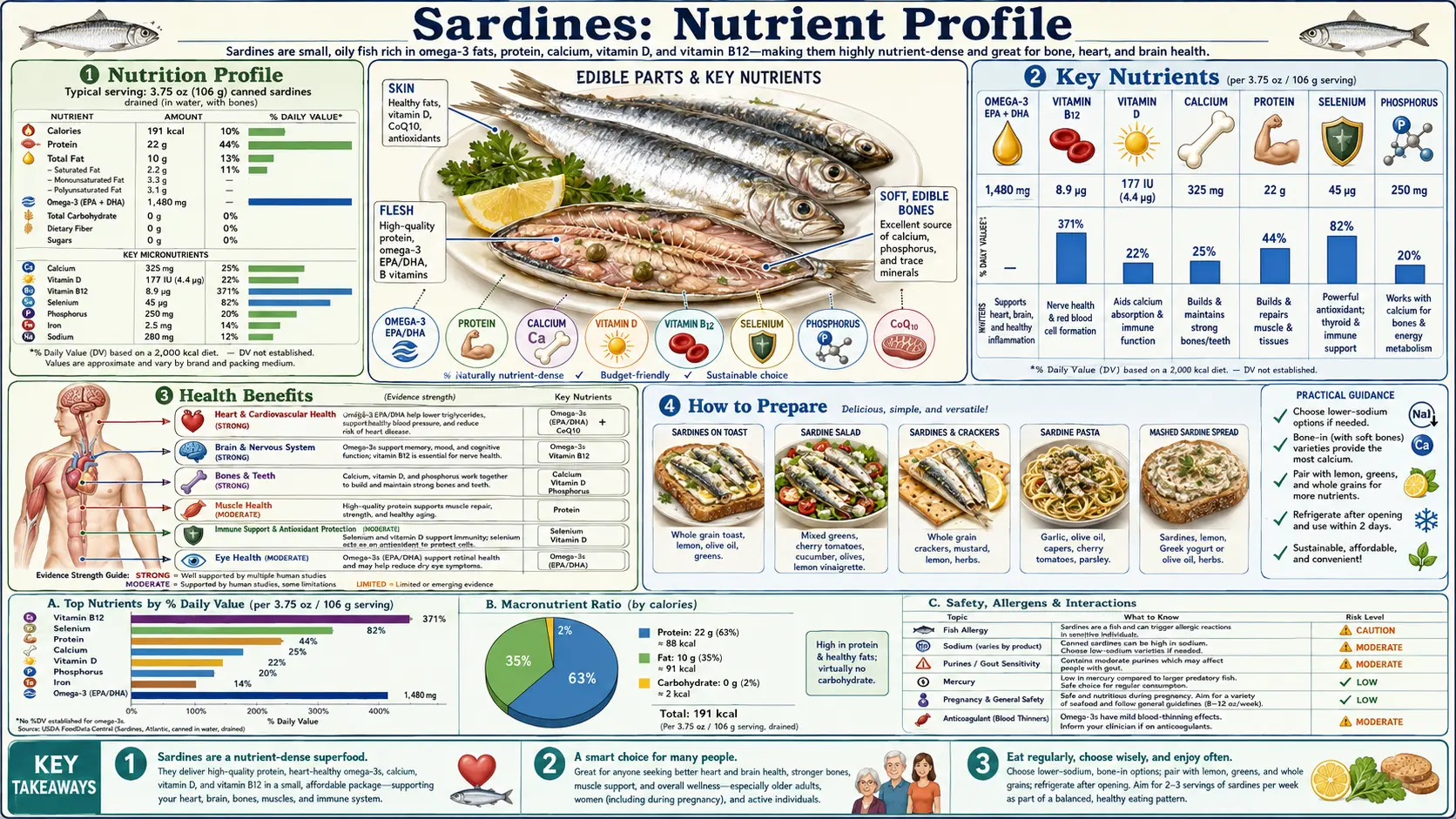
What is Sardines richest in? Below are the vitamins, minerals and amino acids that 100 g of Sardines delivers in the highest amounts. Each one links to that nutrient’s own page listing the best foods to get it from.
| Sardines: Richest Nutrients (per 100 g) | ||||
|---|---|---|---|---|
| Rank | Nutrient | Per 100 g | %DV / 100g | Purpose |
| Vitamins | ||||
| 1 | Vitamin B12 | 8.9 mcg | 🟢 372% | Nerves & red blood cells |
| 2 | Vitamin B3 (Niacin) | 5.2 mg | 🟡 33% | Energy, skin & nerves |
| 3 | Vitamin D3 | 4.8 mcg | 🟡 24% | Bone strength & immunity |
| 4 | Vitamin B2 (Riboflavin) | 0.2 mg | 🟡 17% | Energy & cell health |
| 5 | Choline | 75 mg | 🟡 14% | Brain & liver |
| 6 | Vitamin E | 2.0 mg | 🟡 14% | Protects cells (antioxidant) |
| 7 | Vitamin B5 (Pantothenic Acid) | 0.6 mg | 🟡 13% | Energy metabolism |
| Minerals | ||||
| 1 | Selenium | 53 mcg | 🟢 96% | Antioxidant & thyroid |
| 2 | Phosphorus | 490 mg | 🟡 39% | Bones & cellular energy |
| 3 | Calcium | 382 mg | 🟡 29% | Bones & teeth |
| 4 | Copper | 0.2 mg | 🟡 21% | Iron use; connective tissue |
| 5 | Iron | 2.9 mg | 🟡 16% | Carries oxygen in blood |
| 6 | Zinc | 1.3 mg | 🟡 12% | Immunity & healing |
| Amino Acids — ranked by amount (no Daily Value) | ||||
| 1 | Glutamic acid | 3.7 g | 🟢 | Brain signaling (glutamate) |
| 2 | Aspartic acid | 2.5 g | 🟢 | Cellular energy & detox |
| 3 | Lysine | 2.3 g | 🟢 | Collagen & immunity |
| 4 | Leucine | 2.0 g | 🟢 | Builds muscle (branched-chain amino acid, BCAA) |
| 5 | Alanine | 1.5 g | 🟡 | Energy (glucose cycle) |
| 6 | Arginine | 1.5 g | 🟡 | Blood flow (nitric oxide) |
| 7 | Valine | 1.3 g | 🟡 | Muscle & energy (branched-chain amino acid) |
| 8 | Glycine | 1.2 g | 🟡 | Collagen, calm & sleep |
| 9 | Isoleucine | 1.1 g | 🟡 | Muscle & energy (branched-chain amino acid) |
| 10 | Threonine | 1.1 g | 🟡 | Collagen & gut lining |
| 11 | Serine | 1.0 g | 🟡 | Cell membranes & brain |
| 12 | Phenylalanine | 1.0 g | 🟡 | Dopamine & focus |
| 13 | Proline | 0.9 g | 🟡 | Collagen & joints |
| 14 | Tyrosine | 0.8 g | 🟡 | Dopamine & thyroid |
Values are per 100 g of the U.S. Department of Agriculture (USDA) FoodData Central record FDC 175139, “Fish, sardine, Atlantic, canned in oil, drained solids with bone” (SR Legacy). %DV is the amount per 100 g divided by the adult Daily Value in 21 CFR 101.9.
Omega-3 Fats, Sodium and Cholesterol in Canned Sardines
The table above lists vitamins, minerals and amino acids only, so it leaves out the long-chain omega-3 fats that are the main reason sardines are discussed. The same USDA record (FDC 175139, sardines canned in oil, drained, with bone) gives per 100 g:
- Omega-3 fats: eicosapentaenoic acid (EPA) 0.473 g and docosahexaenoic acid (DHA) 0.509 g
- Total fat: 11.4 g
- Sodium: 307 mg
- Cholesterol: 142 mg
A One-Year Sardine Trial in Prediabetes
In a randomised trial in Barcelona, 152 adults aged 65 or older with prediabetes (fasting blood sugar 100–124 mg/dL) all received the same diabetes-prevention diet for a year, and one group also ate 200 g of sardines a week. Compared with the diet-only group, fewer people in the sardine group remained in the “very high risk” group for developing type 2 diabetes on the Finnish Diabetes Risk Score (FINDRISC, P = 0.035). The sardine group also had lower insulin resistance (HOMA-IR, P = 0.032), higher HDL cholesterol and adiponectin (a hormone made by fat tissue), and lower triglycerides and blood pressure. Eighteen people in the diet-only group and 12 in the sardine group dropped out before the end.
Key Research Papers
- Díaz-Rizzolo DA, Serra A, Colungo C, Sala-Vila A, Sisó-Almirall A, Gomis R. “Type 2 diabetes preventive effects with a 12-months sardine-enriched diet in elderly population with prediabetes: An interventional, randomized and controlled trial.” Clin Nutr. 2021;40(5):2587–2598. — PubMed PMID: 33932804