⚠ Evidence warning: Clinical trials or other evidence do not support the claim that ordinary foods cover choline well, with no need to chase exotic supplements. This page keeps it as a report of what people, websites or other media say.
Choline: Food Sources & Daily Intake
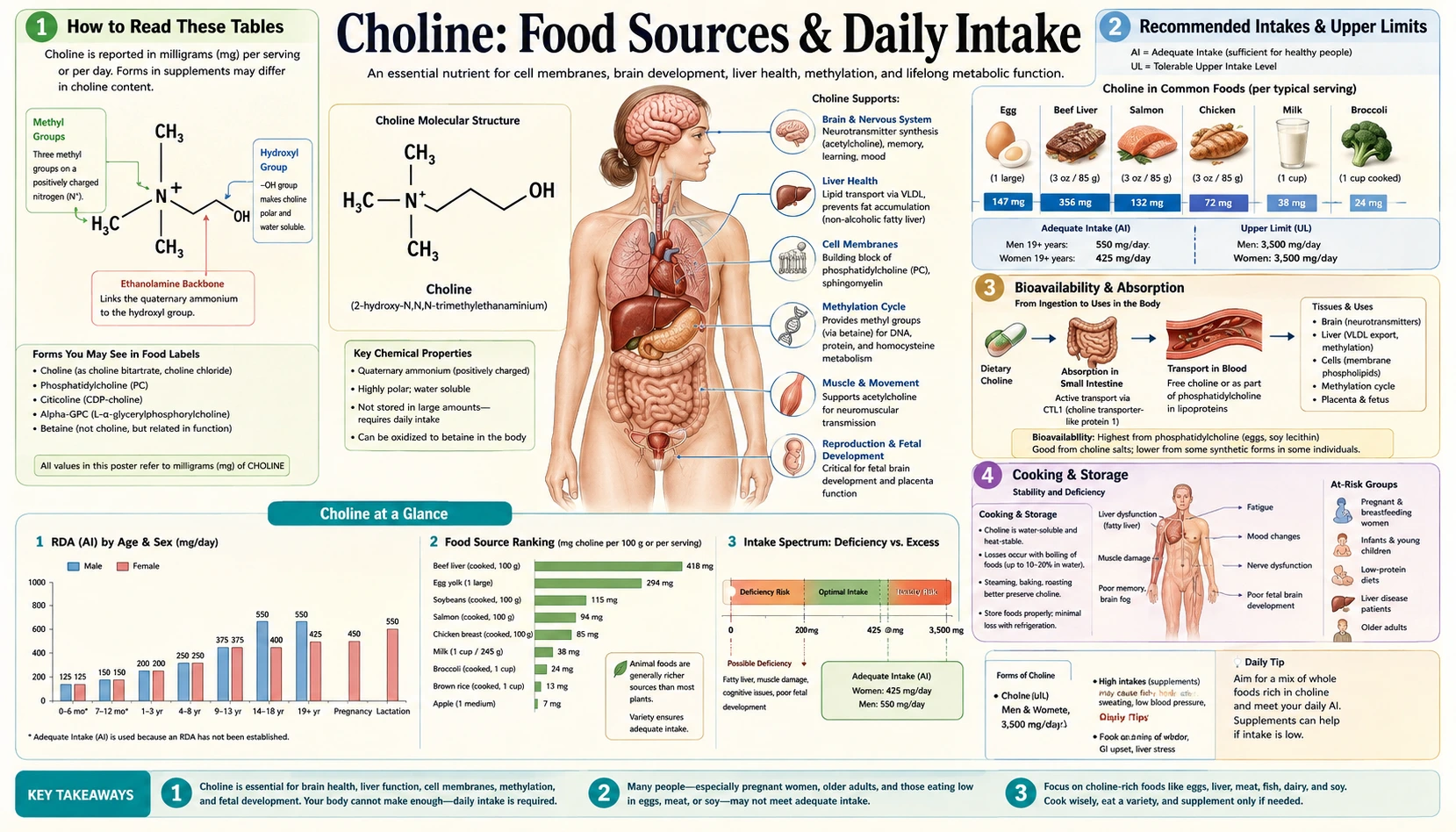
Choline is an essential nutrient that most people have never heard of. It is usually grouped with the B vitamins, and the body uses it to build cell membranes, to make the memory-and-muscle signal acetylcholine, and to move fats out of the liver. The body makes a little on its own, but not enough — so it has to come from food. The richest everyday sources are egg yolks and beef liver, followed by meat, fish, beans, whole grains and cruciferous vegetables.
| Choline: Food Sources & Daily Intake | ||||||
|---|---|---|---|---|---|---|
| Rank | Food (serving) | Per 100 g | %DV / 100g | Glucose | Fructose | Notes |
| 1 | Egg Yolk, Raw 1 yolk / 17 g | 820 mg | 🟢 149% | 0.2 | 0.1 | Where the egg’s choline lives — the white has almost none. |
| 2 | Beef Organ Meats 3 oz / 85 g | 513 mg | 🟢 93% | 0 | 0 | Nutrient-dense organ meat. |
| 3 | Beef Liver 3 oz / 85 g | 418 mg | 🟢 76% | 0 | 0 | By far the richest everyday source — a single serving covers most of a day. |
| 4 | Egg, Whole 1 large egg / 50 g | 294 mg | 🟢 53% | — | — | The standout ordinary source; nearly all of it is in the yolk. |
| 5 | Wheat Germ, Toasted 1 oz / 28 g | 179 mg | 🟡 33% | — | — | |
| 6 | Chicken Organ Meats 3 oz / 85 g | 178 mg | 🟡 32% | 0 | 0 | Nutrient-dense organ meat (giblets). |
| 7 | Salmon, Sockeye 3 oz / 85 g | 113 mg | 🟡 21% | 0 | 0 | An oily fish that also brings omega-3s. |
| 8 | Scallops 3 oz / 85 g | 111 mg | 🟡 20% | 0 | 0 | |
| 9 | Chicken Breast 3 oz / 85 g | 85 mg | 🟡 16% | 0 | 0 | |
| 10 | Cod, Atlantic 3 oz / 85 g | 84 mg | 🟡 15% | 0 | 0 | A lean white fish, easy on calories. |
| 11 | Shiitake Mushrooms ½ cup / 73 g | 80 mg | 🟡 15% | — | — | |
| 12 | Beef Meat 3 oz / 85 g | 72 mg | 🟡 13% | 0 | 0 | |
| 13 | Peanuts, Dry- ¼ cup / 36 g | 65 mg | 🟡 12% | 0 | 0 | |
| 14 | Brussels Sprouts ½ cup / 78 g | 41 mg | ⚪ 7% | — | — | A cruciferous vegetable that helps plant-based eaters. |
| 15 | Broccoli ½ cup / 78 g | 40 mg | ⚪ 7% | 0.5 | 0.7 | |
| 16 | Brown Rice 1 cup / 195 g | 9.2 mg | ⚪ 2% | 0 | 0 | Common staple. |
Table of Contents
How to Read These Tables
- It’s an Adequate Intake (AI), not a Recommended Dietary Allowance (RDA). Choline has an Adequate Intake (AI) rather than a Recommended Dietary Allowance, because researchers decided the data were too limited to set a firm allowance. The Adequate Intake is 550 mg for adult men, 425 mg for women, 450 mg in pregnancy and 550 mg while breastfeeding.
- %DV vs your target. The %DV column compares 100 g of each food against the U.S. Food and Drug Administration (FDA) Daily Value of 550 mg, the same figure used on nutrition labels. It happens to match the men’s Adequate Intake, so women and most children will reach their personal target at a lower %DV.
- Per 100 g vs per serving. Per-100 g lets you compare foods fairly; the serving size shown beside each food is what you actually eat. A serving can be smaller or larger than 100 g — a single egg yolk weighs about 17 g — so the percentage for one serving can differ a lot from the per-100 g figure.
Recommended Intakes & Upper Limits
Your personal target depends on age, sex and pregnancy. The Daily Value used for the %DV column above is a single label figure; the table below is the age-specific guidance.
| Life stage | Recommended Dietary Allowance / Adequate Intake (mg/day) | Upper limit (mg/day) |
|---|---|---|
| Infants 0–6 mo | 125* (Adequate Intake) | Not set |
| Infants 7–12 mo | 150* (Adequate Intake) | Not set |
| Children 1–3 y | 200* (Adequate Intake) | 1,000 |
| Children 4–8 y | 250* (Adequate Intake) | 1,000 |
| Children 9–13 y | 375* (Adequate Intake) | 2,000 |
| Males 14–18 y | 550* (Adequate Intake) | 3,000 |
| Males 19+ y | 550* (Adequate Intake) | 3,500 |
| Females 14–18 y | 400* (Adequate Intake) | 3,000 |
| Females 19+ y | 425* (Adequate Intake) | 3,500 |
| Pregnancy | 450* (Adequate Intake) | 3,000–3,500 |
| Lactation | 550* (Adequate Intake) | 3,000–3,500 |
Bioavailability & Absorption
Choline from food is absorbed well throughout the small intestine. It travels in two main forms: as free choline and as phosphatidylcholine (the form in egg yolk), and the body handles both. Genetics matter more here than for most nutrients — common variations in the genes that let the body make its own choline mean some people, and especially some pregnant women, run short on a diet that would be fine for everyone else. In U.S. survey data, people who ate eggs were far more likely to reach the Adequate Intake than people who did not (see below). There is no need to chase exotic supplements: ordinary foods cover it well if you eat them.
Cooking & Storage
Choline is reasonably stable — far sturdier than fragile vitamin C. Normal cooking does not destroy much of it; most foods in the table are listed cooked, while the egg yolk figure is for raw yolk. The bigger swing comes from which part of a food you eat: almost all of an egg’s choline is in the yolk, so egg-white-only dishes give up most of the benefit. Boiling vegetables in lots of water can leach a little into the cooking liquid; steaming or roasting keeps slightly more.
Vegetarian & Vegan Sources
Choline is harder on a plant-based diet than most nutrients, because the two champion sources — eggs and liver — are off the table and the animal foods just below them (meat, fish, dairy) supply a lot of the average person’s intake. It is doable, but it takes intention. The strongest plant sources are wheat germ, kidney and other beans, peanuts and seeds, and cruciferous vegetables like broccoli and Brussels sprouts. Reaching the Adequate Intake on a plant-based diet usually takes several of these foods across the day; the targets are highest in pregnancy (450 mg) and while breastfeeding (550 mg).
Who Needs to Pay Attention
Choline is especially important in pregnancy: it is used to build the baby’s brain. In rodent studies, extra choline in the mother’s diet during pregnancy produced life-long cognitive (thinking and memory) benefits in the offspring; human studies have given less consistent results. In a tightly controlled feeding trial of 26 women, those eating 930 mg of choline a day from the start of the third trimester (about twice the Adequate Intake) had babies with faster information-processing speed than women eating 480 mg. The demand is high enough that many expectant mothers fall short — in U.S. survey data only about 8.5% of pregnant women met the Adequate Intake — and standard prenatal vitamins often contain little or no choline. More broadly, national surveys show most Americans get less than the Adequate Intake: in 2009–2012 only about 11% of people aged 2 and over reached it, including 6.6% of adults and 1.8% of teenagers, although most children aged 2–3 (62.9%) exceeded it. Eggs make the biggest difference: in 2009–2014 survey data, adults who ate eggs averaged 525 mg a day against 294 mg for those who did not, and 57% of egg eaters met the Adequate Intake against 2.4% of non-eaters. Frank deficiency is uncommon but can cause liver and muscle damage. Toxicity from food essentially does not happen; the only people who hit the upper limit are those taking very large supplements, which can cause a fishy body odor, sweating, and low blood pressure. The adult Tolerable Upper Intake Level is 3,500 mg/day — food never comes close.
Key Research Papers
- NIH Office of Dietary Supplements — Choline Fact Sheet for Health Professionals (AI, DV, UL)
- Linus Pauling Institute — Choline Micronutrient Information Center
- Caudill MA, Strupp BJ, Muscalu L, Nevins JEH, Canfield RL (2018). Maternal choline supplementation during the third trimester of pregnancy improves infant information processing speed: a randomized, double-blind, controlled feeding study. FASEB Journal;32(4):2172-2180. — PubMed PMID: 29217669
- Wallace TC, Fulgoni VL 3rd (2016). Assessment of Total Choline Intakes in the United States. Journal of the American College of Nutrition;35(2):108-112. — PubMed PMID: 26886842
- Wallace TC, Fulgoni VL (2017). Usual Choline Intakes Are Associated with Egg and Protein Food Consumption in the United States. Nutrients;9(8):839. — PubMed PMID: 28783055