Valine: Food Sources & Daily Intake
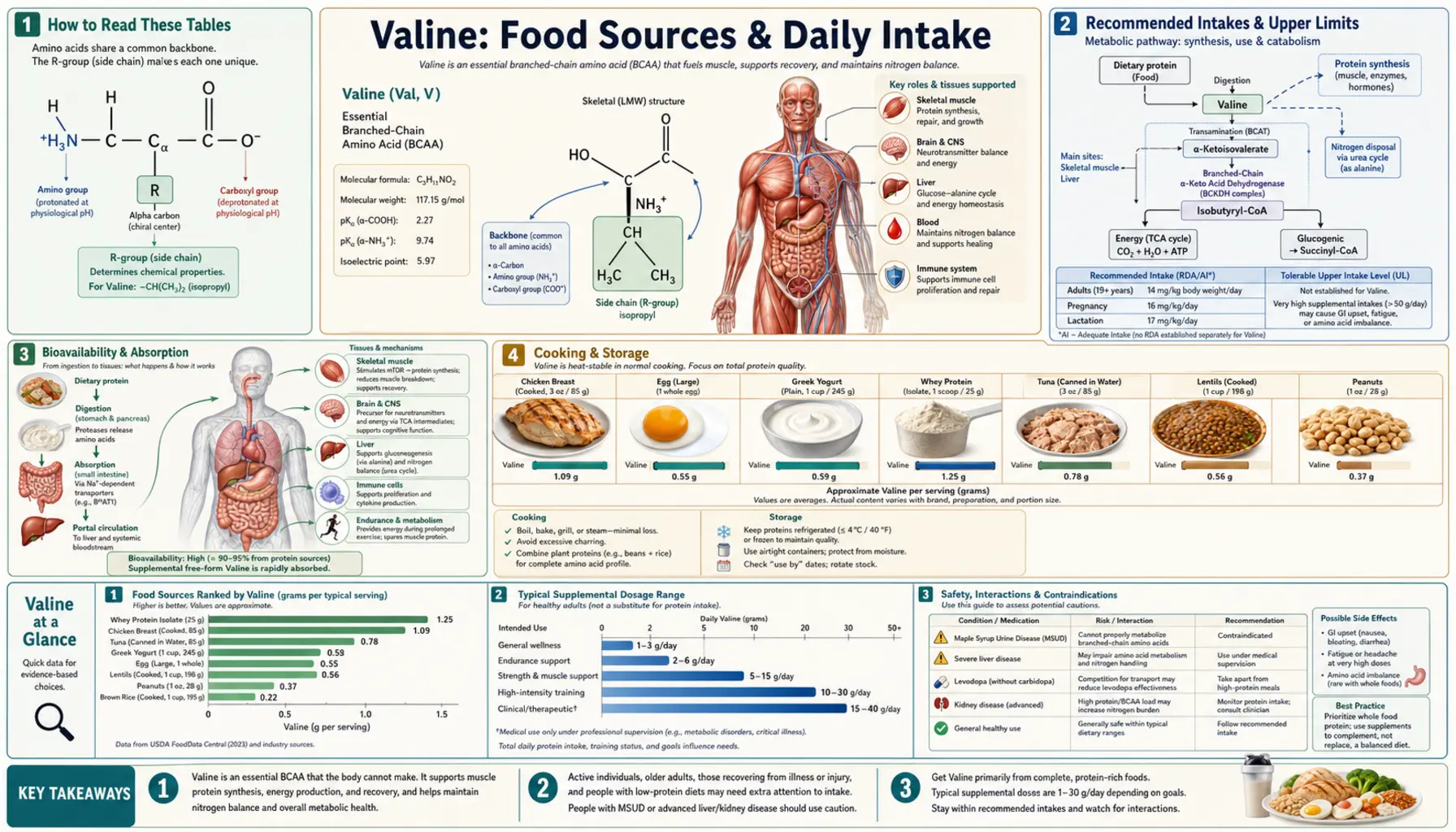
Valine is one of the three branched-chain amino acids (BCAAs), alongside leucine and isoleucine. Muscle tissue burns and rebuilds the branched-chain amino acids directly, so valine plays a hands-on role in muscle growth and repair, energy during exercise, and normal nervous-system function. Because it is essential, the body cannot make it, so it has to come from food. The richest sources are concentrated animal proteins — hard cheeses, meat, fish, eggs — followed by legumes, peanuts and seeds. The table below shows grams of valine per 100 g of food; there is no U.S. Food and Drug Administration (FDA) Daily Value for individual amino acids, so amounts are absolute.
| Valine: Food Sources & Daily Intake | |||||
|---|---|---|---|---|---|
| Rank | Food (serving) | Per 100 g | Glucose | Fructose | Notes |
| 1 | Parmesan Cheese 1 oz / 28 g | 🟢 2.5 g | — | — | Concentrated protein. |
| 2 | Cheddar Cheese 1 oz / 28 g | 🟢 1.6 g | 0 | 0 | |
| 3 | Pumpkin Seeds 1 oz / 28 g | 🟢 1.6 g | 0.1 | 0.1 | |
| 4 | Salmon 3 oz / 85 g | 🟢 1.5 g | 0 | 0 | |
| 5 | Pork Organ Meats 3 oz / 85 g | 🟢 1.5 g | — | — | Nutrient-dense organ meat. |
| 6 | Chicken Breast 3 oz / 85 g | 🟢 1.5 g | 0 | 0 | |
| 7 | Beef Meat 3 oz / 85 g | 🟢 1.4 g | 0 | 0 | |
| 8 | Pork 3 oz / 85 g | 🟢 1.4 g | 0 | 0 | |
| 9 | Tuna 3 oz / 85 g | 🟢 1.3 g | 0 | 0 | |
| 10 | Cod 3 oz / 85 g | 🟡 1.2 g | 0 | 0 | Lean white fish. |
| 11 | Peanuts 1 oz / 28 g | 🟡 1.1 g | — | — | |
| 12 | Sunflower Seeds 1 oz / 28 g | 🟡 1.0 g | — | — | |
| 13 | Egg 1 large / 50 g | 🟡 0.8 g | — | — | |
| 14 | Chicken Organ Meats 3 oz / 85 g | 🟡 0.6 g | 0 | 0 | Nutrient-dense organ meat (giblets). |
| 15 | White Beans 1 cup / 179 g | 🟡 0.5 g | — | — | |
| 16 | Brown Rice 1 cup / 195 g | ⚪ 0.2 g | 0 | 0 | Common staple. |
Table of Contents
How to Read These Tables
- Essential amino acid. Your body cannot synthesize valine, so a regular dietary supply matters. The nine essential amino acids must come from food; the other eleven the body can build itself.
- Grams per 100 g, not %DV. There is no U.S. Food and Drug Administration Daily Value for individual amino acids, so this table reports the absolute grams per 100 g of food and ranks foods by that. A typical serving is shown beside each food.
- Complete vs incomplete protein. Animal foods are “complete” they carry all the essential amino acids in good proportion. Most single plant foods are lower in one or two; eating a variety of legumes, grains, nuts and seeds across the day covers the gaps.
Recommended Intakes & Upper Limits
Valine has no Daily Value: the U.S. food-label rules (21 CFR 101.9) set none for it, and the green and yellow marks in the food table above only rank each food against the richest food listed. The table below summarizes its status.
| Reference | Adult value | Notes |
|---|---|---|
| Essential? | Yes — essential (a branched-chain amino acid (BCAA)) | The body cannot make it; it must come from food. |
| Adult requirement | 26 mg/kg/day | WHO/FAO/UNU 2007 estimate. |
| ≈ for a 70 kg adult | ~1.8 g/day | Easily met by a normal protein intake (~0.8 g protein/kg). |
| Main roles | Muscle, energy & nerves | A branched-chain amino acid burned in muscle for fuel and repair; also supports nervous-system function. |
Bioavailability & Absorption
Valine from food is well absorbed as part of dietary protein. What matters most is total protein quality and quantity: animal proteins (meat, fish, eggs, dairy) are complete and branched-chain amino acid-dense, while plant proteins are usually a little lower in the branched-chain amino acids and benefit from variety. Protein spread across the day's meals — roughly 20–40 g of quality protein per meal is a commonly cited amount — keeps a steady supply of valine and the other branched-chain amino acids available to muscle through the day.
Cooking & Storage
Amino acids are stable to ordinary cooking — valine is not destroyed by normal heat, and cooking actually makes protein easier to digest. Very high, prolonged dry heat (charring) can damage some heat-sensitive amino acids like lysine, but valine is robust. No special handling is needed.
Vegetarian & Vegan Sources
Plant-based eaters can get plenty of valine, but it takes a little planning because plant proteins are less branched-chain amino acid-dense than animal ones. The strongest plant sources are lentils, white and black beans, chickpeas, peanuts, pumpkin and sunflower seeds. Eating a variety across the day (legumes + grains + seeds) supplies all the essential amino acids; total protein simply needs to be a bit higher than for omnivores to reach the same valine.
Who Needs to Pay Attention
Outright valine deficiency is rare in anyone eating enough total protein. The groups at risk are those with low overall protein intake — some older adults (who need more protein per kilogram to maintain muscle), people recovering from illness or surgery, and very-low-calorie dieters. What these groups lack is total protein rather than valine alone; enough quality protein supplies valine along with the other essential amino acids. People with the rare metabolic disorder maple syrup urine disease cannot break down the branched-chain amino acids normally and are treated with a diet restricted in valine, leucine and isoleucine, managed by a metabolic clinic.
Key Research Papers
- NIH MedlinePlus — Amino acids
- National Academies — Dietary Reference Intakes: Protein and Amino Acids (2005), Chapter 10
- Joint WHO/FAO/UNU Expert Consultation (2007). Protein and amino acid requirements in human nutrition. World Health Organ Tech Rep Ser 935:1-265 (valine 26 mg/kg per day, Table 18). — PubMed PMID: 18330140
- PubMed — branched-chain amino acid requirements