Milk: History and Origins
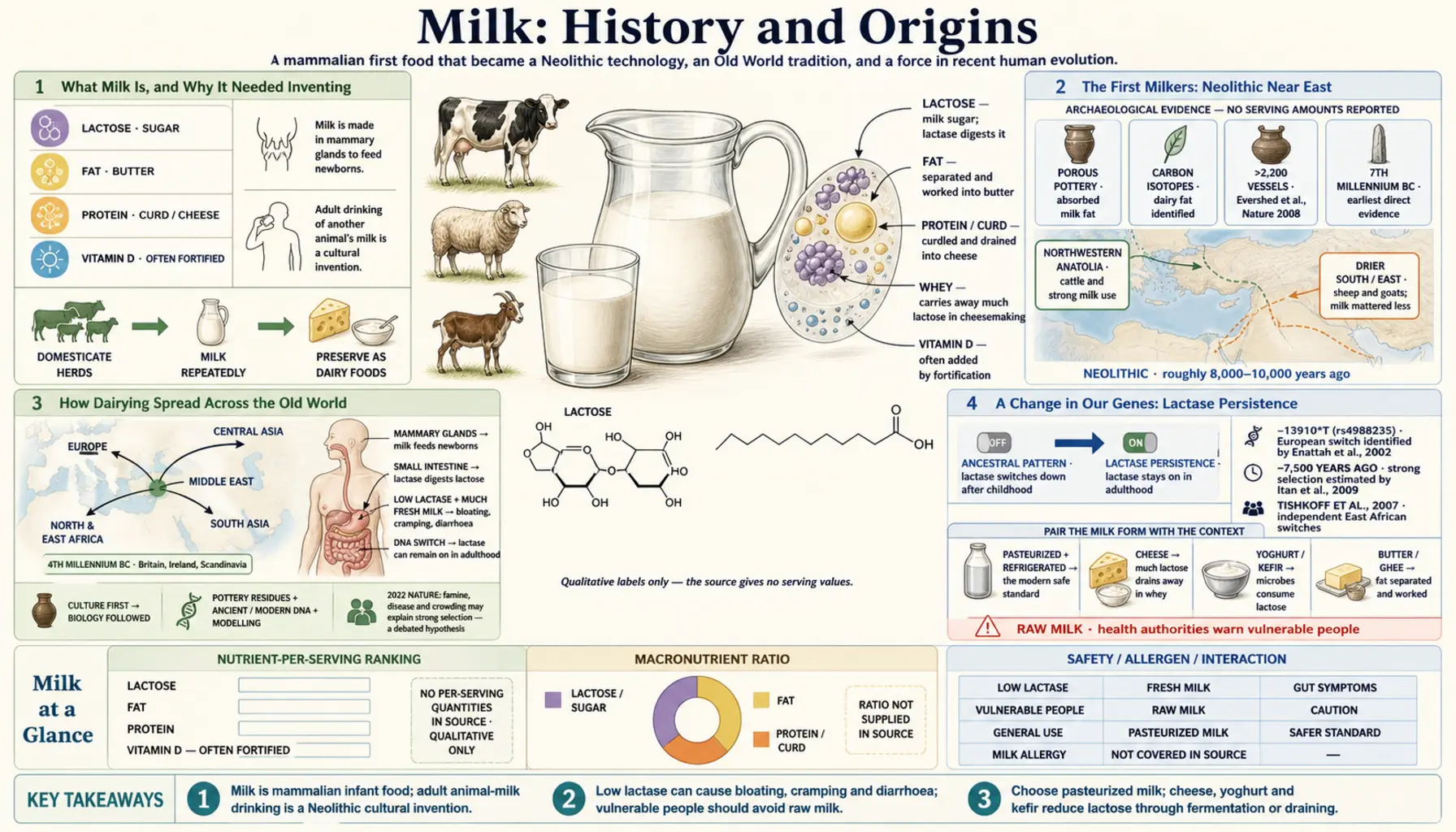
Milk is one of the oldest foods that human beings made for themselves rather than simply gathered. The story does not begin with a single inventor or a single country; it begins in the early farming villages of the Near East, where, sometime in the seventh millennium BC, people first started milking the cattle, sheep, and goats they had recently learned to keep. From there the habit of dairying spread across Europe, Africa, and Asia with the farmers themselves, leaving a faint but readable trail of milk fat soaked into broken pots — and, remarkably, leaving a mark in our own DNA, in the genetic change that lets many adults drink fresh milk at all. This article follows what the evidence actually shows: where and when milking began, how it spread, the strange and genuinely debated question of why so many people can still digest milk as grown-ups, the place milk held in ancient religion and daily life, and how it became the safe, standardised carton on the shop shelf. Where the record is firm we say so; where a date is approximate or a claim is tradition rather than proof, we say that too.
Table of Contents
- What Milk Is, and Why It Needed Inventing
- The First Milkers: Neolithic Near East
- How Dairying Spread Across the Old World
- A Change in Our Genes: Lactase Persistence
- Why the Milk Gene Spread: Famine and Disease
- Milk in Religion, Myth, and Daily Life
- Butter, Cheese, and the Craft of Keeping Milk
- Pasteur, Safety, and the Modern Glass of Milk
- Research Papers and References
- Connections
- Featured Videos
What Milk Is, and Why It Needed Inventing
Milk is the liquid that female mammals make in their mammary glands to feed their newborns. Every mammal does it, including humans, which is why milk is in one sense the most natural food there is — it is literally the first food any of us ever eats. But drinking the milk of another animal, as an adult, is not natural at all. It is a cultural invention, and a fairly recent one in the long span of human existence. For hundreds of thousands of years our ancestors, like the young of every other mammal, stopped drinking milk after weaning and never tasted it again.
What changed everything was the domestication of animals. Once people kept cattle, sheep, and goats nearby and under control, a new possibility opened up: instead of only killing the animal for meat once, you could take a little of its milk over and over while it lived. Animals milked in the ancient world — and still today around the world — include cattle, sheep, goats, water buffalo (the source of much of the milk in South Asia and the original mozzarella in Italy), camels, yaks, horses, and reindeer. In modern global diets the word "milk," unqualified, usually means cow's milk, but that dominance is a relatively late development; the earliest dairying drew on whichever herd animal a community happened to keep.
Because milk is not an invention with a designer but a practice that emerged from herding, it has no single discoverer and no birthplace pin on a map. What it does have is an archaeological record — and that record is surprisingly precise about where the practice first appears.
The First Milkers: Neolithic Near East
The hard evidence for the start of dairying does not come from bones or pictures but from chemistry. When milk is heated or stored in an unglazed clay pot, microscopic amounts of its fat soak into the porous walls and stay there for thousands of years. In the 1990s and 2000s, the biogeochemist Richard Evershed and his colleagues at the University of Bristol developed a way to extract these absorbed fats from ancient potsherds and, crucially, to tell dairy fat apart from the fat of slaughtered animals, using small differences in the carbon isotopes of the fatty acids. This turned ordinary broken pottery into a record of who was processing milk, and when.
In a landmark 2008 study in Nature, Evershed's team analysed more than 2,200 pottery vessels from sites across the Near East and southeastern Europe, dating from roughly the fifth to the seventh millennia BC. They found that milk was in use by the seventh millennium BC — the earliest direct evidence to date — and that milking was especially important in northwestern Anatolia (in what is now Turkey), where conditions favoured cattle. In drier regions to the south and east, sheep and goats dominated and milk mattered less. In other words, dairying began not as a single event but as a regional pattern, tied to the land and the kind of animals it could support.
This places the origin of milk-drinking squarely in the Neolithic, the period when human beings first took up farming and herding, very roughly 8,000 to 10,000 years ago in the Fertile Crescent of the Near East. People had domesticated goats and sheep slightly earlier and cattle somewhat later, and the milking of those animals followed close behind. The often-repeated figure that milk has been part of the human diet "for around 8,000 to 10,000 years" is reasonable as a broad statement; the firmest single anchor we have is the seventh-millennium-BC dairy fat from Anatolia.
How Dairying Spread Across the Old World
Once dairying existed, it travelled — not on its own, but carried by farming communities as agriculture expanded out of the Near East. As farmers and their herds moved north and west into Europe over the following two to three thousand years, milking went with them. The same pottery-fat method that pinpointed the Anatolian origin has traced this advance: absorbed milk residues appear with the first Neolithic farmers of central Europe (the so-called Linearbandkeramik or LBK culture) and, by the fourth millennium BC, in the earliest farming communities of Britain, Ireland, and Scandinavia. Evershed's wider survey of British sites showed that dairying was already a significant part of the economy at the very start of the Neolithic there.
Dairying spread south and east as well as north. It became deeply established across the Indian subcontinent, where cattle and water buffalo milk and its products — especially clarified butter, or ghee — took on enormous cultural importance (discussed below). It spread through the Middle East and across the dry grasslands of Central Asia, where mobile herders built whole cuisines and economies around the milk of horses, sheep, goats, and cattle, including fermented horse-milk drinks. And it took hold in parts of Africa, most strikingly among the cattle-keeping peoples of East Africa and the Sahel, whose lives still centre on their herds.
A useful way to picture the result: by a few thousand years ago there was a broad "dairying belt" running across the Old World — Europe, the Middle East, North and East Africa, Central Asia, and South Asia — where milk was a normal food, and large regions beyond it, including most of East Asia and the Americas, where milking of herd animals never became a major tradition. That geography was not random. As the next two sections show, it lines up closely with a change in human biology.
A Change in Our Genes: Lactase Persistence
Here the history of milk becomes the history of the human body itself. Milk contains a sugar called lactose. To digest it, the gut produces an enzyme called lactase. Like nearly all mammals, humans are born making plenty of lactase — a baby must, in order to live on milk — but in most people the gene that makes it switches down after early childhood. An adult who has lost most of their lactase and then drinks a large amount of fresh milk gets the familiar trouble: bloating, cramping, and diarrhoea. This is the normal, ancestral human condition, and it is sometimes called lactase non-persistence (the everyday term is "lactose intolerance").
What is unusual is the opposite trait. In some populations, a genetic change keeps the lactase gene switched on into adulthood, so that grown adults can drink fresh milk comfortably. This trait is called lactase persistence, and it is one of the clearest examples scientists have of recent, rapid human evolution. In 2002, the geneticist Nabil Enattah and colleagues identified the single DNA change responsible for most lactase persistence in Europeans — a variant known as −13910*T (rs4988235), sitting just upstream of the lactase gene and acting as a switch that keeps it on.
Two further findings make this story remarkable. First, the European variant appears to descend from essentially a single ancestral mutation that then spread widely — a genuine genetic founder event. Using allele frequencies and the dates farming reached different regions, Yuval Itan, Joachim Burger, Mark Thomas and colleagues estimated in 2009 that this variant first came under strong natural selection among dairying farmers around 7,500 years ago, somewhere between the central Balkans and central Europe, in association with the spreading LBK culture. Second, lactase persistence did not arise only once: in 2007, Sarah Tishkoff and colleagues showed that East African herders had evolved their own, different genetic switches for the same ability — a striking case of the same adaptation appearing independently in different parts of the world, each time in a population that kept milk animals. The biology, in short, followed the culture: humans took up dairying first, and the gene that makes milk easy to drink spread afterwards, wherever dairying took hold.
Why the Milk Gene Spread: Famine and Disease
It seems obvious why being able to drink milk would be useful: milk is nourishing, so adults who could digest it should have done better and had more children, and the gene should have spread for that reason. For a long time this "milk is good food" explanation was the standard story. But it ran into a problem. Thanks to the pottery-fat evidence, we know that people across Neolithic Europe were already making and consuming milk products on a wide scale thousands of years before the lactase-persistence gene became common. If simply drinking milk gave a big survival advantage, the gene should have shot up in frequency right away — and it did not.
A large 2022 study in Nature, again led by Richard Evershed together with the geneticist Mark Thomas, the epidemiologist George Davey Smith, and a large team, set out to resolve this puzzle by combining a vast survey of milk-fat residues across Britain and Europe with ancient and modern DNA and statistical modelling. Their conclusion overturned the simple nutrition story. They argued that for most of prehistory, lactose-intolerant people drinking modest amounts of milk — or milk processed into low-lactose forms like cheese — suffered no serious harm, so there was little pressure favouring the gene. The strong selection, they proposed, came at the extremes: during famines, when desperate, malnourished people drank large amounts of unprocessed milk, and amid disease and crowding, when an unhealthy gut made the diarrhoea from lactose genuinely dangerous, even deadly. In such crises, an adult who could digest milk safely had a real edge in surviving — and over many such episodes, the gene rose to the high frequencies seen today.
It is worth being clear about the status of this idea. The dating evidence — milk used widely long before the gene became common — is firm. The famine-and-disease explanation for why the gene was then favoured is a strongly argued, well-evidenced hypothesis, but it is an interpretation of the pattern rather than a settled certainty, and researchers continue to debate the details. What is no longer in doubt is that the rise of the milk gene was not a simple matter of milk being good for you.
Milk in Religion, Myth, and Daily Life
Long before any of this genetics was understood, milk carried deep cultural and sacred meaning in the societies that depended on it. In the dairying cultures of the ancient world, the animal that gave milk was often treated as precious, and milk and its products turned up at the centre of religion as offerings, symbols of abundance, and images of nourishment and life.
Nowhere is this richer than in India, where the cow and her milk hold a sacred place that endures to the present day. In the ancient Sanskrit texts known as the Vedas (composed across roughly the second and first millennia BC), milk, curds, and especially ghee (clarified butter) appear again and again as pure, life-giving substances and as offerings poured into the sacred fire. Ghee in particular became, and remains, a ritual and culinary staple. The god Krishna is famously associated in Hindu tradition with cowherding, butter, and milk, and a traditional offering called panchamrita — a mixture whose name means "five nectars" — combines milk, curd (yoghurt), ghee, honey, and sugar. These are cultural and religious facts about how milk was valued; they are recorded here as history, not as health claims.
Milk left its mark on other ancient cultures too. In Mesopotamia, one of the most famous early images of dairying survives in the so-called milking frieze from the temple of the goddess Ninhursag at Tell al-Ubaid, in southern Iraq, dated to the Early Dynastic period (roughly the mid-third millennium BC). Worked in inlaid shell and stone, it shows cattle being milked from behind and people straining and storing what is generally understood to be butter or a butter-like product — a vivid snapshot of a working dairy nearly 4,500 years ago, now held in the Iraq Museum. In ancient Egypt, milk was prized as a nourishing food and associated with goddesses and divine nurturing. And the image of a land flowing with "milk and honey" as the very picture of plenty, familiar from the Hebrew Bible, shows how naturally milk stood, across the ancient Near East, for prosperity and the good life.
Butter, Cheese, and the Craft of Keeping Milk
Fresh milk has one great drawback: it spoils within hours in a warm climate, and it is hard for lactose-intolerant people to drink in quantity. The genius of early dairying cultures was to turn the fleeting liquid into foods that last and that are far gentler on the gut — and this craft is, in a real sense, as old as dairying itself. The two great preservation methods are butter (separating and working the fat) and cheese (curdling and draining the protein), and both appear early in the record. The Mesopotamian frieze described above already shows butter-making in the third millennium BC.
The connection to the milk gene is direct and important. Both cheese and the souring of milk into products like yoghurt and kefir dramatically reduce the amount of lactose, because microbes consume the sugar during fermentation, and in cheese-making much of the lactose drains away in the watery whey. This meant that even before lactase persistence became common, people who could not comfortably drink fresh milk could still get its nourishment from cheese, yoghurt, and butter. It is no accident that the great cheese and fermented-milk traditions are oldest and richest in exactly the regions where dairying began. These foods were the original technology that made milk usable for everyone.
Different parts of the dairying world specialised in different products: hard mountain cheeses and cultured creams in Europe; ghee and paneer and fermented yoghurt drinks across South Asia; tangy fermented milks and butters among the herders of Central Asia and the Near East; soured and curdled milks among East African cattle peoples. Each was a local answer to the same problem — how to keep a perishable, hard-to-digest liquid and turn it into reliable food — and together they represent thousands of years of accumulated craft.
Pasteur, Safety, and the Modern Glass of Milk
For almost all of its history, milk was drunk close to the cow, soon after milking, in small communities. That changed in the nineteenth century, when growing cities created a demand for milk that had to travel and be stored — and city milk, often produced in filthy conditions and carrying tuberculosis, typhoid, and other infections, became a notorious killer of infants. The solution came out of the laboratory of the French chemist Louis Pasteur. In 1864, working to save France's wine and beer from spoiling, Pasteur showed that gently heating a liquid for a short time killed the microbes that ruined it — the process that now bears his name, pasteurization. It is worth being precise: Pasteur himself developed and applied the method to wine and beer, not to milk.
The leap to milk came a little later and from other hands. In 1886, the German agricultural chemist Franz von Soxhlet proposed applying pasteurization to milk — especially milk for infants — and went on to devise a simple home apparatus for heating it. Commercial milk-pasteurizing machines came into use in the following decade, and over the first half of the twentieth century, as the germ theory of disease took hold, pasteurization of city milk gradually became routine and then legally required in many countries. The public-health effect was enormous: milk-borne epidemics that had killed great numbers of children largely disappeared. Pasteurization kills dangerous bacteria with little loss of milk's nutritional value, which is why it remains standard, and why health authorities continue to warn against unpasteurized (raw) milk for vulnerable people.
The twentieth century added the rest of the modern dairy industry: refrigeration, refrigerated transport, mechanical milking, glass bottles and then cartons, homogenisation (breaking up the fat so the cream no longer rises), and the breeding of high-yield dairy cattle. The result is the food most readers know — a uniform, safe, year-round carton on a shop shelf, often fortified with vitamin D. It is worth pausing on the distance travelled: from a Neolithic farmer in Anatolia milking a half-wild cow into a clay pot, to a genetic switch spreading through whole populations, to a chemist's heat treatment, to the carton in the fridge. The detailed modern debates — raw versus pasteurized, A1 versus A2 protein, grass-fed milk, lactose-free options, and how milk fits a healthy diet — belong to the present, and are covered on the companion Milk Benefits articles and the main Milk page. This history is concerned with how milk came to be on our table at all.
Research Papers and References
The list below combines key peer-reviewed studies on the origins of dairying and the evolution of lactase persistence with curated PubMed topic-search links into the archaeological and genetic literature. Historical sources — the Vedas, the Mesopotamian Tell al-Ubaid frieze, and other ancient material — are named in the article as historical evidence rather than as modern citations. Author names, titles, and journals are given as plain text; only the stable DOI or PMID is hyperlinked, and each opens in a new tab.
- Evershed RP, Payne S, Sherratt AG, et al. Earliest date for milk use in the Near East and southeastern Europe linked to cattle herding. Nature. 2008;455(7212):528-531. — doi:10.1038/nature07180 · PMID: 18690215
- Evershed RP, Davey Smith G, Roffet-Salque M, et al. Dairying, diseases and the evolution of lactase persistence in Europe. Nature. 2022;608(7922):336-345. — doi:10.1038/s41586-022-05010-7 · PMID: 35896751
- Itan Y, Powell A, Beaumont MA, Burger J, Thomas MG. The origins of lactase persistence in Europe. PLoS Computational Biology. 2009;5(8):e1000491. — doi:10.1371/journal.pcbi.1000491 Search PubMed
- Tishkoff SA, Reed FA, Ranciaro A, et al. Convergent adaptation of human lactase persistence in Africa and Europe. Nature Genetics. 2007;39(1):31-40. — doi:10.1038/ng1946 · PMID: 17159977
- Copley MS, Berstan R, Dudd SN, et al. Direct chemical evidence for widespread dairying in prehistoric Britain. Proceedings of the National Academy of Sciences USA. 2003;100(4):1524-1529. — doi:10.1073/pnas.0335955100 · PMID: 12574520
- Origins and history of dairying and milk use PubMed: Neolithic dairying and milk-residue archaeology
- Evolution of lactase persistence and milk digestion PubMed: lactase persistence, dairying, and ancient DNA
External Authoritative Resources
- Nature (2022) — Dairying, diseases and the evolution of lactase persistence in Europe
- World History Encyclopedia — Sumerian milking scene, Tell al-Ubaid
- Encyclopaedia Britannica — Pasteurization