Kale: History and Origins
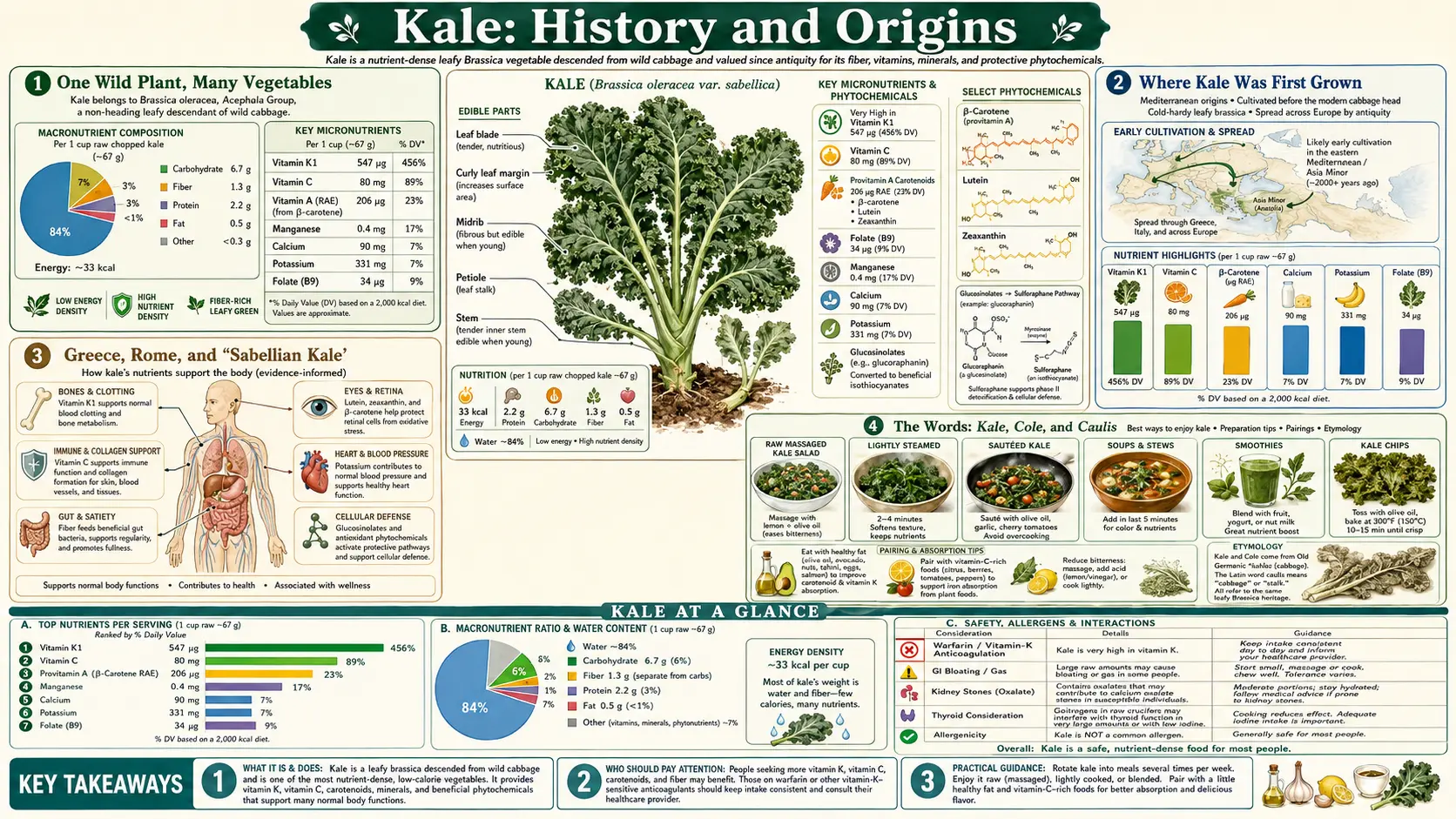
Kale began as a humble wild seaside plant and became one of the oldest cultivated vegetables in Europe. It is not an invention and has no single inventor: like cabbage, broccoli, and cauliflower, kale is one branch of a single domesticated species, Brassica oleracea, that human gardeners coaxed over thousands of years into many shapes from one wild ancestor. This article traces what the documented record actually supports — where that wild plant grew, where and roughly when people first grew it for food, why the ancient Greeks and Romans already knew leafy "kales," how the plant became a winter mainstay across medieval Europe, the strong place it holds in Scottish and German food culture, how it crossed the Atlantic, and how a once-overlooked green became the early-twenty-first-century "queen of greens." Where the record is firm we say so; where a point is debated, a tradition, or a marketing story, we name it as such.
Table of Contents
- One Wild Plant, Many Vegetables
- Where Kale Was First Grown
- Greece, Rome, and "Sabellian Kale"
- The Words: Kale, Cole, and Caulis
- A Winter Mainstay of Medieval Europe
- Kale in Scotland: Kail and the Kailyard
- Grünkohl: Germany's Frost-Sweetened Kale
- Crossing the Atlantic
- From Garnish to "Queen of Greens"
- Research Papers and References
- Connections
- Featured Videos
One Wild Plant, Many Vegetables
The single most important fact about kale's history is also the most surprising: kale, cabbage, broccoli, cauliflower, Brussels sprouts, collard greens, and kohlrabi are all the same species — Brassica oleracea. They are not separate plants that happen to be related; they are varieties of one domesticated species, each bred to emphasise a different part. In cabbage, gardeners selected for a tight head of leaves; in broccoli and cauliflower, for clustered flower buds; in kohlrabi, for a swollen stem; and in kale and collards, simply for large, tender, open leaves. Kale is, in effect, the variety that stayed closest to the wild plant's original loose-leaf form.
That wild ancestor is a tough, salt-tolerant perennial that still grows on sea cliffs and stony coasts. Its closest living wild relatives are Mediterranean and Aegean plants in the same group, and forms of wild cabbage can be found along the Atlantic and Mediterranean shores from northern Europe down to Greece. Researchers who have reconstructed the family tree of Brassica oleracea describe kales as among the earliest and most ancestral of the cultivated forms — the loose-leaf "kale" type appears to have already been diversifying when the headed and flowering vegetables were later bred from it. In plain terms: kale came first, and the more elaborate cabbages and cauliflowers came later, as offshoots of an already-leafy crop.
This is why kale has no inventor and no single moment of origin. It is the product of a very long, gradual, collaborative process — countless growers across many centuries choosing seed from the leafiest, sweetest, hardiest plants, season after season, until a wild cliff-dweller became a garden vegetable. The story below is not the story of a discovery but of a domestication.
Where Kale Was First Grown
The geography of kale's domestication is an active research question, and the best recent evidence points to the eastern Mediterranean and Anatolia (modern Turkey and the Aegean). General reference sources place the start of cultivation there "by 2000 BCE at the latest," and detailed genetic studies have sharpened the picture. A 2021 study in Molecular Biology and Evolution by Makenzie Mabry and colleagues identified an Aegean wild species, Brassica cretica, as the closest living wild relative of cultivated B. oleracea, supporting an eastern-Mediterranean cradle for the crop. A 2022 study in Horticulture Research by Chengcheng Cai and colleagues went further, arguing from the diversity of kale populations for two distinct domestication lineages and a Middle-Eastern origin, and dating the onset of domestication to roughly the mid-third millennium BC.
An important and genuinely debated wrinkle is how the wild plant and the people who first grew it came together. Wild Brassica oleracea grows natively along the Atlantic coasts of western Europe as well as in the Mediterranean, and one well-regarded hypothesis holds that leafy kales were first cultivated by communities along those Atlantic and Mediterranean shores and then carried eastward — possibly along ancient metal-trade routes — to the eastern Mediterranean, where the crop was further domesticated and diversified. The honest summary is that the eastern Mediterranean and Anatolia are the best-supported region for kale's early domestication, that the deep roots of the wild plant stretch along Europe's western coasts as well, and that the precise route and timing are still being worked out by researchers rather than settled.
Greece, Rome, and "Sabellian Kale"
By the classical era, leafy brassicas were unmistakably part of Mediterranean gardens and tables. Greek and Roman writers on agriculture and medicine wrote about cultivated "cabbages" or coleworts, and the historical record indicates that both curly-leaved and flat-leaved forms already existed in Greece by the fourth century BC. These were not the tight round cabbages of a modern supermarket — head-forming cabbage came much later — but open, leafy plants far closer to what we would now call kale or collards.
The Romans grew these leafy types too, and a particular curly-leaved kind is traditionally referred to as Sabellian kale, after the Sabellic peoples of central Italy. These Sabellian (or "Sabellic") kales are commonly described as the ancestors of the modern curly kales, and the connection survives in botany: the curly-leaf garden kale grown today is classified as Brassica oleracea var. sabellica, a name that still carries that old Italian association. The Greeks and Romans valued leafy cabbage as everyday food and also credited it with medicinal virtues — the Roman writer Cato the Elder, for instance, praised cabbage extravagantly as a remedy — though such claims belong to the history of ancient medicine and should be read as part of that worldview, not as modern health advice.
The Words: Kale, Cole, and Caulis
The names we use for kale are themselves a record of its long European history. The English word kale comes from northern Middle English cale, a relative of Scots kail and German Kohl, all going back ultimately to the Latin caulis, meaning "stem" or "cabbage." The same Latin root sits behind a whole cluster of English words for these plants — cole (as in coleslaw and colewort), cauliflower, and the family term cole crops still used by gardeners for the cabbage tribe.
This shared vocabulary tells us something the documents alone cannot: that a single, recognisable group of leafy cabbages spread widely enough, and mattered enough, that languages across Europe built everyday words around it. In Scots the word took the form kail or kale; in German it became Kohl, surviving in Grünkohl ("green cabbage," the German name for kale). A plant gathers this many related names only when many communities have long had reason to talk about it — to grow it, cook it, and store it through winter.
A Winter Mainstay of Medieval Europe
Through the European Middle Ages, leafy kale was one of the most common green vegetables on the continent. Its great advantage was hardiness: kale is remarkably cold-tolerant, surviving frosts that destroy most other greens, and it could be left standing in the garden and harvested leaf by leaf through the cold months when little else was available. For ordinary households, that made it a dependable source of fresh greenery in winter and early spring — a practical, everyday food rather than a luxury.
The written record shows the gradual sorting-out of the cabbage family during this period. The earliest western-European reference to hard-heading cabbage dates to the thirteenth century, and by the fourteenth century English records were distinguishing between head-forming cabbage and loose-leaf kale — a sign that the two had become recognisably different garden vegetables. Kale held this everyday status across much of Europe until roughly the end of the Middle Ages, after which the newer headed cabbages and, later, cauliflower and other forms increasingly shared and in places overtook its place on the table.
Kale in Scotland: Kail and the Kailyard
Nowhere did kale embed itself more deeply in food culture than in Scotland, where its cold-hardiness suited the climate perfectly. Kale — in Scots, kail — was such a fundamental part of the rural diet that the word came to stand in for food and for the household garden itself. The kailyard (literally "kale yard") was the small kitchen garden beside a cottage, and the term became so emblematic of homely Scottish life that a sentimental school of Scottish fiction popular roughly from the 1880s to the First World War — including writers such as J. M. Barrie — is still known as the Kailyard school. The word kail is recorded in Scots sources from the late fourteenth century onward.
Kale also entered Scottish seasonal custom. A traditional dish of kail and herrin' (kale and herring) was eaten in some communities as a wholesome winter meal, and kale broths and soups — often simply called "kail" — were staple cold-weather fare. These traditions are cultural and culinary history; they record how central the plant was to everyday Scottish life rather than making any medical claim. The plant's long Scottish pedigree is one reason it travelled so readily to North America with emigrants from the British Isles.
Grünkohl: Germany's Frost-Sweetened Kale
In Germany, kale — Grünkohl — carries an equally strong winter identity, especially across the north. There it is the centre of a long-standing seasonal custom sometimes called Grünkohlessen ("kale eating") or, in the region around Oldenburg, Bremen, and Osnabrück, the Kohlfahrt ("kale tour"): groups of friends take a brisk midwinter walk, play games along the way, and finish with a hearty feast. The classic dish is Grünkohl mit Pinkel — stewed kale served with potatoes and regional sausages such as Pinkel, a smoked groats-and-fat sausage of the same northwestern German region. The custom is a deep-winter one, most popular around January and February.
A piece of genuine plant science underlies the tradition: northern German cooks famously insist that kale should not be picked until after the first hard frost, which is said to make it sweeter and more tender. There is a real basis for this. Like many cold-hardy plants, kale responds to freezing temperatures by converting some of its stored starch into sugars — a natural antifreeze that protects the leaves — so frost-touched kale really does tend to taste milder and sweeter. Here a centuries-old culinary rule of thumb and modern plant physiology agree, which is part of what makes the Grünkohl tradition such a satisfying piece of food history.
Crossing the Atlantic
Kale reached North America through more than one route. Settlers from the British Isles — for whom kale and collards were familiar garden staples — carried the leafy cabbages with them, and these plants became established in colonial and early-American kitchen gardens. A distinct strand of the story involves Russian kale (sometimes called Siberian kale, a hardy form linked to Brassica napus): historical accounts hold that Russian traders introduced Russian kale into Canada and then into the United States in the nineteenth century, adding cold-tolerant varieties to the North American garden.
The early-twentieth-century plant explorer David Fairchild, a botanist with the United States Department of Agriculture who introduced many crops to America, also brought kale back from Croatia, where it was then widely grown as a cheap, easy, everyday vegetable — though, by his own account, Fairchild personally disliked cabbages, kale included. For much of the twentieth century kale remained a minor crop in the United States, often relegated to a decorative role: a frilly green garnish on buffet tables and salad bars rather than something most people actually ate. That marginal status set the stage for one of the more striking reversals in modern food history.
From Garnish to "Queen of Greens"
For most of the twentieth century, kale in the United States was grown more to look at than to eat. That began to change in the 1990s, as kale's dense load of vitamins, minerals, and protective plant compounds drew the attention of nutritionists, and it accelerated sharply in the early 2010s. American interest in kale rose steeply between roughly 2011 and 2014: searches for kale recipes multiplied, food media embraced it — one prominent magazine dubbed 2012 a "year of kale" — and U.S. government agricultural figures recorded a striking jump in kale farming, with the number of farms reporting kale more than doubling between the 2007 and 2012 agricultural censuses. Massaged kale salads, kale chips, and green smoothies turned the old garnish into a headline ingredient, and the nickname "queen of greens" took hold.
How much of this boom was organic enthusiasm and how much was deliberate promotion is itself a debated piece of recent food history. A widely repeated account credits a public-relations campaign — associated with a publicist and a body referred to as the "American Kale Association" around 2013 — with helping make kale fashionable. Reporting on the episode is genuinely mixed: some accounts treat the campaign as a real driver of the trend, while others have questioned whether any such grower coalition meaningfully existed, noting little trace of it beyond a social-media presence. The fair conclusion is that kale's rise was driven mainly by real shifts in nutrition awareness and culinary fashion, with clever marketing somewhere in the mix — and that the marketing legend should be reported as a contested story rather than settled fact.
What is not in doubt is the through-line of the whole history. A salt-tolerant wild plant of European and Mediterranean coasts was domesticated thousands of years ago into the leafy vegetable we call kale; it fed Greek and Roman gardens, became a winter mainstay across medieval Europe, rooted itself in Scottish and German food culture, crossed the Atlantic with settlers and plant explorers, and — after a long spell as a mere garnish — returned to prominence as one of the most celebrated greens of the modern table. The detailed nutrition behind that modern reputation is covered in the companion Kale Benefits articles and on the main Kale page; this history is concerned only with how the plant came to our plates in the first place.
Research Papers and References
The list below combines peer-reviewed studies on the origin and domestication of Brassica oleracea with curated PubMed topic-search links and reputable history and food-science references. Ancient writers (such as Cato the Elder, Theophrastus, and the Roman agricultural authors) are named in the article as historical sources rather than as modern citations. Author names, titles, and journals are given as plain text; only the stable DOI, PMID, or archive link is hyperlinked, and each opens in a new tab.
- Mabry ME, Turner-Hissong SD, Gallagher EY, et al. The Evolutionary History of Wild, Domesticated, and Feral Brassica oleracea (Brassicaceae). Molecular Biology and Evolution. 2021;38(10):4419-4434. — doi:10.1093/molbev/msab183 · PMID: 34157722
- Cai C, Bucher J, Bakker FT, Bonnema G. Evidence for two domestication lineages supporting a middle-eastern origin for Brassica oleracea crops from diversified kale populations. Horticulture Research. 2022;9:uhac033. — doi:10.1093/hr/uhac033 · PMID: 35184188
- Maggioni L, von Bothmer R, Poulsen G, Branca F. Origin and domestication of cole crops (Brassica oleracea L.): linguistic and literary considerations. Economic Botany. 2010;64(2):109-123. — doi:10.1007/s12231-010-9115-2
- Brassica oleracea origin and domestication — PubMed: Brassica oleracea origin and domestication
- Cole crops history and phylogeny — PubMed: Brassica oleracea kale phylogeny and history
External History and Reference Sources
- Wikipedia — Kale (history, etymology, and varieties)
- Wikipedia — Brassica oleracea (the one species behind kale, cabbage, and broccoli)
- Wikipedia — Grünkohlessen (the North German kale-eating tradition)
- Wikipedia — Kailyard school (kale in Scottish culture)
Connections
- All Food
- Kale
- Kale Benefits
- Broccoli
- Cabbage — the head-forming branch of the same species, bred later than loose-leaf kale.
- Spinach
- Beets
- Vitamin K