Herring Pickled vs Fresh — Preparation Trade-Offs
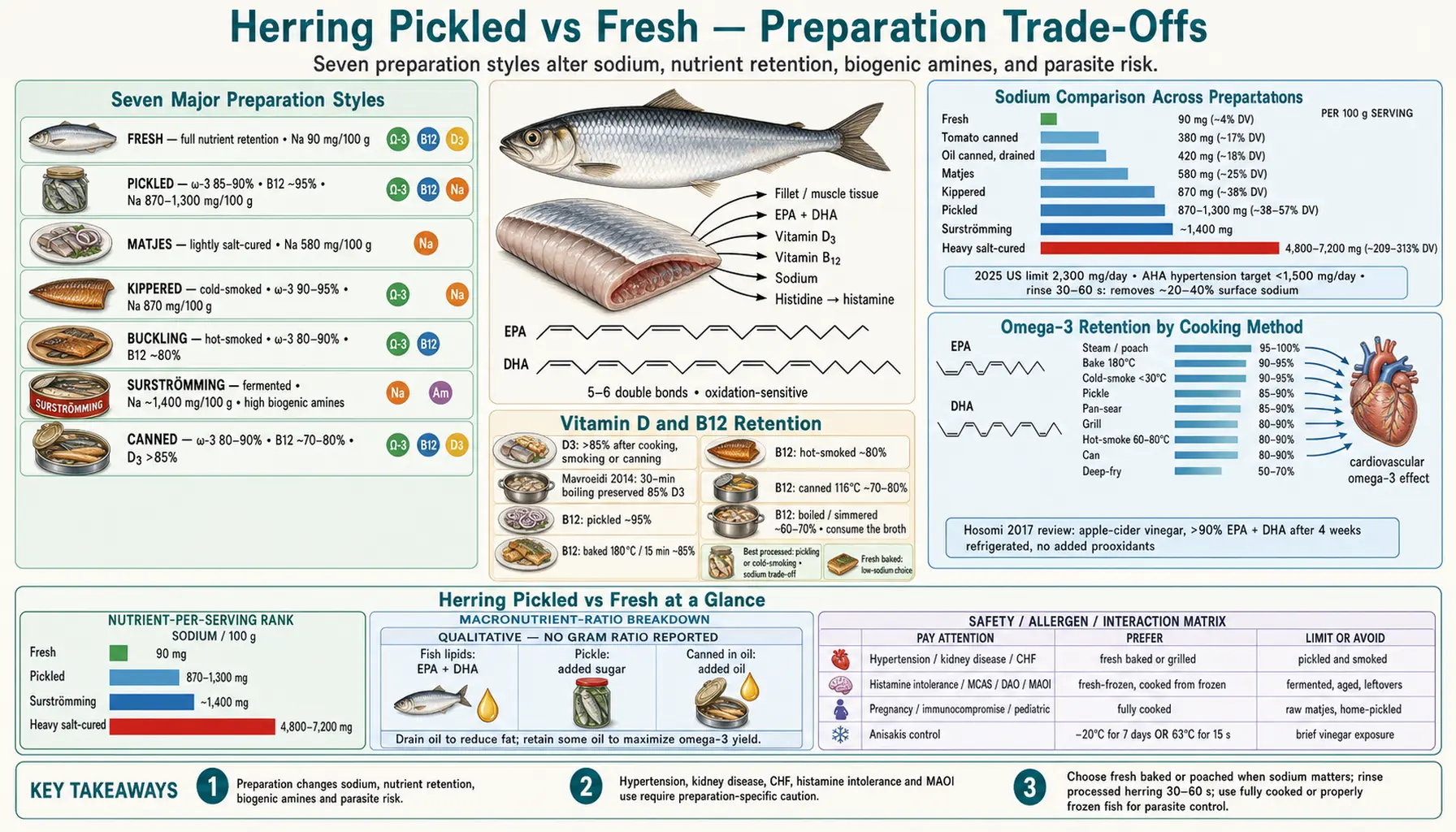
Herring is consumed across Europe and North America in at least seven distinct preparation styles — fresh and grilled, pickled in vinegar, salt-cured ("matjes"), cold-smoked ("kippered"), hot-smoked ("buckling"), fermented (the Swedish surströmming and Dutch Hollandse Nieuwe), and canned in oil or tomato sauce. Each preparation method materially changes the nutrient profile, sodium content, biogenic amine load, and parasite risk — a pickled fillet contains 870–1,300 mg of sodium per 100 g (vs ~90 mg fresh), retains ~90% of the omega-3 yield, and eliminates Anisakis parasite risk through low-pH marinade. A smoked kipper introduces polycyclic aromatic hydrocarbons depending on smoking method but retains nearly the full vitamin and omega-3 profile. The "best" preparation depends on the consumer's blood pressure, kidney function, histamine tolerance, and culinary preference — this deep-dive maps the trade-offs.
Table of Contents
- Seven Major Preparation Styles
- Sodium Comparison Across Preparations
- Omega-3 Retention by Cooking Method
- Vitamin D and B12 Retention
- Histamine and Biogenic Amine Formation
- Anisakis Parasite Risk and Marinade pH
- Smoked Herring and Polycyclic Aromatic Hydrocarbons
- Decision Tree: Matching Preparation to Patient
- Key Research Papers
- Connections
- Featured Videos
Seven Major Preparation Styles
- Fresh herring (raw or briefly cooked) — whole gutted fish baked, grilled, pan-seared, or poached. Shortest shelf life (1–2 days refrigerated), strongest flavor, full nutrient retention.
- Pickled herring — fillets cured in vinegar + salt + sugar + spices for 1–6 weeks. The acidic marinade (pH 3.5–4.0) denatures Anisakis larvae and inhibits spoilage organisms. The classic Eastern European, Scandinavian, and Ashkenazi Jewish preparation. Sodium content 870–1,300 mg/100 g.
- Matjes — young Atlantic herring caught before sexual maturation (May–July), lightly salt-cured with the pancreas left in place to allow brief enzymatic ripening. Less acidic than pickled; sweeter, softer texture. A Dutch and German tradition.
- Kippered (cold-smoked) — whole gutted herring brined and cold-smoked at <30°C for 8–12 hours. The fish is partially dehydrated and develops a distinctive amber color and smoky flavor. The classic British breakfast preparation.
- Buckling (hot-smoked) — whole herring brined and hot-smoked at 60–80°C for 2–3 hours, which cooks the fish in addition to smoking. Shorter shelf life than cold-smoked, softer texture.
- Surströmming (fermented) — Swedish lightly-salted herring fermented in sealed cans for 6+ months. The lactic and propionic acid fermentation produces a powerful aroma (often consumed outdoors). Sodium-restricted but biogenic amines (histamine, tyramine, putrescine, cadaverine) accumulate to high levels.
- Canned (in oil, water, mustard, or tomato sauce) — pasteurized and shelf-stable for 2–5 years. The most accessible form; nutrient retention is excellent due to oxygen exclusion.
Sodium Comparison Across Preparations
Sodium is the single largest nutritional differentiator between fresh and processed herring. Approximate sodium content per 100 g:
- Fresh herring (raw or unsalted cooked) — 90 mg sodium per 100 g (~4% DV)
- Canned herring in tomato sauce — 380 mg per 100 g (~17% DV)
- Canned herring in oil (drained) — 420 mg per 100 g (~18% DV)
- Matjes — 580 mg per 100 g (~25% DV)
- Kippered (cold-smoked) — 870 mg per 100 g (~38% DV)
- Pickled herring — 870–1,300 mg per 100 g (~38–57% DV)
- Salt-cured (heavy salt) — 4,800–7,200 mg per 100 g (~209–313% DV)
- Surströmming — ~1,400 mg per 100 g, but biogenic amines are the larger concern
The 2025 US Dietary Guidelines set a sodium upper limit of 2,300 mg/day for adults; AHA recommends <1,500 mg/day for individuals with hypertension or established cardiovascular disease. A 100 g serving of pickled herring delivers roughly half of the AHA hypertension target sodium in a single sitting — an important consideration for the demographic most likely to benefit from the cardiovascular omega-3 effect.
Practical mitigation: rinsing pickled or salt-cured herring under cold water for 30–60 seconds before serving removes approximately 20–40% of surface sodium without meaningfully affecting flavor.
Omega-3 Retention by Cooking Method
The 5–6 double bonds in EPA and DHA make them susceptible to oxidation during cooking and storage. Approximate omega-3 retention by preparation method, relative to fresh raw fish:
- Baking at 180°C — 90–95% retention
- Steaming or poaching — 95–100% retention (lowest oxidative stress)
- Grilling over moderate heat — 80–90% retention
- Pan-searing in butter or olive oil — 85–90% retention
- Pickling in vinegar — 85–90% retention; some EPA loss during the 1–6 week marinade
- Cold-smoking (<30°C) — 90–95% retention; minimal thermal oxidation
- Hot-smoking (60–80°C) — 80–90% retention
- Canning — 80–90% retention; oxygen exclusion offsets the heat
- Deep-frying in seed oil — 50–70% retention plus dilution with n-6 frying oil (worst case for the omega-6:omega-3 ratio)
The Hosomi 2017 review noted that the omega-3 loss during pickling is partly offset by the chelation of pro-oxidant transition metals by the vinegar matrix — herring pickled in apple cider vinegar with no added prooxidants retained >90% of EPA + DHA after 4 weeks of refrigerated storage.
Vitamin D and B12 Retention
Fat-soluble Vitamin D3 is thermally stable; heat treatment during cooking, smoking, or canning preserves >85% of the original D3 content. Mavroeidi 2014 reported that even prolonged cooking (boiling fish for 30 minutes) preserved 85% of D3.
Vitamin B12 is somewhat heat-labile in aqueous solution; cooking losses for fish are typically 10–30% depending on temperature and duration. Specific data:
- Fresh herring fillet, baked at 180°C for 15 minutes: ~85% B12 retention
- Pickled herring (cold-processed): ~95% B12 retention
- Hot-smoked herring: ~80% B12 retention
- Canned herring (pasteurized at 116°C): ~70–80% B12 retention
- Boiled or simmered herring (worst case): ~60–70% B12 retention; some B12 leaches into the cooking water (recapture by consuming the broth)
For both vitamins, pickling and cold-smoking are the most nutrient-preserving processed forms, while heavy thermal processing (canning, prolonged boiling) produces the largest losses. The accompanying sodium load is, again, the primary trade-off.
Histamine and Biogenic Amine Formation
Herring belongs to the family Clupeidae, which (along with Scombridae — tuna, mackerel) contains high concentrations of free histidine in the muscle tissue. Bacterial decarboxylation of histidine produces histamine; the same bacterial enzyme families produce tyramine, putrescine, and cadaverine from other amino acids. The resulting "scombroid poisoning" syndrome (flushing, headache, palpitations, GI symptoms) is the most common form of marine food poisoning in the US.
Biogenic amine accumulation risk varies by preparation:
- Fresh herring properly refrigerated — histamine <5 mg/kg (well below the 50 mg/kg FDA action level)
- Fresh herring left at >4°C for 4+ hours — can rapidly exceed 200 mg/kg; the formed histamine is heat-stable and cooking does not destroy it
- Pickled herring — vinegar acid inhibits decarboxylase activity; histamine typically remains low if fresh fish is used
- Cold-smoked herring — histamine accumulation depends on the brining step; properly handled smoked herring is low
- Surströmming and other fermented herring — high biogenic amine content by design; not appropriate for histamine-intolerant individuals, MAOI users, or pregnant women
The clinical implication: for the histamine-intolerant patient (mast cell activation syndrome, DAO deficiency, chronic urticaria), fresh-frozen herring cooked from frozen has the lowest biogenic amine risk. Aged, fermented, or improperly stored herring should be avoided.
Anisakis Parasite Risk and Marinade pH
Atlantic and Pacific herring can carry larval Anisakis simplex nematodes, which migrate from the gut to the muscle tissue post-mortem if the fish is not promptly gutted and chilled. Human consumption of live larvae causes anisakiasis — acute gastric pain, nausea, and occasional gastric or intestinal perforation requiring endoscopic removal. The syndrome is most commonly reported in Japan (from sushi consumption) and the Netherlands (from raw matjes).
Effective parasite control methods:
- Freezing at −20°C for 7 days — FDA and EU regulations require this treatment for raw fish intended for sushi or matjes-style consumption
- Freezing at −35°C for 15 hours — equivalent FDA-approved alternative
- Cooking to internal 63°C for 15 seconds — reliably kills Anisakis larvae
- Vinegar marinade at pH <4.0 for 35 days — reliably inactivates larvae
- Salt cure at 6% salt for 17 days — reliably inactivates larvae
Brief vinegar exposure (a few hours, as in some home-pickling recipes) is not sufficient to kill Anisakis; commercial pickled herring requires either pre-freezing or the full 35-day marinade. Home cooks pickling fresh herring should freeze the fillets at −20°C for a week before pickling.
Smoked Herring and Polycyclic Aromatic Hydrocarbons
Traditional smoking exposes the fish to polycyclic aromatic hydrocarbons (PAHs) generated by incomplete combustion of wood. The most-studied PAH, benzo[a]pyrene, is a Group 1 IARC carcinogen. Modern smoking practices have substantially reduced PAH exposure:
- Traditional direct hot-smoking — can produce benzo[a]pyrene levels of 2–5 µg/kg in the finished product
- Indirect smoking (smoke generated separately, channeled to the smoking chamber) — reduces PAHs by 90–95%
- Liquid smoke flavoring — nearly eliminates PAH exposure; the EU Commission Regulation No 836/2011 sets a maximum of 2.0 µg/kg benzo[a]pyrene in smoked fish
- Cold-smoked products — lower PAH burden than hot-smoked due to lower thermal decomposition
EU and FDA regulations have driven the industry toward indirect smoking methods. Consumers concerned about PAH exposure can preferentially choose cold-smoked products from regulated producers, or avoid smoked products entirely in favor of pickled, baked, or canned preparations.
Decision Tree: Matching Preparation to Patient
Practical algorithm for selecting the right preparation:
- Hypertension, kidney disease, or CHF — prefer fresh baked or grilled, or canned in water with low-sodium specification. Limit pickled and smoked to occasional consumption. Rinse all processed herring before serving.
- Histamine intolerance or mast cell activation — prefer fresh-frozen herring cooked from frozen. Avoid all fermented and aged preparations (surströmming, long-pickled). Avoid leftovers.
- Pregnancy — prefer fully cooked preparations (baked, grilled, canned) over raw or lightly marinated. Avoid surströmming and high-biogenic-amine ferments. Pickled herring from a commercial source with pre-freeze treatment is acceptable.
- Immunocompromise or pediatric — prefer fully cooked. Avoid raw matjes and home-pickled preparations.
- Vitamin D and B12 maximization — prefer cold-smoked kippered or fresh baked. These preserve >90% of both vitamins.
- Convenience and shelf stability — canned herring in oil. Drain the oil if reducing fat intake; the omega-3 in the canning oil is partially extracted into the oil itself, so some retention of the oil maximizes omega-3 yield.
- Cultural / culinary preference — for individuals who reach the AHA two-servings-per-week target only through the cultural preparation they enjoy, the cultural preparation is the right answer. The omega-3, Vitamin D, and B12 benefits dominate the sodium and biogenic amine concerns at typical consumption levels.
Key Research Papers
- Aro T et al., omega-3 fatty acid retention in pickled and salt-cured herring — PubMed: Aro herring preparations
- Hosomi R et al., effect of cooking methods on omega-3 retention in fish — PubMed: Cooking methods and omega-3
- Nielsen NS et al., lipid oxidation in marinated herring during storage (Food Chem 2013) — PubMed: Marinated herring oxidation
- FDA fish and fishery products hazards and controls guidance, biogenic amine and scombroid — PubMed: Histamine in fish
- Polycyclic aromatic hydrocarbons in smoked fish and EU regulatory limits — PubMed: PAH in smoked fish
- Anisakis simplex viability in marinated herring (Karl 2011) — PubMed: Anisakis in marinade
- Sodium content of pickled herring vs fresh and impact on hypertensive populations — PubMed: Sodium pickled fish
- Mavroeidi A et al., vitamin D retention in cooked and processed fish — PubMed: Vitamin D retention
- Surströmming microbiology and biogenic amine formation — PubMed: Surströmming microbiology
- Liquid smoke and reduction of PAH exposure in smoked seafood — PubMed: Liquid smoke and PAH
- DASH-Sodium trial and dose-response of sodium reduction in hypertension (NEJM 2001) — PubMed 11136953
- EU Commission Regulation 836/2011 on PAHs in smoked foods (regulatory review) — PubMed: EU PAH regulation
Connections
- All Food
- Benefits Hub
- Herring (Main Page)
- Omega-3 Density
- Vitamin D and B12
- Sustainability and Lower Mercury
- Sodium
- Hypertension
- Anti-Histamine
- Mast Cell Activation Syndrome
- Sardines
- Salmon
- Sodium Excess