Peaches: Fiber, Water, and Potassium
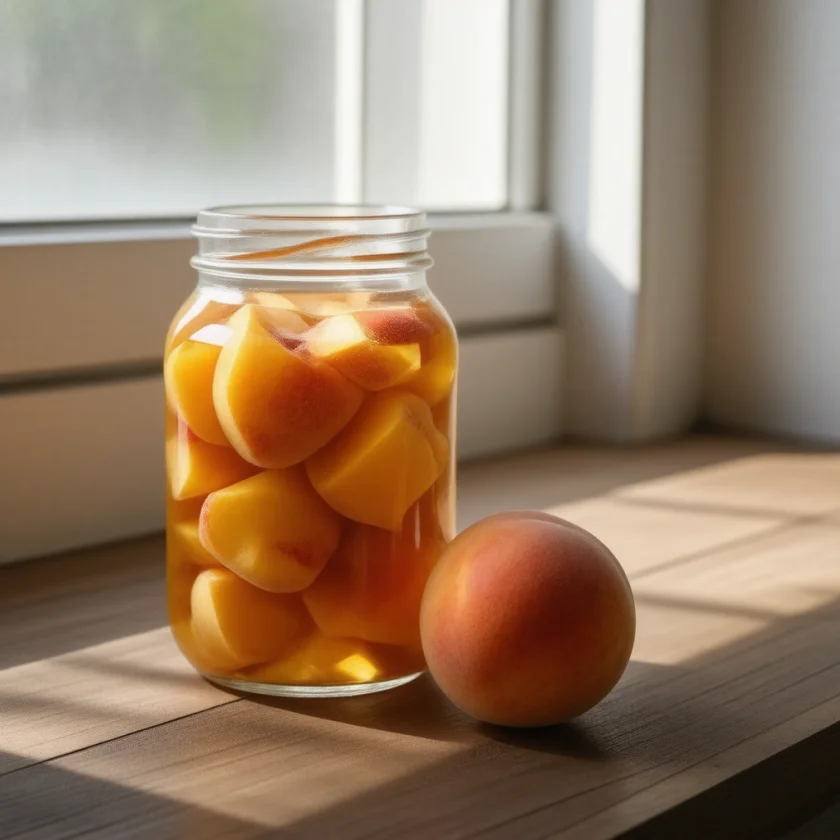
A medium peach is roughly 89% water, about 60 calories, a little over 2 grams of fibre, and about 285 mg of potassium. Those four numbers, taken together, describe a food that does something specific and underrated: it fills you up for almost nothing, it nudges the bowel gently rather than dramatically, and it moves you in the right direction on the one mineral where most people are genuinely short and where the trial evidence for blood pressure is solid. This page takes those four numbers seriously — what soluble and insoluble fibre actually do, why pectin feeds gut bacteria, why peaches contain sorbitol and what that means if you have irritable bowel syndrome (IBS), why water content is the quiet engine of satiety, and why potassium deserves far more attention than it gets. It also says clearly where peaches are not the answer: if you need serious fibre or a reliable laxative effect, prunes and pears outclass them.
Table of Contents
- The Four Numbers That Matter
- Soluble, Insoluble, and What Each One Does
- Pectin: The Fibre That Feeds Your Gut Bacteria
- Sorbitol, FODMAPs, and Who Reports Symptoms
- Water, Energy Density, and Feeling Full
- Fruit and Body Weight: What the Cohorts Show
- Potassium: The Most Underrated Thing in a Peach
- Potassium and Blood Pressure: The Trial Evidence
- Blood Sugar: Why a Sweet Fruit Behaves Gently
- Fresh, Canned, Dried, Juiced: What Changes
- Practical: How to Actually Use Peaches
- Where Peaches Are Not the Answer
- Key Research Papers
- Connections
- Featured Videos
The Four Numbers That Matter
Nutrition labels flatten everything into a column of figures, which hides the fact that some numbers describe the food and others describe what the food does. For a peach, four numbers do almost all the work.
- About 89% water. This is the dominant fact about a peach and the one most often ignored. It sets the calorie count, drives the fullness, and explains why you can eat three without noticing.
- About 60 calories in a medium fruit of roughly 150 g. Extremely low energy density — calories per gram of food — which is the property that actually predicts how filling a food is per calorie.
- About 2–2.5 g of fibre, a mix of soluble pectin and insoluble cell-wall material, with a good share of it in the skin. Modest in absolute terms. Real as a repeated contribution.
- About 285 mg of potassium with almost no sodium. This is the most nutritionally consequential number on the list and the one almost nobody knows.
Two further compositional facts shape the rest of the page: peaches contain about 13 g of sugar per medium fruit, mostly sucrose, and they contain sorbitol, a sugar alcohol that the gut absorbs slowly. Both matter for how the fruit behaves in your digestive tract.
Soluble, Insoluble, and What Each One Does
"Fibre" is a category defined by what your small intestine cannot digest, not by chemistry, and it covers substances that behave very differently.
Soluble fibre dissolves or disperses in water and often forms a gel. In peaches this is chiefly pectin. What it does:
- Slows gastric emptying, so a meal leaves the stomach more gradually — part of why whole fruit produces a gentler blood-glucose curve than juice.
- Holds water in the stool, keeping it soft and easier to pass.
- Is fermentable by colonic bacteria, which is a separate benefit covered in the next section.
- In sufficient quantity, binds bile acids and modestly lowers low-density lipoprotein (LDL) cholesterol — though the quantities that do this are larger than a peach or two supplies.
Insoluble fibre does not dissolve. In peaches it is the cellulose and lignified material of the cell walls, concentrated in the skin. What it does:
- Adds bulk, which stimulates the gut wall mechanically and speeds transit.
- Holds water physically rather than chemically, softening stool by a different route.
The distinction matters practically because they solve different problems. Insoluble fibre and water together are what most people need for sluggish bowels; soluble fibre is what steadies blood sugar and feeds the microbiome. A whole peach with skin gives you both, which is one more argument against peeling.
Scale honesty: a 2–2.5 g contribution against a daily target of roughly 25–38 g is about 6–10% of the day. Most people in Western countries get around half of that target. A systematic review series on carbohydrate quality and human health, covering many prospective studies and trials, found that people with the highest fibre intakes had substantially lower incidence of coronary heart disease, stroke, type 2 diabetes, and colorectal cancer, with the benefit rising across the range up to around 25–29 g a day and possibly beyond. Peaches will not get you there alone. They are one of many small deposits.
Pectin: The Fibre That Feeds Your Gut Bacteria
Pectin is the soluble fibre that makes jam set, and in a peach it is also the fibre that changes as the fruit ripens — the softening of a ripe peach is largely the controlled disassembly of cell-wall pectin. (When that disassembly is interrupted by refrigerating unripe fruit, you get the dry, mealy, woolly texture that ruins so many supermarket peaches. The mechanism has been worked out in detail in cold-stored peach.)
Pectin is fermentable: your own enzymes cannot touch it, but colonic bacteria can. They break it down and produce short-chain fatty acids — acetate, propionate, and butyrate. Butyrate in particular is the preferred fuel of the cells lining your colon, and short-chain fatty acid production is one of the main mechanisms by which dietary fibre is thought to benefit gut and metabolic health.
Is peach pectin a prebiotic? The word has a formal definition. The international consensus statement defines a prebiotic as "a substrate that is selectively utilized by host microorganisms conferring a health benefit" — note selectively, and note that a health benefit must be demonstrated. Pectin is fermentable and is widely described as prebiotic in the loose sense; whether peach pectin specifically meets the strict definition has not been established. The honest phrasing is that peaches supply a fermentable fibre that gut bacteria use, which is a good thing, without claiming a formally demonstrated prebiotic effect.
Practical note: fermentation produces gas. That is normal and is not a sign of damage. But it is why a sudden large increase in fibre intake causes bloating, and why fibre is usually raised gradually, with adequate fluid.
Sorbitol, FODMAPs, and Who Reports Symptoms
Stone fruits contain sorbitol, a naturally occurring sugar alcohol. It is absorbed slowly and incompletely in the small intestine, so a portion of it reaches the colon, where it draws water in osmotically and is fermented by bacteria. That is exactly the mechanism behind the laxative reputation of prunes, which contain a great deal more of it.
Peaches contain sorbitol in far smaller amounts than prunes, and typically less than pears. The laxative effect is correspondingly mild — a gentle nudge rather than a purge. For most people that is exactly what you want from a fruit.
For a substantial minority it is not. Peaches are a FODMAP fruit — the acronym covers fermentable oligosaccharides, disaccharides, monosaccharides and polyols — because they carry both sorbitol (a polyol) and, in some fruit, fructose in excess of glucose. Analytical work measuring short-chain carbohydrates across common fruits and vegetables by HPLC provides the underlying data on which fruits carry what. That study measured 41 fruits: clingstone peach was one of the fruits (with apple, pear, mango and watermelon) that contained fructose in excess of glucose, and sorbitol was measured in 15 fruits, at 0.53–5.99 g per 100 g of fresh fruit.
Why this matters: a randomised controlled feeding trial showed that a diet low in FODMAPs reduces symptoms of irritable bowel syndrome compared with a typical Australian diet, with substantially lower overall gastrointestinal symptom scores. In that trial, 30 people with IBS and 8 healthy controls each ate 21 days of a low-FODMAP diet and 21 days of a typical Australian diet, in random order; on a 0–100 mm symptom scale, the people with IBS scored 22.8 mm on the low-FODMAP diet against 44.9 mm on the Australian diet. If you have irritable bowel syndrome, fructose malabsorption, or sorbitol intolerance, a large serving of peaches can reliably produce gas, bloating, cramping, or loose stools.
What shapes tolerance:
- Portion size. Tolerance is dose-dependent; half a peach may be fine when two are not.
- Spacing. Fruit spread across the day delivers a smaller load at any one time than several pieces eaten at once.
- The low-FODMAP approach is not a permanent ban on fruit. It is designed as a short structured elimination followed by systematic reintroduction, usually guided by a dietitian — not as a permanent restriction. Long-term blanket avoidance of fermentable fibre is its own problem.
- Note that ripeness changes the load. Very ripe fruit generally carries more free sugars and can be less well tolerated.
Water, Energy Density, and Feeling Full
The 89% water figure is not trivia. Energy density — calories per gram — is one of the better-established determinants of how much people eat at a meal, and water is the cheapest way to lower it. A food that is mostly water occupies volume in the stomach, triggers stretch receptors, and provides very few calories for doing so.
The cleanest demonstration of this with fruit is a controlled study — done with apples, not peaches — in which 58 adults ate fruit in different forms before a meal — whole apple, applesauce, and apple juice with and without added fibre, each preload 266 g and 125 kcal — and then ate lunch freely 15 minutes later. Whole fruit produced the greatest reduction in subsequent energy intake and the greatest fullness. Eating the whole apple cut lunch energy intake (preload plus meal) by 15% (187 kcal) compared with no preload, and fullness ran apple, then applesauce, then both juices. Juice performed worst, and adding fibre to the juice did not make it more filling. The same grams of the same fruit, differently processed, produced different outcomes, and the differences ran in the direction the mechanism predicts: chewing, volume, fibre and slower delivery all matter.
This is the most useful practical finding on this page. The authors concluded that solid fruit affects satiety more than pureed fruit or juice, and that eating fruit at the start of a meal can reduce energy intake. Peaches and peach juice were not tested; whole fruit eaten first is the form the study supports.
Water content also explains the ordinary experience of a peach: eating three feels like a snack, not a meal, because three peaches is roughly 400 g of mostly water for under 200 calories. Very few pleasant foods are that cheap.
Fruit and Body Weight: What the Cohorts Show
Long-term observational data supports what the short-term satiety studies suggest, with one interesting wrinkle.
An analysis of three large prospective cohorts followed United States men and women for up to 24 years and examined changes in fruit and vegetable intake against weight change. Increased fruit intake was associated with less weight gain over time. The wrinkle is that the association was not uniform across foods: fruits and vegetables higher in fibre and lower in glycaemic load were more strongly associated with weight loss, and starchier vegetables ran the other way. Peaches sit squarely on the favourable side — high water, low energy density, moderate fibre, low glycaemic load.
Two caveats stated plainly. Observational cohorts cannot prove causation; people who eat more fruit differ in many other ways. And the effect sizes over decades are modest — this is about the slow drift of weight over years, not a diet that produces visible change in a month. What the data supports is a modest, long-run association: more whole fruit went with less weight gain over the years, which is a claim worth far more than most weight-loss advice.
Potassium: The Most Underrated Thing in a Peach
If this page could make one point stick, it would be this one.
Potassium is the principal positive ion inside your cells, and it is central to nerve signalling, muscle contraction — including the heart's — fluid balance, and blood pressure regulation. It works in opposition to sodium: broadly, sodium tends to raise blood pressure and potassium tends to lower it, and what matters is the balance between them, not either in isolation.
Modern diets have that balance inverted. Ancestral diets, built on plants, were high in potassium and low in sodium. Industrial diets are the reverse — heavy in salt from processed food, light in the fruits, vegetables, legumes and tubers that supply potassium. The United States National Academies' Dietary Reference Intakes for Sodium and Potassium set adequate intake values that most adults do not reach; potassium is one of the nutrients most consistently under-consumed.
A medium peach's 285 mg is genuinely useful in that context — more than many people expect from such a light fruit, and it arrives with essentially no sodium, so it improves the ratio as well as the total. It is not a banana (which runs higher), and it is nowhere near a potato or a cup of beans. But peaches are a food people eat repeatedly and casually in summer, which is exactly how the potassium column gets filled.
One important safety note. Potassium from food is safe for people with normal kidney function; excess is excreted. That is not true for everyone. People with chronic kidney disease, and people taking potassium-sparing diuretics, angiotensin-converting enzyme inhibitors (ACE inhibitors), or angiotensin-receptor blockers, are the groups in whom potassium can build up in the blood (hyperkalaemia). The prescribing labels of these drugs warn of hyperkalaemia; the lisinopril (an ACE inhibitor) label lists kidney insufficiency, diabetes, and the use of potassium-sparing diuretics, potassium supplements or potassium-containing salt substitutes as risk factors. The 2013 BMJ review below limited its conclusion to people "without impaired renal handling of potassium". This is a real clinical restriction, not a hedge.
Potassium and Blood Pressure: The Trial Evidence
Unusually for a page on this site, the evidence here is strong, and it is strong at the level that matters: randomised trials in humans, pooled.
A systematic review and meta-analysis published in the BMJ examined the effect of increased potassium intake on cardiovascular risk factors and disease. Across 22 randomised trials (1606 participants), higher potassium intake reduced systolic blood pressure by 3.49 mm Hg and diastolic blood pressure by 1.96 mm Hg in adults, an effect seen in people with hypertension but not in those without. Across 11 cohort studies, higher potassium intake was associated with a lower risk of stroke (risk ratio 0.76, a 24% lower risk). Importantly, increased potassium intake showed no adverse effect on kidney function, blood lipids, or catecholamine concentrations in the populations studied — a reassuring finding, since one worry about promoting potassium is whether it causes problems elsewhere.
A more recent dose-response meta-analysis of randomised controlled trials published in 2020 refined the picture, mapping how blood pressure changes across the range of potassium intakes rather than treating it as a single yes/no exposure. Dose-response analysis is the more useful design for a nutrient, because it tells you whether more is better throughout the range or whether the benefit plateaus.
Its answer came from 32 trials, most in adults with hypertension, using potassium supplements of 30 to 140 mmol a day. The relationship was U-shaped: the blood-pressure reduction weakened above differences of 30 mmol/d between the trial arms, and blood pressure rose above differences of ≈80 mmol/d. The lowering effect was stronger in people with hypertension and at higher sodium intakes. The rise at high potassium excretion was seen in people whose hypertension was treated with drugs, not in untreated people, and the authors cautioned that the estimates for high intakes rest on few trials. These are supplement doses, not amounts from fruit.
The largest trial of the lower-sodium, higher-potassium idea used table salt, not fruit. In 600 villages in rural China, 20,995 people who had had a stroke, or were 60 or older with high blood pressure, used either a salt substitute (75% sodium chloride and 25% potassium chloride by mass) or regular salt, and were followed for a mean of 4.74 years. Stroke was less frequent with the salt substitute (29.14 vs 33.65 events per 1000 person-years; rate ratio 0.86), as were major cardiovascular events (rate ratio 0.87) and death from any cause (rate ratio 0.88). Serious adverse events attributed to hyperkalaemia were not significantly more frequent (3.35 vs 3.30 events per 1000 person-years).
How to read this honestly for peaches: the evidence is for potassium intake, not for peaches. Nobody has run a trial of peach consumption and blood pressure. What is fair to say is that a diet that raises potassium and lowers sodium has good randomised evidence behind it for blood pressure, and that eating whole fruit — peaches included — is one of the pleasant ways to move in that direction. Combined with the wider evidence that higher fruit and vegetable intake is associated with lower cardiovascular disease and all-cause mortality, that is a solid, unexaggerated case.
Blood Sugar: Why a Sweet Fruit Behaves Gently
Peaches taste sweet, so people watching blood sugar often leave them out. The sweetness overstates the effect, and the reason is glycaemic load rather than glycaemic index.
Glycaemic index describes how fast the carbohydrate in a food raises blood glucose. Glycaemic load multiplies that by how much carbohydrate is actually in a serving. A peach has a low-to-moderate index and, crucially, little carbohydrate — USDA lists 9.54 g of carbohydrate per 100 g of raw yellow peach, 8.39 g of it sugars — so the load is low. The sugar also arrives inside a matrix of fibre and water that slows its release, and gastric emptying is slowed by the soluble pectin.
The clearest evidence on this is the distinction between whole fruit and juice. An analysis of three large prospective cohorts found that greater consumption of whole fruit overall was associated with a slightly lower risk of type 2 diabetes (hazard ratio 0.98 for every three servings a week), with the clearest lower risks for blueberries, grapes and apples, while greater consumption of fruit juice was associated with a higher risk (hazard ratio 1.08). The peaches, plums and apricots group itself showed no clear association either way (hazard ratio 0.97, 95% confidence interval 0.92 to 1.02). Whole fruit and fruit juice ran in opposite directions.
What bears on blood sugar, form by form:
- A fresh whole peach carries a low glycaemic load, and the cohort data show no higher diabetes risk with it.
- Protein or fat eaten with it — nuts, cheese, whole yogurt — blunts the curve further.
- Syrup-packed canned peaches and peach juice carry more free sugar and behave like dessert.
- Dried peaches have lost their water, so the sugar is concentrated into a small, easy-to-overeat package.
- Individual variation to the same fruit is real; a glucose meter or continuous monitor shows a person's own response.
Fresh, Canned, Dried, Juiced: What Changes
Fresh whole. The reference standard: full water content, intact fibre, skin fibre and polyphenols included, potassium intact.
Canned. The fruit is peeled, so skin fibre and skin polyphenols are lost, but the flesh fibre and the potassium survive well, and canned peaches are genuinely useful out of season and cheap. The determining factor is the packing liquid: juice or water rather than syrup. Syrup-packed is a dessert with fruit in it.
Dried. Water removed, so fibre and potassium concentrate — per gram, dried peaches are a much better fibre and potassium source. So do the sugars and calories, and dried fruit is very easy to overeat. Two things on the packet matter: added sugar, and sulfites (sulfur dioxide), which preserve colour and can trigger symptoms in people with asthma or sulfite sensitivity.
Juiced. The worst form on every axis discussed on this page. Juicing removes the fibre, removes the chewing, removes the volume-for-calories advantage, and concentrates sugar. It keeps the potassium and some vitamin C, which is not enough to redeem it. The satiety study and the diabetes cohort analysis point the same way.
Frozen. Underrated. Ripe slices frozen at peak keep fibre and potassium fully, work well in smoothies (where you keep the fibre, unlike juicing), and rescue fruit that would otherwise spoil.
Practical: How to Actually Use Peaches
- The skin is worth keeping. Washed under running water, the fruit is eaten whole; the skin carries a good share of the fibre and most of the surface polyphenols.
- Fruit before the meal, not after. In the satiety study the benefit came from fruit eaten at the start of the meal.
- Ripening on the counter, refrigerating only once ripe. Cold storage of unripe fruit produces the mealy texture that comes from arrested pectin disassembly. Stem end down, out of direct sun, a loosely closed paper bag speeds ripening up.
- Sliced peaches into oatmeal or whole-milk yogurt is a genuinely good breakfast: soluble fibre from the oats, insoluble from the peach skin, protein and fat to steady the whole thing.
- Peach with brown rice and a savoury element works better than people expect — diced peach in a brown rice salad with herbs, olive oil, and nuts is a real dish, not a novelty.
- Grilled peach halves caramelise and pair with cheese or nuts; you lose vitamin C, keep the fibre and potassium.
- Fibre raised gradually, with enough water. Fibre without fluid is how people end up more constipated, not less.
- Freezing the glut. Peaches all ripen at once; slices in the freezer keep them.
Where Peaches Are Not the Answer
Being useful means saying what a food does not do.
- Peaches are not a high-fibre food. At 2–2.5 g each they are a contributor, not a solution. If your fibre intake is genuinely low, the fixes that move the number are legumes, whole grains, nuts, seeds, and vegetables — a cup of lentils has several times what a peach has.
- Peaches are not a laxative. If constipation is the problem, prunes and pears carry much more sorbitol and have a far better track record. Peaches help at the margin.
- Peaches are not a potassium supplement. They are a good contributor among many; potatoes, beans, lentils, leafy greens, and yogurt all supply more per serving.
- Peaches are not a weight-loss food in themselves. They are a low-energy-density food that makes a lower-energy-density diet easier to eat. That is a different and more honest claim.
- There are essentially no human trials of peaches. Everything on this page is built either on the composition of the fruit or on the evidence for its individual components and for whole fruit generally. A dramatic peach-specific trial result is therefore not something this evidence base contains.
Key Research Papers
- Reynolds A, Mann J, Cummings J, Winter N, Mete E, Te Morenga L. Carbohydrate quality and human health: a series of systematic reviews and meta-analyses. The Lancet. 2019;393(10170):434–445. — The strongest single summary of what dietary fibre intake does across chronic disease outcomes. — doi:10.1016/S0140-6736(18)31809-9
- Flood-Obbagy JE, Rolls BJ. The effect of fruit in different forms on energy intake and satiety at a meal. Appetite. 2009;52(2):416–422. — Whole fruit beat puree and juice for fullness and for reducing subsequent intake. — doi:10.1016/j.appet.2008.12.001
- Bertoia ML, Mukamal KJ, Cahill LE, et al. Changes in intake of fruits and vegetables and weight change in United States men and women followed for up to 24 years: analysis from three prospective cohort studies. PLOS Medicine. 2015;12(9):e1001878. — doi:10.1371/journal.pmed.1001878
- Aburto NJ, Hanson S, Gutierrez H, Hooper L, Elliott P, Cappuccio FP. Effect of increased potassium intake on cardiovascular risk factors and disease: systematic review and meta-analyses. BMJ. 2013;346:f1378. — doi:10.1136/bmj.f1378
- Filippini T, Naska A, Kasdagli MI, et al. Potassium intake and blood pressure: a dose-response meta-analysis of randomized controlled trials. Journal of the American Heart Association. 2020;9(12):e015719. — doi:10.1161/JAHA.119.015719
- National Academies of Sciences, Engineering, and Medicine. Dietary Reference Intakes for Sodium and Potassium. Washington, DC: The National Academies Press; 2019. — doi:10.17226/25353
- Muraki I, Imamura F, Manson JE, et al. Fruit consumption and risk of type 2 diabetes: results from three prospective longitudinal cohort studies. BMJ. 2013;347:f5001. — Whole fruit associated with lower risk, fruit juice with higher. — doi:10.1136/bmj.f5001
- Halmos EP, Power VA, Shepherd SJ, Gibson PR, Muir JG. A diet low in FODMAPs reduces symptoms of irritable bowel syndrome. Gastroenterology. 2014;146(1):67–75. — doi:10.1053/j.gastro.2013.09.046
- Muir JG, Rose R, Rosella O, et al. Measurement of short-chain carbohydrates in common Australian vegetables and fruits by high-performance liquid chromatography (HPLC). Journal of Agricultural and Food Chemistry. 2009;57(2):554–565. — The underlying analytical data on sorbitol and fructose across fruits. — doi:10.1021/jf802700e
- Gibson GR, Hutkins R, Sanders ME, et al. Expert consensus document: The International Scientific Association for Probiotics and Prebiotics (ISAPP) consensus statement on the definition and scope of prebiotics. Nature Reviews Gastroenterology & Hepatology. 2017;14(8):491–502. — Why "prebiotic" is a stricter word than it looks. — doi:10.1038/nrgastro.2017.75
- Slavin JL, Lloyd B. Health benefits of fruits and vegetables. Advances in Nutrition. 2012;3(4):506–516. — doi:10.3945/an.112.002154
- Aune D, Giovannucci E, Boffetta P, et al. Fruit and vegetable intake and the risk of cardiovascular disease, total cancer and all-cause mortality — a systematic review and dose-response meta-analysis of prospective studies. International Journal of Epidemiology. 2017;46(3):1029–1056. — doi:10.1093/ije/dyw319
- Brummell DA, Dal Cin V, Lurie S, Crisosto CH, Labavitch JM. Cell wall metabolism during the development of chilling injury in cold-stored peach fruit: association of mealiness with arrested disassembly of cell wall pectins. Journal of Experimental Botany. 2004;55(405):2041–2052. — Pectin, ripening, and why the fridge ruins an unripe peach. — doi:10.1093/jxb/erh228
- Bento C, Gonçalves AC, Silva B, Silva LR. Peach (Prunus persica): phytochemicals and health benefits. Food Reviews International. 2022;38(8):1703–1734. — doi:10.1080/87559129.2020.1837861
- Neal B, Wu Y, Feng X, et al. Effect of Salt Substitution on Cardiovascular Events and Death. The New England Journal of Medicine. 2021;385(12):1067–1077. — PubMed PMID: 34459569
- Lisinopril tablets prescribing information, section 5.5 Hyperkalemia. DailyMed, U.S. National Library of Medicine. — DailyMed setid a33d860a-1e17-45b7-aede-51ab3223bebd
- PubMed: dietary potassium intake and blood pressure — live topic search.
- PubMed: sorbitol, stone fruit, and FODMAP intolerance — live topic search.
Connections
- All Food
- Peaches (Main Page)
- Peaches — Benefits Deep Dive
- Peaches: History and Origins
- Carotenoids and Vitamin C
- Polyphenols and Flesh Color
- Kernel Safety and Allergy
- Potassium
- Magnesium
- Prunes
- Pears
- Plums
- Watermelon
- Gut Health
- Irritable Bowel Syndrome
- Constipation
- Hypertension
- Type 2 Diabetes
- Asthma