Peaches: Polyphenols and Flesh Color
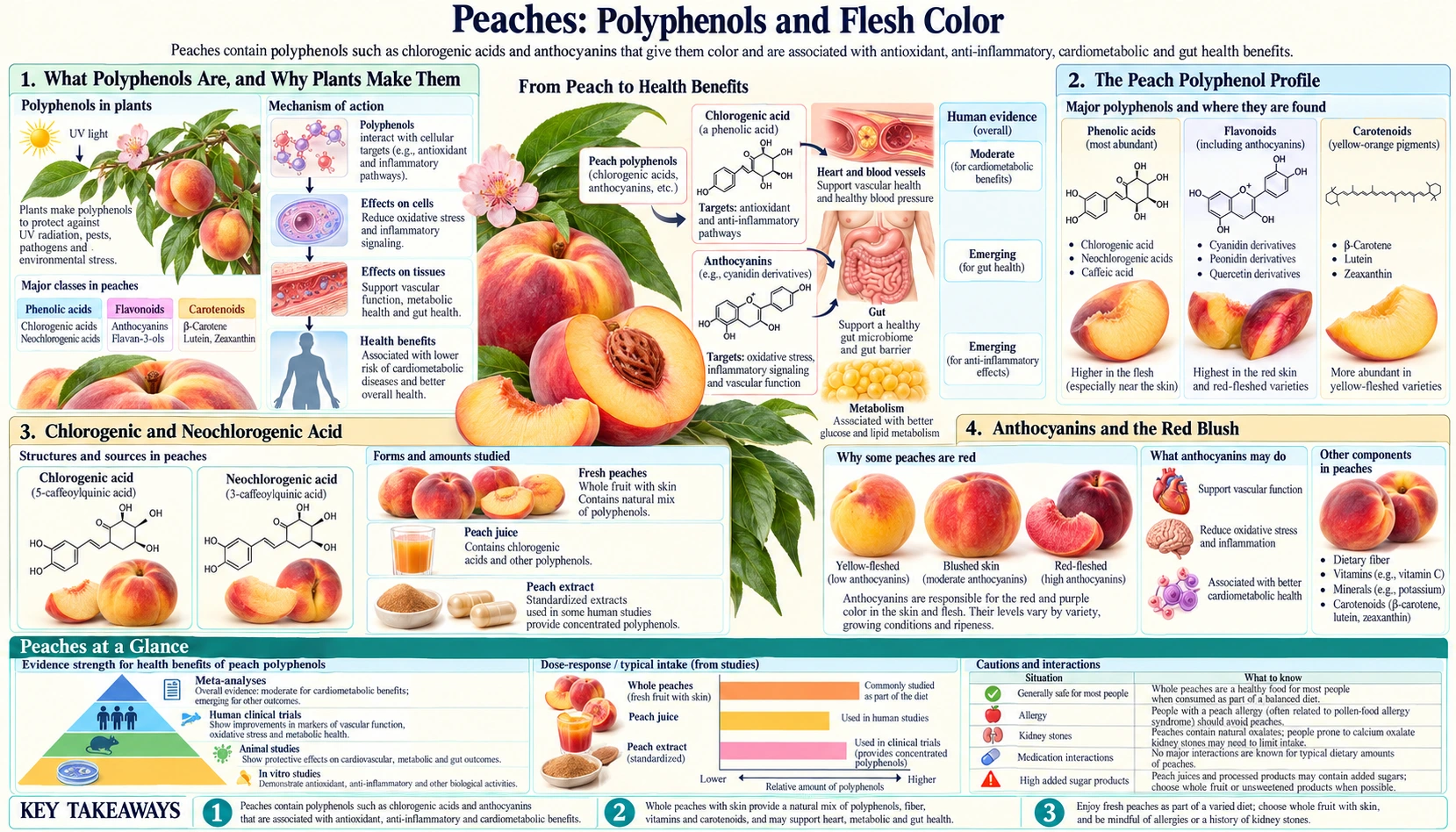
Peel a peach and you have thrown away most of the interesting chemistry. The fruit's polyphenols — led by chlorogenic and neochlorogenic acid, the same family of compounds that makes coffee the largest single source of phenolic acids in many diets — are concentrated in and just under the skin, along with the anthocyanins that paint the red blush. Flesh colour tells you about the carotenoids; skin colour and skin intactness tell you about the polyphenols; and the two are controlled by different genes and vary independently. This page explains which compounds are in a peach, why cultivar-to-cultivar variation is several-fold rather than trivial, what happens to these compounds after you swallow them, and — the part most food writing skips — exactly how far the human evidence goes and where it stops. The short version: the chemistry is real and well measured, the cell and animal work is genuinely interesting, and the human trials on peaches specifically barely exist.
Table of Contents
- What Polyphenols Are, and Why Plants Make Them
- The Peach Polyphenol Profile
- Chlorogenic and Neochlorogenic Acid
- Anthocyanins and the Red Blush
- Flesh Colour, Skin Colour, and What Each One Tells You
- Why Cultivar Variation Wrecks Simple Numbers
- What Happens After You Swallow Them
- The Evidence Ladder: Dish, Rat, Person
- Chlorogenic Acid and Blood Pressure: A Careful Read
- Practical: Choosing, Storing, and Eating for Polyphenols
- Peach Claims the Evidence Does Not Support
- Key Research Papers
- Connections
- Featured Videos
What Polyphenols Are, and Why Plants Make Them
Polyphenols are a large family of plant compounds built around phenol rings. Plants make them for their own reasons — defence against fungi and insects, protection of tissues against ultraviolet light and oxidative damage, colour to attract seed dispersers, astringency to discourage animals from eating unripe fruit. None of those reasons has anything to do with human health. That is worth stating at the outset, because a great deal of nutrition writing quietly assumes that a compound a plant makes for its own defence must be a medicine for us.
What is true is more modest and still interesting. Diets high in polyphenol-rich plant foods are consistently associated with better long-term health outcomes, and a large literature has worked out the structures, the absorption, the metabolism, and some plausible mechanisms — effects on endothelial function, on inflammatory signalling, on gut microbial metabolism. A comprehensive review of dietary polyphenolics in human health lays out both the mechanisms and the evidence of protective effects against chronic disease, and it is careful about the difference between what is measured in a test tube and what is measured in a person. This page tries to be equally careful.
The main groups relevant to peaches are phenolic acids (chlorogenic acid and its relatives), anthocyanins (the red-purple pigments), flavan-3-ols (catechins and their polymers, the procyanidins), and flavonols (quercetin derivatives, mostly in the skin).
The Peach Polyphenol Profile
Peach phenolics were characterised in detail in a 2001 study using high-performance liquid chromatography (HPLC) with diode-array and mass-spectrometric detection across nectarines, peaches and plums. The picture that emerged has held up:
- Hydroxycinnamic acids — chlorogenic acid (5-caffeoylquinic acid) and neochlorogenic acid (3-caffeoylquinic acid) are the dominant phenolics of peach flesh and skin. Neochlorogenic acid is often the larger of the two in peach, which distinguishes stone fruit from coffee, where chlorogenic acid dominates.
- Flavan-3-ols — catechin and epicatechin, plus procyanidins (oligomers of those units). These contribute astringency and a substantial share of measured antioxidant capacity.
- Flavonols — quercetin glycosides, largely confined to the skin, where they act as the plant's own sunscreen.
- Anthocyanins — principally cyanidin 3-glucoside, present only where the skin is red.
Two structural facts about distribution are the practically useful ones. First, concentrations are higher in the skin than the flesh for most of these compounds. Second, total phenolic content and antioxidant capacity track each other closely in peach, which is why measured antioxidant capacity is essentially a proxy for phenolic content rather than an independent property.
A brief note on "antioxidant capacity" as a number. Assays such as oxygen radical absorbance capacity (ORAC) and ferric reducing antioxidant power (FRAP) measure how a food extract behaves in a cuvette. They do not measure what happens in a human body, and the United States Department of Agriculture withdrew its oxygen radical absorbance capacity database in 2012 precisely because the values were being misused in marketing. Comparative antioxidant numbers are useful for comparing cultivars in a lab. They are not health claims.
Chlorogenic and Neochlorogenic Acid
Chlorogenic acid is one of the most-studied dietary phenolics, mainly because of coffee. In many populations coffee is the single largest source of it, and the research base on peach polyphenols benefits from that: what is known about how the body handles chlorogenic acid comes largely from coffee studies and applies to the same molecule arriving in a peach.
The absorption story is instructive because it overturns the naive picture. Only a modest fraction of ingested chlorogenic acid is absorbed intact in the upper gut. Much of it travels to the colon, where gut bacteria cleave and transform it into a range of smaller phenolic metabolites — and it is those microbial metabolites, not the parent compound, that circulate in the blood in appreciable amounts. A human study measuring the impact of dose on chlorogenic-acid bioavailability mapped this out across intakes, showing how absorption and metabolite profiles change as the dose rises.
Three consequences follow, and they apply to peaches:
- Your gut microbiome is part of the mechanism. Different people generate different metabolites from the same intake. This is one reason polyphenol trials produce inconsistent results between individuals.
- The parent compound's test-tube antioxidant power is largely irrelevant. What reaches your tissues is a set of smaller metabolites with different properties.
- Dose scale matters. Coffee drinkers may take in several hundred milligrams of chlorogenic acids a day. A peach delivers far less. Effects demonstrated at coffee-scale intakes cannot be assumed at peach-scale intakes.
A comprehensive review of chlorogenic acid's potential health effects surveys the mechanistic and clinical literature — glucose metabolism, blood pressure, lipids, body weight — and its honest summary is that the mechanistic case is broad and the clinical case is uneven and mostly built on supplements or coffee extracts rather than on whole foods.
Anthocyanins and the Red Blush
The red cheek on a peach is anthocyanin, chiefly cyanidin 3-glucoside — the same class of pigment that colours cherries, blackberries, red cabbage, and blood oranges. A 2013 study of several peach cultivars grown in Spain quantified anthocyanin alongside antioxidant capacity, quality, and nutrient contents, and it makes two things clear.
First, anthocyanin content is strongly cultivar-dependent and correlates with visible red colouration. A peach with a deep, extensive red blush carries more than a pale-cheeked one, and peaches with red flesh — a rarer trait — carry considerably more still.
Second — and this is the point that catches shoppers out — the red blush is not a ripeness signal. It is a varietal characteristic, developed largely in response to sun exposure on the tree. A gorgeously red peach can be rock hard and picked green. The reliable ripeness cues are the background colour (creamy gold or creamy white rather than green), fragrance at the stem end, and slight give along the seam.
Anthocyanins are, in absolute terms, a minor part of a peach's polyphenol load compared with the hydroxycinnamic acids. If you are eating for anthocyanins specifically, berries and cherries are in a different league. But they are one more group of compounds that peeling removes.
Flesh Colour, Skin Colour, and What Each One Tells You
Three colour signals, three different meanings. Keeping them apart makes the fruit bowl legible.
- Flesh colour (yellow vs white) → carotenoids. Yellow flesh means carotenoids accumulated; white flesh means an active carotenoid cleavage dioxygenase degraded them. Work published in 2013 identified the ccd4 gene controlling this. Yellow-fleshed peaches supply provitamin A; white-fleshed ones essentially do not. The Carotenoids and Vitamin C page covers this in depth.
- Skin blush (red vs none) → anthocyanins. Independent of flesh colour and of ripeness. A white-fleshed peach can have a brilliant red skin.
- Background colour (green vs gold/cream) → ripeness. The only one of the three that tells you when the fruit is ripe.
Flesh colour does not predict polyphenols. The 2001 survey of 25 peach, nectarine and plum cultivars found "no clear differences" in phenolic content between white-flesh and yellow-flesh cultivars, and found that anthocyanins and flavonols "were almost exclusively located" in the peel.
Because white-fleshed peaches are typically lower in acid, they taste sweeter at the same sugar content — sweetness is perceived relative to acidity, so removing acid raises perceived sweetness without adding a gram of sugar. That is a genuine flavour difference, not a nutritional one. It also means white peaches often taste under-flavoured to people who grew up on tangy yellow ones, and gorgeous to people who find yellow peaches sharp. Neither camp is wrong.
One more distinction worth having: clingstone versus freestone is about how the flesh attaches to the pit, not about colour or nutrition. Clingstones ripen earlier in the season and dominate the canning trade; freestones are the ones that twist apart cleanly and are easier to eat and cook with.
Why Cultivar Variation Wrecks Simple Numbers
Any time you see a single figure for "the polyphenol content of peaches", treat it as a midpoint of a wide distribution rather than a fact about the fruit in your hand.
A survey of peach and plum germplasm — the breeding collections that hold the species' diversity — found large variation in phytochemical content and antioxidant activity across accessions, with several-fold differences between the low and high ends. A separate evaluation of peach and nectarine breeding progenies reached the same conclusion for phenolics and vitamin C. And the 2013 Spanish cultivar study found the same for anthocyanins and nutrients. The 2001 California survey gives concrete figures: the white-flesh nectarine cultivar Brite Pearl (350–460 mg/kg hydroxycinnamates and 430–550 mg/kg procyanidins in the flesh) contained 10 times more phenolics than cultivars such as Fire Pearl (38–50 mg/kg hydroxycinnamates and 23–30 mg/kg procyanidins in the flesh).
The sources of that variation stack up:
- Genotype — the dominant factor. Some cultivars are simply several times richer than others.
- Ripeness at harvest — a smaller factor than once assumed: the 2001 survey, which sampled each cultivar at two ripeness stages, found "no clear trend in phenolic content with ripening".
- Sun exposure — fruit on the outside of the canopy makes more anthocyanin and more flavonol, because those compounds are partly an ultraviolet (UV) response.
- Growing conditions and season — water status, temperature, and soil all shift the numbers year to year.
- Post-harvest handling — storage time and temperature change what is left.
For an eater, the useful implication is not to chase cultivars. It is that variety-hunting is a worse strategy than simply eating whole, unpeeled, ripe fruit regularly, because the difference between eating peaches and not eating them dwarfs the difference between one cultivar and another.
What Happens After You Swallow Them
This is the section that separates careful nutrition from wishful thinking, so it is worth being concrete.
A polyphenol in a peach is not a polyphenol in your blood. Between the two lies a gauntlet:
- Release from the food matrix. Chewing and stomach acid break cell walls and free the compounds. Ripe, soft fruit does this more readily than firm fruit.
- Limited small-intestinal absorption. Only some phenolics cross the gut wall intact, and glycosylated forms often must be cleaved first.
- Immediate metabolism. What does cross is rapidly conjugated in the gut wall and liver — glucuronidated, sulfated, methylated. The compound circulating is a modified version, usually with lower test-tube antioxidant activity than the parent.
- Colonic microbial transformation. The large unabsorbed fraction reaches the colon and is worked over by gut bacteria into smaller phenolic acids, many of which are then absorbed. For chlorogenic acid this is the main route.
- Rapid clearance. Most of these metabolites are excreted within hours. Plasma concentrations from a normal food portion are typically in the nanomolar to low micromolar range — often far below the concentrations used in cell-culture experiments.
That last point deserves emphasis, because it is where most exaggerated food claims are born. A cell study may expose cancer cells to a polyphenol at a concentration that a person could not reach by eating, and could not survive if they could. The finding may be biologically genuine and still tell you nothing about eating fruit.
The Evidence Ladder: Dish, Rat, Person
Peach polyphenol research has climbed two rungs of a three-rung ladder. Being clear about which rung a study sits on is the single most useful skill a reader of nutrition claims can have.
Rung one — cells in a dish. A 2009 study identified peach and plum polyphenols with chemopreventive potential against estrogen-independent breast cancer cells. This is real, competent laboratory work and it is exactly the kind of study that gets rewritten in the popular press as "peaches fight breast cancer". What it shows is that specific compounds, at specific concentrations, affect specific cells in culture. It does not show an effect in a body, and the authors did not claim one.
Rung two — animals. A 2015 study fed polyphenol-rich peach and plum juice to Zucker rats, a strain bred to become obese and metabolically disordered, and found reductions in several risk factors for obesity-related metabolic disease and cardiovascular disease. This is a step up: it is a whole organism, with a real metabolism and real endpoints. It is also rats, drinking concentrated juice, on a genetic background chosen to make effects visible. Encouraging; not transferable.
Rung three — humans. Essentially absent for peaches specifically. There is no body of randomised controlled trials in which people ate peaches and meaningful clinical outcomes were measured. A broad review of peach phytochemicals and health benefits published in 2022 collates what exists, and the gap is plain in it.
What fills the gap honestly is the general literature on whole fruit, which is strong: large prospective cohorts and their dose-response meta-analyses consistently find lower cardiovascular, cancer and all-cause mortality risk with higher fruit and vegetable intake. Peaches are whole fruit, and that is the evidence that applies to them.
Chlorogenic Acid and Blood Pressure: A Careful Read
Because chlorogenic acid is the peach's headline polyphenol and because it has been trialled in humans, it is worth reading that literature properly rather than borrowing its conclusion.
A systematic review and meta-analysis of randomised clinical trials examined the effect of chlorogenic acid on blood pressure. It pooled five trials with 364 participants and found systolic pressure fell by 4.31 mm Hg and diastolic pressure by 3.68 mm Hg; the authors described the size of the effect as "moderate". That sounds like good news for peach eaters, and there are three reasons to be careful before treating it as such.
- The trials used supplements and extracts, typically green coffee bean extract, at doses far above what a peach supplies.
- Several included trials were small and short, and all were done in Asian populations — the meta-analysis authors noted that few trials have been conducted and that they vary in design and methodology.
- A blood pressure reduction from a concentrated extract does not establish an effect from a fruit containing a fraction of the dose alongside dozens of other compounds.
A larger 2024 meta-analysis of green coffee bean extract, the kind of extract used in these trials, pooled 10 trials with 563 participants. Systolic pressure fell by 2.95 mmHg and diastolic pressure by 2.15 mmHg; the effect was larger in people with high blood pressure, no effect on blood pressure was seen in women, and heart rate did not change. These too are extract doses, not fruit.
The fair summary: chlorogenic acid is a plausible bioactive with some human evidence at supplement doses; peaches contain it; nobody has shown that eating peaches lowers blood pressure. The stronger blood-pressure link for peaches is potassium, where the trial evidence for the nutrient is stronger and the amount in a peach is meaningful.
Practical: Choosing, Storing, and Eating for Polyphenols
- The skin holds most of the polyphenols. Peeling removes them; fruit washed under running water and eaten with the skin keeps them. For peach polyphenols this is the main factor — every other point on this list is small by comparison.
- Fragrance is a ripeness cue. Fragrance at the stem end and a creamy-gold background colour are better signs of ripeness than a red cheek.
- Cold harms unripe fruit. Cold storage of unripe peaches causes chilling injury and the mealy texture that follows from arrested pectin disassembly. Ripe fruit tolerates the fridge for a few days.
- Juicing loses the skin and fibre. Juicing discards skin and fibre. Blending whole fruit at least keeps them.
- Gentle cooking is fine. Grilling or roasting halves concentrates flavour and does not destroy the phenolic acids, though it costs vitamin C. Caramelised peach with yogurt and nuts is a legitimately good way to eat fruit.
- Frozen slices keep well. A good rescue for a glut, and better than letting fruit spoil.
- Canned peaches differ by packing liquid. Canned peaches are peeled, so the skin compounds are gone, but the fruit is still real food. Peaches canned in juice or water carry no added syrup; the added sugar is in the syrup.
- Regular eating matters more than cultivar. As the cultivar section above notes, the difference between eating peaches and not eating them is larger than the difference between one cultivar and another.
Peach Claims the Evidence Does Not Support
A short list of peach claims that circulate without support.
- "Peaches fight cancer." Traceable to cell-culture work on peach and plum polyphenols. Not shown in people; no study has tested peaches as a treatment.
- "Peaches are a top antioxidant food." Antioxidant rankings come from test-tube assays whose relevance to the body is weak enough that the U.S. Department of Agriculture (USDA) withdrew its own oxygen radical absorbance capacity database. Peaches sit in the ordinary range for fruit.
- "The redder the peach, the healthier." Red skin means more anthocyanin, which is a genuine but small part of the picture, and it says nothing about ripeness, carotenoids, or sweetness.
- "White peaches are healthier because they are lower in sugar." They are lower in acid, which makes them taste sweeter. Sugar content is similar.
- "Peach detoxes / peach juice cleanses." There is no mechanism and no evidence. Juicing also strips the fibre.
- "Organic peaches have more antioxidants." Growing conditions do shift phenolic content, but cultivar swamps the effect, and the differences reported between farming systems are small and inconsistent. The studies do not show a large nutritional difference.
Key Research Papers
- Tomás-Barberán FA, Gil MI, Cremin P, Waterhouse AL, Hess-Pierce B, Kader AA. HPLC-DAD-ESIMS analysis of phenolic compounds in nectarines, peaches, and plums. Journal of Agricultural and Food Chemistry. 2001;49(10):4748–4760. — The compositional foundation: chlorogenic and neochlorogenic acid as the dominant peach phenolics. — doi:10.1021/jf0104681
- Gil MI, Tomás-Barberán FA, Hess-Pierce B, Kader AA. Antioxidant capacities, phenolic compounds, carotenoids, and vitamin C contents of nectarine, peach, and plum cultivars from California. Journal of Agricultural and Food Chemistry. 2002;50(17):4976–4982. — doi:10.1021/jf020136b
- Vizzotto M, Cisneros-Zevallos L, Byrne DH, Ramming DW, Okie WR. Large variation found in the phytochemical and antioxidant activity of peach and plum germplasm. Journal of the American Society for Horticultural Science. 2007;132(3):334–340. — doi:10.21273/JASHS.132.3.334
- Reig G, Iglesias I, Gatius F, Alegre S. Antioxidant capacity, quality, and anthocyanin and nutrient contents of several peach cultivars [Prunus persica (L.) Batsch] grown in Spain. Journal of Agricultural and Food Chemistry. 2013;61(26):6344–6357. — doi:10.1021/jf401183d
- Cantín CM, Moreno MA, Gogorcena Y. Evaluation of the antioxidant capacity, phenolic compounds, and vitamin C content of different peach and nectarine [Prunus persica (L.) Batsch] breeding progenies. Journal of Agricultural and Food Chemistry. 2009;57(11):4586–4592. — doi:10.1021/jf900385a
- Adami M, De Franceschi P, Brandi F, et al. Identifying a carotenoid cleavage dioxygenase (ccd4) gene controlling yellow/white fruit flesh color of peach. Plant Molecular Biology Reporter. 2013;31(5):1166–1175. — doi:10.1007/s11105-013-0628-6
- Noratto G, Porter W, Byrne D, Cisneros-Zevallos L. Identifying peach and plum polyphenols with chemopreventive potential against estrogen-independent breast cancer cells. Journal of Agricultural and Food Chemistry. 2009;57(12):5219–5226. — Cell-culture study. Mechanistically interesting; not evidence of an effect in people. — doi:10.1021/jf900259m
- Noratto G, Martino HSD, Simbo S, Byrne D, Mertens-Talcott SU. Consumption of polyphenol-rich peach and plum juice prevents risk factors for obesity-related metabolic disorders and cardiovascular disease in Zucker rats. The Journal of Nutritional Biochemistry. 2015;26(6):633–641. — Animal study. — doi:10.1016/j.jnutbio.2014.12.014
- Bento C, Gonçalves AC, Silva B, Silva LR. Peach (Prunus persica): phytochemicals and health benefits. Food Reviews International. 2022;38(8):1703–1734. — doi:10.1080/87559129.2020.1837861
- Del Rio D, Rodriguez-Mateos A, Spencer JPE, Tognolini M, Borges G, Crozier A. Dietary (poly)phenolics in human health: structures, bioavailability, and evidence of protective effects against chronic diseases. Antioxidants & Redox Signaling. 2013;18(14):1818–1892. — doi:10.1089/ars.2012.4581
- Stalmach A, Williamson G, Crozier A. Impact of dose on the bioavailability of coffee chlorogenic acids in humans. Food & Function. 2014;5(8):1727–1737. — doi:10.1039/c4fo00316k
- Tajik N, Tajik M, Mack I, Enck P. The potential effects of chlorogenic acid, the main phenolic components in coffee, on health: a comprehensive review of the literature. European Journal of Nutrition. 2017;56(7):2215–2244. — doi:10.1007/s00394-017-1379-1
- Onakpoya IJ, Spencer EA, Thompson MJ, Heneghan CJ. The effect of chlorogenic acid on blood pressure: a systematic review and meta-analysis of randomized clinical trials. Journal of Human Hypertension. 2015;29(2):77–81. — Supplement and extract doses, not fruit. — doi:10.1038/jhh.2014.46
- Samavat S, Ashtary-Larky D, Naeini F, Nazarian B, Kashkooli S, Clark CCT, Bagheri R, Asbaghi O, Babaali M, Goudarzi MA, Zamanian A, Emamat H. The effects of green coffee bean extract on blood pressure and heart rate: a systematic review and dose-response meta-analysis of randomized controlled trials. Diabetes & Metabolic Syndrome. 2024;18(9):103120. — Extract doses, not fruit. — doi:10.1016/j.dsx.2024.103120
- Lara MV, Bonghi C, Famiani F, Vizzotto G, Walker RP, Drincovich MF. Stone fruit as biofactories of phytochemicals with potential roles in human nutrition and health. Frontiers in Plant Science. 2020;11:562252. — doi:10.3389/fpls.2020.562252
- Brummell DA. Cell wall metabolism during the development of chilling injury in cold-stored peach fruit. Journal of Experimental Botany. 2004;55(405):2041–2052. — doi:10.1093/jxb/erh228
- Aune D, Giovannucci E, Boffetta P, et al. Fruit and vegetable intake and the risk of cardiovascular disease, total cancer and all-cause mortality — a systematic review and dose-response meta-analysis of prospective studies. International Journal of Epidemiology. 2017;46(3):1029–1056. — doi:10.1093/ije/dyw319
- PubMed: peach polyphenols and chlorogenic acid content — live topic search.
- PubMed: polyphenol bioavailability and gut microbial metabolites in humans — live topic search. — Search PubMed