Asthma
Interactive Visualization Breathing & Gas Exchange — move the diaphragm yourself Fill the alveoli and watch oxygen diffuse into the blood while carbon dioxide leaves, with live pO₂/pCO₂ meters and an exercise mode. Launch → Interactive Visualization Lung Surfactant — keep the air-sacs open See why 300 million wet air-sacs don't collapse from surface tension — a soapy surfactant holds them open — then take it away, as in a premature baby, and watch the lungs stiffen and collapse. Launch → Interactive Visualization Pulse Oximetry — read oxygen with two colours of light See how a finger clip reads your blood oxygen with two colours of light — measuring only the pulsing artery signal — and why it can read dangerously normal in carbon-monoxide poisoning. Launch → Interactive Visualization Asthma — squeeze the airway shut, then open it again Narrow a bronchiole and watch resistance climb with the fourth power of the radius — then fire a rescue inhaler and pull the peak flow back out of the red zone. Launch →
Table of Contents
- What is Asthma?
- The Three Changes That Narrow an Airway
- Types of Asthma
- Common Symptoms of Asthma
- How It Varies Between People
- Triggers
- Risk Factors
- Diagnosis: The Tests and the Numbers
- Measuring Control
- Treatment Options
- Biologics for Severe Asthma
- What the Evidence Does Not Support
- Inhaler Technique and Costs
- Prevention and Management Strategies
- Red Flags: When It Is an Emergency
- Complications of Asthma
- Key Research Papers
- Connections
- Featured Videos
What is Asthma?
Asthma is a chronic disease in which the small airways of the lung are persistently inflamed and react too strongly to things that should not bother them. When they react, they narrow, and air that went in cannot easily get back out.
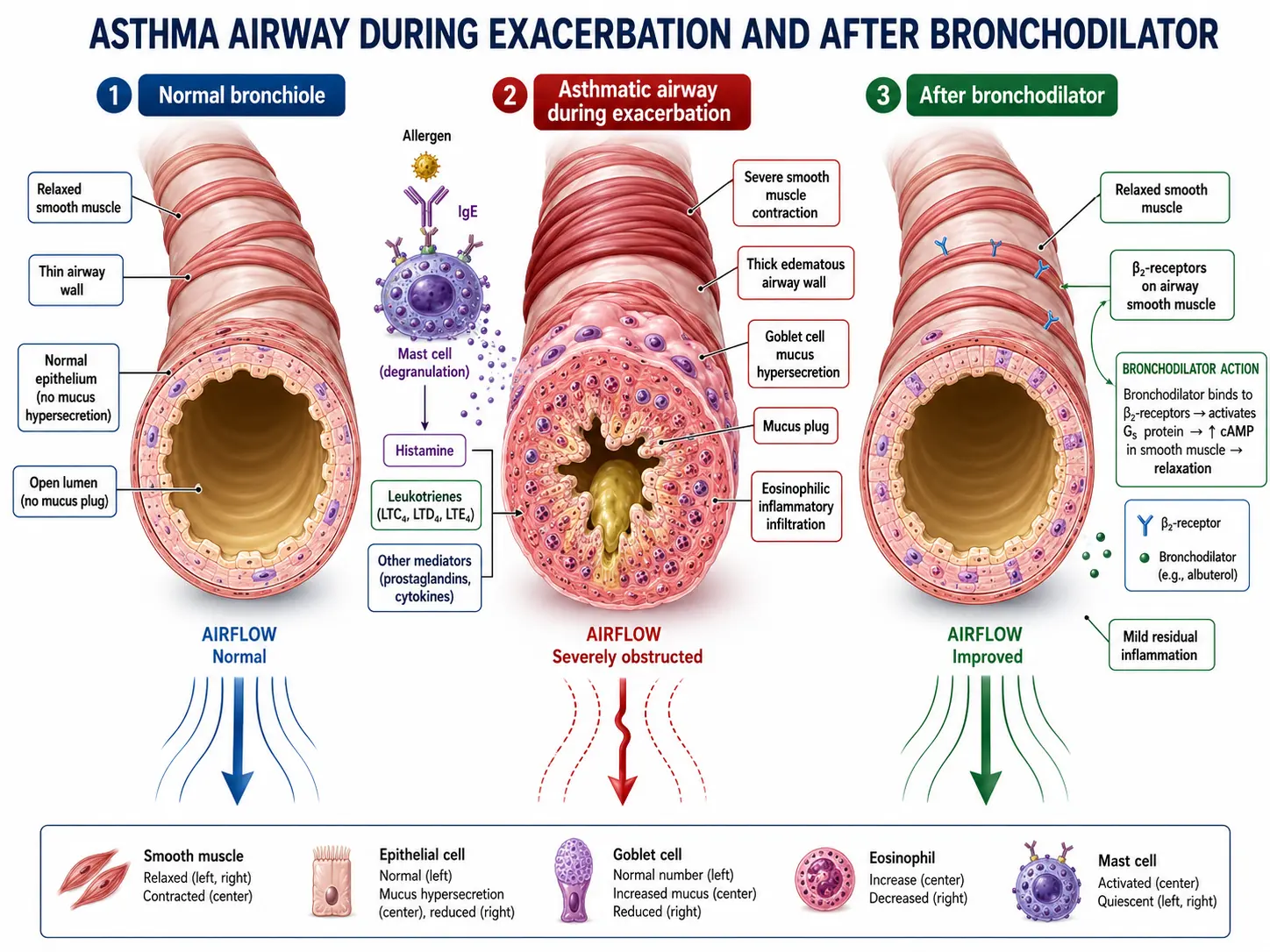
A useful way to picture it: a healthy bronchiole is a smooth, open drinking straw. In asthma that straw is permanently a little swollen on the inside, has a ring of muscle around it that is quick to clench, and produces sticky mucus. None of that is a problem while you are sitting still. Add cold air, a cat, or a chest infection and the muscle clenches, the swelling worsens, mucus fills the middle — and now you are breathing through a coffee stirrer.
The reason a small amount of narrowing feels so dramatic is physics, not psychology. Resistance to airflow rises roughly with the fourth power of the radius. Halve the diameter of an airway and resistance does not double — it rises about sixteenfold. This is why a change invisible on a chest X-ray can leave someone unable to finish a sentence, and why a rescue inhaler that relaxes the muscle by a seemingly modest amount can transform how a person feels within minutes.
Asthma is also not one disease. A 2018 Lancet seminar by Papi and colleagues describes it as a syndrome with shared symptoms and several distinct underlying biologies, and a companion Lancet commission the same year argued for abandoning the label altogether in favour of describing each patient’s specific treatable traits. That distinction matters practically: it is why two people with the same diagnosis can respond completely differently to the same inhaler.
The Three Changes That Narrow an Airway
Three separate things happen, on three different timescales, and each has its own drug class. Knowing which is which explains why you may be given two or three inhalers that seem to do the same thing.
- Bronchoconstriction — the smooth-muscle ring around the airway contracts. This happens in seconds to minutes and is what a rescue inhaler reverses. It is the only one of the three that is instantly reversible.
- Airway inflammation and swelling — the airway lining becomes oedematous and infiltrated with immune cells. This builds over hours to days and is what inhaled corticosteroids treat. It is the underlying disease; the other two are consequences.
- Mucus plugging — goblet cells overproduce thick mucus that physically blocks small airways. In severe attacks this is often the reason someone does not improve as fast as expected after a bronchodilator, and in fatal asthma the small airways are frequently found completely occluded by mucus casts.
Over years, uncontrolled inflammation can add a fourth, less reversible change: airway remodelling, in which the airway wall thickens with extra smooth muscle and collagen. This is the argument for treating the inflammation early even when someone feels well — the START trial (Pauwels et al., Lancet 2003) showed that early low-dose budesonide in mild persistent asthma reduced severe exacerbations and slowed the decline in lung function over three years.
Types of Asthma
Older classifications sorted asthma by trigger. Newer ones sort it by the immune pathway involved, because that is what predicts which drugs will work. Both are given here because you will encounter both.
By trigger (the classical descriptions)
- Allergic asthma — triggered by inhaled allergens such as pollen, house dust mite, mould spores, cockroach or animal dander. Usually begins in childhood, usually accompanied by eczema or hay fever, and usually associated with a raised blood IgE.
- Non-allergic asthma — triggered by irritants, infections, stress, cold air or smoke rather than by an allergen. More often adult-onset, more common in women, and often less responsive to inhaled steroids.
- Exercise-induced bronchoconstriction — airway narrowing that appears 5–15 minutes after exercise stops, caused by the drying and cooling of the airway lining during rapid breathing. Cold, dry air makes it worse; swimming in warm humid air makes it better. It is common in elite endurance athletes.
- Occupational asthma — caused or triggered by a workplace exposure such as isocyanates in spray paint, flour in bakeries, latex, or wood dust. The diagnostic clue is symptoms that improve on holiday and return within days of going back to work. It is worth pursuing, because removal from exposure early can be curative while late removal often is not.
- Aspirin-exacerbated respiratory disease (AERD) — the triad of asthma, nasal polyps, and reactions to aspirin and other NSAIDs. It is not an allergy but a reaction to blocking the COX-1 enzyme, and it typically begins in adulthood.
By underlying biology (what drives modern treatment)
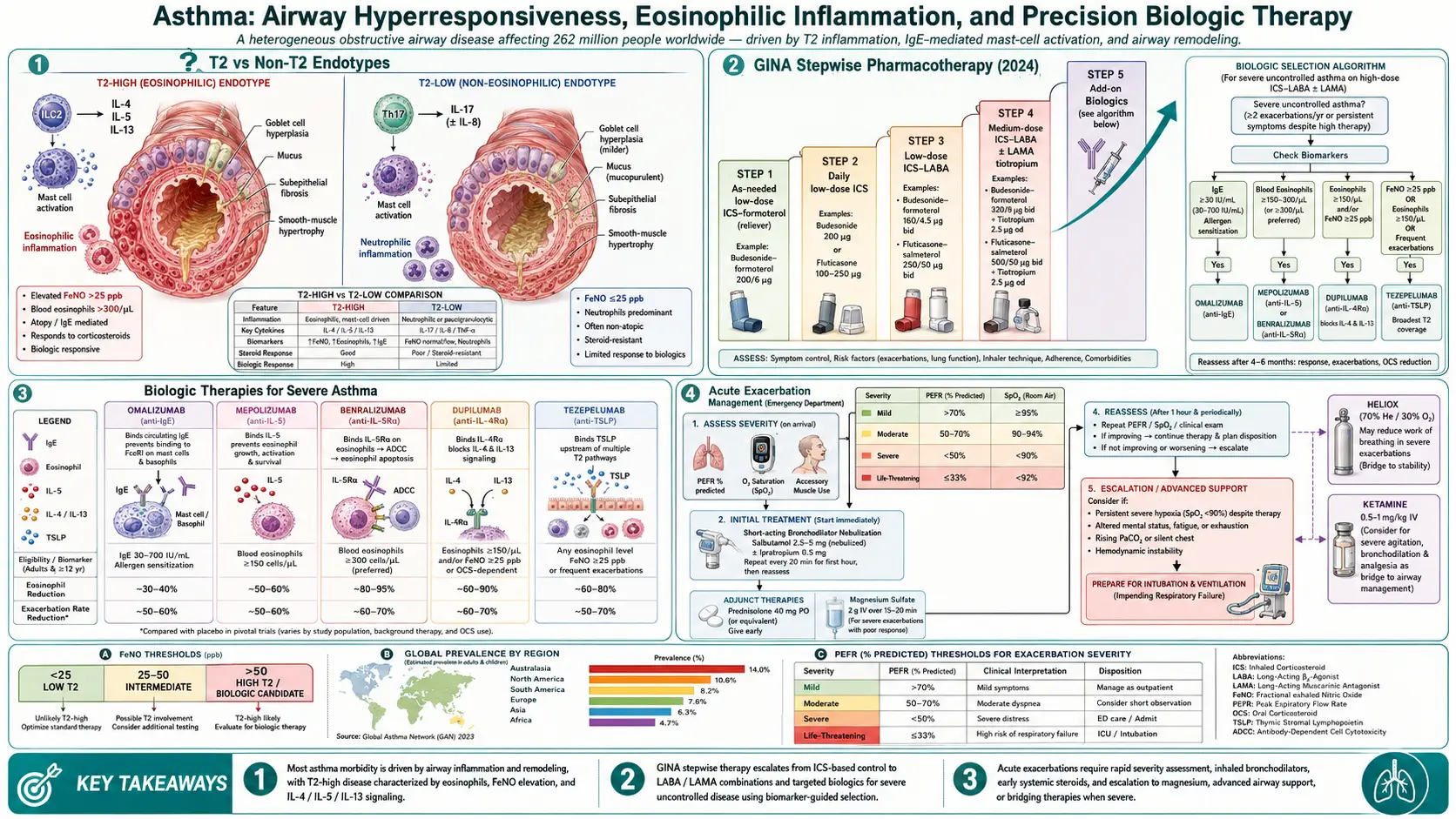
- Type 2-high asthma — driven by the interleukin-4, -5 and -13 pathway. Markers are blood eosinophils, raised fractional exhaled nitric oxide (FeNO), and raised IgE. It responds well to inhaled corticosteroids and is the group that biologic drugs were designed for. It accounts for roughly half of severe asthma.
- Type 2-low (non-eosinophilic) asthma — neutrophilic or paucigranulocytic. More common in adult-onset disease, obesity and smokers. It responds poorly to steroids, which is important to know: escalating steroid doses in someone whose eosinophils are already zero is unlikely to help and certain to cause side effects.
Wenzel’s 2012 Nature Medicine review is the standard reference for this reframing, and it is the reason a blood eosinophil count and a FeNO measurement now appear on severe-asthma workups.
Common Symptoms of Asthma
- Wheezing — a musical, whistling sound, characteristically on breathing out. Absence of wheeze does not exclude asthma, and in a very severe attack a silent chest is an ominous sign, not a reassuring one: too little air is moving to make a sound.
- Shortness of breath, often with a sense that the difficulty is in getting air out rather than in.
- Chest tightness — frequently described as a band or a weight rather than as pain.
- Cough, classically dry and worse at night or in the early hours of the morning. In cough-variant asthma this is the only symptom, and the diagnosis is often missed for years.
- Symptoms that vary — worse at 3–5 a.m., worse with a cold, worse in spring, better on holiday. Variability over time is one of the most useful diagnostic features, and it is why a normal examination in clinic proves nothing.
How It Varies Between People
Two people with the same spirometry can live entirely different lives with this disease, and understanding where you sit changes what treatment is appropriate.
- Age of onset. Childhood-onset asthma is usually allergic, often improves markedly in adolescence, and frequently returns in adulthood. Adult-onset asthma is more often non-allergic, more often eosinophilic without allergy, more often associated with nasal polyps, and generally more persistent.
- Perception of airflow limitation. Some people feel a 15% drop in peak flow acutely; others feel nothing until they have lost 40%. Poor perceivers are at higher risk of near-fatal attacks precisely because they do not seek help early. If your symptoms and your peak-flow numbers disagree, trust the numbers.
- Obesity. Asthma with obesity is a distinct clinical picture: more symptoms, worse quality of life, less eosinophilic inflammation, and less steroid response. Weight loss produces genuine improvement in this group, which is not true for asthma generally.
- Sex. Asthma is commoner in boys before puberty and commoner and more severe in women after it. Some women have a reproducible premenstrual worsening.
- Comorbidities that masquerade as poor control. Reflux, chronic rhinosinusitis, obstructive sleep apnoea, anxiety with hyperventilation, and inducible laryngeal obstruction (vocal-cord dysfunction) all produce breathlessness that does not respond to asthma drugs. Escalating asthma treatment for one of these is a common and avoidable trap.
Triggers
Triggers vary between individuals and are worth identifying specifically rather than avoiding everything.
- Viral respiratory infections — by a wide margin the commonest cause of exacerbation, particularly rhinovirus. The September spike in childhood asthma admissions after schools return is a rhinovirus phenomenon.
- Aeroallergens — house dust mite, grass and tree pollen, cat and dog dander, Alternaria and other mould spores, cockroach.
- Tobacco smoke, including secondhand exposure, and vaping aerosol.
- Air pollution, particularly fine particulate matter (PM2.5) and nitrogen dioxide from traffic.
- Cold, dry air and sudden weather changes; thunderstorms during high pollen counts can cause epidemics of severe attacks.
- Exercise, especially in cold air.
- Drugs — non-selective beta-blockers (including eye drops for glaucoma) and, in the AERD subgroup, aspirin and NSAIDs.
- Occupational exposures — isocyanates, flour and grain dust, latex, persulphate salts in hairdressing, wood dust.
- Strong emotion and stress, which act through changes in breathing pattern and airway tone; this is a real physiological trigger, not evidence that the disease is psychological.
Risk Factors
- Family history — the single strongest predictor. Risk roughly triples with one affected parent.
- Atopy — eczema in infancy and food allergy are strong predictors of later asthma, the so-called atopic march.
- Early-life respiratory infection, particularly severe RSV or rhinovirus bronchiolitis.
- Prematurity and low birth weight.
- Maternal smoking in pregnancy and early-life secondhand smoke exposure.
- Obesity — both a risk factor for developing asthma and a driver of worse control once it is present.
- Air pollution exposure in childhood, especially proximity to major roads.
- Occupational exposure — occupational asthma is thought to account for roughly one adult-onset case in six.
Diagnosis: The Tests and the Numbers
Asthma is over-diagnosed and under-confirmed. A large proportion of adults carrying the label have never had objective testing, and a meaningful minority do not have it at all. Ask for the numbers.
Spirometry with bronchodilator reversibility
The core test. You blow as hard and long as you can into a machine, which measures FEV1 (the volume forced out in the first second) and FVC (the total volume). In obstruction the FEV1/FVC ratio falls below the lower limit of normal — historically a fixed 0.70, though age-adjusted limits are more accurate and are now preferred.
You then inhale a bronchodilator and repeat. A rise in FEV1 of at least 12% and at least 200 mL is the traditional threshold for significant reversibility. Newer guidance also accepts a rise of more than 10% of the predicted value. A negative test does not exclude asthma — it may simply mean you were well on the day — so a normal spirometry with a good story should prompt further testing, not discharge.
Fractional exhaled nitric oxide (FeNO)
A 10-second breath into a handheld analyser. Nitric oxide is produced by inflamed airway epithelium under interleukin-13 signalling, so FeNO is a marker of type 2 inflammation and, indirectly, of likely steroid responsiveness. Broadly: below 25 ppb in adults is low, 25–50 ppb intermediate, above 50 ppb high. Values are lower in children. Smoking lowers it; steroids lower it. A high FeNO in someone already on an inhaled steroid usually means the steroid is not reaching the airway — poor technique or poor adherence — rather than that the dose is too small.
Peak expiratory flow (PEF) variability
A cheap plastic tube used at home twice daily for two weeks. Average day-to-day variability of more than 10% in adults (more than 13% in children) supports the diagnosis. Peak flow is also the best home tool for an action plan, because it detects deterioration before symptoms do in poor perceivers.
Bronchial challenge testing
If spirometry is normal and the story is convincing, a provocation test can demonstrate the airway hyper-responsiveness that defines the disease. Methacholine challenge reports a PC20 — the concentration causing a 20% fall in FEV1 — with values under 4 mg/mL considered positive. Its main value is its high negative predictive value: a normal methacholine challenge in a symptomatic, untreated adult makes asthma unlikely. Exercise or mannitol challenge is used where exercise-induced bronchoconstriction is suspected.
Blood tests worth having
- Full blood count with differential for the absolute eosinophil count. A count above roughly 150 cells/µL, and certainly above 300 cells/µL, marks eosinophilic asthma and predicts response to inhaled steroids and to anti-IL-5 biologics. Note that oral steroids suppress it, so a count taken during a course of prednisolone is uninterpretable.
- Total and specific IgE, or skin-prick testing, to identify allergic triggers and to determine eligibility for omalizumab.
- Vitamin D where deficiency is plausible — see the caveat below about what supplementation does and does not achieve.
What else it might be
Breathlessness and wheeze are not specific. Reasonable alternatives and mimics include COPD (and asthma–COPD overlap), inducible laryngeal obstruction, heart failure, bronchiectasis, chronic cough from reflux or ACE inhibitors, pulmonary embolism, and in children a persistently inhaled foreign body. A wheeze that is always in the same place, or a wheeze that is loudest over the throat rather than the chest, deserves specific investigation.
Measuring Control
“Control” has a technical definition, and it is the number your treatment is adjusted against. Over the previous four weeks, ask whether you have had:
- daytime symptoms more than twice a week;
- any night waking due to asthma;
- reliever use for symptoms more than twice a week;
- any activity limitation due to asthma.
None of these is well controlled; one or two is partly controlled; three or four is uncontrolled. This is the GINA assessment, and it is deliberately simple enough to do in a doorway.
The most informative single number is how many rescue inhalers you go through in a year. Using three or more canisters of a short-acting reliever annually is associated with increased risk of severe exacerbation; twelve or more — roughly one a month — is associated with increased risk of asthma death. If you are buying salbutamol monthly, your asthma is not mild, whatever it feels like.
Treatment Options
The change that rewrote the guidelines
For decades, mild asthma was treated with a short-acting reliever alone, and an inhaled steroid was added only if symptoms became frequent. That is no longer recommended, and the reason is worth understanding. Reliever-only treatment relieves the symptom while leaving the inflammation untreated, and people with apparently mild asthma do die of it. Since 2019, GINA has recommended that every adult and adolescent with asthma receive inhaled corticosteroid-containing treatment — either regularly, or as a combined budesonide–formoterol inhaler taken only when symptoms occur.
The evidence is substantial. In SYGMA 1 (O’Byrne et al., NEJM 2018), as-needed budesonide–formoterol was superior to as-needed terbutaline for symptom control and cut severe exacerbations by about two-thirds, using a fraction of the steroid dose of daily maintenance therapy. In SYGMA 2 (Bateman et al., same issue), as-needed budesonide–formoterol was non-inferior to daily maintenance budesonide for severe exacerbations. Novel START (Beasley et al., NEJM 2019) confirmed the finding in a real-world, open-label setting.
Relievers
- Short-acting beta-2 agonists (SABA) — salbutamol/albuterol, terbutaline. Onset within minutes, duration 4–6 hours. Standard adult dose in an attack is 4–10 puffs via a spacer, repeated as needed. Side effects — tremor, palpitations, a fall in serum potassium — are dose-related and expected, not allergic.
- Budesonide–formoterol as a reliever — formoterol is a long-acting beta-agonist with a fast onset, so this combination works as fast as salbutamol while also delivering a steroid dose with every rescue. This is the preferred reliever in current GINA guidance, and it is the basis of maintenance-and-reliever therapy (MART), in which one inhaler is used both regularly and for relief.
Controllers
- Inhaled corticosteroids (ICS) — beclometasone, budesonide, fluticasone, ciclesonide, mometasone. The foundation of treatment. Most of the benefit arrives at low doses; the dose–response curve is remarkably flat, so quadrupling the dose gives far less than four times the benefit while giving considerably more than four times the local side effects. Rinse and spit after every dose to reduce oral thrush and hoarseness.
- Long-acting beta-agonists (LABA) — formoterol, salmeterol, vilanterol. Never to be used without an inhaled steroid in asthma. LABA monotherapy increases the risk of asthma death, which is why every asthma LABA is now sold only in a combination inhaler. When combined with a steroid the risk disappears: four large FDA-mandated safety trials, including Stempel et al. and Peters et al. (NEJM 2016), found no increase in serious asthma-related events with combination therapy, consistent with the earlier Bateman meta-analysis in Annals of Internal Medicine.
- Long-acting muscarinic antagonists (LAMA) — tiotropium. Useful added to ICS–LABA in persistently uncontrolled asthma. The TALC trial (Peters et al., NEJM 2010) found that adding tiotropium to an inhaled steroid was superior to doubling the steroid dose, and non-inferior to adding salmeterol.
- Leukotriene receptor antagonists — montelukast. A tablet, useful in exercise-induced bronchoconstriction, AERD and where allergic rhinitis coexists, but generally less effective than an inhaled steroid. It carries a boxed warning from the FDA for serious neuropsychiatric events including agitation, sleep disturbance, depression and suicidal thinking. These are uncommon but real; if mood or sleep changes after starting it, stop it and say so.
- Oral corticosteroids — prednisolone, typically 40–50 mg daily for 5–7 days in an adult exacerbation, with no need to taper after a short course. Effective and sometimes life-saving, but cumulative exposure matters: a lifetime total of around 0.5–1 g of prednisolone is associated with measurable increases in osteoporosis, diabetes, cataract and adrenal suppression. Repeated courses are an indication for specialist referral, not for another course.
- Allergen immunotherapy — sublingual house-dust-mite immunotherapy has evidence for reducing exacerbations in allergic asthma with rhinitis, and is worth asking about where a single dominant allergen is identified.
Biologics for Severe Asthma
Roughly 5–10% of people with asthma remain uncontrolled on high-dose inhaled steroid plus a second controller. For those with the right biology, injected monoclonal antibodies have changed outcomes substantially. They are expensive, given by injection every 2–8 weeks, and prescribed through specialist centres. Eligibility is decided on biomarkers, which is why the blood tests above matter.
- Omalizumab (anti-IgE) — for allergic asthma with a raised IgE in a defined range and a positive perennial allergen test. In inner-city children with allergic asthma, Busse et al. (NEJM 2011) found it reduced symptom days and, notably, abolished the autumn exacerbation peak.
- Mepolizumab, reslizumab, benralizumab (anti-IL-5 / anti-IL-5 receptor) — for eosinophilic asthma. In MENSA (Ortega et al., NEJM 2014) mepolizumab roughly halved exacerbation rates. In the companion SIRIUS trial (Bel et al., same issue) it allowed a median 50% reduction in maintenance oral steroid dose while improving control — the more clinically meaningful result for anyone on long-term prednisolone.
- Dupilumab (anti-IL-4 receptor alpha, blocking IL-4 and IL-13) — in the QUEST trial (Castro et al., NEJM 2018) it reduced severe exacerbations and improved FEV1, with the largest benefit in those with higher baseline eosinophils or FeNO. It also treats coexisting eczema and nasal polyps, which often makes it the pragmatic choice. A transient rise in blood eosinophils after starting is expected.
- Tezepelumab (anti-TSLP) — acts further upstream, at an epithelial alarmin. In NAVIGATOR (Menzies-Gow et al., NEJM 2021) it reduced exacerbations across the range of baseline eosinophil counts, including in patients with counts below 300 cells/µL. It is currently the only biologic with clear benefit in the type 2-low group, which had no targeted option at all before it.
What the Evidence Does Not Support
Several widely recommended measures have been tested and have not delivered, and it is more useful to know that than to spend money and effort on them.
- Vitamin D supplementation to prevent attacks in children who are already deficient. This is the strongest negative result in the recent literature. The VDKA randomised trial (Forno et al., JAMA 2020) gave 4,000 IU/day of vitamin D3 or placebo for 48 weeks to children with persistent asthma and 25(OH)D levels below 30 ng/mL. It found no reduction in severe exacerbations — the primary outcome — and no improvement in control or in inhaled-steroid dose, despite the supplement successfully raising blood levels. Correcting deficiency remains reasonable for bone health; expecting it to control asthma is not supported.
- Escalating inhaled steroid doses in non-eosinophilic asthma. If eosinophils and FeNO are both low, additional steroid mostly buys side effects. Look for a mimic, an adherence problem, or a type 2-low mechanism instead.
- Whole-house allergen avoidance packages. Single-measure interventions such as mattress covers alone have repeatedly failed to improve outcomes in trials. Multi-component remediation targeting a documented sensitisation, particularly cockroach or mould in poor housing, does have evidence — the specificity is the point.
- Breathing exercises as a substitute for controller medication. Buteyko and similar techniques can genuinely reduce symptom scores and reliever use, and are reasonable adjuncts, particularly where dysfunctional breathing coexists. They do not reduce airway inflammation and must not replace an inhaled steroid.
Inhaler Technique and Costs
Around two-thirds of people make at least one critical error with their inhaler, and technique explains more treatment failure than drug choice does.
- Use a spacer with any pressurised metered-dose inhaler. It roughly doubles lung deposition, removes the need to coordinate pressing and breathing, and cuts the oropharyngeal deposition that causes thrush and hoarseness. A spacer plus MDI is as effective as a nebuliser for most acute attacks, including in children.
- One puff at a time. Shake, actuate once into the spacer, then take five slow tidal breaths (or one slow deep breath with a 10-second hold). Wait 30 seconds, shake, repeat. Firing several puffs into a spacer at once wastes most of the dose.
- Dry-powder inhalers need the opposite technique — a fast, forceful inhalation, and no spacer. Someone who has learned the slow-breath technique for an MDI will get almost nothing from a DPI without being retaught.
- Rinse and spit after steroid doses, every time.
- Check technique at every review, and ask to be watched doing it. Self-reported technique correlates poorly with observed technique.
On cost: generic salbutamol and generic beclometasone or budesonide are inexpensive in most health systems, and where combination inhalers are unaffordable, a separate low-dose steroid inhaler taken regularly plus a separate reliever is far better than a reliever alone. In the United States, manufacturer copay cards, the GoodRx-type discount networks, and — since 2024 — the capped monthly inhaler pricing offered by several manufacturers have brought list prices down substantially; it is worth asking the pharmacist to price the same molecule under a different brand and device. Biologics are dispensed through specialty pharmacy and essentially always require prior authorisation, for which documented biomarker values and exacerbation history are what the insurer wants to see.
Prevention and Management Strategies
- Take the controller even when you feel well. This is the single highest-yield behaviour, and the commonest one abandoned. Feeling well on treatment is the treatment working.
- Get a written asthma action plan — a one-page document specifying your normal treatment, what to do when symptoms worsen or peak flow falls (typically a defined step-up), when to start oral steroids if you have been given a rescue course, and when to seek emergency care. Written plans reduce hospitalisations; verbal advice does not.
- Stop smoking, and remove smoke from the household. Smoking both worsens asthma and makes inhaled steroids less effective.
- Annual influenza vaccination, and pneumococcal vaccination as advised. Viral infection is the dominant exacerbation trigger.
- Treat the nose. Rhinitis and chronic rhinosinusitis worsen asthma; intranasal steroid treatment of coexisting rhinitis improves asthma outcomes.
- Address weight where relevant. In obesity-associated asthma, weight loss of 5–10% produces measurable improvement in control and lung function.
- Keep exercising. Exercise-induced bronchoconstriction is treatable — two puffs of a reliever 10–15 minutes before activity, an adequate warm-up, and good baseline control. Avoiding exercise deconditions you and makes breathlessness worse.
- Eat for the lung as well as the body. Diets high in vegetables, fruit, oily fish, olive oil, nuts, legumes and whole grains such as brown rice, oats and barley are associated with better asthma outcomes in observational studies; the effect is modest, and it complements rather than replaces treatment.
Red Flags: When It Is an Emergency
Call emergency services, or go straight to an emergency department, if any of the following are present. Do not drive yourself.
- Too breathless to speak in full sentences, or unable to complete a sentence in one breath.
- The reliever is not working, or is lasting less than 3–4 hours.
- Peak flow below 50% of your personal best, and below 33% is life-threatening.
- Oxygen saturation below 92% on a pulse oximeter.
- A silent chest — wheeze that disappears as breathing gets worse rather than better.
- Exhaustion, confusion, drowsiness, or blue lips — these are late and pre-terminal signs.
- Heart rate rising and respiratory rate rising while symptoms worsen.
Two additional warnings. First, a rising arterial carbon dioxide level in acute asthma is a danger sign, not reassurance — someone tiring stops blowing off CO2. Second, a previous near-fatal attack, a previous intensive-care admission, or three or more emergency visits in the past year identifies someone at high risk of dying of asthma, and lowers the threshold for going in.
Interactions to know
- Non-selective beta-blockers (propranolol, and timolol eye drops for glaucoma) can precipitate severe bronchospasm. Cardioselective beta-blockers are usually tolerated where genuinely indicated, but the decision belongs to a clinician who knows you have asthma.
- Aspirin and NSAIDs in the AERD subgroup — typically an acute reaction within an hour, with nasal and airway symptoms.
- ACE inhibitors cause a dry cough in around one in ten people and are frequently mistaken for worsening asthma.
- Repeated oral steroid courses interact with themselves: cumulative dose is what causes harm, and each course counts.
Complications of Asthma
- Severe exacerbations requiring oral steroids, emergency care, or ventilation. Asthma still causes roughly 250,000 deaths a year worldwide, and a large majority are considered preventable.
- Airway remodelling and fixed obstruction — chronic inflammation produces thickening of the airway wall and an accelerated decline in FEV1 that no longer fully reverses with a bronchodilator.
- Pneumothorax and pneumomediastinum during severe attacks, from air tracking out of over-distended alveoli.
- Allergic bronchopulmonary aspergillosis — a hypersensitivity reaction to Aspergillus in the airway, causing difficult asthma, brown mucus plugs, a very high total IgE and, if untreated, bronchiectasis.
- Corticosteroid side effects — local (thrush, dysphonia) from inhaled therapy, and systemic (osteoporosis, diabetes, cataract, adrenal suppression, thin skin) from cumulative oral courses.
- Sleep disruption and daytime impairment, from nocturnal symptoms and from coexisting obstructive sleep apnoea, which is markedly more common in difficult asthma.
- Anxiety and depression, which are commoner in asthma, worsen symptom perception in both directions, and are themselves associated with worse outcomes.
Key Research Papers
Each citation below was checked against its PubMed record; the linked DOI resolves to the paper named.
- Papi A, Brightling C, Pedersen SE, Reddel HK. Asthma. Lancet. 2018;391(10122):783–800. — doi:10.1016/S0140-6736(17)33311-1 ( PubMed PMID: 29273246)
- Pavord ID, Beasley R, Agusti A, et al. After asthma: redefining airways diseases. Lancet. 2018;391(10118):350–400. — doi:10.1016/S0140-6736(17)30879-6 ( PubMed PMID: 28911920)
- Wenzel SE. Asthma phenotypes: the evolution from clinical to molecular approaches. Nat Med. 2012;18(5):716–725. — doi:10.1038/nm.2678 ( PubMed PMID: 22561835)
- Pauwels RA, Pedersen S, Busse WW, et al. Early intervention with budesonide in mild persistent asthma: a randomised, double-blind trial (START). Lancet. 2003;361(9363):1071–1076. — doi:10.1016/S0140-6736(03)12891-7 ( PubMed PMID: 12672309)
- O’Byrne PM, FitzGerald JM, Bateman ED, et al. Inhaled combined budesonide–formoterol as needed in mild asthma (SYGMA 1). N Engl J Med. 2018;378(20):1865–1876. — doi:10.1056/NEJMoa1715274 ( PubMed PMID: 29768149)
- Bateman ED, Reddel HK, O’Byrne PM, et al. As-needed budesonide–formoterol versus maintenance budesonide in mild asthma (SYGMA 2). N Engl J Med. 2018;378(20):1877–1887. — doi:10.1056/NEJMoa1715275 ( PubMed PMID: 29768147)
- Beasley R, Holliday M, Reddel HK, et al. Controlled trial of budesonide–formoterol as needed for mild asthma (Novel START). N Engl J Med. 2019;380(21):2020–2030. — doi:10.1056/NEJMoa1901963 ( PubMed PMID: 31112386)
- Peters SP, Kunselman SJ, Icitovic N, et al. Tiotropium bromide step-up therapy for adults with uncontrolled asthma (TALC). N Engl J Med. 2010;363(18):1715–1726. — doi:10.1056/NEJMoa1008770 ( PubMed PMID: 20979471)
- Bateman E, Nelson H, Bousquet J, et al. Meta-analysis: effects of adding salmeterol to inhaled corticosteroids on serious asthma-related events. Ann Intern Med. 2008;149(1):33–42. — doi:10.7326/0003-4819-149-1-200807010-00229 ( PubMed PMID: 18523132)
- Stempel DA, Raphiou IH, Kral KM, et al. Serious asthma events with fluticasone plus salmeterol versus fluticasone alone (AUSTRI). N Engl J Med. 2016;374(19):1822–1830. — doi:10.1056/NEJMoa1511049 ( PubMed PMID: 26949137)
- Peters SP, Bleecker ER, Canonica GW, et al. Serious asthma events with budesonide plus formoterol vs. budesonide alone. N Engl J Med. 2016;375(9):850–860. — doi:10.1056/NEJMoa1511190 ( PubMed PMID: 27579635)
- Busse WW, Morgan WJ, Gergen PJ, et al. Randomized trial of omalizumab (anti-IgE) for asthma in inner-city children (ICATA). N Engl J Med. 2011;364(11):1005–1015. — doi:10.1056/NEJMoa1009705 ( PubMed PMID: 21410369)
- Ortega HG, Liu MC, Pavord ID, et al. Mepolizumab treatment in patients with severe eosinophilic asthma (MENSA). N Engl J Med. 2014;371(13):1198–1207. — doi:10.1056/NEJMoa1403290 ( PubMed PMID: 25199059)
- Bel EH, Wenzel SE, Thompson PJ, et al. Oral glucocorticoid-sparing effect of mepolizumab in eosinophilic asthma (SIRIUS). N Engl J Med. 2014;371(13):1189–1197. — doi:10.1056/NEJMoa1403291 ( PubMed PMID: 25199060)
- Castro M, Corren J, Pavord ID, et al. Dupilumab efficacy and safety in moderate-to-severe uncontrolled asthma (LIBERTY ASTHMA QUEST). N Engl J Med. 2018;378(26):2486–2496. — doi:10.1056/NEJMoa1804092 ( PubMed PMID: 29782217)
- Menzies-Gow A, Corren J, Bourdin A, et al. Tezepelumab in adults and adolescents with severe, uncontrolled asthma (NAVIGATOR). N Engl J Med. 2021;384(19):1800–1809. — doi:10.1056/NEJMoa2034975 ( PubMed PMID: 33979488)
- Forno E, Bacharier LB, Phipatanakul W, et al. Effect of vitamin D3 supplementation on severe asthma exacerbations in children with asthma and low vitamin D levels: the VDKA randomized clinical trial. JAMA. 2020;324(8):752–760. — doi:10.1001/jama.2020.12384 · PubMed PMID: 32840597 — a negative trial: no reduction in exacerbations.
Historical background
Asthma has been described since antiquity; the Greek word ásthma, meaning panting, appears in the Hippocratic corpus around 450 BCE. Henry Hyde Salter’s On Asthma: Its Pathology and Treatment (1860) gave the first systematic modern clinical description, framing it as a disease of airway spasm in its own right rather than a symptom of something else. The recognition that the central lesion is chronic inflammation rather than intermittent spasm dates only to the 1980s, and it is what put inhaled corticosteroids at the centre of treatment. A fuller account is on the history of asthma page.
PubMed Topic Searches
The following PubMed topic searches surface the current peer-reviewed literature on asthma. Each link opens a live query; results update as new papers are indexed.
- PubMed: Search: asthma pathophysiology
- PubMed: Search: asthma GINA guidelines
- PubMed: Search: asthma inhaled corticosteroid
- PubMed: Search: severe asthma biologic therapy
- PubMed: Search: asthma exacerbation management
- PubMed: Search: exercise induced bronchoconstriction
- PubMed: Search: occupational asthma
- PubMed: Search: maintenance and reliever therapy asthma
- PubMed: Search: eosinophilic asthma mepolizumab
- PubMed: Search: fractional exhaled nitric oxide asthma
- PubMed: Search: asthma spirometry FEV1 reversibility
- PubMed: Search: asthma phenotype endotype
- PubMed: Search: aspirin exacerbated respiratory disease
- PubMed: Search: asthma inhaler technique errors
Connections
- Pulmonology
- Asthma: What Happens in an Attack — interactive animation
- How a Pulse Oximeter Reads Your Oxygen — interactive animation
- Surfactant: Why Your Lungs Don’t Collapse — interactive animation
- Breathing & Gas Exchange — interactive animation
- Shortness of Breath
- COPD
- Pneumonia
- Influenza
- Vitamin D3
- Eucalyptus
- Cold and Flu Treatments
- Chronic Cough
- Magnesium
- Allergies
- Breathwork
- Vitamin C
- Interstitial Lung Disease
- Obstructive Sleep Apnea
- Lead Toxicity
- Thyme
- Immune Boosting
- Obesity
- Mullein
- Lung Cancer
- Common Cold
- RSV
- Whooping Cough